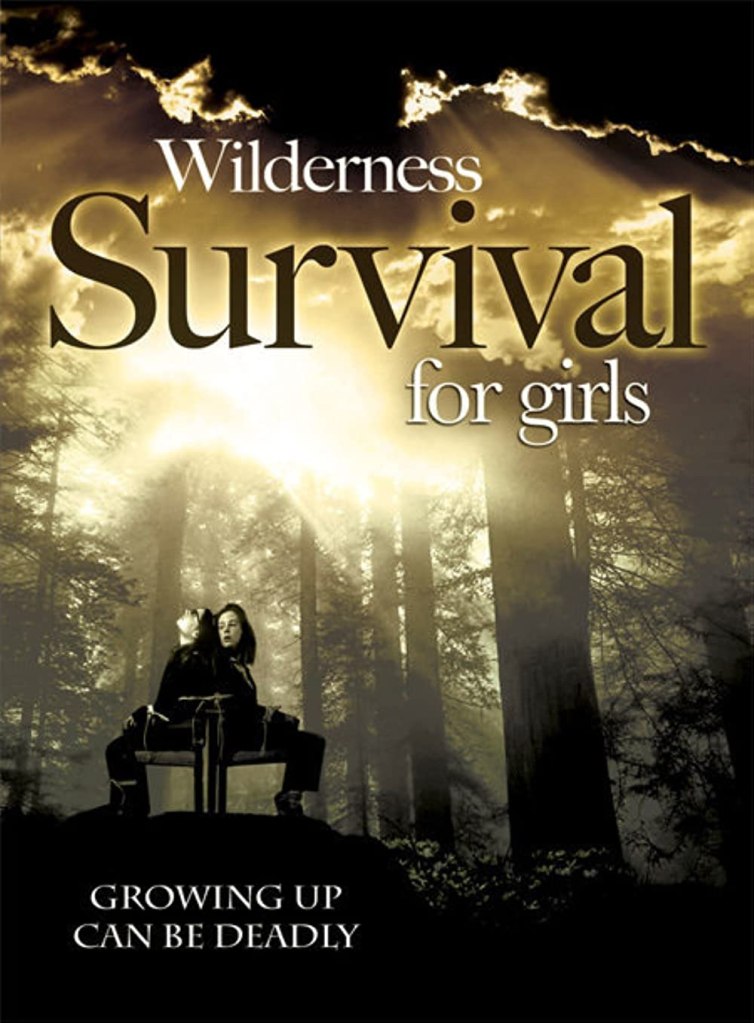
Wilderness Survival for Girls (2004)

Directed by Eli B. Despres [Other horror films: N/A] & Kim Roberts [Other horror films: N/A]

After years of wanting to see this, I really didn’t expect something this atypical. Not that Wilderness Survival for Girls is a bad movie or anything, but it’s not really the type of movie I was expecting, and I think that some people, if they go in with the wrong preconceptions, may walk away from this rather disappointed.

I didn’t expect the film to be anywhere near as low-budget as it was, for one thing. This doesn’t hurt the movie, because, as you all may know, I enjoy quite a few low-to-no budget films, but I was just somewhat taken aback by exactly how amateur this film came across.

What is more important, and definitely far more crucial, to my final verdict is the plot, and I’ll say that I was expecting something significantly different, but it’s also worth saying that this movie did have some feeling and heart which helped it break past what could have been a somewhat dull affair.

And to be clear, I guess I should briefly discuss my expectations – I thought this was a slasher. Why? I don’t know – I guess that, to me, it sounded like one. Some teens go to a cabin and get stalked and killed off by some mysterious figure? Typical slasher stuff, I thought.

Boy, was I wrong. Instead, we follow these three young women who go to this cabin and just hang out for forty minutes or so. They joke around, show off some skin, give the audience a clear view of their varying personalities, and show the small cracks in the friendship, and also sprinkle in a few small, implied character traits that pop up later. They also get high, because these three know how to have a good time.

There’s nothing horror about any of this so far, to be clear. I guess at one point, the three think they see some mysterious guy watching them, but at best, it’s mildly suspenseful, and doesn’t lead anywhere at that time. What it lacks in horror, though, this first half of the film makes up for in giving us three very fleshed out characters, and I love that. These aren’t your average women of horror – these three have a lot of character and personality, and I dig it.

It helps that the performances are great. We have Clea DuVall, Natasha Lyonne, and Velma. Okay, that’s my attempt at a joke, but Jeanette Brox reminded me throughout of Clea DuVall (circa How to Make a Monster) with her somewhat dorky, timid character. Megan Henning, with her glasses and attitude, got me thinking Velma. And the carefree, lower-class character played by Ali Humiston had Natasha Lyonne’s look and attitude from American Pie down beautifully. The three work great together, and the friendship felt authentic.

In many ways, a lot of this film feels more liking a coming-of-age drama with the three teens, unsure of their futures (two of them are going to college while one isn’t), unsure of their sexualities, unsure of love, just hanging out and candidly talking about things such as drugs, sex, masturbation, and their problems. It might be dull to some, but like I said, I think it gives a lot of character to consider, and it all plays in once the action starts ratcheting up.

Not that the movie is ever really inundated with action; once a mysterious man comes to the cabin and the girls, afraid and also high, tie him up believing him to not be cut of clean cloth, the movie certainly becomes more suspenseful, but there’s really only a few distinct moments of actual action. We got a lot of character from the girls, and now we examine this random guy who may or may not be a threat, and based on what the girls have to work with, it could definitely go either way.

If you’re going into this movie expecting some run-of-the-mill slasher plot, like I was, you will definitely be surprised. For some, the movie may not be their cup of tea. Once I got past my slight confusion, though, I was drawn into the characters and the dilemma they faced, and I felt for the characters when they talked about feeling unloved, or when they go for the person they love and are knocked down, or when they bite back and forth over personalities (Debbie telling Ruth’s character that Kate has called her stupid was a heart-breaking, yet very real, very real conversation).

Do I think that the movie is a masterpiece? No, not really. And like I said, I think it has the potential to turn some horror fans off. For me, though, Wilderness Survival for Girls was a pleasant surprise, and what it lacked in the slasher feel I was expecting, it more than made up for in fully-formed characters and great, real dialogue. This is definitely a movie that, while I didn’t love, I won’t be forgetting.

7.5/10

The Werewolf (1956)

Directed by Fred F. Sears [Other horror films: Earth vs. the Flying Saucers (1956), The Giant Claw (1957)]

This mid-50’s film wasn’t what I’d call a bad film, because The Werewolf did have some quality ideas here and there, but I have to admit to finding a decent amount of it a bit dry and sometimes more melodramatic than I’d have hoped.

I’ll give the movie props for the setting, being a small mountain town named Mountaincrest – I liked the feel of the small town, and the townsfolk all knowing each other is quaint. So that’s all fine and well, but otherwise, not much else here really did that much for me.

Let’s start with the werewolf himself – the special effects during the transformation scenes weren’t abominably bad, so I don’t think that was much of a problem, but the character (played by Steven Ritch) didn’t really interest me, and while I did feel quite bad for the man, I just found that I had a hard time caring much beyond that.

I also can’t help but hating the lead, being the sheriff (Don Megowan) – he starts out by wanting to purely kill the werewolf, than he decides to soften his stance and take the werewolf alive, and then after the werewolf escapes from jail (entirely out of the werewolf’s control), he goes back to pure bloodlust entirely without good reason. Megowan gave a fine, if generic, performance, but boy, his character was pretty awful.

Better were Joyce Holden and Ken Christy, or at least their characters were better. Let’s be honest – no performance in this movie is really stellar aside from maybe Steven Ritch, and like I said before, he didn’t do it for me. Harry Lauter was an okay side-character, S. John Launer and George Lynn made for okay antagonists, but again, nothing stellar.

Whatever the case was with this one, The Werewolf really didn’t impress me much. It started out decently, but I just found my interest waning pretty quickly into the film, and at no point did it really pick up for me. It’s an older werewolf film that might be worth looking into if werewolf movies are your thing, but that’s the best I can say about it.

5.5/10

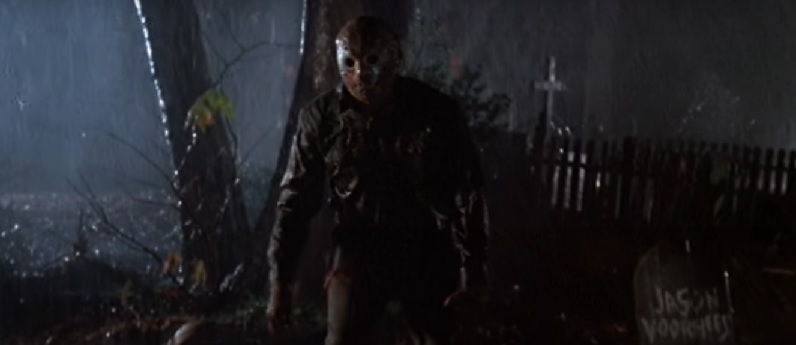
Friday the 13th: A New Beginning (1985)

Directed by Danny Steinmann [Other horror films: The Unseen (1980)]

By-and-large, I feel that this film’s been unfairly maligned since it’s release. Some of my feelings stem from nostalgia, no doubt, but even so, I have always found this a very solid and definitely acceptable entry into the series. Also, I should say that, unlike most of my reviews, there are spoilers here, so be warned.

I mean, look at how many memorable characters are here.

Who can forget Demon (Miguel A. Núñez) and his enchiladas? Joey (Dominick Brascia) and his love of chocolate bars? Reggie (Shavar Ross) and his recklessness? Roy (Dick Wieand) and his son? Violet (Tiffany Helm) and her dancing? Robin (Juliette Cummins) and her breasts, and related, Jake (Jerry Pavlon) and his amazing come-on? Ethel (Carol Locatell) and her stew?

See, I remember all of this stuff, and most of them I’ve remembered since childhood. And none of that even includes the plethora of great kills, such as a guy impaled by a pole or someone’s skull getting crushed by the tightening of a belt. Slit throats, gut stabs, even a solid axe murder to open things up – this movie has both the memorable characters and the gore to back it up.

John Shepard (who plays Tommy years after the events of The Final Chapter) was interesting in that, while he was one of the main protagonists, he rarely felt like it, given the fact he had very few lines and didn’t pop up in a significant way until the finale of the film. He knew how to fight, though, I’ll give him that. Melanie Kinnaman was more an action-oriented woman toward the end, but I sort of thought she never got the character that many of the others got, so I can’t say I found her entirely satisfying.

Otherwise, you have a strong and memorable cast here. Miguel A. Núñez (who, along with Mark Venturini, was also in The Return of the Living Dead) was fun for his short screen-time, and of course Shavar Ross was great as Reggie, as we don’t often see younger kids go against Jason* (aside from Tommy, of course). I sort of wanted to see more of both Tiffany Helm and Juliette Cummins, but even with what we got, they were good characters.

And who doesn’t want to see more of Carol Locatell calling her mentally-challenged son a dildo?

*And as for the final twenty minutes, I can agree that some of it, I didn’t care for, whereas other portions I thought were entirely fine. Spoilers are in these upcoming lines, to be clear: the fact that Jason wasn’t actually Jason but someone using the legend in order to get revenge wasn’t something I found problematic at all. If anything, I thought it was a novel use of how scared the community still was of Jason, and that even a normal individual could use the legend for his own benefit.

[Still spoilers here] The thing I didn’t care for was Tommy’s ascension at the end to seemingly becoming a killer in his own right – no, luckily, this wasn’t carried on into the following film, but it just rubbed me the wrong way, and I wish that, after his dream sequence, he’d have woken up and been done with the troubles Jason caused him his whole life.

Aside from that, this is a hard movie for me to dislike, and in fact, I couldn’t ever imagine giving this lower than a least an 8/10, especially given the fact I’ve seen it so often and enjoy so much of it. You have great kills, some great breasts, great music (Violet’s dancing to “His Eyes” by Pseudo Echo was beautiful – and also beautiful is the chorus to that song, going “There is a man with no life in his eyes,” which is perfect for a Friday the 13th movie), and overall a great atmosphere.

The ending could have used a different direction as far as Tommy’s character went, but if I’m being honest with you, and I see no reason not to be, that’s really my only problem with this one. Otherwise, it’s a fantastic entry into the series, and is about as good as Part 2 and The Final Chapter.

8.5/10

Black Zoo (1963)

Directed by Robert Gordon [Other horror films: It Came from Beneath the Sea (1955)]

Maybe I was expecting too much, but I left Black Zoo feeling somewhat underwhelmed. The movie wasn’t poor, by any means, and there were some amusing scenes, along with performances worth noting, but a few elements of the story tasted funny, and I think the film, for me, ends up around average, if not a little lower.

I did appreciate the first 12 minutes of the film, though, wherein a tour bus of, well, tourists, comes to a zoo, and are taken through a tour by the head of the zoo, played by Michael Gough, and it’s just a nice, pleasant trip through the zoo, almost like one of those science documentaries my people sometimes watched in school when we had a substitute teacher. It was a charming opening, and I enjoyed it.

Also worth mentioning, Black Zoo is in color, which I didn’t know beforehand (and certainly wasn’t a given during this period of cinema). I don’t know if it really mattered in the end, but it was sort of nice to see.

Of course, Michael Gough is best known for playing Alfred in the Batman movies, though he has done plenty of horror (the 1962 Phantom of the Opera, Horrors of the Black Museum, Berserk, What a Carve Up!, Trog), and he gives a solid performance here, occasionally hammy, but enjoyable throughout. I was indifferent on Jeanne Cooper, who played Gough’s wife, but both Rod Lauren (The Crawling Hand, Terrified) and Elisha Cook Jr. (House on Haunted Hill) were solid, though I admit I didn’t care entirely for Lauren’s story.

On that note, there’s a bit of a twist at the end regarding Rod Lauren’s character, but I really didn’t find myself caring that much about it, because it didn’t really make a difference as far as I could tell. Also, while I understand the concept, that one crazy animal cult (they basically believe that the souls of recently-deceased animals can enter a new animal and live again) was just a bit too silly, and Michael Gough’s character didn’t strike me as someone who’d want to mix-in with a lot like that.

Points are given, though, for the murders that Gough’s character plans. Who doesn’t like him taking revenge on people with the help of his lions, tigers, and gorillas? There’s even an emotional scene, of sorts, where one of his animals is killed by Cook Jr. and, in a rage, Gough takes him out (honestly, I can’t blame him at all for that, as Cook Jr.’s character was the one that was begging to be attacked).

Overall, though, Black Zoo was just an okay movie. I didn’t have a terrible time with it, but I definitely think it could have been better in some ways. It’s worth a watch just for something different (how many zoo-based horror films even are there, aside from this and Murders in the Zoo?), but it’s not an amazing film.

6/10

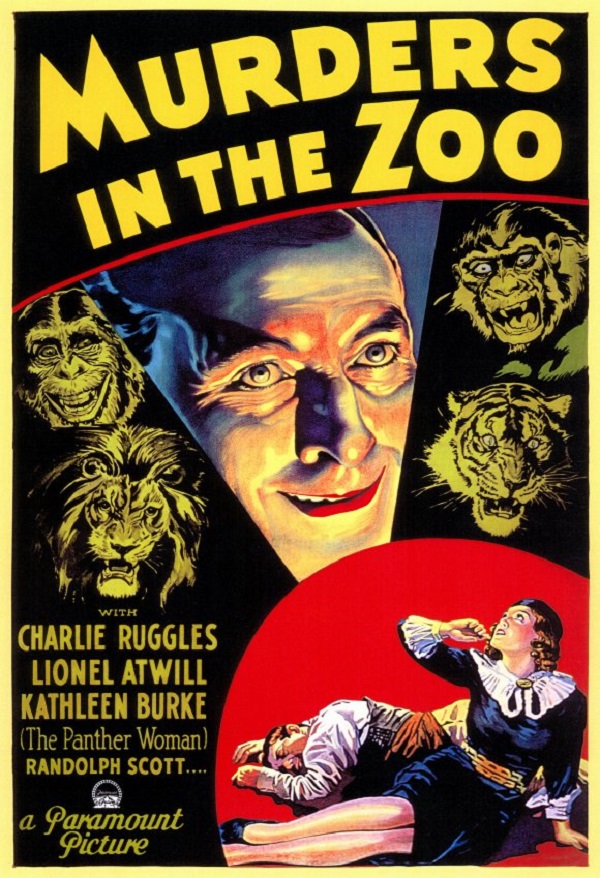
Murders in the Zoo (1933)

Directed by A. Edward Sutherland [Other horror films: The Invisible Woman (1940)]

This is one of those classics that I’ve been wanting to see for quite some time, and I’m decently happy with how this one ended up, especially given that it came not from Universal, whose dominance in horror at the time was unparalleled, but Paramount (Island of Lost Souls, from the previous year, being a big hit for them). Murders in the Zoo isn’t amazing, but it was a pretty good film.

What helps is the somewhat more violent scenes we got occasionally, such as a man getting his lips sewn shut in the opening (a very strong opening, I thought, and I can imagine audiences back in the day finding that distasteful) and a man pushing a woman into water teeming with crocodiles (alas, we don’t see the scaly bois feast, but I liked the idea).

I don’t think that Charles Ruggles made for a great lead (he was generally a comedy lead, and in fact, this was his sole horror film), because that whole scared-of-every-single-animal trait got a bit old. I don’t hold that against him – he had to follow the script as to his character – but I don’t think he was the best lead possible. Luckily, the other lead, Lionel Atwill, is a horse of a different color.

Atwill, who has been in quite a few horror films (such as Doctor X, Mystery of the Wax Museum, The Vampire Bat, The Gorilla, Mark of the Vampire, Secret of the Blue Room, among others) was pretty great here, and really had a menacing and occasionally mad aura. He made for a strong antagonist, and I enjoyed his creative ways at getting revenge.

In other news, Randolph Scott (this and Supernatural, from the same year, made up the sum of his horror appearances) made for one of those characters you wish you’d see more of, the same which could be said of both Gail Patrick and John Lodge. Kathleen Burke (most famous for the aforementioned Island of Lost Souls) was pretty good also, and while a woman in a time where strong women weren’t common in horror, she did well for herself (although I would have advised against telling Atwill’s character that she’d tell everything she knows – that never works out well).

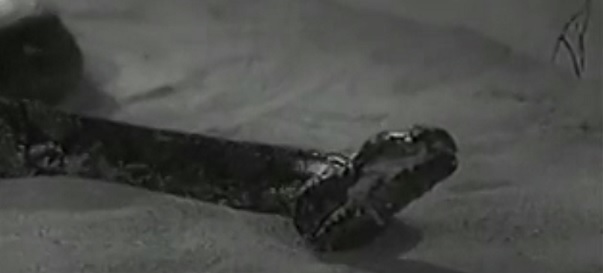
Given that this film is just over an hour, there’s not necessarily a whole lot to digest here, and you never really have time to feel bored, or that the film’s dragging. High-lights for me include the quality opening of the film, along with the dinner held at the zoo and the woman being thrown to the crocodiles. I must admit the ending too was of good stock – saving himself from the lions and tigers only to meet a slithery boi – so no complaints there.

Murders in the Zoo is a pretty strong movie, and one of those horror classics I think has largely been overlooked, which is a shame given the somewhat darker tone of the film along with Atwill’s performance. If you’re into black-and-white horror, and this is at your disposal, go for it.

8/10

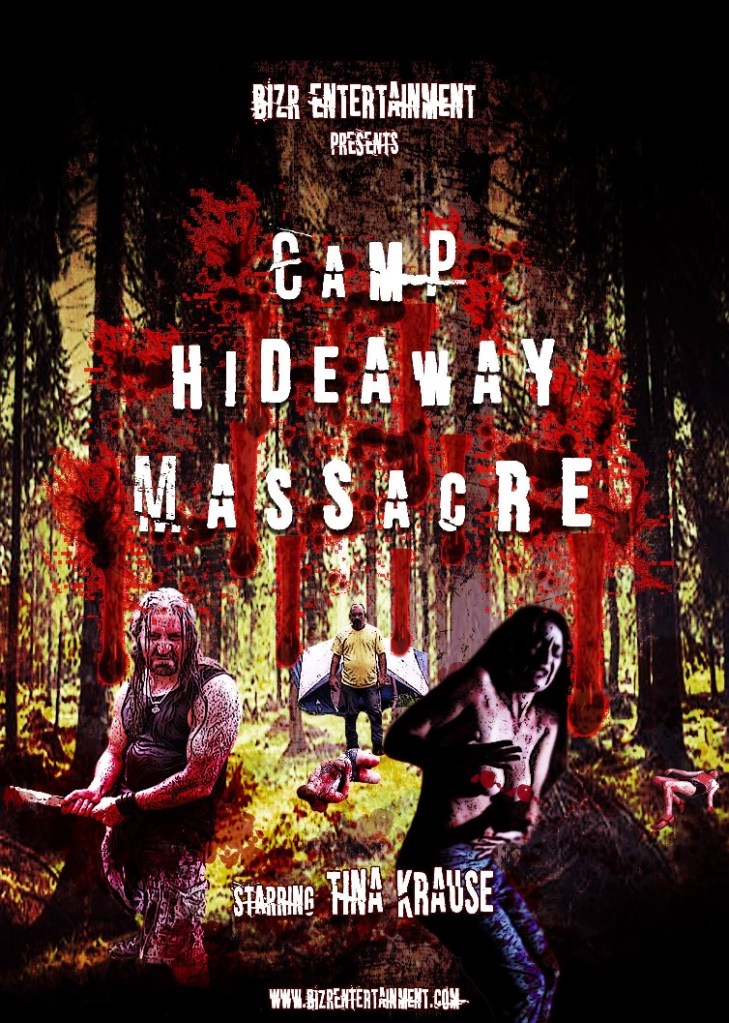
Camp Hideaway Massacre (2018)

Directed by Skip Bizr [Other horror films: N/A] & Ted Moehring [Other horror films: Bloodbath in the House of Knives (2010), Invasion of the Reptoids (2011), Camp Blood 666 (2016), Revenge of the Devil Bat (2020)]

For being a low-budget slasher, Camp Hideaway Massacre is almost okay. It’s not a good movie, but it was close to passable. The main problem, though, was that the film was so repetitive, and while occasionally things got shaken up a little, I can’t say I wasn’t somewhat bored (as bored as one can be watching a low-budget film, anyways) at times throughout the movie.

I’m not sure if this was filmed in Pennsylvania (I know the setting definitely is, and I wouldn’t be surprised if it was filmed there), but I do enjoy the lush look the local environment has, and while the campgrounds themselves are rather pathetic, it was still what I know people refer to as nature.

As far as the special effects go, low-budget films always get a bit of a pass from me. Jockstrap Slaughterhouse, for instance, had horrible effects, but had a lot of heart. This film has okay effects – one of the decapitations looked a bit weak – and the kills were mostly fine, so I don’t have too much to complain about there.

The issue is the story, though, in which new people get to the campground, and are killed shortly thereafter, rinse and repeat. We go through a lot of characters, and in fact, somewhat interestingly, the main characters could really be the killers (primarily Gutrot Layton and his posse) as opposed to any one victim (the best choice would be Tina Krause, who actually appears for more than a handful of scenes), but that doesn’t really help the overall narrative structure.

Probably as one can imagine, the acting is mostly poor. I noticed that, looking through the cast, it looks like characters who were mother and daughter in the film were played by actual mothers and daughters, which I thought was cool (and certainly shows a strong localized production). Not that, of course, either of these pairs (Jessica and Haley Dittrich along with Danielle and Kanyon Fassler) had much of a chance to shine, but it is nice to see.

Tina Krause is a big name in lower-budget horror, having been in quite a few films (such as Female Mercenaries on Zombie Island and Dead Students Society), and while I’ve not personally seen her in anything until now, she did well. She also had a lengthy shower scene, so no complaints there. I think, aside from her, John Young was probably the best performance, but Gutrot Layton (and I sort of doubt, on a side-note, that’s his real name) had some charm too.

The dialogue was pretty awful at times, and like I said earlier, the largest issue was the repetitive nature of the story. None of that makes Camp Hideaway Massacre awful, and for a lower-budget movie, I definitely think that, in some aspects, they did well (such as most of the kills and skirting on an interesting story), and if it had been cleaned up a little, I think this could have been more a contender than what I thought it ended up being. Right now, though, I don’t think it’s that great.

5.5/10

Return of the Living Dead III (1993)

Directed by Brian Yuzna [Other horror films: Self Portrait in Brains (1978), Society (1989), Bride of Re-Animator (1990), Initiation: Silent Night, Deadly Night 4 (1990), Necronomicon (1993, segments ‘The Library’ & ‘Whispers’), The Dentist (1996), Progeny (1998), The Dentist 2 (1998), Faust: Love of the Damned (2000), Beyond Re-Animator (2003), Rottweiler (2004), Beneath Still Waters (2005), Amphibious 3D (2010)]

To quote from a Stephen King novel, Duma Key, ‘I never imagined it could get so bad, and God punishes us for what we can’t imagine.’ This is the punishment I never expected, and it came as quite a surprise to me.

Now let’s be clear – the second film of this series was far from stellar, and I personally thought it was a ways away from good. It was tepidly average at best. Here, they change things up a little, and take another route that I just couldn’t have cared about in the least, removing the comedic influences altogether and inserting a romance that’s doomed to fail because the young woman has become a zombie.

Removing the comedic influences was a bold choice, as The Return of the Living Dead, at least back in the early 1990’s, was probably one of the most popular zombie-comedies in existence, but it didn’t have to be a bad choice, and, if the film had gone in an entirely different direction, might even have been a heralded one. It’s also worth pointing out now that this film amazingly has the same rating as the second one on IMDb (or did at the time of this writing – it now looks like this film is rated 5.9/10 whereas the second is rated 5.7/10), and most of my friends in the horror community find the film moderately enjoyable.

All of that said, I found this movie absolutely and utterly horrible, and would never, under any circumstance, want to sit through this again.

The main problem is the romantic relationship between Melinda Clarke and J. Trevor Edmond. I was okay with them during the first scene, and when Edmond was breaking away from his father (played by Kent McCord), I was somewhat applauding them, but pretty much every moment after that, I just couldn’t stand them. As soon as, in pain and misery, Edmond brings Clarke back from the dead, and she starts eating people and becoming, you know, a zombie, and he sticks with her through it all (and I do mean all – far past the point where any reasonable person would have done so), I just wanted it to be over.

But the movie runs for an insane hour and 40 minutes instead of making it a more reasonable 70 minute film, which, while I wouldn’t have enjoyed it much more, at least would have felt more digestible.

The best character was played by Basil Wallace, who gets killed by Edmond’s idiocy, and later comes back as a zombie and helps out Edmond’s character despite the fact that the only reason he died was due to Edmond. None of that really mattered, as the final 15 minutes of this film was needlessly tacked on anyway, but there you go.

Oh, and Mike Moroff’s character was rather terrible also, but at least it fits in with the movie.

The special effects are decent, I’ll give it that. Though again, I don’t think that really matters as soon as Clarke’s character starts threading metal through her body and becoming a HARDCORE ZOMBIE CHICK. I cringed as soon as I saw that. It just looked awful, and it looked stupid, and I hated every second of it even more than the hate I had for it during the previous scenes.

Plenty of horror fans, as I’ve said, seem to enjoy this film, or at least enjoy it as much as they enjoyed the second film. Like I also said, the second film wasn’t great, but I just don’t get the love this one has. I don’t see it, and I don’t understand it, and I never want to cross paths with this movie again.

3/10

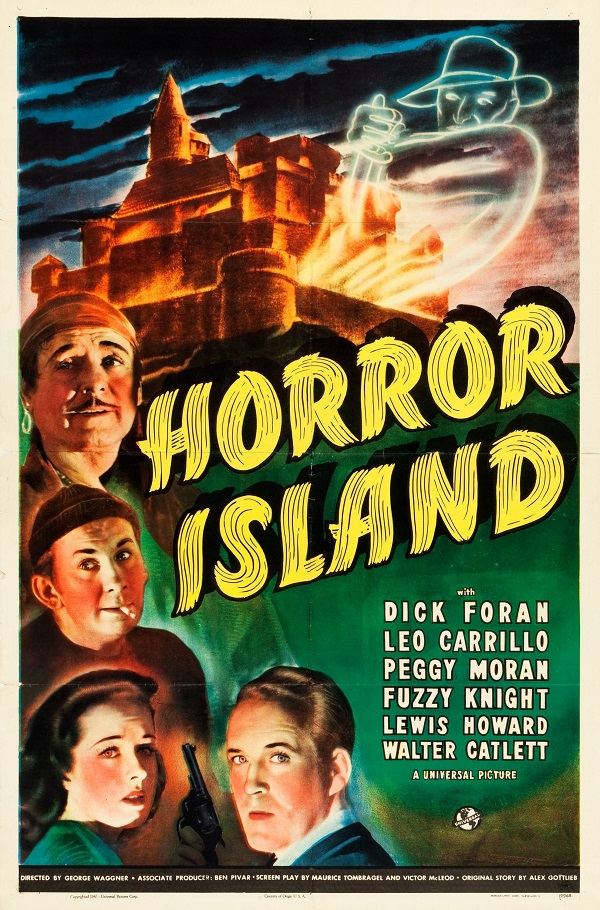
Horror Island (1941)

Directed by George Waggner [Other horror films: Man-Made Monster (1941), The Wolf Man (1941), The Climax (1944), Jack the Ripper (1958), Destination Nightmare (1958), The Veil (1958)]

This is a film that I’ve wanted to see for some time now, and despite it being nothing special or really unique in any way, I am quite happy that I finally got to this one, as it’s a fun ride throughout.

What with a hidden treasure, half of a treasure map, multiple parties looking for the gold, and a mysterious Phantom, Horror Island has pretty much all of the elements that make those old dark house mysteries of the bygone era so damn fun, and it’s made moderately more unique by setting itself on an island (and the opening on the atmospheric docks was also welcomed).

It does carry a more noticeable light-hearted element (think Sh! The Octopus), much of it coming from Fuzzy Knight’s character Stuff, but that doesn’t hamper the quality feel that the film possesses, especially once the group gets to the titular island and deal more and more with the mysterious phantom, not to mention some other dangerous characters.

Dick Foran made for a solid, if potentially unremarkable, lead. Having also starred in both The Mummy’s Hand and The Mummy’s Tomb, Foran had that typical lead look that radiates ‘good guy.’ Fuzzy Knight was a lot more meh if only because he was the central source of comedy, and his side-kick character just struck me as more silly than anything else. Peggy Moran (who was also in The Mummy’s Hand) was solid as the romantic interest, her wittiness often amusing.

Leo Carrillo (who played a heavily-accented sea captain), much like Knight, was another source of humor, though I could sort of dig his style. The others that make a difference, such as John Eldredge and Lewis Howard, were just fine, if not, as Foran was, unremarkable.

Luckily, despite having a few sources of humor here, Horror Island never gets to the point where it’s too silly, and in it’s favor, the fact it takes place on an old castle on a small island, what with multiple mysterious parties running around, is nice to be witness to.

Overall, Horror Island is a movie that I’d wanted to see for quite some time, and it lived up to my expectations. It’s not an amazing movie, but it’s quick and easily digestible, not to mention fun, so if that’s what you look forward to from classic horror, give this a shot.

7/10

Carrie (2013)

Directed by Kimberly Peirce [Other horror films: N/A]

Every horror commenter has one or two opinions (at least) that go against mainstream thought of horror fandom, and the fact that I’m not a fan of the 1976 adaptation of Carrie is one of them. Now to be fair, it has to do more with the story than the movie itself, but there you go. Here, while I can appreciate the modern-day take, I can’t say I’m much happier with this version.

Carrie is based off Stephen King’s first novel, and as it is his first novel, while I’ve consistently found it interesting in the way it was written, it’s never been a book I’ve really gone back to for enjoyment (unlike a handful of his other novels, such as It or Duma Key). I just don’t find the story all that interesting, and though I do like the spotlight being shone on the dangers of religious mania, I don’t think that’s the focus that most people in-universe would have to a situation like this.

This version follows the book (and original adaptation) pretty nicely, though with a few necessary alterations (such as Ms. Desjardin not slapping Portia Doubleday’s Chris during their punishment runs, or mentioning that the state stopped Margaret White from home-schooling Carrie). That said, it does feel, to me, like a closer version to the book than the 1976 movie, only with an updated feel (such as a far more prevalent use of technology, which made the scene in which Chris and her father were talking to the principal, played by Barry Shabaka Henley, all the better).

The adaptational attractiveness of Carrie does bother me a bit. She might look a little plain here, and she has the necessary awkwardness, but Chloë Grace Moretz is far from ugly, and I find it disappointing that no adaptations want to touch on the fact that Carrie, from the novel, was overweight and, to many people, unattractive. This doesn’t take away from Moretz’s performance, which I thought was pretty good, but just something that bugs me. Moretz does great, especially with her scenes when with Tommy (Ansel Elgort), and you really got the sense that this unhappy girl was happy, finally, for the first time.

I did like Judy Greer as Ms. Desjardin. Greer’s an actress I know from really random things, such as 13 Going on 30 and Jurassic World to Ant-Man and a single episode of The Big Bang Theory, and she does pretty good here in her role. She doesn’t really add anything to the character, but she was a solid presence. The same could be said for Julianne Moore (The Lost World: Jurassic Park and Hannibal). Now, I really did like her performance (and a lot of her dialogue was taken directly from the book, which I loved), but like Greer, I don’t think she really stood out in any spectacular way.

Neither Gabriella Wilde nor Ansel Elgort were great, but I did like the humanity I felt from Elgort. Wilde was decently compelling in her regret, but a face-heel turn like this a week before graduation doesn’t really make up for the times that she and friends made life hell for Carrie in the past. Portia Doubleday was a pretty good Chris, so no complaints there.

One way in which I think the 1976 version was undoubtedly better was during the prom sequence at the end. Maybe it’s because the 1976 movie is such a classic (even if it’s a classic I don’t love), but the prom sequence here just felt sort of shallow and almost tepid. I did like some of the scenes after, such as Carrie stopping that car with her telepathic powers in slow-motion, but overall the finale lacks the feel the 1976 version had, and that dream at the end just felt like a failed imitation of what’s been done better.

If you enjoyed the 1976 version of Carrie, you might enjoy this. You might hate it, also, and find it unnecessary, but since I don’t enjoy the 1976 version that much, it doesn’t really bother me that they made a new version of this. I found this movie passable, and certainly watchable, but still not a type of movie I’d watch for pure enjoyment. I think this movie does some things right, and the 1970’s movie did some things right, but both end up around the same for me.

And I wish I remembered more about the 2002 Carrie TV movie, because, ironically, I actually remember liking that one more than the 1976 version, and thus, more than this version. Until I see it again, though, I’ll refrain from pissing people off.

Carrie is a movie that looks pretty good, and has fantastic production quality and names attached to it, but it’s not a story I ever cared for (be it novel or most adaptations), and as such, I found this below average. Kudos to the guy in the library who shows Carrie how to make videos full-screen, though – he’s perhaps the most stand-up character in the movie.

6.5/10

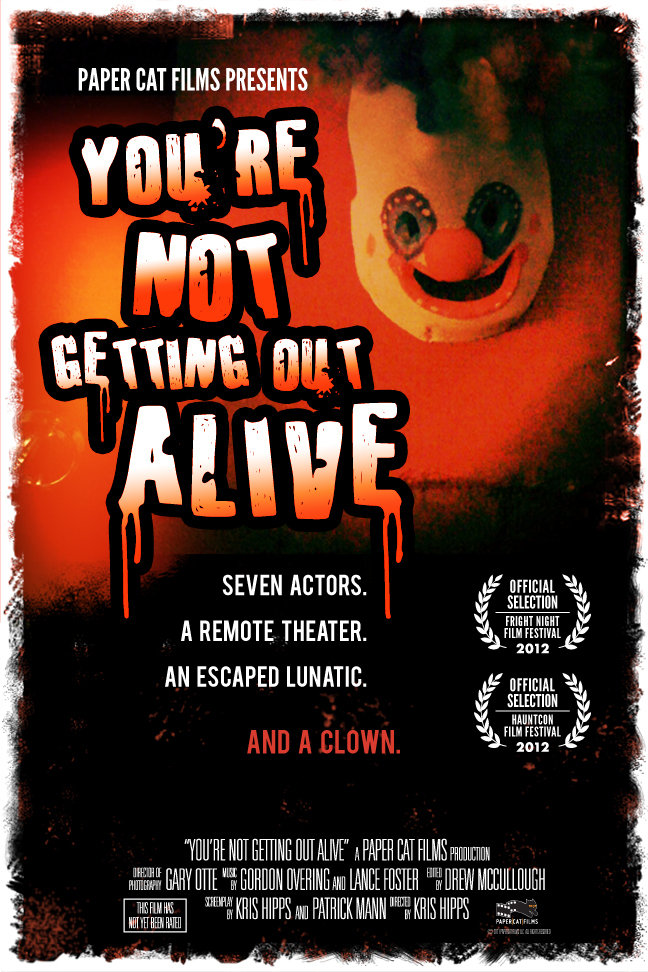
You’re Not Getting Out Alive (2011)

Directed by Kristine Hipps [Other horror films: The Monument (2005)]

Coming to us from Colorado, You’re Not Getting Out Alive is a rather low-budget horror comedy. Like many lower-budget films, some of the special effects can be questionable, but what’s not in question is that this movie has a lot of heart. I enjoyed most of the performances, the story, and overall, no matter what the budget was, this was a lot of fun.

Of course, I’ve always held a healthy respect for independent horror. Even if the movie isn’t great (such as Camp Hideaway Massacre or Curse of Halloween), you have to respect everyone involved for doing their best and trying to pull a movie together without the bottomless well of money that Hollywood can dole out. As such, some of the better lower-budget horror, such as Silver Cell (2011), The Horrible 4 (2010), Clownz R Us, and Vampire Ticks from Outer Space, deserve as much accolades as possible, and this movie is no different.

So many of the performances were great, but before I can even touch on that, I wanted to speak briefly about how amusing the story here was. To be sure, it’s not abnormal as far as slashers go – a group of people are killed by a mysterious killer in a rural location – but what allows this to be more is the fact these people are actors in a low-budget play. The play itself is hilarious – written by a stoner director, the title is “Southern Greens: The Story of the Civil War Stoner.” This stuff is comedy gold.

Aside from the director and assistant director of the play, the seven central characters are actors in the play, and are introduced to us via their auditions to be cast in the play. Some of these auditions are decent, and what you might expect, but some are damn funny, such as Toby’s ridiculous hand-puppet skit, Misty’s piece from Memoirs of a Confederate Jezebel (“Papa? Is that you, papa? I cannot see you for the tears in my eyes and the blindness”), or Ellis performing a piece from Julian Caesar: The Musical. These performances are great, and this is a comedy horror I can get behind.

There are a few performances that don’t stand out that well, but that’s only because some of them here are just so wildly fun. Though James O’Hagan Murphy, Patrick Mann, and Krista Rayne Reckner have a harder time being remembered, I really don’t think that takes away from what they brought into the movie, especially since Reckner’s character of Misty was legit funny at times.

Taking it from the top, though, we have Michael Kennedy, playing the stoner director. This guy, though maybe too stereotypical in his caricature, cracked me up. His play about marijuana saving the Union was great, and possessed some quality lines, such as “I propose a toast to Southern victory and the marijuana plant,” and a bit about “sucking on” someone’s “bubbling pipe” (being a bong, but it’s entirely possible his character didn’t get the sexual innuendo). I loved his character, and Kennedy did a great job with it.

Playing his assistant director was Dawn Bower, who was high-strung and the exact opposite of the laid-back, stoner director. Her character could be curt at times, but I thought she was a lot of fun. And speaking of fun, there’s David William Murray Fisher, who played Ellis, a rather flamboyant gay guy, who was great, and he worked well with Duane Brown, who played Toby. Brown brought a decent amount of humor too, so kudos.

Linda Swanson Brown was pretty perfect as the straight final girl. Not too quirky, but not without personality, she did really well in her role, and playing an entirely different role, Jillann Tafel was amazing. Playing an older actress past her prime, and always drinking, she had a lot of funny lines (“I once took it in the caboose from Benny Hill. That’s how I got my union card,” and “Isn’t she Miss Sunny Tits?”).

You’re Not Getting Out Alive is a funny movie. It’s not over-the-top, like The Stripper Ripper – once bodies start piling up, most of the jokes and banter stop – but for the first forty minutes, there is a lot of fun to be had with this movie.

Of course, the kills aren’t great here. There is a decapitated head that pops up (obviously a dummy head), and there are a few stabbings and bit of bloodshed, but this slasher is more focused on the characters and story (and on a related note, while the story isn’t great, I do think it handles some foreshadowing pretty well) than it is on kills, which works to it’s benefit given the budgetary constraints.

I really like this movie. For whatever budget they had to work with, they did a great job (and provided some amusing outtakes during the credits), and for low-budget horror comedy, I think this movie definitely does what it sets out to do, and fans of independent horror should endeavor to give this one a look.

8/10