Prom Night III: The Last Kiss (1990)

Directed by Ron Oliver [Other horror films: Thralls (2005), Black Rain (2009), Mostly Ghostly: One Night in Doom House (2016)] & Peter R. Simpson [Other horror films: N/A]

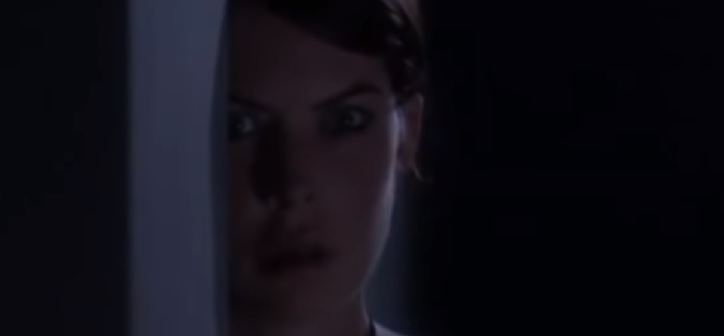
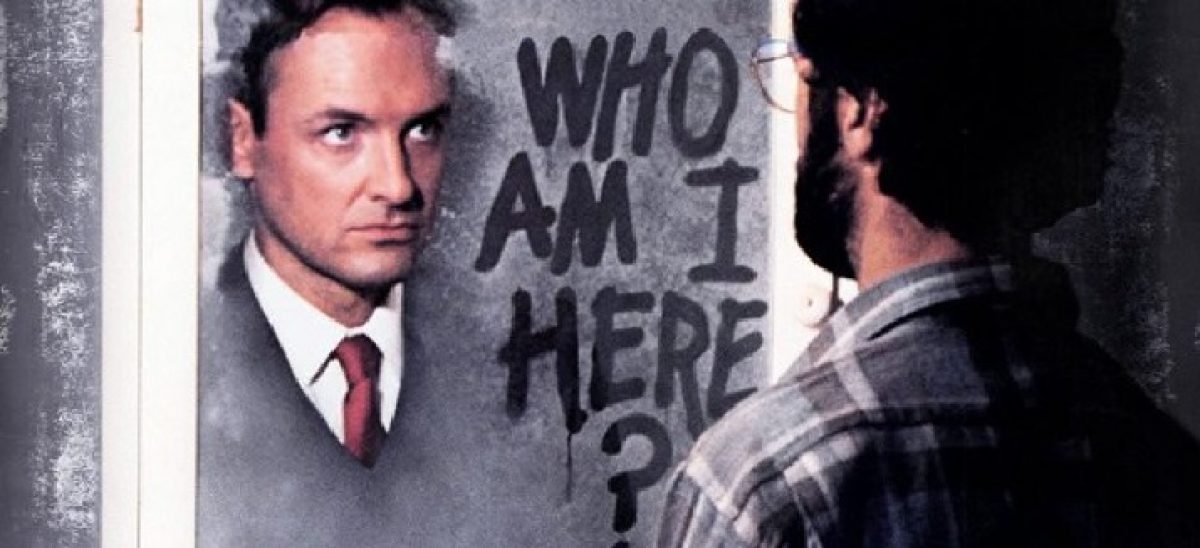
Following the second movie’s Mary Lou Maloney, Prom Night III: The Last Kiss was an adequate sequel. It was nowhere near as enjoyable as the second film, and in fact, I think it ultimately feels the weakest of the first three Prom Night’s, but if you’re into more comedy-influenced horror, and in the right mood, this might be an okay viewing.

It’s not like Hello Mary Lou: Prom Night II didn’t have comedy, but this film is a lot more in-your-face about it, almost to a silly extent (and as soon as something straddles the ‘silly’ line, I’m outtie). There are certainly some rather amusing lines (two which come to mind, both happening in the same scene, are “I don’t want a fucking pie!” and “Alex, it wasn’t a person, it was a guidance counselor”), but sometimes it goes a bit far, especially in regards to some of the kills and those 50’s jingles in the background.

Where I think this movie fails the most is the final twenty minutes, though, which takes place in a Hell-like dimension. I mean, it makes sense as far as the story goes, but I have to say that I didn’t much care for it, especially making some of the victims of Mary Lou more monster than human (such as David Stratton’s character, who was a pretty decent guy overall). The final scene itself was okay, but a lot of the finale didn’t work for me.

Tim Conlon made for a fine lead, if not perhaps sometimes unspectacular. He was pretty well-suited for the style of comedy the movie had, though, so I’d give him props for that. Cynthia Preston (who didn’t get angry, just baked) was solid as Conlon’s girlfriend, and is probably one of the more recognizable faces in the film (as she was also in The Brain and Pin).

Replacing Lisa Schrage as Mary Lou, Courtney Taylor did good, or at least played her part well, given the corny nature of most of her dialogue. Lesley Kelly was funny in her few scenes, and lastly, while not note-worthy in almost any way, Robert Collins appeared somewhere here, and he played the beast Lord High Executioner in the classic Goosebumps two-parter A Night in Terror Tower. Loved that character (and hence, actor) ever since I was knee high to a tadpole, so wanted to give a shout-out.

It’s here I should mention that one of the directors, Ron Oliver, also directed quite a few episodes of Goosebumps, Are You Afraid of the Dark?, The Nightmare Room, and other such kid-oriented entries to horror, which I thought tied in nice with Robert Collins’ appearance. Amusingly, though, while Oliver directed Goosebumps’ episodes such as ‘Werewolf Skin’ and ‘How to Kill a Monster,’ he didn’t directed ‘A Night in Terror Tower.’

Problematically, given the more comedic nature of the film, none of the kills are particularly good. Actually, I think one of the best scenes in the more gory department would be when a character early on accidentally cuts his finger off. Elsewise, you have a guy stabbed with ice cream cones or a woman doused in battery acid. These aren’t terrible, mind, but they don’t really stand out.

Otherwise, though the movie isn’t good, I think most of Prom Night III is largely inoffensive. If you dug the style and vibe of the second movie, it’s probable that, to a certain extent, you’ll enjoy this one also. I didn’t particularly like this movie much, even with some of the choicer pieces of dialogue, but it was an okay watch. I don’t think it’s much more than that, though.

6/10
The House That Cried Murder (1973)

Directed by Jean-Marie Pélissié [Other horror films: N/A]

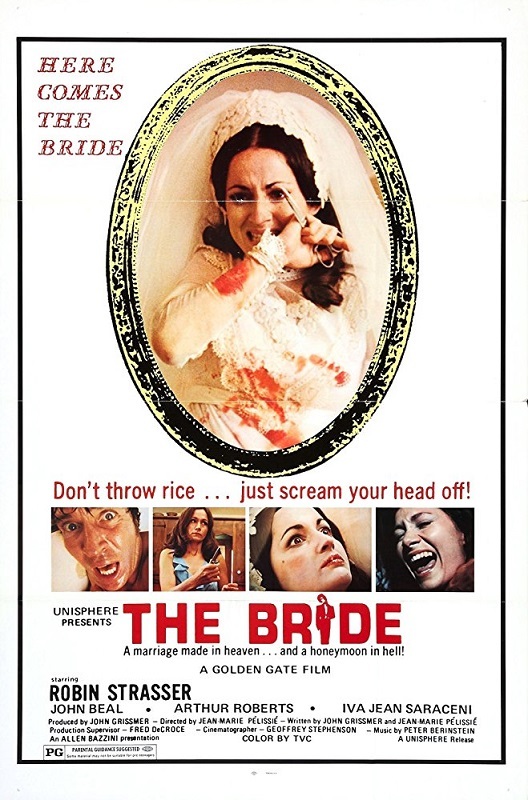
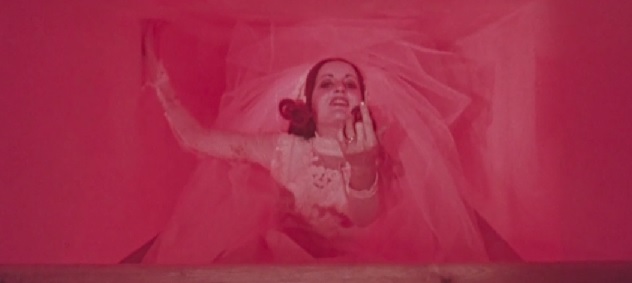
Known under alternative titles such as The Bride and The Last House on Massacre Street, The House That Cried Murder was a film that I didn’t really know much about going into. I may have vaguely heard the title before (or at least one of them), but I didn’t know anything about it, and though the movie wasn’t really good in most conventional senses, I did think there was occasional charm to be had here.

Some of this, perhaps even a lot of it, has to do with the final twenty minutes, in which the film subverted expectations I held from the very beginning of the movie, which both surprised and impressed me. I really wasn’t expecting to be surprised by some low-budget 70’s movie with less than 300 votes on IMDb at the time of this writing, but here I am, so credit where credit’s due.

Really, the route this story took was sort of different. It possessed those quality 70’s sensibilities, and even the fact that the print I viewed was quite far away from stellar probably helped the vibe of The House That Cried Murder. Also moderately working in it’s favor is the fact the film is pretty short, lasting a mere 75 minutes (which at times still feels long, but more on that shortly). None of this is to say the movie is great, or even good, but like I said, it can be charming.

The unfortunate thing is, though, save the final twenty minutes (and if we’re being generous, final thirty minutes), there’s not really that much here to applaud. The rest of the film is rather dry (a fate that’s not entirely uncommon of movies from this time period), and while not painfully dull, there certainly wasn’t much to really help keep your attention. It picks up nicely, no doubt, but like Demented, getting there might be more of a hassle than you’d hope.

Arthur Roberts did okay as a rather unlikable character. I mean, he didn’t do great, but I don’t think most central performances here were that striking, so I wouldn’t take offense to that. And related to that sentiment, Iva Jean Saraceni’s short screen-time didn’t do that much to endear me to her character. Robin Strasser (the Bride in the film) was shaky too, but given what we learn about her character, I don’t really mind that. Out of everyone, I think John Beal (who played Strasser’s father, and starred in 1957’s The Vampire and 1939’s The Cat and the Canary) did the best, and was actually a character you could sympathize with.

There were some okay scares toward the latter half of the film, such as a nice surprise left in someone’s refrigerator and a tense walk up the stairs, but the movie never really gives us too much in that department. What’s more memorable, really, are the final five minutes or so, which seemed almost ahead of it’s time. I don’t personally know if I loved that ending, but it was at least unique, so again, credit where credit’s due.

As okay as the finale was, though, I don’t think credit is due that often. I certainly found The House That Cried Murder watchable enough, and occasionally enjoyable enough, but it’s sluggish pace during the first half is pretty damaging, and I just don’t know if the conclusion really saves it. It may well be worth at least one watch, but I don’t see this becoming a favorite of too many people.

5.5/10

Storm of the Century (1999)

Directed by Craig R. Baxley [Other horror films: Dark Angel (1990), A Family Torn Apart (1993), Rose Red (2002), The Glow (2002), The Diary of Ellen Rimbauer (2003)]

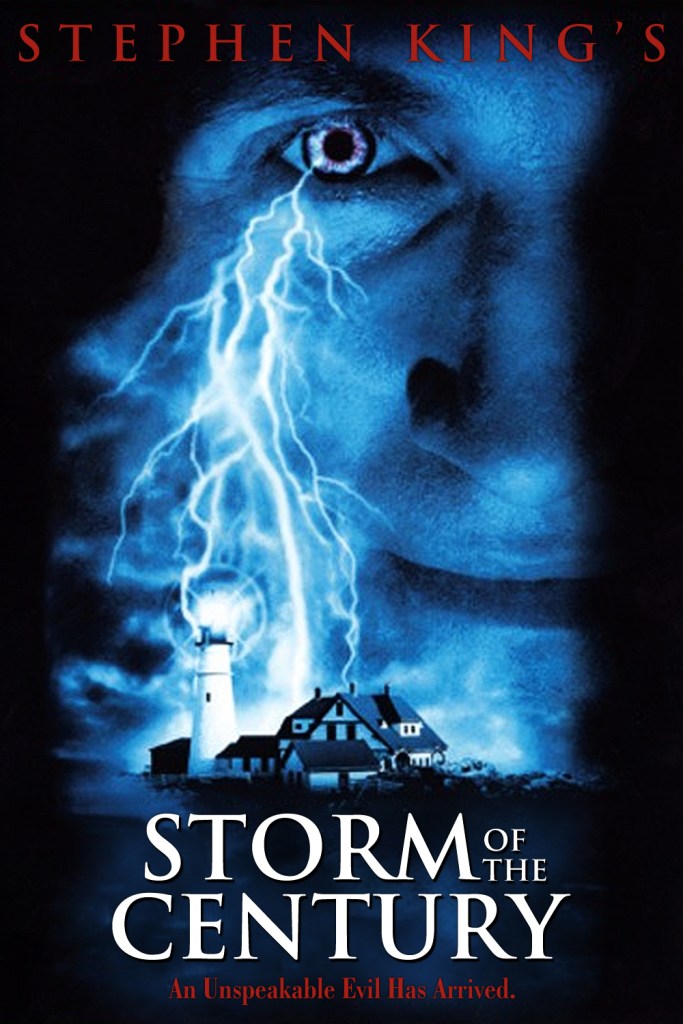
This mini-series, written by Stephen King (and mercifully not based on a novel) is perhaps, aside from his book It, one of the finest things he’s ever done, and it stands as my all-time favorite mini-series, and in fact, one of my favorite pieces of television that I’ve ever witnessed.

I can’t say when I first saw this – I doubt it was when it originally aired over three nights, but I do know I was pretty young, and given I would have been around six years old when this came out (I was born 1993), it’s not out of the question I saw pieces of this when my parents watched it. What I do know is that I did see a lot of this when I was quite young, and that only enhances my pleasure of it now.

With a mini-series like this, it’s hard to know where to start. Storm of the Century possesses three episodes and totals 4 hours and 17 minutes. Out of these four hours and 17 minutes, there’s only one thing I don’t care much for. Otherwise, this is outright perfection in a way that no mini-series has ever come close to matching.

There’s virtually nothing I don’t like about this – the story is fantastic. The setting is fantastic. The performances – almost every single one (and this is a big cast) – fantastic. The moral quandary the characters find themselves in, the mystery, the suspense, the music (oh, the music), the opening and closing narratives, the imagery, the atmosphere, the emotional gut-punches – all fantastic.

A mysterious man comes onto an island off the coast of Maine right before a storm (the titular storm of the century) hits hard, and this man, one André Linoge (Colm Feore), kills a woman and starts off a chain of events I daren’t reveal, because if this is a mini-series you haven’t seen yet, it would be a disservice to dig too deep into the story.

What I can say is that the story is fantastic (and given that I’ve already said such, that may be self-apparent), the mystery behind what Linoge wants (for, as he repeats, if he’s given what he wants, he’ll go away) is fantastic, and the atmosphere, which is already great due to the storm and isolated island setting, is quality dread.

I’ve never seen an island setting put to such great use. The whole theme of how island folk look after their own, and more so, known how to keep a secret, is embedded in the viewers from the beginning, and it only solidifies the longer each episode goes on. It’s a great look at island life (or what I imagine island life is like, given I’ve never set foot on an island in my life), and I love it.

There are a lot of great performances here, central among them Colm Feore and Tim Daly. I could watch Colm Feore walk through a crowd of people and pontificate on their dirty deeds all day, and his performance here is just masterful. Same with Daly – his utterly straight-laced attitude works well given he’s the town constable, and more so, he works great as a moral center and the central character, especially toward the somewhat depressing conclusion. Daly was also in both Spellbinder and The Skeptic.

Who else stands out? Well, who doesn’t? There’s Jeffrey DeMunn (The Blob, The Mist, The Green Mile) as the town manager that few people like. There’s Becky Ann Baker (Freaks and Geeks) with her quality accent, and Torri Higginson with an even better one. I absolutely adore Julianne Nicholson as Kat (“She’s your wife, Mike. How would I know where she’s hot?”), and though she got only two scenes of note, Myra Carter as the elderly Cora stole each of them.

An affable counterpart to Daly was Casey Siemaszko as Hatch, and playing Daly’s wife was Debrah Farentino, who did great despite the maddening choices she made toward the end (but really, it’s pretty hard to blame these people given the dire circumstances they were in). Ron Perkins was great as Peter, same with Steve Rankin as Jack. Denis Forest popped up here and then, and he was always a nice face to see (and his secret was one of the most tragic).

Who couldn’t feel bad for Nada Despotovich as she discusses leaving DeMunn’s Robbie or Adam LeFevre running and screaming in fear after finding a dear friend dead. Kathleen Chalfant was great (especially with her back-and-forth with Myra Carter’s irascible character) and most of the child actors and actresses were acceptable.

Once we figure out exactly what Linoge is after, the characters are thrown into quite a fun moral quandary (and of course, I mean fun for us, the audience, and not fun for them), made all-the-better by the fact that while I fully, 100% agreed with Daly’s vote more, given what the townspeople had been to up to that point, I don’t think it’s out of the question for the vast majority to take the opposite choice (and some try to play both sides, such as Daly’s wife).

They never really needed that many special effects aside from the constant storm raging on. The silver wolf cane did look a little janky at times, but I thought the sequence with the kids in flight looked reasonably decent, and even a better example, the dream in which the townspeople walked off a pier into the ocean really came across well.

I mentioned there’s one thing I didn’t care for, though, and now seems a good time to point it out. Every now and again, Linoge growls at the camera, baring vampire-like teeth. He doesn’t do this to anybody in the mini-series – just us, the audience. Now, something like that happens in the final scene of the mini-series, witnessed by an actual character, which was fine, but otherwise, this technique just struck me as somewhat out of place. I get it, they need to cut to commercial, but they can do that without a toothy growl.

Aside from that, though, like I said – perfection.

And speaking of perfection, that score. This video is a little piece of the score. Throughout the mini-series, it really packs a punch, and there’s plenty of atmosphere and emotion resonating from just the score alone, which is impressive, and, on a personal note, it’s not that common that a score is as consistently moving as this one is.

Storm of the Century may seem like quite an undertaking, given it’s over four hours long, but it’s a journey well-worth it, and if you’re one that’s skeptical of King-related mini-series, I can’t say I blame you, but I’d ask you at least give this one a chance, as this most definitely stands out as a solid work.

Born in sin? Come on it, as my pappy always said.

10/10

Humongous (1982)

Directed by Paul Lynch [Other horror films: Prom Night (1980), Mania (1986, segments ‘Have a Nice Day’ & ‘The Good Samaritan’)]

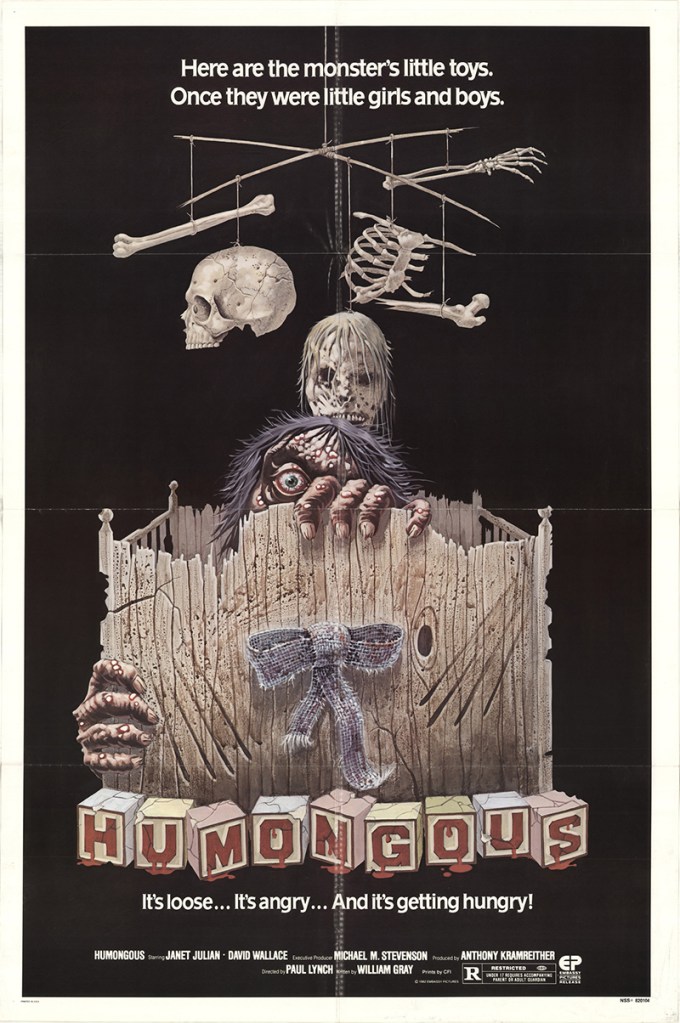
I think that in some ways, Humongous is an almost-decent movie, though there was most definitely room for improvements. Still, it does possess an okay atmosphere, and while far from great (and a step or two away from good), it may be worth checking out at least once.

Though unlikely to amaze anyone, I did find myself enjoying the setting (a secluded mansion on a secluded island) here, and for what little this movie did get down pat, I’d say the location was one of them. The story isn’t anything that hasn’t been seen before, but it was competent enough to be engrossing (though at times, I do think things are running a bit sluggish).

As far as performances go, I think that Janet Julian was pretty good. I don’t think she was amazing, but like much of what the movie does, she was competent, and that thin shirt she wore was A+ material. And speaking of A+ material, Joy Boushel looked quite cute in that pair of short shorts. Boushel’s (Terror Train, Cursed) character was a bit iffy in the beginning, but she got topless a couple of times, so I don’t have any real complaints. Both Layne Coleman and David Wysocki (Mortuary) struck me as forgettable. John Wildman was sort of interesting (in quite a dickish way), but we don’t really learn enough about him to fully get his character.

Most underutilized, though, was Janit Baldwin. When she first disappeared and popped up, that was fine and well, but she never really adds that much to the story, which I really felt was a shame, because though Julian was obviously more action-oriented, Baldwin struck me as a more interesting character. Just one of the potential issues with the film, albeit a small one compared to the largest issues.

And that first issue is the title, which I find horrendous. I mean, you expect someone to jump from movies like The Burning, Happy Birthday to Me, and Iced to a movie called Humongous? I just find the name hideous, but whateves. What was also lacking was lighting – so many of the scenes throughout the film are a bit too dark, and because of that, I felt the finale was lacking a real punch in regards to the reveal of the titular hulking monster.

There’s also a dearth of quality kills. I mean, a couple toward the end were okay (one individual gets their head squeezed, and another gets a snapped back from a too-eager bear hug), but neither were great, and more importantly, the ones beforehand were almost laughably bare-bones (though I do admit that it lead to a somewhat amusing gag cut).

Lastly, the way that the final girl attempted to head off the antagonist’s threat was to dress up as his mother and scold him. And if that sounds familiar, well, there’s a reason for that. Now, that’s not the end of things, as there’s a decent finale in a boat-house, and in fact, the scene itself in which she’s pretending to be his mother was moderately tense, but even so, it felt sort of funny given that this came out just a year later.

Humongous isn’t a bad movie, or at least it’s not a movie that’s without charm. I definitely think a couple of things could have been done better, such as lighting or character motivation (I still don’t entirely get Wildman’s character, which is a shame, as he’s basically the reason why these characters were in this situation to begin with), not to mention the somewhat disappointing kills, but it’s still a movie that has a little going for it (such as the opening in which a rapist is torn apart by dogs, which I can wholly support). Check it out if you’re a fan of 80’s horror – worst case scenario, I led you astray and made you hate your life a little.

6/10

The Food of the Gods (1976)

Directed by Bert I. Gordon [Other horror films: Beginning of the End (1957), The Cyclops (1957), Attack of the Puppet People (1958), Earth vs the Spider (1958), War of the Colossal Beast (1958), Tormented (1960), Picture Mommy Dead (1966), Necromancy (1972), Empire of the Ants (1977), Burned at the Stake (1982), Satan’s Princess (1989), Secrets of a Psychopath (2015)]

For the longest time, this has been one of those films I’ve been aware of and have wanted to see. I didn’t have any delusions that, upon my finally watching it, I’d have discovered a forgotten classic, but I was always hoping for at least an enjoyable film, and I have to admit that I didn’t really get that.

I think this film highlights some of the biggest potential problems with movies from the 1970’s, specifically, in this case, just how dry some of them can be. Certainly other 70’s movies suffer the same problem (one that immediately comes to mind is It’s Alive!), but this is one of the worst cases I’ve seen.

With a plot about some mysterious natural growth serum causing insects and rats to enlarge, you might hope for a little bit of hokey fun, and while I won’t dispute that some of the action may well fall under the category of ‘hokey,’ I don’t think this film has a whole lot of fun ingrained within. Even similar films like Night of the Lepus (which also took itself too seriously) feel a little more enjoyable, and you’d sort of hope that any “nature gets revenge on humankind” movie would have more going for it.

Of course, that may just be my view, but this felt almost entirely dry from beginning to end. You maybe got a little fun out of Ida Lupino’s character, and maybe a pinch of laughs from Ralph Meeker’s insensitive actions, but that’s really all there is, and it’s definitely not enough to keep my interest.

In fact, I actually nodded off not once, but twice, and one of those times was during a giant rat attack (which, by the conclusion, felt far more repetitive as opposed to horrifying, not that they ever once felt horrifying). Perhaps admitting this says more about me and my consistent lack of sleep, but there you go.

I don’t think I really cared much for Marjoe Gortner (of Mausoleum fame) or Jon Cypher here. Neither one really had much feeling to them. It’s the same with Tom Stovall and Belinda Balaski (The Howling) – just more dull characters. Ida Lupino was only remarkable due to having such goofy, old-fashioned beliefs, and Ralph Meeker played a selfish dick, so he was sometimes a hoot. Perhaps best of the cast was Pamela Franklin (The Innocents and The Legend of Hell House), who’s character’s love interest in Gortner’s was just ridiculous but at least Franklin was almost sometimes okay.

Certainly the cast felt uninspired, but I think that has more to do with the film itself. Give these actors and actresses a good story, and I suspect most of them will give decent performances, that’s my motto. And that didn’t happen here, alas, which is more the shame, as this is based (loosely) on a 1904 novel by H. G. Lewis.

The special effects were laughable, but that’s okay, because anything to give this movie a little extra boost is always appreciated, even if it didn’t work. And I have to say, this movie really needed something, but The Food of the Gods never got it. I just didn’t have fun at all – it felt tedious and dry from beginning to end, and I just can’t see myself wanting to give this one another shot anytime soon.

4/10

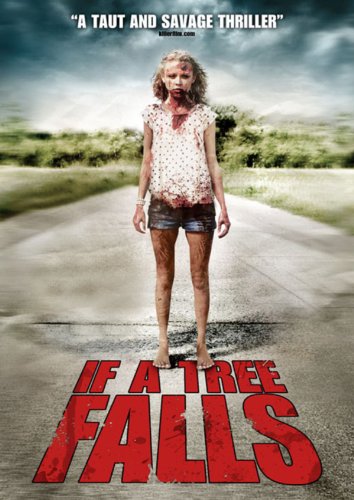
If a Tree Falls (2010)

Directed by Gabriel Carrer [Other horror films: Desperate Souls (2005), Kill (2011), The Demolisher (2015), Death on Scenic Drive (2017), For the Sake of Vicious (2020)]

This is one of the films I watched during an October challenge, and I think it was the year I watched 275 movies in a single month, mainly because I didn’t remember any of this, and I do mean any of it. It felt like a completely new movie, but I have seen it before, so I was hoping for a more memorable occasion this time around.

And I think it will be more memorable, but not in any good way.

Ponderously and pathetically bare-bones, If a Tree Falls is almost entirely void of anything worth seeing. The plot is simple, the only mildly interesting thing about it being characters that were brother and sister, and most of the film deals with people running from other people.

The killers (there were something like six of them for some goddamn reason) were like ultra-cheap rip-offs from The Strangers. Their reasoning, though, is even worse, as a character explains “We find the ones who will never be found.” That’s why they killed three of the four characters and kept the other one alive – because killing is finding and ones that are not found are alive people or something.

Yeah, it makes zero sense, I know.

Aside from the fact that this film was painfully repetitive, it also suffered from somewhat lousy audio, with the music going above the voices multiple times. It didn’t matter, really, as no one in the film was capable of having a conversation worth hearing, but mix that with some shoddy camera-work, and you have what the kids call “shit.”

This may be worth mentioning. When I saw this film years ago, I watched a version that was around 77 minutes, but this time around, I watched what IMDb labels as “the 10th anniversary edition” which runs 89 minutes. I have no idea what was added or changed, and I sort of wonder if I’d have liked the shorter version more, but there you go.

Ry Barrett, Breanne TeBoekhorst, Jennifer De Lucia, and Daniel Zuccala are generally not great. I don’t blame any of them, though, as even if they were the most stellar performances in the history of cinema, the movie would still be God-awful.

And it was indeed God-awful. I did like the exploitation vibe that If a Tree Falls occasionally attempted to give off, but that doesn’t excuse the utter lack of story or meaningful antagonists or the atrociously terrible conclusion. I mean, there were sometimes okay special effects, but when the final product has this much wrong with it, it really doesn’t matter.

I don’t know what happens if a tree falls, and this movie didn’t let me in on the secret (I’m guessing it’s one of those pseudo-intellectual titles that might have some relevance to the movie in a roundabout way). It also wasn’t entertaining, and I hated it. I’ll give it points for being filmed in Canada and having some attractive women in it. Elsewise, there’s virtually nothing going for this.

3/10

This is one of the films covered by Fight Evil’s podcast. Listen below to the disappointment of Chucky (@ChuckyFE) and I as we discuss If a Tree Falls.

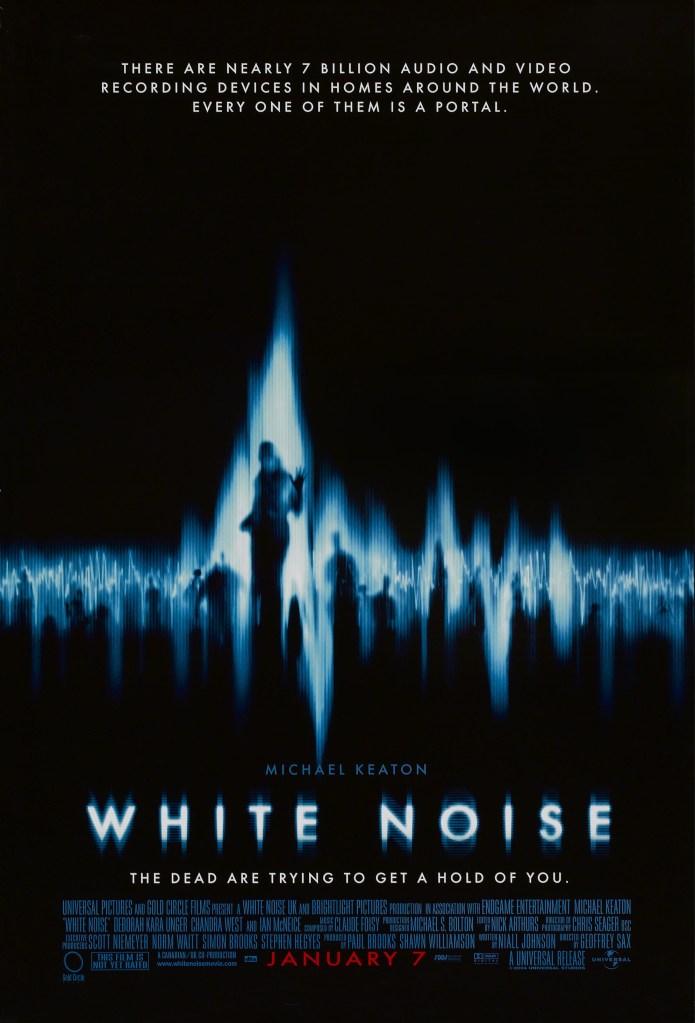
White Noise (2005)

Directed by Geoffrey Sax [Other horror films: N/A]

This is a somewhat more-popular film, partially because it stars Michael Keaton, and as such, much like movies such as Hide and Seek (starring Robert De Niro), What Lies Beneath (Harrison Ford) and D-Tox/Eye See You (with Sylvester Stallone), it’s generally forgotten by the horror community nowadays, and for, I think, pretty good reason.

Not that the movie is an extraordinarily poor one – it’s not memorable enough for that. It’s a pretty high-budget film, as you’d imagine (or at least, as you’d imagine as soon as you see that Keaton’s in it), and there’s no doubt that it’s competently-made, but there’s just not enough here to really make it anywhere near a standout film.

Some of this is because the horror is a bit on the lighter side. It’s there, don’t worry about that, but it’s there in the What Lies Beneath-way, and just feels so incredibly safe and tame. On a related note, this film is PG-13, which isn’t by any means damning, but it does show that this wasn’t going to really turn any heads at any point, and it really doesn’t.

I’ll give it credit for Ian McNeice (who in fact reminded me of another actor that I can’t yet place), who give a pretty enjoyable performance in his limited time, and Deborah Kara Unger. I don’t think Unger did a fantastic job here, but I do know her from The Game (1997), so that’s something. Keaton I really only know from the 1989 Batman, and I’m much more a Christian Bale-type of guy, so I couldn’t really care much about Keaton here. His performance is okay, but it’s far from great, which is fine, because the movie doesn’t warrant A+ acting anyway.

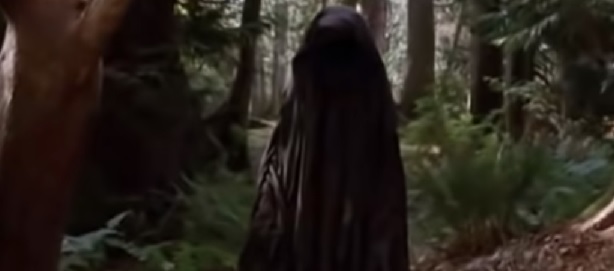
Not that the movie is without strong points. While I really don’t care for 90% of the final thirty minutes, I did like the three silhouettes of the evil ghosts (or whatever they were – that’s one of the things I wish they touched on more), and that final setting (a dilapidated factory, with giant holes and rain falling freely into the structure) was on point. Maybe a few other scenes were cool, but as I try to focus in on one, I just hear white noise and can’t complete my thought.

Also, those final three seconds were terrible. Just entirely unnecessary, which is probably intentional, as I feel that a lot of what they did with Unger’s character throughout the film was unnecessary. And speaking of unnecessary, I didn’t much care for that final message from Keaton’s character to his family. It felt like something out of a touching family drama, and a bit out of place.

White Noise isn’t a terrible movie, and I don’t want to give anyone the impression that I think it is. It’s far from a good movie, but it probably accomplishes a lot of what it set out to accomplish. It just wasn’t the type of movie I enjoy, and much of it fell flat for it.

5.5/10

This is one of the films covered by Fight Evil’s podcast. Listen below as Chucky (@ChuckyFE) and I discuss White Noises.

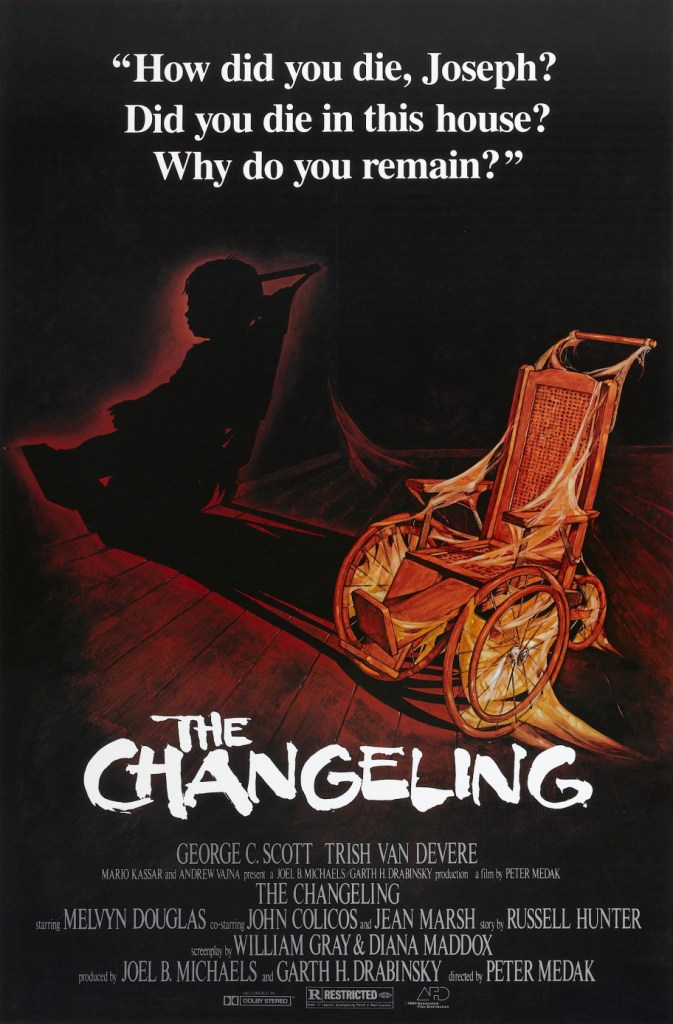
The Changeling (1980)

Directed by Peter Medak [Other horror films: Cry for the Strangers (1982), Species II (1998)]

Often quite atmospheric and somber by the very nature of the focal character’s background, The Changeling is a fantastically done ghost movie with an engrossing mystery and stellar cast. While not often outright frightening, it can get pretty unsettling, and the aforementioned mystery was on point.

That’s not quite what I thought about it when I first saw the film, but the important addendum there is that I was pretty young then, surely no older than 16. My tastes in horror probably haven’t changed significantly since that age (I loved slashers then, and I love slashers now), but my appreciation for some movies have definitely grown, and The Changeling is a good example of that.

Set in the beautiful city of Seattle (I’ve never been there, but I have had a life-long desire to move to Washington state), it follows a man haunted by the recent deaths of his wife and daughter, and upon moving into a Victorian house, has to deal with the inexplicable things people deal with when they move into houses that might be haunted.

For one thing, this can be an emotional ride following just George C. Scott’s character himself. Due to the recent death of his loved ones, there are some really touching scenes here, such as him finding the ball his daughter used to play with, or him sobbing in bed, probably with little will to go on. He definitely sold it, and though his character was one of maybe questionable motives, Melvyn Douglas really brought a lot of emotion to the final twenty minutes of the film also, especially during his face-off with Scott’s character.

George C. Scott is a familiar name, but I can’t really say I’ve seen much with him in it, which is a shame, as he does a fantastic job here, especially since it’s not too common for horror films to focus on solo older individuals. That might partially be why Trish Van Devere (who starred in The Hearse, which came out the same year but to much less fanfare, as deserved) was here – not that her character wasn’t welcome at times, but she wasn’t near as good as Scott or Douglass. And Melvyn Douglas (The Vampire Bat and, in 1981, Ghost Story, his final film before his death) – what a performance he put in at the end. Very moving and definitely worth it.

What really makes this movie work is the mystery of the ghost, and some of my favorite scenes are those of Scott’s and Devere’s characters trying to dig up as much information as they can, from reading microfilm of old newspapers at the library to going through land charts to figure out what piece of land has a well on it, it’s just a fun bunch of sequences leading to them going to some random house and, after some ghostly apparitions, finding bones in an old well. Just stellar.

Though almost an hour-and-fifty-minutes, I wouldn’t really classify this as a slow-burn, as enough of interest occurs throughout the film. I think some of the best parts are in the second half, to be sure, but there’s plenty of stuff throughout (including some delightful overextension of political purviews) that makes The Changeling a ghost film that is definitely worth seeing.

8/10

This is one of the films covered by Fight Evil’s podcast. Listen below as Chucky (@ChuckyFE) and I discuss this classic film.

Goblin (2010)

Directed by Jeffery Scott Lando [Other horror films: Savage Island (2004), Insecticidal (2005), Alien Incursion (2006), Decoys 2: Alien Seduction (2007), House of Bones (2010), Thirst (2010), Boogeyman (2012), Haunted High (2012), Roboshark (2015), Suspension (2015)]

For a Syfy movie, Goblin isn’t that bad. It’s not among the greater outputs from the channel (such as House of Bones or Neverknock), but it’s not as terrible as many of their other films tend to be.

The story isn’t overly original, but it was serviceable here. Some of the elements (such as the strained relationship between the father and daughter characters here, for instance) added some decent emotional impact to some scenes, though I can’t say it ultimately made that big of a difference. Also, it’s worth noting that the finale seems a bit rushed in some ways – it’s not something I want to harp on, because I was at least happy that things were finishing up – but at times it did feel like it was moving a bit quickly.

Tracy Spiridakos did quite well as the lead (and on an unrelated note, she reminded me of a younger A.J. Cook) , and I thought she got along well with both Gil Bellows as her father (Bellows, randomly, played Tommy in The Shawshank Redemption) and Erin Boyes. I appreciated Bellows’ character as a father who is actually as entangled in the supernatural story as are the teen characters, and he did good.

I think that Donnelly Rhodes did surprisingly well (think Crazy Ralph only with some emotional depth), but many of the others who pop up, including Reilly Dolman, Chilton Crane, and Andrew Wheeler, were just on the average side. Julia Maxwell didn’t appear too much, but I thought she had a lot of character, and stood out for that.

There is a bit of gore throughout. You get some disembowelment, slit throats, intestines free of their flesh prison, stuff along those lines. It’s nothing special, and some of it looks a bit on the fake side, but at least they tried. What they didn’t do well, though, would be the CGI of the titular Goblin. It’s almost okay at some points, but most of the time, it’s as pathetic as you might expect from a Syfy movie.

Overall, though, I have to admit that I’ve seen Goblin three times now. It’s not a favorite of mine, but I do think it’s certainly watchable, and though I doubt I’ll see it again anytime soon, as far as Syfy movies go, there’s not much here to really take offense to.

7/10

The House Next Door (2006)

Directed by Jeff Woolnough [Other horror films: Nightworld: Lost Souls (1998), Strange Frequency 2 (2002)]

This made-for-TV movie isn’t the most forgettable film I’ve ever seen (it helps that I’ve just seen it, to be sure), but I don’t think it has the staying power that the creators were probably hoping for, which is a shame, as the story itself isn’t too bad.

I’m not personally one to care about production value – there have been plenty of quality low-budget made-for-DVD and made-for-TV movies, and I don’t judge a film based on what money went into it – but that being said, a lot of this movie still came across to me as bland and occasionally uninspired.

Based off a novel by Anne Rivers Siddons of the same title, published in 1978, the story isn’t that shabby, and has some interesting ideas in it (such as going through different owners of the house and the varied misfortunes they encounter), but the film isn’t able to pull that together into that great a movie-watching experience.

For what it’s worth, I think most of the performances are okay, at least in that Lifetime movie way. Lara Flynn Boyle and Colin Ferguson are decent together, though maybe come out of this a little generic (and that first-person narration that popped up at the beginning and the end didn’t do them wonders). Mark-Paul Gosselaar (of Dead Man on Campus… fame?) was a bit soapy at times, but still serviceable. Of the people who temporarily brought the house, Noam Jenkins (who appeared in Saw II and IV) was the best, becoming an overly orderly and pompous jackass like few others.

There were some okay scenes here, such as a somewhat jarring suicide, and the uncomfortable way Jenkins’ character spoke to his wife during the dinner party, along with any of the scenes of the new home owners giving into the mental pressures of the new house, but all of it feels tame and bland, even when it really shouldn’t.

The House Next Door isn’t a bad story, but the execution wasn’t properly done. The movie was lacking in feeling, and though a few things were decent with it, overall, I can imagine this being one of the many post-2000 made-for-TV movies that people will watch once and forget entirely.

5.5/10