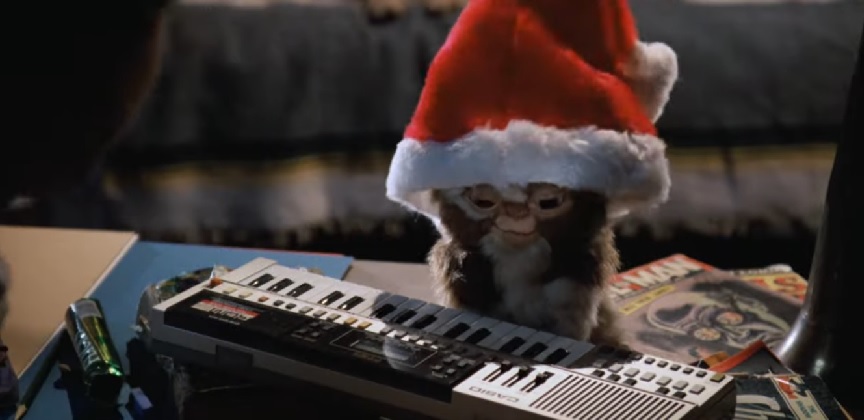
Gremlins (1984)

Directed by Joe Dante [Other horror films: Piranha (1978), The Howling (1981), Twilight Zone: The Movie (1983, segment ‘It’s a Good Life’), The ‘Burbs (1989), Gremlins 2: The New Batch (1990), Trapped Ashes (2006, segment ‘Wraparound’), The Hole (2009), Burying the Ex (2014), Nightmare Cinema (2018, segment ‘Mirari’)]

As with many people, Gremlins is a movie I first saw when I was a kid. I thought it was a great movie than, and very little of the magic has disappeared with the growing years.

There’s so many aspects of this film that are laudable. The small-town feel, the special effects, the characters, the music – there’s a lot here, so let’s #DigIn.

One thing that’s always captivated me about this film is the location of Kingston Falls. It feels like a 1950’s Norman Rockwell painting writ large, though the look and homey feel doesn’t varnish the reality that there are many poor and struggling people in the town. A woman and her children face prolonged hunger, people are out of work, and while everything looks great, there are problems here even before the gremlins decide to make the town and its citizens their bitch.

Still, the small town feel is great in this movie. It seems that everyone knows everyone. The main character, Billy, who’s long out of school, is still in contact with his old science teacher, which I’ve always found odd, and when Billy needs to take his mother for medical attention, they just walk down the street to where their family doctor lives. It’s a small town, and that vibe permeates throughout, which is great.

Naturally, the special effects are pretty good. Gizmo always looks cute (and actually, when I was young, I won a Gizmo doll at a carnival, and it was quite cuddly), the gremlins look moderately frightful, and throughout the film, there are some quality effects, such as the way the gremlins multiple by water. The lighting also plays a part in this – sometimes, the lighting is quite striking, and helps add to the effect.

I also love how at times, when it shows the whole of Kingston Falls, it’s a literal painting. That scene with the group of gremlins first walking into town from the YMCA was stellar. The final shot, with the man walking away with Gizmo, was beautiful. And God, the opening – what an atmospheric, beautiful opening on a busy, Chinatown street with narration by Hoyt Axton’s character. He also gets closing narration, and it’s just great (“before you call the repairman, turn on all the lights, check all the closets and cupboards, look under all the beds. Because you never can tell – there just might be a gremlin in your house.”)

Zach Galligan (Waxwork, Bad Candy, Nightbeasts, Psychic, Hatchet III) doesn’t always make the most engaging lead, but he’s fun enough. Obviously, Phoebe Cates can be overdramatic at times; still, it’s all in good fun. I absolutely adore Hoyt Axton (Buried Alive, King Cobra) – he seems like such a likable guy, and his narration, as I said, was on point. Despite limited scenes, Keye Luke (Dead Heat, The Cat Creature) was great, and playing Billy’s mother was Frances Lee McCain (Back to the Future), who killed four gremlins on her own, which was deff impressive.

Even the smaller characters are pretty good, though, and include some surprising faces. Judge Reinhold (Beverly Hills Cop, The Hollow) appeared only in two scenes, Jonathan Banks (Better Call Saul, Breaking Bad, Dark Breed) only a handful himself, and Corey Feldman (Friday the 13th: The Final Chapter, Voodoo, The Lost Boys) in a few places. All add something, though. I’d be remiss to not include the great Dick Miller (Chopping Mall, A Bucket of Blood, Piranha, Tales from the Crypt: Demon Knight), who is always of good quality, and Jackie Joseph (The Little Shop of Horrors), who got just one sequence, but was a lot of fun.

Oh, and there’s also Glynn Turman (J.D.’s Revenge), Polly Holliday as the quotable Mrs. Deagle (“It will be quick and painless compared to what I would do to him,”), and then let’s not forget the most important character, Barney, who was played by Mushroom (also in Pumpkinhead).

As anyone who’s seen the movie can attest to, the music here is stellar. Not only am I talking about the theme music composed by Jerry Goldsmith (which is officially titled “The Gremlin Rag”), but there’s also “Christmas (Baby Please Come Home)” by Darlene Love and Johnny Mathis’ rendition of “Do You Hear What I Hear?” which pops up in a memorable scene. The music in this film is on point, it’s on fleek, and it’s off the chain-hook dawgs.

I love Gremlins. Sure, I don’t think it’s perfect – not all the comedy works, Cates’ story about the death of her father feels sort of silly (“Now I have another reason to hate Christmas”), and we never see Judge Reinhold’s character torn into pieces – but I think it’s a very solid film, and a perfect onboarding tool to get younger audiences into horror.

8.5/10

Firestarter (1984)

Directed by Mark L. Lester [Other horror films: Class of 1999 (1990), Blowback (2000), Sacrifice (2000), Pterodactyl (2005), Groupie (2010), Poseidon Rex (2013)]

While not an amazing movie, Firestarter is a pretty decent watch. Perhaps it’s because the finale is so explosive that I can forgive how the film seems to drag at times, but it’s a generally solid movie with some good performances and special effects.

I’ve read the Stephen King novel once before, and enjoyed it well enough. I’ve not read it recently enough to compare it to the film, but I think most of the salient points came across pretty well. Actually, the idea is somewhat similar to Carrie – a young girl must learn to control her potentially destructive powers – and both the book and this movie do a good job with the idea.

Having seen this before, I forget how well Drew Barrymore (Cat’s Eye) did here, despite being as young as she was. There were a few patchy moments, as far as her performance went, but overall, it was a pretty good job. Of course, Martin Sheen (The West Wing, The Dead Zone, The Little Girl Who Lives Down the Lane, Grey Knight) was great to see here, and George C. Scott (The Changeling, The Exorcist III) did well as an atrocious individual.

Art Carney only had a scene or two to shine, but shine he did. David Keith (Hangman’s Curse, 2002’s Carrie, Succubus: Hell-Bent, Deadly Sins) consistently reminded me of another actor, perhaps Patrick Swayze, so that’s never a bad thing. Freddie Jones (Frankenstein Must Be Destroyed) had a decent scene, Moses Gunn (Bates Motel) doesn’t do much, but gets blown up with the best of them, and I appreciated a small appearance of Antonio Fargas, who I am very familiar with, having seen almost every episode of Starsky and Hutch.

The finale is when things really pick up. Not that beforehand things weren’t interesting, but the finale is what it’s all about, and it’s certainly a fun time. You get houses and barns being lit aflame or blown up, fireballs flung at people, trails of fire chasing people, helicopters blown up – and the best part, there’s not a single innocent person there, so they can all roast and it’s a-okay. The special effects look quite decent, and like I said, the finale is fun, in the same way the finale of Carrie is a good time.

Even so, it’s not a movie that I’d go out of my way to watch all that often. Having seen it twice now, it’s a good movie, but it’s not a personal favorite. I can definitely appreciate it, though I still think the ending is just a bit on the sudden side.

Quite simply, Firestarter’s a good movie, but I don’t think it’s great. Still, though, no doubt it’s one of the better films based off King’s work in the 80’s, I’d have to say.

7.5/10

Threads (1984)

Directed by Mick Jackson [Other horror films: Demons (2007)]

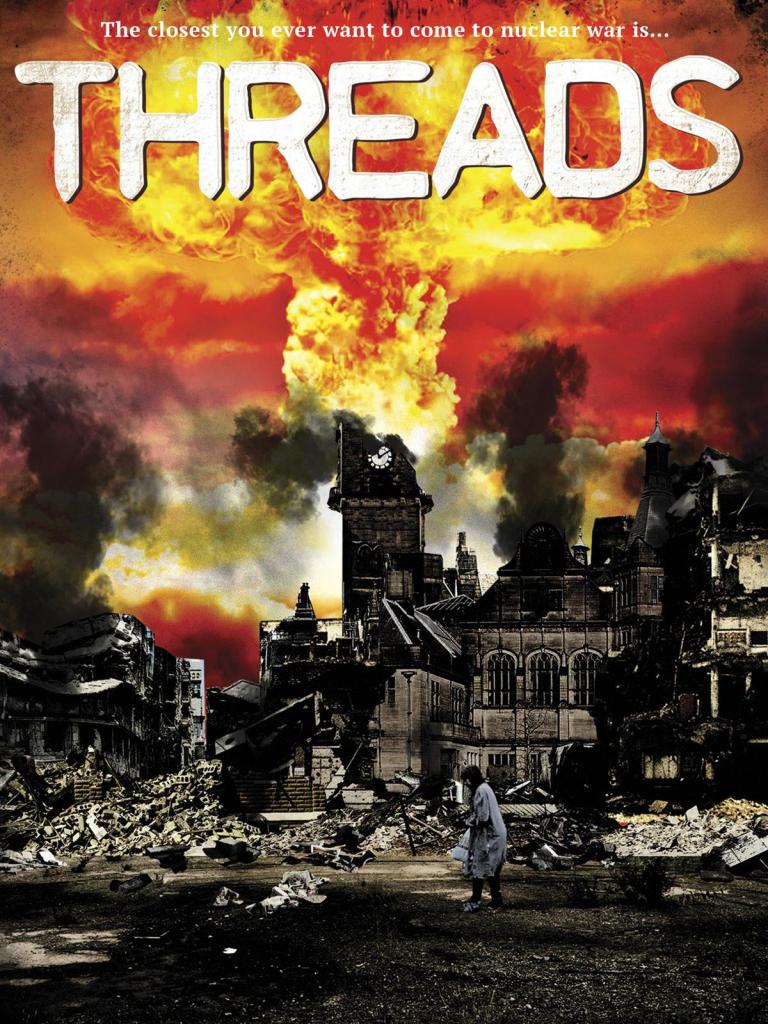
In a conventional sense, referring to this classic television movie as a horror film may not strictly be accurate. At the same time, there are few movies I’ve personally seen that feel quite as stark, bleak, and devastating as Threads does, so counting it as one seems rather fair to me.

To be sure, there have been plenty of films that touched on the horrors of nuclear weaponry, such as Godzilla and Genocide; the difference is that Threads takes a realistic approach to the idea, and instead of causing a monster to roam the countryside, we have widespread starvation, death, looting, radiation sickness, deformities, and atrocities committed by the military. This movie is not for the light-hearted, and with as much an impact it made on me, I can only imagine the impact it made back during the Cold War.

In a way, it’s hard to take a step back. The film feels like a documentary, with some somber narration by Paul Vaughan, slowly showing the audience the build-up to the bombs being dropped, and the horrific aftermath, not just days and weeks, but the widespread effects up to 13 years following the attacks (including a rise in leukemia and cataracts, due to the increased UV rays).

The despair is made all the worse because the characters the film focuses on, primarily a working class couple from Sheffield, have absolutely no way to prevent any of this; like most people on the planet, we live our lives and try to get by, and if a nuclear war should break out between multiple countries, we don’t have a say whatsoever, and so we’re doomed to starve to death (and that’s if we survive the initial blast and the fallout) as crops won’t grow and babies are born dead and deformed.

What’s interesting is that the stark nature present in this film doesn’t end with the final shot (a fantastic final shot, I should add); there’s two minutes of credits, but while the names are coming on the screen (including many scientists who helped with the authenticity, including Carl Sagan), there’s no music. It’s just silence during the credits, and I have to imagine that was done to give people some time to sit, think, and take in what they witnessed.

Aside from Paul Vaughan (the narrator), there’s not too many important cast members. Karen Meagher and Reece Dinsdale felt authentic in their roles, and Harry Beety, while it’s slightly more difficult to feel bad for him given his powers under the Emergency Powers Act, did quite well too. That said, none of the three are really what I’d call the focal point – it’s true we spend a lot of time with Meagher’s character, but the overall picture of a pre-bomb and post-bomb Sheffield is far more important than any individual person.

It’s also worth mentioning that while this film is close to two hours long, and the first bomb doesn’t fall until about 48 minutes in, it never feels dull. In fact, I was captivated through the build-up, what with the USSR and the USA’s conflicts pushing into Iran, tensions growing, all leading to the devastation we soon see. For someone who has long held an interest in politics, I was tuned in from the beginning, and as depressing as the movie was, I did find it rather worth watching.

That said, this is not always an easy movie to get through, especially once the bombs drop and the after-effects are fully realized. There’s plenty of rather disturbing imagery and scenes, such as an older woman who is embarrassed at having made a mess in her bed to a middle-aged woman holding the burned-out husk of what we could imagine was her child. People are shot for looting, locked in make-shift prisons, others are starved and count themselves lucky to be eating rat or possibly radiated sheep.

Threads is a stark and somber film of what nuclear weapons could lead to. Many extras involved in this film were also involved in the Campaign for Nuclear Disarmament, and I’ve long thought it wise to remove these types of weapons from the possible arsenal of any country. After watching a movie like this, no matter how alarmist it might seem to some, I find it difficult to believe many would walk away with a different take on the viability of a weapon that could cause effects even half as atrocious as shown here.

Again, this isn’t a conventional horror film, but I definitely think it counts; it’s more than that too, though, and as disturbing as the film is, I think it’s definitely one of the highlights of the 1980’s. I may not want to watch it again any time soon, and it may not be that enjoyable an experience, but I can’t deny it was a solidly-made film and certainly eye-opening insofar as the horrors of nuclear warfare are concerned.

8/10

Razorback (1984)

Directed by Russell Mulcahy [Other horror films: Tale of the Mummy (1998), Resurrection (1999), The Curse of King Tut’s Tomb (2006), Resident Evil: Extinction (2007)]

I’m never quite sure what to make of many of the Australian horror films I’ve seen. While some can be perfectly normal, so much of the output I’ve seen from Australia tends to be, for lack of a better word, odd.

Certainly that could be a label placed on Razorback also, but I think in this case, that’s not at all a problem.

To be clear, I can’t honestly say I enjoyed Razorback in a traditional sense – it’s quite a dusty, dirty movie, sometimes rather bleak, and portions don’t always enthrall me. That said, I did rather appreciate a lot of it, and though it’s not a film I personally enjoyed a whole lot, it’s definitely a movie that’s worth seeing, and I can understand why I see primarily positive posts about the film.

One thing really allows the movie to stand out, which is the occasionally stellar cinematography. There are two sequences in particular that – after I saw them – I immediately rewatched, one being a dream sequence, the other, shots of a man lost and potentially delirious in the middle of the Outback. Captivating doesn’t begin to describe just how stellar that second sequence was, and I truly thought it possessed some of the most beautiful and desolate scenery I’ve seen in a horror film in recent times.

There’s also a surprisingly shocking dream jump scare at one point – I wasn’t at all expecting it, and I’m not too proud to admit I jumped a bit, so kudos to that scene.

As for the story, it’s not overly original – it’s a giant animal that’s going around killing people, and some characters hunt it down – but the approach taken here does lend a certain je ne sais quoi to the final product. Maybe it’s the scenery – the Australian location is used wonderfully throughout. Maybe it’s the aforementioned dusty and desolation, sometimes grimey, feel. Whatever it is, Razorback does have some feeling to it, and I don’t think it’s a movie, as generic as the plot may sound, that’ll easily be forgotten and discarded.

At first, I thought Judy Morris (The Plumber) was going to have a more central role, but that wasn’t quite to be. She did well early on, though, and when Gregory Harrison (1996’s Summer of Fear) takes the reins, he’s pretty compelling. I can’t say I loved Arkie Whiteley’s character, but Bill Kerr (House of Mortal Sin) has that Australian ruggedness I’ve come to appreciate. David Argue and Chris Haywood (Sweet River and The Tale of Ruby Rose) did well with two rather atrocious characters.

One thing that might be worth knowing before going into Razorback is that an uncut version with a bit more brutality exists. Now, I happened to watch the most-commonly available cut version, but found the missing scenes elsewhere online after I finished the film. Unlike movies such as Cut and Run, I don’t think missing the uncut version of this would be a disaster, but it is something that you may want to watch out for.

I’ve known about Razorback for a long time, and while I’ve always been mildly interested, it’s never been a movie that I’ve been dying to see. After having finally seen it, I can say that I wasn’t blown away by the overall product, but the scenes which did bring something special, being the two sequences I refer to above, are utterly stellar, and I don’t say that lightly. I don’t think Razorback is above average – if it is, it’s not by a lot. Even so, it’s certainly worth seeing, especially for Australian horror.

7/10

The Spirits of Jupiter (1984)

Directed by Russell Kern [Other horror films: N/A]

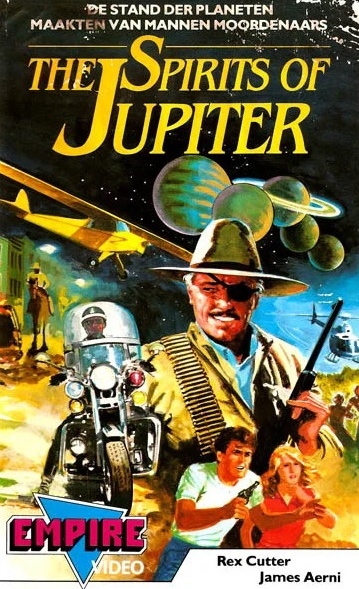
I’m not sure what this mid-80’s obscurity was supposed to be, but if there’s one thing you can say about The Spirits of Jupiter, you have to admit it’s unique.

Reminding me a bit of films like The Crazies and The Carrier, The Spirits of Jupiter deals with the impact that an astrological event has on a small Colorado town. People go crazy – some of it’s harmless, such as lying on your back and riding a bike in the middle of the sidewalk – but most of it results in violence, especially from the police force, who end up shooting everyone on sight.

It’s not an easy movie to describe. There’s a lot of action sequences and chases (be it chases in the air between a helicopter and a plane or ground chases on motorcycle), so it has an action vibe going, but it also has people becoming unstable, resulting in massive death and violence, which is where I’m guessing the horror label comes in. Oh, and let’s not forget this is caused by the gravitational pull of Jupiter or something (they give a six, seven minute explanation of what’s going on about halfway through, but I was already checked out, tbh) which gives the film a science fiction twist.

Here’s the thing – the movie doesn’t have a bad idea or set-up. It’s a mildly interesting idea – a rugged, mine owner has to go into a town full of crazies and rescue his son and daughter – and the action sequences on their own are all pretty solid. In fact, there’s a decent amount of solid scenes in the film.

For instance, the hero early on, who is also a plane pilot, is leaning out of his plane and shooting people, which was hardcore. A police officer pulls over a woman and, upon seeing her license is expired, shoots her in the head. A woman complains to a butcher about the quality of the meat, and gets her hand chopped off. The police lined up a group of people and shot them all down. And let’s not forget the motorcycle chase toward the end.

However, here’s the other thing – this movie is an hour and 47 minutes long. It’s way too damn long, and while some of the sequences are decent, they don’t pop up near enough and, truthfully, they’re probably not worth it anyway. There’s also the matter about some of the comedy – a lot of it comes from Richard Luna’s character, but there’s other characters, such as the manager at the mines (IMDb doesn’t list many credits, and the VHS rip that I saw this in does not lend much clarity to the matter) who just have sort of a slapstick feel. It’s intentional, I’m sure, but it’s not particularly enjoyable.

I admit, I thought Rex Cutter made a nice, rugged lead. He had an occasional John Wayne thing going, which I can appreciate in short bursts. James Aerni was amusing at times, and made an okay antagonist when he bent that way, I guess. Otherwise, given the scant nature of the credits, I’ll just say that few even came close to standing out, aside from Richard Luna as the self-monikered Nostradamus, a character who cared far too much about coffee and not near enough about being sensible.

If you’ve seen The Spirits of Jupiter, and you can excuse the lengthy runtime, you might have had a good time with it. It’s lower-budget, but I certainly don’t think it’s a movie that didn’t try. To be clear, I don’t exactly know what it was trying, but I do know that it tried. It’s not a movie I liked that much – portions were okay, but getting there took so damn long – but if you want something different, and you have a couple of hours to waste, give it a shot.

5.5/10

The Initiation (1984)

Directed by Larry Stewart [Other horror films: N/A] & Peter Crane [Other horror films: N/A]

This is one of those bigger 80’s slashers that I’ve long heard about but never took the time to watch until now. I didn’t know much going into this one, and come the finale, I did find The Initiation pretty close to top-notch.

Plot-wise, the movie is sort of interesting. A lot of films that deal with teenagers or college kids staying someplace overnight (be it One Dark Night, Chopping Mall, or Hide and Go Shriek) would have the individuals get there early on, and most of the movie would take place there. In this case, it’s not until halfway through the film, following character introductions and some plot set-up, that we even see the mall where this sorority prank will take place.

On this sidenote, I have to briefly pause from the movie and reiterate my distaste of fraternities and sororities. This film wasn’t near as bad as movies like Pledge Night or Final Exam, because the prank here was relatively harmless (though it was illegal, so here’s a case of a sorority pushing their pledges to actively break the law – great sisterhood rolls eyes), and there was one character who saw how foolish the whole thing was (kudos to Paula Knowles’ speech), so it’s still tolerable in The Initiation’s case, but boy, do I despise the concept of sororities and fraternities.

Back to the movie, though, I’ll admit that I didn’t see the finale coming. I was of two minds as to how the film could end, and one of my ideas was somewhat shot about halfway through the film. I’m not sure if I particularly love how they chose to end the film, but there were enough hints throughout, and as much as I might have preferred the way I would have concluded it, this ending makes more sense.

Daphne Zuniga (The Dorm That Dripped Blood and The Fly II) made for a pretty likable lead, and I thought she did well. Vera Miles (Psycho), who played her mother, was quite unlikable, and I couldn’t stand her for a single moment, possessing that ‘Karen’ vibe, so she did a good job with a detestable human. Clu Gulager (Hunter’s Blood, A Nightmare on Elm Street Part 2: Freddy’s Revenge, and The Return of the Living Dead) didn’t appear all that often, but it is always nice to see a familiar face.

Others did pretty well also. James Read was my favorite character of the movie, though he did get testy with another of my favorites, played by Joy Jones (in her sole role). Patti Heider played one of the most ill-fitted characters I’ve ever seen to have a job involving the mentally ill, and the other two central sorority pledges, played by Hunter Tylo (credited as Deborah Morehart) and Marilyn Kagan, did well also, especially Kagen, who played another rather likable character.

None of the kills are absolutely amazing, but we did get some fun ones, such as an archery kill, a throat-slitting, an off-screen decapitation (but the silhouettes were nice), some cultivator action (it’s that garden tool with claws – you learn some new things every day), and lastly, a surprise appearance by a harpoon gun. None of these deaths are overly gruesome, but all are of decent quality.

If I’m being honest, I didn’t expect to enjoy The Initiation as much as I did. It’s a pretty fun slasher, and though I have some minor qualms regarding the finale, it’s certainly a movie that slasher fans may want to check out.

8/10

C.H.U.D. (1984)

Directed by Douglas Cheek [Other horror films: N/A]

Some movies hit the right spots. Some movies do very little wrong, and get as much appreciation as possible. Some movies are Gods among cinema.

And C.H.U.D. is one of them.

Dramatic, to be sure, but true. C.H.U.D. is an almost perfect movie in every way. The story is quite good and possesses a true organic feel. The characters and plotlines are great, and how some characters don’t even meet others when investigating the same mystery is a wonderful touch. Everything fits together nicely, and it’s just a wonder to behold.

There’s so much to enjoy about the story. Four of the bigger characters, being the photographer (John Heard), the soup kitchen guy (Daniel Stern), the freelance reporter (J.C. Quinn), and the police captain (Christopher Curry) all have tangential connections – Curry and Heard don’t even meet up until the final three minutes of the film, and Heard had little idea of who Stern was when he ran into him in the sewers, and I doubt that either Stern or Curry had any idea that it was Quinn’s character who helped get Heard to start investigating it.

The story is just very well done. Heard’s wife (played by Kim Greist) doesn’t have a lot to do to start off with, but by the final thirty minutes of the film, she has her own subplot as she has to deal with some cannibalistic humanoid underground dwellers who are forcing their way into her apartment while her husband is trying to avoid the same things beneath the streets.

I just love this story. The movie doesn’t waste any time. Even the very first scene – which some movies would just use to show a random, unimportant victim, getting killed – is deeply crucial to the film, as that individual is a relation to one of the main characters, and is in fact one of the reasons these disappearances have been taken more seriously by police.

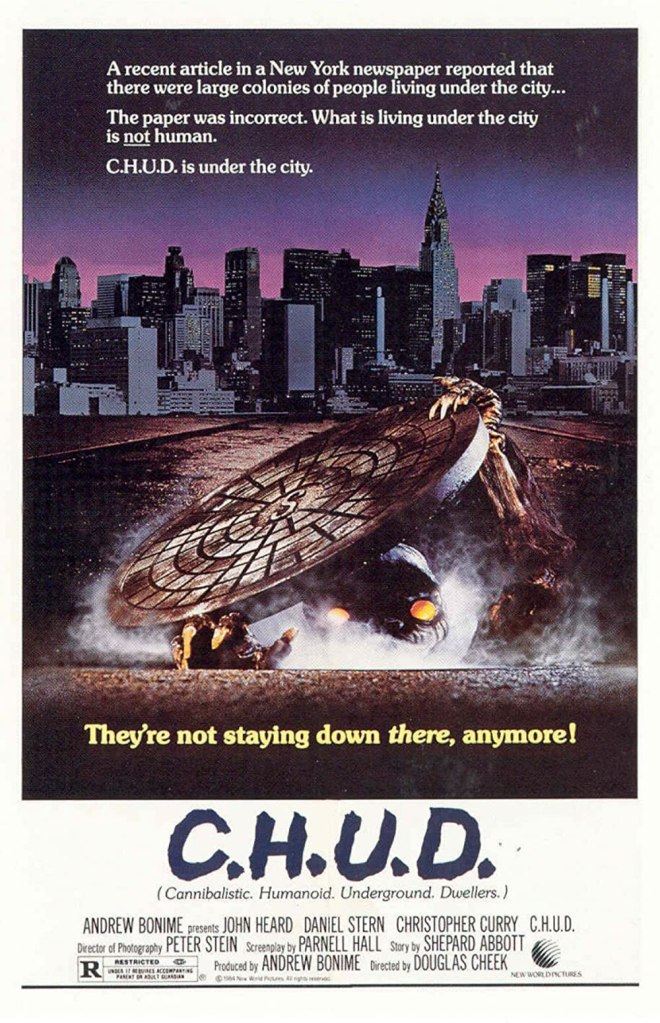
Not to mention the acronym C.H.U.D., which means multiple things (it’s a good thing that waste created what could be described as cannibalistic humanoid underground dwellers, or they would have had to scramble for new matching words), and I just love the sequence where we find out the true meaning, and it shows just how sinister George Martin’s character really is.

Christopher Curry is great, and when he was finally able to punch out the antagonist of the film, that was quality fun. Curry isn’t an actor I know, but he did really well, and I quite liked his emotional scene in the bar. John Heard (Cat People and Locusts) isn’t an actor I generally notice, but he did quite good here, and I just wish his character had more time to work with Curry’s. Playing Heard’s wife was Kim Greist (Manhunter), and when things started going down in her apartment building, she knew how to handle business.

Daniel Stern I know only from Home Alone and Leviathan, but he did fantastic, and I loved his growing working relationship with Curry’s character. J.C. Quinn was used well to move the plot a bit, and George Martin played a horrible, despicable character with great talent. We also get a small appearance from Frankie Faison (The Silence of the Lambs and Hannibal) and a longer appearance by John Goodman (Red State, Arachnophobia, 10 Cloverfield Lane, and the series Roseanne), an actor I love in pretty much anything. The first time I saw this film, I’m guessing Goodman’s appearance went right over my head, so noticing him here out of the blue was a beautiful moment for me.

The design of the cannibalistic hombres is great, particularly the glowing eyes (and at times, they reminded me of The Mole People). I enjoyed how they didn’t show us much of them – just the clawed hands popping out of the sewers every now and again – until late in the film, when we can experience them to our glory. Oh, and the soundtrack is fantastic. It’s subtle, but it’s fantastic, especially during the apartment attack.

Some movies just work. I enjoyed C.H.U.D. when I first saw it, and I enjoyed it immensely with this revisit of it. It’s a great 80’s movie, has a nice New York City vibe (as it was filmed in and under the city), and just works in ways that not too many horror films can. Highly recommended piece of 80’s cinema.

9/10

Death Warmed Up (1984)

Directed by David Blyth [Other horror films: The Horror Show (1989), Red Blooded American Girl (1990), Wound (2010)]

This New Zealand production is such a madcap movie. I don’t necessarily mean that it’s zany or even fun, but it does have a bit of a wild feel to it, and while it’s definitely not what I’d call a good movie, at least Death Warmed Up has flavor.

Luckily, the plot never feels too out there, as we have a good idea of what’s going on from the beginning. Things get a bit hectic toward the end, what with an outbreak of mutated people causing havoc, but the story never gets overly confusing or at any point nonsensical, which I can appreciate.

Also, while it’s hard to say that anyone really stands out as far as performances go in this movie, most of the central actors and actresses were at least decent. Michael Hurst had a pretty unique look to him, and his character was pretty tragic (that opening was just beautiful). Margaret Umbers, William Upjohn, and Norelle Scott all worked well as friends, and I bought their performances. Gary Day did great as the amoral scientist, and as a lesser antagonist, David Letch (who was also in Mr. Wrong, as was Umbers) was notably threatening.

The special effects and gore were never the biggest focus, but there were plenty of mutated patients (though they were never really in focus, so the extent to their mutations weren’t that clear), some gory skull removal during some operations, a few slit throats here and there, aftereffects of a massacre. None of it was great or really memorable, but at least it was there, and more so, at least it all seemed competently done.

One thing that amused me was the fact that some of the scene transitions used what I’d refer to as Powerpoint slideshow transitions – it didn’t take away from the movie or anything, but it just looked sort of funny, and I can’t think of many movies that use transitions quite like this one did.

The opening, as I alluded to earlier, was pretty solid. You have a guy using a shotgun against two people, and the results looked quite gory. Not that the movie dragged later on or anything, but I think the beginning to Death Warmed Up did a good job at making us, as the audience, wonder what’s coming next, because for this movie, it’s not always that easy to tell.

I find the movie amusing, though there wasn’t much in the way of humor actually in the film proper. It just seemed all over the place, and though there was a coherent story, Death Warmed Up just felt weird. I’ve seen this once before (I own it on the Pure Terror 50-movie pack from Mill Creek Entertainment), and the only scene that I remembered vaguely (as it’s been at least ten years since I’ve seen the movie before this rewatch) was the chase in the tunnels, which was a bit dark as far as lighting was concerned, but moderately suspenseful.

Truthfully, I don’t really like Death Warmed Up, but I can’t find it in me to really dislike it. I do think the movie is a bit below average, but at the same time, this is one that I could easily see myself diving into again in the future, if just due to how odd some of it is. If you’re into New Zealand-based horror, give it a look. You could certainly do worse than this.

6/10

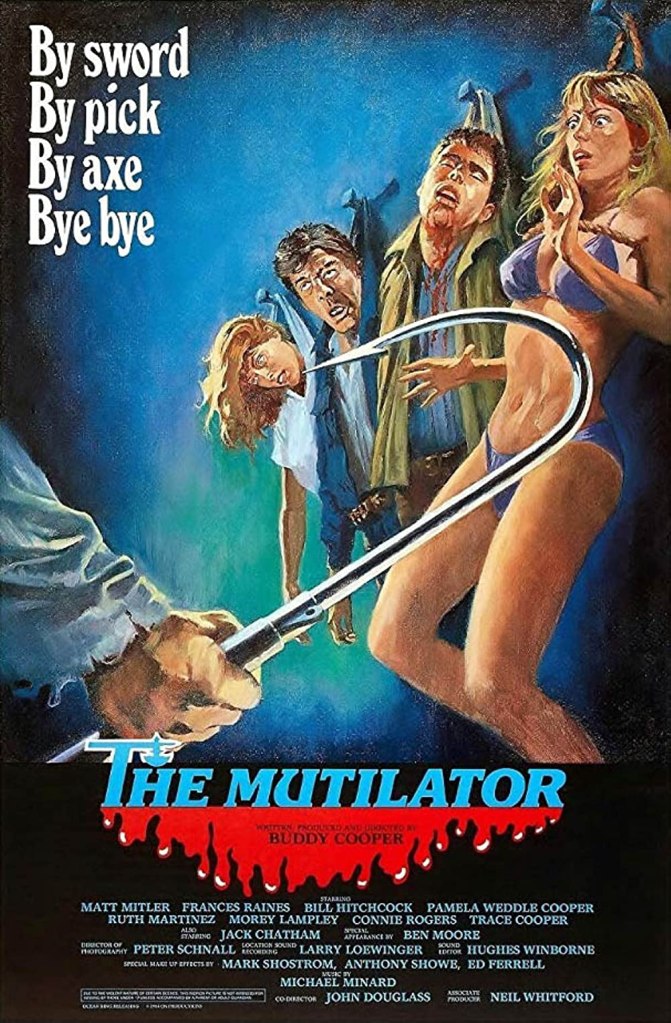
The Mutilator (1984)

Directed by Buddy Cooper [Other horror films: N/A] & John Douglass [Other horror films: N/A]

You know, I have to admit that my recollection of this movie may not have done it proper justice. I saw The Mutilator once many years ago, and ever since, I’ve been telling people about how underwhelming I found the film. Seeing it again with fresh eyes, though, I didn’t feel underwhelmed at all. 

It could fairly be said that neither Morey Lampley nor Frances Raines (Disconnected and Breeders) did much for me, but the other four central characters were pretty good. Bill Hitchcock and Connie Rogers struck me as a realistic couple, Hitchcock’s character even occasionally amusing me. Matt Mitler was strong, and making for a quality final girl was Ruth Martinez, who I really liked here.

Pulling all of this together is the fact that I really got the sense that these were friends just hanging out, so even during the moments void of murder, it was fun just seeing this group of friends chilling (and playing Blind Man’s Bluff, a game that doesn’t look remotely fun).

What adds a little bit to the performances, by the way, is the fact that this was filmed in North Carolina, and most of the actors and actresses have that southern twang in their accents which just gives the movie a little more regional flavor, something that I quite appreciated. 

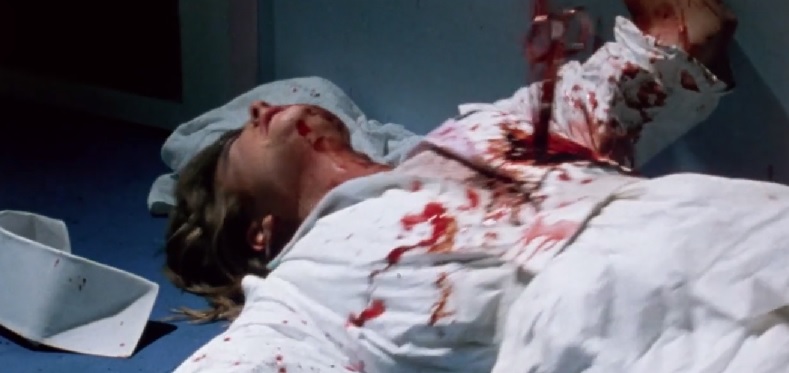
Of course, what really adds to the film is the quality gore, which is something I perhaps missed the first time I saw The Mutilator. With such classy kills as a character getting stabbed with a piece of wood through the throat and thusly decapitated and another guy’s chest getting all ripped up with an outboard motor (which isn’t necessarily clear during the scene, at least to me, but the impact is most definitely worth it), this movie doesn’t slouch off in that department. There might be a weak kill or two (such as the character who was drowned), but that strong finale, with some dismemberment and someone being cut in half by a car, is enough to cancel those out.

While a small point, I wanted to mention the song that sandwiches the film (plays both at the beginning and the ending during the credits) titled “Fall Break” (on a side-note, Fall Break is an alternative title to this movie, and in fact, the print of the film that I saw had this title as opposed to The Mutilator). The song is a bit too jaunty for me at times, but I did think it was a lot of fun, and it’s one of those songs that’ll end up on my iTunes (the same fate which befell “Fade to Black” from Prom Night).

Oh, and another thing that I found a pleasant surprise – unlike many horror films, The Mutilator didn’t go for some final scene jump scare, which surprised me as it sort of felt like they were moving in that direction. Luckily, it was just a little somber scene in a hospital, which I definitely appreciated.

There’s no doubt that this film is somewhat run-of-the-mill, and given that the killer wasn’t particularly distinctive in any way whatsoever, it makes sense to me that for some, this might just not cut it. And to be fair, like I said, the same could have been said of me prior to this rewatch. Seeing it again, though, opened my eyes, and while it’s not a great slasher, I did have quite a bit of fun with it.

7.5/10

Scream for Help (1984)

Directed by Michael Winner [Other horror films: The Nightcomers (1971), The Sentinel (1977)]

Scream for Help is a movie that I’ve only seen once before, and honestly, a movie that I remembered very little of. Pretty much when it came to mind, I just thought of it as the spiritual prequel to The Stepfather (not unlike how I think of 1985’s Blackout). In truth, this really can stand up on its own, because while it’s not an amazing movie, I definitely think a lot was done well.

Problematically, much of the first half deals with a lot of melodrama, what with a step-father’s affair being found out by his step-daughter, and while I can get the emotional upheaval this would cause the family, it’s not always the most engrossing stuff.

Again, though, there’s still decent scenes here, such as the somewhat surprising and intense hit and run that happens quite early into the film. No doubt too there’s tension at different portions of the opening, and while things don’t really pick up until the final thirty minutes, there’s plenty of things going on that are likely to keep your interest.

What sort of interested me was how the story also largely dealt with a teen girl’s coming-of-age, in a way. Over the course of the film, she experiences her first love and experiences her first love-making, and of course love saves them all in the end. Of course, it also led to most of their problems in the first place, but like most teenagers, it’s a confusing time for us all.

Rachel Kelly was pretty convincing as a teenager naive in the ways of lust. I mean, no doubt was her character occasionally ridiculously melodramatic, but she was pretty fun, and she possessed quality strength. Her mother, played by Marie Masters, didn’t interest me as much, but she still did decent enough. Forgettable also was Corey Parker, but I loved how his character, the very day after his girlfriend dies, gets with the girlfriend’s best friend, so a quality example of man.

Speaking of which, while his girlfriend, played by Sandra Clark, didn’t last that long, she was still pretty decent, which was a bit of a surprise given that this was her sole role in anything. David Allen Brooks (who pops up much later in Jack Frost 2) was pretty good here, and Rocco Sisto was even better, but Lolita Lesheim (who provided a bit of nudity) was just okay. Still, decent performances from most of the central cast, especially Rachel Kelly.

While traditional horror scenes were a bit light at times (and the finale felt far more thriller than it did horror), there were a few here and there, and like I said, plenty of tension throughout the whole of the film. Also, there was a kick-ass explosion at the end, which was pretty cool, and while the electrocution wasn’t up to par, it was still fun given the character in question who was electrocuted deserved it.

A lot could be said for the idea that this movie feels far more like a coming-of-age thriller than it does the pure horror movie that you might hope it’d be, and I can certainly see it, to an extent, but no matter what Scream for Help is classified as, I think it’s a movie that has a decent amount going for it, and if you’ve not yet seen it, it may be worth it, even if it’s not amazing.

7/10