Dark Universe (1993)

Directed by Steve Latshaw [Other horror films: Vampire Trailer Park (1991), Biohazard: The Alien Force (1994), Jack-O (1995), Death Mask (1998), Return of the Killer Shrews (2012)]

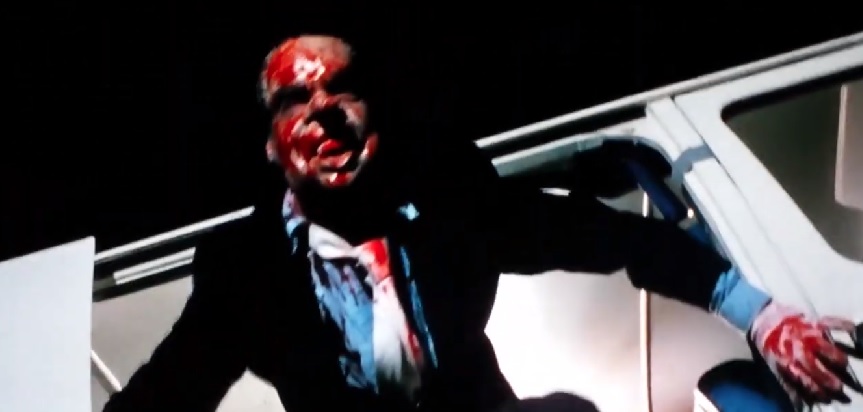
While rather low budget in it’s approach, Dark Universe does have some mild charm to it. It’s not what I’d call a good movie, but for what it is, I don’t think it’s at all awful.

With what looks like a makeshift Xenomorph running around Florida swamps, Dark Universe can be a little fun. Having an alien causing havoc on Earth isn’t uncommon – look at films such as The Incredible Melting Man, The Borrower, Lifeforce, Night of the Blood Beast, and Without Warning – but it’s still unique enough for a lower budget film to try and craft that at least a little respect should be thrown it’s way.

Honestly, while some of the special effects are quite terrible (such as the spacecraft pilot at the beginning morphing into the Xenomorph-lite), some aren’t too shabby. As much as I make fun of the alien design here, it’s okay. There’s also the scenes where the alien sucks the fluids out of some unfortunate souls, leaving their bodies emaciated. It’s not great, but we’re talking about an early 1990’s straight-to-video movie here, so again, I have to give the film some kudos.

It’s not a good movie, though, which may not come as a surprise. It’s sort of fun at times, but there’s not a lot to the film – just people trekking through the swamps, occasionally getting attacked by the alien, and almost always during the day. It’s not generally that interesting, even if it does look okay for the budget they had.

Personally, I thought Blake Pickett (HauntedWeen) made for a somewhat irritating character. She started out fine, but the more she did, the less I cared for her. It’s the opposite with John Maynard (in one of his earliest roles), who I rather liked until the end. Bently Tittle (also from HauntedWeen) was generic, yet fine, Joe Estevez (The Lights and Axe Giant: The Wrath of Paul Bunyan among his most well-known works) popped up for some reason, and we got a small scene with William Grefé (not generally an actor, but the director of suck works as Whiskey Mountain, Death Curse of Tartu, Stanley, and Mako: The Jaws of Death), which was sort of fun.

Dark Universe isn’t a good movie, but I don’t think it’s terrible. It can be quite dull at times, and the finale isn’t what I’d exactly call nail-biting, but for some cheap alien action, and for a retro time, it might be worth checking out at least once.

5.5/10

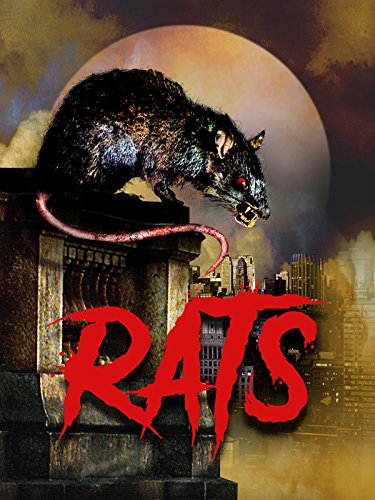
Rats (2003)

Directed by Tibor Takács [Other horror films: The Gate (1987), I, Madman (1989), The Gate II: Trespassers (1990), Mansquito (2005), Kraken: Tentacles of the Deep (2006), Ice Spiders (2007), Mega Snake (2007), Spiders 3D (2013), Bunks (2013)]

While Rats isn’t a good movie, it is a movie that could have been decent. If the plot had been tightened up a bit, and the special effects improved on, it might have been something that was sort of special.

As it is, I have some minor history with this film. Like movies such as Webs, How to Make a Monster, and Piñata: Survival Island, I saw Rats when I was rather young in life, so it does have a bit of a special place in my heart. That doesn’t save the movie – the poor special effects can’t be defended – but I can admit to enjoying this a smidge more because of my past with it.

Also, the story isn’t that bad. A female journalist goes undercover at a private psychiatric hospital to work on a story, and a guy who telepathically communicates with rats tries to hold back a massive rat attack. Okay, well, the first part of the movie (undercover at a mental institution) was a solid idea, in a Nellie Bly-type way. Admittedly, it goes off the rails once the giant rat comes in, but to all good things there must come an end.

The special effects are pretty horrendous. The 3D rats looked, as the kids say, quite shit, and they never really look good at any point. Even during a personal favorite scene in the film (and one that stuck with me the most from my childhood viewing of this movie), in which rats attack people locked up in isolation rooms, straight-jackets and all, show the rats entering the room with some of the worst special effects imaginable.

Sara Downing made a pretty decent lead. She occasionally reminded me of A.J. Cook, and that’s never a bad thing. Ron Perlman (Desperation, The Last Winter, and I Sell the Dead), an actor I can’t stand usually, is pretty tame and tolerable here. Denise Dowse’s character half the time was atrocious, but I liked her performance. On the more generic side, we have Bailey Chase, Michael Zelniker, and Michael Hagerty. The only performance I actively didn’t like was Zelniker’s, but that’s more due to his character than anything else.

Not to be confused with Rats (2000), The Rats (2002), or Rats: Night of Terror (1984), Rats isn’t terrible if you just want someone comfortable to snuggle up with, but if you’re looking for someone to hang onto for the rest of your life, I doubt Rats could do that for you.

5.5/10

Batoru hîtâ (1989)

Directed by Jôji Iida [Other horror films: Kikuropusu (1987), Tokyo Babylon 1999 (1993), Naito heddo (1995), Rasen (1998), Anaza hevun (2000), Hoshi Shin’ichi Mystery Special (2014)]

Known as Battle Heater, this Japanese film deals with a kotatsu heater that goes around and kills people. It’s not a bad movie for it’s sort of goofy niche, but therein lies the problem for me, which is that the movie is just a bit goofy for me.

Sometimes that doesn’t matter. Hausu is a pretty silly movie, but not only do I rather enjoy that, but I consider it a classic of Japanese horror. Bio-Zombie (or Sang faa sau see) is still fun despite how goofy it can be. Tokyo Zombie (Tôkyô zonbi) is the same way, though I do think that one trends more toward average.

My point is that sometimes I can deal with goofy elements in my movies, but at other times, it just comes on way too strong, and Battle Heater is an example of that. It’s okay in it’s niche, but from the goofy characters to the silly set-up, it’s not really my type of thing. From a giant rock hitting a character to indicate the end of the film (the rock says ‘end,’ so it feels like Monty Python) to an electrical-based superhero suit being made to battle the heater, it’s humor is highly silly.

I can appreciate portions of the film, though. A killer kotatsu is a wild concept, and for those who don’t know (myself included before I started the film), a kotatsu is a type of electric heater used almost exclusively in Japan. It looks sort of comfy, and deciding to make that thing some type of homicidal entity is amusing in of itself.

Also, some of the comedy is okay. There’s a scene early on in which two characters stare at each other for a ridiculously long time. At first it was just awkward, but as it spanned into a longer scene, it was just amusing, and had me laughing come the end of it. There’s also a miscommunication regarding a map, which leads to a bunch of crying Japanese high school girls winding up at a low-budget apartment complex for a concert. It’s random, but funny.

Out of the performances, I’d say the best ones were Pappara Kawai and Gorô Kishitani. Kishitani is probably the straightest character, and I appreciated that, but he’s also a bit of a dick, so that takes some enjoyment away. Pappara Kawai does grow on me over the course of the film, as he starts off quite shaky, but he does sort of grow into himself.

This is a pretty obscure movie, and I sense that the right audience would definitely enjoy this movie. It’s a film I’ve wanted to see for a while, though I knew I probably wouldn’t be in the audience this was directed toward. It’s not my type of thing, but if you like Asian horror, especially wacky Asian horror, than you should definitely check this out.

5/10

Hellraiser: Hellseeker (2002)

Directed by Rick Bota [Other horror films: Hellraiser: Deader (2005), Hellraiser: Hellworld (2005)]

I’d say that largely, Hellseeker has the same appeal as Inferno did. I don’t think it’s as good, despite a surprise returning character, but it’s along the same psychological mold. There can be okay scenes, but the disjointed plot sometimes hinders enjoyment, and it’s never been a favorite of mine.

Unlike Inferno, which I had seen multiple times before finally writing up on it, Hellseeker is a movie that I may have only seen once before. I knew the basic gist going in, so nothing here surprised me (and on a similar note, if that ending surprised anyone, I’d be amazed, as it was about as shocking as my shoes), but it was interesting to watch this with somewhat fresh eyes.

In many ways, it really does seem similar to Inferno, which makes sense, as, like Inferno, the script here wasn’t initially a Hellraiser movie. It was refitted to make the Cenobites work into it, and they did as well as they probably could have. Honestly, I don’t mind the idea of the movie, but there’s the thing: when you have a character that has constant hallucinations, and from one second to the next he moves from hospital to office building without realizing it, you know that a lot of the stuff seen isn’t real, and hence, why bother caring?

It’s in the same vein of later movies like Delirium and Dry Blood. When there’s a hallucinating character who constantly sees things that aren’t there, how are you supposed to take any of the movie as real? Could not the whole thing be fake? Is that perhaps exactly what this movie does? Some say the journey is more important than the destination, but when the destination is so easy to see coming, and the journey is a hallucination-filled waste of time, it’s hard to care that much.

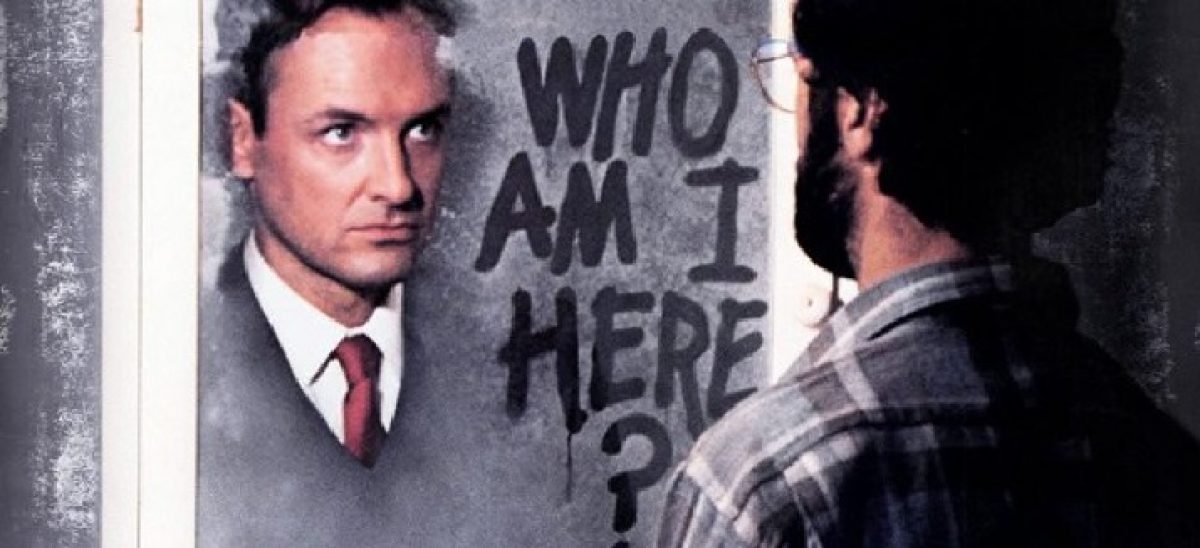
Which is where I think Inferno did a slightly better job. I think it had some creepier scenes, a marginally more interesting story, and things made a bit more sense in that movie. In this film, the lead character Trevor (Dean Winters) is bombarded with mental images of unsavory things he may have done before the amnesia hit – yet he keeps insisting he “wouldn’t do that,” as he “knows who he is.” If you have amnesia, at least to the extent this movie portrays it, you don’t know who you are, and you can’t keep insisting innocence when you have no idea.

Despite my issues with the story, Dean Winters was fine as the lead. In fact, most of the performances were okay, from Jody Thompson, Trevor White, and Kaaren de Zilva to William S. Taylor and Rachel Hayward. Ashley Laurence, returning as Kirsty from the first Hellraiser, was nice to see, but I don’t really think we saw enough of her to make a great impression, and while it’s always good to see Doug Bradley as Pinhead, he didn’t appear too often, and rarely had anything of interest to say.

At least he appeared, though. We do get small glimpses of other Cenobites, but nothing especially concrete. Even Inferno gave us a lot more when it came to Cenobite action, but aside from Pinhead, we get very little here. We saw what looked like Chatterer for a split second, so that was cool, but I would have loved less hallucinations and more Cenobites.

Hellseeker isn’t a good movie, and it’s definitely not a good Hellraiser movie. It’s also not as palatable as Inferno, which was already below average. For what it is, I guess it’s an okay way to spend your time – I don’t find the film entirely without merit. Even so, it’s not a good film, but at the very least, it’s better than Bloodline.

5.5/10

Horror House on Highway Five (1985)

Directed by Richard Casey [Other horror films: Horror House on Highway 6 (2014)]

Horror House on Highway Five is a movie I’ve wanted to see for a long time. I never deluded myself that it’d be a good movie, but it’s still something I wanted to scratch off my list for years, and I can say now that I have seen it, and unsurprisingly, I was disappointed.

Which is sort of amusing, because the film is more ambitious than I would have thought, but it’s in that ambition that it lost me. See, all I knew about this film was that there was a killer in a Richard Nixon mask and he terrorized some college kids.

What I didn’t know is that this Nixon-masked killer isn’t the only killer – there’s two other antagonists who kidnap people as part of some unspecified sacrifice, and there’s also some stuff dealing with a Nazi scientist who came to the USA. It’s also moderately comedic, which is something else I wasn’t clear on.

Look, if the film had been just a single guy in a Nixon mask going around and killing college kids, it might have been uninspired, but at least it’s a plot I can get behind. What this movie had was just too out there – I don’t know why they decided to deal with a Nazi scientist, some brothers who were ineffectual half the time, and brain parasites (?) that may or may not be a delusion of one of the characters. It just complicated things unnecessarily.

So with the bizarre plot out of the way, it’s time to talk about what few performances did something for me. Max Manthey was occasionally amusing. Michael Castagnolia worked okay with Susan Leslie, and Irene Cagen could dance with the best of them.

There are some funny scenes here, of course. A man and woman driving by encounter the Nixon-masked killer, leading to some great lines, from ‘Is he giving me the fingeroo?’ to ‘he sure is a big motha.’ It’s partially the delivery, partially the dialogue, but it’s funny. There’s also Gary’s (Max Manthey) dance, which reminded me of Crispin Glover’s classy dance in Friday the 13th: The Final Chapter. There’s also a character who finds a dead cat in the back of their van, and the other character there literally doesn’t seem concerned at all. It’s just wacky.

I can imagine in some situations Horror House on Highway Five can be a fun movie to watch, but most of those situations involve drugs and alcohol. It can be funny, yes, but personally, that’s not enough, and while I sort of dug the final scenes, this isn’t a movie I particularly enjoyed, and though I’m happy I finally saw it, I can’t say it’s really worth seeing unless you’re into bizarre and possibly drug-influenced movies.

5/10

Whiskey Mountain (1977)

Directed by William Grefé [Other horror films: Sting of Death (1966), Death Curse of Tartu (1966), Stanley (1972), Impulse (1974), Mako: The Jaws of Death (1976)]

Aside from some nice scenery and a rather disturbing rape sequence, Whiskey Mountain doesn’t really have a lot to offer. It’s an okay backwoods exploitation movie, but it’s rather short on the horror aspects, and I don’t know if the action during the end is really enough to boost this movie up.

It does look nice, though. Apparently filmed in North Carolina (at least according to IMDb, and who knows how accurate that is), the scenery is quite beautiful. We got a lot of shots of the mountain and the forests, lakes and rivers, and it looks quite peaceful, aside from the murdering and raping pot dealers and corrupt police force, but that’s just how it’s done in south, apparently.

If Whiskey Mountain tells you anything, it’s that we should just go ahead and legalize marijauna nationwide. We should have done it back in the 1950’s. If we did, then there would be no need for the marijuana growers in this film to take four people captive, as it could just legally be grown and sold. That’s what anti-marijuana laws get you, alas.

Seriously, though, Whiskey Mountain is a movie that I wish I liked more, and in fact, I did like more when I first saw it. It’s quite possible, though, that I was just so stoked to see it way back when I did (I’m pretty sure when I first saw this, Whiskey Mountain had under 60 votes on IMDb – now it has 265 and is widely available on Tubi), and didn’t pay attention to the actual movie. It’s even more likely that was in October, a month when I watch so many movies, it’s not always easy to get an honest and accurate reading on them in the moment.

The problem here is two-fold: for one, it’s a bit slow throughout, and when things to start going in a more action-oriented direction, I can’t say it’s the most exciting stuff (save for the motorcycle jump – that was pretty cool), and two, while I have no problem calling Whiskey Mountain horror, the horror elements are quite scarce. They pop up in a scene or two, but it’s by no means a strong part of the film.

Of course, it is always nice to see Christopher George (Grizzly, Day of the Animals, City of the Living Dead, Graduation Day, Pieces, and Mortuary), and he does well here, as do the other three central stars, being Preston Pierce, Linda Borgeson, and Roberta Collins. John Davis Chandler (Phantasm III: Lord of the Dead and Mako: The Jaws of Death) made for a solid antagonist, though I wish he had a better resolution.

They’re not the only stars, though. Y’all know Charlie Daniels, I’m betting. Well, the Charlie Daniels Band did the theme for this film, surprisingly titled “Whiskey Mountain.” It pops up during one of the scenic portions at the beginning, and again during the credits, and it’s not a bad song. Not as catchy as “The Legend of Wooley Swamp” or “The Devil Went Down to Georgia,” but then again, what is?

If there’s one thing that people are apt to remember about Whiskey Mountain, it would be the rape sequence. Mercifully, we don’t actually see anything, but what we do see is haunting in it’s own way. Pictures are being taken of the two women – polaroids that we see darken – and as the screams continue in the background, we see more pictures – forced kissing, then the women in their underwear, and then just a face in pain. The morning after the rapes is haunting too, and this whole sequence is probably the most striking in a movie that’s otherwise quite tame.

Whiskey Mountain is a movie that I wish I got more out of, but life doesn’t always give us those gifts. It’s not a bad movie for seeing motorcycles, mountains, and men with guns, but if you want some really good southern hospitality, check out Hunter’s Blood.

5.5/10

The Initiation (1984)

Directed by Larry Stewart [Other horror films: N/A] & Peter Crane [Other horror films: N/A]

This is one of those bigger 80’s slashers that I’ve long heard about but never took the time to watch until now. I didn’t know much going into this one, and come the finale, I did find The Initiation pretty close to top-notch.

Plot-wise, the movie is sort of interesting. A lot of films that deal with teenagers or college kids staying someplace overnight (be it One Dark Night, Chopping Mall, or Hide and Go Shriek) would have the individuals get there early on, and most of the movie would take place there. In this case, it’s not until halfway through the film, following character introductions and some plot set-up, that we even see the mall where this sorority prank will take place.

On this sidenote, I have to briefly pause from the movie and reiterate my distaste of fraternities and sororities. This film wasn’t near as bad as movies like Pledge Night or Final Exam, because the prank here was relatively harmless (though it was illegal, so here’s a case of a sorority pushing their pledges to actively break the law – great sisterhood rolls eyes), and there was one character who saw how foolish the whole thing was (kudos to Paula Knowles’ speech), so it’s still tolerable in The Initiation’s case, but boy, do I despise the concept of sororities and fraternities.

Back to the movie, though, I’ll admit that I didn’t see the finale coming. I was of two minds as to how the film could end, and one of my ideas was somewhat shot about halfway through the film. I’m not sure if I particularly love how they chose to end the film, but there were enough hints throughout, and as much as I might have preferred the way I would have concluded it, this ending makes more sense.

Daphne Zuniga (The Dorm That Dripped Blood and The Fly II) made for a pretty likable lead, and I thought she did well. Vera Miles (Psycho), who played her mother, was quite unlikable, and I couldn’t stand her for a single moment, possessing that ‘Karen’ vibe, so she did a good job with a detestable human. Clu Gulager (Hunter’s Blood, A Nightmare on Elm Street Part 2: Freddy’s Revenge, and The Return of the Living Dead) didn’t appear all that often, but it is always nice to see a familiar face.

Others did pretty well also. James Read was my favorite character of the movie, though he did get testy with another of my favorites, played by Joy Jones (in her sole role). Patti Heider played one of the most ill-fitted characters I’ve ever seen to have a job involving the mentally ill, and the other two central sorority pledges, played by Hunter Tylo (credited as Deborah Morehart) and Marilyn Kagan, did well also, especially Kagen, who played another rather likable character.

None of the kills are absolutely amazing, but we did get some fun ones, such as an archery kill, a throat-slitting, an off-screen decapitation (but the silhouettes were nice), some cultivator action (it’s that garden tool with claws – you learn some new things every day), and lastly, a surprise appearance by a harpoon gun. None of these deaths are overly gruesome, but all are of decent quality.

If I’m being honest, I didn’t expect to enjoy The Initiation as much as I did. It’s a pretty fun slasher, and though I have some minor qualms regarding the finale, it’s certainly a movie that slasher fans may want to check out.

8/10

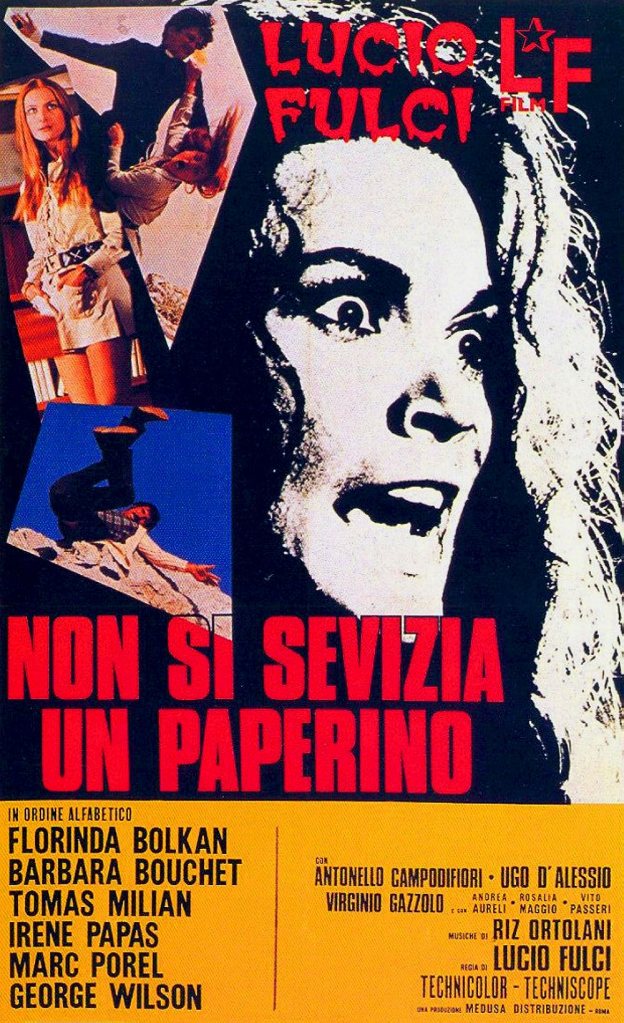
Non si sevizia un paperino (1972)

Directed by Lucio Fulci [Other horror films: Una lucertola con la pelle di donna (1971), Il cav. Costante Nicosia demoniaco, ovvero: Dracula in Brianza (1975), Sette note in nero (1977), Zombi 2 (1979), Paura nella città dei morti viventi (1980), Gatto nero (1981), …E tu vivrai nel terrore! L’aldilà (1981), Quella villa accanto al cimitero (1981), Lo squartatore di New York (1982), Manhattan Baby (1982), Murderock – Uccide a passo di danza (1984), Aenigma (1987), Zombi 3 (1988), Il fantasma di Sodoma (1988), Quando Alice ruppe lo specchio (1988), La casa nel tempo (1989), La dolce casa degli orrori (1989), Un gatto nel cervello (1990), Demonia (1990), Hansel e Gretel (1990), Voci dal profondo (1991), Le porte del silenzio (1992)]

For a long time, Don’t Torture a Duckling (the well-known English title of this giallo) has been among my favorite Lucio Fulci films. That’s probably still true, as it’s a pretty solid giallo, and while not overly violent, has a decent amount going for it.

The story is fun, and somewhat atypical as far as gialli goes. The victims are almost exclusively young boys, and while their deaths aren’t violent (they mostly seem to be strangled or suffocated), there is a certain pleasure in seeing a younger victim range, as not too many films deal with dead kids.

I also love the setting, being a rather rural and small Italian town. It’s filled with superstitious people, which unfortunately plays a part later on in the film when some confessed killers come out of the woodworks. There’s a lot of mob mentality in the film, kept in check partially by the mostly logical police force.

Most of the central performances were pretty good. Tomas Milian was a bit generic, but he was more interesting once he began working with Barbara Bouchet’s (The Black Belly of the Tarantula, The Red Queen Kills Seven Times) character. The main faces we see from the police force were all fun – especially Virgilio Gazzolo, but both Antonello Campodifiori and Ugo D’Alessio were solid also. Marc Porel (who died at the young age of 34 in 1983) was great here, and Florinda Bolkan had quite the tragic story to her.

Unlike later Fulci films, this movie is pretty tame as far as the violence goes, with two exceptions. There’s a sequence in which a woman is beaten with a chain – if you remember the opening to The Beyond, it’s quite similar. It looks hella painful to get chain whipped across the face, so I may avoid that part of Italy. Also, there’s a character who falls off a mountain at the end, and their face bumps and scrapes against the mountain. The thing falling is obviously a dummy – it looks incredibly fake. Even so, the sequence is quite fun.

In fact, the finale is quite great overall. During the scene in which the character is falling to their death, we’re given flashbacks as to explain the reasoning behind the revealed killer’s actions, why they went out of their way to kill kids. It’s even a bit emotional, with soft music playing in the background, and it’s a finale, despite the dummy, that has always stuck with me.

Like I said, this has been my favorite Fulci film for a long time, and I think that’s still pretty true. I finally watched The New York Ripper earlier this month, and I quite liked it, and it might be fair to say that Don’t Torture a Duckling is on par with that one. Even so, I think this one is a bit better – the mystery is mildly more interesting, and the finale is definitely a bit stronger.

I don’t think Don’t Torture a Duckling is perfect. Unlike Dario Argentino with Deep Red, Fulci’s been unable to amaze me quite that much. Even so, Don’t Torture a Duckling is quite a good film, and definitely a giallo that’s worth seeing.

8/10

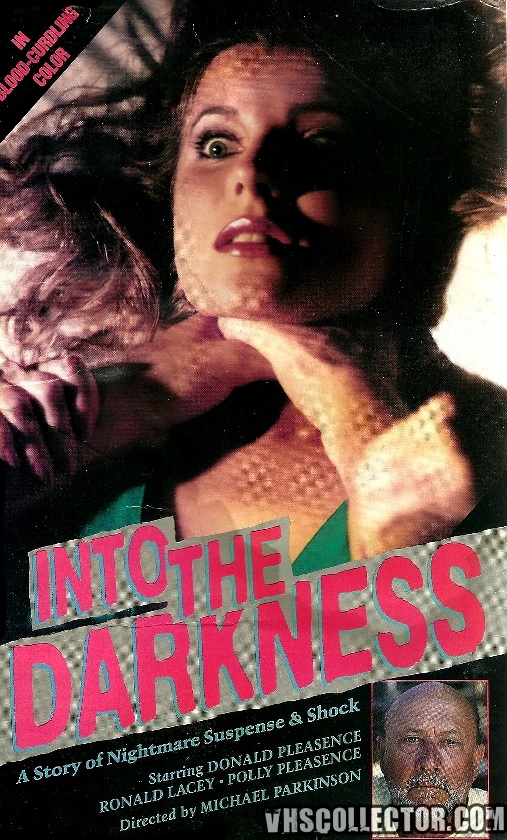
Into the Darkness (1986)

Directed by David Kent-Watson [Other horror films: The Eye of Satan (1992)]

This is a relatively obscure British SOV film, and there’s probably a good reason for that. It’s not entirely without merit – large portions took place, and were shot in, Malta, giving it a Mediterranean feeling – but it’s quite weak in most aspects, and it’s probably not a film that many horror fans would go out of their way to watch.

In fact, if anyone is cognizant of this movie, it’s likely because Donald Pleasence appears. He’s not the star – in fact, he doesn’t say anything until 51 minutes into the movie – but he does make some appearances, and if I’m being honest, he may even be the most enjoyable cast member of the movie.

To be fair, John Saint Ryan’s not bad. I actually think he made for a decent lead. Brett Sinclair had some strong moments, and Paul Flanagan was okay, but Pleasence was definitely where most of the enjoyment came from. The four central women – Heather Alexander, Sara Hollamby, Jadie Rivas, and Jeanette Driver – all felt somewhat interchangeable, and I’m only mentioning Polly Jo Pleasence’s short appearance out of deep respect for her father, Donald Pleasance. John Saint Ryan, Brett Sinclair, and mostly Pleasance make this movie work, as far as the performances can.

Which isn’t easy, because the story, while serviceable, is quite basic. During a photo shoot in Malta, a killer bumps off those related to the shoot. Not in exciting ways, either – in fact, most of the kills are off-screen, and what kills we do see, well, it doesn’t make an impact whatsoever.

What gives the film a bit more oompf is the Malta location – filmed in the Jerma Palace Hotel (now closed, but it was once one of the finest hotels in Marsaskala, Malta) and the city of Naxxar, Into the Darkness definitely can boast a unique location. There’s a fun scene in some catacombs, another in some old ruins. It can’t make up for how stale a lot of the film feels, but it is a fresh sight.

Even so, a lot of the film is quite dull, which can’t be a surprise, as the kills aren’t good, and while the performances can be okay, we don’t get Donald Pleasence until 50 minutes in, and it’s a bit of a drag to get there. The finale is pretty decent – we get plenty of red herrings throughout the film, and while the killer’s motive is no surprise, the identity is decently well-hidden – and perhaps the best part of the film.

The one gripe I do have about the finale is this – a woman is being chased by someone, a chase that began in a hotel room. Logically, I’d think that she would leave the hotel room and go to the hotel lobby, but what actually happens is that she leaves the hotel room, and we cut to her running outside in the deserted streets. I’m not sure how she got outside – did she run past the lobby, waving off the people with concern on their faces, so her chase could be more dramatic? I don’t know, but that scene felt so damn stupid.

Small thing though it may be, I also wanted to mention the soundtrack, filled with songs from Chris Rea. It’s not a name I actively knew before the film, but apparently he was somewhat well-known, and his music here isn’t shabby. I think the best song might be “Out of the Darkness”, but there’s another called “Love’s Strange Ways” that has a soft, atmospheric vibe to it. Definitely not a bad soundtrack, for whatever that’s worth.

Overall, though, Into the Darkness is what it is. It’s by no means a terrible movie. 80’s slashers from the United Kingdom are somewhat hard to come by (Don’t Open Till Christmas and Goodnight, God Bless are the first two that come to mind), and slashers using Malta as the prime location even rarer. Into the Darkness has some good flavor, but I honestly think it’d only attract either slasher completionists or Donald Pleasence fans.

6/10

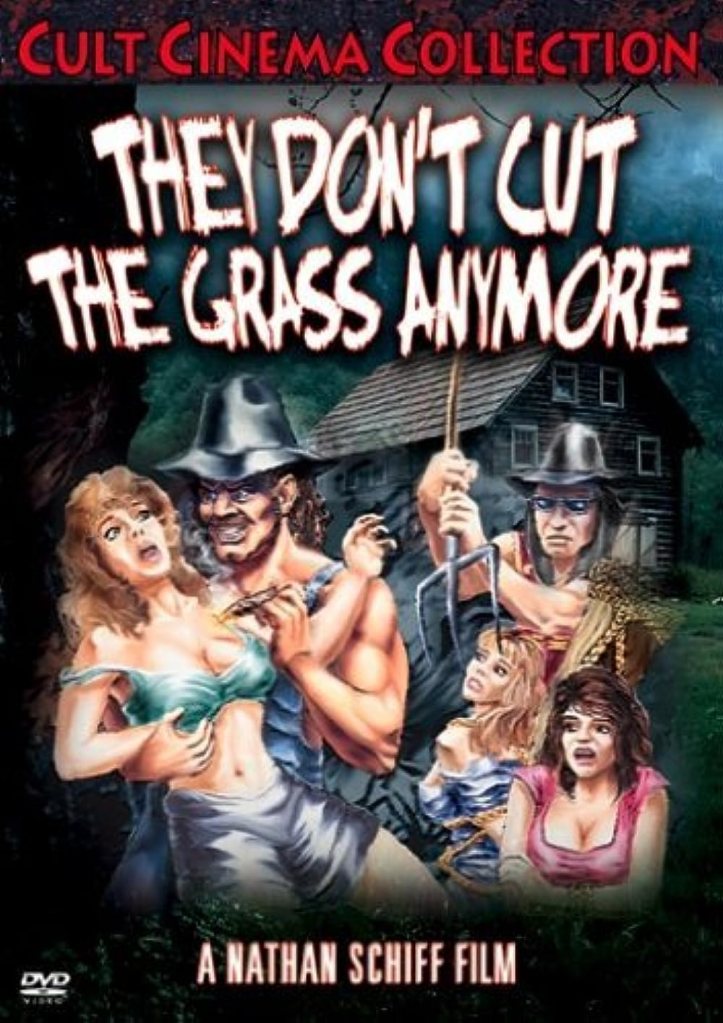
They Don’t Cut the Grass Anymore (1985)

Directed by Nathan Schiff [Other horror films: Weasels Rip My Flesh (1979), The Long Island Cannibal Massacre (1980)]

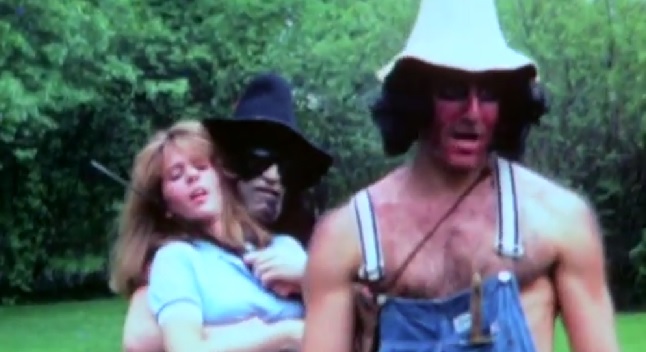
Among the most repulsive films I’ve witnessed, They Don’t Cut the Grass Anymore is somewhat of a classic, in my eyes. The gore effects here, while often looking exceptionally fake, are absolutely gruesome, and if you want an extreme movie, this is one you have to see.

The plot here is pretty much non-existent. Two southern gardeners in a well-to-do northern community kill and mutilate people. And that’s it. It’s 70 minutes of these two gardeners killing and mutilating people, occasionally taking time off to go to the movies to watch other people kill and mutilate. It’s a good time.

Nathan Schiff is a director I’ve long respected for this movie alone. I’ve not seen his other films (most well-known ones including The Long Island Cannibal Massacre and Weasels Rip My Flesh), but I saw They Don’t Cut the Grass Anymore a long time ago, and while I never loved it, it stuck with me, because the gore effects are simply as tasteless as one could imagine.

I won’t spend much time talking about the gore – you have to see the movie for yourself. I can tell you that if you want to see people’s legs and arms cut off with chainsaws and handsaws, then They Don’t Cut the Grass Anymore is your movie. If you want to see intestines pulled out of peoples’ stomachs and vaginas and then beat to an unrecognizable pulp, They Don’t Cut the Grass Anymore is your movie. And if you want to see faces ripped and torn up, all the way to the bone, with the jaws ripped off and the tongues ripped out, their eyes squeezed from their sockets (and they always made a point of squishing them in their hands), then I need only repeat myself once more:

They Don’t Cut the Grass Anymore is your movie.

The dialogue is often quite flat and stale, but it’s also some of the most hilarious stuff I’ve ever heard. From the weak and utterly without emotion “Please don’t rape me,” to the way these two women get out of captivity – wait, no, I need to explain this scene in detail.

See, two women have been captured by the maniac gardeners, but luckily, one of the women is a psychiatrist. She knows how to deal with the mentally disturbed (“You are in great need of psychiatric help”), and will use those skills to get out of the situation. So when one of the men comes in, she asks him to grab her mirror and look at himself. Once he does, and he looks into the mirror, she says, her tone helpful, “Look, look how fucking ugly you are. You’re a disgrace.”

I lol’d. A lot.

Or when two cops are discussing a murder – they’re standing over a body (we don’t see the body – we don’t see an inkling of a body – but it’s apparently there), and one of the cops is quite negative when considering the killers, thinking that the boxcars happened 40 years too soon (referring to the Holocaust). The other cop says they still need to solve the crime, and the cop replies “Fuck that, I’m going home to listen to my Billie Holiday tape.”

I lol’d. A lot. It’s funnier because these cops literally never show up again. They were in this single scene that had zero relevance, and that’s it.

Another point here – we get some musical numbers. One is a song that is played on the radio that these two women are listening to. The song, sung by a woman, is about how stupid she [the singer] is, and the catchy chorus goes “That’s why he calls me Dumb Dumb Yummy Yummy Dumb Dumb.” I couldn’t make that up if I tried.

Also, toward the end of the film, the killers are laying back and relaxing, one of them strumming a guitar, the other playing a harmonica. And they sing for us, and here’s the whole song:

“We came up here from Texas / But it didn’t work out for us / We met a lot of fine people / But they ain’t around no more / We were professional gardeners / But it got to be a bore / So seek some new adventure / Cause we don’t cut the grass no more.”

Genius.

Oh, and I forgot one of my favorite lines in the movie. While a woman is attempting to defend herself, and beating on one of the gardeners (played by John Smihula, who does beautifully), the gardener says “Keep this up, bitch. There’s going to be a lot of irate neighbors complaining about their uncut lawns.”

I lol’d.

This movie is a mess, and it’s not a good movie, but it can be quite an amusing movie if you’re into low-budget, ultra-gory films. They Don’t Cut the Grass Anymore is something special, and while I can’t honestly give it a high rating, I can say that it’s a treat in many ways.

6/10