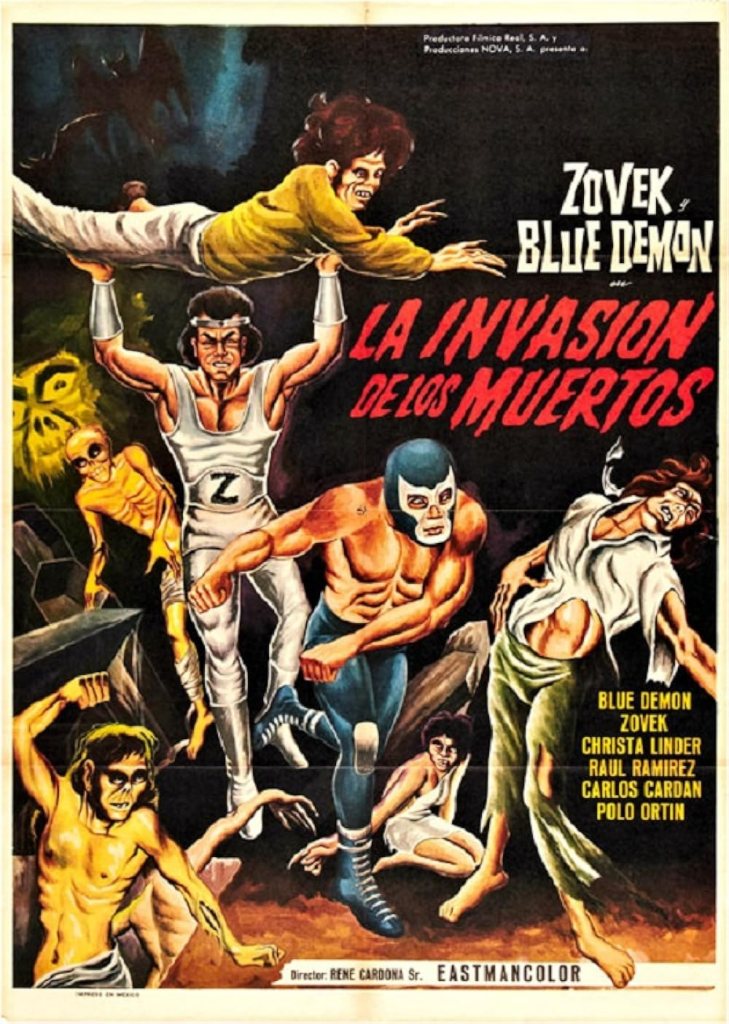
Blue Demon y Zovek en La invasión de los muertos (1973)

Directed by René Cardona [Other horror films: El espectro de la novia (1943), La mujer sin cabeza (1944), The Living Idol (1957), La Llorona (1960), Las luchadoras contra el médico asesino (1963), Las luchadoras contra la momia (1964), Santo vs el estrangulador (1965), Espectro del estrangulador (1966), Las mujeres panteras (1967), La mujer murcielago (1968), Las luchadoras vs el robot asesino (1969), La horripilante bestia humana (1969), Santo en El tesoro de Drácula (1969), Santo contra los jinetes del terror (1970), Santo en la venganza de la momia (1971), Capulina contra los vampiros (1971), El increíble profesor Zovek (1972)]

Known in the USA as The Invasion of the Dead, Blue Demon y Zovek en La invasión de los muertos is a movie that is utterly unlike most things I’ve watched. That alone doesn’t make it bad, but even so, this isn’t that good.

Now, I’ve seen it once before, but like two other Mexican horror films in the same vein I’ve seen (Santo contra la magia negra and Santo el enmascarado de plata y Blue Demon contra los monstruos), I saw this without subtitles, which, as you can guess, makes it rather hard to tell what’s really going on. This time around, I understood more. Well, sort of – whatever the Hell Zovek was rambling on about most of the time, I didn’t quite get – but otherwise, I certainly got more clarity.

If you don’t know either Blue Demon or Zovek, I couldn’t say I blame you. This is a luchador film – a film that stars Mexican wrestlers of the Lucha Libre variety. Blue Demon, or Alejandro Moreno, wears a mask throughout, and Zovek has a headband he rarely removes. As far as I can tell, at least from this film, Zovek is both a mentalist and an escape artist, along with being talented in hand-to-hand combat, while Blue Demon is a historian/scientist who runs some information agency, and also knows hand-to-hand combat.

Oh, it’s also worth mentioning that, as the film is known here as The Invasion of the Dead, this is a zombie movie. Sorry – when a film has random things like wrestlers going on, some of the more important pieces get pushed to the side of my mind.

The basic idea of the film is that an object is sent from alien beings to Earth, and this object (a sphere) brings the dead back to life. Apparently Professor Zovek (his full title) believes this to be due to an old calendar that predicts calamities. Oh, he also, toward the end, was attempting to contact the master who trained him telepathically, but his master couldn’t be reached, which would have been a good sequel hook, had Zovek not died in 1972 (at 31 years old) from a helicopter crash.

Actually, it’s on that note that I should also mention that, unlike what you might expect from the title, Zovek and Blue Demon get virtually no on-screen time together. This is perhaps because of Zovek’s untimely death, and Blue Demon being pulled in to finish up the movie. To be fair, the movie doesn’t feel too disjointed due to that unfortunate incident, but it does go a long way to explain that Blue Demon doesn’t have any action sequences until the final 15 minutes of the movie.

When it comes to the zombies, well, I had to admit I wasn’t impressed. For the most part, the only way one could tell they were zombies was due to either their blank stare or rigid way of walking. No make-up went to making any of them look particularly zombie-esque. Hell, even Sugar Hill threw cobwebs on their faces, but no luck here. Related, there’s about zero special effects, unless you want to count the occasional fire. That’s not that surprising, given this was a Mexican film, but even so, a zombie movie without any blood always struck me as sad.

As far as the performances go, it’s really hard to judge. I suspect that, for the most part, Blue Devil (or, again, Alejandro Moreno) and Professor Zovek just played themselves. Zovek got much more screen-time than did Blue Devil, which I’d say was a good thing, as Blue Devil had a subordinate who was used exclusively for ‘comedic effect’ (played by Polo Ortín), and he got old pretty quick. Speaking of pretty, Christa Linder (Night of 1000 Cats, The Incredible Invasion, and The Drifter in the Rain) didn’t have a lot to do, but she did wear some tight jeans and a tight shirt, so I had little to complain about.

Horror-wise, it’s rather hard to recommend the film. Sure, some of the sequences in the second half were fun, such as Zovek fighting off a zombie attack in a cave (twice, if not three times, he picks up a zombies and throws them back to the group), or Blue Demon fighting two random werewolf-type guys (don’t ask me where they came from – I honestly have no idea, they just popped up one scene), but those scenes struck me as more fun than horror. There was a cool scene of zombies slowly walking through a graveyard, but otherwise, this movie never felt all that spooky at all, which, while not necessarily surprising, was disappointing.

As it was, I was happy to see The Invasion of the Dead again, especially as I had subtitles this time around. I imagine some of you know how tedious it can be to watch a film in a different language with no subtitles, but if you don’t, I can personally attest to it rarely being a fun time. In this case, even with subtitles, the movie was hella slow, and I didn’t have that much fun with it, save a scene here or there.

If you’re interested in seeing Mexican horror films, or early post-Night of the Living Dead zombie films, this might be worth checking out, but otherwise, I wouldn’t really urge people to do so.

4.5/10

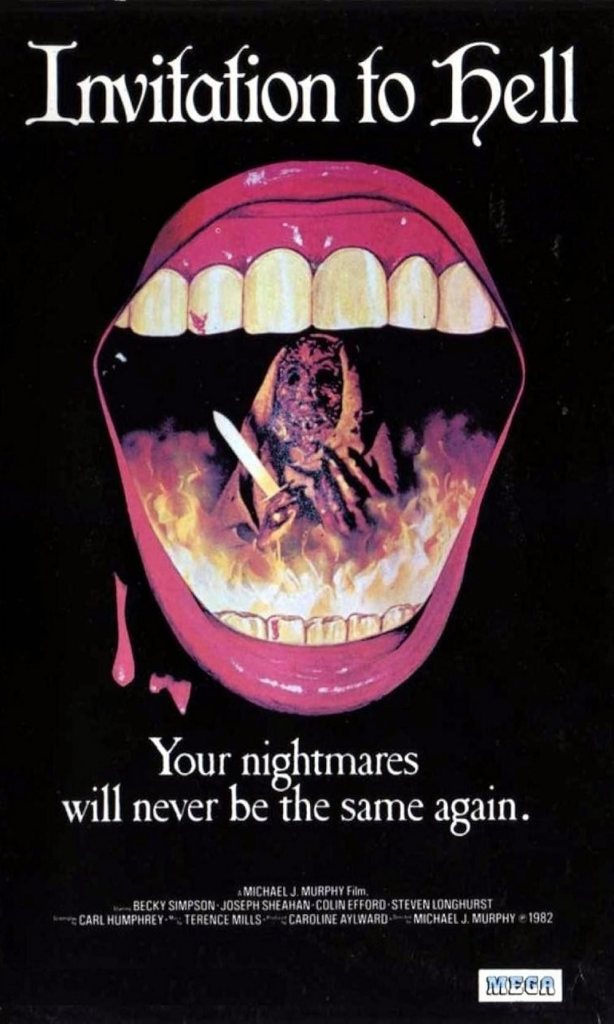
Invitation to Hell (1982)

Directed by Michael J. Murphy [Other horror films: The Last Night (1983), The Hereafter (1983), Bloodstream (1985), Death Run (1987), Moonchild (1989), The Rite of Spring (1995), Skare (2007), Zk3 (2013), Nekros (2015)]

Not to be confused with the Wes Craven film of the same name, Invitation to Hell is a short film coming to us from the United Kingdom, and a low-budget short film at that.

In fact, this is perhaps one of the roughest movies I’ve seen since Blood Cult, and if you’ve seen Blood Cult, then you know the comparison is a damning one. Now, to be sure, given this is a short film (about 41 minutes), it’s not quite as much suffering, but from the questionable audio quality to the blurry and difficult-to-decipher scenes, Invitation to Hell has it’s own issues.

There’s actually a short sequence in which a woman is being chased by someone at night. My television screen, when the screen gets too dark, sort of turns off – not completely, but if it registers what it perceives as darkness on screen, it goes black. This scene had such bad lighting that my TV screen was constantly flashing between ‘active’ and ‘black’. It only happened that once, and I found it more amusing than anything, but it’s a good testament to the type of quality that I’m talking about.

Plot-wise, well, there were some problems. The basic idea is that Jacky (Becky Simpson) is invited to the country home of a school friend, Laura (Catherine Rolands); the problem is, Jacky is a virgin. Now, I don’t know how Laura and company knew, but they do, and so they want to give Jacky to the Devil for a bride. Well, ‘want’ is a strong word, but they opened the wrong book, and the Devil has power to sort of possess those on the lands, so they don’t see as they have a choice.

It’s not really that shabby an idea. I mean, don’t get me wrong, I don’t think it’s good, if for no other reason I have zero theological beliefs, and stories about how scary the Devil is never did much for me. The problem is that the execution is rather shabby, the performances ultimately feckless, and overall, there’s not a ton going on to save this.

If I can give Invitation to Hell some credit, it did have a pretty solid kill toward the ending, in which a character got stabbed through the neck and both hands, effectively being crucified. It wasn’t overly gory or anything, but it did look pretty decent, and I dug it. There was also an earlier scene in which someone was stabbed through the neck. Of course, that woman being chased that I referenced earlier was killed too, but I couldn’t see how – she was either strangled or hit over the head, but it was too dark to tell.

Ah, well, you can’t win them all.

Of all the performances, I think the best comes from Colin Efford (who was also in another short horror film by the same director of this one, titled The Last Night). Efford played a mute farmhand who was often possessed by the Devil in order to do his dirty deeds. He was far from exceptional, but I thought his stoic and, more importantly, dialogue-free, performance suited him. I mean, compared to the others, even the lead Becky Simpson, he was a superstar. Most performances were just so dull and flat, making what should be dramatic moments somewhat laughable.

I don’t hold that against any of the actors or actresses, though – this was clearly a low budget film, and I highly doubt anyone involved were what we’d traditionally call professionals. I certainly don’t fault them for their performances, and the bigger problem is the somewhat awful presentation, or perhaps more importantly, the quality of the existing print.

Oh, and that ending, while not surprising in any way, was sort of awful. It doesn’t ruin the experience, as the experience was already shaky, but I thought it was worth mentioning.

Invitation to Hell isn’t without some charm to the right groups of horror fans. I can say for a certainty that it’s better than plenty of other films, be it Death by Invitation or Fist of the Vampire. The fact it’s only 41 minutes does help, and there’s also a sprinkle of potential throughout the film. It’s still far from good, though, and only if you’re a die-hard fan of horror would I truly recommend you take the time to watch this one.

4/10

Hansel & Gretel Get Baked (2013)

Directed by Duane Journey [Other horror films: N/A]

While largely an inoffensive movie (which may itself be an accomplishment, based on the title), Hansel & Gretel Get Baked certainly had potential. The wacky idea of a stoner movie mixed with a horror-themed Hansel and Gretel sounds a lot of fun, and is in fact why I went out of my way to watch this one. As it is, the movie isn’t terrible, but I do think they somewhat squandered some of the potential.

Partially, I’d say this has to do with a couple of unnecessary characters. By a couple, I mean the characters played by Cary Elwes, Reynaldo Gallegos, Lochlyn Munro, Yancy Butler, Eddy Martin, Joe Ordaz, Celestino Cornielle, and David Tillman, along with arguably Bianca Saad. To be sure, most of these individuals didn’t have a lot of on-screen activity, but more to the point, few of them made much of a difference, especially the two police officers (played by Munro and Butler), who appeared twice just to set up a comedic scene, it seems.

As it is, the comedy in the film wasn’t actually overbearing, which was a nice surprise. There are a few elements I found a bit much, such as some pot-controlled zombies, but it’s worth mentioning that they barely appear, and if you close your eyes for half a minute, there’s a good chance you won’t know they’re in the movie (which is how I prefer it). Otherwise, while there’s definitely some comedic elements (including a few rather amusing lines from Lara Flynn Boyle’s character), it’s luckily toned down.

I do have to say something about one of the lines, though: early in the film, girlfriend (Molly C. Quinn) and boyfriend (Andrew James Allen) are talking about some weed the guy got from a sweet, old grandmother in Pasadena. Both of them are quite high, so Quinn’s character begins singing the song “The Little Old Lady from Pasadena.” The guy looks blankly at her, and she says, “You know, the Beach Boys.”

I definitely appreciate that she gets into the classic surf rock that I too grew up on. I do love The Beach Boys. However, and I imagine this is either an in-joke to the common misconception, or perhaps just a joke about how stoned they are, but “The Little Old Lady from Pasadena” isn’t originally sung by The Beach Boys, it’s a song by Jan & Dean (who also did such hits as “Dead Man’s Curve” and “Surf City”). To be fair, The Beach Boys did cover the song live, but even so, I wanted to spend two paragraphs talking about Jan & Dean, who I find deeply underrated.

Back to the movie, though, another lost piece of the puzzle would be Hansel and Gretel. Naturally, they’re brother and sister, played by Michael Welch and Molly C. Quinn, respectively. I think they work pretty well in a brother-sister combo role, but unfortunately, they don’t really do that much together. Most of the film follows Gretel as she deals with her missing boyfriend, and Hansel really doesn’t do that much until the finale, and even then, what he does is quite limited. I just think it’s a shame, as the two of them felt like real siblings, and I would have definitely preferred the two of them working together as opposed to Gretel getting help from another stoner’s girlfriend (Bianca Saad’s character).

Even so, I really enjoyed Molly C. Quinn’s performance. She isn’t an actress I know that well (though I have seen her in We’re the Millers, and she starred in Agnes), but she held her own, and I thought she worked well with both Michael Welch (A Haunting in Cawdor, Before Someone Gets Hurt, Blood Craft, All the Boys Love Mandy Lane, The Final Wish, and most importantly, the TV series Joan of Arcadia) and Andrew James Allen (Blood Is Blood, Smiley). Welch had a good performance too; I just wish he did more.

Otherwise, it’s hard to really say anyone else stood out. Certainly Lara Flynn Boyle (The House Next Door) had some funny lines, but I was overall underwhelmed with the story behind her character. Lochlyn Munro (Freddy vs. Jason, The Blackburn Asylum, The Unspoken) was nice to see, but ultimately pointless, as was Cary Elwes (Saw), who only appeared during the opening, and was close to unrecognizable. Bianca Saad was okay, but she really only got perhaps ten minutes of notable screen-time, and that doesn’t really do much to impress me.

When it popped up, the gorier aspects of Hansel & Gretel Get Baked weren’t bad. There was an individual early on who was tied down, has one of his eyes eaten, and a portion of his chest skinned. I can’t say the special effects were great, but I did feel a deal of sympathy for him. Another thing I liked, as ridiculous as it sounds, was a bomb shelter that was used as a growing room – rows and rows (this was a big-ass bomb shelter) of weed certainly made it a place worth investigating.

At this juncture, I should mention that perhaps one of the best ways to consume this movie is shortly after consuming some grade-A bud. Unfortunately, I don’t have any weed on me at the moment, and went in sober. Even so, it’s not a bad film; it’s not good, of course, but at least we avoided awful.

More than anything, I think it was inoffensive and ultimately underwhelming. I don’t think most people would have a bad time with Hansel & Gretel Get Baked, but I’d be somewhat surprised if over half of viewers actively enjoyed it. It’s below average, but it might still be worth a watch if you’re in the right state of mind.

6/10

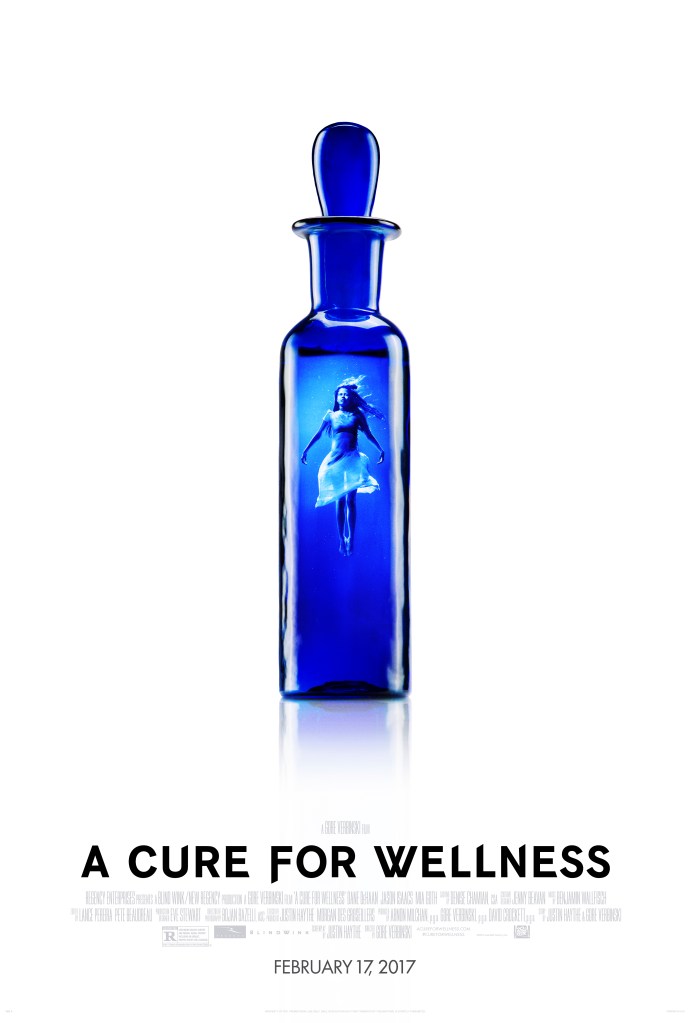
A Cure for Wellness (2016)

Directed by Gore Verbinski [Other horror films: The Ring (2002)]

When I first saw A Cure for Wellness, I was quite impressed. I didn’t entirely understand everything that was going on, but the very fact the film is about two hours and 30 minutes yet it kept me engaged throughout was definitely a positive.

I was definitely interested in revisiting it, especially since I don’t really hear that many people speaking about this one at all. Part of that, I would suspect, is due to the film not doing well in theaters, understandably so, given the length and somewhat ambitious nature of the movie.

Even so, I found it just as engrossing this time around as I did the first time I saw it. Personally, while the narrative structure is occasionally mystifying (such as the death of the central character’s mother), I found most of the story quite enjoyable. It’s true that you could easily guess some of the twists – if you’ve seen any classic Hammer horror, it’s not too far removed – but the journey to the finale, while perhaps long-winded, was still worth seeing.

The cinematography is absolutely stellar, and a large reason I’d recommend this. A Cure for Wellness is a beautiful movie – even during some of the more horrific scenes (such as someone being tied down, a tube shoved down their throat, and eels swimming down into their body), there’s a beauty. Much of the medical facility/spa looks sparse, and even scenes with a large body of people (such as the dance toward the end) possess a certain charm to them too.

Horror-wise, you have both the oppressive feeling of being in a situation you can’t get out of, along with a more traditional element of gore. Being caught in a seemingly idyllic spa with no way to communicate to the outside world is indeed horrifying, especially when mixed with the idea that something is very wrong at the spa; not only are hallucinations plaguing the main character, but their teeth are falling out. Oh, and there seems to be a moose/deer loose in the steam rooms.

On the gorier side, there’s a stillborn calf cut out of cow – not only do a bunch of eels come out of the cow’s stomach alongside the calf, but there seems to be tiny eels moving under the stillborn calf’s skin. There’s a lot of eels in general – from a quality scene with a water tank to an unfortunate location for a young (????) woman to menstruate – you better enjoy your eely friends, as they’re everywhere. Oh, and someone gets one of their teeth drilled into, in what has to be one of the most painful scenes I’ve seen in some time.

I personally love how the story of the baron and baroness is slowly uncovered, piece by piece. It has a predictable conclusion, to be sure, and there’s really nothing that surprising during the finale, but I still think most things came together okay. I especially enjoyed the dance the staff was having, though it didn’t end that well for some of them.

I don’t really know Dane DeHaan (who also starred in Life After Beth), but despite how atrocious his character is to start with, I can’t help but sympathize with him from early on. The fact he looks like a clone of Leonardo DiCaprio helps. Jason Isaacs (of Harry Potter fame, along with roles in Event Horizon and The Patriot) is about as fun as always. Mia Goth (Marrowbone, X) didn’t have a ton of agency until the finale, but she was still quite good in her role.

For the right type of horror fan, I think that A Cure for Wellness can be a rewarding experience. Admittedly, for a movie that’s about two and a half hours long, anything less than rewarding might justifiably be criticized to Hell and back, but even so, I think there’s a lot to like here, from occasionally creepy scenes and brutal sequences of drills and teeth, to stellar cinematography and a familiar, yet interesting enough plot.

A Cure for Wellness won’t be for everyone. Personally, I think the film has a lot going for it. I find so much of it an enjoyable, if not necessarily fun, ride. It’s atmosphere is quality, and the steam rooms look comfortable. It’s not a film for everyone, but I enjoy it.

8/10

Vivarium (2019)

Directed by Lorcan Finnegan [Other horror films: Without Name (2016)]

From the striking poster to the intriguing trailer, Vivarium is a movie that held my interest from the first time I heard of it. I didn’t seek it out, though – like a bird of prey, or a sleek panther, I waited. I watched. I wanted to hear what others thought of it before I jumped in. I was going to watch it anyway, but I like to have a barometer on odd occasions.

And I didn’t really hear that much about this one. A few comments on Twitter, perhaps, but either negative or positive, I didn’t run across all that many. Now, that could in part be due to the fact I don’t delve deeply into the Twitter horror community, but I think something also has to be said about how Vivarium, despite the unique premise, doesn’t end up feeling that memorable.

To be sure, there are a few scenes and ideas I’ll remember, but for a film that’s about an hour and forty minutes, there’s a bit of dearth when it comes to meat in the story. The basic idea is cool, and it’s what first got me interested in the movie – a young couple go to see a house, and get stuck in a suburban maze of houses with no way out.

It’s a fine idea. It’s a more philosophical approach to horror, and the story primarily comes from the cyclical natures of parenthood. The movie isn’t much grounded in reality, of course – there’s seemingly no way out of this suburban neighborhood, boxes are mysteriously left for the couple with no idea of who dropped them off, and sidewalks can be lifted up, but that’s philosophy for you: it has something to say, and little practical ways to apply it.

There’s a large portion of the movie which deals with the couple, who, after being given a mysterious baby in a box, have to raise the child. It’s not a normal child – it shrieks inhumanly whenever it wants something, it mimics the couple’s voices with eerie accuracy, and it has an abnormal physiology. Personally, I’m assuming it’s an alien, but because this movie goes hand-in-hand with Kafka, don’t expect any answers, because you’re not getting them.

Some of the horror, or more appropriately, tension, is pretty well done. Early on, Jonathan Aris’ character mimics Imogen Poots while showing the couple the house, and generally acts like an over-enthusiastic, creepy individual. The sprawling neighborhood, impossible to escape from and the houses all exactly the same, does bring a strong sense of oppression with it. Related, the clouds that never seem to move, and in fact, never vary in shape, are rather disturbing too. Oh, and toward the end, while I’m lukewarm to the finale as a whole, there was a pretty creepy scene in which a character seemed to lift up the sidewalk and go inside another realm.

Imogen Poots (Green Room, Fright Night, Black Christmas) does pretty well. There’s certainly a good sense of despair, though as we’re given a few time-skips, I don’t think we see it occur naturally in real time. Jesse Eisenberg (who I know best from The Social Network, but has also been in Zombieland and Cursed) does decently too, though there comes a point where his character sort of fades into the background. Though Jonathan Aris (who played Anderson on Sherlock) only really appears toward the beginning of the film, his creepy mannerisms do add quite a bit.

Like I said, I felt lukewarm toward the finale. It’s not that I necessarily wanted all the answers (such as the nature of the neighborhood, the realities under the pavement, whether these things were alien or not, etc), but at the same time, I think a few would have been nice. Cube is a fun film, but I’d still like more than just the set-up, and the same goes for Vivarium, which has such a striking plot, but aside from being a clear metaphor for parenthood, I’m not sure how many of the elements make sense.

More to the point, while some scenes were well worth seeing, I don’t think that Vivarium is going to end up that memorable a movie. It was okay, and I definitely didn’t think it was a bad film, but memorable? I doubt it. Interesting idea, but I wish the execution went better.

6/10

Leprechaun (1992)

Directed by Mark Jones [Other horror films: Rumpelstiltskin (1995), Triloquist (2008), Scorned (2013)]

Leprechaun is a film that I’ve seen before and enjoyed, but it’s been a long time. I mean, ten years+ long, if not longer, so I was worried that when I revisited this one, some of the charm would be lost.

Well, it’s a mixed bag, but generally, I still hold the same positive views that I had when seeing this movie those many years back.

Naturally, I think the biggest problem is that some of the humor is a bit too goofy for my liking, such as that skateboard sequence, or perhaps that scooter chase. Hell, even popping out of those cabinets felt a bit too Scooby-Doo to me. However, unlike later movies in the franchise, the humor is somewhat restrained, and while I wouldn’t exactly call the movie dark or overly serious in tone at any point, Leprechaun isn’t entirely without merit for the traditional horror fan.

It’s in the characters, I think, that this movie really shines. Certainly Jennifer Aniston’s Tory is bratty and unlikable for a solid third of the film, but Mark Holton’s Ozzie has a lot of heart, and his interactions with Robert Hy Gorman’s Alex were low-key my favorite portions of the film, as I felt they could be somewhat touching at times (especially concerning Ozzie’s mental disabilities, which I felt were handled decently in the film).

What’s somewhat impressive, at least to me, is that most of the central cast was pretty solid. Sure, the story may not have been a work of the Gods, but the performances were all varying degrees of good, which, for a movie that feels like a Full Moon feature half the time, is a stunning feat.

Aniston is an individual that some people might know from Friends, but as I’ve never seen an episode of Friends, my knowledge of her comes from films such as Along Came Polly, We’re the Millers, and Derailed (none of the three, sadly, will be reviewed on this blog). Like I said, she’s bratty at the beginning, but has some quality lines (“I know what it feels like when a man caresses my leg,” followed by John Sanderford’s reply, “You do?”), and she does improve as the movie goes on.

Speaking of Sanderford (The Alchemist), he doesn’t appear much past the first twenty minutes, but he’s of good value. Robert Hy Gorman (Sometimes They Come Back), as I said, had some touching moments with Mark Holton’s character. Somewhat amusingly, I saw Holton rather recently when I revisited a crime-drama film from 2003, Gacy, which stars Holton as the infamous serial killer. Also from films such as Hoboken Hollow and Madhouse, I found Holton’s performance great here. Ken Olandt (April Fool’s Day) probably stands out the least, but he still has his moments.

Warwick Davis brings a palpable energy into his role as the titular Leprechaun. It really seems as though he’s having a blast. Like I said, some of his actions are a bit goofy, but I definitely don’t fault Davis, and I love what he brought to the film. Plus, his rhymes are dope (though they get doper), and I love a man with that much dedication toward getting back his gold.

Now, Leprechaun isn’t exactly a gory film. There are a few moments, such as the pogo stick scene, that give us a little something, but that’s not the point of the movie. What I think Leprechaun does quite well are the other special effects, and toward the end, I couldn’t help but think of Gremlins and the gooey goodness both that classic and this provided.

As much as I appreciate a lot of this, though, it still occasionally felt too goofy for me. That doesn’t make the film a bad one, as I did enjoy revisiting this quite a bit, but then I think of how they distracted the Leprechaun by throwing shoes toward him (his compulsive desire to shine any and all shoes well-established by that point), or I think back to that (mercifully short) skateboard sequence, and I have to sort of reign in my praise.

Leprechaun is a solid movie. I personally find it fun, the cast fantastic, and the story amusing enough. It does go overboard, though, which I think is my only real issue. On a related note, if you want to say that I don’t know how to have fun, that’s certainly alright. When it comes down to it, I think the movie is a high average. It may be above average, in fact, but for the time being, I feel an average rating fair.

7/10

The Pumpkin Karver (2006)

Directed by Robert Mann [Other horror films: R BnB (2023)]

I’ve known about The Pumpkin Karver for a long time, and in fact, way back in 2009, I made a list of about 150 or so horror films I wanted to see. That list has grown to 529 at the time of this writing, but the point of this is that from the beginning, The Pumpkin Karver was on that list.

I don’t really know why. If I had to guess, I heard it was a Halloween-themed slasher, and that was all it took to create interest for me. I doubt I heard much more about it, and really, aside from seeing a consistently low rating on IMDb (right now, on March 29th, 2022, it holds a 3.3/10 with 1,546 votes), I’ve not heard much about it since.

Honestly, though, after seeing it, I can see why.

This movie is rather poor. Sure, the budget is low, but the bigger issue is that the script is rather horrible, and the story doesn’t really make a lot of sense, at least not to me. That ending was absolute shit, also, which didn’t help. Even worse than the poor plot, though, is the fact it’s often boring. The film follows a group of teens as they party, and it’s not until half-way through the film that things really pick up, and I use ‘pick up’ loosely.

A few of the kills are okay, and by a few, I mean two. There’s a decapitation, which was simple, but always effective, and far more memorable was someone who was forced into a drillbit, which impaled the individual and revealed their organs for the world to see. It was really the only gore in the film, and it didn’t actually look that bad, so minor kudos for that.

And speaking of kudos, while most of the cast is rather unspectacular, I sort of dug Michael Zara as the lead. He had that quiet, brooding vibe you’d expect from John Shepherd’s Tommy from A New Beginning. It wasn’t great, but it was tolerable. Minka Kelly (who later played Dawn Granger, or Dove, in Titans) was pretty cute here, and one of the few characters who actually seemed okay.

Amy Weber (Dangerous Seductress) starts off pretty horribly, at least as far as her character goes, but doesn’t turn out half-bad come the end. Playing two utterly intoxicated fellas, David Phillips and Alex Weed were incredibly annoying most of the time, but they did provide some amusement in an otherwise dragging film. Oh, and Terrence Evans was overly silly, and while some of his dialogue was amusing, it didn’t do much to endear me to him.

Overall, The Pumpkin Karver is pretty awful, it’s biggest sin being that it’s dull. It’s a lower-budget slasher, so if you’re into that type of thing, it might be worth checking out if you can catch it free, but I really don’t think it’s worth it, and it didn’t do much for me at all, if truth be told. In the right mind-set, though, I suppose it could be fun.

4/10

Twice-Told Tales (1963)

Directed by Sidney Salkow [Other horror films: The Last Man on Earth (1964)]

I’ve long heard of this film, and remember the title primarily due to the quality alliteration, and as it turns out, Twice-Told Tales is a pretty good film. I mean, it’s an anthology that stars Vincent Prince in all of it’s stories, so perhaps that shouldn’t come as a great surprise, but even so, I was rather entertained by the film.

Twice-Told Tales comprises of three stories, each one based on works of Nathaniel Hawthorne, being ‘Dr. Heidegger’s Experiment’, ‘Rappaccini’s Daughter’, and ‘The House of the Seven Gables.’ I regret to say that I’ve not read any of the source material – in fact, I have very limited exposure to Hawthorne’s writings, and the only writings from him I can swear to have read would be the short story “Young Goodman Brown.”

Despite my lack of experience with Hawthorne’s work, I can say that each of the three stories here are pretty solid. All have a rather classic horror feel, the second segment, ‘Rappaccini’s Daughter,’ perhaps being the most experimental and daring. Given the film is about two hours, each segment lasts forty minutes, which I do think causes minor dragging at times – certainly this isn’t the fast-paced horror that modern-day audiences might be used to. Even so, I found it rather worth it.

I think that, while all three stories are decent, the strongest is the last segment, being ‘The House of the Seven Gables.’ Amusingly, it’s not an easy choice, though, as ‘Dr. Heidegger’s Experiment’ is a very strong segment, and has some of my favorite performances and characters in the whole of Twice-Told Tales. That said, while ‘The House of the Seven Gables’ (which is definitely a title I recognize from cultural osmosis, but before watching this, I couldn’t tell you what it was pertaining, as my hombre Serge from Beverly Hills Cop says) is a bit slow at the beginning, come the finale of the story, things pick up beautifully, and it’s a wildly fun time reminiscent of House of Usher.

When it comes to ‘Rappaccini’s Daughter’, I’m torn. I didn’t dislike it, but it certainly felt like the weakest of the three segments, though of course I appreciated the horrors of botany being displayed some years prior to The Revenge of Doctor X/Body of the Prey/Venus Fly Trap. I think the main issue I have is that, while the finale of the story was decent, there weren’t really any ompf moments, which the other segments definitely had. I do think, because of this, that it was well-placed as the middle story, as it allows the film to both begin and end on higher notes.

Naturally, Vincent Price is the glowing star here – in all three stories, he does wonderfully, and I think he especially shines in both the first and final story. Price has long been a favorite actor of mine – from classics such as House on Haunted Hill and Pit and the Pendulum to films such as Theatre of Blood and The Oblong Box, he rarely does poorly, and this film showcases his great talent. My second-favorite performance here would be Sebastian Cabot (Journey to Midnight), as I found his performance in the first story rather poignant, and I thought he worked fantastically with Price.

Others who warrant a mention include Jacqueline deWit, Joyce Taylor (13 Frightened Girls, Beauty and the Beast), Abraham Sofaer, Richard Denning (Creature with the Atom Brain, Target Earth, Day the World Ended, The Black Scorpion, Creature from the Black Lagoon), and Brett Halsey (Demonia, Return of the Fly). Admittedly, Halsey takes a little while to really make a positive impression on me, as portions of his performance seemed weak, but the others listed were fun from beginning to end.

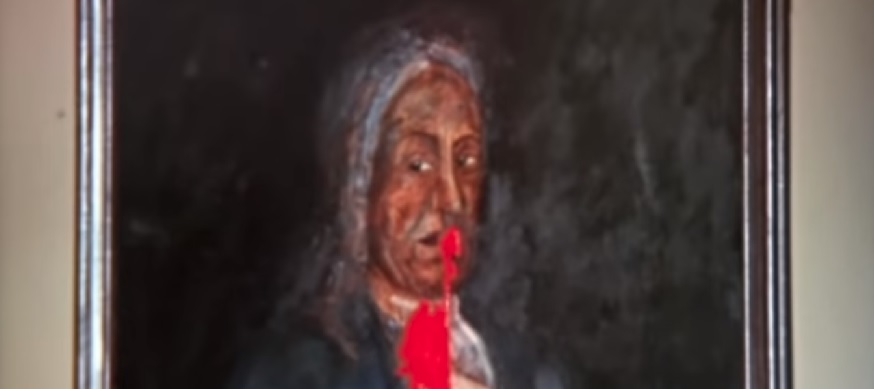
There were a few portions of the film that really stood out – naturally, given how much I enjoyed the first segment, a lot of that finale kept me really happy. Even more, though, would be the finale of ‘The House of the Seven Gables’, which, as I said earlier, was just wild. There was a house that was seeping blood from the ceiling and walls, blood coming from a portrait, all made more effective due to the fact this film is in color (which isn’t always a given when it comes to 60’s horror). Oh, there’s also a floating skeleton arm that attacks someone in the final story, which was of great value also.

All-in-all, while it’s possible that Twice-Told Tales runs a bit long, it’s an overall solid film, and if you’re a fan of either classic horror or Vincent Price, then it’s definitely worth keeping an eye out for. I don’t know if it’ll impress others as much as it impressed me – and to be sure, I wouldn’t exactly call the movie amazing – but I do think many would get a kick out of it.

7.5/10

The Maze (2010)

Directed by Stephen Shimek [Other horror films: Nocturne (2016)]

I don’t know if The Maze is an easy movie to look at. Certainly I found most of the first 50 minutes rather unspectacular and quite generic, but the film also changes gears in the final 35 minutes or so, and while not executed amazingly well, I deeply appreciate what they were going for.

In fact, it’s because of the finale that I remember this movie as much as I do. I saw it many years back (since the movie came out 2010, I’d wager to say I saw it no later than 2013, and it’s March 2022 as I write this), and really, the only thing I remembered about it, aside from the fact much of it took place in a corn maze, is the finale, which I thought was stellar. Well, the execution isn’t stellar, but seeing it again, damn it, I still liked it.

The first 55 minutes, though, is, as I said, rather generic, following a group of five friends being stalked and killed while playing tag in a corn maze. There’s not much here that’s really interesting – even the killer, who perpetually wears a red hoodie, is utterly unspectacular – and it can feel pretty dull, even once the tepid killings begin.

Luckily, the latter portion of the film follows the only survivor as they’re taken in by the local police and has an opportunity to relay what happened to their friends. Naturally, the killer isn’t happy that one of his would-be victims got away, so attempts to remedy this by going after them, even if they’re in police custody. It might not sound like much, but it’s also here that we discover more about the killer, and I entirely dug it.

There’s not much in the way of memorable performances. I sort of liked Seven Castle’s (what an interesting name that is, on a side-note; sounds like an amusement park – oh, and she was in 2015’s Delirium) character, though, like many of her friends, we never learned a whole lot about her. Related, Clare Niederpruem (Zombie Hunter, Nocturne, and Thirst) was sort of fun – at least, I liked her Velma scene – but she doesn’t make a huge impression. Luke Drake (who sort of rocks a Cillian Murphy vibe) shines at times, though, which is something.

None of the kills, even toward the finale, are all that interesting, and like I said, the killer, or more particularly, the design of the killer, is rather unremarkable. I don’t know if the flawed finale makes up for any of these shortcomings, but I can say that I personally rather enjoyed what the movie tried to do. It may not have succeeded – at this time, The Maze sports a 3.8/10 on IMDb with 1,068 votes – but I definitely appreciated what they were going for.

It’s because of that that I can’t really say I disliked the film. I don’t think it’s particularly good, and I can’t say that the movie overcomes it’s flaws altogether, but I can see myself both recommending it and personally watching it again in the future due to the almost clever direction the movie takes.

I’d never go as far as to say The Maze is required watching, though, even for a fan of slasher movies, but I think I probably see the film as around average, which is definitely more than what most people apparently take away from the movie.

7/10

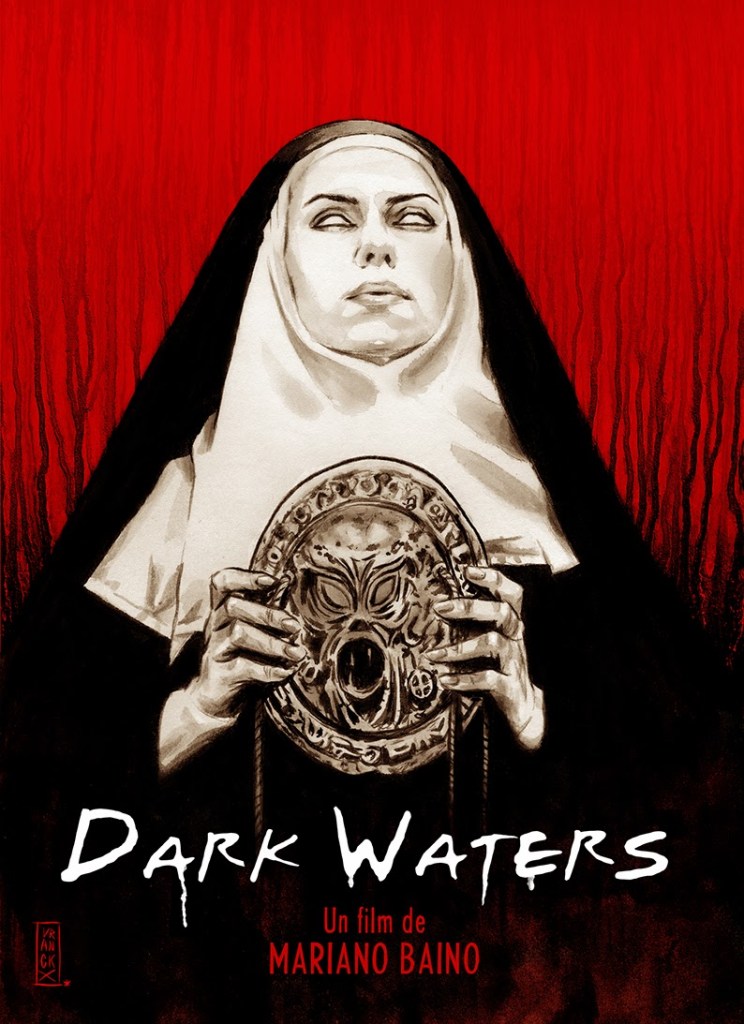
Dark Waters (1993)

Directed by Mariano Baino [Other horror films: The Trinity of Darkness (2014)]

I went into Dark Waters not knowing much at all, and while I was initially impressed, and am generally still impressed, I do wish the final product had been a bit more sensible. Certainly Dark Waters is a film that has some strong elements, but I can’t say I overall enjoyed it.

The basic story is on point – a woman goes to an island run by a religious covenant in order to speak to a friend and in the meanwhile, figure out her mysterious connection to the island. It actually reminded me of Apostle (had Apostle been made 25 years earlier) and a 1988 movie called Catacombs. Unfortunately, I didn’t enjoy Dark Waters as much as either of these films, but the potential was there.

It should be said, though, that the movie isn’t without some impressive elements, mostly being, to me, the atmosphere and occasionally quality cinematography (which I think can mostly be seen during the opening of the film, but pops up throughout). The atmosphere is due to the creepy setting (it’s not stated in the movie, but the island appears to be off the coast of Russia, as this was filmed primarily in Ukraine and Russia) and the never-ending sense of death, as these nuns don’t appear to want our main character (played by Louise Salter) to enjoy her stay.

Speaking of Salter, I can’t say that I adored her performance, but she did okay. I think the biggest issue here is that, given the story leaves out some background information (I don’t need everything tied up in a bright bow, but I do like some explanation here and there), her character isn’t easy to latch onto. It’s even harder for Venera Simmons’ character, who I suspected from the beginning of being something more. The acting is fine, but the story, while not disjointed, exactly, doesn’t always lend much focus to the performances.

Certainly the term ‘surreal’ could be used to describe some of this film, which isn’t a word I’m particularly keen on using in this case (make no mistake – this film makes 150% more sense than Eraserhead ever did), but does fit at times. I think the basics are sort of revealed, but I would have liked something more, especially given the somewhat weak and almost anticlimactic finale, which I don’t think did the previously built up tension any justice.

There was a few solid scenes, such as the death of a woman caught snooping where apparently she wasn’t supposed to, and she got #StabbedInTheBack like ten times, which was a very solid kill. Otherwise, though, there aren’t really that many kills worth noting – someone got thrown out a window, but that was more accidental than anything. As for the special effects, well, they mostly become prominent toward the finale, and since I didn’t particularly dig the finale that much, I can’t say it made too much of an impression on me.

Dark Waters isn’t a movie that I hated, but I was disappointed, especially after the eight-minute opening (all done with about no dialogue), which impressed the hell out of me. The rest of the movie didn’t really have that much to offer aside from the skeleton outline of an okay story, but I just wasn’t that enamored with where the story went, and because of that, I do feel the movie ends up below average.

5.5/10