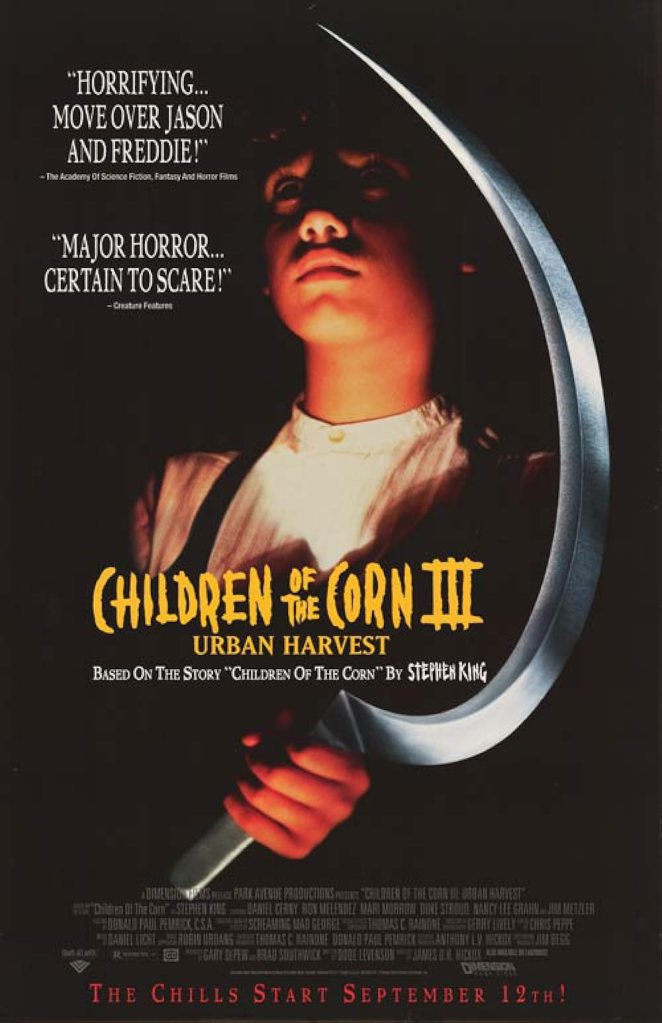
Children of the Corn III: Urban Harvest (1995)

Directed by James D.R. Hickox [Other horror films: The Gardener (1998), Krocodylus (2000), Sabretooth (2002), Detention (2010)]

I think that Urban Harvest is among one of the more enjoyable sequels in the Children of the Corn series. It’s not a great movie, and it does have some problems, but entertaining? As some folks say, you betcha.

Let’s get some of the issues out of the way first.

The finale was awful. Toward the end, a giant creature rises from a make-shift cornfield, and while it does lead to a few solid scenes, the overall execution is pretty atrocious.

Related to the finale, Ron Melendez’s character went to Gatlin and then back to Chicago, where the majority of the film takes place. To me, it seems clear this is happening the same night, as it’s the night of the Harvest Moon. However, it was night when Melendez was in Gatlin, Nebraska, and when he gets back to Chicago (at least a 7 hour drive), it’s still dark.

That’s what I’d call a problem.

Also, I have to admit to some dissatisfaction when it comes to the He-Who-Walks-Behind-the-Rows cult that Eli forms, and this is a problem I had dating back to the first movie, so allow me to take it a step at a time.

The idea of children, with religious upbringings and living in an isolated, rural community decided to band together under a charismatic leader preaching a harder line of their faith makes sense to me. I find it a legitimately creepy idea, and I love plenty of scenes from the original Children of the Corn.

Where the problem comes in is how the 1984 movie ended – by showing some type of actual entity that seemed to represent He-Who-Walks-Behind-the-Rows. This movie does sort of the same thing, with the random monster at the end. I truly believe these movies would be creepier if they dropped the supernatural elements and went purely with the idea of religious mania in kids causing them to kill adults.

Related, Eli (who takes the place of Isaac/Malachai/Micah) sort of brainwashes much of his religious private school (which really felt more like a public school, on a side-note) to create a cult in Chicago. I would have preferred he used his charisma – and he does have charisma, as the scene in which he’s given a sermon shows – and urged the young onto his side naturally. It would have felt more sincere, I think, then just dosing them and creating a cult of young followers all at once.

And also related, Eli says a few things that seem, at least to me, to imply he’s the Devil, or at the very least a demon, or something along those lines (this is most prevalent when he’s speaking with Michael Ensign’s Catholic father character). Maybe I took Eli’s comments the wrong way, but those who worship He-Who-Walks-Behind-the-Rows would theoretically have a religious system that’s more Biblical, fire-and-brimstone stuff. It’s not anti-Christianity, it’s just a more harsh interpretation of the exact same Bible.

My point is, if I’m understanding Eli’s comments correctly, and he’s the Devil or a demon, that goes entirely against what makes the basic idea of Stephen King’s short story so good. These children who follow Isaac/Malachai weren’t following some Pagan belief system, they were Biblical Christians, twisting things around a bit to create a more rural flavor. Making Eli some sort of supernatural figure (which this movie sadly does, as it shows newspaper clippings of Eli in Gatlin in the 1960’s, before the events of the 1984 movie transpire) just damages the whole idea.

Obviously, those are a lot of critiques, and if someone thinks they’re a bit nit-picky, I’d personally have to disagree. Even with the very real problems in the movie, though, Urban Harvest does generally tend to be entertaining, and like I said, among one of the better sequels in the series.

It’s somewhat of a wild ride, which is where I think a lot of the entertainment can come from. Two kids from Gatlin (Ron Melendez and Daniel Cerny) experience major culture shock when they’re adopted by a couple in Chicago, and it leads to a lot of fun scenes, including a sort of corny one in which Melendez’s character is kicking ass in a basketball game despite appearing an Amish guy.

There are somewhat surprising deaths of characters, some wild dream sequences (two of which actually show scenes from the previous movies, such as the opening diner massacre of the 1984 film and the death of the doctor, getting stabbed by a ton of syringes, as shown in the second movie), a few gory deaths; certainly there’s stuff here that should be able to keep you engaged with the story.

Not all of the special effects look great, though. Sometimes they do get it right – there’s a decapitation by cornstalk and another individual cut in half by a window that look solid – but then there’s someone who sort of swallows fire from a lighter that looks pretty iffy, and the finale, what with the giant monster and Eli throwing fireballs of faith at Joshua, had quite a few effects that didn’t seem altogether special.

Daniel Cerny (Demonic Toys) is no John Franklin or Courtney Gains, but he definitely has a solid aura to him, and the scene in which he’s giving a moving sermon over the objections of the priest was some quality stuff. Ron Melendez (Voodoo) does well as a teen who’s lived a hard life and is trying to adjust to a new one. I wish that Mari Morrow and Jon Clair, who played sister and brother, had been a bit more involved at times, but they had their moments.

Nancy Lee Grahn isn’t the focus you might at first think, but she’s a decent character. Jim Metzler (976-EVIL, Sundown: The Vampire in Retreat), on the flip-side, never really grows, and while his performance was okay, there didn’t seem a lot to his character. Michael Ensign (Doctor Hackenstein) is decently fun, and Yvette Freeman almost has a CCH Pounder-feel to her, which I can dig.

Plenty of the kills are entertaining also. Like I said, there’s a few duds here that don’t hit right, but the film opens with someone being attacked by cornstalks and effectively turned into a scarecrow (complete with sewing the lips and eyes shut), which was decently gruesome. Likewise, while that decapitation by the cornstalks wasn’t amazing, it was decently gory, and a fun kill to watch.

All-in-all, Urban Harvest is a flawed movie that tends to be rather entertaining. I think it could have been better had they changed a few things around, but even with the final product as it is, it can be a fun movie to watch, and though I’ve seen it around three times now, it’s a movie I can still see myself enjoying in the future also.

7.5/10

Freddy’s Dead: The Final Nightmare (1991)

Directed by Rachel Talalay [Other horror films: Ghost in the Machine (1993), The Dorm (2014)]

After the drab, disappointing fifth movie, Freddy’s Dead is honestly a breath of fresh air. It’s never been a movie I loved, but I was always entertained by it. Seeing it again, I have to confess, though, that perhaps I’m closer to loving it than I previously thought.

Here’s a warning, first off – there’s a lot I want to talk about, and I don’t have much of a cohesive plan in which to tackle the various different points I want to bring up and expound on, so if at any time I seem to be rambling, I’ll say this in advance: sorry, brahs.

I critiqued the hell out of The Dream Child for being confusing, and since I don’t want to be labeled a hypocrite, I’ll concur with anyone who says this one is confusing too. However, in this case, it didn’t bother me at all.

Well, I shouldn’t say at all – one of the characters, John (Shon Greenblatt), is apparently the last kid who lives in Springwood. Apparently Freddy killed the rest of the kids, causing a deep economic depression and mass psychosis of those who still live there. I fail to see how a kid could have gone unnoticed, though – where did he live? Did he have parents? It just seems odd that a kid could live in Springwood and somehow not attract the attention of the crazy townspeople.

Related, we can see that Springwood isn’t that far from the unnamed city John winds up. Much like Children of the Corn, I cannot believe that a town could survive in the state they’re in and not make national news, nor be smothered by social service workers. It makes more sense in Children of the Corn, actually, because it was a small town in the middle of nowhere, but we can clearly see that Springwood is pretty close to what seemed to be at least a moderately-sized city.

So yes, some of the logic bothers me. The first one, I can’t find a way around, but for the second point – well, technically, this film takes place in an alternate future (the opening says ‘10 years from now,’ which, to me, means 2001), and it’s possible that they was some type of collapse of a national government. Certainly the scenes in the city make it seem seedy, and the shelter for troubled youth seemed painfully underfunded. I guess my point is that, in times of economic despair, it’s not out of the question that the suffering of a small town might go largely unnoticed to a population living close by.

In a way, though, this makes the movie more fun. The fact it takes place in 2001 doesn’t really matter aside from explaining how there are zero children or teens left in Springwood, but it does make the story more interesting, in my view.

Look at Springwood, for instance – I absolutely loved the little we saw of the town. Adults holding a fair with no potential of joy, a teacher (Matthew Faison) reciting senseless lectures about Freddy to an invisible class, a woman at an orphanage who is so out of it, she thinks she sees children playing and having fun. The execution isn’t perfect – I don’t know why Roseanne Barr had to make an appearance – but the concept is pretty cool, and that chalk drawing of Freddy is the icing on the cake.

I also think the cast here is pretty strong. Lisa Zane (The Nurse, Toughguy, Natural Selection) was pretty solid in her role. I can’t exactly describe why, but I found her a lot of fun. Naturally, Yaphet Kotto (Alien, Warning Sign) is fun to see, and his character is solid. I’ve always been a fan of Breckin Meyer (from comedies such as Rat Race and Blue State to horror films such as Stag Night), so seeing him here young was fun.

Lezlie Deane’s (976-EVIL, Girlfriend from Hell) character was pretty good too, and perhaps the most traumatic of the characters here. She’d be top-tier if it weren’t for Zane and Kotto, actually. Ricky Dean Logan and Shon Greenblatt were the weakest here, but still fun at times. Lastly, though he’s as corny as expected, Robert Englund appears to be having fun here.

Speaking of fun, I think one of the reasons this movie sort of works is the fact it is actually entertaining. It doesn’t always hit – the video game/power glove sequence was pretty damn painful, and that Wizard of Oz reference hurt me in ways a man’s not meant to be hurt – but generally speaking, there’s some good times here. In fact, a couple of quotes come to mind: ‘The map says we’re fucked!’ (which is a line I use in my daily life – well, whenever I see a map, anyway) and ‘Damn it! I hate this house’ (a simple quote, sure, but hilarious in context).

Actually, there’s another quote, this one said by Freddy, and one I’ve loved since I was a kid, being ‘Every town has an Elm Street.’ Sure, much of this movie is goofy, but I’d put that line up against ‘You are all my children now,’ as one of Freddy’s best quotes.

And it’s on that note that I need to discuss something I probably should have discussed before. I’ve seen Freddy’s Dead probably twice before, but I never saw it as a kid. I did, however, once have my mom rent out Critters 3 on VHS – I don’t know why, as up to that point, I’d never seen the two previous Critters.

The point is, while we rented it, I watched the movie perhaps three times (and to this day, I have a very soft spot for Critters 3). The movie came out 1991, same year as this one, and before the film started, the VHS tape had a trailer for this movie – a trailer that I watched quite a lot – and it became ingrained in memory. My main point being, while I never saw this movie when I was young, I did see bits and pieces from the trailer, so I do feel a bit of nostalgia when watching this.

Another thing that I absolutely adore about this movie happens toward the finale – Lisa Zane’s character finds out something disturbing about her childhood, and goes to confront her mother, by banging on her door and shouting ‘MOTHER!’. I have to imagine that was intentional, as it’s exactly like how Nancy shouted for her mother in the first movie after seeing the bars on her windows.

But that’s not all – it’s around this same time that we hear the original theme music, as Lezlie Deane falls asleep. And to add to the nostalgic feel of the 1984 classic, while Freddy’s speaking with Yaphet Kotto’s character, he’s casually cutting off his fingers, just as he did in the first movie. It’s like these three things were thrown in as a way to celebrate the (supposed) end of the franchise, and I loved it.

Speaking of a celebration of the franchise, I loved how the film ended with a montage of clips from all six movies – some of the best, creepiest scenes are shown, and it’s a nice look back on the series that so many enjoyed, even during it’s worst moments. And ending with a ‘Freddy RIP’ was fun also.

Oh, another thing I rather liked was how they delved into Freddy’s past, showing his messed up childhood and abuse at the hands of his father. Anyone growing up in an environment like that would find it hard to become a functioning adult, so it’s hard to entirely blame Freddy for where his life took him. Admittedly, the Dream Demons looked rather shitty, but that’s 90’s 3D action for you.

Speaking of the abuse that Freddy faced, by the way, this was a pretty dark movie in terms of characters. As it dealt with troubled youth, you had a kid who has hearing issues due to an abusive mother, you have a teen girl who was sexually abused by her father, and you have a stoner who can’t live up to his father’s image of him. Combine that with the childhood trauma of Lisa Zane’s, and, despite this film being goofy at times, it can get pretty dark.

I don’t doubt that, in many ways, Freddy’s Dead is a mess. I find it thoroughly enjoyable, though, in ways that The Dream Child, and in fact, The Dream Master, couldn’t match. It worked for me, and that’s all that matters.

7.5/10

Deadly Friend (1986)

Directed by Wes Craven [Other horror films: The Last House on the Left (1972), The Hills Have Eyes (1977), Stranger in Our House (1978), Deadly Blessing (1981), Swamp Thing (1982), Invitation to Hell (1984), The Hills Have Eyes Part II (1984), A Nightmare on Elm Street (1984), Chiller (1985), The Serpent and the Rainbow (1988), Shocker (1989), The People Under the Stairs (1991), New Nightmare (1994), Vampire in Brooklyn (1995), Scream (1996), Scream 2 (1997), Scream 3 (2000), Cursed (2005), My Soul to Take (2010), Scream 4 (2011)]

Deadly Friend is a Wes Craven movie I’ve not really heard much about, and after seeing it, I can’t say I’m surprised. It’s not an awful film, though – I just think it’s largely mediocre and will end up a pretty forgettable affair.

Based on a 1985 novel by Diana Henstell titled Friend, the story here deals with an intelligent young man who uses his knowledge in much the same way Frankenstein did back in 1931. Of course, it takes something like forty minutes to get to that point, and I can honestly say I wasn’t sure where the movie was going based off the first third, so there’s that.

Even so, I think I enjoyed the first third more than the rest of the movie – once a character dies and is essentially resurrected, I have to admit that I lost a lot of interest. Part of this is I was sort of hoping the antagonist force would have been the robot BB (in a horror version of Short Circuit), which I thought could have been decent, but the Frankenstein-esque route they took didn’t really do much for me at all.

It’s also worth mentioning that, based on a little reading, that the final product isn’t one that Craven is happy with – he wanted more a supernatural love story, whereas the studio wanted blood, as to match Craven’s previous work (such a A Nightmare on Elm Street), which naturally messed up Craven’s hopes for the film.

That said, I can’t say that I’d have enjoyed a more PG version much more than this one, and in fact, the scene in which a basketball is launched at someone’s head, and said head explodes, is the stand-out scene in the movie to me, especially in the latter portions, when I didn’t care for much that was going on.

To delve into this a little, the main character (Matthew Labyorteaux) brings back to life a friend and potential love interest. He’s depressed, and tries to fix her, and so he does what he can, re-animating her. However, he didn’t seem to have a plan past that point – unless he moves off on his own with his corpse bride locked away in the basement, there was zero chance that others, such as his mother, wouldn’t find out about it. It’s that lack of forward-thinking, especially from what we see as a very intelligent character, that bothered me quite a bit.

Grief hits people differently, to be sure. But if you’re going to bring back someone from the dead, try to have an actual plan to follow if it actually works. Just Jiggy’s advice.

Otherwise, Matthew Labyorteaux (Little House on the Prairie) made for a fine lead. I didn’t care where his story went, but he had a solid performance. Kristy Swanson’s (Swamp Shark, Mimesis Nosferatu, Killer Under the Bed) performance was captivating, at least while she actually had character. Others, such as Michael Sharrett, Russ Marin, and Anne Twomey, failed to make much of an impact.

Really, I think the biggest issue here is that, as decent as I found the beginning (save the annoying robot in the form of BB), I just don’t care where the story goes. There are some okay scenes (such as that basketball one), but it’s just not a movie I found overly enjoyable, nor do I think it’ll really stand out much in my memory.

5.5/10

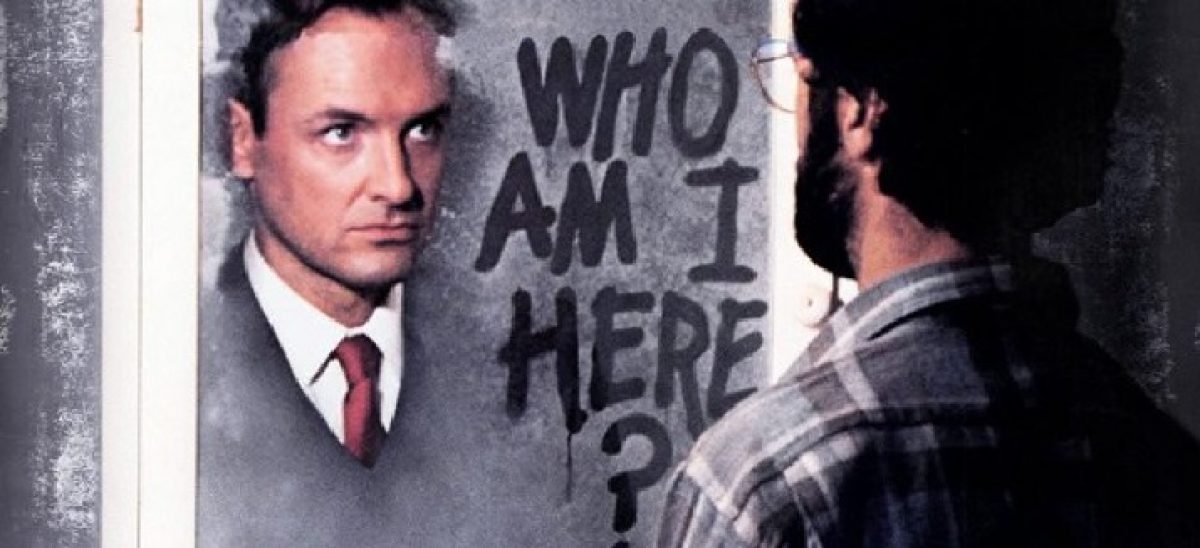
Scanners (1981)

Directed by David Cronenberg [Other horror films: Shivers (1975), Rabid (1977), The Brood (1979), Videodrome (1983), The Dead Zone (1983), The Fly (1986), Dead Ringers (1988), Naked Lunch (1991), eXistenZ (1999), Crimes of the Future (2022), The Shrouds (2024)]

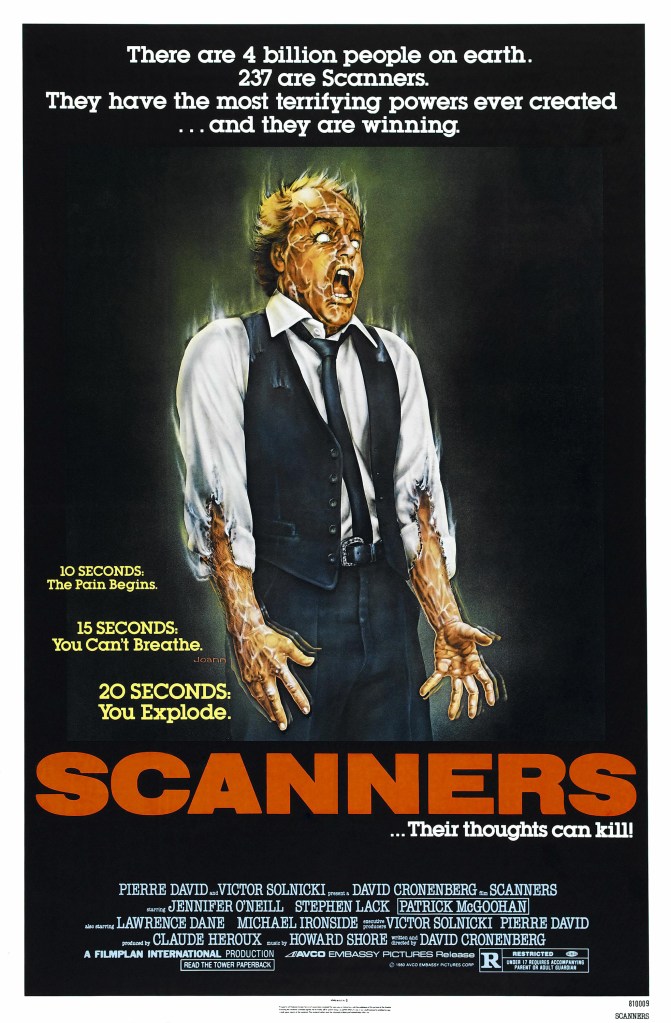
David Cronenberg has always been a director I’ve had a bit of a mixed record with. While it’s true I enjoyed films such as Shivers and Rabid, others, such as The Brood and Videodrome, are ones I found it difficult to dig into. Scanners is a classic I’ve never had the urge to see, partially due to that mixed record, but after having seen it, I do think it’s one of his better films.

By no means, though, do I find it fantastic – it’s a pretty solid story with a wide scope (not dissimilar to Videodrome, albeit infinitely more sensible), quality action sequences, an interesting idea, and, of course, very solid special effects.

I knew the basics of the story going in, and I have to admit to being pleased that I could actually follow everything along. Some of Cronenberg’s films can veer toward the complex, such as Videodrome and The Brood, and while this one does deal with large topics, pretty much everything makes sense, which is a relief (as it was a worry of mine, and one of the reasons I put off watching this for so long).

Admittedly, the horror aspects here are couched heavily in science fiction, which probably isn’t a surprise, but it is worth mentioning. Many of the more action-packed sequences feel like, well, an action movie, or perhaps a thriller, as opposed to horror, and in fact, I think it’s by the quality special effects alone that allow this entry into the genre.

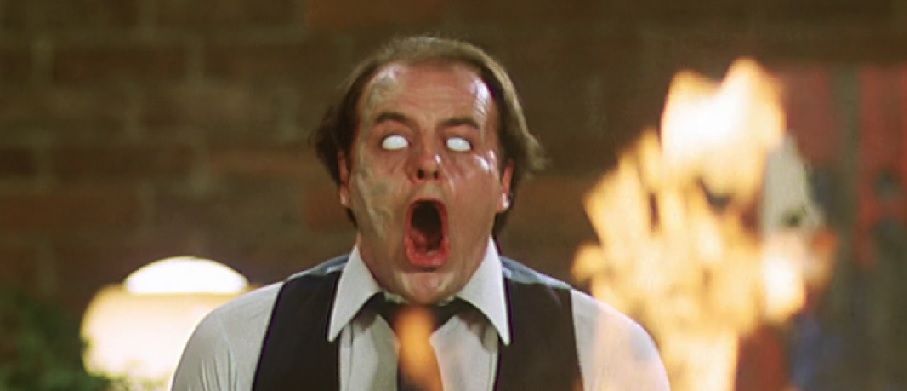
Everyone, and I mean everyone, knows about the scene in which someone’s head explodes. Even before I was born, I knew about the scene, and I think it’s fair to say that even if people don’t realize what movie it’s from, or recognize the name ‘Cronenberg,’ they know the scene too. And it’s a good scene, but what’s great about Scanners is that it’s not even the most gruesome scene – the telepathic duel, of sorts, during the finale was some grisly stuff, and led to a final moment that I rather liked, so there’s some good stuff here.

To be fair, much of the other action tended to be more generic and tame, even scenes that you might expect a bit more from (such as the shotgun massacre). Again, it feels like it’s an action movie at times, which is fine, because it works with the story, but disappointing even so. However, I did really enjoy the computer sequence, in which Stephen Lack’s character scans ConSec’s computers – that was some enjoyable, explosive action.

Somewhat amusingly, I don’t think Stephen Lack is the stand-out here. His performance was decent, but by the nature of his character, he sort of lacked many expressive capabilities. Patrick McGoohan, on the other hand, played a pretty complex character, and while it wasn’t easy to get a read on him, I loved his performance.

As for the other performances worth mentioning, Michael Ironside (Hello Mary Lou: Prom Night II, Visiting Hours, The Next Karate Kid) was solid, though not as in-focus as you might think, Jennifer O’Neill (The Psychic, The Reincarnation of Peter Proud) seemed almost pointless, but otherwise did fine, and Lawrence Dane (Of Unknown Origin, Rituals, The Clown Murders, Happy Birthday to Me) made for a solid character with an exciting end.

I’m surprised that I enjoyed Scanners as much as I did, but it’s certainly a pleasant surprise. It’s not exactly the type of movie I’d generally go out of my way to see, but it was pretty enjoyable at the time, and from the action to the special effects, it’s definitely a movie worth seeing for a nice mix of genres.

7.5/10

Rattlers (1976)

Directed by John McCauley [Other horror films: Deadly Intruder (1985)]

Certainly a movie with potential, Rattlers was an okay entry into the mid-1970’s. The finale is pretty sudden, and the overall story seems sort of lackluster, but I didn’t exactly have a terrible time watching it.

I do think it’s fair to say that, compared to other animals-gone-mad films from the 1970’s, that Rattlers is on the lower end. Sure, it’s better than The Food of the Gods and possibly more entertaining than Grizzly (though not a better film overall), but there are plenty of more enjoyable films, such as The Swarm, Phase IV, Squirm, Piranha, The Pack, Nightwing, Jaws 2, Stanley, Kingdom of the Spiders, Orca, Prophecy, Tentacles, hell, even Night of the Lepus.

My point is that though I don’t think Rattlers is awful, it’s certainly not a stand-out movie. The finale seems to pop up so suddenly, and I personally found it widely unsatisfactory, which isn’t helped any by the lack of good snake action in the last half hour.

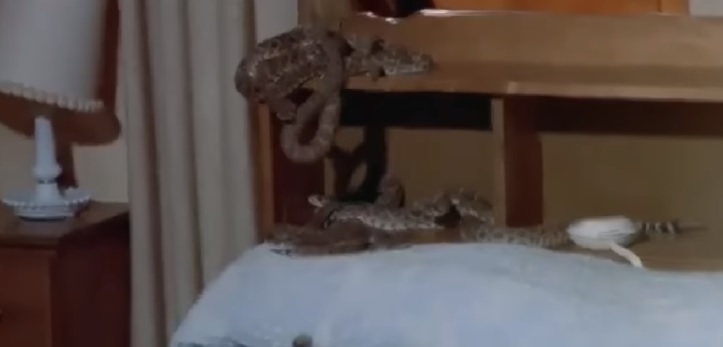
In fact, many of the later snake attacks seem so weak. One of them happened in a mine, which might sound good, but it wasn’t executed very well. Another had two characters in a tent surrounded by snakes, but that didn’t even feel that action-packed either. I think there were some good snake attacks – a plumber getting bit while under a house, and a woman attacked in a bathtub as snakes slither through the pipes – but you can’t really tell that from the final half hour.

One thing I was mildly amused by was the small point of Elisabeth Chauvet’s being a woman photographer, which upset the patriarchy, in the form of lead Sam Chew Jr.. Chauvet’s character made good points about how there weren’t women holding high positions, and Chew Jr.’s character just waved the explanations off. This point is muddled by the fact that, of course, the two of them fall in love and engage in carnal activities and have an out-of-place date that lasts a minute in Las Vegas, but hey, it’s the 70’s, who needs equality, right?

There’s also a portion which deals with the mystery behind why the snakes here are so aggressive, which, of course, is all the fault of the Commies. See, Communists had a better political system than capitalists did, and the USA (capitalism’s #1 defender) lied about the Gulf of Tonkin to get young American boys killed in Vietnam. Naturally, biowarfare is the only way to defeat a better economic system, and so due to the Communists, the American military created deadly snakes.

Damn those Commies.

Actually, it’s somewhat amusing, because this same idea was also used in Piranha, which came out a couple of years later. In both, the military is so intent on killing innocent people in Vietnam that they wind up killing innocent people in the USA, but then again, that’s how the military do.

As a socialist, it’s always nice to see solid political messages come up (which is one of the reasons that Prophecy, from ‘79, is a personal favorite). It doesn’t play a huge part here, though it does lead into what truly is a weak finale.

Sam Chew Jr. (Time Walker) makes for an okay lead. Honestly, he never really came across as having that much in the way of character, but he had a good look to him. Elisabeth Chauvet was okay, but she never really added that much to the story, and was pretty forgotten by the end. Lastly, Dan Priest was, I guess, okay. I mean, he seemed pretty ridiculous toward the end, but I’m guessing his character had an off-screen mental breakdown, so it’s all cool.

The more I consider Rattlers, the weaker I think it is. For the first hour or so, it honestly wasn’t a bad time, but the last twenty minutes really dropped the ball. It’s definitely a below-average film, and though I maintain it’s still not terrible, I can’t blame others who tend to think it is.

5.5/10

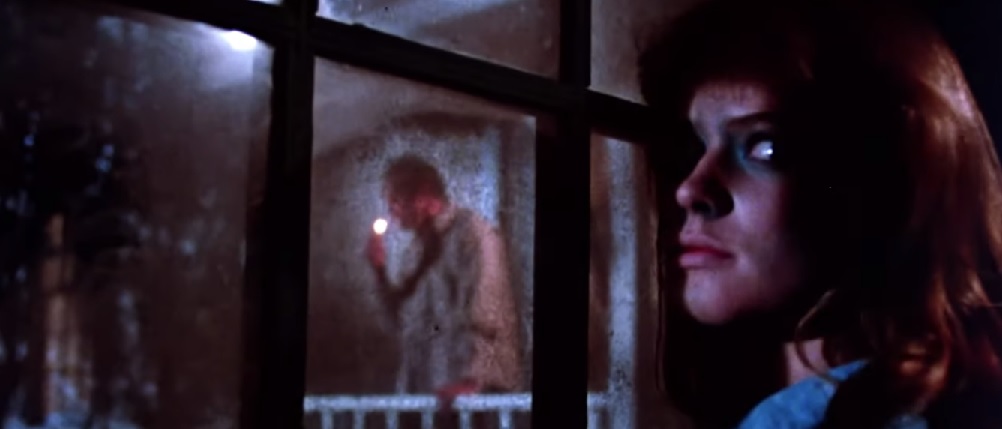
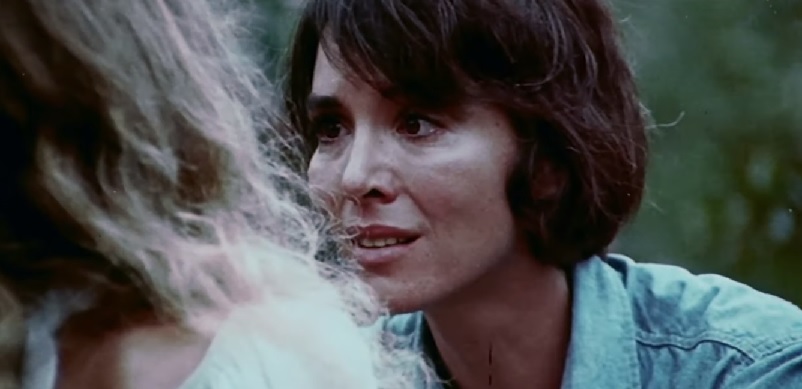
Let’s Scare Jessica to Death (1971)

Directed by John D. Hancock [Other horror films: N/A]

Though I’ve seen this cult classic before, it’s been quite some time, and truth be told, I didn’t recollect too much of it before going in. Let’s Scare Jessica to Death isn’t an easy movie to describe, and I’m not even sure if it’s fair to say I enjoy it, but I do think it’s a special little movie that may well be worth seeing.

In many ways, this movie really feels like a product of it’s time. It reminds me a bit of both Warlock Moon and Welcome to Arrow Beach, in that it just possesses the sensibilities of the early 1970’s. Now, true, I wasn’t born until 1993, so it’s quite possible I know little about the sensibilities of the early 70’s, but even so, this movie has it.

Honestly, though, this isn’t an easy film for me to write about. The story sort of feels free-form in some ways – the finale doesn’t explain much of what’s been going on – but in this case, I don’t think that’s a bad thing. In fact, I think it adds to the dreamy atmosphere of this one, and at times, I’m reminded a bit of Phantasm.

With that said, though, it’s more than that. This movie feels comforting, calming, relaxing. There are tense moments and uneasy scenes toward the finale, no doubt, but the overall aura of this one is almost soothing. Part of it has to do with the 70’s atmosphere of the film, some of it has to do with the way they approached the story, and some of it has to do with the soft, peaceful music that plays throughout; whatever combination of parts that makes this work, though, I just know it does, and I’ve rarely described a horror film as ‘peaceful,’ but I certainly am now.

And on that note, I’d argue it’s more the atmosphere and feeling of Let’s Scare Jessica to Death that causes it to stand out, as opposed to the story. The story is decently haunting at times (a few moments bring to mind Ghost Story), but it’s also true that it almost feels aimless, and it’s certainly slow. It doesn’t harm the film any, because it just adds to what ends up a rather soothing, captivating movie, but it is slow, and I sort of doubt those who are really into modern horror would fully understand the charm of this one.

In fact, I don’t fully understand the charm of this one. I just know I was engaged throughout the movie, and it had little to do with the performances, which I found somewhat average, or the story, which is never fully expanded on, or the first-person narration style the film’s presented in.

Zohra Lampert’s performance was okay. To be honest, it felt a bit shaky at times, but I think that has more to do with the fact I didn’t really get these characters rather than Lampert’s performance itself. Oh, and the fact her character was recently released from a psychiatric hospital may too play a part. Honestly, none of the other performances, be it Mariclare Costello, Barton Heyman, or Kevin O’Connor, did a lot for me, but again, I think it’s more the characters than anything else.

Another aspect that shouldn’t go overlooked is how Lampert’s character was dealing with some undefined mental illness, a fact that she thought about quite a lot during her narration. It’s possible that much of what we see and experience in the film isn’t actually what’s going on, and certainly her reaction at times does lend some potential credence to that idea, but it’s an ambiguous film, so if you’re expecting a clear-cut answer, you may want to look elsewhere.

This may be easy to tell, but this movie just sort of hits different. It’s vibe is something that I’ve rarely seen, and though I can’t say that I necessarily enjoyed the movie, I can say that it’s calming, soothing atmosphere was quite a balm in these trying days. Oh, and we got a little bit of blood toward the end, which was nice too.

Let’s Scare Jessica to Death isn’t an easy movie for me to write about, which may well be evidenced in my ramblings above. Like I said, I’ve seen it before, but it’s been a long while, so much of it felt new, and I definitely didn’t remember how unique the film felt. It’s not a movie that will work for everyone – aside from the story, it can be a bit slow and perhaps muddled – but I’ve not seen many movies that felt like this one, so that has to mean something.

7.5/10

Picture Mommy Dead (1966)

Directed by Bert I. Gordon [Other horror films: Beginning of the End (1957), The Cyclops (1957), Attack of the Puppet People (1958), Earth vs the Spider (1958), War of the Colossal Beast (1958), Tormented (1960), Necromancy (1972), The Food of the Gods (1976), Empire of the Ants (1977), Burned at the Stake (1982), Satan’s Princess (1989), Secrets of a Psychopath (2015)]

I have a bit of a mixed-to-negative record with Bert Gordon’s movies – I enjoy Earth vs the Spider well enough, but some of his other films, such as The Food of the Gods, Tormented, and Attack of the Puppet People, have failed to leave much of an impression on me.

Though I’m loath to say it, given the promise this movie held, I think the same fate befalls Picture Mommy Dead.

And it is a shame, because the story here is pretty close to those old dark house horror movies I enjoy so much, such as The Cat and the Canary, The Bat, and The Monster Walks. The only difference here is that, instead of a young woman forced to deal with multiple characters due to the reading of a will, we have a teenage girl. Otherwise, it’s pretty similar to plenty of previous films of the genre, which in part may explain how this feels somewhat been-there, done-that.

It’s not a bad movie, though; I think it’s worst sin is that it’s just somewhat uninspired. Don’t get me wrong, films like Lo spettro, The Screaming Skull, Dominique, etc., all have their charm, but the idea of someone being driven insane to further the financial causes of another is nothing new. It’s often a decent watch, but it’s not new.

Things are shaken up a bit here, though, in regards to the mysterious death of a woman three years before the bulk of the movie. There are multiple suspects, as usual, and plenty of reasonable solutions to the mystery. The one we got was decent, and it led to an interesting finale – I’m not sure if the ending is actually good, but it was somewhat striking (and almost reminiscence of Mark of the Vampire in some ways).

Susan Gordon (the daughter of Bert Gordon, the director) did pretty well in her role. She did succumb at times to hysteria, but then again, her character suffered a traumatic event and spent three years in a psychiatric asylum, so she can’t be blamed for that. In fact, I think she did well with the arrested development of her character. The performances of both Don Ameche and Martha Hyer were okay, but neither did much for me.

I did like Maxwell Reed (Daughter of Darkness) – his character wasn’t always easy to get a read on, but he was one of the more interesting cast members. I don’t know what Wendell Corey’s (Astro-Zombies) accent was, but his one-scene appearance was memorable. Zsa Zsa Gabor also makes an appearance, but given her character was unlikable as Hyer’s was, I can’t say it moved me.

Though I don’t think it made much an impact for this movie, Picture Mommy Dead is in color. There’s a scene or two with a bit of blood, but naturally, this isn’t a H.G. Lewis affair, so everything is pretty light. The movie’s more psychological in focus anyway, and it probably could have gotten away with being in black-and-white had it wanted to (as it is, the coloring seemed almost faded on the print I saw).

Honestly, there’s nothing terrible about the film. It feels like plenty of other movies I’ve seen, but it’s still generally an okay watch. That said, while there’s a few plot elements of interest, Picture Mommy Dead doesn’t really do anything special. It might be worth a watch or two, but it’s not the type of movie that I think would particularly stand out to too many people.

6/10

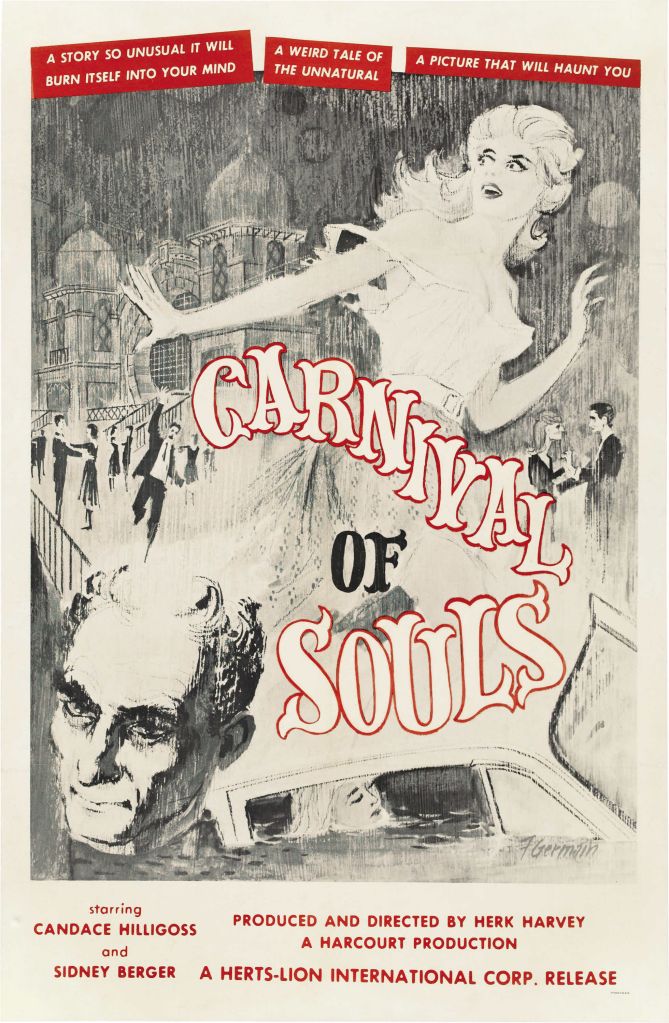
Carnival of Souls (1962)

Directed by Herk Harvey [Other horror films: N/A]

From a modern-day perspective, Carnival of Souls may seem a bit pedestrian, as the ending seems quite easy to predict. Truthfully, though I’ve seen this once or twice before, I don’t love it myself, though that has little to do with the finale. I don’t doubt Carnival of Souls is a classic, but certainly tastes may vary.

Oh, and this review will have spoilers in it.

I’m not sure exactly where my hang-ups with this one arise from. The atmosphere and suspense are top-notch, and in fact, it’s probably one of the most atmospheric movies of the 1960’s, an amazing feat given the lower budget nature of this film. The suspense needs no explanation – there are multiple scenes throughout that pack a punch, and all without scare chords, which is a nice change of pace compared to more modern-day movies.

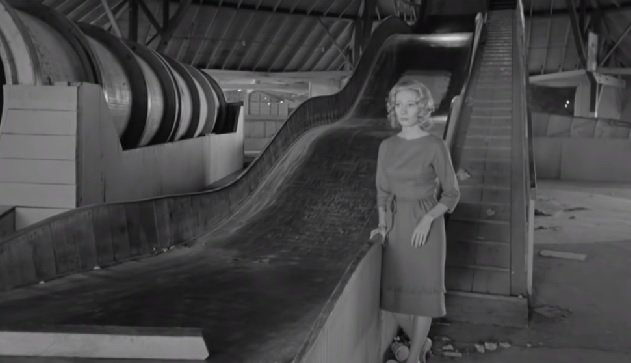
Even so, I can’t say that I’m not occasionally bored during this. The story is engaging enough, especially the abandoned pavilion that Candace Hilligoss’ character has a sinister attraction to, but because Hilligoss’ character is sort of hard to relate to, she doesn’t always make the most interesting protagonist.

There’s also the question of what’s actually happening at some points during the movie. Given the finale, I don’t quite know what’s happening during some scenes, and it’s not easy to expand on without spoiling anything, so warning, HERE THERE BE SPOILERS:

At the end, it’s revealed that the main character died due to the automobile accident at the beginning of the film (which took place in Kansas), and everything after was her soul attempting to move on. In one of the final scenes, we see her body in a car being pulled from the water.

We also see a police officer, minister, and doctor examining the last place she was seen after moving to Utah. She didn’t move to Utah until after she died, so therein lies my confusion. If she died, her physical body still in the car that went underwater, then I’d think everything after wouldn’t be reality as those alive know it. But it seems that her spirit is actually a physical form that moved and interacted, however frigidly and ineffectively, with the people she met in Utah.

All of this could have been solved if they had just removed the scene in Utah, as then the only relevant, real-world scene would be the car, with her body, being dragged up in Kansas. But they do show that she was apparently in Utah, so she apparently has two physical bodies, which is one more than I have, so in a way, that’s impressive. Even if it’s a Limbo situation, I wouldn’t think that would have an impact on the actual reality others live in and perceive.

I know this is a classic, but this point doesn’t seem nit-picky to me; it just seems logical. It doesn’t mean that the movie isn’t atmosphere or possessing of an occasional uneasy, dreamlike quality. It’s just something that bothered me when I first saw this movie, and something that still bothers me today.

Otherwise, though Candace Hilligoss’ character isn’t easy to relate to, the film is decent. It feels like an extended episode of The Twilight Zone, and as I said, it does have some pretty creepy and suspenseful scenes throughout to keep your engagement going.

Though I didn’t understand Candace Hilligoss’ character, I do think she gave a pretty stellar performance, and not only that, but she was about the only cast member who truly mattered. Sidney Berger did well as a pushy, annoying guy, and both Art Ellison and Stan Levitt are calming voices in what otherwise is a howling storm, but when it comes down to it, Hilligoss’ performance pretty much stands far above anyone else’s.

Naturally, Carnival of Souls is a classic, and there’s good reason for that. It’s not a classic that I’ve ever loved, but I have good friends who do indeed see the movie as a masterpiece. It’s decent, but as far as personal enjoyment goes, I don’t even know if this is something I’d give an above-average score. Plenty of things work, but some story elements befuddle me, so while many others may give this one a higher rating, I have to go with what I truly feel, for better or worse.

7/10

The Ruins (2008)

Directed by Carter Smith [Other horror films: Swallowed (2022)]

It’s been some time since I’ve seen this film. If I had to guess, I’d say around ten years or so. I can’t remember if I’ve seen it once or twice, but I do remember enjoying it whenever it was I last saw it, and I can say that, after seeing it again with fresh eyes, that’s largely still true.

Based on a novel of the same title by Scott Smith (a novel I’ve not read, but am interested in possibly reading in the future), the idea is pretty simple – six unfortunate souls in Mexico decided to go to a ruin that’s not good for their health, largely out of their control. It’s a somewhat bleak film, as there’s very little within their control in the situation they find themselves in, and it’s done pretty well.

The cast is solid – the six performances really worth mentioning would be Jonathan Tucker, Shawn Ashmore, Jena Malone, Laura Ramsey, Joe Anderson, and Sergio Calderón. It’s true that Calderón doesn’t have a lot to do aside from look threatening, but he does it well. Ashmore (who I know as Bobby Drake from the X-Men films, but has also been in Mother’s Day, Devil’s Gate, Wolf Girl, The Day, and Solstice) is more likable than Tucker (The Texas Chainsaw Massacre), but Tucker’s character is pretty good.

Jena Malone (Antebellum) reminded me of an actress on the tip of my tongue, but I can’t place her. Either way, Malone was pretty solid, and more stable than Laura Ramsey (Cruel World). I was hoping that Joe Anderson (The Crazies, Abattoir, The Reckoning) would have a bit more to do than he did, as I rather enjoyed his character, but it wasn’t to be.

The gore here can be pretty grisly. See, plants that grow around this ruin can get into your body if you have an open wound, and this happens to a couple of people. Not only does someone have their body cut in multiple places to pull out weeds, another individual has their legs cut off. That particular scene wasn’t too gory, but there’s a later one in which someone, under heavy mental stress, takes a knife to themselves in order to rid their body of the parasitic weeds, and that one can be trying.

It’s at this juncture that I should profess an odd love of plant-based horror. There’s not too many examples that come to mind, but those that do (including the somewhat awful Revenge of Doctor X) are films I have somewhat of an affinity for. I’ve always found malicious plant-life (or not even malicious – it’s just how they evolved) an interesting idea in horror. I have to imagine it comes from my love of Goosebumps as a child – Stay Out of the Basement, both the book and the two-part episode, are favorites of mine.

And on that note, I do wish we had some opportunity in this movie to learn more about these plants. Sure, the terror is in not knowing or understanding what exactly the characters are facing, but even so, it’d have been nice to have a biologist’s perspective, or even one of the Mayans who could perhaps manage some broken English.

Related, I understand where the Mayans are coming from, but wouldn’t it have been better to have a constant guard around the ruins as opposed to just trying to contain the problem after it was too late? Preventative measures, and all that.

I am aware that certainly they tried, but the problem is that the Mayans speak, well, Mayan, and can’t effectively communicate with people who don’t speak Mayan. If you’re trying to prevent people from going near this particular ruin, it might benefit them to at least learn Spanish, as many of those who approach the ruins could at least effectively be warned away.

Oh, and one last thing – did it never occur to any of the characters to possibly burn the plants? Sure, it might have been suicide, but I’d have definitely tried to light the plants on fire as opposed to starving to death with roots and weeds growing inside of me.

Despite those small issues, The Ruins is a well-made film. I don’t know what was changed from the novel, if anything, but it’s a high-budget film that’s somewhat dreary at times (and definitely could have done with an ending packing a bit more of a punch), plenty gory, and an overall enjoyable watch. It’s not stellar, but it is good.

7.5/10

Hostel: Part III (2011)

Directed by Scott Spiegel [Other horror films: Intruder (1989), From Dusk Till Dawn 2: Texas Blood Money (1999)]

Hostel has never been a film I considered amazing, but it’s a pretty solid film. Hostel: Part II is even better. It’s just a damn shame that Hostel: Part III is such shit.

My primary issue – actually, scratch that. I have more than one main issue, which is obviously problematic. Among them being the location switch, organization set-up, deaths, and ending.

In this film, they switched locations from Slovakia to Las Vegas, Nevada. It’s not a super gritty, dilapidated factory anymore – it’s a clean-cut room of torture with implements laid out and spaced beautifully. It doesn’t have anywhere near the atmosphere of grittiness that the Slovakia setting held, and it’s hard to take seriously.

It’s also hard to take the organization seriously. It’s the Elite Hunting Club, sure, but now it’s not just people who pay huge sums to torture people, it’s VEGAS, BABY!!!!!!!!!!! which means gambling. See, the victims are in a room with a giant glass window so the wealthy can watch them get tortured and killed, all while placing bets on how long it takes and also hoping to spin a Wheel of Misfortune.

If at this point you think this movie is a parody, I couldn’t blame you, but it’s not, God help our souls.

As for the deaths, there’s only one I sort of liked, in which a guy’s face was cut off. It didn’t look great, but it was at least brutal. Otherwise, we had a woman suffocated by cockroaches, a man who got his arm cut off (you could barely see anything, though), a guy shot via shotgun, a guy getting tased to death, a woman shot in the spine, a guy who was stabbed. There’s very little in the way of torture in this film, and though the first Hostel didn’t feature a ton of gore, it was so much better than this amateur hour.

Oh, it also did that thing I really, really, really love, where there’s some bloodshed, but the blood gets on the camera, because that’s so cool it’s like i;m actually there OMG BLOOD>>>>W>E>FW

In all seriousness, fuck that shit, brah.

The ending was terrible. There was a twist. The twist was illogical. I hated it. It sucked as much as the rest of the movie, though, so consistency, AMIRIGHT?????

As for performances, I did like seeing Kip Pardue (Sunshine from Remember the Titans, also in films such as The Wizard of Gore and Stag Night), though the character was pretty bad. It’s the same for most performances, such as the lead Brian Hallisay, and others, such as Chris Coy (Rogue River, The Culling, Deliver Us from Evil), John Hensley (Teeth, Campfire Stories), Skyler Stone, Thomas Kretschmann (2004’s Frankenstein, Dracula 3D, Discarnate, Rohtenburg, Open Grave, The Stendhal Syndrome), and Sarah Habel.

Well, to be fair, Habel’s character is okay, but at the same time, her character amounts to virtually nothing, so it doesn’t come to much.

I’ve seen Hostel: Part III once before, and I didn’t care for it then either (which I can’t imagine comes as a big shock). I wasn’t that hopeful seeing it again would lend any more pleasure, which was a good perspective, as this movie is just as poor as I remember. Pretty much an insult to the first two movies, this just isn’t a sequel I’d ever recommend. I’m sure some out there would have a fine time with it, but that’s deff not me.

4/10