Jigsaw (2017)

Directed by Michael Spierig [Other horror films: Undead (2003), Daybreakers (2009), Winchester (2018)] & Peter Spierig [Other horror films: Undead (2003), Daybreakers (2009), Winchester (2018)]

It’s a strange feeling watching an entirely new Saw movie, having no idea where it’s going or what the twist is beforehand. I last had this feeling watching Saw 3D in theaters, and while that film definitely has its problems, I thought that Jigsaw generally came out an okay film.

To be sure, being the first Saw movie in seven years, this does feel different than the previous films. Few previously-appearing characters are mentioned, the cast is almost entirely new, and the episodic feel of films IV through 3D is gone. John Kramer, by the point of this movie, has been dead ten years, and his games largely done shortly thereafter (once all of his accomplices got done bickering and butchering one another).

It’s a really odd feeling being thrown into another Saw film, but having almost no touchstones to previous events. To be clear, we do get a flashback with John Kramer – that shouldn’t really come as a surprise, and naturally, I was delighted by it. We also get even a little more backstory on John’s early days in his new vocation, which again, I sincerely enjoyed.

Still, almost all of the important characters here are new. We have two police detectives – Brad Halloran (Callum Keith Rennie) and Keith Hunt (Clé Bennett) – and two medical pathologists, Logan Nelson (Matt Passmore) and Eleanor Bonneville (Hannah Emily Anderson). It’s strange not having people like Hoffman, Rigg, and Perry slinking around, not to mention a complete absence of the FBI (which indeed makes sense, given how long it’s been since the last game).

The story is about what you’d expect. A group of five people – all with sins they must confess to – are dragged through traps in what appears to be a large barn. That location shift was fascinating, as we’re so used to these traps taking place in abandoned, industrial buildings. Here, at least the participants got some of that healthy country air.

Past a certain point, and even with a bit of wild guessing early on, one of the twists becomes almost a foregone conclusion. That’s not a bad thing, because I think the twist was done well, but I have to be honest and say that it’s the same type of twists we’ve seen a time or two before. Also, a lot of the suspense over who’s taking over John’s mantle – is it that suspicious Bonneville, who seems a Kramer fangirl, or Detective Halloran, who seems very quick to point the finger, or Nelson, who lost his wife some years back – seems almost too much, because really, as we don’t know these people, it could be any one of them (or any combination of them). When any answer is possible, the mystery almost feels like a joke.

Callum Keith Rennie (Case 39, eXistenZ) was a dick a lot of the time, but his performance was solid. Same can really be said for most of the main cast – I particularly liked Hannah Emily Anderson (Dark Nature, What Keeps You Alive, The Curse of Audrey Earnshaw), and Clé Bennett had a fresh feel to him. I feel like Matt Passmore’s character could have used a bit more depth, but it still worked.

Paul Braunstein (The Thing) could be amusing at times, so he was fun. Though Laura Vandervoort (Rabid) felt a little generic, she grew on me. I have to say, I did expect a little more from Mandela Van Peebles’ (Karma) character, but whateves.

The gore here did seem a bit downplayed. They were some painful-looking moments, such as someone’s leg gets severed from their body, or some spinning blades that didn’t look all that playful, along with falling knives and pitchforks and sawblades risking bodily injury, but honestly, the movie felt somewhat tame, which, when combined by how glossy and new-age it felt (Jigsaw had messages on computer chips and flat-screen TVs), it might turn some fans of the initial string of movies away.

Generally, I found it a decent time. I don’t think it matches with the best of the classics, but it was definitely a step up from Saw 3D, and if I’m being honest, that’s all I was looking for when I came into this one. I also feel, though, that a couple of story elements should have been cleared up a bit. Not a great film, but for a fan of the series, certainly serviceable.

7/10

Saw 3D (2010)

Directed by Kevin Greutert [Other horror films: Saw VI (2009), Jessabelle (2014), Visions (2015), Jackals (2017), Saw X (2023)]

Boy, as a long-time Saw fan, I have a lot to say about this one, and I only hope I can keep my rambling to a minimum.

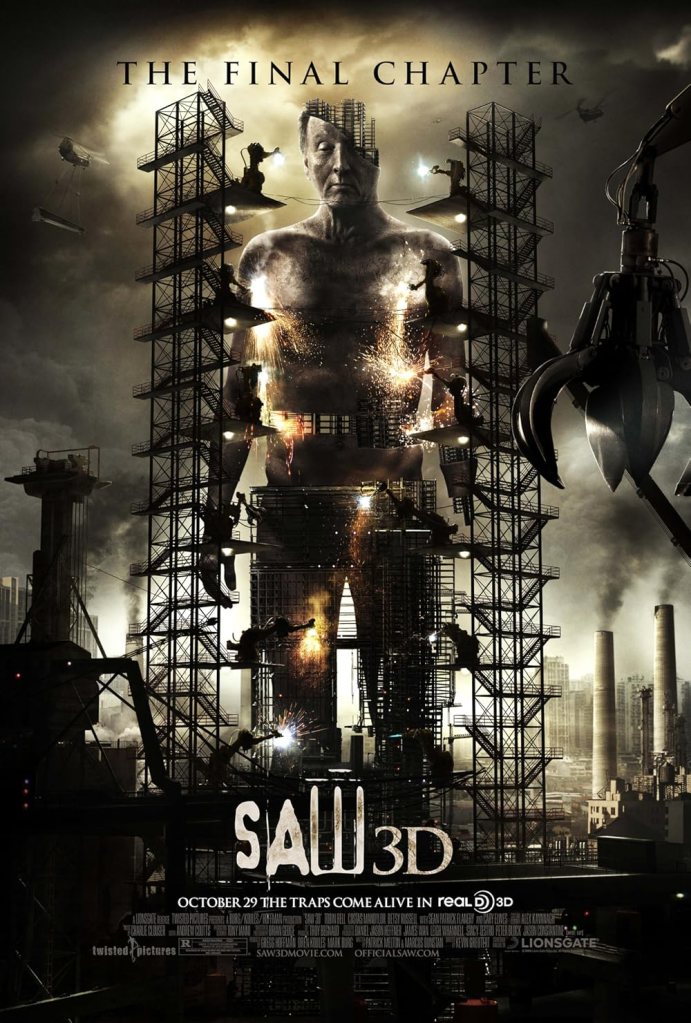
Saw 3D, also known under the title Saw: The Final Chapter, is quite a disappointing film. There’s plenty of reasons why, but I also want to be clear right now: I will be giving some spoilers to this movie in order to cover it to the best of my ability, so if you’ve not seen Saw 3D, do not read further.

Firstly, let’s discuss the 3D – it’s terrible. I know around this time, 3D movies were coming out like crickets on a quiet night, but just because it was a trend doesn’t mean Saw had to follow suit. The 3D added absolutely nothing to the movie, and though you could say it’s one of the film’s smaller sins – the story and structure and execution of twists far worse – it’s still emblematic of the problems Saw 3D has.

Let’s talk turkey, though, ‘turkey’ being my code-word for plot. Following the events of the last movie, Mark Hoffman is on the warpath, his prime target being Jill (who, if you didn’t know, attempted to kill Hoffman, and while it just ended up disfiguring him, you can tell he’s none-too-pleased). Jill then decides to go to the police, specifically Internal Affairs detective Matt Gibson (Chad Donella). Why Matt Gibson? I don’t really know, as he’s never been mentioned, let alone appeared, until this movie.

While Jill is trying to ensure her survival against an angry Hoffman, a self-help speaker (Sean Patrick Flanery), who has been amassing fame and wealth by speaking about his survival of one of Jigsaw’s traps, is placed in a new game. Like William Easton in Saw VI, he’s forced to go through a bunch of traps, attempting to help his friends and staff from grisly fates, and face the lies that brought him to where he is now.

In theory, that portion of the film should at least be suitable, but it’s really not. The sixth film had some really solid portions during the game, but here, it feels largely weak. There’s a portion where he has to talk a blindfolded friend over planks, so the friend doesn’t fall to his death. Tense, perhaps, but not particularly great. Sure, someone has their eyes and mouth at risk of spikes, but I didn’t feel a whole lot of care for anyone involved.

Perhaps the most interesting trap, at least in this section, was one in which a woman was tied down, and the key to unlock her was on a fishhook that’s in her stomach. Flanery’s character has to pull the fishing line from her mouth, doing God knows what type of internal damage, all while any speaking, or screaming, will ensure that the woman’s throat gets pierced by spikes. I’m not saying this is a great execution, but at least it’s something. The idea of having a fishhook pulled through your innards is not what I’d call a fun time. Some props, though, to that pulling-teeth section.

Perhaps because of the 3D nature, though, some of the movie feels really over-the-top. There’s a group of survivors from Saw traps (and we see some familiar faces), and as one woman recounts her survival story (of a trap previously unseen), it seems almost goofy. The trap with two men and the woman they’re both in a relationship with, set up in the middle of a busy city center, seemed far too ridiculous to feel real. Oh, and that dream sequence – I say again, dream sequence – of Jill’s, where she’s caught by Hoffman and killed by some silly train thing, was so fucking cringe boys.

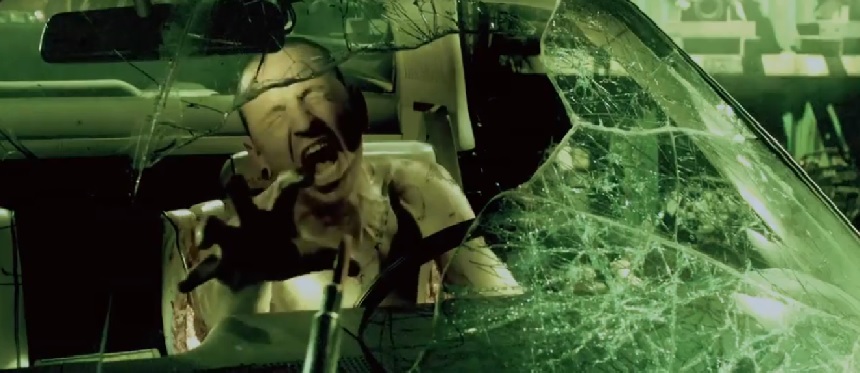
However, the most over-the-top award goes to that junkyard trap. A bunch of racists are placed in a complicated trap. It looks painful – a man’s glued to a seat of a car, and has to pull forward, tearing the skin from his back in large chunks, to potentially free them all – but given the victims are racist, and the movie wants to show some carnage, it comes as absolutely no surprise that things go the way they go.

Onto perhaps the most important thing here, though, I need to speak about Lawrence Gordon (Cary Elwes). Ever since the end of the first movie, and the fact that he wasn’t mentioned as dead in the follow-up film, I’ve been of the opinion that Gordon survived. I even thought it likely that he was blackmailed by John to help him out with some of the traps. I know others out there thought the same thing – I have no idea of the percentage of Saw fans who would proudly claim “I believe Gordon is alive,” but I can say that others thought people like me distasteful.

Well, as it turns out, Gordon did survive. That in itself isn’t a big spoiler, because the movie opens showing how he was crawling from the bathroom following the events of the first film, and how he cauterizes his stump (which looked painful as FUCK). The real spoilers of his character come later on, but I think they’re executed particularly poorly. It hurts most, because Gordon’s return was something I had been hoping for for many years, and they bring him back in an execution as shoddy at this? More than anything – the 3D, that stupid fucking dream sequence, the over-the-top junkyard trap – this pissed me off something awful.

I appreciated Costas Mandylor in Saw VI, but I have to say that he’s starting to feel a bit OP. He’s not John – he used inferior blades and knives in the past, and he doesn’t have the Godlike omniscience that John did, and yet he’s like Hannibal Lecter the way he massacres through people. Actually, I started wondering if he had some military training in the past, and though this might be a small thing, if they had mentioned that indeed, he was in the Special Forces for a stint, I would have found Hoffman’s role here more believable. That said, I did appreciate his plan to break into the police department – solid stuff.

Betsy Russell’s Jill here feels sort of weak, in comparison. She honestly only got a few moments to shine in the last film, but here, it’s like she’s completely out of her depth. I’ll admit that I found Chad Donella (Final Destination) amusing at times, though he seems a far cry from the threat posed by Peter Strahm. Sean Patrick Flanery (The Evil Within, Lasso, Kaw, Mongolian Death Worm) did fine, but his character struck me as somewhat pointless, truth be told.

The most exciting face for me to see, of course, is that of Cary Elwes (The Alphabet Killer, Hellgate, Psych:9), but I don’t really think they do justice with his character, which is a damn disappointment, given how long I’ve waited for this.

I’m not going to say that Saw 3D is a terrible movie, but I can say that I think it’s the first movie in the series that’s below average. It’s not an utter disaster, but given how great the first movie is, and how sequels generally did well to keep the standards high, this was just a major let-down, especially as a long-time fan of the series.

6/10

Playing with Dolls: Havoc (2017)

Directed by Rene Perez [Other horror films: The Dead and the Damned (2011), Demon Hunter (2012), Alien Showdown: The Day the Old West Stood Still (2013), The Snow Queen (2013), The Dead the Damned and the Darkness (2014), The Burning Dead (2015), Playing with Dolls (2015), Playing with Dolls: Bloodlust (2016), Little Red Riding Hood (2016), The Obsidian Curse (2016), From Hell to the Wild West (2017), The Dead and the Damned 3: Ravaged (2018), Cabal (2020), Cry Havoc (2020), Legend of Hawes (2022), The Vampire and the Vigilante (2024)]

I’ve had the misfortune of sitting through both the first and second movies in the Playing with Dolls series. Neither one was something I’d personally call a good time, but I was told that the third is a better film. IMDb ratings back that up – the first has a 2.6/10, the second a 2.5/10, and this one, a 3.7/10. The question then, of course, becomes whether this movie is actually better.

And the answer is: Yes and no.

As far as an engaging story goes, I’d have to admit that they do a better job here. See, a woman and her maid are going up to her husband’s cabin to surprise him, and meet the husband’s mistress; said mistress didn’t even know the guy was married. So because of that emotional material, certainly this portion of the film is at least watchable – some of the acting is just terrible, of course, but the material itself is still entertaining.

On the other hand, absolutely nothing about the horror aspects of the film are better. We still have the killer – apparently called Havoc – who we know next-to-nothing about. He seems to enjoy ripping spines out, as he does that more often. We still have Richard Tyson (in a single scene), who is another character we know next-to-nothing about. I’ll give the movie mild props for changing things up a little – instead of the killer following Tyson’s directives, he breaks out of captivity and hunts on his own. It doesn’t change a damn thing, but at least it’s different?

This movie had pretty much the same problems the previous movies did. Sure, the production value looks nice, and they try insofar as the gore’s concerned, but I can’t describe how disinterested I am in a killer I know nothing about chasing down women and interrupting conversations that I actually find mildly interesting. When I say that the horror aspects of Havoc are the worst parts, I’m not at all lying brahs.

Not that the performances here really bring weight to the aforementioned emotional material. Nicole Stark (Little Red Riding Hood) was generally weak throughout, Wilma Elles little better, and Kyle Clarke largely a non-entity. I did sort of like John Scuderi’s character, but I don’t think he leaves near as much an impact as one would to tilt this film in a positive direction.

As I often say, though, bad performances rarely destroy movies for me. With what these actors and actresses had to work with, I don’t blame them at all for whatever performance they happened to give. You can’t make gold out of toxic sludge; the performances could have been stellar, and it wouldn’t at all have made up for the failures of the plot and dialogue.

I’ll give Havoc one last kudo for the opening of the film. Don’t get me wrong, most of it was absolute shit, the type of thing I’ve come to expect from director Rene Perez. It was, however, filmed in the Lake Shasta Caverns – an underground network of caves in northern California. That was a nice filming location, and though what was actually filmed there was pointless drivel, it did at least look unique.

Is Playing with Dolls: Havoc a better film than it’s predecessors? Sure. There’s some mildly entertaining emotional drama going on, and there’s actually an ending here that didn’t make me want to slit my wrists. Given how much I despised the first few movies, though, that praise can only do so much. So sure, it’s better, but this film is still a long ways from good, and still not a movie I’d recommend even to fans of slashers.

4.5/10

Playing with Dolls: Bloodlust (2016)

Directed by Rene Perez [Other horror films: The Dead and the Damned (2011), Demon Hunter (2012), Alien Showdown: The Day the Old West Stood Still (2013), The Snow Queen (2013), The Dead the Damned and the Darkness (2014), The Burning Dead (2015), Playing with Dolls (2015), Little Red Riding Hood (2016), The Obsidian Curse (2016), Playing with Dolls: Havoc (2017), From Hell to the Wild West (2017), The Dead and the Damned 3: Ravaged (2018), Cabal (2020), Cry Havoc (2020), Legend of Hawes (2022), The Vampire and the Vigilante (2024)]

Well, the first Playing with Dolls was utterly abysmal, and I can say that Bloodlust is a better movie. It’s not that much better, though – this is still a far cry from even average – and I wouldn’t think it’d appeal to too many people, regardless.

Unlike the first film, though, there’s something of a plot here – people are lured to an abandoned cabin to be part of a horror reality TV show. I have no idea if these people signed contracts, but if so, they’d have a good lawsuit on their hands, because this is one terrible reality TV show idea.

On a side-note, I’m not sure why most horror films that revolve around reality television tend to be absolutely terrible – I’m thinking movies like Reality Check, Cruel World, and, to a lesser extent, My Little Eye, which certainly wasn’t terrible, but was underwhelming. The only reality show-themed horror film I’ve ever cared for was Wrong Turn 2: Dead End, and that’s not even that great a movie.

Regardless of why this seems to be the case, Bloodlust certainly doesn’t help improve my view any, as it’s legit awful.

Sure, it does have more of a plot, and perhaps more importantly, more than one protagonist, but only one of the performances is decent, and we still don’t have context as to why any of this is happening. The same rich guy (Richard Tyson) is recording the same killer (credited as Prisoner AYO-886, because the movie’s trying to be cute) as he kills people, and apparently it’s because that’s the only truth. It’s that same type of philosophical rambling that makes absolutely no sense, and gives absolutely no insight into his character at all.

These movies just bug me. The gore here is okay – someone gets their head smashed in with a sledgehammer, someone gets their arm cut off, someone gets their leg cut off, someone gets one of their toes cut off (this movie is big into dismemberment apparently) – but gore without proper context doesn’t interest me, and as such, this didn’t do a hell of a lot for me.

I can’t stand Richard Tyson’s character, because, like in the first movie, he doesn’t have much of one. Karin Brauns (who died in 2022 at the age of 32) was pretty poor (her character had an accent, but unlike Natasha Blasick’s character from the first, there’s no in-universe reference to this), Elonda Seawood wasn’t particularly interesting, and Andrew Espinoza Long, despite potential, didn’t bring much to the table. I will admit to liking Colin Bryant here, and Marilyn Robrahn (who was also in the first film) had an okay moment or two, but for the most part, there’s little here to praise.

Oh, and it’s worth mentioning that there’s no ending to this film. Two characters are fighting each other, two other characters are watching, and then the movie ends. The first movie didn’t have much in the way of a conclusion either, but at least that one felt like it could have worked, whereas this was just pathetic in every way, which, honestly, is on point.

I’m sitting here and realizing just how much of a waste of time I found this. The worst part is, I’ll likely be watching the sequels (Playing with Dolls: Havoc and Cry Havoc), so I’ll have ample time to complain in the future. All I’ll say is that Bloodlust was better than the first movie, but not by much, and neither are movies I was glad to have seen.

4/10

Angmareul boatda (2010)

Directed by Kim Jee-woon [Other horror films: Joyonghan gajok (1998), Keomingaus (2000), Sam gang (2002), Janghwa, Hongryun (2003), Illyumyeolmangbogoseo (2012)]

Commonly known under the title I Saw the Devil, this South Korean film is a true treat. A bloody and brutal story of revenge, Angmareul boatda would likely make most horror fans happy, and perhaps more important, most movie fans happy.

Certainly it’s not a movie for everyone, though. When you have a film that has so much violence – someone’s Achilles heal being cut, very bloody stabbings, a decapitation that brings with it some emotional impact, a cannibal eating some of that scrumptious human flesh – some people won’t much care for it. Luckily, though, if you’ve a fan of thrillers, or action films, or revenge movies in general, this may be of interest. Personally, like Battle Royale, I think there’s enough here to classify it as a horror film, but also like Battle Royale, it’s true to say that the movie’s far more than that.

Following a man’s revenge after a serial killer dismembers his fiancée, I Saw the Devil is a depressing and rather dark film. It’s fun watching Lee Byung-hun’s character get his revenge, but all the while, he’s becoming more and more similar to the man he’s chasing, and when things stop going his way, they really stop going his way (not that the murder of his wife was going his way, but to all things, there is a season). It’s not a happy movie, and the finale is also not ringing of hopefulness. Even so, it’s definitely a well-made one.

And obviously, you don’t need me to tell you that. I Saw the Devil is a very well-known and well-respected film. It currently has a 7.8/10 on IMDb with over 138,000 votes, so this isn’t some kind of hidden gem. The cinematography is stellar, the story is simple, yet engaging, and the special effects here really add a lot to applaud.

Oh, and it’s also two hours and twenty minutes long. It’s a lengthy boi, but like I said, that doesn’t at all hurt how engaging the film is, and while it’s not wall-to-wall action, there’s not many five-minute stretches here without something to get you going, which is certainly impressive.

I don’t think I have complaints about any of the cast. Lee Byung-hun (Three… Extremes) made for a stellar lead, and Choi Min-sik (The Quiet Family) a despicable and memorable antagonist. These two were great together. Others I particularly enjoyed were Jeon Gook-hwan, Moo-Seong Choi, Yoon-seo Kim, and Lee Jun-hyuk. Again, most performances were great, but it’s really Byung-hun and Min-sik who steal the show.

It’s an action-packed film with a lot going for it. It’s a lot more violent than your average action film, but I can imagine that if you’re into movies like The Raid, than this would appeal to it. Certainly it’s far from a typical horror film, but like I said, there’s a lot here that would appeal to fans of the genre.

When I first watched I Saw the Devil, I was impressed. I forget how many years ago that was, but it’s been so long that I forgot a lot of where the story went. I remembered the basics – someone’s woman gets killed, and he seeks revenge – but I forgot a lot of the details, which I’m grateful for. This was a fantastic film to revisit, and if it’s not a movie you’ve seen, then perhaps this South Korean treat should make it’s way onto your want-to-see list.

9/10

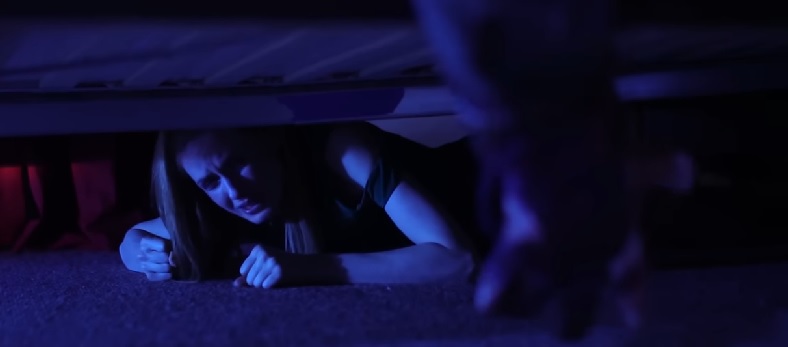
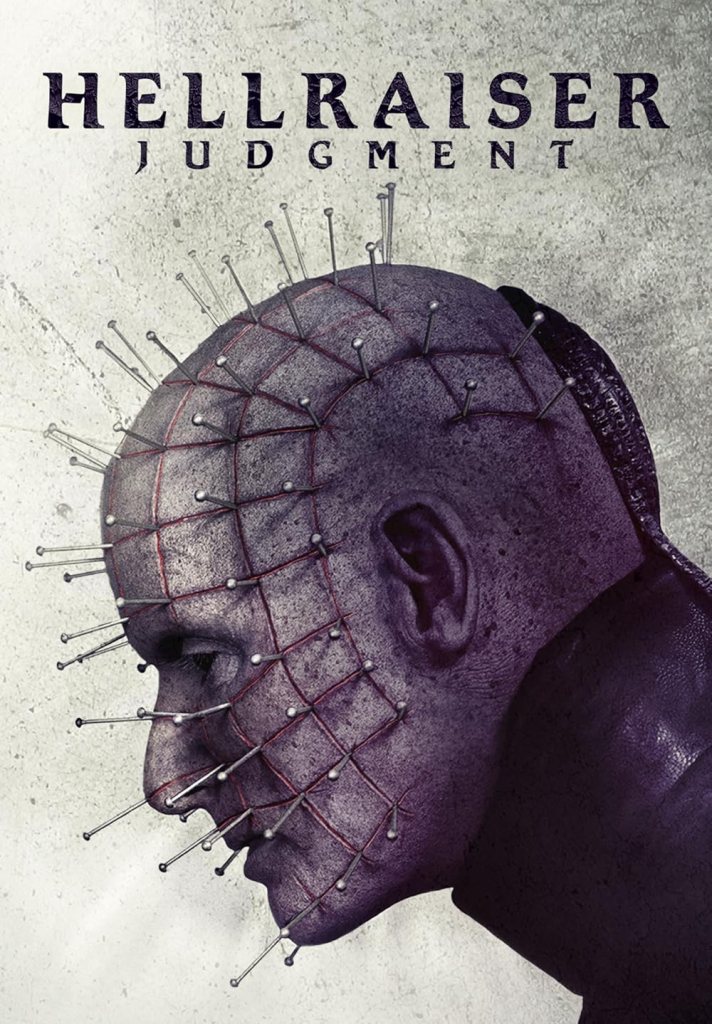
Hellraiser: Judgment (2018)

Directed by Gary J. Tunnicliffe [Other horror films: Within the Rock (1996)]

I’ve been curious about Hellraiser: Judgment ever since it came out. After Revelations, I was hoping the series could get back on track, and after watching the trailer to this one, I thought it had some potential. Well, I have some serious problems with Hellraiser: Judgment, but at the very least, I do think it’s mildly better than the previous entry, albeit not by a lot.

This doesn’t start out well, though, as I absolutely abhorred the first 12 or so minutes. In that time, we see Pinhead speaking to a character called the Auditor, which was fine (though I’d have liked some context as to who or what the Auditor was), and a man being lured to a house.

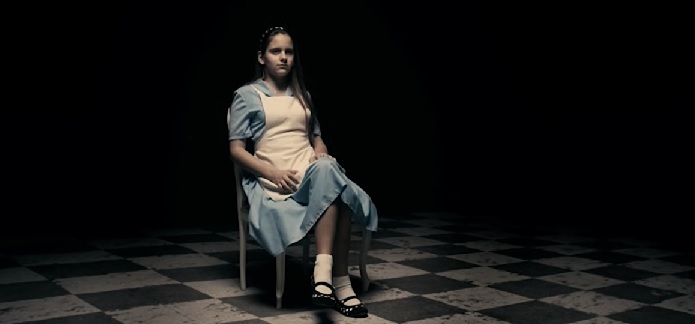
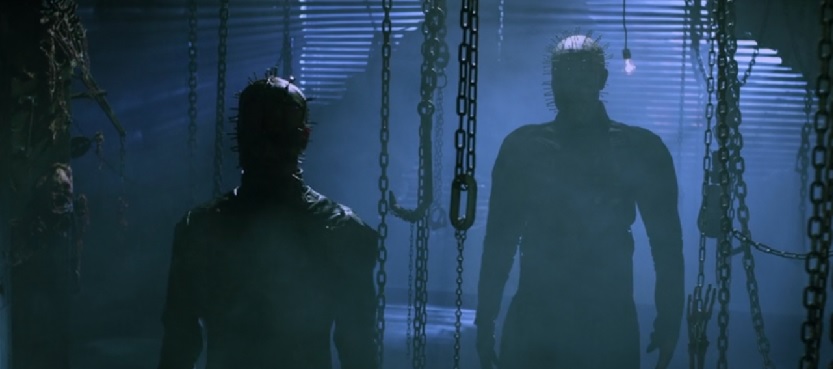
Once the man gets to the house, he meets the Auditor, who asks him questions about the man’s sins. Once those sins are written down, the man is sent to the Assessor (who looks completely human, on a side-note). The Assessor has a bottle of children’s tears, and combines that with the papers of the man’s sins, and eats them. He then throws the combination up into a pipe. That pipe leads down to the Jury. The Jury are three naked women with messed up faces who spread the vomit over their bodies to render a verdict. Once that verdit is rendered, the man is sent to the Butcher and the Surgeon (the Butcher a big, hulking hombre, and the Surgeon someone in a body-tight leather suit), who then do what they do best.

The whole thing feels like some dark, disturbing fantasy. As someone who doesn’t care for dark fantasy, I hated it. It reminded me of The School, in that it was trying to be as grimy and dirty as possible, and it came across as trying too hard. We get no information during this process – why is the Assessor the only human here? Is he human? Why are the Jury three nude women? Are they women? Why is the Butcher carrying around the Surgeon? Can the Surgeon walk?

We don’t get an answer to any of those questions. Not just during the first 12 minutes, but during the whole of the film. We never learn what these things are. Wikipedia says that they’re the Stygian Inquisition, which is a separate group from the Cenobites. Now, the movie never once mentions the word “Stygian” or “Inquisition,” so I have no idea if that’s accurate. If that’s the case, it would have been great if they mentioned that somewhere, because from my view, having a Hellraiser movie with only minimal Cenobite action, replacing that with random judgy things, doesn’t do much for me.

The reason I’m focused so much on this is because it had to be among one of the most unpleasant beginnings to a film I’ve seen in recent times, rivaling The Rage. During that time, I was thinking that if the movie continued on in that vein, I’d have absolutely no problem saying that Revelations is a better movie.

In fact, a good case could be made that while Judgment is certainly a better film insofar as budget is concerned, it’s a worse Hellraiser film than Revelations. Keep in mind, the focus of this film aren’t the Cenobites, it’s the Auditor. The movie doesn’t say what the Auditor is, but it’s clear that he and the process he follows has little to do with Pinhead, who seems to be an advisor (?) more than anything else. We do see a few other Cenobites, such as Chatterer (for brief moments) and some conjoined women, but we never get much of any of these, save Pinhead toward the end of the film.

Story-wise, I generally liked this one. It follows two detectives (who are also brothers) as they attempt to locate a religious serial killer. Throw in another detective, who is investigating, in part, one of the brothers, and the film feels almost like Se7en at times. I know some have complained about the procedural feel this sometimes has, but in truth, it never bothered me, and there’s a twist toward the end that I thought was actually decent.

Damon Carney (The Harrowing) and Randy Wayne (The Fun Park, Scar, Escape Room, The 13th Alley, Ghost Town, Hold Your Breath) made for somewhat believable brothers. I sort of expected more from Wayne’s character, but Carney was solid. Alexandra Harris (All Light Will End) appeared for a bit, but honestly didn’t stand out that well.

Playing Pinhead was Paul T. Taylor (Shifter), who did decently (though he was certainly no Doug Bradley). Director Gary J. Tunnicliffe himself plays the Auditor. Shame that this fact doesn’t give any more insight into his character. Lastly, playing an angel (I guess) is Helena Grace Donald.

I certainly don’t want to sound ungrateful, as I appreciated that Judgment tried to expand the mythos of Hellraiser. We have some ambitious, theological elements toward the finale, and I actually sort of liked that. I just wish they did a better job of explaining some of what we were seeing, such as the Auditor and his group’s relation to the Cenobites. The ending, too, was sort of unexpected, as Pinhead apparently went too far in his role.

Although I did want to touch on Pinhead, because again, I don’t think his character was done correctly. It’s my understanding that Pinhead is not a malevolent entity. In Hellbound, he stated that “It’s not hands that call us, but desire,” after a character was forced to open the box. In this film, two characters are forced to open the box at gunpoint, and Pinhead takes them anyway. I just don’t care for the more malicious characterization that Pinhead’s gotten in the last couple of movies, and I find it more interesting when he and the Cenobites are amoral as opposed to immoral.

Judgment’s a problematic movie. I was hoping that I’d like it a lot more than I ended up doing, but that doesn’t mean it’s not an improvement over Revelations. However, I can certainly understand why someone might prefer Revelations, if I’m being honest. Judgment was okay, but I really think if some things were cleaned up a bit, it could have possibly great. As it is, though, it’s nowhere close.

5/10

Srpski film (2010)

Directed by Srdjan Spasojevic [Other horror films: The ABCs of Death (2012, segment ‘R Is for Removed’)]

I think most people in the horror community have at least heard about this one. Known most commonly as A Serbian Film, Srpski film is a controversial film, sometimes listed as one of the most disturbing movies ever made. Given the content in the film, I don’t have a problem with that label, but I also think it’s fair to say that the film isn’t without merit.

First, though, I should say that I don’t usually go out of my way to watch extreme movies. I’m one of those casuals who watches movies that I think I’ll enjoy (unless I’ve seen it before, in which case I need to rewatch in order to write a review for it, but that’s beside the point), and I don’t find most extreme horror to be likely candidates as an enjoyable film. I’ve seen a handful of more disturbing films, of course – Men Behind the Sun, The Human Centipede, Schramm, The Poughkeepsie Tapes, Wedding Trough. I even watched half of Guinea Pig 2: Flower of Flesh and Blood (though I turned it off as I was feeling ill).

That said, most extreme cinema isn’t something I’m too keen on seeing, and A Serbian Film is no different. I’d heard of this one plenty of times, of course, but I didn’t know anything about it. I had heard it was disturbing, and sickening, and, from some people, that it never should have been made. It’s hard to pinpoint why I chose to watch this earlier today, but I think it was just plain curiosity – despite not being into these types of movies, I wanted to see if it was as bad as I’ve heard.

And you know what? It’s that case of overhyping things in your mind, because while this movie was definitely disturbing, I was honestly expecting worse. There are three scenes that I found the hardest to watch, and two of them weren’t even that explicit. Disturbing, sure, but not explicit. There was a lot of violence at the end of the film, but at that point, it felt little different than what you’d expect from a rape/revenge movie, at least to me.

I guess what I’m saying is I thought this movie would be worse. I thought I’d be shook after finishing it into a silent stupor, not wanting to talk for the rest of the day. And that didn’t happen. There are some shocking scenes here, but even one of the most disturbing scenes, revolving around the main character’s son, is one that didn’t really come as a surprise to me at all. I’d heard the movie was fucked up, so the fact they went where they did didn’t faze me all that much.

Insofar as the details are concerned, I’m not giving them away here. I can say that there are some decent, gory portions – someone gets decapitated, someone else gets a chunk of flesh torn from their throat, someone gets their eye fucked out. Actually, I have to say, that last one just felt over-the-top in a silly way, so though the movie is a dismal and dark one, that scene sort of took me out of it. It’s a violent and disturbing film, but some of the violence, at least to me, feels entirely typical.

Few of the performances here really stood out that much to me. Sure, Srdjan ‘Zika’ Todorovic made for a perfectly fine lead, and Sergej Trifunovic made a decent antagonist (although I could have done without his rambling about pornography, art, life, and Serbia). I’m not surprised by where Slobodan Bestic’s character went, but I sort of wished we got more from him. Otherwise, though, nobody here really did much for me.

Obviously, A Serbian Film is a movie that would appeal to only a small subsection of movie-lovers. Personally, while I didn’t think it was near as bad as expected, it wasn’t a movie I necessarily enjoyed watching. To be fair, the more objectionable material doesn’t even pop up until an hour into the movie, so it’s not like the whole thing is disgusting, nihilist debauchery. Enough of the last forty minutes are, though, that I think this one viewing will also probably be my last. It has it’s fans, though, so more power to it.

5/10

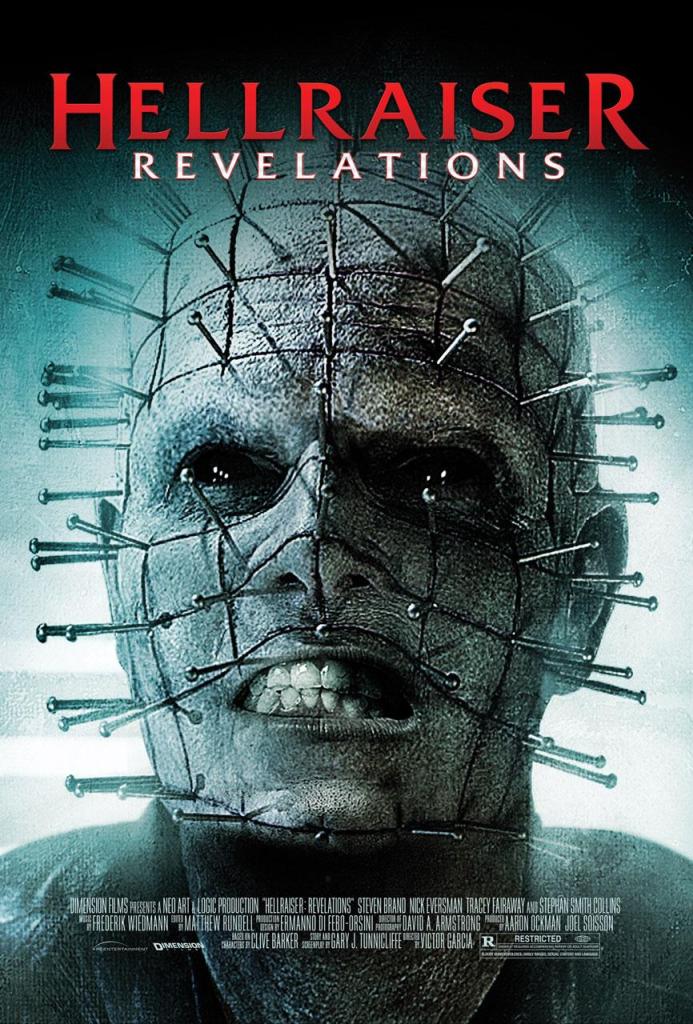
Hellraiser: Revelations (2011)

Directed by Víctor Garcia [Other horror films: Return to House on Haunted Hill (2007), Arctic Predator (2010), Mirrors 2 (2010), Gallows Hill (2013), An Affair to Die For (2019), La niña de la comunión (2022)]

It should come as no surprise that I didn’t care for Revelations. I don’t know if it’s quite as bad as others tend to feel it is, but it’s definitely a long way from good, and I don’t think it’s too much a stretch to say it’s the worst film in the franchise.

No doubt Deader, the seventh movie, had some issues, such as the fact it made no sense whatsoever, whereas Revelations does tend to explain most aspects of the story. However, Deader felt more like the Hellraiser I’d come to expect up to that point, and this one, despite theoretically going back to the basics (including a Frank-like character who steals someone’s skin), I just couldn’t get into it.

Most people know the history behind this one – it was shot in eleven days because Dimension Films realized that they’d lose the rights to the Hellraiser series if they didn’t get a sequel to Hellworld out. Given the short filming schedule and rushed post-production, Revelations does feel quite cheap. That alone isn’t necessarily damning, though the fact that they apparently got down to the wire as opposed to starting months earlier and making a far better film is worthy of some contempt.

Honestly, I don’t think the story itself is that bad. There are some elements of found footage that I could personally have done without, but there’s not enough of that to scare people away, in my view. Following two preppy teens as they fall into a hedonistic nightmare, you can certainly see that portions here are reminiscent of the original Hellraiser, and I can appreciate that. It’s also true, though, that I’ve never been the biggest fan of the first Hellraiser, so though this movie may bring back the vagrant with the puzzle box, I don’t know if that does much for me.

It’s not the story here that’s problematic, though – it’s the acting. I’m not one who goes out of my way to pin issues on performances, but I really felt like some of the performances here weren’t good. It may partially be due to some awkward dialogue (paired with occasionally awful delivery), but regardless, what interest the story may have cobbled up easily got lost in the sea of poor performances.

Nick Eversman (At the Devil’s Door, Urban Explorer) had some funny pieces of dialogue (“They want to experience your flesh”), but he’s a bit much as the movie goes on. Jay Gillespie (2001 Maniacs) and Tracey Fairaway (Patchwork) have more bad moments than good, but again, some of their lesser moments can still be amusing. I didn’t have much against Steven Brand (Triassic Attack, Echoes, The Diary of Ellen Rimbauer, XII, Demons) or Sebastien Roberts, aside from their dull characters, and Devon Sorvari was more stable than Sanny van Heteren, but there’s nothing much here that I think will wow people.

Oh, and we have to talk about Doug Bradley. Naturally, he didn’t reprise his role as Pinhead in this one, and instead we got Stephan Smith Collins (though Pinhead was voiced by Fred Tatasciore, apparently). I don’t know Collins, but I didn’t care much for his portrayal of Pinhead. It wasn’t necessarily the performance as far as the characterization, which felt more malicious than need-be, but he certainly doesn’t hold a candle to Bradley.

Another thing I wanted to mention may come as no surprise. Because of the quick filming schedule for this one, I don’t think the special effects look particularly good. A few sequences are okay, but generally, the hooks looked weak, the pillars of flesh looked faker than usual, and the Cenobites – well, we only see a handful, not counting Pinhead, including a female Chatterer and a Pinhead-wannabe – looked somewhat forgettable also.

Revelations is a movie with problems. Is it as bad as the current IMDb rating of 2.7/10 purports? I don’t think so. It’s a disappointment, but I don’t think it’s quite that poor at all. However, it’s definitely not good, save the basics of the story. Some people may appreciate this for at least breaking the mold of the previous four films (Inferno, Hellseeker, Deader, and Hellworld), but personally, I’d take most of those over this one any time.

4.5/10

Evidence (2013)

Directed by Olatunde Osunsanmi [Other horror films: Within (2005), The Fourth Kind (2009)]

It’s been some years since I’ve seen Evidence, but I recall enjoying it a decent amount, and despite remembering important plot points of the finale, I was looking forward to revisiting this one. Despite not packing the same punch it did when I first saw it, I still feel that Evidence does a decent amount right.

The style of the film is certainly interesting. About 60% of the film is done in the style of found footage, with the other 40% being police investigators watching the footage. Because of this, the movie’s approachable even if you’re not generally into found footage films. Of course, it’s also worth mentioning that some of the film seems a bit much – there’s a sort of freeze-frame thing that happens a couple of times – and the finale does strike me as being a bit too dramatic, but still, it’s fun.

Because I remembered (generally speaking) the ending of this one, I wasn’t surprised by much. I sort of found it funny how the red herrings that are brought up are sort of thrown aside as soon as the perfectly-timed “new” evidence pops up in the videos – it just struck me as awfully convenient. Also, while I enjoy the twist in this one, I sort of wish it had been executed a bit differently, because, as I said above, the finale does feel a tad over-dramatic. I’m also not entirely sure I buy the motive of the antagonist, which is something that perhaps could have been fleshed out more.

Caitlin Stasey (Fear, Inc., Kindred Spirits, All I Need) and Torrey DeVitto (I’ll Always Know What You Did Last Summer, Killer Movie) made for decent focal points, though I have to admit that when neither of them spoke, I couldn’t tell them apart (Stasey’s Australian, so that did turn out to be helpful). Stephen Moyer (The Barrens, The Caller) was good, and though we didn’t see much variety from her, Radha Mitchell (Pitch Black, The Darkness, Rogue, The Crazies) was solid also. Others who merit a mention include Harry Lennix (Cruel Will, Suspect Zero), Svetlana Metkina (Trackman), Nolan Gerard Funk (Bereavement, The Coven), and Barak Hardley (Mockingbird).

Because much of the film was done in the found footage style, there wasn’t really a ton of special effects here. The killer’s design looked grand – imagine a figure in a welder mask with a blowtorch – and that was fun. We did see a kill in which a blowtorch apparently dismembered someone, so that was brutally fun. Generally, though, I feel the movie’s mystery was more interesting than the effects and kills they had going on here.

Evidence isn’t a great movie, and I can understand some of the lukewarm reaction this has gotten from the average person (while I find some of the downright negative reception it’s gotten from critics somewhat questionable), but despite its flaws and a couple of loose ends, I generally had fun revisiting this one. It won’t work for everyone, but personally, I had what the kids call a good time.

7.5/10

Playing with Dolls (2015)

Directed by Rene Perez [Other horror films: The Dead and the Damned (2011), Demon Hunter (2012), Alien Showdown: The Day the Old West Stood Still (2013), The Snow Queen (2013), The Dead the Damned and the Darkness (2014), The Burning Dead (2015), Playing with Dolls: Bloodlust (2016), Little Red Riding Hood (2016), The Obsidian Curse (2016), Playing with Dolls: Havoc (2017), From Hell to the Wild West (2017), The Dead and the Damned 3: Ravaged (2018), Cabal (2020), Cry Havoc (2020), Legend of Hawes (2022), The Vampire and the Vigilante (2024)]

I’ve known about Playing with Dolls for a long time, and because of the little I knew about it, I avoided it. Well, after seeing it, I wish I had kept avoiding it, as it really is quite awful.

To be sure, the movie is not without it’s strong points. The killer, for instance, uses a sledgehammer to kill two people, and that was sort of fun. Uh, perhaps Natasha Blasick had a few moments in which she was quite attractive. Um, the trees were nice?

Okay, there’s not many strong points, and on the flip-side, a whole lotta negative ones. For instance, it seems that little really happens for the first hour of the film. Sure, we get the set-up, but once Blasick’s character is at the cabin, we get nothing for forty minutes save “creepy” scenes of her being followed and watched while not knowing it. It was just tedious and often boring, in my view.

I don’t want to harp on the performances. It’s true that I found pretty much everyone’s acting stilted, including Natasha Blasick (Death of Evil), but I don’t really blame them for it. The story was pretty damn bare-bones, so it’s not like any of these people had much to work with. Blasick looked cute now and again, which was something. David A. Lockhart (The Dead and the Damned) seemed rather weak, but again, I’m hesitant to blame him. Richard Tyson (The Fear Chamber, Flight of the Living Dead, Big Bad Wolf) literally had no character, but boy, was he great at staring at a computer screen menacingly.

There’s also not a real ending here. Sure, where things leave off with Blasick’s character, we’ve seen before, and that’s all well and good, but what happens to Lockhart’s character? What happens to the killer? We literally have no idea. I would hope that this is picked up immediately in the following film, being Playing with Dolls: Bloodlust, but given the quality of the story, I wouldn’t be surprised if it wasn’t.

All-in-all, Playing with Dolls (or, as an alternative title, Metalface, which is the God-awful title I saw this under on Tubi) was pretty bad. When it wasn’t dull af, it was beyond mediocre, and the lack of story doesn’t do this one any wonders. It’s not like the kills make up for that either, which is all the more disappointing.

I wasn’t surprised that this movie didn’t do much for me. Perhaps some out there would enjoy something about it, but it was just terribly bare-bones, in my view, and not at all my type of thing.

3/10