House of the Witch (2017)

Directed by Alex Merkin [Other horror films: No Escape Room (2018)]

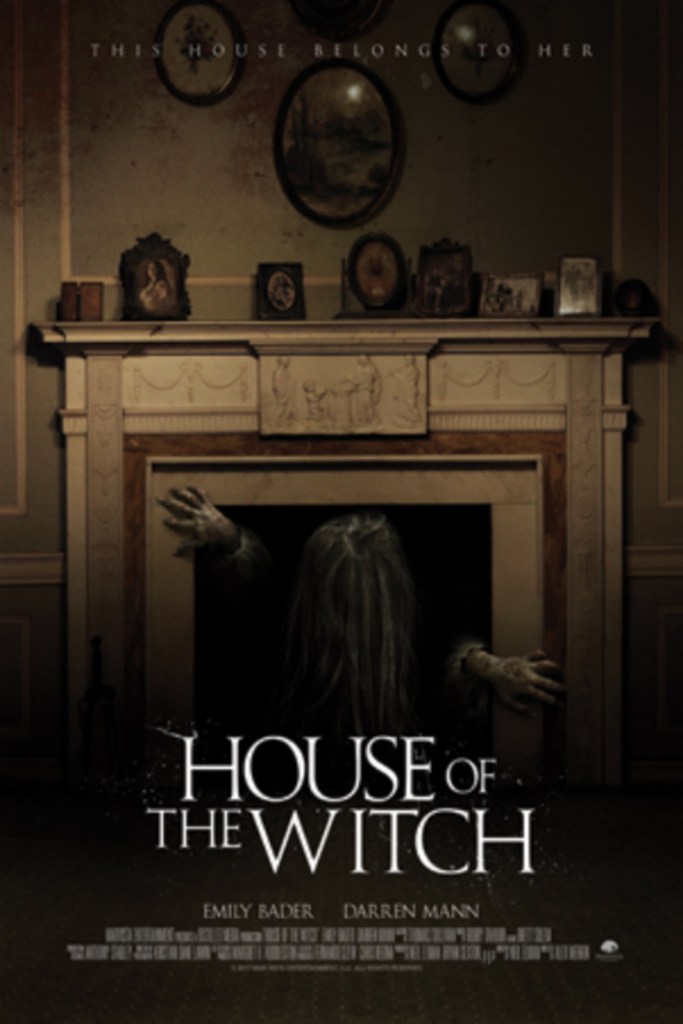
For a Syfy original, I think House of the Witch is decent. It’s not great, by any means, but I do think it transcends much of the crap that they’ve put out in the last seven years.

There’s not much in the way of plot – a group of teenagers go to the local haunted house for a small Halloween party, but shortly after arriving, things begin to happen, such as entities appearing in mirrors, and the doors lock, trapping them all inside.

Despite this, I generally found the film enjoyable, albeit easily on the average side. I think a large part of my tepid enjoyment was due to the six central performances all being reasonably decent. Starring Jesse Pepe, Coy Stewart, Michelle Randolph, Darren Mann, Arden Belle (who is probably the weakest link), and Emily Bader, I found most of them acceptable and decently realistic, so while the story itself isn’t overflowing in creativity, it comes together nicely.

Most of the special effects are your average Syfy fair, but there was one decent scene in which one of the characters had a few of their fingernails pulled our – definitely a painful sequence to watch. Another thing I enjoyed was the idea that breaking the windows of the house didn’t lead outside, but into something else (what that could have been wasn’t explained, but I liked the way they went about it).

House of the Witch isn’t the most inspired Syfy original, but I do think it was decent enough to be thrown an around average score. It’s not as good as Neverknock was, but it blew films like The Sandman and Truth or Dare (all three Syfy films from 2017) out of the water.

7/10

Bedlam (1946)

Directed by Mark Robson [Other horror films: The Seventh Victim (1943), Isle of the Dead (1945)]

What an amazing film on so many levels.

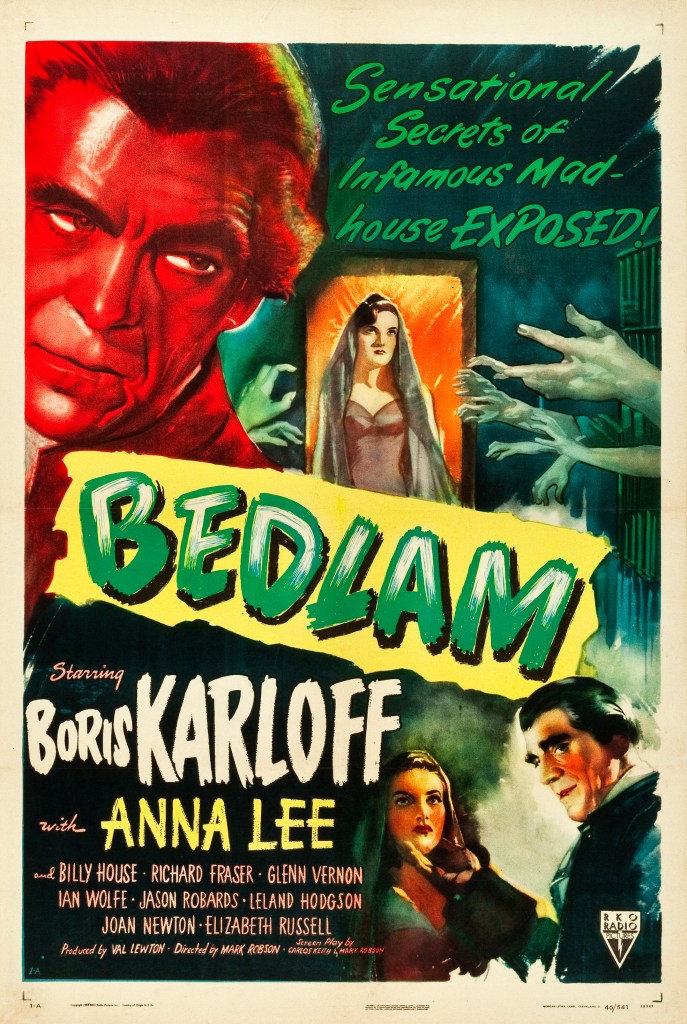
Once a well-to-do lady becomes concerned about the state of a local mental institution, with a little help from a Quaker, and finding that neither Tory nor Whig seemingly care about reforms, she takes it upon herself to fight for what she believes right. Unfortunately, the head of the institute, played by Boris Karloff, has little interest in the welfare of his patients (which seems too generous a term to describe them, truth be told), and instead plots to throw the lady herself into the asylum, so she can no longer speak out.

There’s a lot in Bedlam to really like. What’s easy is the cast. Boris Karloff (who really needs no introduction at this point) is fantastic as the sinister head of the asylum, and has a pretty satisfactory story arc come the conclusion. Anna Lee, too, is fantastic as the lead character, and she definitely has a passion in her throughout the film. At times, her character is unlikable, but for a woman who is starting to see the poor and maligned people as people for the first time, I think that’s understandable. Billy House (who plays an amusing, mostly inoffensive, pompous lord) and Richard Fraser (who plays a straight-laced Quaker wonderfully) both add a lot to Bedlam.

It’s the story that really makes things work. A woman of high standing, Lee’s character slowly becomes moved by the plights of the mentally unsound, but even when in the institute, she can’t get past her deep fear and mistrust of the insanity surrounding her. And when she does make friends in the institution, they’re the higher class of patients (beautifully comparing her previous life of abject apathy with her new life locked up).

There’s a line in the film that really got to me. “Why should we help.” asks one of the upper echelon of patients to Lee’s character, in reference to the cruelty others are facing, “We are the people of the pillar.” I think it’s at that point that the character finally realized exactly the type of person, even locked up, she tended to be, and then set out to change it, by making beds, and tending wounds, of those who couldn’t do it for themselves.

Earlier in the film, there’s a member of the Whig Party who purports to care (as opposed to the Tories, who, much like many modern-day Republicans, revel in the despair of the poor and unfortunate), but later we see him laughing with the rest at a mockery of a play, using the patients themselves as actors. Like many modern-day Democrats, he gives lip service to the issue, but as a man from the upper class, he doesn’t truly have a concern for the welfare of those beneath him.

It takes a Quaker, one opposed to violence of any type, and not prone to lofty ideals, to really bring the idea of equality between all men, poor and rich, peasants and lords, insane and sane, to Lee’s character. At the same time, this Quaker sets too much faith in the laws to really hold a revolutionary view of the best way to help those who need it the most.

Bedlam has a lot of political ideas, and that deeply interests me, but if you can somehow separate the politics from the film, I still think most people would see what a great and clever film this is.

All of my praise aside, I do wish there had been a few more suspenseful and tense scenes. The trial at the finale was fantastic, and the scenes afterward were damn amazing, but it wasn’t enough to make up for the lack of great suspense beforehand. In some ways, Bedlam’s a slow-burn, but I don’t really know, as great as the ending is, if it makes up for what the movie was lacking previously.

The 1940’s is probably, in my opinion, the worst decade for horror films since the creation of the genre, but there are some really great films that came out in this ten-year range, and Bedlam is definitely one of them. I loved this when I first saw it many years back, and the movie still has so much to offer.

9/10
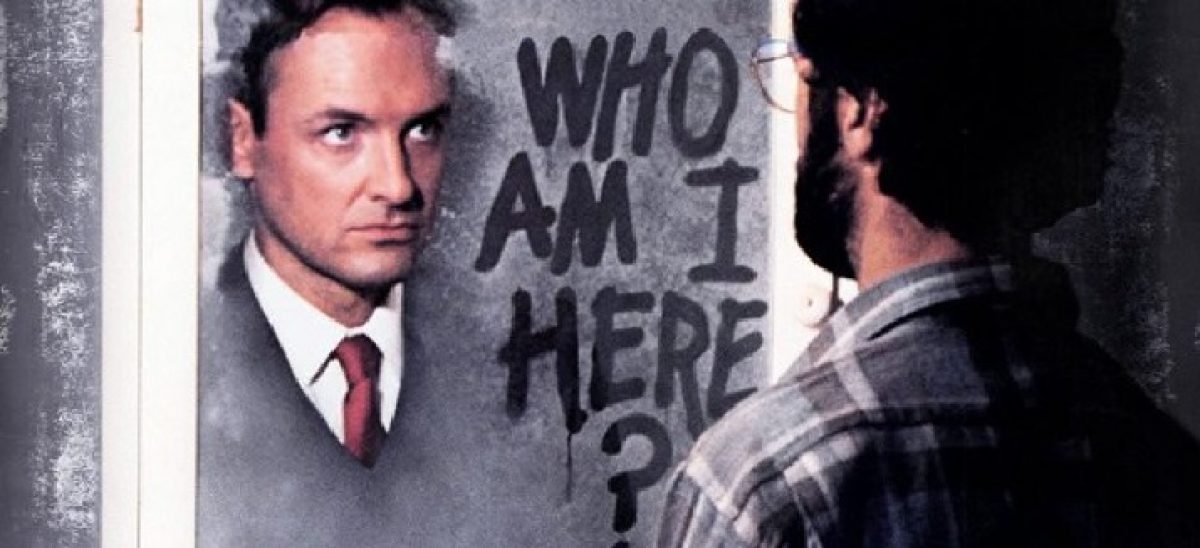
Urchin (2007)

Directed by John Harlacher [Other horror films: N/A]

While a moderately interesting movie, I don’t really have a lot to say about Urchin, as it ultimately didn’t really do much for me, either as a horror film or a drama.

I will say that the Kid, played by Sebastian Montoya, did pretty decent for a young actor (he apparently turned ten during the filming of the flick). Other main actors did well also, such as Rick Poli and Larry Swansen (who died just a couple of years after Urchin was released). Norm Golden didn’t have a whole lot of screen-time, but I enjoyed his character also.

It’s the story of this film, though, that will probably draw the bulk of attention Urchin gets. A homeless man claims he can lead some other homeless people to a paradise within the Earth, but he must find noble souls. One of the homeless guys (Poli) decides to murder five ‘good’ people as a ticket to paradise, while The Kid (Montoya) tries to bring money to the Old Man (Swansen) in order to also secure his place on his side.

As one might imagine, most of the horror-centered scenes come from Poli’s kills, such as a decapitation that was decently well done, along with the kidnap and murder of another person. The Kid gets in some kills too, though, with the use of an acid-filled water-gun and an electrified fork weapon as he fights some gangsters who stole some money he was able to get his hands on. Combine this with a subplot of a man who takes to The Kid, because his daughter recently died, and he’s trying to find closure.

Urchin isn’t an average film, and it can’t cleanly be placed in any real genre. Elements were very strongly drama at times, such as most of the end (and in fact, the finale is actually somewhat moving), but there’s some horror at the beginning that’s decent also.

For a low-budget film with a rather unique story, not to mention ambitious, Urchin was okay, but it wasn’t my cup of tea at all, and while I did enjoy a few things in the film (enough to allow me not to rate the film nearly as lowly as others), it’s not something I can really see myself having the urge to watch again.

5/10

Lavalantula (2015)

Directed by Mike Mendez [Other horror films: Killers (1996), Bimbo Movie Bash (1997), The Convent (2000), Masters of Horror (2002), The Gravedancers (2006), Big Ass Spider! (2013), Tales of Halloween (2015, segment ‘Friday the 31st’), The Last Heist (2016), Don’t Kill It (2016)]

What makes a movie good?

That’s a question I sometimes, perhaps often, find myself wrestling with. There are occasions which I watch a movie that’s terrible on many technical levels, but I still enjoy. The IMDb score might be south of 3/10, but I still want to rate the film an average score (7/10 for me). Is enjoyment more important than technical value?

It must be, because despite the flaws, I found Lavalantula an exceptionally acceptable and enjoyable film.

Let’s talk cast, brothers and sisters: Steve Guttenberg (of Police Academy fame) stars, and while he’s definitely older, you can certainly tell it’s him. Honestly, I’ve not seen Guttenberg in anything outside of the 1984 classic comedy – at the same time, Police Academy is one of my favorite comedy movies ever, so it’s enough to feel nostalgic seeing him here. I really enjoy his sometimes over-the-top performance, and overall got a kick out of him.

No one else really blows me away in particular, but there are some solid performances here. Nia Peeples (who I just saw a few days back, at the time of this writing, in DeepStar Six) does pretty good as an action-oriented mother. Patrick Renna (X-Files ‘Bad Blood’ episode, 2006’s Dark Ride, 2016’s Fear, Inc.) was pretty amusing as a fanboy of Guttenberg’s action-hero persona. There are three characters here who also played characters in the original Police Academy (Michael Winslow, Marion Ramsey, and Leslie Easterbrook), but none of them really do a whole lot for me.

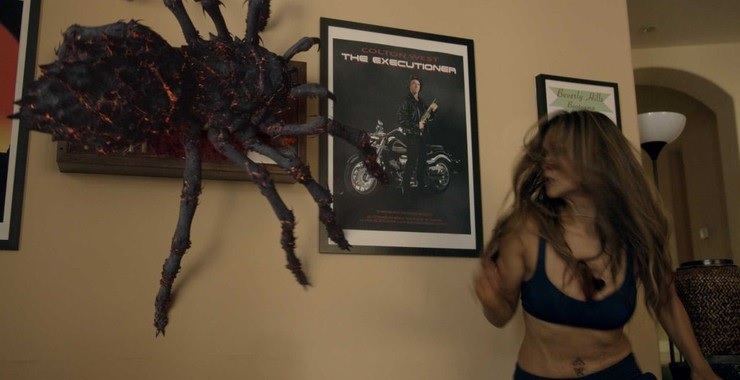
What makes this movie fun is the fact Guttenberg plays a washed-up action-hero, and there are quite a few references made to other films throughout Lavalantula that made me crack a grin (such as Raiders of the Lost Ark, Jurassic Park, and of course, 1997’s Volcano). There’s not really anything that special about the humor, but I had a good time with it.

And I think that’s what this comes down to. Certainly, the special effects here, while still terrible, were better than fellow contemporaries like Arachnoquake, and the spiders here definitely had a better design than the creatures in Arachnoquake, but what matters more was that I had a lot of fun with this one. The conclusion is a bit more ridiculous than I’ve have preferred, but it doesn’t really damage the film much. Overall, Lavalantula is a movie I could see myself buying on DVD, or at the very least, watching again, without much guilt. Or at least, too much guilt.

7.5/10

House of the Damned (1963)

Directed by Maury Dexter [Other horror films: The Day Mars Invaded Earth (1962)]

This one seems to have flown almost completely under the radar, and in fact, ever since I’ve known this movie existed, despite the promise the plot shows on IMDb, it’s never been classified in the ‘horror’ genre [though after this review was first written, it has since been categorized as such]. After having seen the film finally, I can dispel that and say it’s definitely horror, and not only that, but also a pretty decent one, all things considered.

What works well in this rather short film (clocks in around an hour and two minutes) is the creepy vibe it happens to possess. The setting, an old, large house on a hill, looks great, and the black-and-white brings with it additional charm. But there are some legitimately spooky scenes, one in which a man, walking on his hands (as he has no legs) crawls into a room and steals the keys to the house. They filmed that well, because I found it actually somewhat chilling.

The characters, those who appear for more than a few minutes, anyway, work out good too. Ron Foster does a pretty decent, if not perhaps somewhat unremarkable, job as the lead character, and playing his wife, Merry Anders (from the criminally-forgotten 1960 flick The Hypnotic Eye) provides a solid performance also. I could take or leave Erika Peters, but Richard Crane (The Alligator People) comes across well.

Extra interesting note: House of the Damned does contain a somewhat early appearance of Richard Kiel, who many may know from a couple of James Bond movies, but I always remember from the comedy Happy Gilmore. He’s a hell of a lot younger here, playing a mute giant, but he definitely has the same face and brings a good presence to the film.

If this had been done in the 1940’s, I suspect that it’d feel a bit less stellar, if only because old dark house films like this were all the rage back then. By the early 1960’s, though, they’d fallen out of favor, and because of that, this seems made during a somewhat unique time period for a movie of this nature. This doesn’t make House of the Damned any better, by any means, but I do think it allows the film to stand out a bit more (though given the fact not many people seem to know this one, perhaps only I got the memo).

House of the Damned isn’t likely to blow anyone away, but I did occasionally find the vibe really creepy, and the house was such a good, quality setting. A few good red herrings, along with a satisfactory conclusion (which I admittedly saw coming miles away, but I still appreciated it), I rather enjoyed this one. It’s short, charming, and definitely a film that I think more people should at least know about.

8/10

DeepStar Six (1989)

Directed by Sean S. Cunningham [Other horror films: Case of the Full Moon Murder (1973), Friday the 13th (1980), A Stranger Is Watching (1982), The New Kids (1985), XCU: Extreme Close Up (2001), Trapped Ashes (2006, segment ‘Jibaku’)]

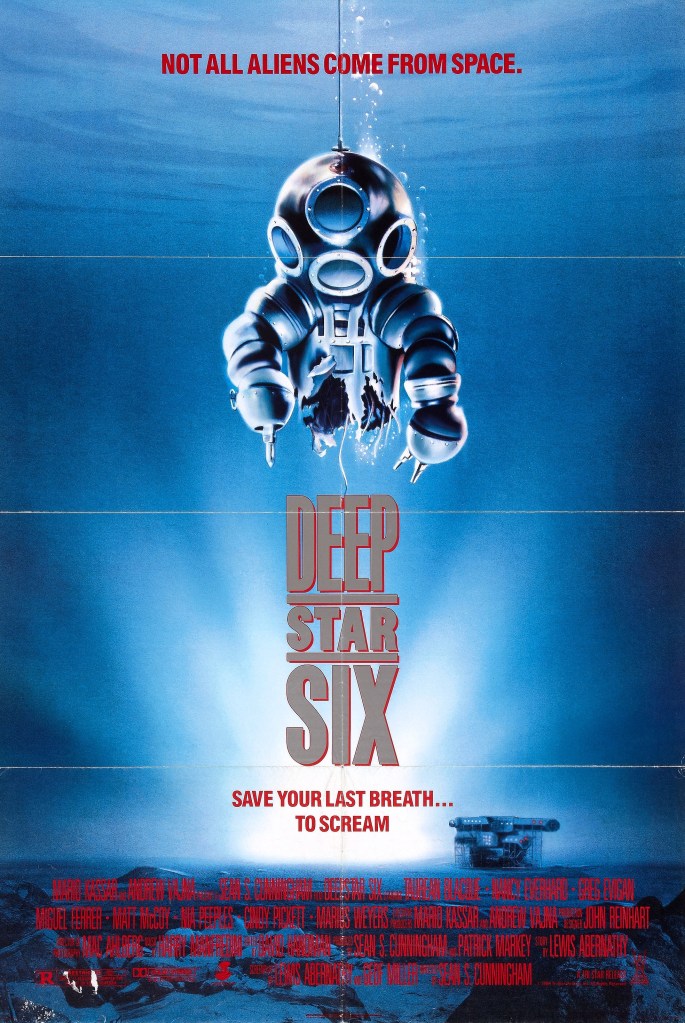
I’ve seen this one once before, and I feel that not much has changed insofar as my view on this aquatic adventure: while much of the story is decently fun, and some of the performances are memorable, I think the film is about as average as it gets.

My only complaint, really, with the story is how, for much of the middle portion of the film, DeepStar Six feels more like an underwater action film as opposed to anything resembling horror. I have nothing against action films (if I did, you better believe this would be getting a lower rating), but that type of focus took away from what I came into this movie for. Once the underwater beast pops up again in the final twenty minutes or so, things pick up nicely.

Many performances are certainly memorable, if not entirely enjoyable. Greg Evigan (who appeared a few years previously in Stripped to Kill) was pretty good as the focal point, though I don’t know if he’s overly memorable. Taurean Blacque (who was a long-standing star on the series Hill Street Blues) was rather great, and I wish the guy had gotten a bit more screen-time. Of course, I think the most memorable guy here is Miguel Ferrer (who later appeared in The Stand mini-series and 1997’s enjoyable The Night Flier), who was pretty fun throughout, and pretty much one of my favorite characters. Others I enjoyed to varying degrees include Nia Peeples, Matt McCoy, and Elya Baskin (also in Air Force One, an enjoyable Harrison Ford flick).

The special effects are overall pretty good. I don’t really love the design of the underwater creature menacing the crew, but plenty of the deaths are really solid, a few bordering on gruesome (such as the death due to lack of depressurization). I just wish there wasn’t such a lengthy period of time that more focused on a disaster-type situation.

Directed by Sean S. Cunningham (of Friday the 13th fame), I can’t necessarily pinpoint why I don’t like DeepStar Six anymore than I do, but it’s much the same as when I first saw it. That said, I certainly don’t dislike the film, so I’d probably call this a perfect example, at least in my view, a very average movie with some good and some mediocre.

7/10

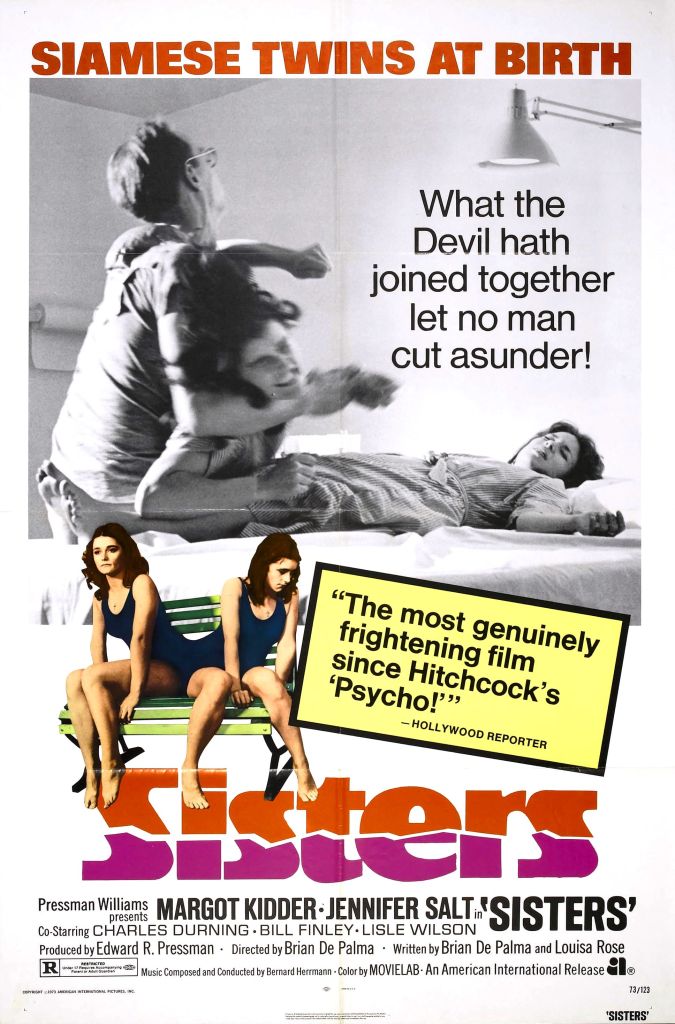
Sisters (1972)

Directed by Brian De Palma [Other horror films: Phantom of the Paradise (1974), Carrie (1976), The Fury (1978), Raising Cain (1992)]

Brian De Palma’s first real movie of note (shortly afterwards overshadowed almost entirely by the immensely popular Carrie), Sisters is a rather interesting and somewhat decent film, though it’s not necessarily altogether as enjoyable as I remember it being from my first experience viewing.

For the longest time, pretty much everything works out. You’ve a journalist (played by Jennifer Salt, an actress often used in De Palma’s earlier films) investigating a murder she witnessed (which the police don’t have enough evidence to look into) with the occasional help of private detective (Charles Durning). The murderer, Margot Kidder’s potentially psychotic character. For the first 50-odd minutes, I think Sisters is an enjoyably immersive movie.

There comes a point, though, about in hour in when there’s a bit of a turn taken that I didn’t entirely care for. Instead of a more clear-cut investigation, it turns more into a trippy, drug-fueled flick for ten, fifteen minutes, and that transition I didn’t care for. Also, while I really love the final shot in the film, I find the overall conclusion somewhat unsatisfactory.

Honestly, I’m not a big fan of Kidder’s performance here, but I did really enjoy both Charles Durning and Jennifer Salt. William Finley (who later appeared in such films as Hooper’s Eaten Alive and The Funhouse) also appeared, but much like Kidder, neither his character nor his performance, especially toward the end, did much for me at all.

Sisters does have a few positives going for it, of course, perhaps most notably a rather fun sequence involving split screen (which was also used briefly in De Palma’s later film, Carrie). The split screen sequence was really enjoyable, and brought with it a solid vibe. Also, the gore, while not a highlight of the film, by any means, is decent. Lastly, like I said, I really love the final shot of the film – not sure exactly why, but it always has a somewhat ominous feel to me.

I enjoyed Sisters a lot more the first time I saw it than I did this time around. Certainly aspects are well-done, and for a majority of the movie, I find myself having a good time, but the conclusion really didn’t work out for me, and while it’s likely still worth seeing, I actually find the film somewhat below average, at least this time around.

6.5/10

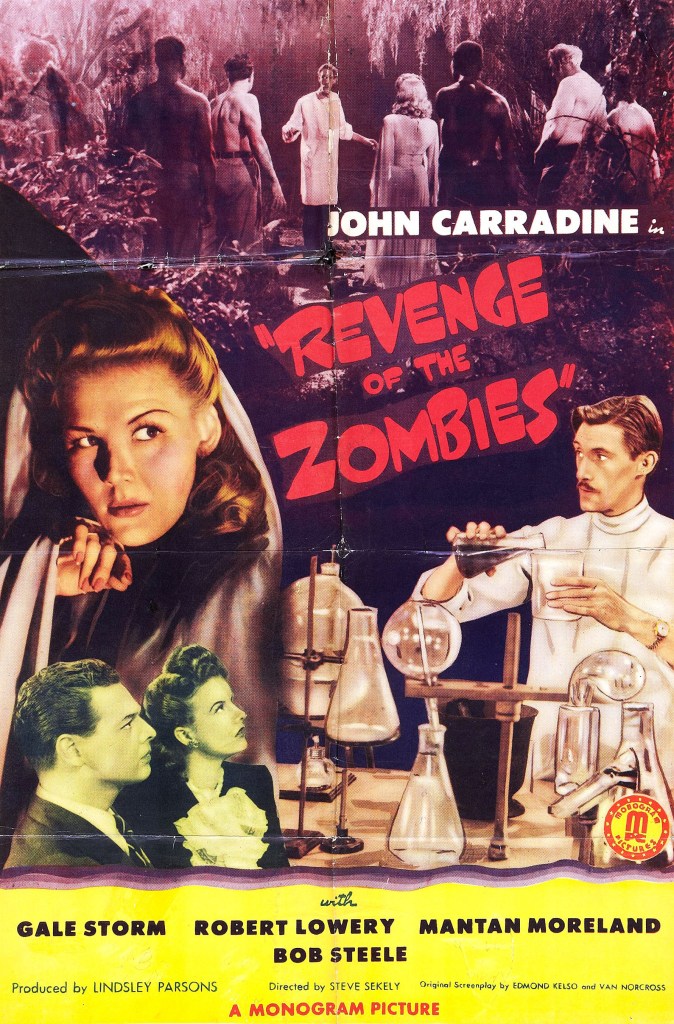
Revenge of the Zombies (1943)

Directed by Steve Sekely [Other horror films: The Day of the Triffids (1963)]

There’s not really that much interesting going on in this early 1940’s zombie flick. Sure, there are some okay performances (most notably John Carradine, sporting a mustache), and a few humorous lines, courtesy of Mantan Moreland, but otherwise, I can’t think of a reason to really give this film much time.

Of course, it’s not really horrible, by any means, just rather generic and derivative, even for the time. I enjoyed a few of the twists (regarding Bob Steele’s character), but the story ultimately wasn’t too different from an earlier zombie comedy, King of the Zombies (interesting note: this film is sometimes considered a sequel to King of the Zombies, but aside from Moreland’s character, there seems to be little connection, and in fact, Madame Sul-Te-Wan, who also appears in both, is a different character here).

John Carradine does well for himself here, though his performance isn’t going to win any awards. Gale Storm was okay, though not overly relevant to the story. The aforementioned Madame Sul-Te-Wan was a bit over-the-top, but still worked well with James Baskett. Of course, Moreland is both humorous and unfortunately not helpful to racial stereotypes. A solid performance, but marred in that he didn’t get any different a storyline than from King of the Zombies. Robert Lowery, Barry Macollum, and Mauritz Hugo all do fine, but none of the three will be overly memorable once the movie’s done.

Ultimately, Revenge of the Zombies isn’t a great zombie film, nor a great horror film, nor a great film of any kind. It’s not even necessarily worth a watch – it certainly wouldn’t hurt, but I don’t see any reason for it, unless it’s due to being a large fan of Carradine. Really, while some of the settings are cool, such as the swamp, and a few aspects of the story are decent, in that war-time, mistaken identity, the bad-guys-are-Nazis-type-of-way, but I’ve seen this twice now, and I can about guarantee I’ll not be seeing it a third time. It’s just not worth it.

5.5/10

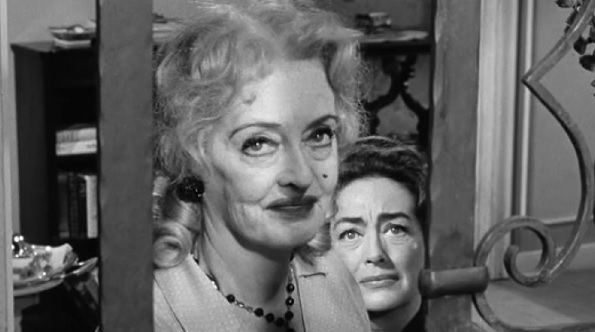
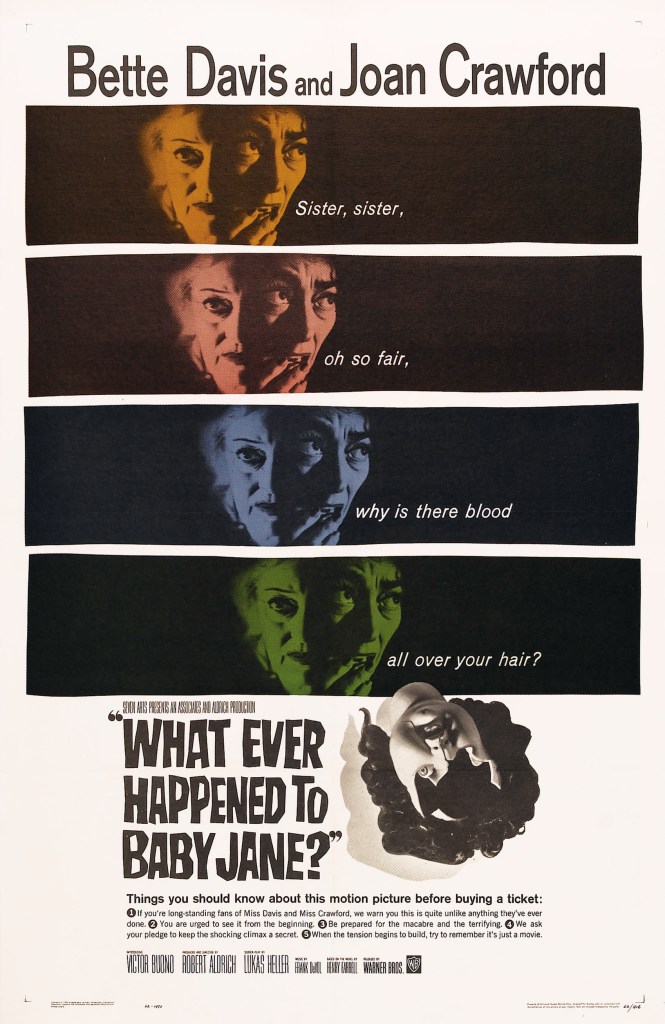
What Ever Happened to Baby Jane? (1962)

Directed by Robert Aldrich [Other horror films: Hush…Hush, Sweet Charlotte (1964)]

It’s been some many years since I first saw this movie, but I’m happy to report that, with a rewatch, this classic movie has lost exactly none of the magic. With a strong cast, an engaging story, and a rather dreary and helpless atmosphere, What Ever Happened to Baby Jane? is an utterly amazing movie.

A lot of the reason this movie works are the performances involved. Both Joan Crawford and Bette Davis do a fantastic job, Crawford as a wheelchair-bound character in a desperate situation, Davis as a long-faded former star, who’s slipping into deeper mental instability, probably not helped by her heavy drinking. Along with an early role from Victor Buono (perhaps most well-known as King Tut from the 1966 Batman series) rounding out the main cast, you can see the movie has a lot going for it already.

These three did a decent amount for the genre too, which I think’s worth mentioning. Davis later appeared in such films as Hush…Hush, Sweet Charlotte (which I think makes a great double feature with this one, if you have five hours free), Scream, Pretty Peggy, and Burnt Offerings. For Crawford, she appeared in Strait-Jacket, I Saw What You Did, and Berserk. While Buono was more well-known for Batman, he did appear in both The Strangler and Lo strangolatore di Vienna (also known as The Mad Butcher).

Strong cast aside, the story here is deeply engaging. On the surface, it’s not overly complex, but they throw in a few surprises, and the relationship examined between the sisters brought a lot of emotion to the movie (especially regarding Davis’ performance, who’s character was both often heinous and often heartbreaking).

I suspect the biggest issue that some people would have with this film, or at least the largest hurdle they’d have before watching it, would be the length. At two hours and fourteen minutes, What Ever Happened to Baby Jane? is a long movie, but I personally don’t think any scene needs cutting, and I think the whole film is rewarding, especially the somewhat tonally different finale on a bright, sunny day on the beach.

The black-and-white is crisp in the film, and I think it helps loan the film some additional atmosphere (which the film certainly isn’t lacking on, but even so, every little bit plays it’s part). The suspense here is very solid, and with the story and cast, I can’t think of a good reason not to recommend this one.

9/10

Attack of the Puppet People (1958)

Directed by Bert I. Gordon [Other horror films: Beginning of the End (1957), The Cyclops (1957), War of the Colossal Beast (1958), Earth vs the Spider (1958), Tormented (1960), Picture Mommy Dead (1966), Necromancy (1972), The Food of the Gods (1976), Empire of the Ants (1977), Burned at the Stake (1982), Satan’s Princess (1989), Secrets of a Psychopath (2015)]

I wasn’t much impressed with this late 50’s flick at all. Though it was decently well-paced and had a somewhat interesting and innovative story, not to mention a few solid performances, the film just felt somewhat off to me.

The best I can say about this is that John Hoyt has a very solid (and somewhat hammy) performance as a lonely, somewhat unstable doll-maker. Hoyt’s character was sort of sympathetic (though honestly, they easily could have thrown more of an origin), and decently creepy near the finale. The only two others who make any difference at all are June Kenney (who appeared also in 1958’s Earth vs the Spider and 1961’s Bloodlust!) and John Agar (who was in such classics as Revenge of the Creature, 1955’s Tarantula, 1956’s The Mole People, 1957’s Daughter of Dr. Jekyll, and others), and neither one really bring a whole lot to this picture.

Admittedly, Kenney does occasionally have a solid ‘little innocent girl’ feel to her, and due to the plot turn taken about twenty minutes in (which sort of took me by surprise, if I’m being honest), she’s placed in a rather compromising position. A big part of my problem with this, though, are the reactions of the other characters reduced in size – that is, to relax and enjoy the fact that they no longer have any worries. When they sort of change attitudes when alone with Kenney and Agar’s characters, I didn’t feel much more pleased with them, and it’s around that time what was a somewhat taut flick begin falling flat for me.

The special effects are okay, but The Devil-Doll (1936), a film with a somewhat similar idea to this one, was almost more impressive in terms of what they could do on-screen, and it’s perhaps not really surprising coming from a director like Bert I. Gordon, who, while he’s done some films I enjoy, is somewhat well-known for his lower-budget features. In fact, there’s a minute or two of a previous film of his, The Amazing Colossal Man, in this film, playing at a movie theater. Solid advertising, brah.

Attack of the Puppet People had potential, but after a certain point, despite the somewhat quick-moving and interesting story, this just didn’t possess that feeling of dread I was looking for. Certainly a lower-class tier flick for the late 50’s (which was a decently prolific and solid time for the horror genre), Attack of the Puppet People (which, by the way, is a somewhat misleading title) just didn’t do a lot for me, and I couldn’t see myself watching this a second time all that willingly.

5.5/10