The Hand of Night (1968)

Directed by Frederic Goode [Other horror films: N/A]

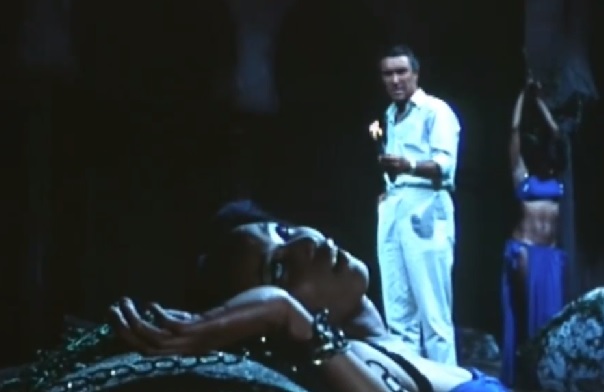
I have to admit that I didn’t expect to care much for this one, but came out pleasantly surprised. While it’s not a great film, and perhaps ultimately just around average, I do think The Hand of Night is a decent little piece of forgotten cinema.

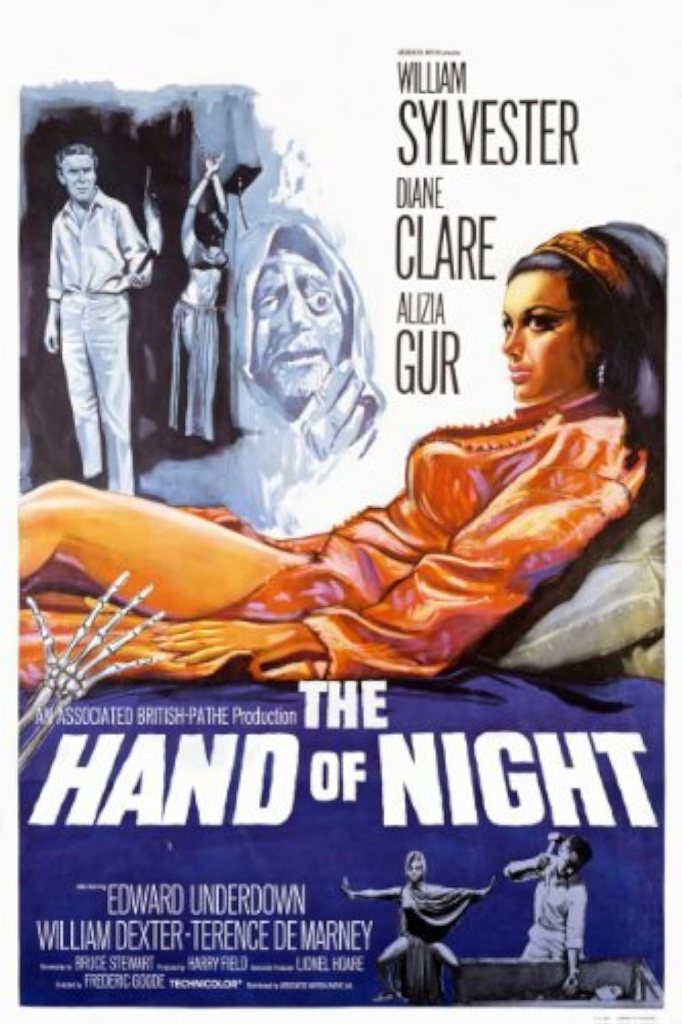
Taking place and filmed in Morocco (a county I know extraordinarily little about), The Hand of Night (or, alternatively, Beast of Morocco) follows a depressed man (William Sylvester) as he becomes enchanted by encounters of a mysterious woman (Aliza Gur) who is potentially a vampire, albeit not in the stereotypical sense. It’s a story that sounds simple, and I guess it is, but they approach it with good style.

The opening is particularly striking, and almost psychotronic, showing a bunch of random images that have no context (naturally, as the movie goes on, we learn more about what we see). I have to also add that I’m a big fan of the dialogue in this movie – plenty of the lines seemed snappy to me, like something I’d expect from films back in the 1930’s or 1940’s, giving this film sort of a classy feel.

Something also has to be said for the editing. The special effects here generally aren’t relevant (though there was a pretty cool bit near the end), but the shots and editing used did strike me as quite nice. This movie definitely had some production value behind it, and while some could argue that the movie isn’t exactly the most memorable film out there, it does seem a shame to me that many don’t seem to know this one at all.

As it is, I do think it lost a bit of steam near the finale. The last sequence I really enjoyed was Sylvester and Diane Clare’s characters running into William Dexter’s in a type of bazaar. Well, I guess that technically leads into another solid sequence, dealing with the history of the mysterious woman, but even so, the last ten minutes or so, sadly, feel the most pedestrian of the entire movie.

William Sylvester (Devils of Darkness, Devil Doll) was great here, as he had some emotional material to deal with, and he did so with heart. Diane Clare (The Haunting, The Plague of the Zombies, Witchcraft), in her final acting role, was solid too, and worked well with Sylvester. Edward Underdown had a lot of heart, and though he only had one scene of real import, William Dexter cracked me up in most of the scenes he appeared in. Technically, Aliza Gur is also here, but I honestly don’t think the story gave her enough to do to properly stand out.

It’s a real shame that the finale has such a familiar feel, because the rest of the movie, while not great, was generally engrossing. To be fair, The Hand of Night isn’t a movie that I’m likely to watch again soon, or even in the next ten years, but it was a very competent and surprisingly philosophical film at times, with some good dialogue and an interesting enough story.

Most horror fans might take a pass at this one, and I don’t even know how easy it is to find (I watched it from a shady Russian site, myself), but fans of classic horror, 60’s British horror, or Morocco, may find this one to be of interest.

7/10

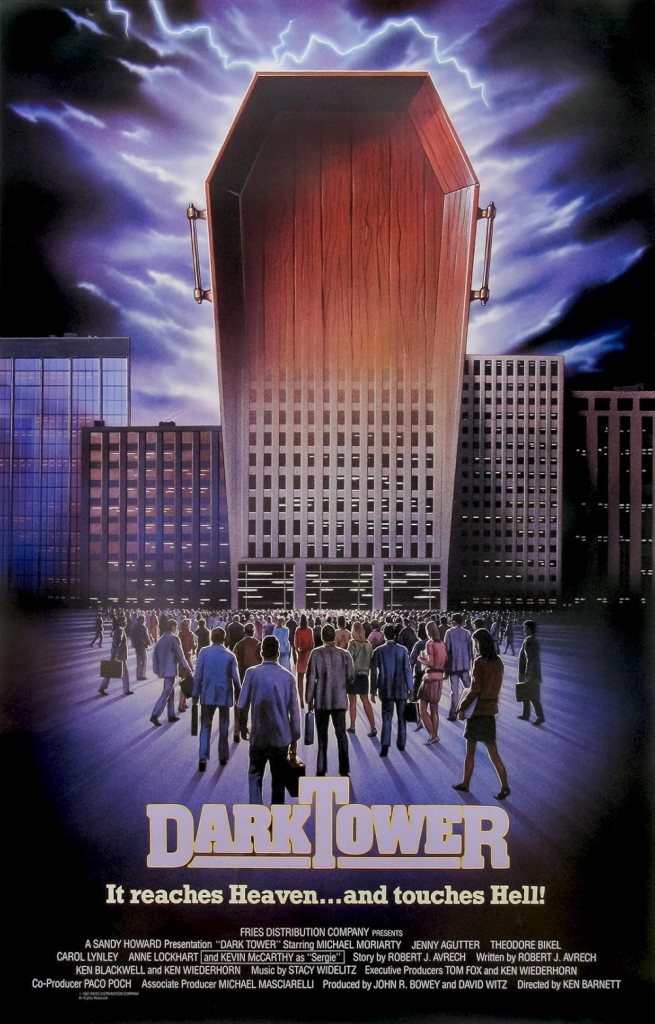
Dark Tower (1987)

Directed by Freddie Francis [Other horror films: The Brain (1962), The Day of the Triffids (1963), Paranoiac (1963), Nightmare (1964), The Evil of Frankenstein (1964), Dr. Terror’s House of Horrors (1965), Hysteria (1965), The Skull (1965), The Psychopath (1966), The Deadly Bees (1966), They Came from Beyond Space (1967), Torture Garden (1967), Dracula Has Risen from the Grave (1968), Mumsy, Nanny, Sonny & Girly (1970), Trog (1970), Gebissen wird nur nachts – das Happening der Vampire (1971), Tales from the Crypt (1972), The Creeping Flesh (1973), Son of Dracula (1973), Tales That Witness Madness (1973), Craze (1974), Legend of the Werewolf (1975), The Ghoul (1975), The Doctor and the Devils (1985)] & Ken Wiederhorn [Other horror films: Shock Waves (1977), Eyes of a Stranger (1981), Return of the Living Dead: Part II (1988)]

I’ve wanted to see Dark Tower for some time now. The idea of a haunted high-rise appeals to me, and I thought it might be an interesting idea to play around with. Sadly, though, I don’t think that Dark Tower is the best execution of this idea.

This is likely known by those involved with the movie, too. I’m not someone who delves into behind-the-scenes information, but I did notice that the original director of this one (Ken Wiederhorn) was replaced by well-known Freddie Francis. And yet, when the movie starts playing, we’re told it’s directed by Ken Barnett; apparently Francis wanted his name removed from the film because he was dissatisfied. I should also mention that he never again directed another movie.

It’s not all bad, though – Dark Tower was filmed in Barcelona, Spain, so anytime we see outside shots, we see some beautiful structures and buildings older than the hills. Despite being in English, the film does possess a foreign flavor throughout, which is nice. It doesn’t make the film altogether that much more interesting, but it’s nice all the same

And while many of the deaths here aren’t too memorable there’s always potential. Early on in the film, a window wiper falls from his scaffolding, perhaps pushed by a malevolent spirit. After being possessed by the same spirit, another takes part in a mass shooting, which was at least filmed well. On the other hand, there was a very weak elevator death – I’d personally stick with De lift or Damien: Omen II.

In the finale, we did see someone get electrocuted, and another get impaled. Well, technically, we didn’t see this individual get impaled, but even so. Unfortunately, though, the finale – or, if I’m being honest, the last twenty minutes – seemed a bit of a mess. Here’s just a small example – three characters go to the haunted building (Michael Moriarty, Kevin McCarthy, and Theodore Bikel), and for some forsaken reason, they split up. No reason was given – we see these three characters enter an elevator, and the next we see of them, they’re in completely different rooms (if not floors).

I liked the idea of this movie, but it definitely felt a bit choppy at times. I appreciated aspects of the finale, and while there’s not really a twist, we do learn more about Jenny Agutter’s character. I had thought that it might have gone in the direction it did, and I was happy that they did so. It didn’t really make the ending much better, but it was at least good in concept.

At first, I did think the movie would follow Jenny Agutter (The Survivor, Child’s Play 2, Dominique), but instead we largely followed Michael Moriarty (A Return to Salem’s Lot, Troll, Blood Link, The Stuff, Q). I was surprised, but okay, with this – it’s not that Agutter wasn’t decent, but Moriarty was more interesting to me (though at times, I have to say that his delivery wasn’t stellar).

I think that Theodore Bikel (I Bury the Living) is easily the most enjoyable performance in the film – despite the movie seeming somewhat lifeless, all of his scenes had character. Lastly, Kevin McCarthy (The Sleeping Car, Piranha, Invasion of the Body Snatchers) appeared, but we never really got a great hang on his character.

Dark Tower can be an okay movie to watch, but it’s definitely a far cry from good, and while aspects were at the very least interesting, I can’t say it’s a movie that will really stick out in my mind, at least not with the rather lack-luster execution managed with this movie. Just a shame, in my view.

5.5/10

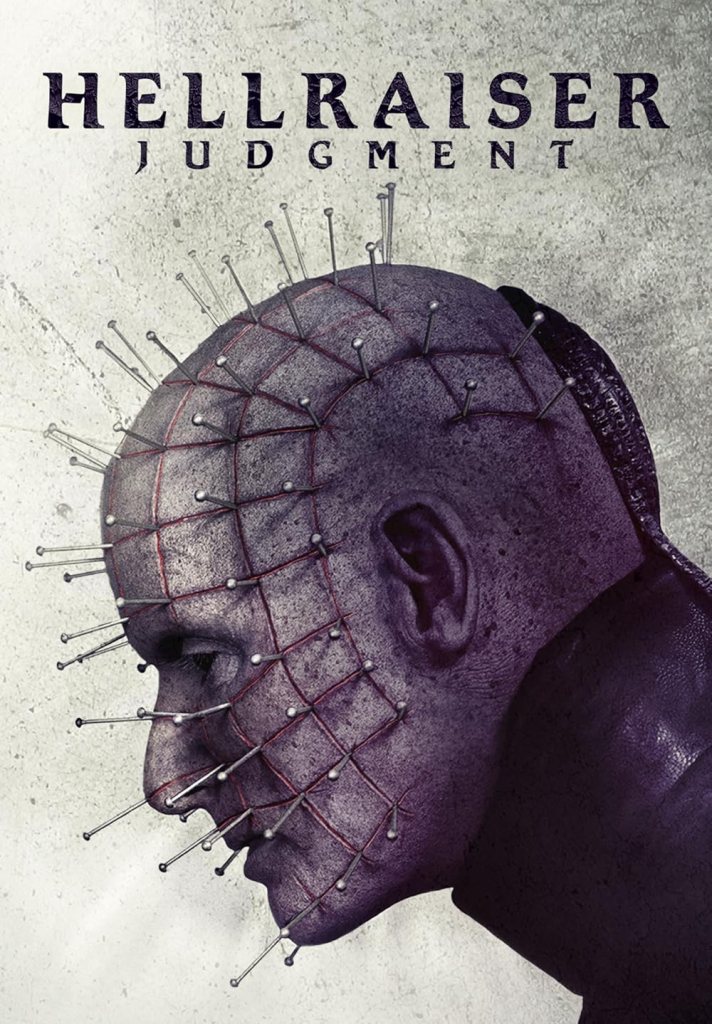
Hellraiser: Judgment (2018)

Directed by Gary J. Tunnicliffe [Other horror films: Within the Rock (1996)]

I’ve been curious about Hellraiser: Judgment ever since it came out. After Revelations, I was hoping the series could get back on track, and after watching the trailer to this one, I thought it had some potential. Well, I have some serious problems with Hellraiser: Judgment, but at the very least, I do think it’s mildly better than the previous entry, albeit not by a lot.

This doesn’t start out well, though, as I absolutely abhorred the first 12 or so minutes. In that time, we see Pinhead speaking to a character called the Auditor, which was fine (though I’d have liked some context as to who or what the Auditor was), and a man being lured to a house.

Once the man gets to the house, he meets the Auditor, who asks him questions about the man’s sins. Once those sins are written down, the man is sent to the Assessor (who looks completely human, on a side-note). The Assessor has a bottle of children’s tears, and combines that with the papers of the man’s sins, and eats them. He then throws the combination up into a pipe. That pipe leads down to the Jury. The Jury are three naked women with messed up faces who spread the vomit over their bodies to render a verdict. Once that verdit is rendered, the man is sent to the Butcher and the Surgeon (the Butcher a big, hulking hombre, and the Surgeon someone in a body-tight leather suit), who then do what they do best.

The whole thing feels like some dark, disturbing fantasy. As someone who doesn’t care for dark fantasy, I hated it. It reminded me of The School, in that it was trying to be as grimy and dirty as possible, and it came across as trying too hard. We get no information during this process – why is the Assessor the only human here? Is he human? Why are the Jury three nude women? Are they women? Why is the Butcher carrying around the Surgeon? Can the Surgeon walk?

We don’t get an answer to any of those questions. Not just during the first 12 minutes, but during the whole of the film. We never learn what these things are. Wikipedia says that they’re the Stygian Inquisition, which is a separate group from the Cenobites. Now, the movie never once mentions the word “Stygian” or “Inquisition,” so I have no idea if that’s accurate. If that’s the case, it would have been great if they mentioned that somewhere, because from my view, having a Hellraiser movie with only minimal Cenobite action, replacing that with random judgy things, doesn’t do much for me.

The reason I’m focused so much on this is because it had to be among one of the most unpleasant beginnings to a film I’ve seen in recent times, rivaling The Rage. During that time, I was thinking that if the movie continued on in that vein, I’d have absolutely no problem saying that Revelations is a better movie.

In fact, a good case could be made that while Judgment is certainly a better film insofar as budget is concerned, it’s a worse Hellraiser film than Revelations. Keep in mind, the focus of this film aren’t the Cenobites, it’s the Auditor. The movie doesn’t say what the Auditor is, but it’s clear that he and the process he follows has little to do with Pinhead, who seems to be an advisor (?) more than anything else. We do see a few other Cenobites, such as Chatterer (for brief moments) and some conjoined women, but we never get much of any of these, save Pinhead toward the end of the film.

Story-wise, I generally liked this one. It follows two detectives (who are also brothers) as they attempt to locate a religious serial killer. Throw in another detective, who is investigating, in part, one of the brothers, and the film feels almost like Se7en at times. I know some have complained about the procedural feel this sometimes has, but in truth, it never bothered me, and there’s a twist toward the end that I thought was actually decent.

Damon Carney (The Harrowing) and Randy Wayne (The Fun Park, Scar, Escape Room, The 13th Alley, Ghost Town, Hold Your Breath) made for somewhat believable brothers. I sort of expected more from Wayne’s character, but Carney was solid. Alexandra Harris (All Light Will End) appeared for a bit, but honestly didn’t stand out that well.

Playing Pinhead was Paul T. Taylor (Shifter), who did decently (though he was certainly no Doug Bradley). Director Gary J. Tunnicliffe himself plays the Auditor. Shame that this fact doesn’t give any more insight into his character. Lastly, playing an angel (I guess) is Helena Grace Donald.

I certainly don’t want to sound ungrateful, as I appreciated that Judgment tried to expand the mythos of Hellraiser. We have some ambitious, theological elements toward the finale, and I actually sort of liked that. I just wish they did a better job of explaining some of what we were seeing, such as the Auditor and his group’s relation to the Cenobites. The ending, too, was sort of unexpected, as Pinhead apparently went too far in his role.

Although I did want to touch on Pinhead, because again, I don’t think his character was done correctly. It’s my understanding that Pinhead is not a malevolent entity. In Hellbound, he stated that “It’s not hands that call us, but desire,” after a character was forced to open the box. In this film, two characters are forced to open the box at gunpoint, and Pinhead takes them anyway. I just don’t care for the more malicious characterization that Pinhead’s gotten in the last couple of movies, and I find it more interesting when he and the Cenobites are amoral as opposed to immoral.

Judgment’s a problematic movie. I was hoping that I’d like it a lot more than I ended up doing, but that doesn’t mean it’s not an improvement over Revelations. However, I can certainly understand why someone might prefer Revelations, if I’m being honest. Judgment was okay, but I really think if some things were cleaned up a bit, it could have possibly great. As it is, though, it’s nowhere close.

5/10

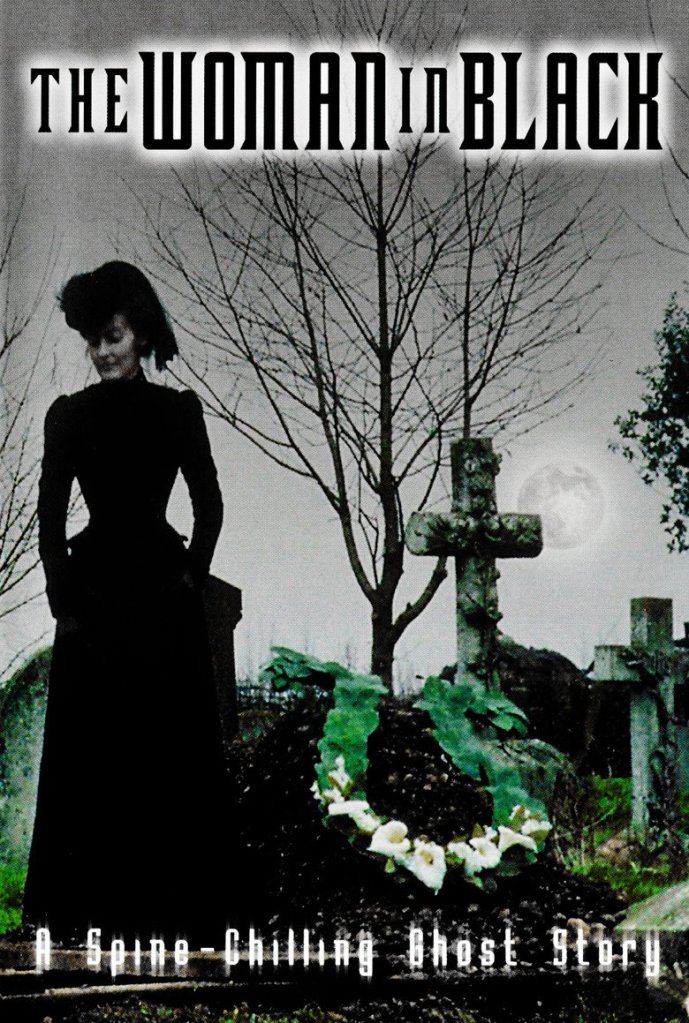
The Woman in Black (1989)

Directed by Herbert Wise [Other horror films: N/A]

Many consider The Woman in Black among one of the better television horror films, certainly when it comes to those that aired in the late 1980’s. For it’s specific classic ghost story, period piece niche, I do think The Woman in Black is quite decent. However, I also have to admit that I suspect many modern-day audiences would find it a tad sluggish, and I don’t think that’s without good reason.

Based on a 1983 novel of the same name written by Susan Hill, the plot follows that of a very traditional ghost story – think The Uninvited, with some sprinklings of The Changeling. It’s not a story that possesses much in the way of surprise or anything – it’s just a mildly tragic ghost movie that reminded me at times of films like The Orphanage and Mr. Wrong.

It’s a rather methodical story, too. It’s not bogged down in details or anything, but the movie can be quite slow. There’s what seems to be a two-and-a-half minute scene of a man going around a large house, looking around the rooms, and turning lights on. It just feels quite sluggish at times, and while it can pick up nicely during some well-placed scares, and the finale itself is decently well paced, I do personally think the film could have been trimmed a bit.

Insofar as the scares are concerned, being a more classy ghost movie (not to mention made-for-television), The Woman in Black is more subtle, largely speaking. There’s maybe four scenes that I’d classify as meant to be scary, and only two actually got much of a reaction from me (and to qualify this, I should say that I’ve seen this movie once before, and had vague memory of it, but it’s been so long that much of it felt fresh).

There is a scene in a small cemetery that works quite nicely, though, along with perhaps the most famous sequence in the movie during the main character’s sickness toward the end. It’s a scene I knew was coming, but still came out very effectively. No doubt the movie, to many modern-day audiences, would feel beyond slow, but a case could be made that it’s that fact that makes the spooky scenes stand out all the more.

Oh, and the ending is rather grim, too. Nothing unexpected whatsoever, but grim nonetheless, and I can see why this frightened so many people when it first aired on that cold Christmas Eve so many years ago in the UK.

Adrian Rawlins (2000’s Blood) made for a likable, if moderately forgettable, lead. He was a pleasant-enough character, but I don’t know if there was necessarily a lot to him. Perhaps one of the other few important cast members was Bernard Hepton, who had some solid moments toward the latter half of the film, and John Cater (The Abominable Dr. Phibes) was decent too. Otherwise, though, the cast here didn’t really hold much a candle to the atmosphere.

Even with the atmosphere, though, the movie runs for about an hour and 42 minutes. I fully think some scenes are great, but to get to those scenes, there’s a lot of material that’s not exactly my idea of engaging. Because of that, it’s sort of a hard movie to tackle – I definitely appreciate what it was going for, and I largely think it succeeded, but it still just feels quite sluggish to me, and it’s a hard case for me to make to call this stellar.

All-in-all, I do think The Woman in Black is a good movie. I just can’t personally see myself watching it all that often, as it’s the type of slow-moving period piece that you’d definitely have to be in the mood for.

7/10

The Beast Must Die (1974)

Directed by Paul Annett [Other horror films: N/A]

Though the idea behind The Beast Must Die is largely fun, I don’t think the execution really does the idea justice. Portions are solid, even tense, but more often, I tend to find myself somewhat bored with the presentation.

I did appreciation the addition of the werewolf break, though – see, this is a whodunit, and we’re directed, as an audience, to try and figure out who the werewolf is, and toward the end of the movie, a 30 second werewolf break is given to us, so we can make our final selections.

It’s the exact type of thing I’d expect out of a William Castle movie. Apparently the director of this one, Paul Annett, wasn’t too keen on the idea, but he got overrode by the producer. It’s nothing that really changes the movie any, but it’s sort of fun, and had the film overall be a bit more lively, it might have made for a solid addition.

The story here is decent, though. Based on a 1950 short story titled ‘There Shall Be No Darkness,’ written by James Blish, the movie revolves around a group of people being brought to a country mansion by a rich businessman, and as he suspects one of them is a werewolf, he hopes to figure out the identity and kill the beast.

Like I said, the plot’s fun on the face of things. And again, there are some decent scenes, such as a werewolf (which pretty much looks just like a wolf) attacks a man through a skylight, or a tense moment in which Calvin Lockhart’s character is facing down a charging werewolf at night in the forest. Still, I found much of the material here somewhat dry, and I’m pretty sure I felt the same way when I last saw this one.

Calvin Lockhart makes a solid, somewhat tense, lead. He’s not an easy character to understand, but Lockhart’s character is decent. Naturally, Peter Cushing (Captain Clegg, Scream and Scream Again, The Abominable Snowman) is great to see, and his character, an academic of werewolves, is fun. Though his screen time was limited, Anton Diffring (Circus of Horrors, The Iguana with the Tongue of Fire, The Man Who Could Cheat Death, the Sylvester McCoy Doctor Who story Silver Nemesis) was nice to see, and he was perhaps one of the best characters here.

Others were decent here. Charles Gray (The Devil Rides Out), Marlene Clark (Ganja & Hess, Black Mamba), and Michael Gambon (the guy who ruined Dumbledore) were all fine. I can’t say that either Ciaran Madden or Tom Chadbon (Duggan from Tom Baker’s Doctor Who story City of Death) made much of an impression, but they didn’t take anything away from the movie.

Again, the issue here is that the movie just feels so dry at times. It’s never a terrible time, but it’s just not always that engaging. I don’t doubt The Beast Must Die has a lot of potential, and I know the movie has it’s fans, but it’s not a movie I personally find that great, despite the fun whodunit element to the plot.

6/10

Tempus Adolpha (2010)

Directed by Shaun Robertson [Other horror films: N/A]

Some movies are almost beyond explanation, and Tempus Adolpa is one of those types of films.

The story is pretty simple – a gay couple is attacked by a gang of werewolves, and one of them survives to become a time-traveling werewolf out to avenge the death of his lover. Well, I don’t know how simple it is, but while it’s definitely a campy comedy/horror mix, it can be an enjoyable experience. The time-travel aspect does lead to some okay ideas also, though nothing that I think would surprise many.

I’ve got to talk about the presentation, though. Look, I’ve said before that I don’t know anything when it comes to behind-the-scenes editing, or anything about how people actually make movies. According to the video description on YouTube, this is “The last film to be filmed with a hi-8 camcorder!” I don’t know what a hi-8 camcorder is, or how hard it would be to make a movie on it, but what I can say is that it seems pretty much every scene was recorded in front of a green screen.

By that, I mean that all the actors have sort of a fuzzy, shimmering lines around them, and it’s obvious the background images are static, and not actual locations the scenes are being filmed at. It’s extraordinarily amataur, as you can imagine, and I’ve never seen anything like it, but I can’t deny there’s both charm and gall in making a movie like that.

There’s no way I can describe this movie and do it justice. As one of the characters uses a watch to go back in time, a black-and-white portal (that looks like it was found on Google Images) pops up, and he goes through it. Well, by ‘goes through it,’ I mean he walks toward it and disappears instantly, cause that’s how portals do.

You have to see this for yourself, because again, I don’t have the right vocabulary to describe this experience. I can say that the werewolf transformations are absolutely abysmal, and I loved them. I can also say that one of the scenes in the movie – a dream a character is having about a werewolf singing ‘Beauty School Dropout’ from Grease – is just beautiful. But talking about these scenes and seeing them are two different things.

The performances are all awful, but it’s a campy comedic movie about a gay, time-traveling werewolf that takes place in the United Kingdom, so I largely cut them a lot of slack. Jack Gardner did just fine as the main character, and his camp gay personality is amusing. Lee James Rosher actually has an emotional scene toward the end, so while he wasn’t in the movie much overall, he definitely stood out. Jasmine Atkins-Smart and Tom Cruz could have done with more personality, but at least Atkins-Smart was occasionally fun.

Some of the music here was decent. True, I could have done without that version of ‘Beauty School Dropout,’ but the song that starts during the finale and plays through the credits, ‘Just Go’ by Nick Celino, was actually quite nice. ‘No Regret’ by Tony Gardner was rough (reminding me of low-budget classic Linkin Park), but I actually thought it showed a lot of potential. You have a band called 3 Daze Lost who perform a song ‘Win Win Situation’ as a gang of werewolves are slaughtering people on the dance-floor, so that was fun also.

The special effects here are, well, not great. But like I said, what this movie lacks in budget, quality, and common courtesy, it makes up for in heart and gall. It’s a terrible movie, and I’ve suspected that ever since I first heard about this one, but it’s truly an experience that I won’t forget. And again, I really do find the ending rather sad.

Tempus Adolpha isn’t a movie that many people would care for. On IMDb, this has under 5 votes, and it’s been available on YouTube in full for years, so I have that idea on good authority. However, as atrocious as it can be, it’s a 63-minute movie that I did have fun watching, so I can dig it.

7/10

House of the Long Shadows (1983)

Directed by Pete Walker [Other horror films: Die Screaming Marianne (1971), The Flesh and Blood Show (1972), House of Whipcord (1974), Frightmare (1974), House of Mortal Sin (1976), Schizo (1976), The Comeback (1978)]

Despite the stellar cast of this one, I didn’t care that much for House of the Long Shadows when I first saw it. Well, I thought it was okay, but I didn’t think it was particularly great. I generally feel the same way now – it’s a solid movie in many aspects, and again, the cast is stellar, but I also think it runs a bit long, and it’s not a movie I’d revisit all that often.

Based on a 1913 novel by Earl Derr Biggers titled Seven Keys to Baldpate (which was later turned into a play, and made into multiple movies), the story follows Desi Arnaz Jr.’s character’s attempt to write a book to win a bet in the deserted mansion at Bllyddpaetwr (Welsh for the win), though he finds that the mansion is not quite as deserted as he was told. It’s a decent idea, but like I said, I feel like it’s a bit long (the movie runs for an hour and 42 minutes), and though the story is okay, I don’t know if it’s enough to carry the film.

Look at that cast, though – true, Desi Arnaz Jr. is the main star, and you could argue Julie Peasgood is a co-star, and neither one is particularly well known (though both do perfectly fine), but look at the others: Peter Cushing (The Abominable Snowman, The Masks of Death, The Skull, The Creeping Flesh, Frankenstein and the Monster from Hell), Vincent Price (Witchfinder General, The Tomb of Ligeia, The Fly, Tower of London ’39 and ’62, Cry of the Banshee), Christopher Lee (I, Monster, The Two Faces of Dr. Jekyll, The Virgin of Nuremberg, Curse III: Blood Sacrifice, Circus of Fear), and John Carradine (Crowhaven Farm, The Nesting, The Unearthly, Curse of the Stone Hand, Revenge of the Zombies).

Obviously, all four are giants of the genre – I’ve long been a fan of Vincent Price and Peter Cushing, and both Lee and Carradine are always decent too. In this movie, I actually do think that Christopher Lee’s character is the most interesting, but Price gives a lot to the movie also. Peter Cushing is a little more limited here, and John Carradine (who was around 77 at the time this was filmed), while fun, doesn’t have that much to do either. Still, it’s great to see the four of them in a single movie, despite the fact I don’t think the movie’s great.

Other performances worth mentioning include Sheila Keith (Frightmare, House of Whipcord), Richard Todd, Louise English, and Richard Hunter. I don’t think any of them add as much as Price, Cushing, Carradine, or Lee, but then again, how could they?

The story is reasonably fun. It’s worth mentioning, at this point, that the movie does have a somewhat light-hearted tone to it. The finale is almost whimsical, and while the humor is never over-the-top, the light-hearted nature is obvious throughout. And speaking of the finale, while I don’t know if it was executed entirely well, I can sort of appreciate it. It does seem a little bit ludicrous, but at least it was different.

As far as the kills go, there were two that I thought stood out – in one, a woman is washing her face, but unfortunately the water in the basin was replaced with corrosive acid, and that doesn’t do wonders for the woman’s complexion. In another, a character is killed with a battleax – we don’t see the kill, but we do see the attack through silhouettes, which looked pretty damn cool. The movie harkens back to the old dark house mystery days, but there are a few scenes here that does remind us it takes place in the 1980’s.

For the cast alone, I think it’s a movie worth watching, and generally, it’s regarded pretty well. Having seen it twice, it’s not something I personally love, but I suspect many would be happy with this one, and they’re not without reason.

7/10

Last Night in Soho (2021)

Directed by Edgar Wright [Other horror films: Shaun of the Dead (2004)]

I had consistently heard positive things about Last Night in Soho, but tried to go into this one without expecting too much. As it turns out, I found the film absolutely stellar, and I pretty much loved everything about it.

Given the movie is almost two hours long, it’s sort of hard to know where to start. I suppose the story is as good a place as any – a somewhat naive girl with a love for the 1960’s goes off to London to attend a fashion school, and things happen.

I have heard it said that while the movie is visually stunning (and it is – I’ll talk about this later on) – the story is sort of weak. Honestly, I get where those type of comments are coming from, because you can definitely see some things coming from a mile away, but even with that fair critique, I still dug the hell out of the film.

A lot of it is Thomasin McKenzie’s character. When she gets to London and the student housing, she’s out of place – while most others are interested in getting wasted, going out, having sex, and listening to shit music, all her character wants is a quiet room so she can listen to high quality tunes.

And to be fair, I’m biased. When I went to college, I felt very out of place myself. I never drank before college, never did drugs, never had sex. Hell, I pretty much never drove. So trying to form connections with people at college was awkward and difficult. In fact, I have a clear memory of talking to some guy at breakfast, and he was looking forward to the weekend for the parties, and I told him that I’d never drank nor been to parties.

Pretty sure I never spoke to that guy again.

My point is that I felt very connected to McKenzie’s character, and her performance of said character was absolutely fantastic. I haven’t seen McKenzie in anything else, but she does a lot for this movie. In her final role before her death, Diana Rigg (Game of Thrones, Theatre of Blood) was great to see, and she did fantastic as well. It’s a true shame she died before the film came out. Matt Smith (Doctor Who, His House, Patient Zero) was a pleasure to see also, despite his rather awful character.

Naturally, Anya Taylor-Joy (The VVitch, Split, The New Mutants, Marrowbone) is a household name by now, and she did great here too. Her character isn’t necessarily fully delved into, but no doubt she’s one stylish lass. Michael Ajao took a bit to appear in detail, but his character was one of the good ones. Terence Stamp (who I only know randomly from Yes Man; also in Spirits of the Dead, Mystery on Monster Island, and Link) was good, though his character seemed sort of easy to get a hold on.

Other performances that merit a mention include Synnove Karlsen and Rita Tushingham. Karlsen did well as the sort of stereotypical mean girl, and Tushingham, as McKenzie’s grandmother, added a lot of additional emotional resonance into the film.

Visually, there’s no doubt the movie was stunning. During the 1960’s portions, it seemed rather authentic. Of course, I was born in 1993, and no nothing about how authentic it actually was, but it definitely had that swinging vibe I’d expect. There were great uses of visual effects throughout, be it the cinematography or the use of colors. Toward the end, as a character is climbing some stairs to get away from someone – well, the way I write that doesn’t sound like much, but the way the scene is filmed is simply stellar.

And I can’t say enough how amazing the soundtrack was. Most of the songs here are by artists from the 1960’s – you have The Searchers (‘Don’t Throw Your Love Away’), Cilla Black (‘You’re My World’ and ‘Anyone Who Had a Heart’), The Walker Brothers (‘Land of 1000 Dances’), Dusty Springfield (‘Wishin’ and Hopin’’), Peter and Gordon (‘A World Without Love’), Sandie Shaw (‘(There’s) Always Something There to Remind Me’), and Dave Dee, Dozy, Beaky, Mick and Tich (‘Last Night in Soho’).

My favorites, though, were ‘Starstuck’ by The Kinks, ‘There’s a Ghost in My House’ by R. Dean Taylor, and ‘Eloise’ by Barry Ryan. I have to admit, somewhat shamefully, that I didn’t know any of these songs, but I did listen to plenty of 60’s music growing up, so I definitely loved a lot of this. I do know Cilla Black, for instance, but just her song ‘Everything I Touch Turns to Tears,’ and I of course know ‘Downtown,’ but the version I know, by Mrs. Miller, doesn’t have quite the impact the one in the film does.

Actually, there is one last song I have to mention. See, most of the music in the film are songs from the 1960’s, but there is a scene in a club, where McKenzie’s character is trying to block out the horrors and confusion that she’s facing, and though the song as she enters the club is ‘There’s a Ghost in My House,’ it soon turns to Siouxsie and the Banshees’ ‘Happy House.’ I admit, I only know Siouxsie and the Banshees’ first album (The Scream), but I’d know those vocals anywhere, and though the song is so different from most everything else, it fit in beautifully.

The mystery here may not be as engaging as the music or visual styles, and while I was surprised by some things during the finale, again, I saw some of it coming far earlier on. Even so, this movie was so unique, and so moving (I loved the final scene), that I loved it quite a bit, flaws and all. I don’t think the movie’s perfect – I can’t quite go that far – but I do think it’s very good, and definitely one that I’d want to see again in the future.

9/10

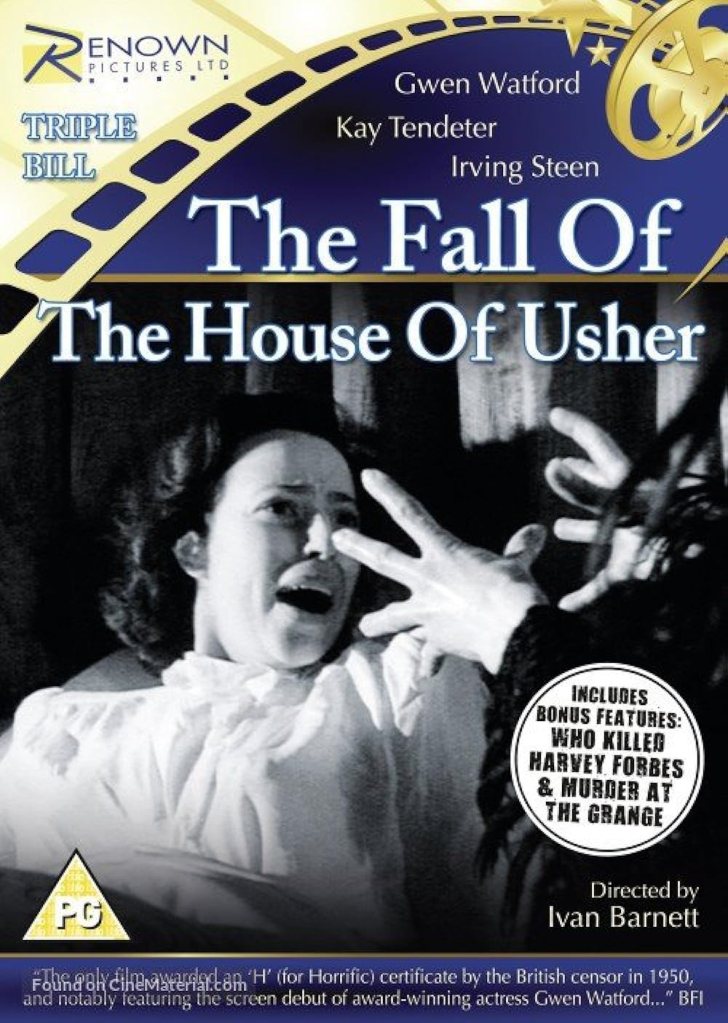
The Fall of the House of Usher (1950)

Directed by Ivan Barnett [Other horror films: N/A]

This is a movie I’ve been wanting to see for some time. Sure, seeing another rendition of a classic Edgar Allan Poe story is nice, but it’s more the time period this came out that drew my attention. As it is, while the movie has potential, it also feels a wee bit on the lifeless side.

There are two periods of time in which horror films were close to nonexistent, being the late 1930’s (specifically 1937 and 1938) and the late 1940’s to early 1950’s. Exceptions exist, of course – Sh! The Octopus, The Ghost Cat and the Mysterious Shamisen, The Terror, Uncle Silas, Things Happen at Night, Inner Sanctum, The Queen of Spades, The Invisible Man Appears, and El hombre sin rostro – but it’s a rather dry period, and so any film released around that time is of immediate interest to me. Ever since I ran across this one on IMDb, I’ve been curious, and though it’s a somewhat disappointing version of the story, I am happy to have finally seen it.

I think the main issue is that the movie feels quite stagy, as though we’re watching a play. Some of the acting is exceedingly melodramatic, especially toward the end, and though there are promising portions – the temple of torture, and the old woman entombed within, are good examples – much of the film doesn’t seem that engaging, and the finale, while containing some action, seems too little too late.

Also, I find it somewhat amusing that while Irving Steen’s character is narrating the story, his character is absent for much of the plot, and he never actually does anything at all, really, aside from painting and reading with Kaye Tendeter’s character. Oh, another odd thing – this main story is framed by a group of gentlemen at a club, with one of them reciting the Poe story The Fall of the House of Usher – at the end of the film, these men discuss what the finale of the story means, and it’s just an odd way to present the film.

As for the faithfulness and veracity of this rendition, I cannot speak, nor would I dream of doing such, of whether the story possessed within conforms to it’s source. That said, I did rather enjoy Steen’s narration, as it definitely had that style of writing down that I do tend to associate with Poe. It was melancholy, dreary, dramatic, and all the more fun for it, and arguably, the best part of the movie.

Really, that’s what Irving Steen brings to the film – a quality narration. Given his character doesn’t do anything else, it’s good to have a part. Kaye Tendeter was nowhere near as engaging as Price was in the role of Roderick Usher, and as I said, he was both dramatic and, conversely, stilted, at times. Actually, many of the performances felt stilted – again, this whole film feels somewhat lifeless.

Gwen Watford (in her earliest role – she was also in Taste the Blood of Dracula, The Ghoul, and Never Take Sweets from a Stranger) didn’t seem to have that much in the way of agency, but she had an okay scene or two. Vernon Charles was actually relevant to the plot, which was at least nice, but his performance was probably the worst here. Lucy Pavey looked creepy, so kudos.

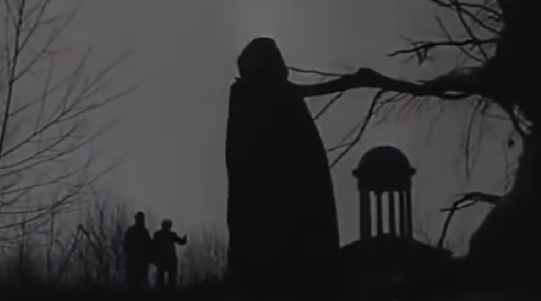
There were some cool shots of the temple – a fact I think they knew, as we saw the same angle about four times throughout the film – what with the silhouettes of people walking toward it from the moors. The backstory of the curse the Ushers are under was pretty gruesome, and I dug it. Most of story is even decent – it’s just that the execution here is both stilted and dry.

While I did enjoy this version more than the 1928 French movie, it doesn’t have the charm of the 1960 Price movie. It’s a curiosity insofar as it’s release date, but beyond that, I don’t really think it’s a movie that will be all that memorable.

6/10

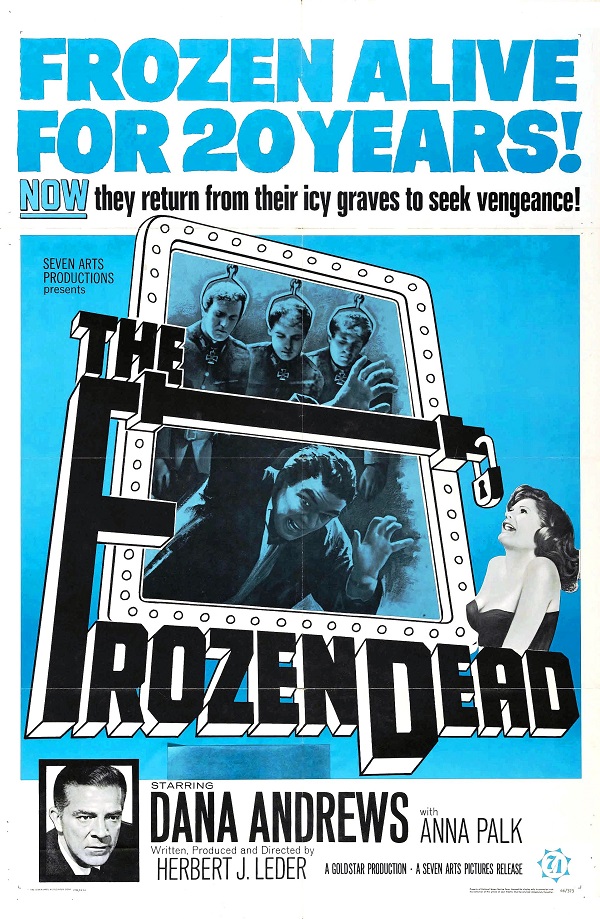
The Frozen Dead (1966)

LEAD Technologies Inc. V1.01 Sized3000

Directed by Herbert J. Leder [Other horror films: It! (1967)]

More than anything, while I wouldn’t say The Frozen Dead was a dry film, or even a bad film, I just didn’t care for the story. It doesn’t help that far more important to the movie than the titular frozen dead is a decapitated head kept alive, and that’s simply not where my interest lies.

Dealing with a Nazi scientiest twenty years following the fall of Nazi Germany attempting to revive frozen Nazi soldiers, there’s some okay Nazi action going on here. Some solid loyalty to the party, some nice German accents, and a scheme to, I guess, get into another war after reviving around 1500 soldiers. I don’t know how exactly they expected that to work, but I guess kudos for the optimism.

Some story elements didn’t seem entirely delved into, such as Dr. Norberg’s (Dana Andrews) connection with Mrs. Smith/Schmidt (Ann Tirard), or what happened with Basil Henson’s character, who just seems to disappear after an attempted murder. I doubt an answer to either one would change my overall perception on this one, but it’s just small things I noticed. Oh, speaking of which, I did enjoy seeing a crew member clearly on screen during one of the final scenes of the film. Looked totes professional.

Related, this was apparently released to American theaters (it’s a British movie) in black-and-white, though the print I saw on TCM was in color. I sort of wonder if perhaps seeing the movie in black-and-white would have increased the atmosphere at all, but at the same time, even if I had seen it in that form, it wouldn’t have made the story here any more enjoyable.

For what his character is, Dana Andrews (Night of the Demon) is fine. I’d have like to see him wrestle between the love of his niece and his loyalty to the Nazi Party, but whateves. Anna Palk (Tower of Evil) was okay, but didn’t strike me as memorable. Honestly, while Basil Henson was fun as a Nazi who likes to inflict pain, and Karel Stepanek made for a decent former Nazi general, that seemed to be all there was to their characters. It may come as little surprise that Alan Tilvern was likewise unspectacular.

At least Philip Gilbert’s character was sort of interesting. True, he was the expected generic love interest of Palk’s, but his character, an American scientist, actually takes an active part in Andrews’ unethical science experiments, and it’s not until things get worse that he decides to take a step back. It’s not much, but it at least added some flavor.

Elsewise, there’s not a whole lot here. I would have likely enjoyed it more if it actually dealt with the frozen dead, but they play very little part in the movie. Even toward the finale, when it seems like their focus could deepen, it doesn’t. The wall of arms (which, by the way, was hella creepy) got more action than the frozen dead, and it’s just a disappointment.

Even so, I don’t think it’s a terrible movie. If it’s the type of horror you’re into, then got for it. I’d never say The Frozen Dead doesn’t have some okay ideas, but generally, I just didn’t enjoy this one, and I doubt that seeing it again in the future will change that.

5/10