Tentacoli (1977)

Directed by Ovidio G. Assonitis [Other horror films: Chi sei? (1974), There Was a Little Girl (1981), Piranha Part Two: The Spawning (1982)]

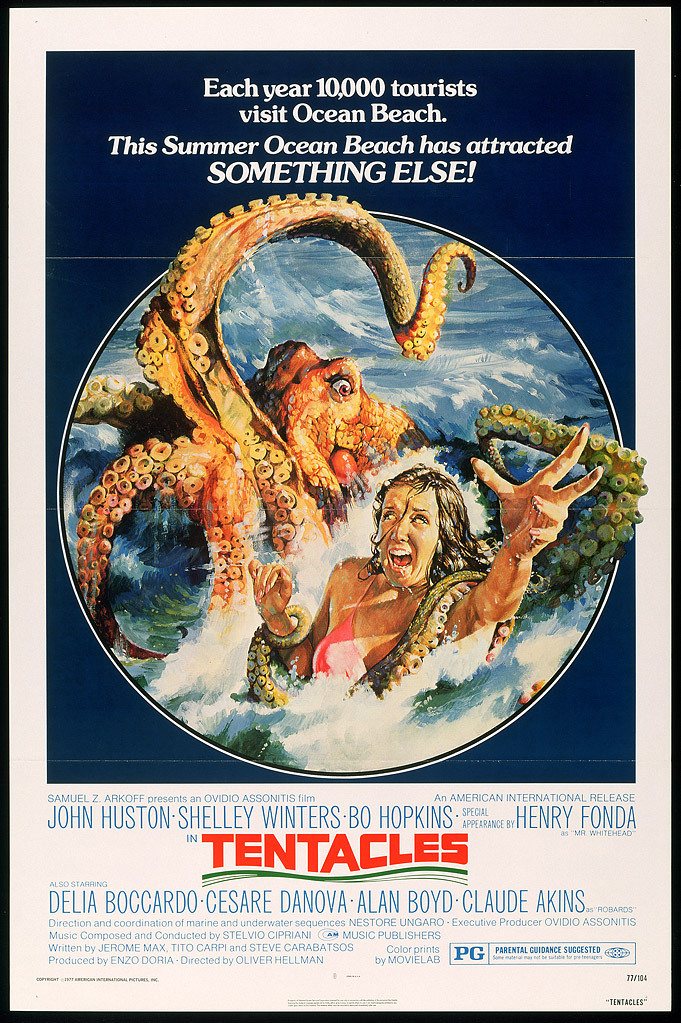
Commonly known in the USA as Tentacles, Tentacoli is a movie that could have been better. As it is, it’s not a bad time, but it can be a bit dry, and perhaps there’s not enough action to bolster it.

I first heard of this film in a rather unconventional way. See, I’m a big music guy – I listen to pretty much everything (save blues and jazz), and some of what I listen to is quite out of the mainstream. There’s a band called Tentacle PornMonster, sort of a pornogrind/goregrind mix, and their song ‘The End Of The Tentacle Orgy On The Beach’ starts off with a trailer for this movie, finishing off with calling it the ‘most gripping suspense you will ever experience.’

Since that point, I’ve wanted to see it, and some years later, I did. I can’t really remember much about what I thought about Tentacoli the first time I saw it – certainly I recall the regatta sequence – but while I find it a decent time, I can’t say that there weren’t quite a few times when the film wasn’t that engaging.

There’s no doubt in my mind the best scene is the aforementioned junior regatta. A bunch of young kids go out on a yacht race, but something else (and by ‘something else,’ I mean a giant octopus, not Marjean Holden) wants to join in on the festivities. It’s a good sequence from the beginning parade with the jaunty music to the flash-freezes used throughout, followed by the action in the water and the tragic premature conclusion of the regatta. It’s good stuff.

Another thing I really enjoyed about this was the music. There was a bunch of funky music throughout the film – it was sometimes suspenseful, it was sometimes jaunty – and it was always fun. I’m not sure why Italy’s movies of the 1970’s and 1980’s has more noticeable music than the United States counterparts, but in my personal view, they do.

Bo Hopkins (Night Shadows, Sweet Sixteen, A Crack in the Floor) was pretty good. I liked his relationship with the whales, and in fact, his little speech to the whales toward the end was pretty emotional. John Huston (The Visitor) was fun, though he doesn’t really have anything to do in the latter portions of the film. Henry Fonda was okay, but his character never got the comeuppance he was due, not by a long shot.

Others, such as Delia Boccardo (A Black Ribbon for Deborah), Claude Akins (The Norliss Tapes, Monster in the Closet, Where Evil Lives, The Curse, Tarantulas: The Deadly Cargo), and Shelley Winters (Poor Pretty Eddie, The Mad Room, Whoever Slew Auntie Roo?, The Initiation of Sarah, The Devil’s Daughter) all did decent, but none of them added that much to the movie as a whole.

I think the biggest problem with this, aside from it sometimes being a bit dull, is that the finale, the final battle between the giant octopus and two killer whales, just isn’t that engaging at all. I mean, it’s about five minutes of them fighting underwater (as one can expect) while Hopkins’ character tries to escape the fray and survive. It just wasn’t an interesting finale, and I think it probably could have been done better.

Naturally, this is, in many ways, a rip-off of Jaws, but in typical Jiggy fashion, I do tend to enjoy it more. Partially, as I mentioned in It Came from Beneath the Sea, it’s due to the fact I enjoy octopi, and the octopus here was pretty fun when he popped up.

Even so, I can’t say the movie is great. It’s entertaining at times, but other times it can be a bit of a struggle to sit through, and the fact it’s an hour and 42 minutes doesn’t help matters. Some sequences were really fun, such as the regatta, but overall, I tend to find this around average.

7/10

La casa dalle finestre che ridono (1976)

Directed by Pupi Avati [Other horror films: Balsamus l’uomo di Satana (1970), Thomas… …gli indemoniati (1970), Tutti defunti… tranne i morti (1977), Zeder (1983), L’amico d’infanzia (1994), L’arcano incantatore (1996), Il nascondiglio (2007), Il signor Diavolo (2019), L’orto americano (2024)]

I have to admit that, though I expected a decent amount from this giallo, given the positive reception I’ve heard as long as I’ve known about the movie, La casa dalle finestre che ridono struck me as more than a little disappointing.

Commonly known as The House with Laughing Windows, this Italian movie definitely had some charm to it, not to mention tension and a pretty foreboding atmosphere, but I also don’t know if they explained everything as well as they could have.

And I don’t like saying this, either. The movie currently has a 7/10 on IMDb (with 5,394 votes), and since finishing it, I’ve read theories and ideas on some of the things in the film, such as how it’s a take on Italy’s cowardice during Mussolini’s reign. A lot of these ideas are interesting, but I usually expect gialli to lay at least a decent amount of it out, and that’s not what happened here.

Sure, there’s a shocking scene at the end. Anyone who’s seen this movie knows the scene I’m talking about. But what does it mean? I have no trouble buying that there’s a mass culture of silence in the community (as it’s pretty clearly stated in the movie), but there’s so many unanswered questions that, no matter how atmospheric and oppressive the movie is, I’m bothered by it.

The performances weren’t the issue here – Lino Capolicchio (Il signor Diavolo) made for a perfectly fair lead, Francesca Marciano an acceptable love interest, Giulio Pizzirani was good while he appeared, and Pietro Brambilla, while odd, was okay. Vanna Busoni’s character appears for five minutes, but then entirely disappears, which was an interesting choice.

The red herrings throughout weren’t bad ideas, but some of them (such as the watch Fransesca Marciano’s character has) seem to be set up, only to never be mentioned again. The whole movie, on a side-note, seems to move pretty quickly, but there were times when I was wondering what exactly was worrying the characters, as little we’d seen up to that point really seemed worth being frightened over.

Not everyone needs answers, and obviously, plenty of people enjoyed this one quite a bit. I was hoping to be one of them, but I just can’t. Maybe I can grow to appreciate this one with future watches, but the fact that so much is left unclear rubs me the wrong way. If I wanted an artistic allegory about post-fascist Italy, I wouldn’t be a horror fan, and this one, while it has it’s strong elements, just felt off to me.

6/10

Orca (1977)

Directed by Michael Anderson [Other horror films: Dominique (1979), Murder by Phone (1982)]

I’ve seen Orca once before, and found it a pretty solid experience. Seeing it again confirms that. While I wouldn’t call the movie great, I would argue it possesses a pretty solid story, and even more, a primal example of man versus nature.

Naturally, I have to applaud Richard Harris (Silent Tongue), who starts off as a rough, unlikable character, only to grow into a man accepting of his own fate. It’s a very solid transformation, and Harris does a great job with it. Doing some scant narration is Charlotte Rampling’s (Angel Heart, Asylum) character, which provides a good atmosphere for this. While admittedly a stereotypical portrayal of a Native American, Will Sampson (Poltergeist II: The Other Side) does well too, though I was somewhat surprised by his character near the end.

Smaller roles are provided by Peter Hooten (Night Killer), Robert Carradine (I Saw What You Did, Slumber Party Slaughter, 1996’s Humanoids from the Deep, Attack of the Sabretooth, Massacre at Central High), Bo Derek, and Keenan Wynn (The Devil’s Rain, Piranha, The Dark). Hooten probably stands out most among all of these performances, and he does become an intense character come the finale.

The story is one of pure revenge – off the coast of a small village in Nova Scotia, Harris’ character accidentally slaughters an orca’s mate and child, and because orcas have an intelligence near that of humans, it seeks it’s revenge. I don’t know the science behind that, but I do know the revenge was solid – the orca destroys other ships in the small, coastal town this takes place in, blows up what looks to be some type of power plant, even decimates Harris’ house and eats the leg off one of his subboardanants. It’s a quality time.

Actually, I forgot how long it took to get to the finale that I remembered – Harris’ character sailing north, following the Orca to the end of the earth (well, perhaps not that far, but there were plenty of icebergs in the water, and it sure looked mighty cold) – not that I’m complaining. The build-up was a bit slow, but all of it was fun. At least to watch, that is, as the movie had (as many 70’s movies do), a rather somber feel to it.

More than that, though, I was fascinated by the finale. I was when I first saw the movie, and I still am. Seemingly giving into the killer whale, Harris and his crew follow the whale as its leads them further and further north. Even the sequence they begin sailing out is great, as the townspeople are crowded on the docks, watching his boat sail off.

It has a really inevitable feeling to it. Ever since Harris truly understood the atrocity of his actions, I think he knew that he didn’t really have much of a choice but pit himself against the whale, especially given what we learn about his character’s background. In some ways, it’s a good character study, and though I’ve only seen this movie twice now, I doubt that I’ll ever forget the finale to this one.

Most of the violence is what you might expect from aquatic horror. A couple of people get consumed by a killer whale, a character gets one of their legs torn off, someone dies due to being buried by falling ice. Well, that last one might not be the first thing that comes to mind, but you get my drift. Sure, some people call this one of the many rip-offs following Jaws, but as I enjoy this more, and find it far more digestible, I can only say that the action here is all pretty top-notch.

I enjoyed Orca when I first saw it, and I enjoy it still. It’s not an overly special movie, but it is a very solid movie, and despite the reputation this has in some people’s minds, I personally think it has a lot to offer.

8/10

La terza madre (2007)

Directed by Dario Argento [Other horror films: L’uccello dalle piume di cristallo (1970), Il gatto a nove code (1971), 4 mosche di velluto grigio (1971), Profondo rosso (1975), Suspiria (1977), Inferno (1980), Tenebre (1982), Phenomena (1985), Opera (1987), Due occhi diabolici (1990, segment ‘The Black Cat’), Trauma (1993), La sindrome di Stendhal (1996), Il fantasma dell’opera (1998), Non ho sonno (2001), Il cartaio (2003), Ti piace Hitchcock? (2005), Giallo (2009), Dracula 3D (2012), Occhiali neri (2022)]

The third part of the Three Mothers trilogy (following Suspiria and Inferno), La terza madre, better known as Mother of Tears, is pretty awful. It’s just not good. Even as a stand alone movie, it suffers, which is nothing compared to how much it suffers as a follow-up to two classics of horror. The ideas here are generally okay, but the execution is atrocious.

And I suspected that going in. I’ve held off on watching Mother of Tears for years, despite having bought it on DVD for $4 a couple of years ago, because I’ve heard it’s pretty lackluster and disappointing. It’s a pretty big shame, as you’d hope the final movie in a trilogy that began in 1977 would pack a hell of a lot more punch than this one did.

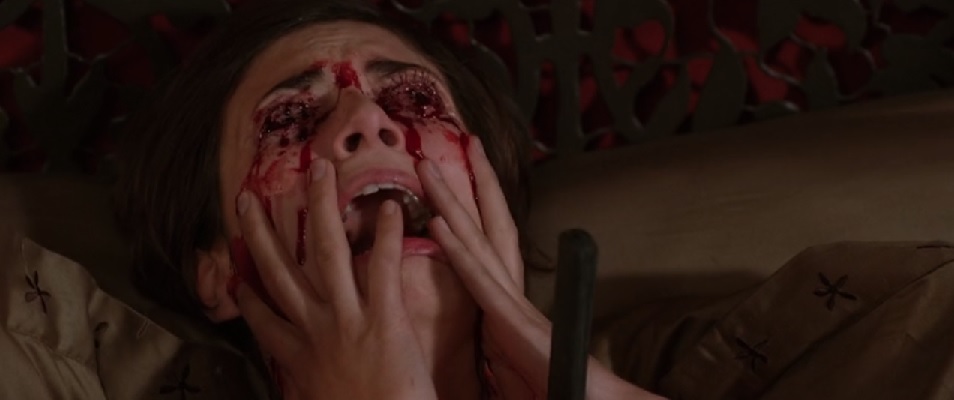
For positives, I can say that the gore here is okay. I was going to say ‘solid,’ but changed my mind last second, as some of it does feel a little cheap (and in fact, the whole of the movie shares the same feeling in my view). Still, there’s a woman who’s disemboweled and gets her tongue ripped out, someone gets their arm cut off, another gets their head smashed in, someone else gets their eyes pierced, and others get stabbed. It’s decently gruesome at times, which is sort of fun, but unfortunately, the story’s too messy to really take advantage of the decent gore.

Well, perhaps it’s not fair to call the story a mess. It gets it’s point across, and I’m sure Dario Argento knew what he was doing. I just didn’t personally care for the apocalyptic vibe of it, nor all the witches converging on Rome. It makes sense that the final movie in a trilogy would feel larger in scope, but by doing that, Mother of Tears doesn’t feel remotely similar to either Suspria or Inferno, both of which felt more intimate and personal affairs.

The base idea here was fine. I could have done without a character needing to master their innate magic (just by concentrating, she can turn invisible – quality stuff), and the whole finale felt especially weak to me. I did appreciate how they specifically referenced the events of Suspria, and spoke about Suzy Bannion by name, but this just didn’t have the same feeling that I associate with Dario Argento.

I also have to admit that I didn’t really buy into Asia Argento’s performance. I was surprised to recognize her (from the Vin Diesel movie xXx, but has also been in the 1998 Phantom of the Opera, The Stendhal Syndrome, and Trauma, Dario Argento movies all), but her performance just felt rather weak to me. Unfortunately, the rest of the cast, including Cristian Solimeno, Adam James, even Udo Kier, likewise failed to leave an impression on me.

I don’t know how much of this is necessarily the movie’s fault – I just couldn’t jive with this one. I liked some of the ideas, but the apocalyptic nature of the story didn’t do much for me (and I can honestly say I thought the 1997 movie The Eighteenth Angel does it better). I did like the scene in which a mother, under whatever mania was going around, threw her baby off a bridge, but overall, I left this quite unsatisfied.

For some people, perhaps this long-await finale worked. I just know that I didn’t care for it, and while I tried to keep my expectations low because I had heard lukewarm things about this one, I do think this is perhaps my least favorite movie from Dario Argento thus far.

5/10

Flesh for Frankenstein (1973)

Directed by Paul Morrissey [Other horror films: Sangue per Dracula (1974), The Hound of the Baskervilles (1978)] & Antonio Margheriti [Other horror films: Il pianeta degli uomini spenti (1961), La vergine di Norimberga (1963), Danza macabra (1964), I lunghi capelli della morte (1964), Nude… si muore (1968), Schreie in der Nacht (1969), E Dio disse a Caino… (1970), Nella stretta morsa del ragno (1971), La morte negli occhi del gatto (1973), Killer Fish (1979), Apocalypse domani (1980), Alien degli abissi (1989)]

Flesh for Frankenstein, sometimes commonly known as Andy Warhol’s Frankenstein, isn’t a movie I enjoyed at all. It had some disgusting gore and sexual depravity, which is all good and well, but I personally found the acting quite horrid and the story rather meandering.

As it is, I’ve actually seen this film before. I can’t imagine under what circumstances, though – I couldn’t have been older than 14, as I barely remembered any of this. And in fact, the idea that I actually sat through this movie at that age, if accurate, is a testament to my devotion of the genre. Well, either that, or the idiocy of my youth.

Yes, that may well sound like a dig at the movie. I know it’s a film that some people do rather enjoy, and I can partially see why. The gory sequences are pretty solid, and even I will admit that the finale was overall enjoyable. Some of the dialogue is rather quotable (from “You filthy thing!” to the classic line “To know death, Otto, you have to fuck life in the gall bladder!”), and certainly the horrible acting can add to the charm, but even so, I generally found the film tedious.

Udo Kier (who I know from films such as Pray for Morning, Love Object, and Shadow of the Vampire) was just awful in this. Half the time, he literally reminded me of Tommy Wiseau, which was amusing, but probably not good. Just as good was Arno Jürging (Andy Warhol’s Dracula). Joe Dallesandro (The Gardener and Black Moon) was at least fine, and while I couldn’t stand her character, Monique van Vooren was serviceable, at least when she wasn’t sucking on someone’s arm (I’d say it makes sense in context, but I’m not sure that it does).

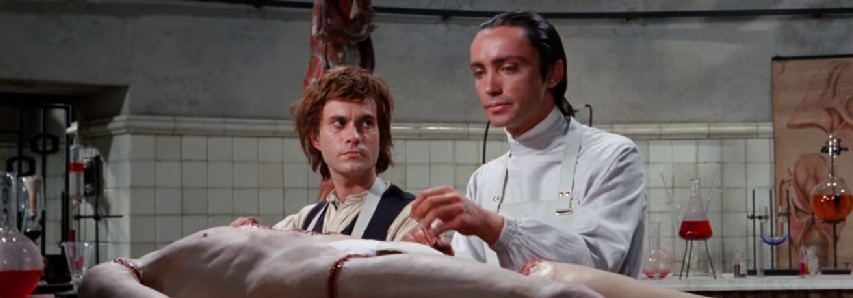
Certainly there are some WTF scenes, such as one where the Baron is rather involved with a corpse (after shouting at his assistant to look away, calling him a filthy thing), and that scene certainly is disturbing. It leads to the classic line about life and fucking gall bladders, so there you go. There’s certainly plenty of nudity and gore here, and while that might help in some cases, it doesn’t really impact things much here.

Don’t get me wrong – I liked seeing the gore, and it’s especially solid near the end, in which a door is slammed on a character’s hand, cutting it off (and that dismembered hand is later thrown at another character, amusingly enough). That was quality gore, as was an amusing decapitation early on in the film. The blood certainly runs free in the film, which is far from a bad thing.

The problem, though, is that much of the film, save the enjoyable finale and tense final minutes (which I rather enjoyed) feels like a soap opera. There’s a husband who has no time for his wife, who is a sex maniac, and thus seeks companionship elsewhere, such as farmhands. The farmhand in question has a friend who is considering becoming a monk, so he tries to get that friend laid in order to show him what he’ll be missing. Oh, and there are children mucking about also, but they aren’t really important until the final twenty minutes of the film.

Oh, also worth mentioning, the husband and wife are also brother and sister. I was confused at first, wondering if I was hearing that right, but it became obvious that I was indeed accurate in my hearing. Talk about a messed up family, what with some Targaryen shit going on here.

I can see why Flesh for Frankenstein would appeal to some people, but I just couldn’t get that much enjoyment out of it, save a few scenes. It’s not a movie I found utterly unredeemable, but I really didn’t care for a lot of it. I felt so much of it was tedious, and overall, it wasn’t what I’d personally call a good time.

5/10

Caltiki il mostro immortale (1959)

Directed by Riccardo Freda [Other horror films: I vampiri (1957), Maciste all’inferno (1962), L’orribile segreto del Dr. Hichcock (1962), Lo spettro (1963), L’iguana dalla lingua di fuoco (1971), Estratto dagli archivi segreti della polizia di una capitale europea (1972), Murder Obsession (1981)] & Mario Bava [Other horror film: I vampiri (1957), La maschera del demonio (1960), Ercole al centro della Terra (1961), La ragazza che sapeva troppo (1963), I tre volti della paura (1963), La frusta e il corpo (1963), 6 donne per l’assassino (1964), Terrore nello spazio (1965), Operazione paura (1966), 5 bambole per la luna d’agosto (1970), Il rosso segno della follia (1970), Ecologia del delitto (1971), Gli orrori del castello di Norimberga (1972), Lisa e il diavolo (1973), The House of Exorcism (1975), Schock (1977)]

Caltiki il mostro immortale, better known as Caltiki – The Immortal Monster, is a decent film, if not perhaps a bit generic for the time. It looks quite nice, with some solid special effects, and it’s nice to see Italy get back into the genre after a long hiatus, but I think the film finishes out around average.

The story is probably what holds the film back most, and to be clear, I don’t think the plot is bad, but it’s not too different from many films at the time, such was the giant monster craze. Obviously, it’s similar to The Blob – the creatures here are amorphous, single-cell organisms, but also movies like The Black Scorpion, so it’s not the most original stuff.

It does have some surprisingly decent special effects though. The best would probably be someone’s face melting, which was beautifully gruesome for the time. The creature itself doesn’t look near as smooth as the Blob we know and love, but when it’s multiplying toward the finale, it does strike me as impressive.

It’s never easy for performances from giant monster movies to make a big impression, and it’s the same here. John Merivale is fine as a lead, and Gérard Herter was fine as a more antagonist force, but neither one stood out. Daniela Rocca and Didi Sullivan were fine, but again, neither one really added that much.

Italy got back into the horror genre in 1957 with The Vampire – the country had a couple of horror films in the early days, such as 1917’s Malombra and 1925’s Maciste in Hell – which was also directed by both Riccardo Freda and Mario Bava. Obviously, Italian horror skyrocketed during the 60’s and 70’s, so it’s sort of nice seeing Italian horror before it became the big thing, and though Caltiki is in black-and-white, it did look quite nice, despite the story not being particularly interesting.

When it comes down to it, while I enjoyed some aspects about the film, and I still think it’s an adequate movie, I don’t know why I’d watch this when I could just watch The Blob, unless I wanted something with Italian flavor.

7/10

Paura nella città dei morti viventi (1980)

Directed by Lucio Fulci [Other horror films: Una lucertola con la pelle di donna (1971), Non si sevizia un paperino (1972), Il cav. Costante Nicosia demoniaco, ovvero: Dracula in Brianza (1975), Sette note in nero (1977), Zombi 2 (1979), Gatto nero (1981), …E tu vivrai nel terrore! L’aldilà (1981), Quella villa accanto al cimitero (1981), Lo squartatore di New York (1982), Manhattan Baby (1982), Murderock – Uccide a passo di danza (1984), Aenigma (1987), Zombi 3 (1988), Il fantasma di Sodoma (1988), Quando Alice ruppe lo specchio (1988), La casa nel tempo (1989), La dolce casa degli orrori (1989), Un gatto nel cervello (1990), Demonia (1990), Hansel e Gretel (1990), Voci dal profondo (1991), Le porte del silenzio (1992)]

Known best as City of the Living Dead, this Lucio Fulci film is one that I’ve been looking forward to for a while. I’ve only seen it once, and it’s been over ten years since that occasion, so this is one I definitely wanted to revisit. As it stands, though, I think the movie is just okay.

Lucio Fulci is a director that I appreciate, but a lot of the work I’ve seen from him doesn’t generally impress me too much. I quite enjoy The Beyond, and both Don’t Torture a Duckling and The New York Ripper are hella fun, but sometimes his films don’t hit the right spots, and while I enjoyed bits and pieces of City of the Living Dead, this is a good example of that.

Overall, it’s probably more cohesive in my view than The House by the Cemetery, which is a positive. I sort of liked the final ten minutes – the final scene leaves quite a bit up to interpretation, but given this is the first of the Gates of Hell trilogy, I can dance to that tune. The base story isn’t bad, and I did like how it took an hour for Carlo De Mejo and Christopher George to finally meet up.

It’s the gore here that’s of primary interest. There are a few disturbing scenes here, but the sequence in which a poor woman regurgitates her organs has to be one of the most sickening scenes I’ve seen in recent times. The special effects are decent – sometimes the brains look a bit bleh, and the power drill scene seemed a bit janky, but City of the Living Dead did have enough gore to keep things moderately interesting, not to mention the maggot showers.

Also, despite the name, it’s sort of hard for me to see this as a zombie movie. Sure, zombies appear, but it’s nothing at all like Zombi 2 – here, the zombies teleport, crush someone’s skull, take some of their brain matter, and move on. It’s a much more supernatural take on zombies, which fits in with the tone of the movie, and definitely felt unique, but it’s sort of hard for me to fully enjoy it.

One thing I did enjoy was the sequence in which a woman wakes up in a casket after having been buried. People thought she was dead, of course – they weren’t being dicks. It’s a tense moment, as another character is slowly walking out of the cemetery, occasionally stopping, as he thinks he hears banging and screaming from a grave behind him. It’s stretched out wonderfully – at times, it feels like he’s actually leaving the cemetery, and the buried character, behind. That was a quality tense sequence.

Christopher George (Whiskey Mountain, Graduation Day, Day of the Animals, Mortuary, Pieces, and Grizzly) was okay, but I can’t say I thought he had a lot of character. In fact, I think that holds true for a lot of the performances here – Carlo De Mejo, Janet Agren (Rat Man, Eaten Alive, and Panic), Catriona MacColl (The Beyond and The House by the Cemetery) and Giovanni Lombardo Radice (Cannibal Ferox, Cannibal Apocalypse, and House on the Edge of the Park) were all fine, but none felt well-developed, especially in Radice’s case, as he felt like such a random character.

Obviously, different people have different takes on Fulci films. I know some people who rather love this particular movie. For my part, though, it feels somewhat confused, the plot not particularly well thought out, the finale somewhat impressive, but again, nowhere near as great as The Beyond. I still enjoy this more than The House by the Cemetery, but I do feel it’s a bit below average, at least with having seen it twice.

6.5/10

Non si sevizia un paperino (1972)

Directed by Lucio Fulci [Other horror films: Una lucertola con la pelle di donna (1971), Il cav. Costante Nicosia demoniaco, ovvero: Dracula in Brianza (1975), Sette note in nero (1977), Zombi 2 (1979), Paura nella città dei morti viventi (1980), Gatto nero (1981), …E tu vivrai nel terrore! L’aldilà (1981), Quella villa accanto al cimitero (1981), Lo squartatore di New York (1982), Manhattan Baby (1982), Murderock – Uccide a passo di danza (1984), Aenigma (1987), Zombi 3 (1988), Il fantasma di Sodoma (1988), Quando Alice ruppe lo specchio (1988), La casa nel tempo (1989), La dolce casa degli orrori (1989), Un gatto nel cervello (1990), Demonia (1990), Hansel e Gretel (1990), Voci dal profondo (1991), Le porte del silenzio (1992)]

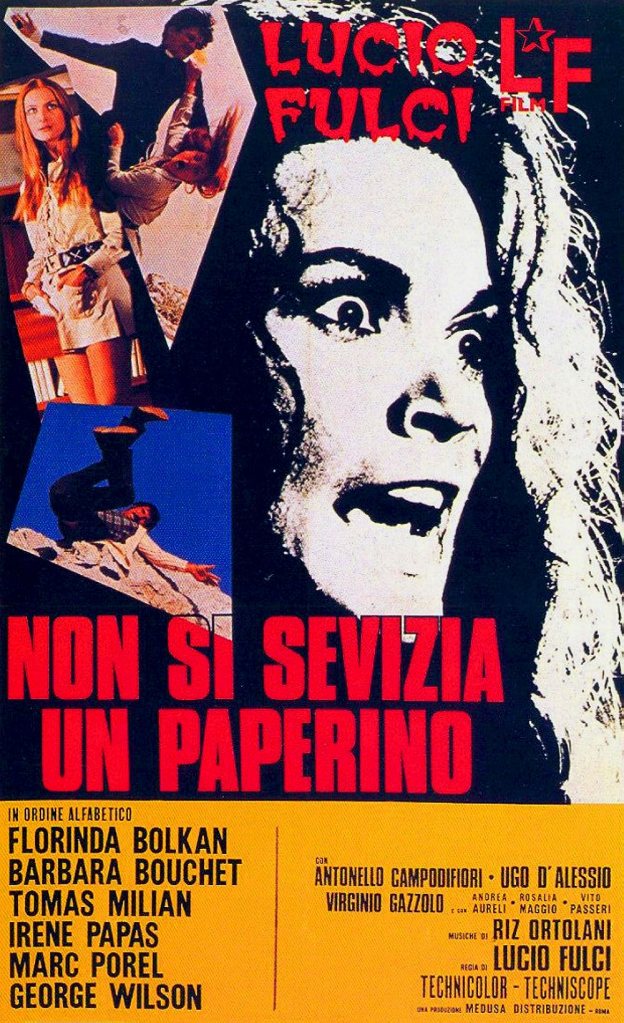
For a long time, Don’t Torture a Duckling (the well-known English title of this giallo) has been among my favorite Lucio Fulci films. That’s probably still true, as it’s a pretty solid giallo, and while not overly violent, has a decent amount going for it.

The story is fun, and somewhat atypical as far as gialli goes. The victims are almost exclusively young boys, and while their deaths aren’t violent (they mostly seem to be strangled or suffocated), there is a certain pleasure in seeing a younger victim range, as not too many films deal with dead kids.

I also love the setting, being a rather rural and small Italian town. It’s filled with superstitious people, which unfortunately plays a part later on in the film when some confessed killers come out of the woodworks. There’s a lot of mob mentality in the film, kept in check partially by the mostly logical police force.

Most of the central performances were pretty good. Tomas Milian was a bit generic, but he was more interesting once he began working with Barbara Bouchet’s (The Black Belly of the Tarantula, The Red Queen Kills Seven Times) character. The main faces we see from the police force were all fun – especially Virgilio Gazzolo, but both Antonello Campodifiori and Ugo D’Alessio were solid also. Marc Porel (who died at the young age of 34 in 1983) was great here, and Florinda Bolkan had quite the tragic story to her.

Unlike later Fulci films, this movie is pretty tame as far as the violence goes, with two exceptions. There’s a sequence in which a woman is beaten with a chain – if you remember the opening to The Beyond, it’s quite similar. It looks hella painful to get chain whipped across the face, so I may avoid that part of Italy. Also, there’s a character who falls off a mountain at the end, and their face bumps and scrapes against the mountain. The thing falling is obviously a dummy – it looks incredibly fake. Even so, the sequence is quite fun.

In fact, the finale is quite great overall. During the scene in which the character is falling to their death, we’re given flashbacks as to explain the reasoning behind the revealed killer’s actions, why they went out of their way to kill kids. It’s even a bit emotional, with soft music playing in the background, and it’s a finale, despite the dummy, that has always stuck with me.

Like I said, this has been my favorite Fulci film for a long time, and I think that’s still pretty true. I finally watched The New York Ripper earlier this month, and I quite liked it, and it might be fair to say that Don’t Torture a Duckling is on par with that one. Even so, I think this one is a bit better – the mystery is mildly more interesting, and the finale is definitely a bit stronger.

I don’t think Don’t Torture a Duckling is perfect. Unlike Dario Argentino with Deep Red, Fulci’s been unable to amaze me quite that much. Even so, Don’t Torture a Duckling is quite a good film, and definitely a giallo that’s worth seeing.

8/10

…E tu vivrai nel terrore! L’aldilà (1981)

Directed by Lucio Fulci [Other horror films: Una lucertola con la pelle di donna (1971), Non si sevizia un paperino (1972), Il cav. Costante Nicosia demoniaco, ovvero: Dracula in Brianza (1975), Sette note in nero (1977), Zombi 2 (1979), Paura nella città dei morti viventi (1980), Gatto nero (1981), Quella villa accanto al cimitero (1981), Lo squartatore di New York (1982), Manhattan Baby (1982), Murderock – Uccide a passo di danza (1984), Aenigma (1987), Zombi 3 (1988), Il fantasma di Sodoma (1988), Quando Alice ruppe lo specchio (1988), La casa nel tempo (1989), La dolce casa degli orrori (1989), Un gatto nel cervello (1990), Demonia (1990), Hansel e Gretel (1990), Voci dal profondo (1991), Le porte del silenzio (1992)]

Commonly known as The Beyond, Lucio Fulci’s …E tu vivrai nel terrore! L’aldilà is definitely a slice of Italian horror worth seeing, if only for the goriness alone. I don’t personally find it an amazing movie, but it can be decently fun if you’re a fan of Fulci’s work.

I’ve seen The Beyond before, but it’s been a long time. I’ve only seen it the one time, and I can’t quite fathom exactly how long ago that would have been, so coming into this one again was a treat. I was slightly hesitant – when I revisited The House By the Cemetery in recent times, I wasn’t blown away – but this film has more going for it, at least in my eyes.

The story, such as it was, isn’t too bad, dealing with a hotel placed on one of the Seven Gateways of Hell. It’s the second part of Fulci’s Gates of Hell trilogy, sandwiched between City of the Living Dead and The House By the Cemetery. Luckily, there’s not much reason to watch them in order, as they stand alone perfectly fine, and like I said, I found this a bit better than The House By the Cemetery.

For a certainty, it’s not for the plot, which is a bit janky. I mean, let’s be honest, most people don’t come into a Fulci movie for the plot, so that’s not a big problem, and the main point – a woman inherits a hotel, and soon terrifying things start happening – gets across just fine. And since most probably come for the gore, they certainly came to the right place.

It’s hard to say what my favorite scene here was – part of me wants to say either the final scene, which was quite creepy (if not a bit nonsensical), another part when the characters leave the hotel, but in the light, we see plenty of souls through the windows – that scene was shot quite beautifully.

As far as the gore goes, though, I’m a sucker for eyes. So are tarantulas, apparently, as a paralyzed man has one of his eyes punctured and torn from his head by a tarantula. Another one takes a portion of his lip; another, his tongue. As someone with mild arachnophobia, that was a harsh scene. There was also a great shotgun blast to the head, along with someone’s head shoved through a spike, causing, you guessed it, her eye to come out. A woman got her ear and throat torn off by a dog, and a woman’s face got melted by acid. All around, a film for the whole family.

Only two performances come close to mattering, and I’m not sure that they really do, as they don’t really impact much that happens in the film. Catriona MacColl (City of the Living Dead and The House By the Cemetery) was perfectly adequate as the lead, though her character can be a bit of a dick, I feel. David Warbeck (Miami Golem, Rat Man, and The Black Cat) was more well-rounded, but his character also wasted a lot of bullets in the last twenty minutes, so I can’t love him too much.

Speaking of which, the final twenty minutes of this one does contain an all-out zombie attack. To be honest, I forgot that happened in this film, but the zombies themselves (while not looking particularly great – Burial Ground zombies were totally more awesome) were appropriately creepy, and it led to a solid finale. Also, the score in this one was fantastic – that piano theme (as sampled in Necro’s “As Deadly As Can Be”) was simply gorgeous – so I can’t be too unhappy.

And that’s really how I feel about the movie as a whole – it was an enjoyable rewatch. It’s not my favorite Fulci movie, as both Don’t Torture a Duckling and The New York Ripper exist, but it is a fun slice of supernatural and zombie horror.

7.5/10

Massacre (1989)

Directed by Andrea Bianchi [Other horror films: La tua presenza nuda! (1972), Nude per l’assassino (1975), Malabimba (1979), Le notti del terrore (1981), Maniac Killer (1987), Incontri in case private (1988), Gioco di seduzione (1990)]

This offering of a late 80’s giallo leaves a lot to be desired. It’s not an exceptionally poor movie, but it is an exceptionally generic and forgettable one, and save a few scenes, I don’t know if it’s worth it.

Which is a bit of a shame, because the director here is Andrea Bianchi. He’s probably best known for Burial Ground, but he also directed Strip Nude for Your Killer and Malabimba. He’s not an extremely big name, but I will admit I was expecting a bit more from this one once I saw he directed it (and the fact this was apparently produced by Lucio Fulci didn’t help).

The story isn’t a terrible one – a film crew working on a horror film are being killed off by a mysterious killer. Admittedly, it takes something like 40 minutes to really get moving, and the finale isn’t particularly great, but the basic story has potential.

As far as the kills went, they were okay when they popped up. The film opens with a woman being attacked, one of her hands getting cut off, and then being decapitated. And this happened in the first two minutes. It takes a while after that, though, for more kills to take place, and none of them (including a throat-slitting and someone getting stabbed multiple times with a spike) are quite as striking as the first.

One thing I really think hurt the film were the characters. We’re sort of just thrown into the cast and crew of those making a horror film, and it takes a bit for them to really stand out, and I’m not sure that some of them (including one of the leads, Patrizia Falcone) ever did. There’s only one character I really took notice of (played by Danny Degli Espositi), and that’s not particularly ideal.

In fact, because of that, performances are close to impossible to really discuss. I’d say that because he stood out, Danny Degli Espositi was pretty decent (despite not really doing that much), and I guess that Gino Concari made an okay detective, but despite having a nude scene, Silvia Conti was pretty much just there, and Lubka Lenzi was pretty much interchangeable with everyone else.

By the mid-80’s, giallo was pretty close to dead, and in the latter half of the decade, they weren’t easy to come by. Massacre is a pretty low budget film, and stylistically it seems far more akin to some SOV slasher like Night Ripper! than it does something like Lamberto Bava’s You’ll Die at Midnight (which was a reasonably solid giallo from the latter half of the 1980’s). I can’t blame Andrea Bianchi too much for that, but that ending, man, was just painful.

I won’t say that Massacre has been a film I’ve wanted to see for years, but it has been on my radar of movies to take time with. I can’t say I’m that surprised by how forgettable the movie tended to be, but at least I saw it in Italian as opposed to dubbed, which I could only imagine would make it worse. Even so, Massacre wasn’t a particularly great time.

5.5/10