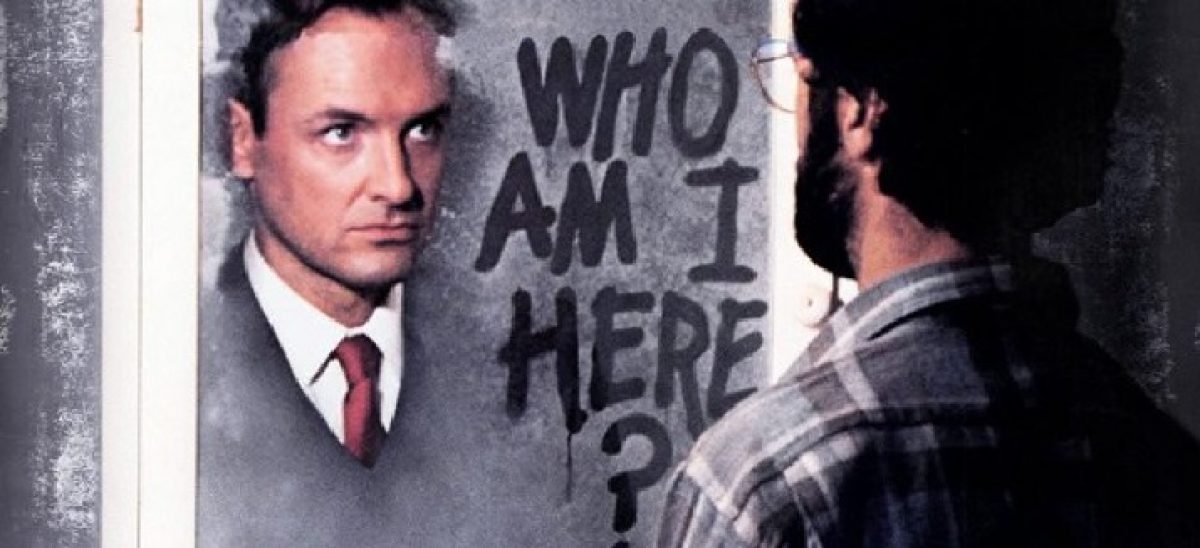
The Beast Must Die (1974)

Directed by Paul Annett [Other horror films: N/A]

Though the idea behind The Beast Must Die is largely fun, I don’t think the execution really does the idea justice. Portions are solid, even tense, but more often, I tend to find myself somewhat bored with the presentation.

I did appreciation the addition of the werewolf break, though – see, this is a whodunit, and we’re directed, as an audience, to try and figure out who the werewolf is, and toward the end of the movie, a 30 second werewolf break is given to us, so we can make our final selections.

It’s the exact type of thing I’d expect out of a William Castle movie. Apparently the director of this one, Paul Annett, wasn’t too keen on the idea, but he got overrode by the producer. It’s nothing that really changes the movie any, but it’s sort of fun, and had the film overall be a bit more lively, it might have made for a solid addition.

The story here is decent, though. Based on a 1950 short story titled ‘There Shall Be No Darkness,’ written by James Blish, the movie revolves around a group of people being brought to a country mansion by a rich businessman, and as he suspects one of them is a werewolf, he hopes to figure out the identity and kill the beast.

Like I said, the plot’s fun on the face of things. And again, there are some decent scenes, such as a werewolf (which pretty much looks just like a wolf) attacks a man through a skylight, or a tense moment in which Calvin Lockhart’s character is facing down a charging werewolf at night in the forest. Still, I found much of the material here somewhat dry, and I’m pretty sure I felt the same way when I last saw this one.

Calvin Lockhart makes a solid, somewhat tense, lead. He’s not an easy character to understand, but Lockhart’s character is decent. Naturally, Peter Cushing (Captain Clegg, Scream and Scream Again, The Abominable Snowman) is great to see, and his character, an academic of werewolves, is fun. Though his screen time was limited, Anton Diffring (Circus of Horrors, The Iguana with the Tongue of Fire, The Man Who Could Cheat Death, the Sylvester McCoy Doctor Who story Silver Nemesis) was nice to see, and he was perhaps one of the best characters here.

Others were decent here. Charles Gray (The Devil Rides Out), Marlene Clark (Ganja & Hess, Black Mamba), and Michael Gambon (the guy who ruined Dumbledore) were all fine. I can’t say that either Ciaran Madden or Tom Chadbon (Duggan from Tom Baker’s Doctor Who story City of Death) made much of an impression, but they didn’t take anything away from the movie.

Again, the issue here is that the movie just feels so dry at times. It’s never a terrible time, but it’s just not always that engaging. I don’t doubt The Beast Must Die has a lot of potential, and I know the movie has it’s fans, but it’s not a movie I personally find that great, despite the fun whodunit element to the plot.

6/10
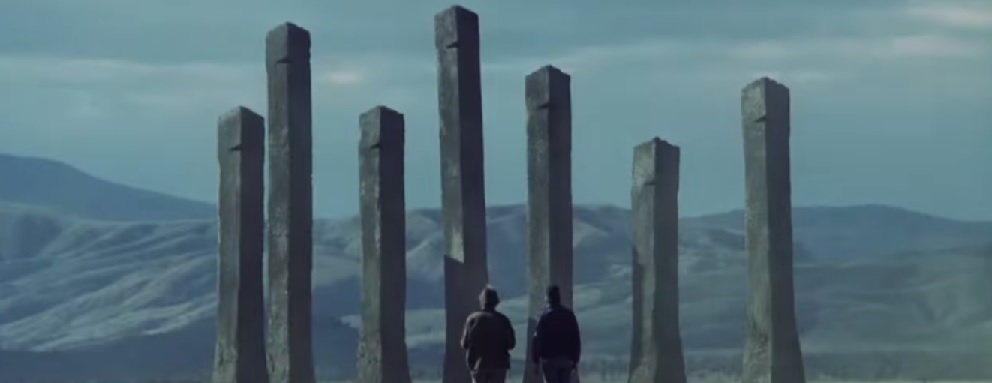
Phase IV (1974)

Directed by Saul Bass [Other horror films: N/A]

Phase IV is a film I’ve known about in a vague sense for a long time, but after seeing it, it’s fair to say that I probably didn’t really know a thing about it. Intensely interesting in the visual effects, the plot of Phase IV is sometimes questionable, but for a slice of 70’s science fiction/horror, you should definitely see this.

My expectations going into this were that it’s be a typical insect invasion movie (such as The Swarm or Kingdom of the Spiders), and while there is sort of an invasion, the movie is not at all typical in approach, which certainly gives the film a very unique look.

Most apparent in the style here is the insanely beautiful cinematography, especially close-ups. More often than not, you can see the hair on each individual ant, and there are scenes here, such as an ant crawling up someone’s shirt, that I have absolutely no idea how they shot. The cinematography was fascinating, and it often felt like a nature documentary. I liked a decent amount about the movie, but the cinematography is easily the best part.

The story feels a little aimless at parts, though perhaps a better description would be hopeless, as the characters probably don’t have much in terms of options, as they were caught in a scientific resort center, trapped by a few trillion ants (that number is an estimate, but it’s probably not far off). The ants don’t attack the people, though – they could, and one person does get bit in an accident; they instead use the people almost as experiments, a nice reversal of the norm.

Phase IV is not your typical movie. It’s nothing at all like The Swarm or Kingdom of the Spiders (and though I’ve seen neither of these movies, I suspect it’s nothing like Empire of the Ants or It Happened at Lakewood Manor either); it’s more philosophical in it’s execution. It’s certainly a horror film, but it feels more at times, and that’s what gives the film such a unique feeling.

Nigel Davenport (1974’s Dracula, 1977’s The Island of Dr. Moreau, 1973’s The Picture of Dorian Gray) played the scientifically-focused stereotype, not overly concerned with welfare if it’s likely to impact his experiment. Michael Murphy (Shocker, Count Yorga, Vampire) had a few moments where he annoyed me, but I enjoyed his more personable attitude, and while Lynne Frederick (Schizo) didn’t add a lot, she did give a fine performance.

This isn’t a movie to watch if you want to see ants swarm over people. Most of the ant action is more at the microscopic level, such as them working together to get a piece of poison to counteract it, or tricking a praying mantis into shorting out an air conditioner. There is a quality scene in which ants crawl out of a dead man’s hand, but most of the action here isn’t on a violent level.

I’ve not seen many films like Phase IV. I suspect if I watched science fiction, I probably would, but the only science fiction I watch tends to be infused with horror, so my exposure to straight science fiction is very limited. Phase IV had an interesting idea going for it, and the final scenes will probably give you something to think about. I can’t say I thought it was an amazing movie, but visually, I do think the film is fascinating, and very much worth approaching.

7.5/10

The Cars That Ate Paris (1974)

Directed by Peter Weir [Other horror films: Picnic at Hanging Rock (1975), The Plumber (1979)]

Sometimes known under the title The Cars That Ate People, this Australian film is just bizarre. When I first saw it rather young, I didn’t get it at all. While I understand the plot perfectly nowadays, I still don’t get it. It’s sort of a comedy-horror mix, but the comedy isn’t quite clear, and the horror is scarce.

Because of that, this is a hard movie to parse. The basic plot, which deals with a town that intentionally causes car crashes so they can salvage the wrecks (and help with their economy), is just so bizarre. There’s a doctor who does experiments on those caught in the wrecks – these experiments aren’t focused on near as much as you might expect, but that’s going on too. I don’t know. The movie makes sense, and the plot is coherent, but it’s such an odd film.

Truth be told, finding a normal horror film from Australia is always a tricky task. It seems that a lot of the horror movies I watch from that country are just off (Body Melt, Undead, Long Weekend, Razorback, Frenchman’s Farm), which is fine, because it gives them a unique feeling, but it’s always a bit of a challenge getting into them.

I liked John Meillon (Crocodile Dundee, Frenchman’s Farm) here, mostly because it was nice seeing a recognizable face. Terry Camilleri (who apparently played Napoleon in Bill & Ted’s Excellent Adventure, a fact that, now that I know it, I can actually see in the face) was fine, but his character honestly didn’t do much aside from experience the strangeness of the small Australian town of Paris along with the audience.

Plenty of interesting things happen throughout the film, but personally, I think by far the best portion is the finale, in which a bunch of the youth of Paris go on a rampage, and destroy a good portion of the town in their cars. Their cars are monstrosities – sure, some are just painted with shark mouths, but some have been modified (the most striking, a Volkswagen Beetle covered with impractical spikes), and they just rampage throughout the town. It’s not a long sequence, but it’s easily the most action-packed in the film.

When it comes down to it, though, The Cars That Ate Paris is just a bizarre movie. It’s an okay viewing experience, I guess, but it’s not one that I particularly enjoy, nor do I suspect it’s a film I’ll be seeing again anytime soon, if ever.

5/10

Madhouse (1974)

Directed by Jim Clark [Other horror films: N/A]

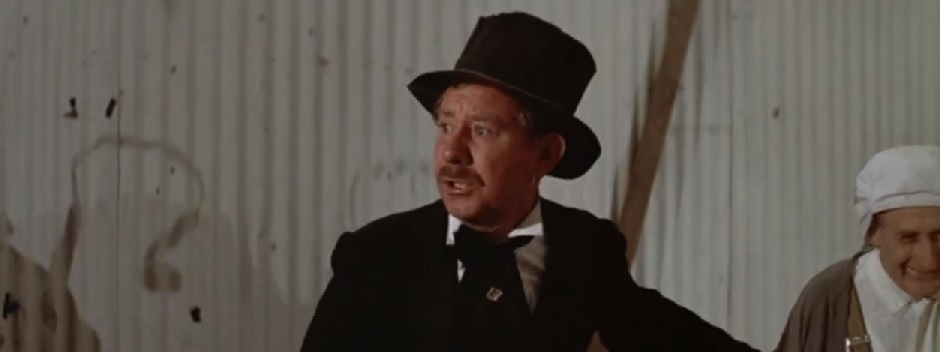
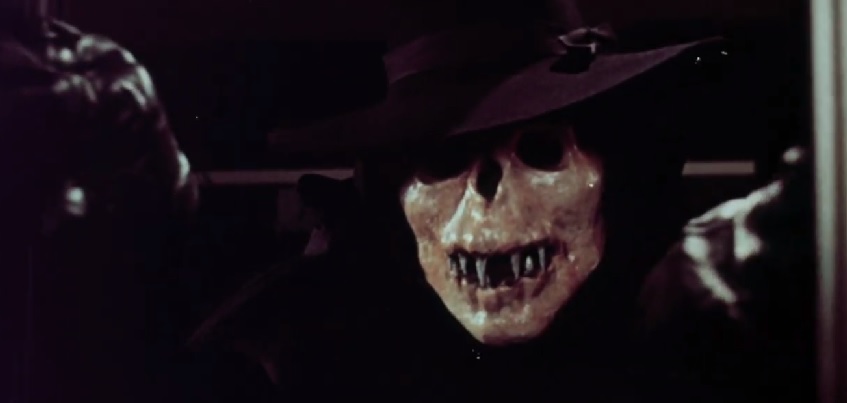
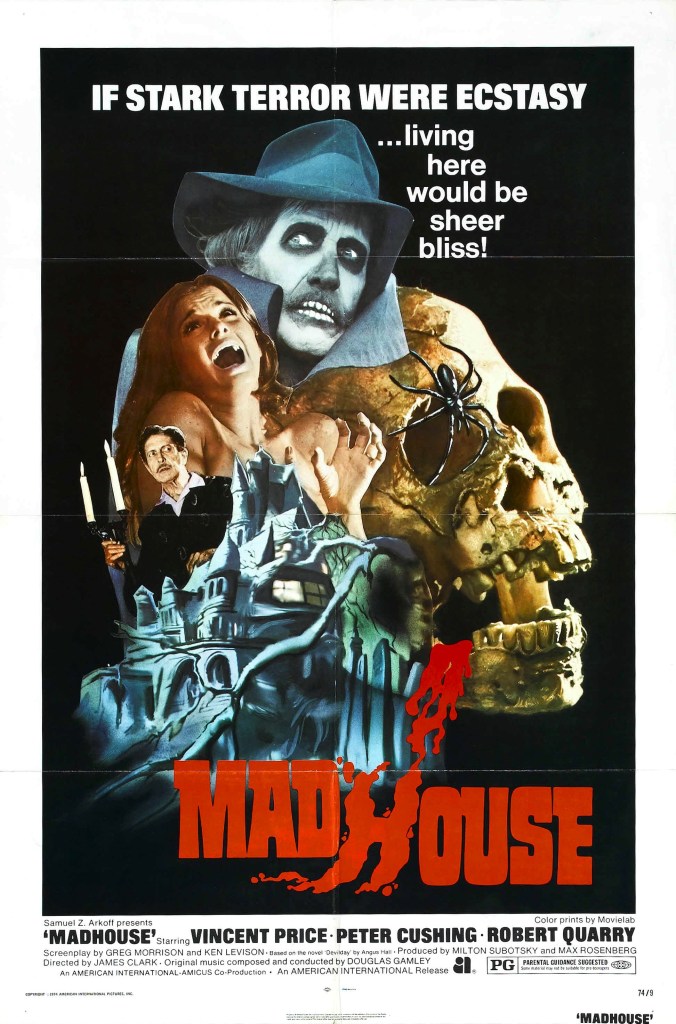
Madhouse isn’t the greatest movie I’ve ever seen. No doubt it’s a fun film – what more could you expect from a movie starring Vincent Price and Peter Cushing? – but it’s not necessarily the most original film, and while I certainly had a good time with it, I’m not sure it will stand the test of time like many of the films each have otherwise been involved in.

Of course, the story is decent, albeit in a been-there, done-it way, as Price’s character has to decide whether someone is trying to frame him for the murders going on around him or he’s having a mental break-down, as he has in the past. We’ve all seen films like this before, and to be sure, it was based on a novel titled Devilday, written by Angus Hall, so it’s not entirely the film’s fault, but given the fact Price and Cushing are here, I’d have hoped for a more original story.

Even so, they work decently well with what they have. I don’t think the finale is great, and I pretty much suspected who was behind the killing somewhat early on, but at the very least, the film is quite serviceable, and though it may not be as memorable as something like The Abominable Dr. Phibes or Theatre of Blood, it’s not a shabby film.

Vincent Price, as readers may know, is perhaps one of my favorite actors, and there are plenty of clips in this movie of his past works (among them, House of Usher, The Pit and the Pendulum, The Raven, and The Haunted Palace), and there’s even a joke made in-movie about him previously playing the Invisible Man (as he did in both The Invisible Man Returns and the ending of Abbott and Costello Meet Frankenstein). Price is a lot of fun here, as he always is, and seeing him with Cushing is a treat.

And speaking about Peter Cushing, he’s another actor of whom I have a deep appreciation for. He appeared in a ton of horror films, including, but not at all limited to, The Abominable Snowman, The Mummy, Dracula, The Flesh and the Fiends, The Skull, Horror Express, Incense for the Damned, and Night of the Big Heat. Cushing was quite solid, and though there are times when he doesn’t appear too often on screen, you alway know he’s lurking about, which is good enough for me.

Others here obviously have difficulty standing out, but they still did well, all things considered. Natasha Pyne, Robert Quarry (Count Yorga, Vampire, Moon in Scorpio, Deathmaster), Linda Hayden (Taste the Blood of Dracula, The Blood on Satan’s Claw), and Ian Thompson were all pretty solid, though I will say, both Catherine Willmer and Ellis Dale felt way, way too goofy with their characters.

The kills here weren’t what I’d call great. You did see a double impalement on a sword, and a woman stabbed with a pitchfork, but being a mid-70’s British film, they’re just quick sequences with little to them, so though this may well be an interesting proto-slasher, it’s not always the most engaging when it comes to the death sequences (though there is the after-effects of a decapitation near the beginning which wasn’t half bad).

Madhouse is a decent movie, but given the names involved, I was sort of expecting more than decent. Maybe that’s on me – God knows it’s not the first movie I went into with possibly unrealistic expectations. As it is, I found the movie a decent and fun watch, but ultimately, I do think it rests somewhere around average.

7/10

From Beyond the Grave (1974)

Directed by Kevin Connor [Other horror films: Motel Hell (1980), The House Where Evil Dwells (1982), Frankenstein (2004)]

I’ve not seen nearly all of the Amicus anthology horror films yet, but this being the final one they released, I was expecting something more. Unfortunately, this felt like leftover stories from previous films, and I hate to say that almost nothing here was up to the standards that I really expected.

None of the stories here were on par with the best stories from, say, Tales from the Crypt or Vault of Horror, or even The House That Dripped Blood (which was a bit more average than the first two listed). I guess that, if I had to pick a favorite story, I might go ‘An Act of Kindess,’ but even that one didn’t really hit the spot.

Of the five stories, that’s a common complaint. I don’t think any of them are actually bad, but all of them feel like they’re missing something, which is unfortunate, given that, like every Amicus anthology I’ve seen, this one possesses a decent cast.

Peter Cushing (who is a favorite of mine, with the various horror films he’s been in) was solid in his role, and I liked his corny finish, as he’s speaking to the audience. David Warner (The Omen and Nightwing) was fine, but his character didn’t really have much depth, and the story he was featured in (‘The Gate Crasher’) was the definition of average. And as for Donald Pleasance, I loved seeing him here, but I didn’t really get what his character was supposed to be, which isn’t on him, but just the nature of his story ‘An Act of Kindness.’

Only a few others really stand out, such as Ian Carmichael, Margaret Leighton (who was by far the funniest performance in the film) and Ian Banner, which isn’t a problem, as I doubt that more solid performances would have really helped when the stories were all varying degrees of lack-luster.

From Beyond the Grave, being Amicus’ final anthology horror outing, was a disappointment, and more of a disappointment than I’d have really believed possible from Amicus. I wasn’t a fan of Torture Garden, but that was early on for them, and it seemed that by Tales from the Crypt and Vault of Horror that they found a good balance with their stories. This one didn’t cut it, though.

5.5/10

Sugar Hill (1974)

Directed by Paul Maslansky [Other horror films: N/A]

I’ve known about this movie for some time now, but it never sounded like something I’d really care to see (especially having such a limited experience with blaxploitation). After seeing it, though, I was pleasantly surprised by how much I enjoyed it. By no means an amazing movie, Sugar Hill is a decent amount of fun.

Seeing a wronged woman get revenge is a good set-up. It’s quick, too, and it doesn’t take long for her to approach an old voodoo priestess and gain the power of Baron Samedi (who was one of the best characters in all of cinema, let’s be honest). After that, she uses her army of zombies to strike against those who killed the man she loved, and it’s a fun ride.

Marki Bey (who was really never in that much) did a great job playing the titular character, and you can definitely feel sympathy for her character and support her revenge. Don Pedro Colley did great as the hammy Baron Samedi – he spent a good portion of his screen-time laughing evilly at the revenge that Sugar Hill was getting. He seemed quite supportive of her, and the two of them made a quality pair.

Robert Quarry (Count Yorga, Vampire and Madhouse being two of his more well-known roles) and Betty Anne Rees made for some solid antagonists. I sort of felt bad for Rees’ character at the end, but at the same time, I think of the racist things she said throughout the film, and just shrug it off. I expected a little more from Richard Lawson’s character, but he was somewhat limited as far as the plot went, so that’s okay.

As far as the zombie design went, it was moderately simple, but I was happy with it. I could have done without the bulging eyes, but I did like how some of their faces were covered with webs – that lent them a creepier look. They were also used to good effect, and reminiscent of what you might see from the voodoo zombie horror films of the genre’s yesteryears (such as White Zombie).

It’s somewhat true that Sugar Hill felt a little shallow, but it was still a pretty fun time, knew what it was going for, and gave us the hammy and delightful performance from Colley, which I just loved. Certainly a surprise, I won’t regret watching Sugar Hill.

7.5/10

It’s Alive (1974)

Directed by Larry Cohen [Other horror films: God Told Me To (1976), It Lives Again (1978), Full Moon High (1981), Q (1982), Special Effects (1984), The Stuff (1985), It’s Alive III: Island of the Alive (1987), A Return to Salem’s Lot (1987), Wicked Stepmother (1989), The Ambulance (1990)]

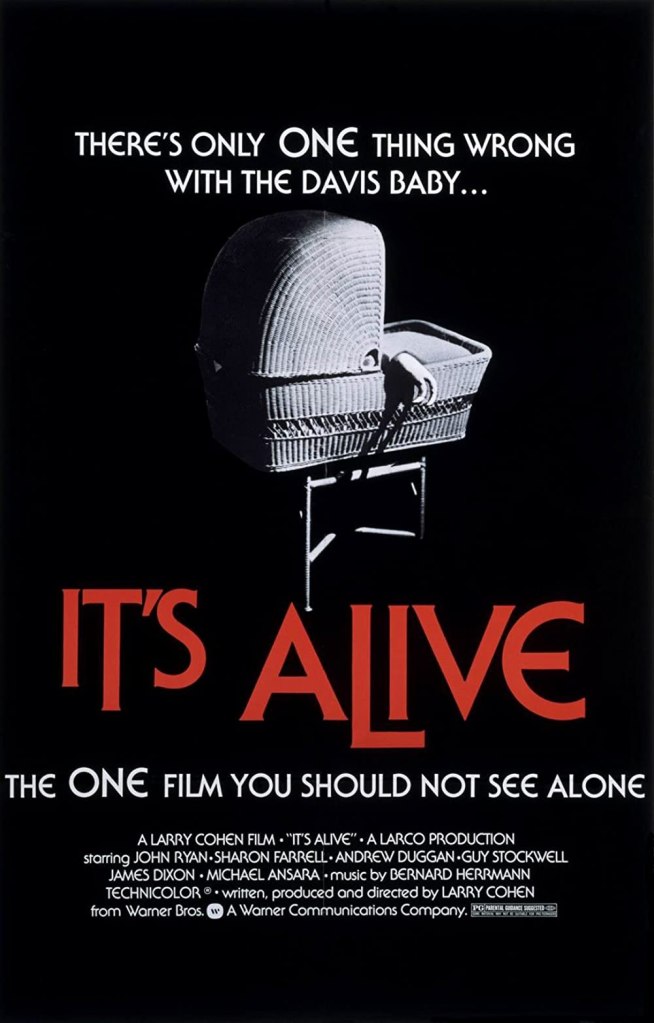
It’s Alive suffers from one of the most common problems that haunts 70’s movies, being that it’s dry. It doesn’t help that, like some of Cohen’s other movies (The Stuff and God Told Me To) it has a wider scope, so we’re dealing with more than just the husband and wife of a deadly and murderous mutated child. Because of that, a lot of the movie seems to drag, and doesn’t seem able to ever pull itself out of that.

I certainly enjoy aspects of the film fine, which is the same that I can say for most movies from the 1970’s – I like the vibes they had, and it always interests me to see how far we’ve come in terms of technology. During a scene, the main guy reaches into a refrigerator, and then once he closes the door, there’s what looks like another refrigerator right next to it (spoilers: it’s a freezer). That’s a small thing, and of no consequence whatsoever to the movie, but I like little things like that.

What I didn’t care for was much of It’s Alive, though. It could have ended around an hour and 12 minutes, and I think that would have been welcomed, but it keeps going for another twenty minutes, and I just don’t know why. It’s not like there’s that much here that’s overly interesting anyway, and like I said, it just felt like it was dragging for most of the film.

Never having seen this, I was sort of expecting something like I Don’t Want to Be Born, but you know, as bad a rep as that film has, I thought it was both a lot more fun and a lot more memorable than this one. Here, you have no performances at all that stand out, almost no scenes that stand out, and just an overall lack of interesting content. Maybe I’m missing something, but for the time being, this one just failed hard.

5/10

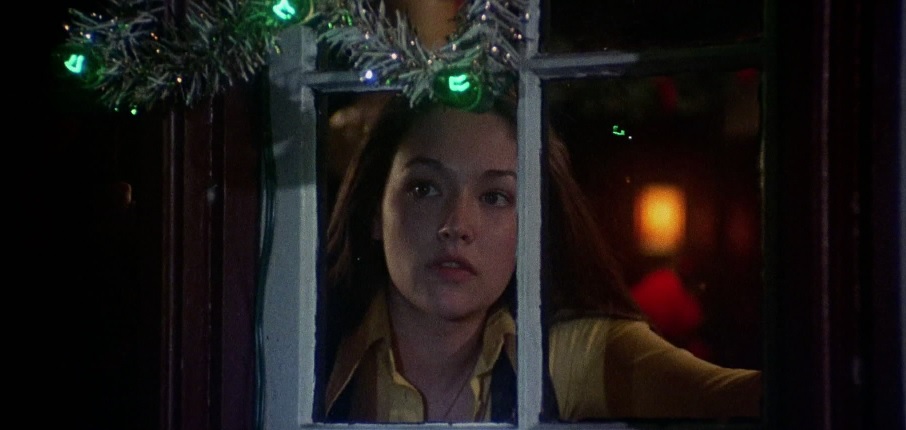
Black Christmas (1974)

Directed by Bob Clark [Other horror films: Children Shouldn’t Play with Dead Things (1972), Dead of Night (1974), Murder by Decree (1979)]

This is a true classic of the genre, and one of the first real slashers, coming out four years before Halloween. It’s a movie that, to be honest, I’ve only seen once before sitting down and revisiting it, but that doesn’t mean I don’t adore Black Christmas and the approach the movie took.

While it could perhaps rightfully be said that the plot here isn’t anything to celebrate that heavily, Black Christmas was one of the first movies to really throw together your typical slasher situation. Sure, a few movies prior had similar ideas (such as the British oddity The Haunted House of Horror, also known as Horror House), but this one cemented many of the core elements (including the final girl finding bodies of deceased friends and a first person point-of-view from the killer). The plot may not read like anything special, but it really is.

And taking a step back from the importance of the movie itself, the cast here holds some rather interesting faces, among them Olivia Hussey and John Saxon. Hussey, I won’t lie, I know purely from the 1990 mini-series It, but she looks pretty much the same, and I just loved seeing her here. Saxon’s been in quite a few horror films, A Nightmare on Elm Street being the finest, and he too brought a lot to the film, though he was far from a central character.

Lynne Griffin was one of the earlier casualties in the film, but given she played one of the main characters of the slasher Curtains nine years later, it was, much like Hussey, fun to see her. Both Margot Kidder and Marian Waldman were solid in this too, though Waldman’s character was mainly for comic relief, which, while funny, did feel off at times.

It is true that there’s not many great kills here – the best one, and I think this is beyond dispute, would be the stabbing with the glass unicorn, which was well-done due to it being spliced in with Christmas carolers blocking out the screams. The death wasn’t amazing, but I think it was still solid. What’s more effective is how an early victim in the film would keep popping up, just a body on a rocking chair with her head wrapped in plastic (which, if it sounds familiar, I’d recommend you check the poster). Not sure why, but that just had a creepy aura to it.

Another aspect that certainly merits mention is the somber finale. It’s not entirely dreary, but it is definitely downbeat, and I think that final scene is one of the more memorable things about the movie. It’s a good cherry on top of an already delicious dessert.

I said at the beginning, though, that Black Christmas isn’t perfect. When I think of 70’s horror I love, Black Christmas doesn’t often make my top ten or fifteen. No doubt it’s a good movie, not to mention an important one, but it’s never been my go-to. That said, if you’ve not yet seen this one, I highly recommend giving it a watch, because it’s well-regarded by many for good reason.

8/10

This is one of the films covered on Fight Evil’s podcast. Listen below as Chucky (@ChuckyFE) and I discuss this one.

Nightmare Honeymoon (1974)

Directed by Elliot Silverstein [Other horror films: The Car (1977)]

If ever a movie has been marketed to the wrong audience, Nightmare Honeymoon would be a great example. Looking at the poster, you’d expect perhaps a somewhat exploitative grindhouse flick, but instead, you get a drama with a pinch of horror (and that’s if you’re being generous).

This isn’t really the movie’s fault, but more whoever decided to try and pitch the film to horror fans. When all’s said and done, Nightmare Honeymoon is almost okay, but it’s really not what I was looking for whatsoever, and I can’t help but find a lot of it a waste of time.

It could have been decent, though. This could have been a bloody tale of revenge, but instead, it felt like a subdued action movie at best, and overly melodramatic at worst. It wasn’t without it’s potential, as Rebecca Dianna Smith does well as a tragic victim of rape, and her husband (of a few hours, as they were on their honeymoon when she was attacked) Dack Rambo did good as someone seeking revenge.

But the revenge here wasn’t like what you might think from watching The Last House on the Left or I Spit on Your Grave, but just chasing down the manic rapist (played sadistically by John Beck) with ill intent and a gun.

If this is the type of movie you’re looking for, then it probably works well for you. The movie isn’t bad, like I said, just marketed to the wrong people. As a drama, Nightmare Honeymoon might be worth a watch, and even as a tepid tale of revenge, maybe there’s an audience, but as a horror movie, I think it’s quite weak and very much a disappointment.

4/10

Young Frankenstein (1974)

Directed by Mel Brooks [Other horror films: Dracula: Dead and Loving It (1995)]

Perhaps one of the most famous horror spoofs of all time, Young Frankenstein is a great flick with mostly solid comedy and a good feel of classic horror films, especially, unsurprisingly, the 1931 classic Frankenstein.

Gene Wilder is an actor I’ve not seen in many other films, but he is great nonetheless. I particularly love his louder moments, from his outburst at the beginning of the movie (“I AM A SCIENTIST, NOT A PHILOSOPHER!”) to the always-fun “IT COULD WORK!” He’s funny throughout, though, from lines like “That goes without saying,” to “What knockers,” all eliciting solid laughs.

Marty Feldman is the other piece that really makes the film work. His often-sassy attitude (“Well, they were wrong then, weren’t they”) is a lot of fun, and he works well with Wilder, though his charade ability really sucks. Also worth mentioning, playing the Monster, Peter Boyle does a fantastic job, and though his dialogue is rather lacking, he does present some great facial expressions.

In all honesty, Young Frankenstein isn’t really the type of movie that I’d go out of my way to see. Personally, I do happen to consider spoofs of the horror genre a part of the genre themselves, but even so, overtly comedic horror films aren’t my go-to (though I am certainly no stranger to comedy films in general). This one did get a bit silly a few times (such as the dancing scene during the scientific demonstration), but much of it was just as funny now as it was when I last saw it. It’s a classic for a reason, and Wilder certainly makes it a film that’s not forgettable.

8/10