Directed by Bill Corcoran [Other horror films: The Unquiet (2008), Vipers (2008), Death Warrior (2009)]
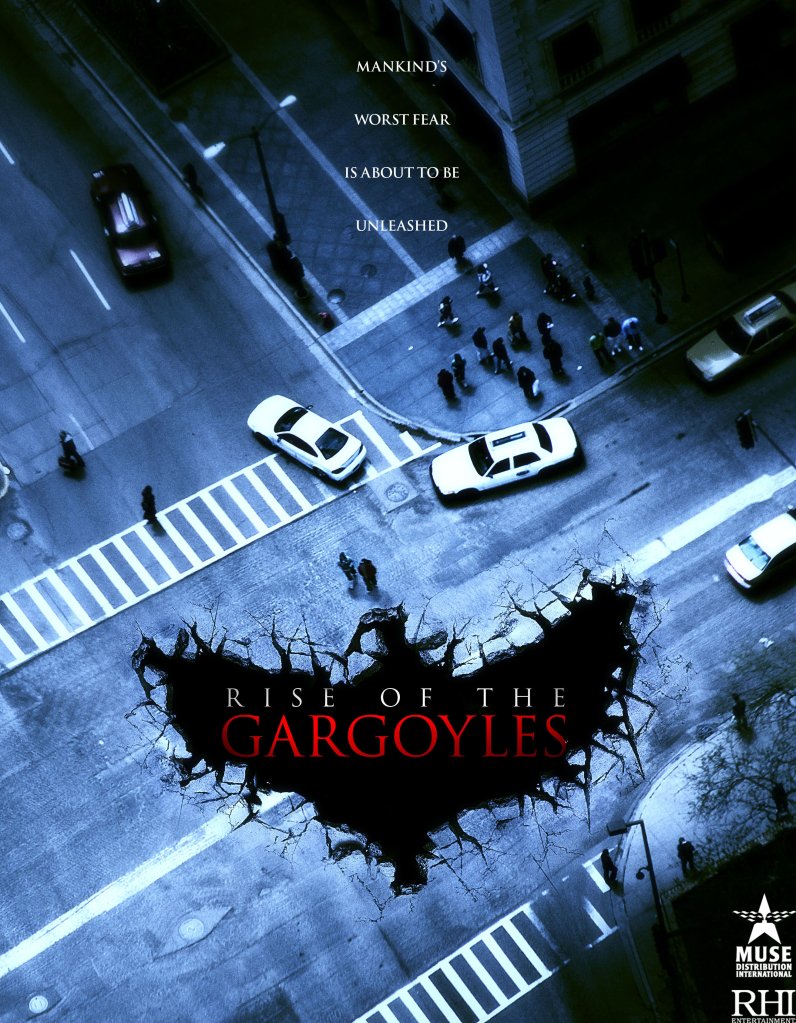
This Sci-Fi film is one that I’ve seen before, and while I can’t much speak on my original impressions (mostly because the movie’s so forgettable, I barely remembered anything about it), I can say that Rise of the Gargoyles is spectacularly generic and uninspired.
I certainly think that the story had potential, to be fair, if only because there are so few gargoyle horror films out there (off the top of my head, three come to mind, being a movie I’ve not yet seen from 1991 titled Soul of the Demon, then one of the segments from Tales from the Darkside: The Movie, and lastly the 1972 TV movie Gargoyles), but even with that niche monster checked off, the movie didn’t work.
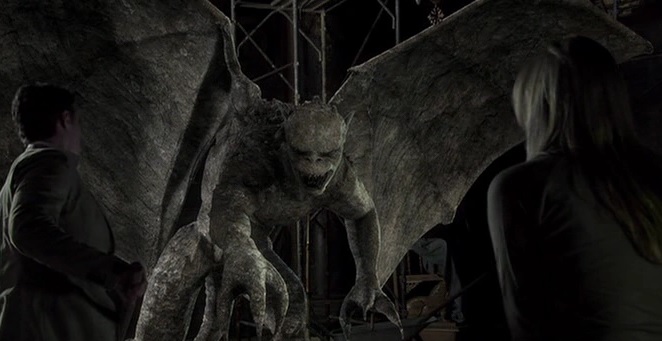
Why that was isn’t easy to pinpoint. Though certainly questionable at times, I don’t think the CGI was really that terrible (save for maybe a somewhat laughable decapitation in the first half of the film). The gargoyle itself was decent, though (perhaps luckily) we didn’t really see it in full, out of the shadows, all that often.
A larger culprit would probably be a combination of the story itself and the cast. The story was uninspiring, to be sure, and void of many interesting add-ons, but the cast was somehow worse. I think most of them knew what type of movie they were making, and that didn’t much endear themselves to strong performances. And in their defense, to be sure, stronger performances wouldn’t have done that much to improve the film.
I only know Eric Balfour from The Texas Chainsaw Massacre remake and a very small appearance in The West Wing. Even so, Balfour consistently reminded me of other actors, be it Adrien Brody or (amazingly) Sylvester Stallone. He’s neither, though, and really felt off at times as the lead here. Other performances, such as those by Caroline Néron, Nick Mancuso, Justin Salinger, and Ifan Huw Dafydd, were similarly uninspired, with Dafydd doing the best (though still being a stereotypical untrusting foreign police detective).
Honestly, I don’t really think Rise of the Gargoyles warrants that much more discussion – certainly the movie’s not terrible, but especially given the fact it’s a gargoyle-based horror film, there’s virtually nothing about this one that really stands out, which is a damn shame.
On a slightly interesting endnote, presuming the dates I’m seeing are correct, this was probably one of the last original movies put out while Syfy was still Sci-Fi (this was released June 21st, 2009 and the name change went into effect July 7th, 2009). It’s not a mind-blowing fact, but nor is this movie exceptional, so it fits in.
One could certainly do worse than Rise of the Gargoyles, but as stated, the film’s definitely sub-standard, and I really don’t think most who see this will find it overly memorable one way or the other.
Directed by Christopher Smith [Other horror films: Creep (2004), Severance (2006), Black Death (2010), The Banishing (2020), Consecration (2023)]
I’ve seen this one twice now, and while I appreciate what the movie’s going for, I can’t say that I’ve been particularly impressed either time. Mostly this comes from the fact that the story’s a bit too confusing to fully wrap my head around, which, while it may be on me, still stains the film.
If there’s a time loop, and you know you’re stuck in a time loop, trying to break out of a time loop isn’t going to work as you’re already in the time loop. And if there’s three other versions of you in the same (but different) time loops, and three other other’s in other time loops (or dimensions), and the loop’s divided by an additional sea, is the time loop a circle or oval?
False, triangle.
Triangle’s interesting, and I think the movie looks really nice. The story, though, just isn’t my cup of tea. Jess trying to get home to her son to kill her original (or is that another loop version #2?) self to become a better mother only to loop again because loop loops loop.
On a serious note, when there is something like a time loop, in this case, and there are multiple versions of the same character floating around, it’s really hard for any impact to be felt when they’re killed. Because, well, you know they might have died, but there’s two other ‘theys’ around, and while they might also die, hey, look, another one. So how is anyone supposed to get pulled into the suspense at all if everything’s circular?
I’m sorry if I’m coming across as some uneducated philistine. It just doesn’t make sense to me. The whole point of a loop is that there’s no ending (or beginning), so no way to escape it. When Jess kills another version of herself, before that other version dies, she states that the only way to ‘break the loop’ is to kill the others on board. I don’t know if she meant just one group of the others or all the others, but it doesn’t matter, because it isn’t logical.
Not that our character of Jess (played by the only noteworthy performance, Melissa George) is particularly logical, so I can excuse that, but come on, did anyone not almost immediately guess purgatory? As soon as Sisyphus was mentioned, who didn’t see it coming?
I may be in the minority here. Triangle is generally well-respected, and has a solid rating on IMDb. And to be fair, maybe the movie makes sense outside of logic, or maybe I’m not understanding something entirely. This is entirely plausible, and I won’t hold that against the film. To be fair, maybe Triangle is a movie that should be seen more than twice in ten years to fully comprehend, but for the time being, I found this movie a nice-looking film but lacking in substance.
5.5/10
This is one of the films covered by Fight Evil’s podcast. Listen below as Chucky (@ChuckyFE) and I discuss this one.
Directed by Kinji Fukasaku [Other horror films: The Green Slime (1968), Fukkatsu no hi (1980), Makai tenshô (1981), Chûshingura gaiden: Yotsuya kaidan (1994), Batoru rowaiaru II: Chinkonka (2003)]
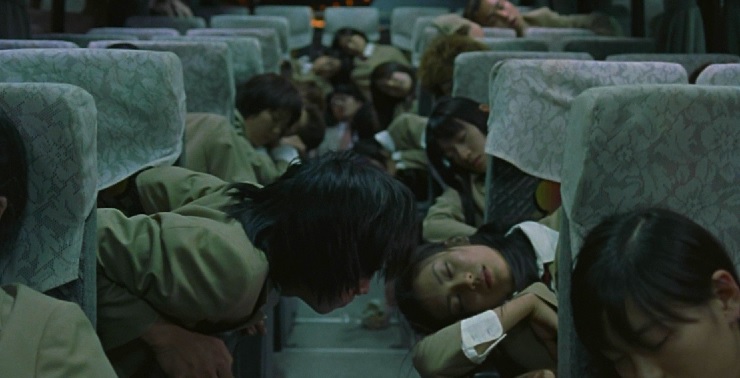
Undeniably more than just a horror/action movie, Battle Royale (or Batoru rowaiaru) is an utterly beautiful, yet violent, film which never fails to leave an impact on me when watching.
We all know the story – a bunch of classmates are dragged to an island and forced to kill each other off due to a fascist Japanese government. If the adults are scared of the youth, I’m not sure making one of them into a super killer is the best idea, but the faulty logic aside, it’s a story that really gets to me, and it’s just so tragic.
The adolescent view of life is apparent in most of these kids. You have people harboring untold crushes which influence their actions, or people relying on past friendships in the hope that they’ll work toward a peaceful outcome as opposed to slaughter. Loners and the misunderstood now have a chance to make something of themselves, and petty disputes can now turn kids murderous.
In many ways, Battle Royale is drenched in the angst of being a teenager. Some of these kids have more to deal with than others, but the core of it is they’re all still kids (well, mostly, aside from one of the transfer students, a winner of a previous Battle Royale). It’s due to this that I think the movie has a greater impact – not just shock value due to the fact that they’re young, but in that these characters have only lived for 15, 16 years, and are now expected to fight for an adulthood they may not even comprehend on violent terms (there’s four who opt out and commit suicide in the situation, and I can’t say that’s a bad choice).
Also, it’s a movie of friendship. Sure, some of these characters love one another, but the bonds of friendship really shape most of the relationships. Look at the tragic story of Chigusa (Chiaki Kuriyama) and Sugimura (Sôsuke Takaoka). Hell, look at Mitsuko’s actions and the basketball flashback – she’s never felt like a part of the group, so do her actions really come as a shock, given her background? If she had some solid bonds, would she have taken a different route?
Battle Royale isn’t for the light-hearted, not with this level of violence beautifully melded with a very tragic story. I won’t even get into specific scenes to watch out for – there’s fantastic gunplay, of course, but there’s also more traditional horror deaths, such as knives, axes, and other fun sharp implements. It’s a bleak movie, but don’t be surprised if a few surprising moments of levity arise.
I won’t go as far as to refer to this one as a black comedy, but there certainly are elements here and there, especially in the jubilant Battle Royale explanatory video and Kitano’s (Takeshi Kitano) commentary and obsession over the cookies. Or his final scene, as a matter of fact (not counting the requiems at the end).
If there are any standout performances here, it’s either Tatsuya Fujiwara (Nanahara) or the aforementioned Takeshi Kitano. Kitano has a pretty good scene with Aki Maeda (Noriko), and Maeda’s really good too. Maeda and Fujiwara have solid chemistry, and I buy their adolescent affections.
Tarô Yamamoto (Kawada) was a bit of a mystery at first, but really came into a pretty good character. If you discount Kitano, the two main antagonists are Masanobu Andô (Kiriyama) and Ko Shibasaki (Mitsuko), both of whom are strong. It could be said that maybe Andô’s performance is a bit on the cliché side, but I still think it was good.
Others who positively stood out include Eri Ishikawa (Yukie, who really only had one scene of note, but it made her a lovable character), Takayo Mimura (Kotôhiki, who’s heartbreaking scene with Sugimura was amazingly sad), Sôsuke Takaoka (wish he would have done more than look for Kotôhiki, but the heart wants what the heart wants), Chiaki Kuriyama (Chigusa, who added another rather depressing scene in the film), and Takashi Tsukamoto (Shinji, who had a cool, revolutionary uncle and was perhaps one of the most interesting and apt characters in the film).
Battle Royale, if it hasn’t been made clear by now, is an emotional experience. The way that flashbacks and dreams are utilized just work really well, and gives depth to some characters who might otherwise just be seen as one-dimensional caricatures. There’s a sense of hopelessness throughout the film, but come the ending, with the final monologue, we’re told to “run for all you’re worth”, and if that’s not an optimistic conclusion, one of a hopeful future, I don’t know what is.
It could be said that the three requiems at the end aren’t necessary, and the third one (an extended dream conversation between Noriko and Kitano) is just bizarre, but what the hell, they still add some flavor into the film.
And speaking of flavor, that music, tho. Sure, you get some quality classical pieces, such as Johann Strauss’ Blue Danube and the epic Dies Irae by Guiseppe Verdi, but the whole score is gold, and the cherry on top is the concluding song by Dragon Ash, titled “Shizuka na hibi no kaidan wo.” I fell in love with this song when I first saw the film, and even now, the song sends chills down my spine. An utterly fantastic song to end with.
All things said, Battle Royale is a film that, if approached with an open mind, you can really fall in love with. I didn’t fully follow the events when I first saw this movie (I was much younger, and couldn’t tell many of the characters apart from each other), but even then I sensed this was special, and Battle Royale certainly is. It’s a horror movie in my eyes, no doubt about it, but it’s so much more. A perfect movie, with great violence, amusing black comedic moments, and characters you can find yourself getting attached to. I doubt films get much better than this.
10/10
This is one of the films covered on Fight Evil’s podcast. Listen below as Chucky (@ChuckyFE) and I discuss this one.
Directed by Albert Lewin [Other horror films: The Living Idol (1957)]
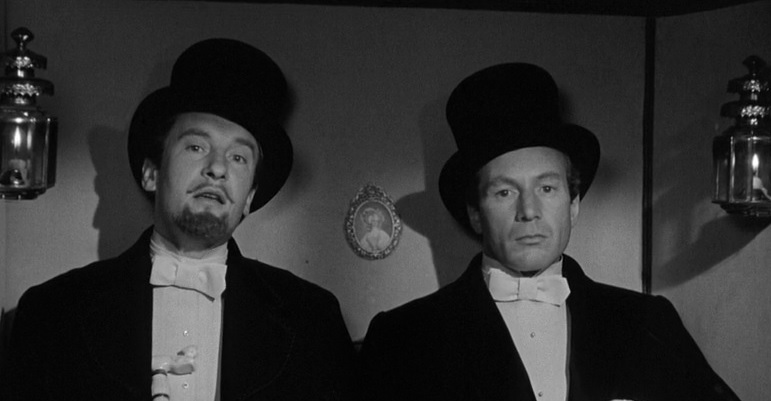
While certainly more a morality tale than a straight horror film, there’s a reason that this classic is often listed as part of the genre, especially come the end of the film in it’s debauched glory.
More than anything, The Picture of Dorian Gray questions morality. Personally, when it comes to many aspects of the hedonistic lifestyle portrayed in the film, I didn’t have a big deal with it. It was a different time, though, so if you can get past how tame Dorian’s ‘sins’ seem (some of the worst stuff is off-screen, only alluded to), you can have a good time.
The cast here is stellar. Hurd Hatfield does a great job as the debonair but somewhat soulless Gray, and his youthful appearance lends credibility to the story. He’s never really been in much that I’ve seen, but given that this was only his second role, it shows the quality of his performance. Honestly, though, George Sanders and his amoral character impressed me more. He was witty, fun, and most importantly, entirely able to defend the actions others see as questionable. Sanders here really brought a great character to life.
Donna Reed and Angela Lansbury played two love interests of Gray at different periods of his life. Reed was decent, but it was Lansbury who made a bigger impression, and the scene in which she’s singing prior to meeting Gray was great. Her time with Gray was short and tragic, especially come the test of her virtuousness (all thanks to Sanders’ character).
One more name need be mentioned, and that’s Cedric Hardwicke, who narrated the film. I sometimes have an issue with narration (look at how awful it was in Curse of the Faceless Man), but it was very solid here, and only added to the tone of the film.
Another thing very much worth pointing out was how, despite the film being black-and-white, there were a few scenes in full color, when first showing the titular picture of Dorian Gray and again toward the end once, showing just how far his soul has fallen (which led to some unnecessary “Pray for your soul, Dorian,” stuff, but whateves, I can deal with it). It was a very effective use of dramatic coloring, and that, coupled with a murder that happens moments after the second portrait reveal, really bring the horror element of the film to the forefront for those scenes.
When it comes to classic films, it’s not uncommon for horror elements to get mixed up with heavy dollops of drama, and this movie is a prime example of that. For fans of modern-day horror, The Picture of Dorian Gray might not be up to their standards. It’s a great mixture, though, of a morality tale, throwing in elements of romance, horror, and the desire for one to better himself. Certainly a movie that’s recommended, and referred to a ‘classic’ for a reason.
Directed by Christopher Landon [Other horror films: Paranormal Activity: The Marked Ones (2014), Scouts Guide to the Zombie Apocalypse (2015), Happy Death Day (2017), Freaky (2020)]
While it’s true that this sequel isn’t near as good as the first movie, Happy Death Day 2U is still pretty strong, and treads some new waters along with keeping some emotional content within as to not over-focus on the comedy.
If there’s one problem with the film, it’s that the comedy is more prevalent here. It’s just a more light-hearted affair, and while the first film obviously had it’s moments, just the montage of suicides in this movie was enough to put it over-the-top. Also, that sequence with Rachel Matthews’ character pretending to be a French blind girl could have probably been toned down.
Another problem dealt with the fact that the mystery killer portion of the film didn’t seem near as interesting as it was in the first movie. Not that much time was spent on trying to figure out who it might be, and honestly, there’s not that many suspects to begin with, so when we get to the end and find out, it’s not that much of a shock.
The film started out interestingly enough, focusing on a time loop that Ryan (a side-character from the first movie played by Phi Vu) was stuck in, only to move back onto Tree (Jessica Rothe) once an experiment goes awry. I thought sticking with Ryan’s character would have been okay, but with where they took Tree, I didn’t think this fake out was a big let-down.
As such, Phi Vu gets a bit more character here (though still not that much), which was nice to see. Much of the accolades, though, go to Jessica Rothe, especially during the scenes in which she spent time with her mother (alternate universe which her mother’s alive = fun times for Tree). It’s not quite as strong as Tree’s emotional scene with her father in the first movie, but I still think it brought this movie a much needed tone check.
Israel Broussard was just as good in this one as he was in the first, and he and Tree had some sweet moments. If there’s a big flaw insofar as performances go, it’s that Charles Aitken’s character seems so obviously evil, it borders on ridiculous. Sure, he wasn’t that different in the first movie, but here, I just couldn’t get out of my mind that he was a dark doppelganger of Jesse Spencer’s Chase from House.
Happy Death Day 2U isn’t a terrible film. I still found it above average, even, but compared to the first one, which was surprisingly fantastic, it doesn’t leave near as much an impact. I mean, come the end, we get a hideous rendition of “Stayin’ Alive” and a mid-credit sequence which just didn’t land for me. The idea of an alternate world was decent, and it lead to some okay additions, but really, it’s the first movie alone that I find actually special.
Directed by Joseph Sargent [Other horror films: Nightmares (1983)]
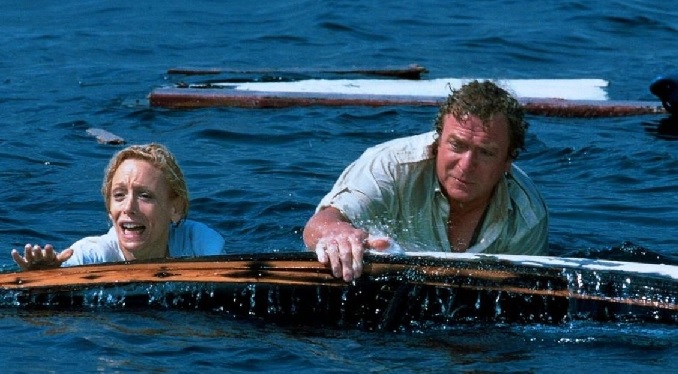
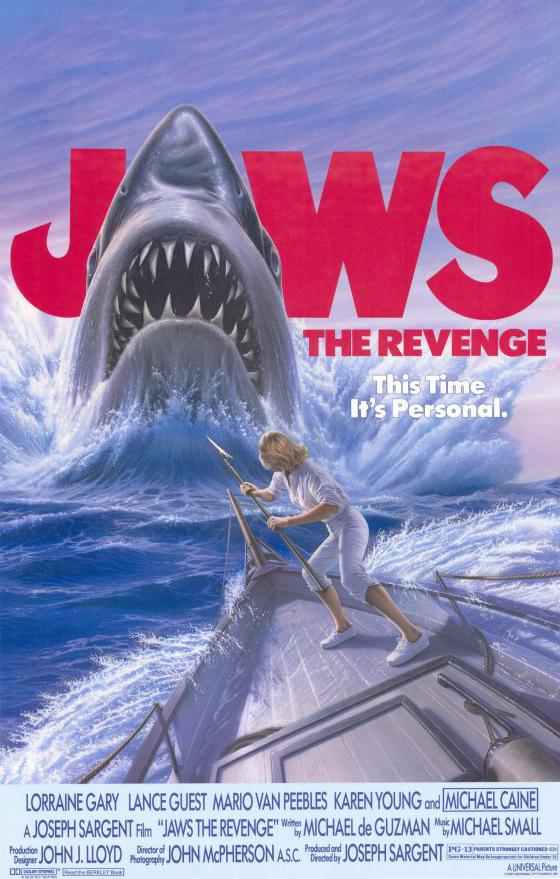
Before touching on any details, I want to get this controversial viewpoint out of the way: I actually like this movie more than the first Jaws. Not that it’s a better movie, necessarily, just that I had more fun with this. It occasionally drags, and there’s not near enough action, but hey, Michael Caine is fun here.
Caine appeared in few horror films, among them a starring role in The Swarm, which is perhaps his most notable one. His role here isn’t mind-blowing or anything, but he has a consistently fun personality, which melds nicely to most others’ rather somber attitudes. I’m glad that Lorraine Gary came back as Ellen Brody, but the fact that neither Dennis Quaid or John Putch return as Mike and Sean (instead, there’s Lance Guest and Mitchell Anderson) was disappointing.
Not that Guest is actually that bad here, though he does have a few moments of mediocrity. That’s probably more the film than his acting abilities, though. Mario Van Peebles was decently fun as Jake, but really, Caine held most of my attention, which is fine, because he was probably one of the most interesting people here.
I get a lot of why this movie gets a bad rap – the idea that a particular shark is specifically going after the Brody family (why is never made clear – perhaps the sharks killed in the first and second movies were it’s parents) is pretty laughable, especially coming to an environment that isn’t ideal for it. More so, the movie’s goofy at times. The seemingly-psychic way Ellen knows that the shark is hunting her and her family is pretty bad, and that finale wasn’t near as dramatic as you’d hope (in fact, the whole the finale had an improbably positive outcome for all involved).
Still, though there isn’t nearly as much action as there should be (the shark chasing Michael was decent, but aside from that, there weren’t many action sequences of note), I think Jaws: The Revenge is reasonably fun. If it’s only because of Van Peebles and Caine, so be it, but it undeniably had more life than the often-dull Jaws 3. I’m not saying that this film is great, but I can’t deny that I enjoy it more than I probably should, and probably find it somewhere just below average.
Directed by Barbara Peeters [Other horror films: N/A] & Jimmy T. Murakami [Other horror films: N/A]
This is a film I’ve seen only once before this rewatch, and I have to admit to enjoying it a smidge more the first time I saw it. Not that Humanoids from the Deep is a particularly bad movie, it’s just that there’s not enough meat to the story.
What the movie gets right is probably one of the most common things to hear about it, being the creature design and the heavy use of gore. And indeed, there’s also some pretty quality nudity here, and some ever hot interspecies rape going on (just what you look forward to in a movie, I know), so no complaints there.
As good as a gore is, though, and as fun as the finale, which is mostly an attack by the creatures upon the small town’s festival on the docks, I think a lot of the first two-thirds of the film are unremarkable, and much of this is due to the utter lack of memorable characters or performances.
I never really got a hold on Doug McClure’s character here, and he seemed to just be there much of the time. Marginally more interesting was Anthony Pena’s character, due to an element of racial unease between the white town and Native Americans (though I don’t think enough was really done with this subplot). Otherwise, Vic Morrow and Ann Turkel are both unremarkable, and the story just isn’t that intriguing without the creatures present.
In some ways, this movie feels more like a 70’s flick than it does the 1980’s, especially due to the fact that there’s not a whole lot of lighter moments here. Humanoids from the Deep generally takes itself seriously, and while that’s not a problem in of itself, I partially think this movie could have had a bit more spice thrown in. Thank God it wasn’t as dull as Grizzly or Without Warning, but it’s not altogether too far removed from either.
Overall, I really adore the gore here. I love the creature design, and their freakishly long arms. Also, you won’t hear me say no to nudity like that. But when these elements aren’t the focal point of the scene, Humanoids from the Deep can come across as surprisingly dry. Still, for it’s flaws, you’ve gotta see the festival ambush – if the movie was building up to that, I think a lot of the smaller flaws can be forgiven.
7/10
This is one of the films covered by Fight Evil’s podcast, so if you’re interested in hearing Chucky (@ChuckyFE) and I discuss this one, listen below.
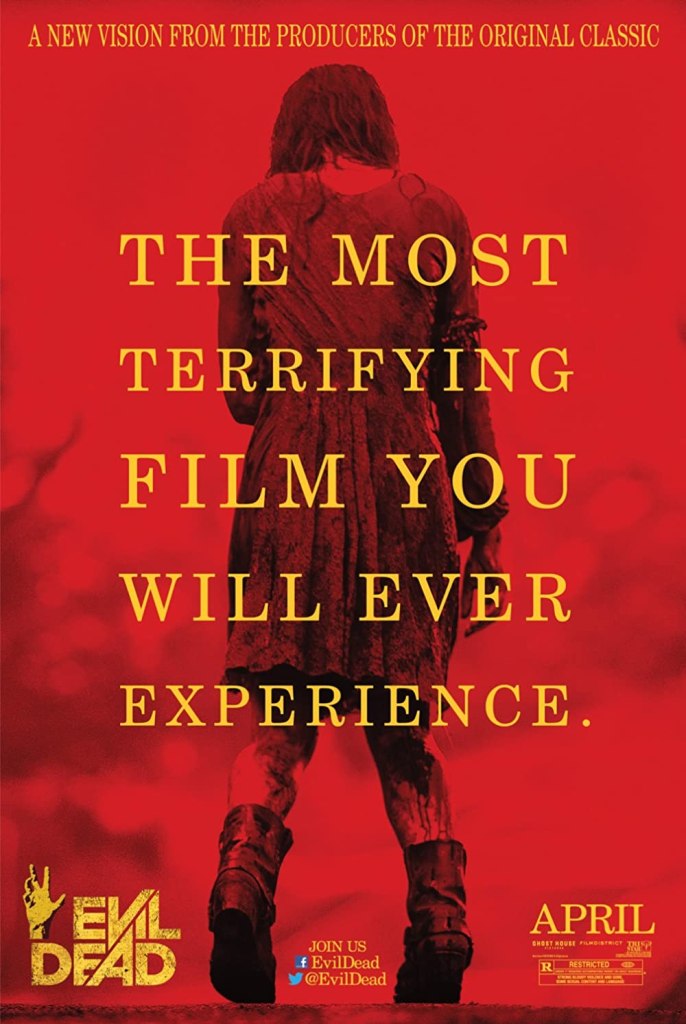
Directed by Fede Alvarez [Other horror films: Don’t Breathe (2016)]
This remake/soft reboot/re-imagining (however you wish to describe it) certainly ups the ante from the original film, but much like how I’ve never found The Evil Dead all that amazing, I’m likewise lukewarm to this rendition.
No doubt the gore here is noteworthy. What with electric knives cutting arms off, or faces getting peeled off, or tongues getting halved with box cutters, or any of the other various brutal scenes within, Evil Dead has the goods as far as gore’s concerned. It literally rains blood toward the end, so it’s not necessarily a movie for the queasy.
And all of that’s good-and-well, but that doesn’t make me any more a fan of the story. Personally, I’ve never found possession all that interesting. More than anything, when someone becomes demonically possessed, I just get annoyed that their friends and family keep getting fooled by their innocent acts after demonstrating utterly inhuman abilities.
That happens here, too, multiple times. I get it, Shiloh Fernandez’s character wants to believe the best of his sister, played by Jane Levy (Don’t Breathe), but come on, after some of the stuff that the demon does, get it through your head that it’s no longer your sister and do what needs to be done. Stuff like that just always aggravated me, and as such, Fernandez’s character didn’t leave much a positive impression.
Actually, the only one here I really liked was Lou Taylor Pucci. His character made mistakes now and again, but it’s through him we got most of the lore, so I definitely appreciate what he brought to the table. Jane Levy wasn’t bad, by any means, but for most of the film, she was a demon, so we don’t really get to spend that much time with her.
I guess the big issue is that I’ve never been a big fan of The Evil Dead series. I enjoy the second well enough, but the first and Army of Darkness aren’t really my cup of tea. No doubt the atmosphere of the original is decent, and this film itself does have a pretty epic finale, but possession-themed flicks aren’t my go-to when it comes to horror.
Evil Dead isn’t a bad movie due to this – I think it did enough right to satisfy many watching it. The setting (desolate cabin) and some prop pieces (especially that book, which looked hella hip, as the kids say) were commendable, but I did find the movie a bit below average, and that one-second post-credit scene with Bruce Campbell? Pointless.
All-in-all, the movie’s fine, with a decent amount of gore it can boast about. I’d just rather watch so many other things, personally.
6/10
This is one of the films covered by Fight Evil’s podcast. Listen below as Chucky (@ChuckyFE) and I discuss this one.
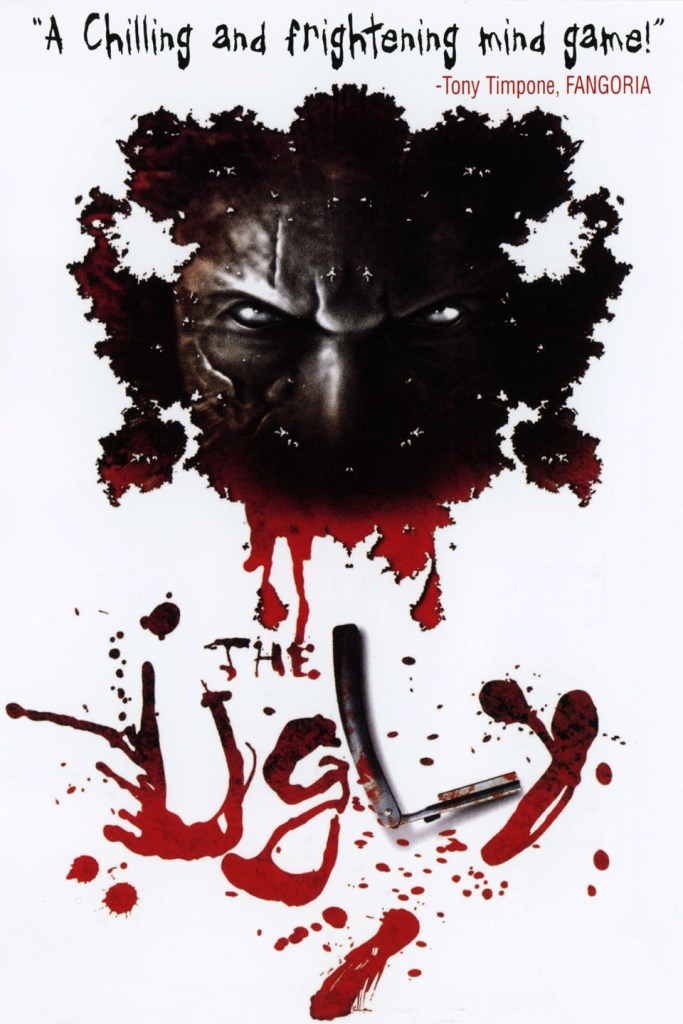
Directed by Scott Reynolds [Other horror films: N/A]
Honestly, The Ugly is a pretty simple movie, which the lower budget does well with. Certainly not a classic or anything so grand, this New Zealand film still has enough going for it to be consistently enjoyable.
First off, the budget here is a bit on the lower side, evidenced by both the somewhat terrible set (though I think it works to a point in-universe) and the small cast. They didn’t really need a large cast, though, and I definitely think what they had worked out well.
The idea behind the movie (a psychologist learning about the life of an insane serial killer) wasn’t anything too special, but the film was somewhat innovative in its stylistic flashbacks. Some good lighting, some interesting black blood, things just jelled here. I wish that the ending had been a bit more reasonable, as it sort of reminded me of Frailty, but whateves, it’s cool.
There’s plenty of solid cast members here, from Jennifer Ward-Lealand (who plays one of the most unlikable mothers in cinema) to Rebecca Hobbs and Roy Ward (that guy just struck me as utterly random throughout the film). My two favorites here, though, are the main serial killer, played wonderfully by Paolo Rotondo and a childhood friend of his, played by young (at the time, she was around 13) Beth Allen. Both brought a lot to the film, and I especially enjoyed Allen’s scenes early on. Her adult counterpart (Vanessa Byrnes) didn’t do near as much for me, alas.
Much of the film might come across as a typical origin story of any run-of-the-mill serial killer, but I thought it packed a pretty emotional punch here and there. Like I said, it’s more the stylistic nature of some of the sequences more than anything that make it memorable, but there are some decent kills and suspenseful scenes throughout.
I didn’t really think that much of The Ugly when I first saw it years back, but it’s aged nicely, and though I don’t think it’d make my ‘Best of the 90’s,’ it’s certainly a slice of foreign horror that might be worth experiencing once.
7/10
This is one of the films covered on Fight Evil’s podcast. Listen below as Chucky (@ChuckyFE) and I cover this one.
Directed by Bob Clark [Other horror films: Children Shouldn’t Play with Dead Things (1972), Dead of Night (1974), Murder by Decree (1979)]
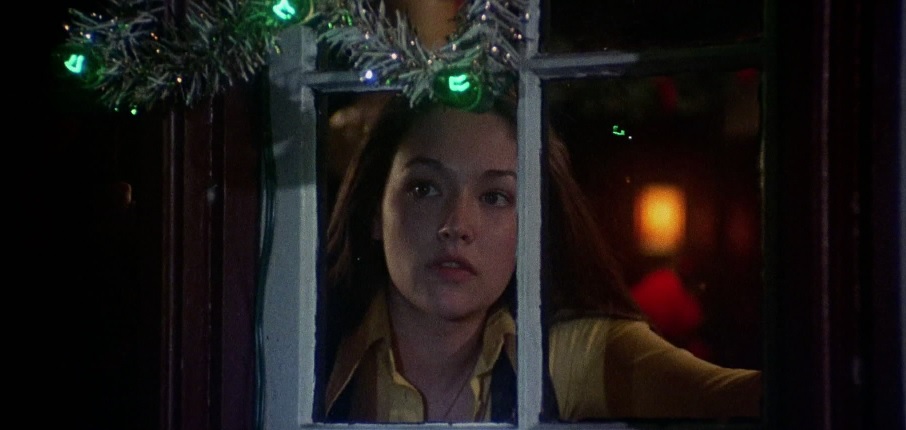
This is a true classic of the genre, and one of the first real slashers, coming out four years before Halloween. It’s a movie that, to be honest, I’ve only seen once before sitting down and revisiting it, but that doesn’t mean I don’t adore Black Christmas and the approach the movie took.
While it could perhaps rightfully be said that the plot here isn’t anything to celebrate that heavily, Black Christmas was one of the first movies to really throw together your typical slasher situation. Sure, a few movies prior had similar ideas (such as the British oddity The Haunted House of Horror, also known as Horror House), but this one cemented many of the core elements (including the final girl finding bodies of deceased friends and a first person point-of-view from the killer). The plot may not read like anything special, but it really is.
And taking a step back from the importance of the movie itself, the cast here holds some rather interesting faces, among them Olivia Hussey and John Saxon. Hussey, I won’t lie, I know purely from the 1990 mini-series It, but she looks pretty much the same, and I just loved seeing her here. Saxon’s been in quite a few horror films, A Nightmare on Elm Street being the finest, and he too brought a lot to the film, though he was far from a central character.
Lynne Griffin was one of the earlier casualties in the film, but given she played one of the main characters of the slasher Curtains nine years later, it was, much like Hussey, fun to see her. Both Margot Kidder and Marian Waldman were solid in this too, though Waldman’s character was mainly for comic relief, which, while funny, did feel off at times.
It is true that there’s not many great kills here – the best one, and I think this is beyond dispute, would be the stabbing with the glass unicorn, which was well-done due to it being spliced in with Christmas carolers blocking out the screams. The death wasn’t amazing, but I think it was still solid. What’s more effective is how an early victim in the film would keep popping up, just a body on a rocking chair with her head wrapped in plastic (which, if it sounds familiar, I’d recommend you check the poster). Not sure why, but that just had a creepy aura to it.
Another aspect that certainly merits mention is the somber finale. It’s not entirely dreary, but it is definitely downbeat, and I think that final scene is one of the more memorable things about the movie. It’s a good cherry on top of an already delicious dessert.
I said at the beginning, though, that Black Christmas isn’t perfect. When I think of 70’s horror I love, Black Christmas doesn’t often make my top ten or fifteen. No doubt it’s a good movie, not to mention an important one, but it’s never been my go-to. That said, if you’ve not yet seen this one, I highly recommend giving it a watch, because it’s well-regarded by many for good reason.
8/10
This is one of the films covered on Fight Evil’s podcast. Listen below as Chucky (@ChuckyFE) and I discuss this one.








 Jiggy's Horror Corner