House of Wax (2005)

Directed by Jaume Collet-Serra [Other horror films: Orphan (2009), The Shallows (2016)]

It’s been a long time since I’ve seen House of Wax. If I had to guess, it’s been over ten years. So I was quite excited to see this one again, as I thought it was a pretty solid movie the first couple of times I saw it, and with fresh eyes, I can confirm this movie is quite solid.

A remake-in-name-only of 1953’s House of Wax (which is itself a remake of 1933’s Mystery of the Wax Museum), I can’t say exactly why it works. It’s a slasher movie, and not overly original, but I’m guessing that the whole wax element adds a lot. There’s not really much mystery, but that finale, which takes place in a melting literal house of wax, is one of the coolest things I’ve ever seen.

I think time has been somewhat kind to this one, because while I remember plenty of critiques when it came out, it’s not uncommon for me to hear positive things about it nowadays, and I can see why. It’s a bit generic insofar as the story goes – two killers are killing people – but it’s filled with fun ideas, a memorable setting, and some quality violence.

The best piece of violence would probably be a scene in which someone’s fingertip gets cut off with a wirecutter. That’s a scene that’s stuck with me ever since I first saw the movie – there’s a lot of blood, as you can imagine, and it looks so damn painful. Another individual is sprayed with hot wax. Someone else gets a pair of scissors to their Achilles’ Heel. An individual who has been covered in wax gets his face peeled off. Someone else get stabbed in the heel – it was quick, but #Painful. For a mid-2000’s slasher, House of Wax can be a violent film, which I definitely think works in it’s favor.

I also think the setting does a lot for the film. A largely abandoned small town with wax figures in every building, plus a house of wax made entirely of wax (which leads to the aformentioned fantastic melting finale, and digging through a wax wall for freedom), this movie just has a lot of great atmosphere. Even at the length of the film – an hour and 53 minutes – the setting and story keep things wonderfully engaging.

Chad Michael Murray (The Haunting in Connecticut 2: Ghosts of Georgia and Camp Cold Brook) was fantastic in this movie. I loved his character – he started out a bit of an asshole, but he quickly grows on me, and even without the violent attacks he’s trying to defend himself and his sister against, I was rooting for him. Elisha Cuthbert (Captivity) was quite good, and while he wasn’t around as long as you might expect, Jared Padalecki (Friday the 13th and Cry Wolf) was pretty solid. Paris Hilton (Nine Lives and Repo! The Genetic Opera) appeared for a bit, but not for long, so that’s fine.

I wasn’t surprised that I enjoyed House of Wax, given that, while it has been many a moon, I’ve enjoyed it before, but I was surprised that I enjoyed it as much as I did. This movie holds up quite well in my mind, and while I know the reception is more on the lukewarm side, I find this movie a hell of a lot of fun, and definitely recommend it.

8.5/10

Night of the Demons (1988)

Directed by Kevin Tenney [Other horror films: Witchboard (1986), The Cellar (1988), Witchtrap (1989), Witchboard 2: The Devil’s Doorway (1993), Pinocchio’s Revenge (1996), The Second Arrival (1998), Endangered Species (2002), Brain Dead (2007)]

Night of the Demons has never been a favorite of mine, but it can be a reasonably fun Halloween fair. It’s a bit silly for me at times, especially once the demons start making their presence known, but it has an engaging enough story and fun characters, so it’s not a bad watch.

I always loved the opening here – an animated look into the house featured in the film, with ghosts as curtains and monsters creeping up the stairs. It’s a fun little opening, getting you in the mood for the Halloween season, and I’ve always appreciated it.

Most of the cast are decent in the roles they’re supposed to play. I personally didn’t care much about Billy Gallo (Sal) or Lance Fenton (Jay), but others, such as the lead Cathy Podewell and the lucky Alvin Alexis, were sympathetic. Hal Havins (Sorority Babes in the Slimeball Bowl-O-Rama) was quite quotable, with lines such as “Shut up and drive, bitch!” and “Eat a bowl of fuck!” along with the fascinating exclamation “festering fuckwads!” Certainly a memorable character.

Speaking of memorable, Linnea Quigley’s first scene here is a doozy. It’s a scene that, believe it or not, has stuck with me since I first saw the film, and it’s always fun to watch. Quigley (Return of the Living Dead, Silent Night, Deadly Night, Graduation Day, Nightmare Sisters) isn’t really an actress that I care that much for, but she does have her moments, and I think this movie is one of her stronger roles.

The special effects here are all reasonably impressive. Night of the Demons isn’t a gory movie, generally, though there are some solid scenes, the best one being someone’s eyes having an unfortunate meeting with someone else’s thumbs. There’s also the somewhat bizarre ending, but it’s all in the spirit of Halloween.

And I think that’s perhaps the best thing about Night of the Demons – the Halloween spirit. Early in the film, we see a rather dark cartoon (The Cobweb Hotel from 1936) playing on TV, we have the animated opening, we see some pumpkins, we have costumes. This film has a solid Halloween vibe, and while it’s nowhere near as good as movies like Trick ‘r Treat or, well, Halloween III: Season of the Witch, it’s still not shabby.

Night of the Demons has never been a favorite, and for as much as it can get right, some of the humor toward the latter half of the film doesn’t do it for me. It’s just a bit goofy at times. It’s never overwhelming, but it’s there, and because of that, with as many times as I’ve seen this, I find the movie just around average. Worth watching for the Halloween vibe, though.

7/10

Uncle Sam (1996)

Directed by William Lustig [Other horror films: Maniac (1980), Maniac Cop (1988), Maniac Cop 2 (1990), Maniac Cop 3: Badge of Silence (1992)]

Uncle Sam might be a good example of a movie that’s better in concept than execution. It’s not a bad film, but I think there was a lot more potential here than what the final product displayed, and while portions were solid, I definitely think the movie could have been more memorable.

I think the basic plot is fun, which deals with the resurrection of a soldier who was killed by friendly fire in Kuwait going around his hometown and killing people. Some of the people he kills seems to be for ideological reasons – such as him going after a teacher who protested Vietnam back in the 1960’s – but others seem to be pure revenge, such as his wife who has moved on.

What makes the story mildly more interesting is that there’s a nephew of his, played by Christopher Ogden, who is quite the patriotic youth, and despite the fact his Uncle Sam wasn’t the nicest person in the world, the kid looks up to him, and respects him. He wants to join the military when he’s older, and do whatever the president tells him to, because “he knows best.”

I don’t know if this movie was intentionally attacking the idea of blind patriotism. I’d like to think so, and the poem spoken during the credits – ‘Desert Storm’ recited by William Smith (yes, the actor, who also has a small role in the film) – leads me to that conclusion, but even if the story is just supposed to be a story (fans of Stephen King’s best novel It should catch that reference), I do enjoy what I perceive as the anti-war message, which is best delivered by Isaac Hayes’ character, who was a soldier himself, and lost a leg in Korea.

And this might go without saying, but this movie never could have been made even five years later. After 9/11, patriotism was at an all-time high (along with other delightful things, like illogical wars and xenophobic attitudes toward Muslims, or those who could almost “look” Muslim, such as Sikhs or Hindus), and movies that questioned such fervent and emotional attitudes probably wouldn’t have done too well. None of this makes Uncle Sam a good movie, but it does make it an interesting movie to look at, at least through the political climate of the nearby years.

The main problem here is that the movie is simply adequate. Some of the kills are solid, such as someone being hung from a flagpole, or a cannon being shot at someone, or even someone getting stabbed by a flag, but I’d argue none of these are great kills, and even the decapitation here doesn’t really stand out. A lot of the film feels somewhat tepid, and while it’s nice to see a slasher shortly before Scream brings the subgenre back to prominence, I can see why this might not do a lot to advance love of the genre.

Of course, none of this is supposed to say the movie’s bad, because I don’t think it is. I think some elements are a bit off, such as Zachary McLemore’s wheelchair-bound character’s unspecified relationship with Uncle Sam, but the movie’s still palatable. It’s just that I think the story had a lot more potential, and while I’m glad they veered away from heavy comedy (there’s surprisingly few one liners here from the killer, which I appreciated), maybe that approach would have given the film a bit more flavor. At the very least, Uncle Sam’s costume design was pretty solid.

Christopher Ogden was good as the patriotic kid, and though I didn’t care for his blind worship of the military, he’s a young boy, and made a fascinating main character. Anne Tremko and Leslie Neale weren’t that relevant, but did have one good scene. Isaac Hayes took a bit to appear, but I rather enjoyed him, and while she didn’t do much at all, it was sort of nice seeing P.J. Soles (Halloween, B.O.R.N., and Carrie) here.

Like I said at the beginning, I think the concept of Uncle Sam is stronger than the final product. Make no mistake, this movie is superior to films like The Tripper, but it’s also true that William Lustig made a much more memorable film in Maniac Cop.

7/10

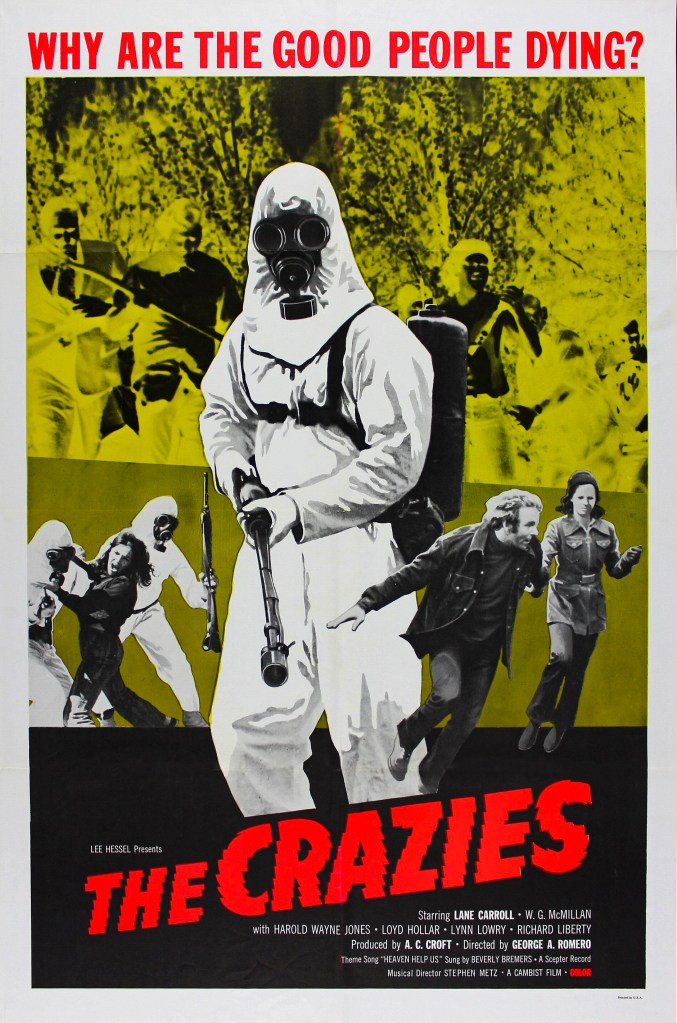
The Crazies (1973)

Directed by George A. Romero [Other horror films: Night of the Living Dead (1968), Hungry Wives (1972), The Amusement Park (1975), Martin (1976), Dawn of the Dead (1978), Creepshow (1982), Day of the Dead (1985), Monkey Shines (1988), Due occhi diabolici (1990, segment ‘The Facts in the Case of Mr. Valdemar’), The Dark Half (1993), Bruiser (2000), Land of the Dead (2005), Diary of the Dead (2007), Survival of the Dead (2009)]

While The Crazies isn’t a favorite of mine, I always found it a unique take on a not too uncommon story, at least nowadays. It’s a bit meandering at times, but it’s overall solid, and has some strong elements.

It’s hard to pinpoint the antagonistic force here, which is partially why I find the film interesting. Certainly those infected with the virus would count, but the army invading a small Pennsylvania town would count also, and while they were following orders, they were also stealing money and other things (such as fishing poles) from private citizens, so the soldiers here are also sinister. So is the military sending the orders out – a plane crashed that had a bioweapon on it, and because of “national security” they need to round up American citizens like cattle.

Sometimes this is a frustrating movie to watch. It’s like a much more focused version of The Stand. I get needing to contain a virus, but of course if you don’t give adequate information to people, the people will fight back. Those soldiers who were killed throughout the film didn’t deserve that, but the higher ups in the military certainly did, and the fact that, as far as the film itself went, we never saw the story get out to the media about how a bioweapon created by the USA caused this, so appropriate blame could be placed on the American government, was sort of disheartening (not that you could expect anything less from the guy who ended Night of the Living Dead as he did).

My views on unjust military takeovers to cover their own mistakes aside, there are times when The Crazies doesn’t feel exactly well-written. We have our protagonists (Will MacMillan, Harold Wayne Jones, and Lane Carroll) and we have our insight into the military’s plans (mostly from Lloyd Hollar), but there are times when things don’t really feel focused. There’s action throughout, mostly revolving around the townspeople defending themselves from the invaders, but there’s still a bit of a dry aura at times here.

Few of the actors and actresses here stood out. I liked Will MacMillan as a lead, especially toward the end, and Harold Wayne Jones got some good scenes in, but it’s Lloyd Hollar’s role as the military colonel I found most interesting. I think he was trying his best with the situation thrown at him, but incompetence from the higher ups just made his job functionally impossible. I felt quite bad for Richard France’s character, and Lynn Lowry (one of the few to make a career of movies, as she was in films such as Beyond the Dunwich Horror, Shivers, and Basement Jack) had some solidly creepy moments.

It’s not at all a gory movie, and to be clear, it’s also rather low budget (though what George A. Romero was able to do with the budget, making a film with a rather fast-paced and tense plot, was impressive). There is a fun scene in which a bunch of townspeople attack the soldiers, one of them attacking with a pitchfork, stabbing a soldier’s wrist. In another scene, there’s a pretty solid headshot. Most of the violence here is due to gunfire, so there’s not many stand out scenes.

Which really applies to the movie as a whole. I’ve only seen it twice now, but despite it not being a great film, I also sort of liked it. It occasionally has a similar vibe to Night of the Living Dead, though as I said, this is significantly faster paced. Portions of the finale are quite tragic, but in a quiet way, and I think that, despite the best efforts of some involved, containing the biological weapon Trixie may not be something that’s even accomplishable.

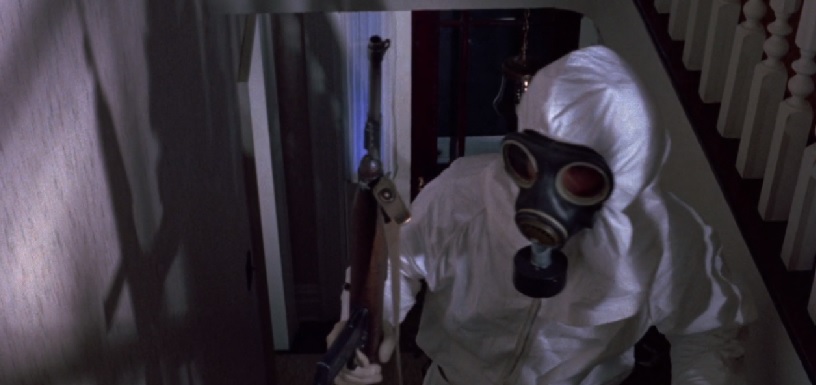
Definitely a lesser work by Romero, but one that does have some charm, I think The Crazies is really around average. I rate it a little higher, due to the rather creepy suits the soldiers wear throughout, but this certainly isn’t a masterpiece in my eyes.

7.5/10

Horrorvision (2001)

Directed by Danny Draven [Other horror films: Hell Asylum (2002), Cryptz (2002), Deathbed (2002), Dark Walker (2003), Urban Evil (2005), Tales from the Grave (2006, segment ‘Beyond Death’), I, Vampire (2006), Ghost Month (2009), Reel Evil (2012), The Dead Reborn (2013), Weedjies: Halloweed Night (2019)]

Horrorvision is perhaps one of the most dated films I’ve seen, and it wasn’t necessarily sensical at times, but it still has a bit of charm. It’s a Full Moon movie, and that certainly plays a part, but it’s also a somewhat interesting concept despite the rather poor execution.

I liked some portions of the plot, dealing with a website that, when seen, caused madness and mass murder. It featured early 2000’s technology – QuickTime was referenced, and someone boasted about hacking AOL and sending a virus through someone’s email – and it had that nostalgic charm.

To put a finer point on this, I was born in 1993, so I was pretty young in the early 2000’s, but I remember bits and pieces, especially post-9/11. Remember that site MadBlast? Or perhaps the game site PopCap, with games like PsychoBabble? Bonus.com, one of the best Flash game sites? The early 2000’s is my childhood, and a lot of movies from that time, despite not being good, do hold an appeal to me.

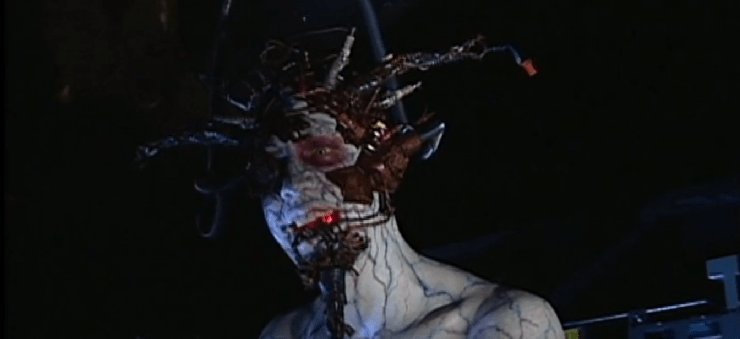
Horrorvision is a good example. It’s a poor film, and probably way too ambitious in it’s goals (it’s partially apocalyptic, which is seen primarily through news reports and via characters hearing about it), but seeing hideous technological monsters (which looked like cheap rejects from films like Hardware and Death Machine) pop out of technological devices (watches, beepers, that type of thing) and cause mayhem can be a decent amount of fun.

There’s also a sequence which features a creature/person called Wetwire that looked like some really bad Doctor Who antagonist. It looked ultra shitty, and I didn’t entirely get the point of this thing, but hey, it had heart. The special effects overall are quite poor, but if you find lower budget films from this time period charming, it might be worth it.

Len Cordova’s overacting at times was a bit much, but it was also funny at every turn, so I dug it. James Black (Zombie Cop) had a Morpheus from The Matrix thing going for him, and he was a fun character. Both Brinke Stevens (The Slumber Party Massacre, Nightmare Sisters, October Moon, and a hundred other movies) and Maggie Rose Fleck get a few good scenes in, especially Fleck, so they were reasonably enjoyable also.

[This is the paragraph where I would possibly compare this to Feardotcom, which has a similar idea, but I’ve not seen Feardotcom in over 15 years, so I’ll just leave this here to remind myself to watch it later on.]

Two more quick notes about Horrorvision: the runtime of this one is quite short, at around an hour and 12 minutes, and a good six minutes of that is traveling sequences (the one that takes place in a desert is the most unnecessary one), but it’s still a quick film, and also, the soundtrack of this was decent. It’s sort of a dark, electric rock type thing – “Strawberry Gashes” by Jack Off Jill played during the credits, which is a band I’ve not thought of in years, which was cool.

In many ways, Horrorvision is a bad movie, but I can’t say I didn’t occasionally feel a glimmer of enjoyment. It’s certainly below average, but I also think it’s somewhat certain I wouldn’t mind giving this another go in the future.

6/10

City in Panic (1986)

Directed by Robert Bouvier [Other horror films: N/A]

So this film has a bit of a negative perception for some obvious reasons, but I think it’s a decent film. It’s not great – aspects are certainly amateurish and I think the killer’s identity could have been hidden better – but it’s a decently entertaining slasher, and I’ve enjoyed it both times I’ve seen it.

Let’s talk the controversy first, though – many of the victims in the film are gay men, many of whom have AIDS. AIDS plays a somewhat large part in the film, and obviously that was a heated topic in the 1980’s. It’s not really dealt with in all that sensitive a manner, but it’s also accurate that the gay people in the film aren’t all sterotypical, and there is a character who berates a homophobic cop, so it’s not all negative in it’s portrayal, for whatever that might be worth.

In a way, while insensitive, it’s at least different. In most slashers, women get the brunt of violence, but in the first scene of City in Panic, we see a man getting killed in a shower (quite reminiscent of Psycho), which is a nice change of pace. It’s not a great kill, but seeing a different group being targeted at least keeps things fresh, and leads to a few kills that actually are good.

The best one, of course, would be a castration after one poor man attempts to use a gloryhole. There’s decent blood splatter, and while it’s not overly graphic, it does look quite painful. Another kill took place in a gym – a man doing some upside-down exercises gets attacked, which is at least a unique death. Not all the kills are good, as some are a bit dry (one individual gets run over by a car), but when they get them right, it’s enjoyable.

It’s also worth mentioning that the killer here has a good giallo look to them. A long trench coat, a fedora, black gloves – this killer could have been in any number of Italian movies back in the 70’s, and while I think they perhaps mishandled the identity of the killer here, I do rather appreciate the retro look they have.

David Christopher Adamson didn’t do bad as a lead, but as with many characters in the film, I don’t think we really get a great handle on him. He’s a radio host who seems moderately liberal (supports gun control, and also supports ‘law & order’), but we just don’t learn all that much that makes us care for him. Edward Chester’s attitude toward homophobic cops was one I appreciated, and as a homophobic cop, Derrick Emery did well. I’m mixed on Lee Ann Nestegard, but I did love Ron Rynka’s dancing (as the male stripper named He-Man, he was quite a hoot).

City in Panic isn’t the best slasher from Canada, and it’s sometimes problematic in it’s approach on a rather sensitive topic, but I’ve seen this one twice, and I keep having a good time with it. It can be a bit slow, but it’s engaging throughout, and City of Panic is worth seeing, at the very least, if you’re a fan of 80’s slashers, or if you want to see what a Canadian giallo might feel like.

7.5/10

Caltiki il mostro immortale (1959)

Directed by Riccardo Freda [Other horror films: I vampiri (1957), Maciste all’inferno (1962), L’orribile segreto del Dr. Hichcock (1962), Lo spettro (1963), L’iguana dalla lingua di fuoco (1971), Estratto dagli archivi segreti della polizia di una capitale europea (1972), Murder Obsession (1981)] & Mario Bava [Other horror film: I vampiri (1957), La maschera del demonio (1960), Ercole al centro della Terra (1961), La ragazza che sapeva troppo (1963), I tre volti della paura (1963), La frusta e il corpo (1963), 6 donne per l’assassino (1964), Terrore nello spazio (1965), Operazione paura (1966), 5 bambole per la luna d’agosto (1970), Il rosso segno della follia (1970), Ecologia del delitto (1971), Gli orrori del castello di Norimberga (1972), Lisa e il diavolo (1973), The House of Exorcism (1975), Schock (1977)]

Caltiki il mostro immortale, better known as Caltiki – The Immortal Monster, is a decent film, if not perhaps a bit generic for the time. It looks quite nice, with some solid special effects, and it’s nice to see Italy get back into the genre after a long hiatus, but I think the film finishes out around average.

The story is probably what holds the film back most, and to be clear, I don’t think the plot is bad, but it’s not too different from many films at the time, such was the giant monster craze. Obviously, it’s similar to The Blob – the creatures here are amorphous, single-cell organisms, but also movies like The Black Scorpion, so it’s not the most original stuff.

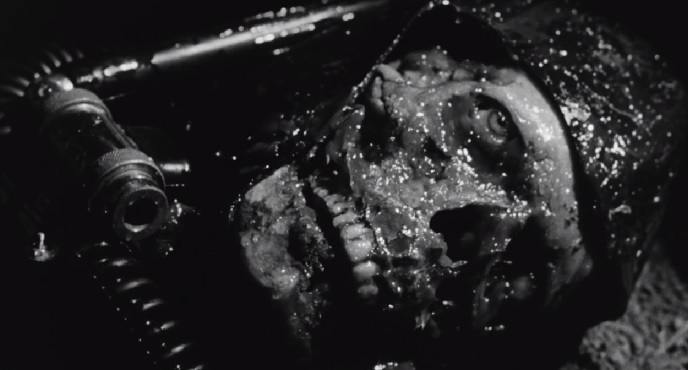
It does have some surprisingly decent special effects though. The best would probably be someone’s face melting, which was beautifully gruesome for the time. The creature itself doesn’t look near as smooth as the Blob we know and love, but when it’s multiplying toward the finale, it does strike me as impressive.

It’s never easy for performances from giant monster movies to make a big impression, and it’s the same here. John Merivale is fine as a lead, and Gérard Herter was fine as a more antagonist force, but neither one stood out. Daniela Rocca and Didi Sullivan were fine, but again, neither one really added that much.

Italy got back into the horror genre in 1957 with The Vampire – the country had a couple of horror films in the early days, such as 1917’s Malombra and 1925’s Maciste in Hell – which was also directed by both Riccardo Freda and Mario Bava. Obviously, Italian horror skyrocketed during the 60’s and 70’s, so it’s sort of nice seeing Italian horror before it became the big thing, and though Caltiki is in black-and-white, it did look quite nice, despite the story not being particularly interesting.

When it comes down to it, while I enjoyed some aspects about the film, and I still think it’s an adequate movie, I don’t know why I’d watch this when I could just watch The Blob, unless I wanted something with Italian flavor.

7/10

Moonstalker (1989)

Directed by Michael S. O’Rourke [Other horror films: Deadly Love (1987)]

Moonstalker may not be a great movie; it’s pretty cheap, and it’s not overly memorable, but I’ve always had a bit of a soft spot for it. For a late 80’s slasher, Moonstalker may not be the type of film you go back to often, but it can be a bit fun.

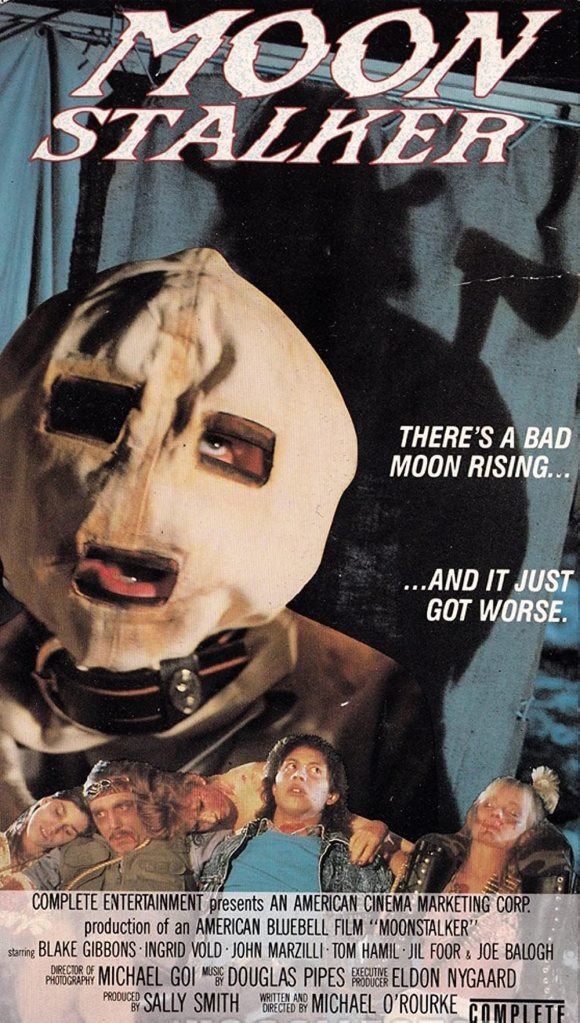
The story isn’t anything all that unique – a maniac runs around a campsite and kills people. At first, the maniac wears a mask (which is featured on the VHS cover, which, on a side-note, always struck me as a good cover), but that doesn’t last long, as the killer soon dons a Maniac Cop look, being a bulky man wearing sunglasses and a hat. The mask is cooler, but whateves, I can accept change.

Few of the scenes here are great, but there are a few okay kills, such as a quality impalement toward the finale, along with a decent amount of chopped off arms and limbs. Someone gets a throwing knife in their face, which was fun. There’s not much in the way of gore, but for a lower-budget slasher from this time period, I can take it.

I didn’t mind Joe Balogh (Demons 3/Black Demons, Hollywood’s New Blood, Hitcher in the Dark, and Monstrosity) as the lead, and in fact, I thought his story went to an almost interesting place. Jill Foors was okay, Alex Wexler had some moments, and John Marzilli was funny as a hardcore camp counselor, but aside from Balogh, it’s hard to say anyone stands out. Oh, and though I don’t remember her character, I wanted to mention Sioux-z Jessup because it’s a cool name.

Really, there’s not a whole lot to Moonstalker. It starts off with a family on vacation falling prey to the killer, and then the killer attacks a nearby camp, and that’s pretty much the extent to the movie. It rarely gets more complicated than that – there’s no mystery, and only marginal suspense. Even so, I know when I first saw the movie, I thought it was sort of fun, and I still feel much the same way. Plus, it was filmed entirely in snowy Nevada, so that was sort of cool.

It’s not a movie that I suspect many would find great (though the 80’s synth soundtrack is pretty damn phat), and it’s not among the best of late 80’s slashers (Intruder has to be up there), but it’s reasonably fun, and I personally have a good time with it.

7.5/10

Katakuri-ke no kôfuku (2001)

Directed by Takashi Miike [Other horror films: Ôdishon (1999), Tennen shôjo Man next: Yokohama hyaku-ya hen (1999), Tajuu jinkaku tantei saiko – Amamiya Kazuhiko no kikan (2000), Bijitâ Q (2001), Koroshiya 1 (2001), Gokudô kyôfu dai-gekijô: Gozu (2003), Chakushin ari (2003), Sam gang 2 (2004, segment ‘Box’), Aku no kyôten (2012), Kuime (2014), Kamisama no iu tôri (2014), Gokudô daisensô (2015), Terra Formars (2016)]

Known as The Happiness of the Katakuris, Katakuri-ke no kôfuku is a movie I’ve long wanted to see. I’ve never been the biggest fan of Japanese cinema, but I thought this looked quite interesting from the first time I heard of it.

And certainly it is an interesting movie; a memorable one, too. Portions of the film were quite decent and occasionally innovate, but I can’t say I actually enjoy that film that much, truth be told.

I think the main reason for this is that the story is more steeped in comedy than I thought it would be. It’s not always over-the-top stuff, but there’s a lot more humor here than horror, and while there were some standout scenes and sequences, for the hour and 53 minute runtime, I don’t know if there were enough.

At times, it almost feels like an Indian movie, what with all the songs popping up. I liked the concept – there are plenty of Indian movies I enjoy – but here, a lot of the songs don’t strike me as that catchy. Some certainly are, such as the final song, but even that karaoke potion felt sort of weak, though again, I liked the idea.

So here’s a movie with many songs I don’t personally find catchy along with more comedy than I’d have liked, and the fact that it is as long as it is only stretched out my relative disinterest. It’s not fair to say I ever became disengaged – the story of the movie is interesting throughout – but past a certain point, I didn’t think the movie was able to truly capture my appreciation, and that happened something like halfway through once I got a better idea of what this film was.

The characters are all reasonably fun. My favorite performances are those of Tetsurô Tanba and Shinji Takeda, especially Takeda, who got some strong scenes near the end. I never really felt that Kenji Sawada’s character came into his own, but he still did fine, and the other central performances, from Keiko Matsuzaka to Naomi Nishida, were good. I can’t say Tamaki Miyazaki’s narration did that much for me – she barely had a role in the events of the film – but it was an interesting touch.

So too were the moderately hideous claymation portions. They were impressive, and I can imagine that it took a while to do, but boy, did they look ugly (I imagine partially by design). The opening claymation didn’t seem to mean too much, but the final use of the style was decent, and it had story relevance, so I can’t complain there.

I would imagine few people really know what they’re getting into when they start The Happiness of the Katakuris up. I was expecting the musical portions – in fact, looking forward to them – but the movie is so much more than that. It’s partially a drama, partially horror, largely comedic, occasionally tragic; it’s all over the map, and while a lot of people enjoy that, especially given Takashi Miike directed this, it wasn’t really my cup of tea.

By no means did I have a horrible time with the film, though. It kept me entertained, and I was consistently curious as to what would happen next. I just expected a little more from it, and while I appreciate some things about the film, it’s simply not as enjoyable as I wish it were.

5.5/10

Paura nella città dei morti viventi (1980)

Directed by Lucio Fulci [Other horror films: Una lucertola con la pelle di donna (1971), Non si sevizia un paperino (1972), Il cav. Costante Nicosia demoniaco, ovvero: Dracula in Brianza (1975), Sette note in nero (1977), Zombi 2 (1979), Gatto nero (1981), …E tu vivrai nel terrore! L’aldilà (1981), Quella villa accanto al cimitero (1981), Lo squartatore di New York (1982), Manhattan Baby (1982), Murderock – Uccide a passo di danza (1984), Aenigma (1987), Zombi 3 (1988), Il fantasma di Sodoma (1988), Quando Alice ruppe lo specchio (1988), La casa nel tempo (1989), La dolce casa degli orrori (1989), Un gatto nel cervello (1990), Demonia (1990), Hansel e Gretel (1990), Voci dal profondo (1991), Le porte del silenzio (1992)]

Known best as City of the Living Dead, this Lucio Fulci film is one that I’ve been looking forward to for a while. I’ve only seen it once, and it’s been over ten years since that occasion, so this is one I definitely wanted to revisit. As it stands, though, I think the movie is just okay.

Lucio Fulci is a director that I appreciate, but a lot of the work I’ve seen from him doesn’t generally impress me too much. I quite enjoy The Beyond, and both Don’t Torture a Duckling and The New York Ripper are hella fun, but sometimes his films don’t hit the right spots, and while I enjoyed bits and pieces of City of the Living Dead, this is a good example of that.

Overall, it’s probably more cohesive in my view than The House by the Cemetery, which is a positive. I sort of liked the final ten minutes – the final scene leaves quite a bit up to interpretation, but given this is the first of the Gates of Hell trilogy, I can dance to that tune. The base story isn’t bad, and I did like how it took an hour for Carlo De Mejo and Christopher George to finally meet up.

It’s the gore here that’s of primary interest. There are a few disturbing scenes here, but the sequence in which a poor woman regurgitates her organs has to be one of the most sickening scenes I’ve seen in recent times. The special effects are decent – sometimes the brains look a bit bleh, and the power drill scene seemed a bit janky, but City of the Living Dead did have enough gore to keep things moderately interesting, not to mention the maggot showers.

Also, despite the name, it’s sort of hard for me to see this as a zombie movie. Sure, zombies appear, but it’s nothing at all like Zombi 2 – here, the zombies teleport, crush someone’s skull, take some of their brain matter, and move on. It’s a much more supernatural take on zombies, which fits in with the tone of the movie, and definitely felt unique, but it’s sort of hard for me to fully enjoy it.

One thing I did enjoy was the sequence in which a woman wakes up in a casket after having been buried. People thought she was dead, of course – they weren’t being dicks. It’s a tense moment, as another character is slowly walking out of the cemetery, occasionally stopping, as he thinks he hears banging and screaming from a grave behind him. It’s stretched out wonderfully – at times, it feels like he’s actually leaving the cemetery, and the buried character, behind. That was a quality tense sequence.

Christopher George (Whiskey Mountain, Graduation Day, Day of the Animals, Mortuary, Pieces, and Grizzly) was okay, but I can’t say I thought he had a lot of character. In fact, I think that holds true for a lot of the performances here – Carlo De Mejo, Janet Agren (Rat Man, Eaten Alive, and Panic), Catriona MacColl (The Beyond and The House by the Cemetery) and Giovanni Lombardo Radice (Cannibal Ferox, Cannibal Apocalypse, and House on the Edge of the Park) were all fine, but none felt well-developed, especially in Radice’s case, as he felt like such a random character.

Obviously, different people have different takes on Fulci films. I know some people who rather love this particular movie. For my part, though, it feels somewhat confused, the plot not particularly well thought out, the finale somewhat impressive, but again, nowhere near as great as The Beyond. I still enjoy this more than The House by the Cemetery, but I do feel it’s a bit below average, at least with having seen it twice.

6.5/10