Cries in the Night (1980)

Directed by William Fruet [Other horror films: Death Weekend (1976), Spasms (1983), Killer Party (1986), Blue Monkey (1987)]

Though the print I possess is of dubious quality, I’ve consistently found this Canadian movie pretty decent. Sure, the print is rough, but the atmosphere is on point, and while elements may not be the most original, Cries in the Night is worth seeing.

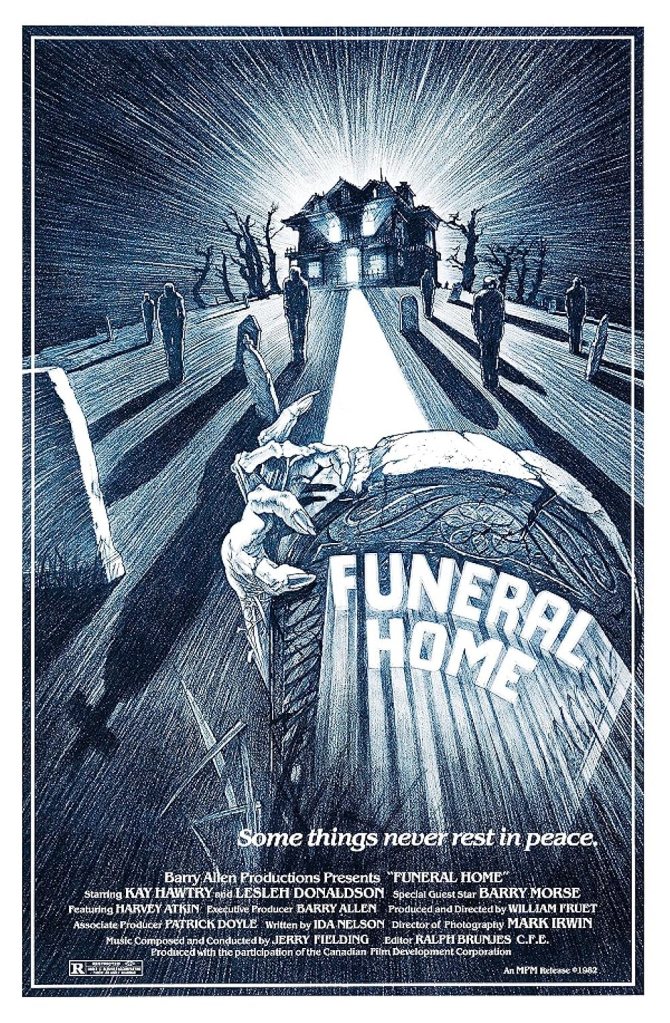
Of course, you probably won’t see it under the name Cries in the Night, as it was retitled Funeral Home (which I tend to think is a better name). The print I own (from Mill Creeks 50-disc set Creepy Classics) is rough – the audio is occasionally a bit garbled, and visually, some scenes can be dim, others blurry. In a way, it’s a testament of my feelings on the film that despite this, I’ve watched the film twice, and had fun each time.

It’s largely the story, revolving around a young woman staying at her grandmother’s bed-and-breakfast inn (which was previously – you guessed it – a funeral home), that helps the film out. Guests seem to disappear without warning, voices tend to come from the cellar (which is kept locked), and the mystery around her grandfather’s departure is still unsolved. Funeral Home can be quite atmospheric, and the big old house helps with that vibe.

Another thing I rather liked is the use of flashbacks – three different flackbacks pop up throughout the film, all of which add a little something (one that involved two boys sneaking around the funeral home was pretty solid stuff). The movie isn’t really that emotionally-charged, and I sometimes wonder if they were going for a more somber vibe, but it’s still quite nice.

All of the central performances, I thought, were solid. Lesleh Donaldson (Curtains) felt a little weak as the lead at times, but I enjoyed her character well enough. Kay Hawtrey did quite well as a grandmother potentially hiding some secrets. Stephen E. Miller impressed me, Alf Humphreys (Howard from My Bloody Valentine) amused me, Barry Morse intrigued me, and Harvey Atkin also amused me. Dean Garbett was decent, and for extra points, we got Jack Van Evera in a flashback (who played Happy the bartender in My Bloody Valentine).

There’s no gore here, at least not in the version I’ve seen. Someone gets stabbed in the back with some funeral home implement, and a couple had their car shoved into a lake, but for the most part, the film’s not overly violent. In fact, some people may feel the movie is slow, as the body count is quite low. Even so, I can say that while that’s true, I personally never reached the point where the story disengaged me.

I wouldn’t mind seeing a higher quality print of Funeral Home, but even if the only print I see is the one I own, that’s fine, because the movie is still pretty solid. It has a great atmosphere, and though I don’t think it’s an unsung classic, I’ve always personally enjoyed it.

7.5/10

Satan Place: A Soap Opera from Hell (1988)

Directed by Scott Aschbrenner [Other horror films: N/A] & Alfred Ramirez [Other horror films: N/A]

A rather low budget anthology horror film, Satan Place: A Soap Opera from Hell is certainly an experience. It’s far from a good movie, but it can be reasonably entertaining, if you’re into SOV horror from the 1980’s.

Of the four stories (‘Disposable Love’, ‘Say Goodnight, Sophie’, ‘Too Much TV’, and ‘Sally Satan’), the most entertaining is either ‘Disposable Love’ or ‘Too Much TV.’ Both have decent special effects (or what passes as decent for a film of this quality), and while the first story may be more quotable (“What the FUCK is for dinner?”), ‘Too Much TV’ has some amusing performances and is a wild story.

Now, to be sure, this isn’t a good movie. The framing story is a bit of a mess, and the conclusion to the sequence, being ‘Sally Satan’, is probably the weakest of the bunch (though it does feature an okay-looking demon). There’s still fun to be had overall – in the third story, both Psycho and Texas Chainsaw Massacre are referenced (the latter from an in-universe short called Missouri Mop Massacre – “You can’t stop him, and he doesn’t do windows”) – but it’s definitely not a movie most people would go into and have a good time with.

For some of the better performances (or perhaps more apt, most amusing), you have Warren Andrews, Hollis Wood, Mark Rackstraw (as classy TV host Dick Slasher), and Lisa Hatter. It’s a campy and low budget movie, so expecting any real great performances might be unrealistic.

The gore isn’t too shabby. It stands out most during the first story, ‘Disposable Love’, a big portion of which is about a husband who accidentally kills his wife, and so chooses to cut up her body and put it down a garbage disposal. There’s okay gore here (such as a zombie-type thing cutting open their stomach and feeding their organs to a poor hombre), especially toward the story’s finale. Also, in ‘Too Much TV’, there’s a decent throat-slitting.

Much like the 1982 film The Toxic Slime Creature, this is a film that popped out of nowhere for me. Until about a month ago (which would be September 2021 – this is being written mid-October 2021), I’d never heard of this. And it’s not great, of course. It is, however, entertaining at times, and though it’s a movie I have a hard time imagining I’ll see again anytime soon, I can’t hate it. I don’t love it, but I can’t hate it.

5.5/10

Motel Hell (1980)

Directed by Kevin Connor [Other horror films: From Beyond the Grave (1974), The House Where Evil Dwells (1982), Frankenstein (2004)]

When I say it’s been a while since I’ve last seen Motel Hell, I don’t mean it’s been a couple of years, five years, or even ten years. It’s been at least 15 years since I’ve seen Motel Hell – so much so that aside from the most striking and memorable portions, everything felt new. It was a good experience, because while Motel Hell can sometimes be a bit much, it’s quite a solid film, and I dig it.

Which isn’t exactly what I was expecting when I revisited this one. As any reader of mine may know, when there’s too much of a comedic infusion into the horror, I check out. Given this film is often described as a black comedy, I was worried that it might be too goofy and offset the otherwise creepy and occasionally unsettling ideas in the film.

Luckily, that’s not the case. This is one sequence that strikes me as being a bit much – the two swingers – but for the most part, it wasn’t that silly. I mean, it’s sort of silly that Nina Axelrod’s character would fall for Rory Calhoun’s, but then again, the heart wants what the heart wants, and Farmer Vincent is a pretty suave character with folksy charm.

Seeing this originally when I was quite young, there are some seriously creepy images here, primarily the field of bags (and of course, under the bags are the heads of living people). Just the idea of keeping someone buried, their head above ground so you can keep them alive by force feeding them, and then killing them off for smoked meats, well, that’s a classy business plan. It’s done pretty well, because while the film does have some comedy, those scenes don’t become any less unsettling.

Rory Calhoun (Night of the Lepus) does great as Farmer Vincent, and you can sort of tell early on he’s destined as a cult classic character (“It takes all kinds of critters to make Farmer Vincent’s Fritters”). He has a fun personality, and I really dig him. Nancy Parsons and Paul Linke I felt more lukewarm toward, but Nina Axelrod (Critters 3 and Time Walker) did pretty good most of the time.

Motel Hell isn’t a violent movie whatsoever, and given it involves cannibalism and the occasional chainsaw, this might surprise people. What it has instead is a pretty good atmosphere, as I said earlier, and some of the sequences can be pretty foreboding (such as the routine Vincent and Ida have before pulling their livestock out of the ground).

Truth be told, I was surprised by how much I enjoyed a lot of this. The humor is all pretty decent save a scene or two, and the unsettling scenes are just quality. Add in Farmer Vincent’s fun character, and you have a pretty solid movie. Nothing stellar, but solid.

7.5/10

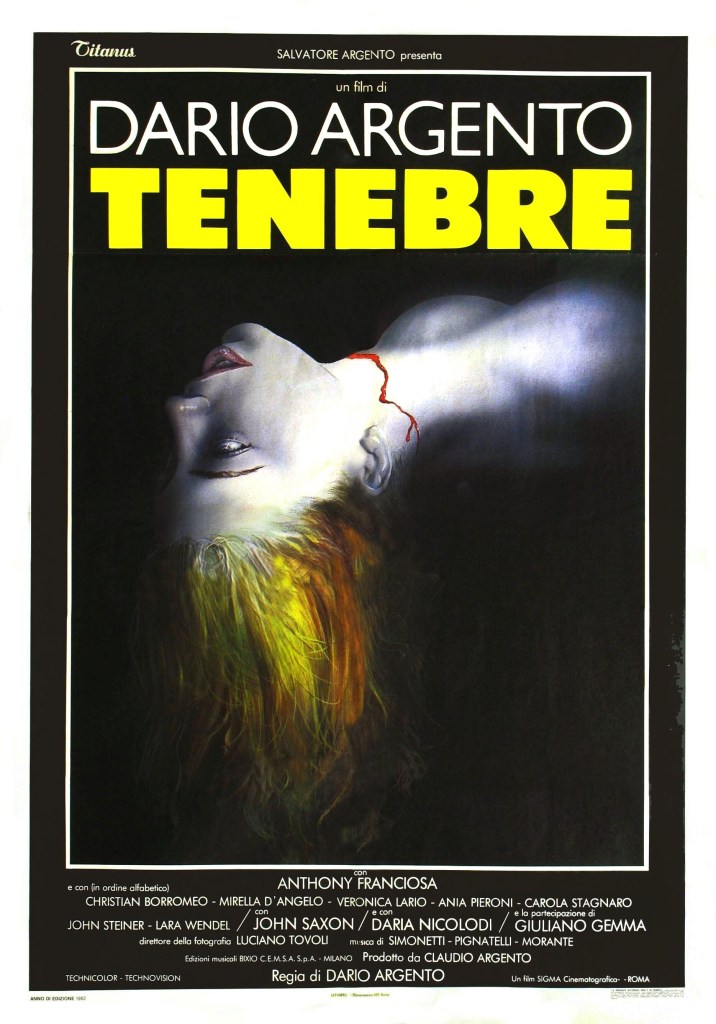
Tenebre (1982)

Directed by Dario Argento [Other horror films: L’uccello dalle piume di cristallo (1970), Il gatto a nove code (1971), 4 mosche di velluto grigio (1971), Profondo rosso (1975), Suspiria (1977), Inferno (1980), Phenomena (1985), Opera (1987), Due occhi diabolici (1990, segment ‘The Black Cat’), Trauma (1993), La sindrome di Stendhal (1996), Il fantasma dell’opera (1998), Non ho sonno (2001), Il cartaio (2003), Ti piace Hitchcock? (2005), La terza madre (2007), Giallo (2009), Dracula 3D (2012), Occhiali neri (2022)]

Dario Argento is a director that I’ve long appreciated, and while Tenebre isn’t the most famous work of his I’ve not seen up to this point (Phenomena is still a film I’ve not taken the time to witness yet), it is one of his bigger ones. Finally seeing it, I enjoyed quite a bit about it, but I also don’t think it’s quite up there with the big boys.

And by “big boys,” I primarily mean Deep Red, which is not only my favorite Argento movie, but among one of the 24 or so horror films I rate a 10/10. Tenebre isn’t that good – I feel the ending, while pretty solid, could have done with a bit more explanation, and I’d have liked to see a bit more information given on some of the characters – but it’s still a perfectly solid film.

I’ll say this much – I never guessed the killer. That took me completely by surprise. Maybe it shouldn’t have, but the fact that I can watch gialli and still be taken for a ride just shows how much I love this subgenre of horror, and Tenebre is a good giallo.

Anthony Franciosa (Curse of the Black Widow, Death House, and Julie Darling) isn’t a name I recognize, but he played a pretty strong lead, bolstered by quality performances from Giuliano Gemma and Daria Nicolodi (Phenomena, Le foto di Gioia, Schock, Paganini Horror). I was expecting a bit more from Christian Borromeo’s (La casa sperduta nel parco and Estigma) character, and Veronica Lario’s character didn’t quite connect to me, but whateves. Other good performances include John Saxon (A Nightmare on Elm Street, Black Christmas, etc.), Carola Stagnaro (Minaccia d’amore), Mirella D’Angelo (Maya), and Lara Wendel (Killing Birds: Raptors, I frati rossi, La casa 3).

Of course, the kills here were pretty good. Someone’s arm got chopped off, which caused quite the blood spray, which I found amusing at the time. Murders by straight razor and ax were the flavors of the day, and even attacks by terrifying dogs. Perhaps one of my favorites deaths, though, is one done in a public square – a quick stab to the gut. Reminded me of a kill in The Case of the Bloody Iris, and if something reminded me of that one, then that’s a point to the film’s favor.

Even so, as good as the kills were, as fun as the mystery was, and as bitching as the soundtrack was (apparently recorded by three of the four members of the then-disbanded Goblin), I still felt like something more could have been tacked on. I especially was hoping for more from Lario’s character. Part of the reason I love Deep Red is that if you pay attention during the beginning, you get an important clue. Here, I don’t know if there’s anything comparable. I’m not saying the finale comes out of nowhere, but I can’t imagine too many accurately guessed the answer to this one, so in that way, it’s a bit of a let-down.

Tenebre is still a great movie. I don’t think it’s Argento’s best, but I did enjoy a lot about it, and during future viewings, I’m wondering if more will click into place. As for now, it’s definitely above average, but I don’t think it’s quite as good as many others may think.

8/10

O Segredo da Múmia (1982)

Directed by Ivan Cardoso [Other horror films: O Lago Maldito (1980), As Sete Vampiras (1986), Um Lobisomem na Amazônia (2005), A Marca do Terrir (2005), O Sarcófago Macabro (2005)]

Perhaps better known, though not by that much, as The Secret of the Mummy, O Segredo da Múmia is the only Brazilian horror film I’ve seen not directed by José Mojica Marins. To be sure, The Secret of the Mummy is more a comedy/horror mix, but even so, for that one fact alone, it stands out.

And it is a unique movie. It’s not exactly zany, but the comedy here can feel a bit goofy at times. Some of the movie is in black-and-white, and other sequences are in color, and what’s more, there doesn’t seem to be a thematic reason for switching between the two. Some of the plot is ill-explained (why is the mad scientist locking up half-naked women and turning them into werewolf-like things?), and so while I do think the film is different, I can’t say I’ve ever cared for it.

I have seen this once before, some years back. I remember thinking it was a bit wacky, but fundamentally okay. Truth be told, I may have been too generous – not that The Secret of the Mummy is bad, but it’s really not my type of movie, and I probably thought more of it just because I’ve not seen many horror movies from Brazil (the only ones I have save this one would be At Midnight I’ll Take Your Soul, This Night I’ll Possess Your Corpse, Awakening of the Beast, and The Strange Hostel of Naked Pleasures).

Being a mummy movie, I will say I enjoyed seeing the mummy attack people. It didn’t happen near as frequently as I’d have liked but I did enjoy it when the mummy popped up. There’s not that many great mummy movies past the early 1970’s (Blood from the Mummy’s Tomb FTW), and this one certainly isn’t great, but at least there was a mummy, and his sequences were solid. Oh, and the mummy decapitated someone, so that was funny.

As far as performances go, I have to give some credit to Felipe Falcao, who played a servant named Igor. Falcao’s performance was a bit much at times, but he consistently reminded me of Anthony Carrigan from Gotham. I mean, he looked and acted almost exactly like him. It was uncanny. Otherwise, Wilson Grey was decent, but lacked character, and others, such as Evandro Mesquita, just didn’t get enough to work with.

I certainly wish I did enjoy this one more. It’d be cool to have some somewhat obscure Brazilian horror movie in my back pocket to recommend to friends and show that I’m a man of culture. I just don’t dig The Secret of the Mummy that much.

I liked hearing a foreign cover of The Beatles’ ‘I Should Have Known Better’ during a mummy attack, and I’m amazed at how much nudity Brazil was apparently okay with during the 1980’s, but otherwise, this isn’t a movie I’d really recommend unless you wanted a taste of something different.

5/10

Heavy Metal Massacre (1989)

Directed by Steven DeFalco [Other horror films: N/A] & Ron Ottaviano [Other horror films: N/A]

Well, this is about as inept as a movie can be. Heavy Metal Massacre is one of those SOV horror films that can be amusing, but ends up more tedious than anything else.

Part of it is a lack of story. No doubt, there is a story – there’s just not much of one. Some metalhead (played by David DeFalco, though credited as Bobbi Young) is killing women, and the police are looking for him. And that’s about it. There’s a little more, primarily revolving around two friends (played by Sami Plotkin and Michele De Santis) who run afoul of the killer, but really, there’s no conclusion to the story, and things just end.

That’s not exactly what makes Heavy Metal Massacre tedious, though. It’s more the constant dull heavy metal (many of the songs performed by an artist credited as The Electric After Burner Band) and really amateurish special effects. I don’t mean special effects as in CGI or anything, I mean in pointless aesthetics that can apparently be done with a video camera, such as changing the contrast or superimposing some scene on top of another, or even a corny blood dripping thing to convey a scene switch.

Really, I’m not a filmmaker, so I don’t have the vocabulary to describe exactly what they do here, but it’s something I’ve never seen in a movie before, and I don’t think it’s hard to figure out why after seeing this.

If I have to give credit for performances, I guess I can say that David DeFalco, despite a complete lack of character, did okay. I mean, he posed in his leather and spikes, staring into the camera with the best of them (that’s literally the first four minutes or so of this movie). Michele De Santis and John Thayer were okay, I suppose. Otherwise, there’s not a whole lot of strong points here.

Apparently filmed in Providence, Rhode Island (a fact you can tell by the police cars in the film), Heavy Metal Massacre isn’t a movie without charm, and if someone out there listed this as a guilty pleasure, I could sort of see it. Honestly, the kills weren’t awful – someone getting hit in slow motion with a giant sledgehammer was pretty decent (and in fact, this is the fate that befell two people), and another got #FuckedUp with a chainsaw, so that was all fine and well, but I don’t think that’s near enough to make this palatable.

For a long time, I knew this film would probably end up being a mess, and by all means, Heavy Metal Massacre is. The story is quite uninspired, and given there’s not really much of a conclusion, unsatisfactory. Maybe it’s worth a watch if you’re into SOV horror, but for most people, I think turning it off halfway through, if not sooner, is a more likely fate for this one.

4.5/10

Screamtime (1983)

Directed by Michael Armstrong [Other horror films: The Haunted House of Horror (1969), Hexen bis aufs Blut gequält (1970)] & Stanley A. Long [Other horror films: N/A]

This British anthology horror film may be cheap, but I think it has a lot of heart and occasional originality. It’s not the most polished movie, but Screamtime does have a decent amount going for it.

I’ve seen this one before, and I remembered a good portion of it (being the framing story, along with two of the three tales here). I remembered that I thought it was decent, but not great. That assessment is spot on, but that’s not at all damning. All three of the stories here are, at the very least, good, and when all the stories in an anthology horror film are good (which doesn’t happen very often), then you know you’re doing something right.

To be sure, the framing story here is laughably weak. It’s not as bad as Slices, but then again, what is? Here, two guys steal some videotapes from a store, and go to a friend’s apartment to watch them. Those tapes make up each of the three stories, being ‘That’s the Way to Do It,’ ‘Dreamhouse,’ and ‘Do You Believe in Fairies?’. Obviously, the set-up is utter weaksauce, but because I sort of like the movie, it doesn’t lose anything because of that.

Of the three stories, the one that comes closest to great is the last one, ‘Do You Believe in Fairies?’, This is partially due to quite an original story dealing with gnomes and fairies, and it’s just a lot of fun, especially with the performances of Jean Anderson and Dora Bryan. Both of the others are pretty fun too – ‘Dreamhouse’ is more a slow-burn about a woman seeing visions in her house, whereas ‘That’s the Way to Do It’ is decently solid throughout, about an older gentleman being put down by his family for running a Punch and Judy puppet show.

There are good performances in all of the stories (aside from the framing sequence, that is), which is nice. From the first segment, there’s Robin Bailey (See No Evil), whose performance reminds me a decent amount of Peter Cushing from his segment in Tales from the Crypt. Yvonne Nicholson wears the biggest pair of glasses I’ve ever seen in ‘Dreamhouse,’ and she’s believable throughout. And from the final story, as I mentioned you have the pair Dora Bryan and Jean Anderson. Both played the sweet older women nicely, and Jean Andersone reminded me of a mixture between Frances Bay (Happy Gilmore) and Myra Carter (Storm of the Century).

No doubt Screamtime is a cheap film. There’s not much in the way of special effects, and the framing sequence is never great (though I do love the utterly ridiculous ending). Even so, Screamtime has a lot of heart and originality, and I deeply applaud this British film for that. If you want an anthology horror film that’s worth seeing, give Screamtime a chance.

7.5/10

Island Claws (1980)

Directed by Hernan Cardenas [Other horror films: N/A]

There are some movies that I just wish were better, either because I think the concept is pretty cool or the film has a lot of potential. Island Claws is one of them. While it could have been a nice little treat from the early 80’s, instead it’s just mostly slow and really doesn’t have much in the way of reward.

A small part of this perception may be the print I watch, which was likely a VHS rip, and as such, was quite low in quality. Specifically, sequences that took place at night were quite difficult to decipher, and though I doubt my rating would change much had it been Blu-ray quality, that is worth taking note of.

Either way, it’s no doubt a slow movie, with it’s plot just crawling along and rarely doing much to pull the audience back in. There were a few good sequences – a man who lived in an old bus (not typical living quarters, but it looked comfortable) gets attacked by crabs, and the bus catches fire and blows up. And now that I think about it, that might be the only sequence I think of as actually good.

There were only five performances of note, and that’s being generous. Robert Lansing (Empire of the Ants, 4D Man, and The Nest) was pretty decent as one of the leads, working well with Steve Hanks (12/12/12) and Jo McDonnell. Barry Nelson (who some may recognize from The Shining) was good also, though he didn’t stand out as much as I’d have liked. Tony Rigo (who reminded me a little of Dick Miller) had his moments also.

Even so, the story here was just so slow, and even the occasionally interesting elements thrown in (such as some racism toward Haitians who are hiding out on the island) just didn’t amount to much in the end, especially when the final battle against the sole giant crab was so damn luckluster. I mean, I guess the crab looked okay, but when you have a choice between a film like this and Corman’s Attack of the Crab Monsters, and you’re leaning Corman, you know the movie has a problem.

Certainly there is a little charm to be had here. I personally liked the small-town feel, especially a scene early on in a rambunctious bar where everyone knew everyone. It was nice and homey. That doesn’t make the film worth seeing though, and despite hoping that I could like this (and I gave it two chances – I first saw this one some years back), it’s just really not that good.

5.5/10

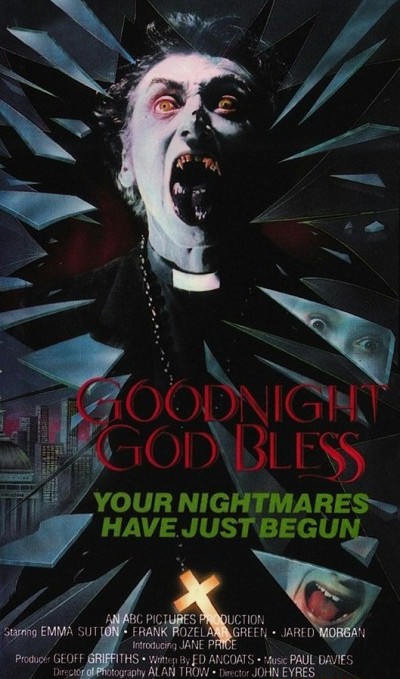
Lucifer (1987)

Directed by John Eyres [Other horror films: Project Shadowchaser III (1995), Judge and Jury (1996), Octopus (2000), Ripper (2001)]

This is a bit of an odd film. Lucifer (which was apparently released under the much catchier title Goodnight, God Bless later on) is a slasher with a fantastic opening, but very little past that point really makes an impact.

I have to first say, though, that I don’t quite know the origins of this one. It’s filmed in London, and multiple reviewers call it a British movie, which makes sense, but then IMDb lists the country of origin as Canada, so I don’t know what that’s about. I’ll just assume it’s a Canadian film made in London for some reason, as that’s really all I have to work on.

No matter where it’s from, though, that opening is strong. It’s also sort of sad, because nothing else in the movie comes even close to matching it, but hey, I guess if you start off strong, then that’s the risk you have to run.

A man dressed as a priest approaches a schoolyard – kids are frollicking and playing as kids do, and being watched over by a teacher. The priest enters the yard, and the teacher walks up to him. It’s a short conversation, though, as he pulls out a knife and stabs her. He then pulls a handgun out and shoots the kids. He doesn’t kill all of them – only five children die in the opening (we see their body bags a little later on) but one of the girls he does attempt to kill gets lucky, and becomes the focus of his obsession throughout the film.

Not too many horror films deal with the death of kids in a senseless act of violence like this, and I definitely appreciated how this film ignored convention and began with five young kids getting shot in a schoolyard. Masterful opening, definitely memorable, and it’s a shame little else in the film does much.

Which isn’t to say the other kills are bad – there was an okay one dealing with a police officer falling prey to a spike-trap of sorts, which was sort of fun. There was an almost suspenseful scene in a movie theater in which the priest stabbed a knife through the chair in front of him, which would have killed the target had they not dropped something and was leaning forward to pick it up. Even so, for a slasher film, Lucifer just doesn’t have enough pop, and feels far more sluggish than one would hope.

Frank Rozelaar-Green wasn’t a very interesting lead, but then again, Emma Burdon-Sutton wasn’t particularly noteworthy either, but I guess Jane Price did well as a young kid who almost gets killed multiple times throughout the movie. Really, there’s no great performances here, and that coupled with the sluggish nature of the film, not to mention bloodless kills, is a disappointment.

Oh, I should mention a couple of more things. We never find out the killer’s identity – despite the fact we never see his face and it just seems that his identity might be important, I guess we were misled (which is a mild shame, because while simple in design, I did like the killer’s priest look). Also, the final scene, in which there’s a confession given, strikes me as nonsensical, unnecessary, and somewhat ridiculous.

Lucifer (or as I prefer, Goodnight, God Bless) is a dull film with not much aside from the opening truly going for it. For a late 80’s British/Canadian slasher, I’m guessing there’s not a lot of choices out there, so if you’re desperate, give this a watch. Otherwise, this isn’t a great film, nor a good one, and though I recommend watching the first five minutes, most of this film isn’t worth it.

5.5/10

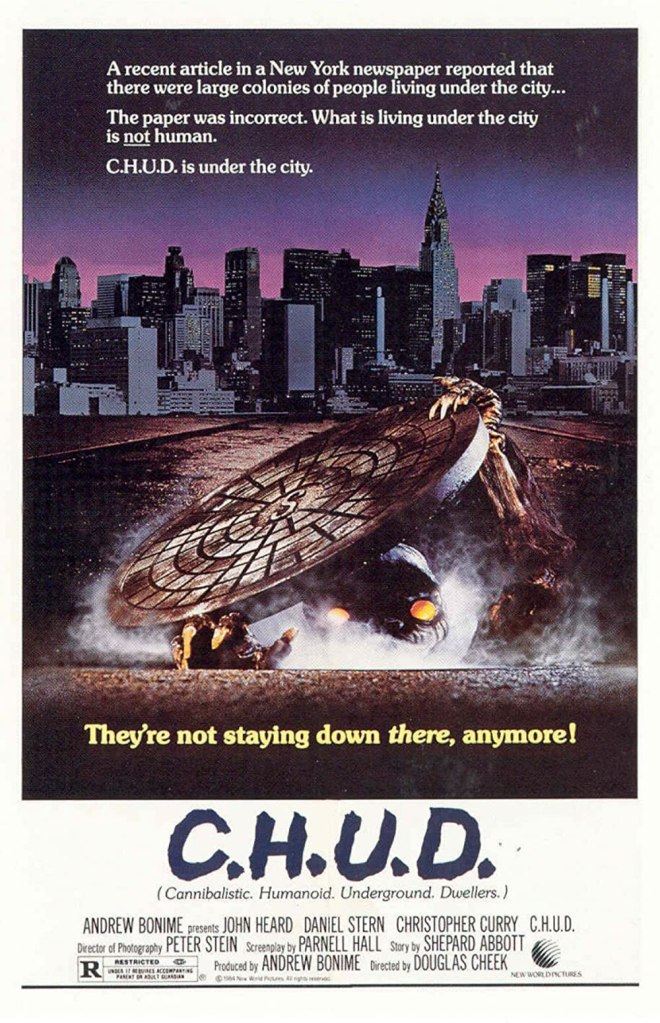
C.H.U.D. (1984)

Directed by Douglas Cheek [Other horror films: N/A]

Some movies hit the right spots. Some movies do very little wrong, and get as much appreciation as possible. Some movies are Gods among cinema.

And C.H.U.D. is one of them.

Dramatic, to be sure, but true. C.H.U.D. is an almost perfect movie in every way. The story is quite good and possesses a true organic feel. The characters and plotlines are great, and how some characters don’t even meet others when investigating the same mystery is a wonderful touch. Everything fits together nicely, and it’s just a wonder to behold.

There’s so much to enjoy about the story. Four of the bigger characters, being the photographer (John Heard), the soup kitchen guy (Daniel Stern), the freelance reporter (J.C. Quinn), and the police captain (Christopher Curry) all have tangential connections – Curry and Heard don’t even meet up until the final three minutes of the film, and Heard had little idea of who Stern was when he ran into him in the sewers, and I doubt that either Stern or Curry had any idea that it was Quinn’s character who helped get Heard to start investigating it.

The story is just very well done. Heard’s wife (played by Kim Greist) doesn’t have a lot to do to start off with, but by the final thirty minutes of the film, she has her own subplot as she has to deal with some cannibalistic humanoid underground dwellers who are forcing their way into her apartment while her husband is trying to avoid the same things beneath the streets.

I just love this story. The movie doesn’t waste any time. Even the very first scene – which some movies would just use to show a random, unimportant victim, getting killed – is deeply crucial to the film, as that individual is a relation to one of the main characters, and is in fact one of the reasons these disappearances have been taken more seriously by police.

Not to mention the acronym C.H.U.D., which means multiple things (it’s a good thing that waste created what could be described as cannibalistic humanoid underground dwellers, or they would have had to scramble for new matching words), and I just love the sequence where we find out the true meaning, and it shows just how sinister George Martin’s character really is.

Christopher Curry is great, and when he was finally able to punch out the antagonist of the film, that was quality fun. Curry isn’t an actor I know, but he did really well, and I quite liked his emotional scene in the bar. John Heard (Cat People and Locusts) isn’t an actor I generally notice, but he did quite good here, and I just wish his character had more time to work with Curry’s. Playing Heard’s wife was Kim Greist (Manhunter), and when things started going down in her apartment building, she knew how to handle business.

Daniel Stern I know only from Home Alone and Leviathan, but he did fantastic, and I loved his growing working relationship with Curry’s character. J.C. Quinn was used well to move the plot a bit, and George Martin played a horrible, despicable character with great talent. We also get a small appearance from Frankie Faison (The Silence of the Lambs and Hannibal) and a longer appearance by John Goodman (Red State, Arachnophobia, 10 Cloverfield Lane, and the series Roseanne), an actor I love in pretty much anything. The first time I saw this film, I’m guessing Goodman’s appearance went right over my head, so noticing him here out of the blue was a beautiful moment for me.

The design of the cannibalistic hombres is great, particularly the glowing eyes (and at times, they reminded me of The Mole People). I enjoyed how they didn’t show us much of them – just the clawed hands popping out of the sewers every now and again – until late in the film, when we can experience them to our glory. Oh, and the soundtrack is fantastic. It’s subtle, but it’s fantastic, especially during the apartment attack.

Some movies just work. I enjoyed C.H.U.D. when I first saw it, and I enjoyed it immensely with this revisit of it. It’s a great 80’s movie, has a nice New York City vibe (as it was filmed in and under the city), and just works in ways that not too many horror films can. Highly recommended piece of 80’s cinema.

9/10