The Boogie Man Will Get You (1942)

Directed by Lew Landers [Other horror films: The Raven (1935), The Return of the Vampire (1943), The Mask of Diijon (1946), Inner Sanctum (1948), Terrified (1962)]

Despite the encouraging title, this horror-comedy mix doesn’t really do a whole lot to stand out. Sure, it has some good performances, and some occasionally wacky moments, but I don’t think it’s enough to solidify this as any type of classic. It’s serviceable, but little more than that.

The plot follows a young woman (Jeff Donnell) as she buys an old house, with the intention to convert it into an inn, all while dealing with a doctor doing experiments in the basement, mysterious disappearances, a town official who gets a bit nosy, and plenty of traveling salesmen. Oh, and what seemed to be an Italian fascist toward the end, which was an interesting addition.

Actually, it’s on that note that I should say much of the film’s plot revolves around the then-ongoing World War II – the scientist’s experiments are designed to create a super-soldier, someone seems as though they could be a spy, and there’s even a munitions factory in town, causing a delay when the police are finally called to the hopeful inn.

The central cast – and by central, I mean two – are great, being Boris Karloff and Peter Lorre. Karloff (The Strange Door, The Mummy, Frankenstein 1970, The Man They Could Not Hang) does amusingly as a somewhat absent-minded scientist type of good intentions, and Lorre (You’ll Find Out, Mad Love, The Comedy of Terrors, The Beast with Five Fingers) was even better playing a sheriff/mayor/investor/loan shark. I think Lorre probably brought more to the film than Karloff did, but it was great to see the two of them.

Technically, Jeff Donnell (The Unknown) and Larry Parks might be more the central characters, or at least the primary protagonists, but I didn’t really care for either one’s character. Maxie Rosenbloom and Maude Eburne (The Vampire Bat, The Bat Whispers) provided some of the comedy here, but it mostly fell flat to me. Frank Puglia’s character felt like a random add-on, but I will admit that Don Beddoe’s character did interest me.

Certainly a couple of lines were amusing, my favorite being when Karloff was showing Lorre five bodies of failed experiments, and explaining that there were traveling salesmen, pointing one out as selling encyclopedias, to which Lorre replied “I’m sure he didn’t mind.” There were a few other laughs to be had, but like I said, I personally think a lot of the comedy fell somewhat flat.

It’s not a bad movie, though. Sure, The Boogie Man Will Get You isn’t likely to stand out aside from the fact it has both Karloff and Lorre in it, but it’s still serviceable as a horror-comedy mix. It’s digestible too, at only an hour and seven minutes.

If you enjoy the classics of the genre, and are looking for something you’ve perhaps not seen, this might be worth a look, but I don’t really think it’ll end up being that memorable, all things considered.

6/10

Bring It On: Cheer or Die (2022)

Directed by Karen Lam [Other horror films: Evangeline (2013), 7 from Etheria (2017), Shevenge (2019, segment ‘Doll Parts’), The Curse of Willow Song (2020)]

Being the first horror film I’ve seen from 2022, Bring It On: Cheer or Die had a lot to live up to, and while this Syfy original has some problems, I can’t say that I didn’t have fun.

In part, likely a large part, I imagine this has to do with the film being a slasher. Syfy have made some decent originals before, such as Killer High, Neverknock, and They Found Hell, but I can’t think of many original slashers of theirs, and luckily, this one was decent.

To be fair, I don’t think they stuck the landing (see, I tried to use cheerleading terms and nailed it, amiright?), and the finale isn’t great. The identity of the killer, and the reason behind the killing, struck me as a bit ridiculous (and by ‘a bit,’ I actually mean ‘a lot’).

Also, some of the humor, such as the Cheer or Die portion (basically, the insane killer revealed themselves, and is now forcing those still alive to perform cheer moves; if they mess up, they die), or how sometimes by performing a cheer move, someone can dodge being struck by an arrow, but it’s overall not as bad as you might think.

I should now mention that I don’t know a thing about Bring It On, which is apparently a cheerleading movie series that started in 2000. I have no idea if this is supposed to be a spin-off, or completely unrelated, but to be honest, as I will never watch a Bring It On movie in my life, I doubt it matters. It’s certainly an interesting use of an idea that some people already know – to be honest, I’ve possibly never once thought about cheerleaders in the last ten years, so this was different.

Also, it’s modern, and by modern, I mean I feel like an old fogey watching it. There’s one scene in which it shows people on their phones, and the texts they’re writing pop up on the screen (like Non-Stop, an action movie I saw once). It only happens once, but reeks of the modern age. There was a joke made about eggplants and tacos – I still use a flip phone, but I was able to follow along with the intended joke well enough.

Like I said, not all the humor hits.

When it comes to performances, I was expecting a little more from Gino Anania and Samuel Braun, but that’s more where the story takes them. I don’t think that Makena Zimmerman’s character was fleshed out that well, and Tiera Skovbye (Summer of 84, Forever 16, Even Lambs Have Teeth) didn’t appear as much as I was hoping.

Even so, much of the central cast of nine is good – Kerri Medders, Alexandra Beaton, Alten Wilmot, Sierra Holder, Rudy Borgonia, Sam Robert Muik, Marlowe Zimmerman, Madison MacIsaac, and Erika Prevost mostly all brought something to the movie. Not all were necessarily memorable – Erika Prevost, Marlowe Zimmerman, and Rudy Borgonia didn’t get a lot of good characterization – but all were at least manageable.

I do think Kerri Medders (Do Not Reply) made for a solid lead. She wasn’t notable insofar as personality goes, but she did well as the main character. For comedic relief, Alten Wilmot was great – his line ‘Oh my God, were the chains on sale?’ cracked me up quite a bit – and I did dig his character. I wasn’t moved by Sierra Holder at first, but then she had a scene with Alexandra Beaton that I thought was awkwardly cute.

See, Beaton’s character finds a notebook with a list in it of the nine characters – not by name, but by stereotype (stoner, slut, jock, badass, klutzy nerd, ditz, sexy blonde, basic bitch, and final girl). Beaton, who sprained her ankle early on in the film, was complaining to Holder that she didn’t find it fair to be labeled the ‘klutzy nerd,’ to which Holder replies, ‘Well, you could be the sexy blonde.’ It wasn’t clear to me if this was intentional flirting or not (as it turns out, it was), but I found it awkwardly cute, and I shipped it immediately.

Sam Robert Muik (A.M.I.) only got one scene to really shine; being a stoner doesn’t usually grant much in the way of staying power in horror movies, unless you’re in The Cabin in the Woods. Even so, he was fun for his moments on air. Lastly, Madison MacIsaac did pretty well as a ditzy blonde. At times, she felt a bit too airheaded, but she was still reasonably fun.

And actually, maybe she wasn’t too airheaded. I remember, back in high school, a teacher was discussing nuclear power plants, and there was a girl in my class who was confused about how plants could be dangerous. She was thinking about plants that grow in the ground, as opposed to power plants. It’s small moments like that which lend credibility to some silly airheaded moments MacIsaac’s character has on-screen.

Unfortunately for a slasher, none of the kills were particularly good. That can’t be a big surprise, given this is a Syfy original and, as such, made-for-TV, but even so, it’s a disappointment. Someone got suffocated with a pom pom, another got their head bashed in, someone else took an ax to the back, but nothing here is at all gory. Also, while the killer’s design is okay – simply the mascot of the school these girls are cheering for – it’s nothing that really stands out much.

Bring It On: Cheer or Die isn’t a good movie, but I can’t say that I didn’t have a decent amount of fun with it. The finale doesn’t do the rest of the film justice, and I could have done without a couple of the sillier moments, but honestly, I had an okay time with this one, and could easily see myself giving it another watch, if only because some of the characters and dialogue were solid. Below average, sure, but not a bad time at all.

6.5/10

Dead Still (2014)

Directed by Philip Adrian Booth [Other horror films: Death Tunnel (2005), ShadowBox (2005), DarkPlace (2007), Children of the Grave (2007), Ghouls Gone Wild (2008), The Possessed (2009), The Haunted Boy: The Secret Diary of the Exorcist (2010), Soul Catcher (2011), Children of the Grave 2 (2012), The Exorcist File (2014), The Attached (2023)]

Dead Still isn’t a movie I want to spend a lot of time on. I found it absolutely abysmal the first time I saw it, and time hasn’t been overly kind to it. It’s one of those movies in which it’s hard to put into words exactly why I despise it, but the dislike is indeed real, and based on how terrible this movie is, I imagine the feeling is mutual.

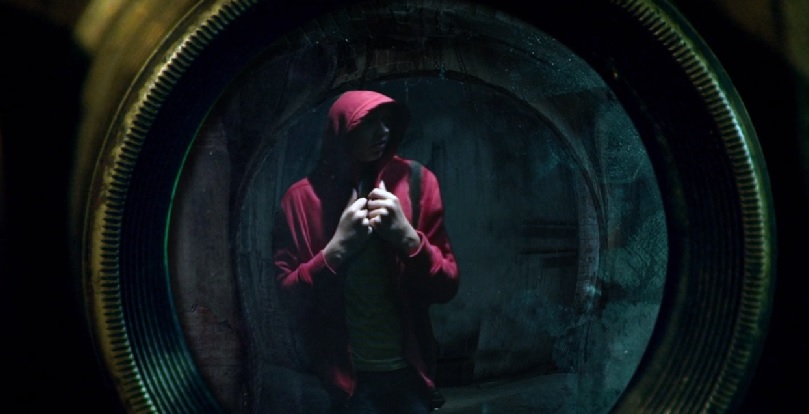
The basic plot – a camera used for death photography (taking pictures of dead bodies, apparently a thing back in the olden days) is discovered by a descendant, and things happen – could have been okay, but it wasn’t because the movie sucked.

To elaborate, I just didn’t get it – the souls of spirits are caught in the Negative World, and have been since they were originally photographed, but apparently mean no harm toward the person who trapped them there, one Wenton Davis (played by Ray Wise), but once a live kid (not the only live person, because a little girl who died is also alive apparently) gets there, things happen.

If someone is photographed by this old camera, they die a couple of days later. But that’s not all – even if someone has been nowhere near the camera, the ghost trapped in the camera can leave the camera to possess someone to self-mutilate themselves, and there’s a cult watching a house but the cult only has one member and that member has an ancestor who is dead but also alive and cameras and sacrifice and the worst ending I’ve seen in my life.

Dead Still is shit.

And even after I watched it the first time, I was curious as to why. I’ve not touched on the meta reasons it’s shit – I will, don’t worry – but this film was directed by Philip Adrian Booth. I didn’t know at the time I first watched Dead Still that Booth was the same director behind Death Tunnel, which was another amazingly bad film that I couldn’t believe was as atrocious as it was. After I found out that the same guy behind Death Tunnel was behind Dead Still, everything fell into place.

See, as terrible as the story is, the technique is worse. I’m not a behind-the-scenes guy. I can’t describe filming techniques or properly use filming terminology. What I can say is that many of the scenes here feel like they’re from a ‘scary’ music video – they quickly flash on the screen with no context, and the editing too is shit, also in a way I can’t describe. Actually, if you’re a director, or editor, or have some movie-making ambitions, watch this movie and tell me what went wrong – even if I never find it, it’s worth seeing how not to make a movie.

Ben Browder (Bad Kids Go to Hell, Hoax) isn’t a good lead. Ray Wise (Dead End, Jeepers Creepers 2, The Butterfly Room) was hammy, so at least he was having fun. Eric Ruff was terrible. Elle LaMont (Mercy Black, The Devil’s Gravestone) was sort of hot, but also not great. I felt quite bad for Gavin Casalegno, as he was only a kid, and he didn’t deserve this.

The performances don’t matter. No performance in the history of mankind could make a movie with this story and this editing worth watching. I’ll give Dead Still props for it’s gore, but I’ll take them all away for two reasons:

  1. The finale was about 15 seconds long. It showed that, despite destroying the evil, that the evil wasn’t destroyed, and was still able to possess people.
  2. Apparently, this was ‘based on a true story.’ Show me one piece of evidence that a ghost/spirit was trapped in a camera and was able to possess and kill people and I will give this movie a 10/10 and publically apologize for giving it the rating it deserves. Cameras do exist, but that’s as true as this movie gets.

I was going to give this points for a scene toward the end – not exactly a twist, or at least not a good twist, but an almost okay scene – but this movie just pisses me off. It gets nothing. It loses. GOOD DAY, SIR!

0/10

Blood Slaves of the Vampire Wolf (1996)

Directed by Conrad Brooks [Other horror films: Jan-Gel, the Beast from the East (1999), Jan-Gel 2: The Beast Returns (2001), Jan-Gel 3: Hillbilly Monster (2003), Gypsy Vampire (2005), Gypsy Vampires Revenge (2008), Gypsy Vampire: The Final Bloodlust (2009), Zombie on the Loose (2010)]

Despite the wild title this film has, this straight-to-video film really isn’t as fun as you might hope. It’s not dreary or lifeless – certainly the people involved in this movie had some fun – but Blood Slaves of the Vampire Wolf does tend to be a bit repetitive, overlong, and generally, not my type of film.

The budget is quite low here, but you have to give director Conrad Brooks credit for doing what he was able to. The film opens up with a ‘This film is dedicated to the memory of Ed Wood,’ which is then followed by the fakest bat I’ve ever seen as it flies around. If you can’t get into low-budget horror, I can promise you that this is not the movie for you.

I can get into some low-budget horror films, though I generally gravitate toward slashers (such as The Horrible 4 and You’re Not Getting Out Alive). The problems I have with this movie have little at all to do with how cheap everything looks. Well, I guess one problem is related – the audio, while mostly audible, wasn’t particularly great. I don’t think I ever lost track of a conversation, but I don’t think they had much in the way of audio equipment when they made this one.

Otherwise, though, the problem is that the movie is an hour and 44 minutes long, and it’s just dull most of the time. A vampire lady makes a slave of a big horror movie fan, and uses both him and a mute servant to send out and collect blood for her. It’s not until the final 40 minutes that things get mildly interesting, as a British police officer (apparently here in Hollywood because he and another cop traded places for training or something) works with a woman to investigate some mysterious murders.

And that doesn’t mean that the final forty minutes are good, either; just that they had more going for them then the previous material, and I suspect that’s largely to do with Michael Hooker’s character, who I sort of liked.

To be fair, I thought that Don Miller did okay with his role, but it’s hard to stand out when you spend most of your screen-time as as a soulless blood slave of a vampire queen. Before that upgrade, though, he seemed like a pretty fun guy. I can’t say that Jennifer Knight’s portrayal of a hundred year old vampire did much for me, and Annette Perez didn’t add much either, but like I said, at least Michael Hooker was fun.

There’s not really much in the way of gore here. Early on, we do have a guy who’s stabbed multiple times with a hatchet (we get that classy ‘blood-running-down-the-camera-lens’ thing going on with it), and that was a decent scene, but otherwise, I’d say most of the kills are entirely ineffective, and wouldn’t be a drawing point to this movie.

What really should be the drawing point is the heart they put into this. I may not have enjoyed it, but it’s good to see people put hard work into cheap movies – case in point, I despised The Stripper Ripper, but I never once doubted that they had fun making it. The problem is that this movie is an hour and 44 minutes, which is way too long to warrant, and I just don’t think there was enough meat in the story to keep it that engaging.

If you enjoy the occasional lower-budget vampire movie, Blood Slaves of the Vampire Wolf may be worth a visit. Personally, it’s not the type of movie that I really cared much for, but on the other hand, I’ve definitely seen worse in my time.

3.5/10

Shock Waves (1977)

Directed by Ken Wiederhorn [Other horror films: Eyes of a Stranger (1981), Dark Tower (1987), Return of the Living Dead: Part II (1988)]

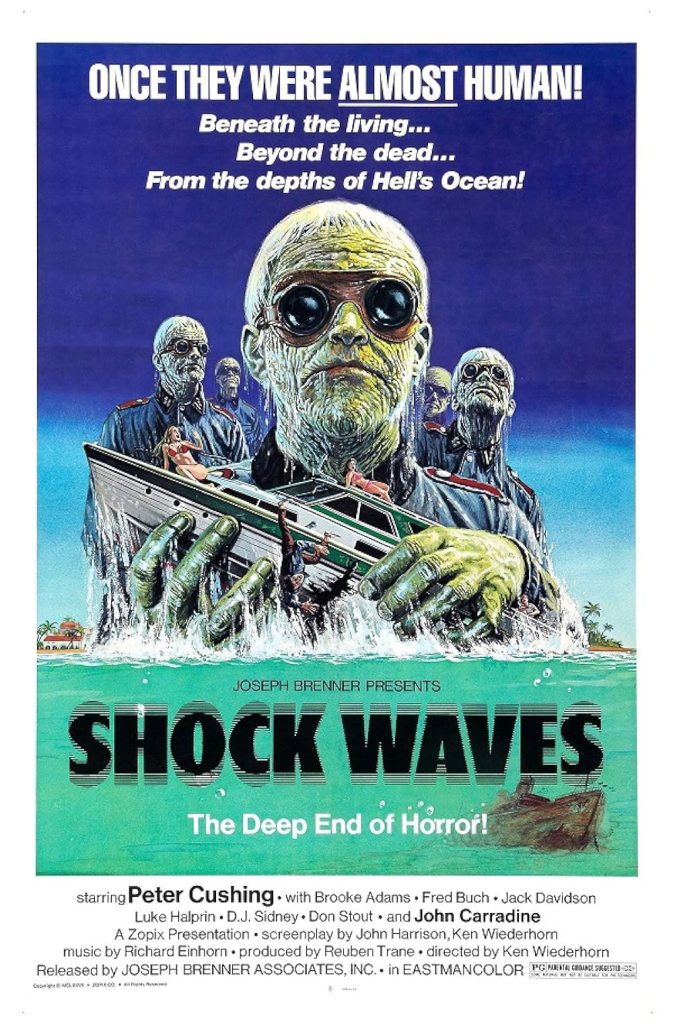
I’ve known about Shock Waves for over ten years now, and I’ve heard generally good things about it in that time. After seeing it, though, I think it’s at best okay, and I don’t personally know if it’s really a movie that will really stand out in the long run.

Like some 70’s movies, Shock Waves does move a bit sluggishly. That said, while most of the action isn’t going on until the final half hour, it’s a pretty atmospheric, and somewhat bleak, movie. It’s somber, and feels totally like the 1970’s atmosphere that I tend to expect.

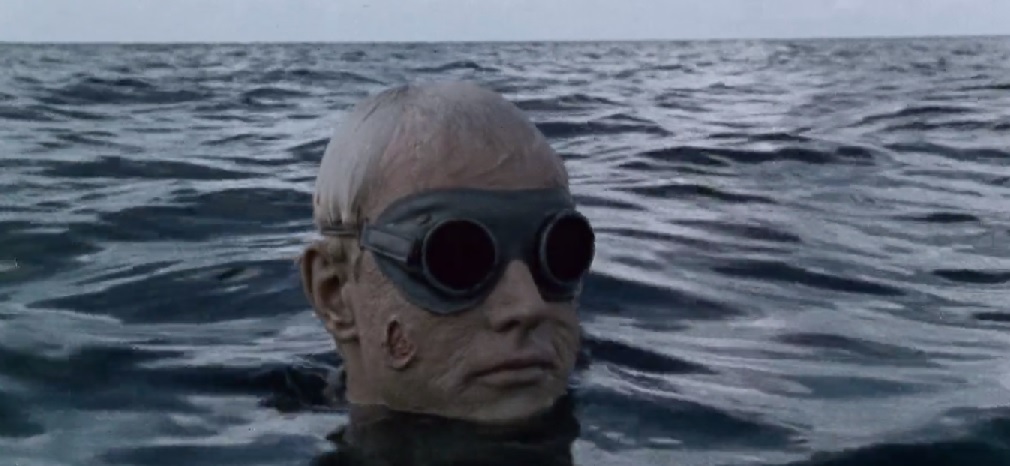
Despite having Nazi zombies, I don’t think that this movie has quite the character of other 70’s zombie films, such as Tombs of the Blind Dead, Let Sleeping Corpses Lie/The Living Dead at the Manchester Morgue, and Sugar Hill. Certainly the movie does some things well, such as the atmosphere, but it just can’t pull everything past the finish line alone.

Neither Peter Cushing (The Gorgon, Scream and Scream Again, The Hound of the Baskervilles, Island of Terror, The Flesh and the Fiends, Night of the Big Heat, Dracula, The Creeping Flesh) nor John Carradine (Bluebeard, The Unearthly, House of Dracula, The Mummy and the Curse of the Jackals, Horror of the Blood Monsters) get a lot of screen-time, but obviously, both are icons of the genre, and as a personal fan of Peter Cushing, it’s always a pleasure to see him.

The real focal points are Brooke Adams (The Unborn, The Dead Zone, Sometimes They Come Back, Invasion of the Body Snatchers) and Luke Halpin, but unfortunately, neither one has much character. We literally learn nothing about either one of them; they’re just empty vessels being chased by zombies, and that’s it. Fred Buch did have character, and as such, was one of the more interesting characters, while Jack Davidson played one of the more annoying characters I’ve seen recently, but that’s not really enough to bring life to the film.

That might be the biggest issue – it’s a decent movie, but it’s just dry at times, reminding me of Death Ship every now and again, and when I’m reminded of Death Ship, that’s a problem. Most of the time, zombies just drown people, so it’s not some gore-fest like Zombi 2 either. It has atmosphere, and it’s somber, but that’s really all it has.

I’m not saying that Shock Waves is a bad film. I personally think it’s a bit below average, but it definitely has some charm. Others seem to enjoy it a bit more than I did, and I would say that if you’re into zombie movies, Shock Waves may be worth checking out, but it didn’t personally wow me by any stretch.

6/10

Strait-Jacket (1964)

Copyright HAG ©2009

Directed by William Castle [Other horror films: Macabre (1958), House on Haunted Hill (1959), The Tingler (1959), 13 Ghosts (1960), Homicidal (1961), Mr. Sardonicus (1961), The Old Dark House (1963), The Night Walker (1964), I Saw What You Did (1965), Let’s Kill Uncle (1966), The Spirit Is Willing (1967), Shanks (1974)]

I’ve not seen Strait-Jacket in some time, and it was an enjoyable movie to revisit. Admittedly, if not for Joan Crawford’s stellar performance, this might be a more generic William Castle fair, but because of Crawford, and some other factors, it turns out quite a solid film.

A lot of the ideas in this one seem similar to Castle’s Homicidal. Honestly, I think I enjoy the both of them equally, though in a somewhat interesting fashion, this movie doesn’t necessarily feel quite as campy as some of Castle’s previous films (such as House on Haunted Hill and The Tingler).

I did like the plot here, though, with a woman twenty years in a mental institution being released, only to possibly be facing a relapse. It’s nothing that’s quite new, and the finale felt rather like the end of Psycho, but the performances and occasionally tense story allow it to work well.

Naturally, Joan Crawford (What Ever Happened to Baby Jane?, Trog, Berserk) did great here, and you can really see the emotional range she has throughout the film. Admittedly, Diane Baker (The Ghost of Sierra de Cobre) isn’t a name I know that well, but she did a great job also, especially toward the finale. The last individual to really make an impression was Leif Erickson (I Saw What You Did, Invaders from Mars, Night Monster), who played a pretty gentle individual.

Others aren’t bad, though – George Kennedy (Death Ship, Wacko, Creepshow 2, Uninvited, Demonwarp, Just Before Dawn) had some good scenes, reminding me a little of Henry Jones’ role in The Bad Seed. A couple of other performances – John Anthony Hayes, Rochelle Hudson (Gallery of Horror), Howard St. John, Edith Atwater (Die Sister, Die!, The Body Snatcher), and Mitchell Cox (who wasn’t even an actor, but did just fine) – didn’t really have enough room to breathe, which isn’t a surprise, given this is largely the Crawford show.

A few other notes – I enjoyed the decapitations we get. The first pair was shown in the shadows, which had a nice vibe to it, but we do get an on-screen decapitation, and while it doesn’t look amazing, nor is it gory whatsoever, it was fun to see. Also, the finale does feel a little silly, mainly around the mask we’re shown, but as much as it feels like Psycho, I still found it fun.

Strait-Jacket isn’t a movie I think is amazing, but it’s a solid movie, and a quality entry in William Castle’s filmography.

8/10

The Monster That Challenged the World (1957)

Directed by Arnold Laven [Other horror films: N/A]

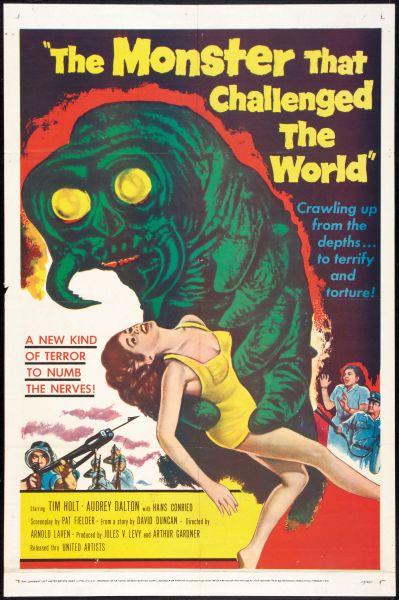
Though sometimes heralded as one of the many solid giant-animal movies of the late 1950’s, I have to say that The Monster That Challenged the World didn’t do much for me. The movie’s not bad, or anything, but the more and more I see these types of movies, the more I lose interest in them.

Some of them, of course, do have something special – The Giant Claw had a lot of science going on, Earth vs the Spider has been a mild favorite for a while, and Attack of the Giant leeches has hokey charm – but I’m widely disinterested in this particular portion of the genre. Giant monsters causing havoc just isn’t my thing.

Taking place around the Salton Sea in southern California (which I never heard of before this movie), we have a mollusk-like thing that entertains some people, and by ‘entertain,’ I mean suck their blood out entirely and kill them. Of course, it’s not just one – the thing laid eggs, so there’s a potential of hundreds, though we only see three or so others, and as the film focuses around a Navy Base, I can’t say there was much character in the characters we got.

Tim Holt plays a generic, gruff military guy. Because a monster movie isn’t complete without romance, Audrey Dalton (Mr. Sardonicus) plays a young woman who falls head over heels for him, and he saves her from the monster at the end, and I don’t have the words to describe how uninterested I was in their romance. Hans Conried didn’t really do that much, but he did later voice the Grinch in Halloween is Grinch Night, so that’s something.

Honestly, I don’t know what more to say. The special effects were iffy, the finale somewhat underwhelming, the monsters were monstering. I don’t know – these types of movies just often don’t interest me, but they can work for others, so if this sounds like your type of thing, give it a watch. I just may not be the exact audience to enjoy it.

6/10

The Spider Woman Strikes Back (1946)

Directed by Arthur Lubin [Other horror films: Black Friday (1940), Hold That Ghost (1941), Phantom of the Opera (1943)]

Perhaps one of the earliest examples of what I’d label botanical horror, The Spider Woman Strikes Back is a decent film, short, digestible, and with a solid atmosphere and occasionally creepy vibe. Not that it’s stellar, but it’s a solid little film.

I speak a bit about my enjoyment of botanical horror in The Ruins – I think it largely has to do with growing up on the book and two-part episode of Goosebumps titled Stay Out of the Basement!, which was always one of my favorite Goosebumps stories. The idea of plants consuming blood, or flesh, or attacking, just has a creepy vibe to it, and while I can’t explain it any better than that, it’s always been something I loved.

To be clear, there’s no plant attacking anyone in The Spider Woman Strikes Back. This isn’t The Revenge of Doctor X. However, there are sequences of a plant being fed blood to keep it strong, and while it’s true Gale Sondergaard deals with spiders, she uses them to feed plants (when she’s not using blood), so really, this should be The Plant Woman Strikes Back.

Of course, this is sort of meant to mimic a sequel-in-name-only, or a spin-off, of the 1943 mystery/thriller film The Spider Woman, which also starred Gale Sondergaard. Aside from Sondergaard’s presence, there’s no relation, so that just adds to the fun. Really, though, this movie, despite the somewhat confusing title, does have a decent amount going for it, so it’s a shame some people might shy away because they think it’s a sequel to something else.

The story is pretty basic, but it’s also somewhat atmospheric. Now, I did watch a rather scratchy print of this one on YouTube, which is amusing, because there’s actually a 1080P HD version I didn’t notice until after I watched the version with ten pixels. Even so, I had a pretty good time with it, and while I wish the finale had been a bit better (especially regarding Rondo Hatton’s character), it was pretty good for a 40’s horror film.

Brenda Joyce (Strange Confession, Pillow of Death) made for a fair lead, but like many women of the time period, her character’s only given limited agency. Gale Sondergaard (The Climax, Echoes, Savage Intruder, The Cat Creature, 1939’s The Cat and the Canary) had a sinister aura to her, so no complaints there. Neither Kirby Grant nor Milburn Stone (Captive Wild Woman, The Frozen Ghost, Strange Confession) do that much, but Stone’s character had some potential.

It’s Rondo Hatton I have the biggest issue with. He’s a familiar face (having been in movies such as The Jungle Captive, House of Horrors, and The Brute Man), and his performance is perfectly solid, playing a mute servant of Sondergaard’s character. I saw inklings of his character fighting for his independence, but come the end, they don’t really do much with it. Hatton’s performance was good, but they could have done a bit more with the character.

When it comes down to it, I can’t say that The Spider Woman Strikes Back is an amazing movie, but I did find it a good, quick way to spend an hour. At 59 minutes, it’s digestible, it’s decently fun, and while it could have been a bit better, it’s not at all a bad watch. If you’re into classic horror, this may well be worth a watch.

7.5/10

The Phantom of the Opera (1925)

Directed by Rupert Julian [Other horror films: Creaking Stairs (1919), The Cat Creeps (1930)], Lon Chaney [Other horror films: N/A], Ernst Laemmle [Other horror films: N/A] & Edward Sedgwick [Other horror films: Beware Spooks! (1939)]

When it comes to silent horror, The Phantom of the Opera has never been one of my favorites. Oh, it’s a pretty solid movie, and if you’re into silent horror, or looking to get into silent horror, it’s most definitely worth seeing, but there are other silent films I’d personally prefer to spend time with, such as The Last Warning and The Cat and the Canary.

Some of this may have to do with Mary Philbin’s character Christine. She’s an understudy to another opera singer, but a mysterious voice beyond her dressing room wall has been championing her, making her climb up the opera ladder easier. And Christine is completely okay with it. Apparently unknown voices that advance your career are a-okay in her eyes. She even willingly refers to him as her ‘Master,’ and vows to be his.

Well, until she found out he wore a mask, then all of the sudden the Phantom’s the bad guy. To be fair, Christine didn’t know the voice in question was the Phantom, but regardless, she didn’t seem to care, nor do we see her ask much up front about the mysterious voice calling to her from her mirror. She’s completely fine with it, and I 100% believe that if the voice came from a typical handsome man, Christine would have continued willingly calling him ‘Master.’

Perhaps this isn’t a critique of Christine’s character at all, but more the sexist way in which the character was written. Either way, the idea that she’s okay with her career being advanced and willingly calling unknown voices ‘Master,’ then getting upset when the unknown voice comes from a man wearing a mask – the character just pisses me off. The Phantom, a generous guy named Erik, tries to explain to her about himself, but Christine doesn’t listen, and later calls him a ‘monster.’

Looking different from other people doesn’t make someone a monster. I get the sense that Christine has absolutely zero empathy and, based on her being okay with her career being advanced by the voice, a huge sense of entitlement.

I don’t like Christine as a character at all, and that was my biggest hurdle to fully enjoying this one. I mean, otherwise, it’s a pretty charming silent horror with some great set pieces, good tension, deeply memorable scenes, and a decent finale.

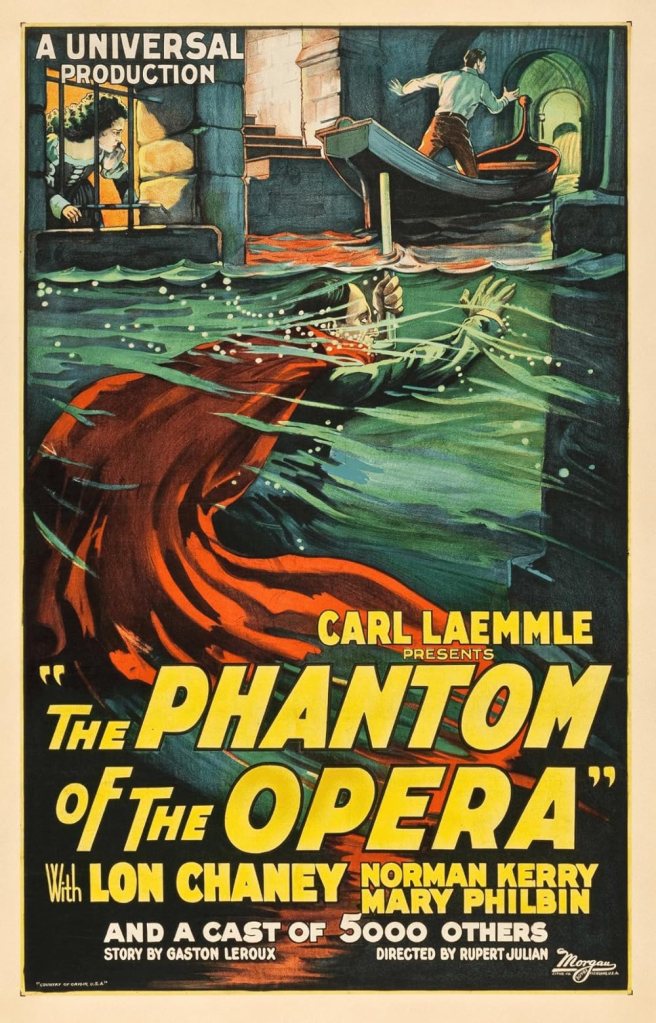
The Paris Opera House itself looks quite grand (and I didn’t know this until today, but it’s apparently the same opera house as was used in Dracula), but what’s more interesting is what’s beneath the Opera House, being a pleasant underground lair of the Phantom (and actually, on a side-note, throughout much of the film, I couldn’t help but compare it to V for Vendetta). I especially enjoy the underground lake, and the Phantom’s use of a bamboo stick-type thing that he uses to breathe with as he strolls along underwater (used to great effect as he attacks someone in a boat too near his lair).

Perhaps without question, the most famous sequence in the film is when Christine creeps up behind the Phantom and pulls his mask off whilst he’s playing music – despite being warned against this very act just minutes before – and finally revealing his face to the audience (and Christine, to her privileged shock). It’s a good, tense moment, and the make-up looks stellar.

Another scene that I have to mention is the Bal Masque de l’Opera sequence, or the Masque Ball. The version of this movie I’ve seen always has this sequence in early Technicolor – think Doctor X, only rougher – and it looks beautiful. It’s made even more beautiful by The Phantom, as so many things are, as he strolls in dressed as the Red Death and admonishes them their merriment while they’re dancing over the skeletons of the tortured who died in the catacombs below. He’s what I like to call a buzz-kill, but hey, he has his issues and he’s speaking to them, so who can complain?

It’s a solid sequence, followed by him standing atop a statute on the roof of the Opera House as Christine and her lover (not her mysterious, voice-in-the-wall lover – she’s over him by this point) Raoul (played by Norman Kerry) plot to get away from The Phantom’s grasp. What’s cool about this scene is that it’s tinted as Christine and Raoul speak, as most of the movie is tinted, but when it goes to The Phantom overhearing, it’s still technicolor. It looks stellar.

Lon Chaney (The Monster, London After Midnight, The Penalty, The Hunchback of Notre Dame) did fantastic as The Phantom, who truly is the victim here in many ways. He has a grandiose and power to him, and his expressive nature works wonderfully. He’s also quite amusing at times, such as his lines about “Callers” near his lair. I don’t like her character, but Mary Philbin (The Man Who Laughs, The Last Performance) does well with what she has, though I don’t find her terribly sympathetic.

I can’t say that I ever got much of a sense of Norman Kerry’s (also of The Hunchback of Notre Dame, along with The Unknown) character – he seemed like the generic, manly man willing to fight for the woman he loved. I did like Arthur Edmund Carewe’s (Doctor X, Mystery of the Wax Museum) character, though. He doesn’t appear much until the end, but he’s of quality stock.

Overall, the finale was solid also. People were storming the catacombs after The Phantom kills the wrong man, characters trapped in an underground torture chamber, soon to die due to high levels of heat – there’s just a lot of action come the ending. I even like how The Phantom goes out – he gets one last jab in before the mob deals out their illegal brand of “justice.” I should mention that I’m glad the mob was there because The Phantom killed a working man’s brother, as opposed to abducting a privileged woman. I didn’t agree with the mob’s actions, but their hearts were in the right place.

Like I said, The Phantom of the Opera isn’t my go-to when it comes to silent horror. It’s a decent movie, and certainly one that’s above average, but as far as personal enjoyment goes, I don’t love it. Still, if you’re in the mood for a silent classic, or you want some classy Phantom action, than this movie may be worth seeing if you haven’t already.

7.5/10

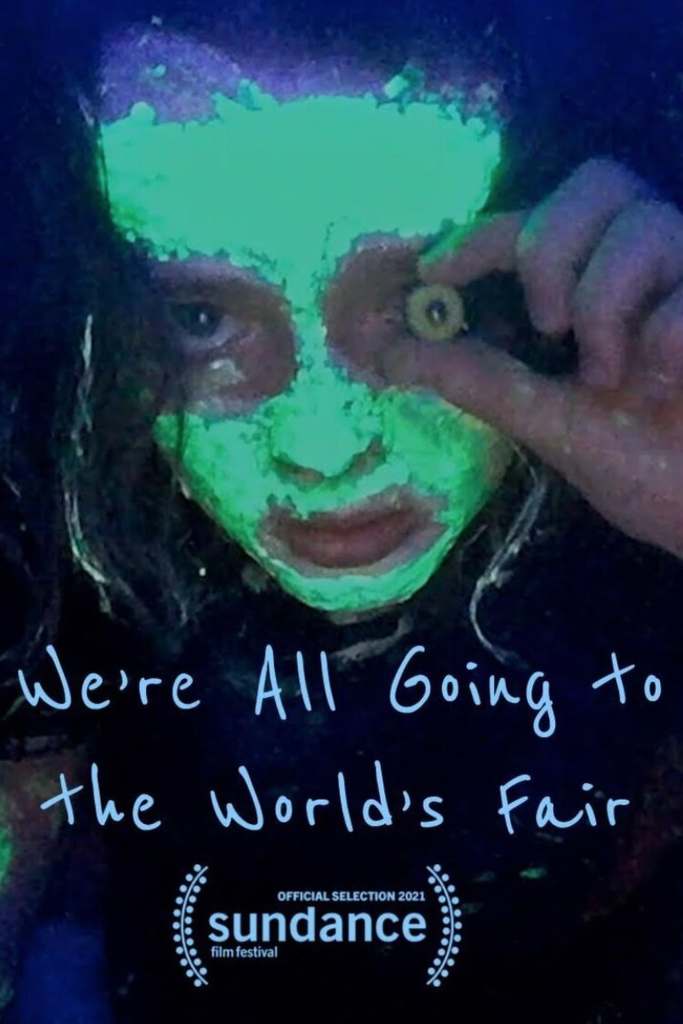
We’re All Going to the World’s Fair (2021)

Directed by Jane Schoenbrun [Other horror films: A Self-Induced Hallucination (2018), I Saw the TV Glow (2024)]

This movie has been on my radar since the beginning of 2022 (currently writing this on October 8th, 2022 – God knows when it’ll be published), and was one of the movies I was interested in seeing for my annual marathon of horror films for the previous year (which is why I watched films such as The Power, In the Earth, The Land of Blue Lakes, and Broadcast Signal Intrusion).

Alas, early on this year, it wasn’t available for easy viewing. Luckily, it hit HBO Max, and since I love spending money I rarely have on streaming services I rarely use, I have a subscription to HBO Max, and so was quite eager to watch this one.

Going in, I didn’t know much – I had read the plot outline on IMDb, but didn’t look any further, as it seemed to me the type of movie that might be quite the treat going in blind. After having watched it, I certainly think that We’re All Going to the World’s Fair is an interesting movie, but unfortunately, I don’t think it’s great.

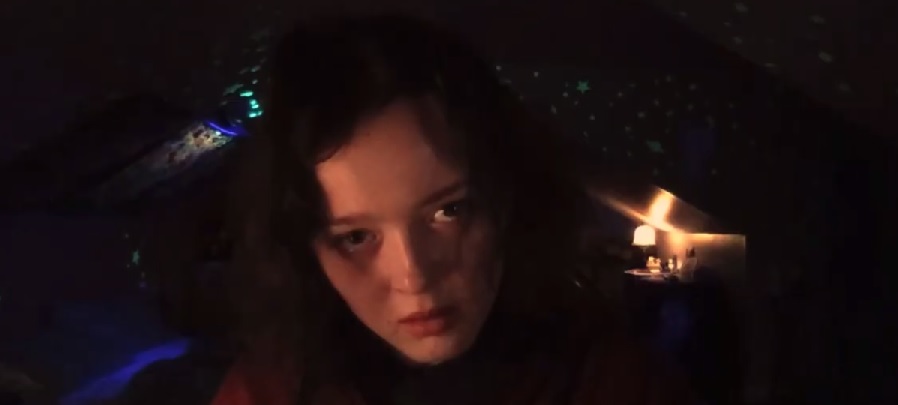
The narrative is a bit unconventional in that there’s only two characters of relevance, being Casey (played by Anna Cobb) and JLB (Michael J Rogers). The story is simple enough – a socially awkward and isolated teen girl takes an online challenge, and seems to be going through some type of change in her mental state.

I will say, as flawed as the final product might be, I do think this is a solid showcase on how mental illness could impact teens, especially lonely, isolated kids who spend much of their time on the internet. I was never much for Reddit or 4chan, or wherever kids went back in the early-to-mid 2000’s (I was born 1993), but the type of isolation – while technically, with the internet, much of the world is at your fingers, but you still feel just as disconnected as always – this movie portrays is something I personally struggle with also.

It’s the final 15 minutes, though, that I found somewhat troubling. While I do think the film suffers from a rather anticlimactic finale, it’s something that we find out right toward the end which, in a way, takes a bit of feeling and meaning away from the movie. I’m not saying it ruins the whole thing, because it doesn’t, but had they approached things differently, it might have done more for me.

All of which I know is rather vague. There were a few small things I found difficult to reconcile given what we know toward the end, which was another problem, but I just think the movie loses a bit of it’s impact once we hit the final 15 minutes.

No doubt in my mind, though, that Anna Cobb gave a great performance (in her first film). She did stellar showing how isolationing and lonely life can be, not just in general, but especially for teenagers. Again, things are given a different light toward the end, which does harm the character in my view, but Cobb’s performance was great. I wanted a little more from Michael J Rogers’ (Beyond the Black Rainbow, Children of the Corn: Revelation, Demonic) character, but it was a film focused on Cobb, so I can’t be too bitter.

While disturbing in some aspects, this isn’t at all a gory movie. There might be some minor elements of body horror – in a video that Casey watches, a man pulls ticket stubs out of his arm – but far more than that, it’s the horrors of mental illness. During one sequence, Casey is recording herself singing a song called ‘Love in Winter,’ and toward the finale, apropos of nothing, she starts shrieking. This lasts for perhaps five seconds, and then, without reaction, she goes back to singing the song.

The character of Casey is a self-professed horror fan, and name-drops Paranormal Activity in the film. I should add, on a side-note, that I’m an old fogey, and it amazes me to think that there are kids born who, when they think of the horror films of their childhood, they go to Paranormal Activity. Obviously, if someone was born in the late 1990’s or early 2000’s, it makes sense, but even so, it shows how fleeting this life is.

I should also add that much of this film is inspired by Creeypasta subcultures. I’ve never really understood the Creepypasta thing (I don’t even know if it should be capitalized) – they’re just scary stories, are they not? In the film, the World’s Fair Challenge is sort of a Creepypasta thing, in which there’s multiple videos online of people taking the Challenge and in different, disturbing ways, they change.

Not much is touched on this exact topic – we do hear from Michael J Rogers’ character a bit about different theories, such as what the fair is, or how Loop Theory might mean life itself is all, more or less, not true reality, but this type of stuff is on the periphery, and not at all the focus (really only popping up in a single conversation). Still, it’s interesting, especially as we see a clip of a sort of text video game that could be related to the origins of this thing/Creepypasta/Challenge.

We’re All Going to the World’s Fair isn’t an easy movie to discuss. It can often be uncomfortable, with Cobb’s character just staring into the camera, or making her awkward videos, and may even seem dull to some. I was never disengaged, but I know this movie won’t be for everyone. I certainly liked portions of it (and was reminded a bit of ‘The Sick Thing That Happened to Emily When She Was Younger,’ the only segment worth anything from V/H/S), but it’s definitely a movie that’s plenty flawed.

6/10