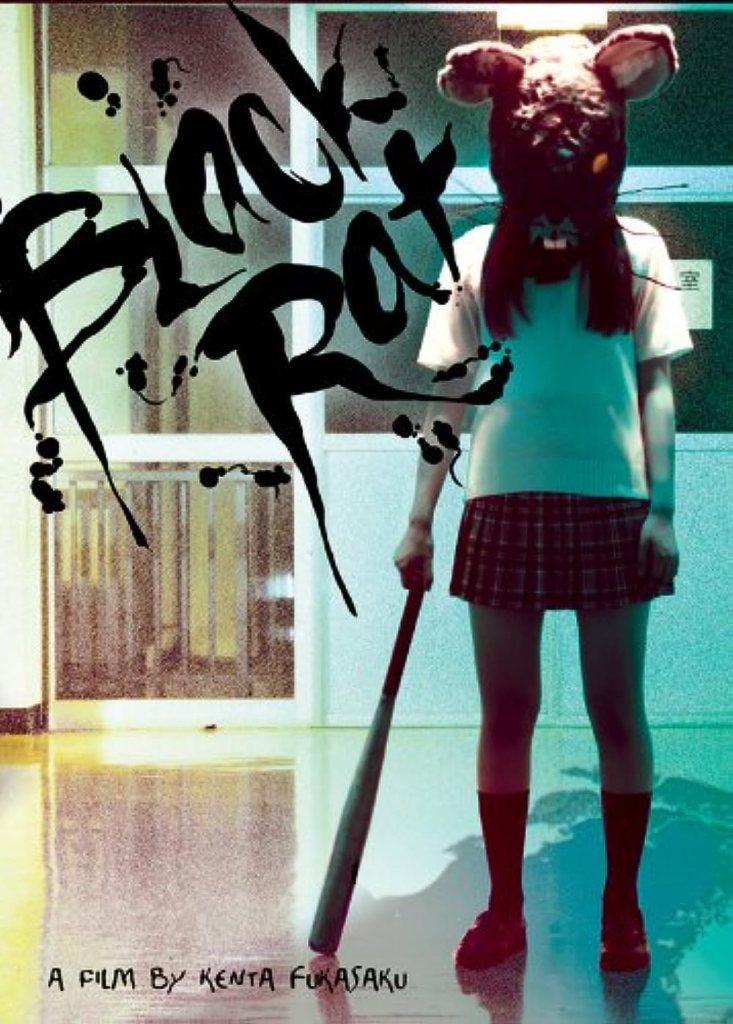
Directed by Kenta Fukasaku [Other horror films: Batoru rowaiaru II: Chinkonka (2003), XX (ekusu kurosu): makyô densetsu (2007)]
I believe this is either the third or fourth time I’ve seen this Japanese film, and I still find it a pretty enjoyable ride. Known as Black Rat (if it’s known at all – even though I first saw this in 2013, it still seems like a somewhat obscure film), this is an emotionally-packed film with a few things going against it, but ultimately ends up quite memorable.
Ever since I first saw this one in 2013 (and if you’re wondering why I’m sure about that date, it’s due to the fact I left a comment on the Horror Movie a Day blog’s entry), it felt like a special movie. I didn’t fully know why at the time – I just knew it was a solid emotional ride, and I enjoyed it immensely, and that’s still true, but there’s more to it.
This was directed by Kenta Fukasaku, the son of Kinji Fukasaku, the individual who directed Battle Royale. Kenta finished directing the second Battle Royale after his father died of cancer, and more importantly, wrote the screenplay for the 2000 classic. I bring this up because there are pieces of humor within Black Rat that remind me strongly of Battle Royale, and if you know how much a fan I am of Battle Royale, you’ll know that such a resemblance bodes well.
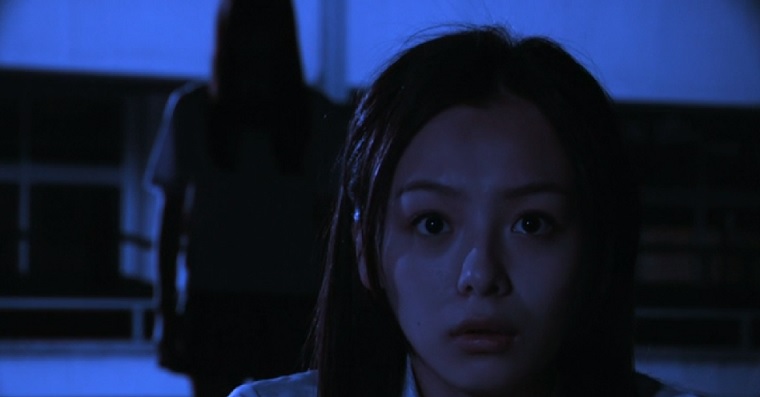
Plot-wise, the movie is simple. Six friends (Ryota, Kanako, Takashi, Kengo, Misato, and Saki) get a text from Asuka, a friend of theirs who committed suicide a month and a half previously. The text tells them to come to a classroom at midnight, and when they do, a killer in a rat mask takes them #down.
None of that is particularly impressive or noteworthy, to be sure, but what pulls the movie together, and gives it a hell of a lot of feeling, are the flashbacks scattered throughout the film, giving a deeper look at all of the friends, their relationships with Asuka, and how they hurt her in various, and sometimes unintentional, ways. It’s a Japanese slasher, which is rare enough, but it’s also a very strong film about friendship and how bonds can fall apart, sometimes in tragic ways.
Unfortunately, the film isn’t well-documented on IMDb. Eight cast-members are listed, but only four are credited, being Rina Saito (Asuka), Misaki Yonemura (Misato), Makoto Sakamoto (Takashi), and Hiroya Matsumoto (Ryota), leaving four cast-members without a credit, being: Haruka Shimizu, Mika Shimizu, Shôta Miyazaki, and Rihoko Shimomiya.
Here’s what I know – three of the uncredited individuals are women, leaving the sole male, Shôta Miyazaki, as the one who played Kengo. As for the other three (and if you’re wondering where the eighth cast-member comes from, it’s a sister of one of the characters), I don’t know who played who (Kanako, Saki, and the sister are the only options), which is a damn shame, as I can’t properly give credit to Kanako’s actress, who I rather liked.
Really, the only issue I had with any of the performances would be Makoto Sakamoto, who played a rather timid and cowardly character, almost to the level of parody. He just didn’t seem like a real person, and that sort of hurt.
And to be fair, it’s not the only problem with the film. Some of the special effects (such as an electrocution and an explosion) were a bit shaky, and there were some choices made toward the latter half of the film that felt quite questionable. Also, I’m not the biggest fan of the last scene.
Even so, there’s a lot going in Black Rat’s favor. Among them would be the shorter runtime, as the movie clocks it at around 76 minutes. It doesn’t overstay it’s welcome, and it still manages to use quality emotional flashbacks to great effect throughout the film, and I think it was done fantastically.
Also, some of the kills early on, or more specifically, the set-up to the kills, are great. You know how I mentioned the humor reminding me a bit of Battle Royale’s? It’s during these scenes where that comes up. The killer gives a character a chance to block a soccer goal – if the character can save the goal, they won’t be killed (or so the killer insists). Well, of course the block isn’t made, and the killer does a cute little dance before they take a baseball bat to the unathletic fellow.
My favorite scene, though, is the killer giving someone a chance to get 100 points on a karaoke song – if they can get the required points on the song, they’re free to go. Of course, they flub the song (being tied down and cut with a boxcutter can put a damper on my singing also), but during the performance, the killer is waving their arms along to the song (again, because this movie isn’t documented well, I don’t know the song, but it’s damn catchy, and the chorus, which goes “Everybody, let’s live for love” is fun).
Neither of these scenes are explicitly comedic, and given the scenario, no one was laughing, but they were both fun, especially the karaoke sequence, and more than that, quite unique.
Asia has largely never been big on slashers, especially since the surge of both Japanese and Korean movies beginning in the late 1990’s. Hong Kong had Dream Home in 2010, and South Korea gave us To Sir, With Love (also known as Bloody Reunion) in 2006, but for the most part, there’s a dearth of modern-day Asian slashers. Black Rat is one of the few Japanese slashers I’ve seen, and for that fact alone, it’s unique, but add on the other stuff I liked about it, and it’s big news.
I get the sense I enjoy Black Rat a lot more than most people. It’s an obscure movie, sure, but many of the reviews I have read on the film (including the one linked above by Horror Movie a Day) have been mediocre, and the film has only a straight 5/10 on IDMb (EDIT: or did when I wrote this on October 21st, 2021, as it now has a 4.7/10). I guess it just hit the right spots for me when I first saw it back in 2013, and seeing it with fresh eyes, it largely still does.
8.5/10






 Jiggy's Horror Corner