Il trono di fuoco (1970)

Directed by Jesús Franco [Other horror films: Gritos en la noche (1962), La mano de un hombre muerto (1962), El secreto del Dr. Orloff (1964), Miss Muerte (1966), Necronomicon – Geträumte Sünden (1968), The Blood of Fu Manchu (1968), Der heiße Tod (1969), Marquis de Sade: Justine (1969), The Castle of Fu Manchu (1969), Paroxismus (1969), De Sade 70 (1970), Nachts, wenn Dracula erwacht (1970), Les cauchemars naissent la nuit (1970), Vampyros Lesbos (1971), Sie tötete in Ekstase (1971), Jungfrauen-Report (1972), Drácula contra Frankenstein (1972), Der Todesrächer von Soho (1972), La fille de Dracula (1972), Dr. M schlägt zu (1972), Les démons (1973), La comtesse noire (1973), La maldición de Frankenstein (1973), La nuit des étoiles filantes (1973), Los ojos siniestros del doctor Orloff (1973), Al otro lado del espejo (1973), La noche de los asesinos (1974), Les possédées du diable (1974), La comtesse perverse (1974), Les gloutonnes (1975), L’éventreur de Notre-Dame (1975), Sexorcismes (1975), Frauengefängnis (1976), Jack the Ripper (1976), Un silencio de tumba (1976), In 80 Betten um die Welt (1976), Die Marquise von Sade (1976), Greta – Haus ohne Männer (1977), Die Liebesbriefe einer portugiesischen Nonne (1977), Die teuflischen Schwestern (1977), Der Ruf der blonden Göttin (1977), El sádico de Notre-Dame (1979), Mondo cannibale (1980), El caníbal (1980), Die Säge des Todes (1981), La tumba de los muertos vivientes (1982), La mansión de los muertos vivientes (1982), Revenge in the House of Usher (1983), El tesoro de la diosa blanca (1983), Macumba sexual (1983), Sola ante el terror (1983), Sangre en mis zapatos (1983), Mil sexos tiene la noche (1984), El siniestro doctor Orloff (1984), Lilian (la virgen pervertida) (1984), La esclava blanca (1985), Faceless (1987), Killer Barbys (1996), Tender Flesh (1997), Mari-Cookie and the Killer Tarantula (1998), Lust for Frankenstein (1998), Vampire Blues (1999), Dr. Wong’s Virtual Hell (1999), Helter Skelter (2000), Vampire Junction (2001), Incubus (2002), Killer Barbys vs. Dracula (2002), Snakewoman (2005), La cripta de las mujeres malditas (2008), La cripta de las mujeres malditas II (2008), La cripta de las condenadas (2012), La cripta de las condenadas: Parte II (2012)]

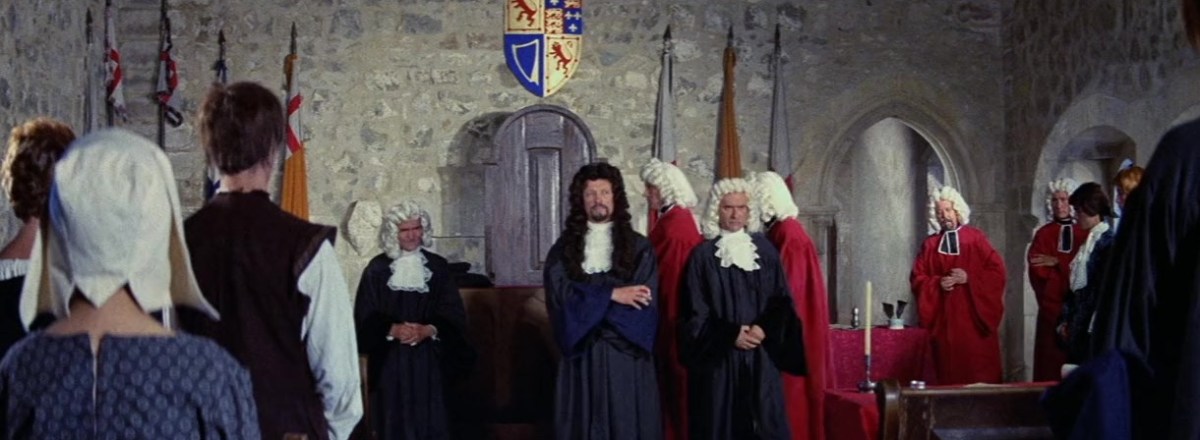
This Jesús Franco film didn’t really do a whole lot for me. While there are some solid scenes of torture every now and again, much of the film came across as a historical drama, and were it not for Christopher Lee (playing the sinister Judge Jeffries), I would have liked this film a lot less.

Widely known as The Bloody Judge, I really appreciate, as a moderate student of history (a minor of mine in college) the historical nature of the film, though I am slightly put off by how it overshadows any and all of the horror aspects (which come primarily from the torture sequences).

Of course, this film isn’t without it’s positives. Christopher Lee does great in his role (though I don’t think the conclusion insofar as Jeffries was concerned was that satisfactory), and Hans Hass Jr., Milo Quesada, and Maria Rohm stand out also. Also, there was a solid sequence at the end once William of Orange came ashore. Alas, the ending played out somewhat quickly, which gave it a somewhat anticlimactic feel.

Personally, I think the biggest problem with this film is it’s meandering plot. The basic plot, in which the son of a Lord is looking to get married to the sister of a woman killed for being a witch and escape out of England is all well-and-good, but at an hour and forty minutes, I will admit to having stopped caring past a certain point. Loved the torture sequences (though none were overly over-the-top), and every scene with Lee, but much of the film just wasn’t my cup of tea.

As it is, when it comes to historical horror films, I already have the 1968 Witchfinder General to fill the void. If you see this for any reason, it should be Lee’s solid performance as a despicable judge killing innocents in the name of God and country. Truth be told, I was hoping for more than I got from this. The Bloody Judge may work for you, but it didn’t do a lot for me.

5.5/10
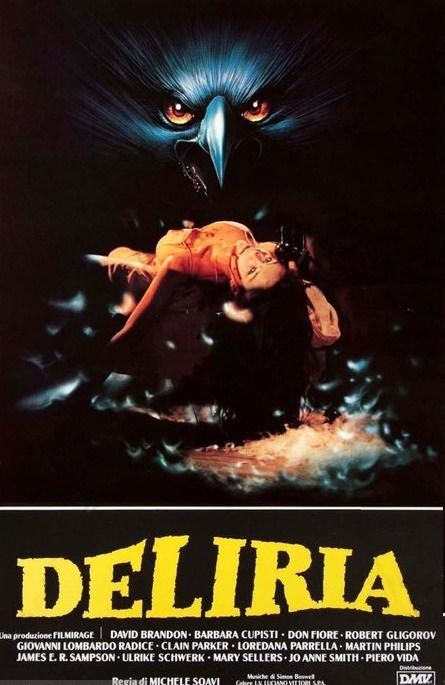
Deliria (1987)

Directed by Michele Soavi [Other horror films: La chiesa (1989), La setta (1991), Dellamorte Dellamore (1994)]

Perhaps it’s due to the fact that, at the time of this writing (4/23/2019, should anyone be interested) I’m drunk off my fucking ass, but this movie was excellent. Great death scenes, damn good suspense, fantastic movie, and just overall a fun movie.

I saw this before, and I enjoyed it, but this time around, I get the sense I enjoyed it a lot more. I have virtually no complaints about Deliria (as that’s it’s original title), and it really has a lot of things going for it.

The funky Italian music is especially fun throughout the film, and toward the ending, there’s a great sequence on the catwalks with the music playing that was just a delight. The special effects were great, and pretty much every kill was enjoyable (favorites including the dismemberment and decapitation, along with the drill and chainsaw). My all-time favorite kill, though, was one of the earlier ones, when a character gets stabbed on-stage. The way that scene was filmed was great, and it had such an epic feel to it (music, of course, played a large part in that). It’s not necessarily an overly gory kill, but it was my favorite in the film.

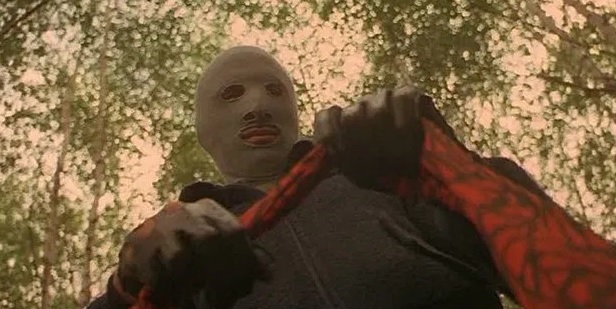
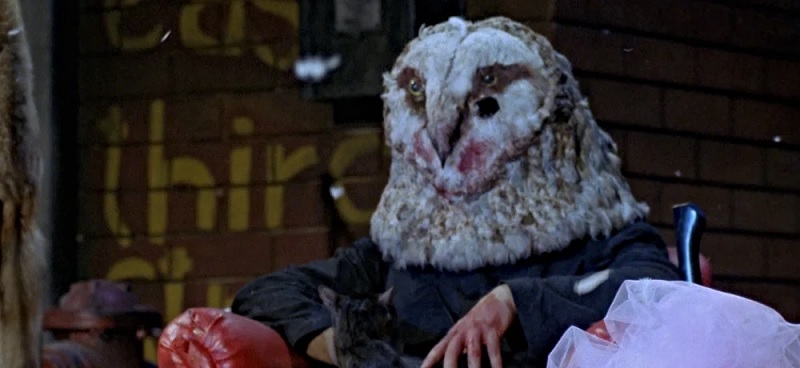
Most of the main performances are pretty decent. Barbara Cupisti and David Brandon in particular impressed me, but I also rather enjoyed Giovanni Lombardo Radice, Loredana Parrella, Martin Philips, James Sampson, and Ulrike Schwerk. Clain Parker played the killer wearing the owl headpiece (which, by the way, was a rather random yet fun addition to the film), and I really loved Parker’s calm style, especially the sequence when he’s just sitting around all those he’s killed, stroking a cat (which, on a side-note, was a fantastically suspenseful sequence).

While I sort of wish the film had gone the giallo route (by attempting to hide the identity of the killer, or throwing in some type of plot twist where there were multiple killers), I sort of appreciate how the movie kept things simple. We know who the killer is from the beginning, and the body count rises and rises in generally gory and satisfying ways.

Truth be told, I don’t think there’s any really big issues with the film. If you’re a fan of slashers, I really don’t see where this film would do you wrong. Pretty much everything’s solid about it, and there’s even a little humor provided by two cops sitting outside the studio while all the mayhem’s taking place (the younger cop played by the director, Michele Soavi). Whether you know this movie as StageFright, Aquaris, Deliria, whatever, this Italian movie has the goods, and was a fantastic rewatch.

9/10

I corpi presentano tracce di violenza carnale (1973)

Directed by Sergio Martino [Other horror films: Lo strano vizio della signora Wardh (1971), La cado dello scorpione (1971), Tutti i colori del buio (1972), Il tuo vizio è una stanza chiusa e solo io ne ho la chiave (1972), Morte sospetta di una minorenne (1975), La montagna del dio cannibale (1978), L’isola degli uomini pesce (1979), Il fiume del grande caimano (1979), Assassinio al cimitero etrusco (1982), 2019 – Dopo la caduta di New York (1983), American risciò (1989), La regina degli uomini pesce (1995), Mozart è un assassino (1999)]

Generally known as Torso, and originally known as I corpi presentano tracce di violenza carnale (what a mouthful that is), this giallo is a pretty solid and enjoyable film, though I don’t think it truly shines until the final thirty minutes.

Much of the success is due to Suzy Kendall’s strong performance. Throughout much of the film, she plays the type of protagonist you can really root for, as she does some solid investigation, along with making rather intelligent decisions toward the end. Probably one of the stronger women in horror at the time, which I appreciated. Her main friends (played by Tina Aumont, Angela Covello, and Carla Brait) all did well, but the only one to really make an impression was Aumont.

Otherwise, John Richardson was about the only other performance to really do much for me. Playing one of the many suspects (what’s a giallo without at least three suspects?), Richardson is decently memorable despite his moderately short screen-time.

What’s more memorable than him, though, is the ample nudity in the film. A lot of topless scenes here, including a drugged-out dance, skinny-dipping, and, of course, nude sunbathing. There was even some softcore lesbian action at times, which was kind of them to throw in. It sort of came out of nowhere, but that’s Italy for you.

The gore was pretty decent also, though not quite as good as I recalled. Still, it’s pretty solid, what with multiple slit throats, a rather nasty (but also rather fake) head injury, and of course, some mild dismemberment toward the end. Much of the violence wasn’t really gory, but it still had a strong sense of being brutal.

It’s in the final thirty minutes where Torso takes off from an okay giallo to a really suspenseful and mysterious film. The killer’s identity wasn’t really hard to decipher, but the reason for their actions was what had me most curious (and we get a fun flashback at the end to showcase just that). There’s some great suspenseful scenes in the finale, such as the newspaper scene and a taut sequence of a woman trying to conceal herself from the killer in the hilltop villa (which was a pretty solid setting, by the way).

All-in-all, Torso’s not quite the amazing movie I remember it being, but it’s still very much above average, and it’s definitely a giallo I’d recommend. Sergio Martino did a lot for Italian horror (and I mean a lot), so his entry here is unsurprisingly solid. The specific scarf design one of the girls was attempting to remember was classic giallo. Not an overly amazing movie, Torso was still a lot of fun.

7.5/10

Inferno (1980)

Directed by Dario Argento [Other horror films: L’uccello dalle piume di cristallo (1970), Il gatto a nove code (1971), 4 mosche di velluto grigio (1971), Profondo rosso (1975), Suspiria (1977), Tenebre (1982), Phenomena (1985), Opera (1987), Due occhi diabolici (1990, segment ‘The Black Cat’), Trauma (1993), La sindrome di Stendhal (1996), Il fantasma dell’opera (1998), Non ho sonno (2001), Il cartaio (2003), Ti piace Hitchcock? (2005), La terza madre (2007), Giallo (2009), Dracula 3D (2012), Occhiali neri (2022)]

While I’ve seen Suspiria a few times before, perhaps as many as three times, I’ve not seen Inferno up until the point of this writing. It’s a difficult movie to really get a feel for, but I’ll say that, while it wasn’t as striking and, I suspect, as memorable as Suspiria, there’s still stuff in here to enjoy.

It’s just possible that the movie lacks a certain cohesion. That’s not to say that Suspiria didn’t, but Inferno takes it to a whole new level. There’s a basic plot here, but the movie takes a rather meandering and sometimes disjointed approach to it, especially with Leigh McCloskey’s character not having a clue as to what was going on until the ending, and I’m guessing he didn’t really know then.

Inferno has a rather dream-like quality to it. There are some scenes that just seem off, or riddled with awkward dialogue, or character actions that don’t make a lot of sense. Most of the kills are great, but we never really find out who exactly is the one doing most of them, and generally, portions of the movie strike me as somewhat nonsensical.

None of this means the movie isn’t enjoyable. I will say that it probably went on a bit longer than it needed to, and the conclusion was, well, not amazing (and just brought forth a few more questions that were never even attempted to be answered), but it’s still occasionally fun. The special effects are decent, and the lighting is, of course, rather seductively ambient (though I will say that Suspiria’s lighting was quite a bit better). I think, in terms of enjoyment of the ludicrous nature of the film, the whole eclipse scene was definitely a trip.

Generally, I don’t know if most of the performances are all that memorable. McCloskey sort of had appeal as the lead, given that he had no idea whatsoever that anything supernatural was even going on until the end. He was basically clueless throughout the whole film (which lead to a somewhat amusing line near the end), but I don’t know if that makes him necessarily memorable. That said, the same could be said for both Irene Miracle and Eleonora Giorgi. Daria Nicolodi seemed somewhat pointless, but Alido Valli was rather fun to see again (she was also in Suspiria).

It’s sort of hard to pinpoint what exactly makes this film a little less stellar than his former film in the series. Inferno does meander a bit, and at times feels a bit aimless. The conclusion, especially that skeleton costume, seemed a iffy. The soundtrack was just a bit eclectic. It’s still a decent film, and I do think it’s probably above average, but Suspiria is, in my opinion, better.

7.5/10

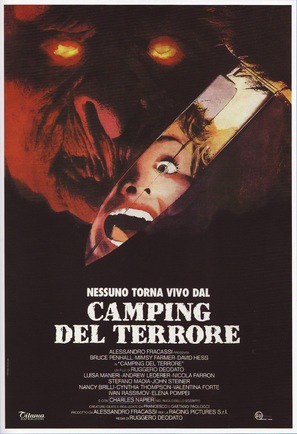
Camping del terrore (1986)

Directed by Ruggero Deodato [Other horror films: Ultimo mondo cannibale (1977), Cannibal Holocaust (1980), La casa sperduta nel parco (1980), Inferno in diretta (1984), Un delitto poco comune (1988), Minaccia d’amore (1988), Vortice mortale (1993), The Profane Exhibit (2013, segment ‘Bridge’), Ballad in Blood (2016), Deathcember (2019, segment ‘Casetta Sperduta in Campagna’)]

This Italian film (most commonly known as Body Count) was a bit of a muddled, scatter-shot mess. It was certainly still enjoyable as a slasher fan, but boy, you’d hope that Ruggero Deodato would have been able to make a more stable slasher than what this shows.

As it is, the kills throughout are decent. I particularly liked seeing one character’s fingers getting chopped off by an ax, or another in which a girl gets stabbed through the hand, and the killer twists the knife. There are some painful scenes in this one, and though it doesn’t really compete with the best of the best, the kills were very competent.

A bigger problem, though, is the story and characters. Maybe it’s because the movie’s Italian, but the story here seems a bit on the messy side. It’s true that I had an issue remembering who was who here (though to be honest, I don’t know if that matters much), but starting out the movie, then jumping 15 years later, then later throwing in a flashback of a ‘bear attack’ (that was very obviously a murder, on a side-note) just left me feeling jumbled. The ending, which implied that there was another killer, also didn’t help.

Even once we find out who’s behind the murders (which isn’t a big surprise, but there were a few legitimate suspects here), we’re told that one of the earliest murders (that happened in the introduction, 15 years prior to the core of the movie) wasn’t done by the killer. Wait, I missed something – who killed that first person, then? Maybe it slipped past me, or maybe that wasn’t clarified.

The characters here were all sort of goofy and hard to really feel much for. The worst offender was Andrew J. Lederer (who provided us with some solid male frontal nudity), but to be honest, he did crack me up a few times, and at least stood out, which can’t be said for any of the other teen characters (despite the fact that a handful of the young women weren’t what you might refer to as ‘modest’).

Some of the others here were okay, though. Ivan Rassimov (who starred in a handful of classic cannibal films, such as Man from Deep River, Jungle Holocaust, and Eaten Alive!) brought a solid performance as a sheriff, though I wish the movie did more with him. Ditto John Steiner, who I thought would play a bigger role here. David Hess (Last House on the Left) and Charles Napier were also solid presences, but given the story they’re dealing with, I don’t think either stood out.

I’ll give Body Count kudos for the 80’s score, which I rather liked, but I’ll take the kudos away due to the atrocious lighting at various parts throughout the movie. Maybe if the lighting had made some of the scenes more visible, some of the movie might have been more on the comprehensible side.

The question is, though, did I enjoy Body Count? I did, given all of it’s flaws. I still think this Italian slasher is below average, but hell, it’s an 80’s slasher, and there are decent kills here, so even if the story is lacking, at least we get a little something.

6/10

This is one of the films covered on Fight Evil’s podcast, so if so intrigued, check out below as Chucky (@ChuckyFE) and I discuss Body Count.

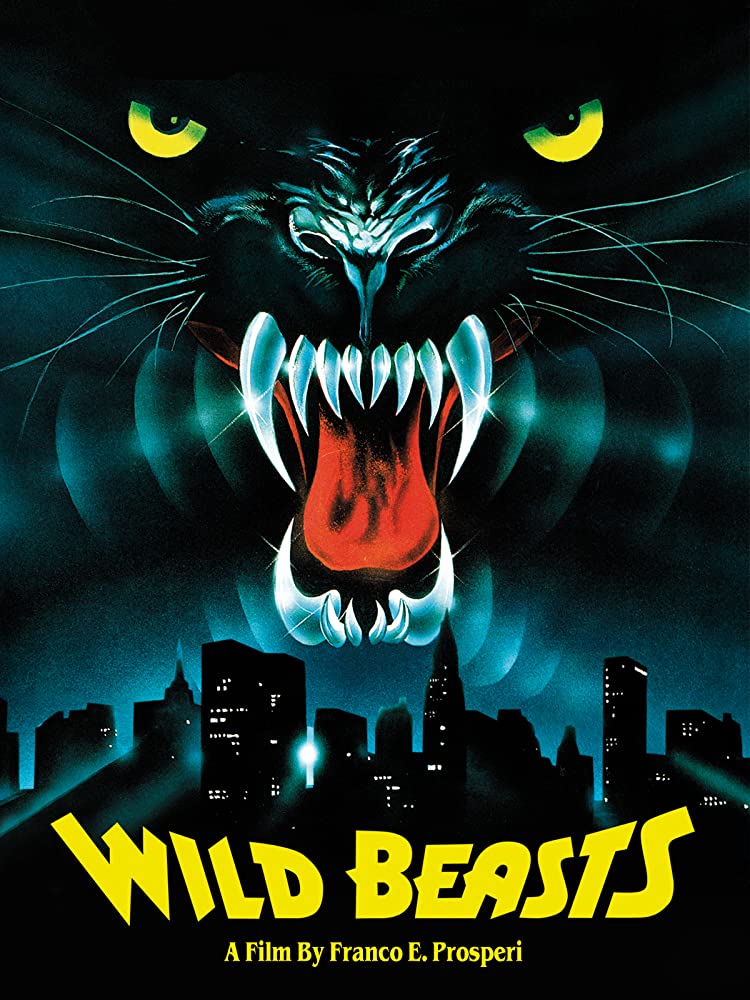
Wild beasts – Belve feroci (1984)

Directed by Franco Prosperi [Other horror films: Mondo cane (1962), Africa addio (1966)]

This Italian movie is something of a hoot. Truth be told, while it has the tendency to drag a little, overall, I definitely think it’s a film worth seeing, should you be a fan of Italian entries to the genre.

I wouldn’t say you should see it for the cast, however – make no mistake, I think the principal actors/actresses (John Aldrich and Lorraine De Selle) do fine, but neither one is special, especially considering the rather horrible dubbing job done. I did appreciate Ugo Bologna as the Police Chief, along with Louisa Lloyd as De Selle’s bratty daughter (and, on a side-note, I detected what had to be close to underage nudity early on in the film, which came as a bit of a shock). Still, these four are virtually the only important cast members, and while none of them are bad (which isn’t to say unlikable), it’s not why you’d come to this flick.

Instead, it’d be for the sometimes brutal animal attacks, of all flavors. Favorites of mine including an elephant stomping on a woman’s head (unfortunately cut somewhat short), an epic rat attack toward the beginning, which was beautifully gory, and a rather tragic attack upon a blind man by his seeing dog (which was filmed in a much more somber way than you might expect from a piece of schlock like this). The gore is never too in-you-face, and there are plenty of suspenseful scenes that go without, but when it did pop up, it was generally of solid quality.

At times, though, because of switching between mostly random people being attacked by random animals (such as the six minute cheetah chase, which was moderately suspenseful), the movie felt a bit aimless at times. It’s not necessarily a bad thing, because within the context of the story, such a route makes sense, but Wild Beasts definitely felt a bit off at times.

Personally, I think that this movie had a lot of get-up-and-go despite some of the issues I had with the cohesiveness (I should point out that the conclusion is pretty cool, albeit a bit weak in the way it played out). It’s not a great movie, but I do think that this Italian flick has a lot of character, and while I wish it had more gore, there were some kills (such as the seeing dog attack and the rat attack) that were well-worth seeing, and generally, I’d say Wild Beasts is enjoyable, just not special.

7/10

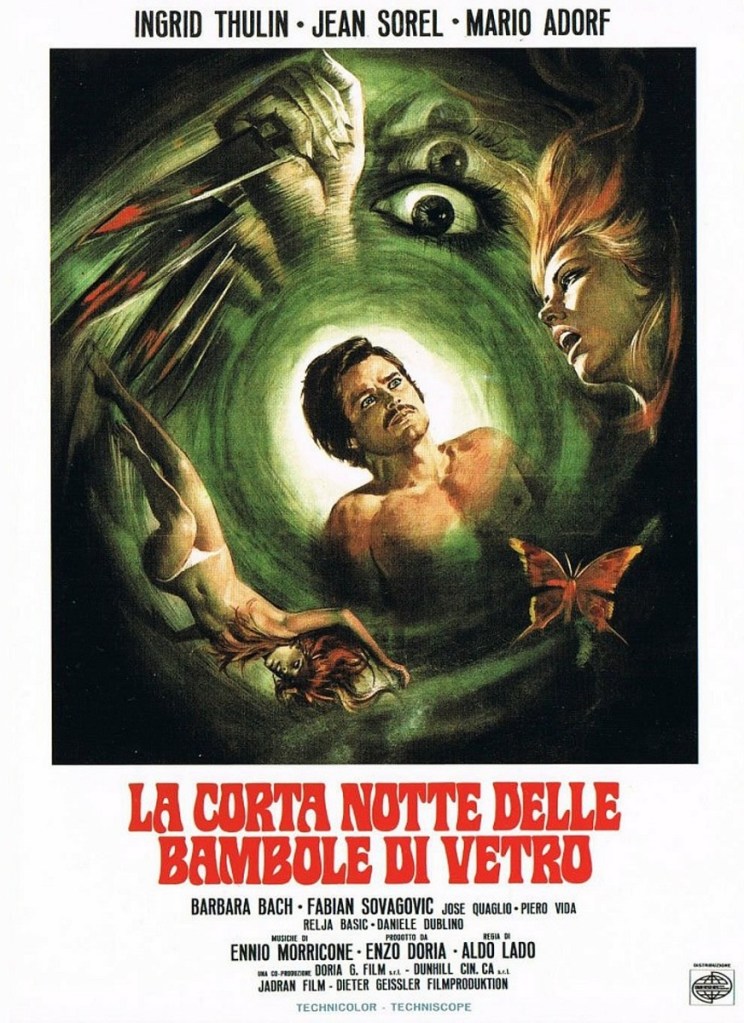
La corta notte delle bambole di vetro (1971)

Directed by Aldo Lado [Other horror films: Chi l’ha vista morire? (1972), L’ultimo treno della notte (1975), Il Notturno di Chopin (2013)]

This Italian giallo, widely known as Short Night of Glass Dolls, was a decent film for much of the run-time, but toward the end, it sort of went into a somewhat incoherent mess.

The mystery here is pretty good, and enjoyable to watch unfold. A young woman disappears without a trace in Prague, and her lover, an American journalist, attempts to find her. It’s typical for a giallo, but that doesn’t make it any less fun. It’s made better by the setting, and more so, the time period, as this took place when then-Czechoslovakia was a Communist state behind the Iron Curtain.

Because of that, there is a bit of anti-USSR material strewn throughout the film, and even toward the conclusion, though I don’t think it’s terribly over-troubling. It does lead to a more oppressive feel, and much of the going-ons have a very conspiratorial feeling to them. Problematically, the conclusion doesn’t explain what’s going on nearly as well as I’d have liked, and honestly, I’m at a loss right now as to what actually happened, and why. It’s just not made clear, as far as I could tell.

Worth noting, most of the main story is told via flashback, and the present-day material, luckily, is decently engaging. Still, I don’t care much for the conclusion they had there, either, though it certainly possessed a somewhat bleaker feel than some audiences might be used to.

I’m not trying to harp too much on the movie, because much of it is really engrossing. It’s not until the final ten minutes or so that the movie, in my opinion, falls apart. It’s just rather noticeable because my enjoyment level went down so much as the ending unfolded, and I felt that given how good the film was before, it was rather unfortunate.

I liked much of the principal cast of this film. Jean Sorel took a little bit, but he grew on me as the film went on. Playing a friend of his, I thought that Mario Adorf did well with his more care-free, fun-loving character. Lastly, playing the woman who goes missing, Barbara Bach did well as a beautiful, semi-mysterious woman.

For a giallo, La corta notte delle bambole di vetro is extraordinarily tame. There’s little to no gore, and many of the staples you might expect from the subgenre, such as first-person view from the killer, or black gloves, are absent. The mystery is certainly here, and like I said, it’s done well, but this movie feels really toned down, and if you’re expecting a run-of-the-mill giallo, then you’ll likely to be disappointed.

I will admit to being disappointed by this one, if only because the conclusion (to both the flashback and present-day stories) were so unsatisfactory. I can live with little gore, because the story was otherwise engaging, but what draws me to giallos is how everything’s pieced together nicely at the end, and I definitely didn’t get that feeling here. For what this movie is, it’s okay, but I’d definitely temper your expectations before jumping in.

6/10

Le notti del terrore (1981)

Le notti

Directed by Andrea Bianchi [Other horror films: La tua presenza nuda! (1972), Nude per l’assassino (1975), Malabimba (1979), Maniac Killer (1987), Incontri in case private (1988), Massacre (1989), Gioco di seduzione (1990)]

This Italian zombie offering (commonly known best as Burial Ground: The Nights of Terror) has some fantastic special effects in both their zombie design and exuberant amounts of gore. Unfortunately, it doesn’t really offer up much aside from that.

Really, it’s hard for zombies movies to not feel derivative – at times, this felt like fellow Euro-horror forebears such as Tombs of the Blind Dead and Let Sleeping Corpses Lie/The Living Dead at Manchester Morgue (though in somewhat unique fashion, the former is a Spanish film while the latter an Italian-Spanish production), and of course emulated Fulci’s Zombi 2 and City of the Living Dead, along with taking some elements from Umberto Lenzi’s Nightmare City.

All of this is to say that you pretty much know what you’re going to get: a thread-bare story but great gore and effects, and by God, Burial Ground delivers.

Obviously, perhaps one of the most memorable scenes is a woman getting her nipple and breast tip gnawed off, but there are also plenty of scenes of zombies digging through peoples’ entrails (thinking Night of the Living Dead, only in glorious color), along with just general great use of gore. The zombies themselves have a great design too, looking both overly decayed, dried out, and decrepit, along with being inundated with maggots and seeping brownish liquid (which one can only imagine would be quite foul) when punctured.

Most of the performances here aren’t really note-worthy in any way. One that just has to be mentioned, though, is Pietro Barzocchini (credited as Peter Bark in the film). Because of Italian laws that restricted the use of children in violent and sexual scenes, Barzocchini (age 25 at the time) was cast as a young child (I’m guessing he was supposed to be between the ages of seven and ten), which added such a strange, surreal feel to the scenes he was present in. It also allowed for a rather creepy scene where he tried to seduce his mother.

Oh, fun times indeed.

On a small side-note, I rather liked the somewhat low-key way this film ended. I can imagine it bothering some viewers, but it also plays into the whole hopelessness the characters felt throughout the whole film.

For a fan of classic horror, there’s a lot to appreciate about this movie, but Zombi 2 will always be my go-to when it comes to Italian zombie movies, no matter how good some of the effects here tend to be. Still, I definitely recommend giving this one a look, as really, you can’t go wrong with Italian zombie flicks from that golden era.

7/10

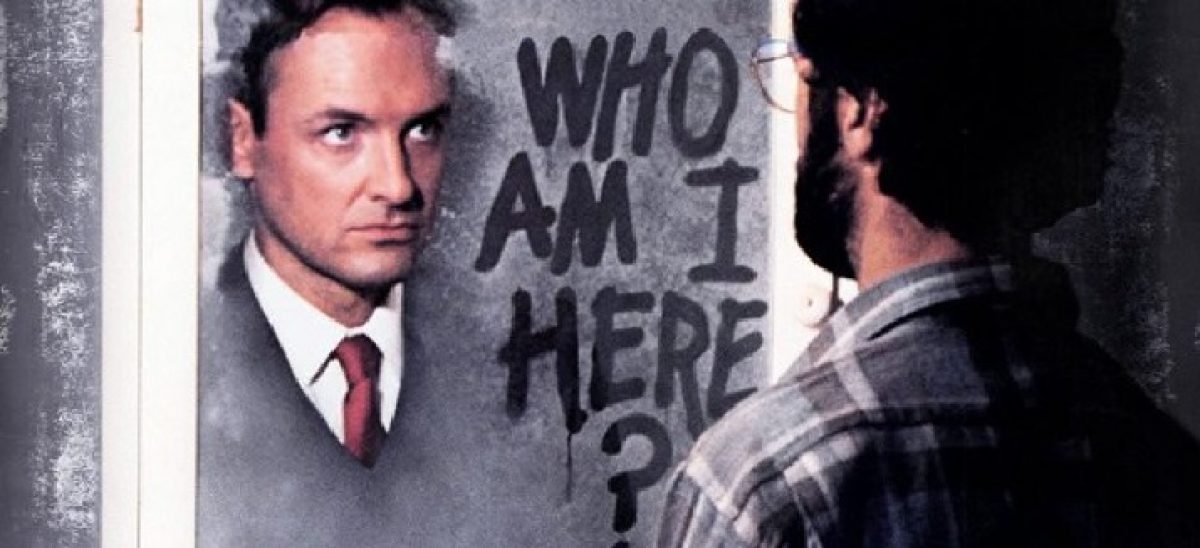
Due occhi diabolici (1990)

Two EVIL

Directed by Dario Argento [Other horror films: L’uccello dalle piume di cristallo (1970), Il gatto a nove code (1971), 4 mosche di velluto grigio (1971), Profondo rosso (1975), Suspiria (1977), Inferno (1980), Tenebre (1982), Phenomena (1985), Opera (1987), Trauma (1993), La sindrome di Stendhal (1996), Il fantasma dell’opera (1998), Non ho sonno (2001), Il cartaio (2003), Ti piace Hitchcock? (2005), La terza madre (2007), Giallo (2009), Dracula 3D (2012), Occhiali neri (2022)] & George A. Romero [Other horror films: Night of the Living Dead (1968), Hungry Wives (1972), The Crazies (1973), The Amusement Park (1975), Martin (1976), Dawn of the Dead (1978), Creepshow (1982), Day of the Dead (1985), Monkey Shines (1988), The Dark Half (1993), Bruiser (2000), Land of the Dead (2005), Diary of the Dead (2007), Survival of the Dead (2009)]

Featuring two Edgar Allan Poe stories directed by two well-respected directors (George A. Romero and Dario Argento), I wish that I could like Two Evil Eyes (as it’s known here) more. As it is, the first story is really enjoyable, but Argento’s addition here just drags, and deeply pulls down my enjoyment of the film overall.

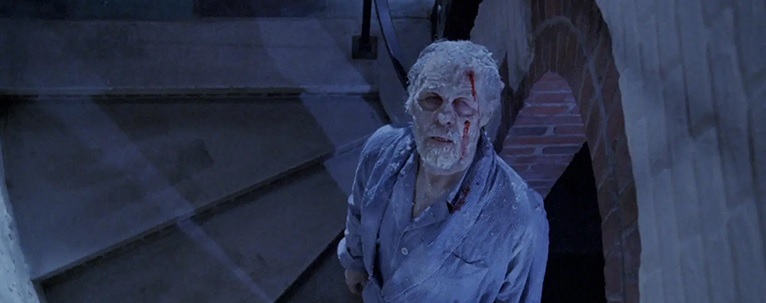
Directed by Romero, the first story is a pretty spooky idea, and has a rather classical feel to it. It felt like one of those stories you might see in a 70’s Amicus anthology (Tales from the Crypt, Vault of Horror, what-have-you), with a great feel for suspense and a solid conclusion.

Argento’s story, based off The Black Cat, just felt off, for lack of a better word. The last six minutes or so were pretty good, if only because it was moderately suspenseful, but the rest of the story just didn’t do it for me. It’s made worse by both the fact that it’s the longer of the two stories (about an hour and three minutes long as opposed to the first story’s fifty-five minutes) and almost none of the performances wowed me, and in fact, the main actor bothered me quite a bit.

The cast for the first story is so much better anyway. Starring Adrienne Barbeau (from such classics as The Fog and Creepshow) and Ramy Zada (who I know only from a segment in 1989’s After Midnight), who work rather well together, this story also has strong performances by Bingo O’Malley, Tom Atkins, and E.G. Marshall. O’Malley isn’t a name I’m familiar with, but Atkins was in such genre classics as The Fog, Halloween III: Season of the Witch, Night of the Creeps, and Maniac Cop, and was great to see here. E.G. Marshall hasn’t done much for the horror genre (in fact, this movie aside, he’s only been in two others, 1979’s television movie Vampire and a segment in Creepshow), but was amazing in the 1957 classic 12 Angry Men, and seeing him here was sort of a treat.

The second story, on the other hand, had just one performance I actually liked, being that of John Amos (who, along with being in the second Die Hard, was also in twenty or so episodes of The West Wing), who played a police detective. The star, Harvey Keitel (who I know mostly from Pulp Fiction), had a pretty weak performance here – his character didn’t really make much sense to me, and he seemed all over the place. Both Madeleine Potter and Sally Kirkland were in much the same vein, and I especially didn’t like Kirkland’s esoteric character.

Originally titled Due occhi diabolici (though the film’s in English, it’s an Italian production), Two Evil Eyes had a decent concept, but it didn’t work out, which is a shame. If I could rate the movie off the first story only, it’d be getting a pretty high rating. But as an overall package, Two Evil Eyes isn’t a movie I’d want to see again. My advice is to give the first story a watch, as it truly is pretty good, and just ignore the second.

5.5/10

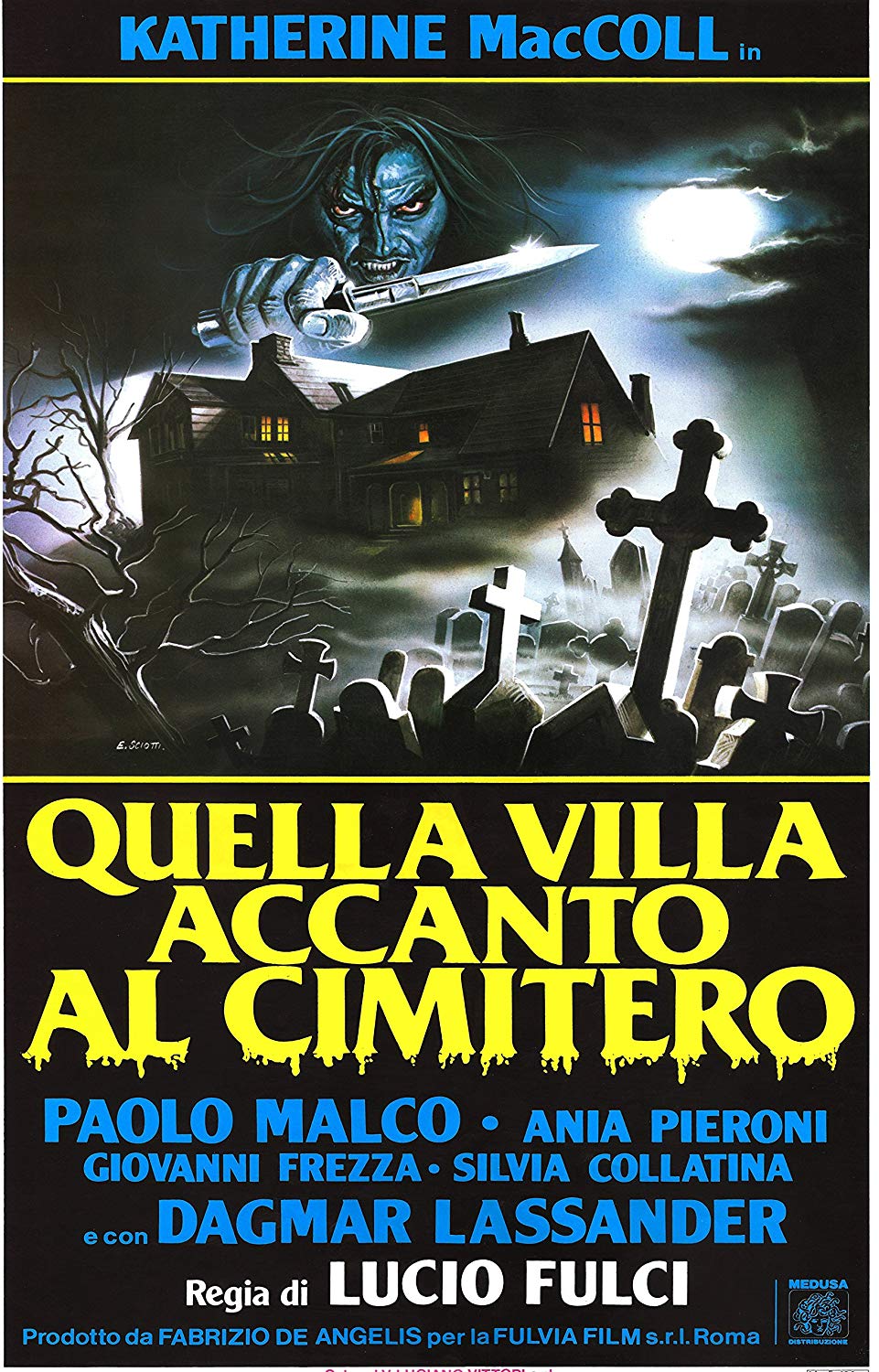
Quella villa accanto al cimitero (1981)

House by the

Directed by Lucio Fulci [Other horror films: Una lucertola con la pelle di donna (1971), Non si sevizia un paperino (1972), Il cav. Costante Nicosia demoniaco, ovvero: Dracula in Brianza (1975), Sette note in nero (1977), Zombi 2 (1979), Paura nella città dei morti viventi (1980), Gatto nero (1981), …E tu vivrai nel terrore! L’aldilà (1981), Lo squartatore di New York (1982), Manhattan Baby (1982), Murderock – Uccide a passo di danza (1984), Aenigma (1987), Zombi 3 (1988), Il fantasma di Sodoma (1988), Quando Alice ruppe lo specchio (1988), La casa nel tempo (1989), La dolce casa degli orrori (1989), Un gatto nel cervello (1990), Demonia (1990), Hansel e Gretel (1990), Voci dal profondo (1991), Le porte del silenzio (1992)]

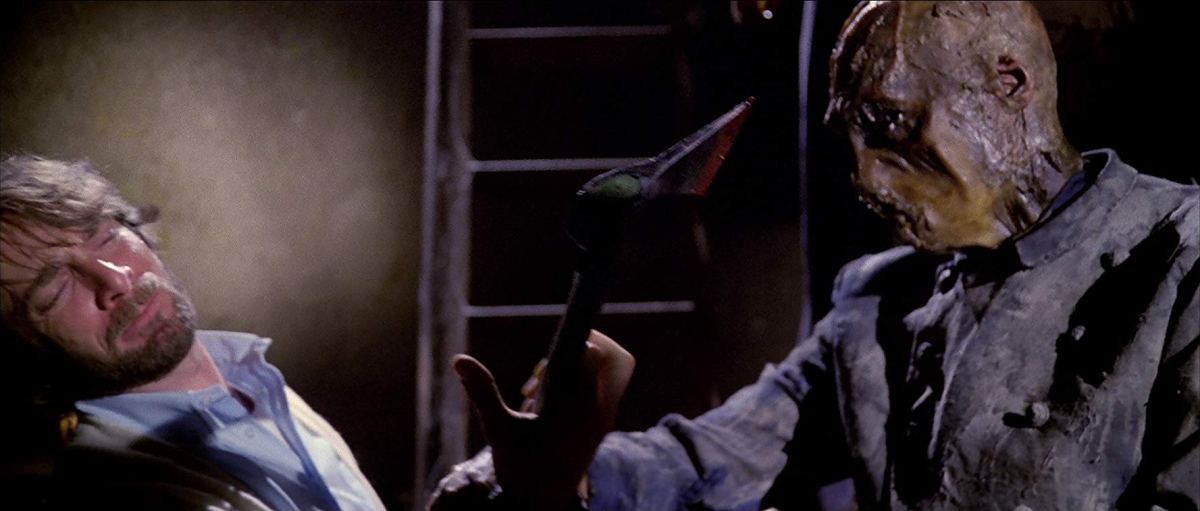
As with much of Fulci’s horror output, Quella villa accanto al cimitero (or The House by the Cemetery) lacks some cohesion at times, but comes forth with strong gore, though this doesn’t entirely save it.

At first glance, the story is somewhat simple, but there are elements never really touched upon aside from being referenced once or twice (such as what exactly the deal with the babysitter was, and under what circumstances did the main guy visit the house previously, or the psychic girl subplot), which creates an occasionally incoherent film, perhaps par for the course, as far as Fulci’s concerned.

That said, many don’t come to Fulci’s films for their unparalleled stories, they come for the gore, and this movie certainly has that. Dismembered body parts, a bloody bat attack, multiple stabbings, this movie knew what it was doing insofar as the gore and special effects were concerned.

I watched a dubbed version of the film (which is the same as last time I saw this, if I recall), and the dubbing wasn’t spectacular, but it didn’t really harm the performances. Paolo Marco was still decently strong as the main character, though he wasn’t as involved as I thought he might be. Catriona MacColl was a bit hysterical at times, but it worked for her character. Playing the babysitter with an unexplained connection to the house, Ania Pieroni did fine, but was lacking characterization. Lastly, the boy, played by Giovanni Frezza, was hurt most by the dubbing, and came across as annoying half the time, but I could live with it.

The lack of cohesion here is the biggest problem. Certainly there’s occasionally a strong atmosphere, and of course the gore is pretty top-notch, but when the story’s not amazing, those other factors can only do so much. Related, while much of the score was pretty good, it was rather eclectic at times, and seemed cut oddly, at least in the print I saw.

The House by the Cemetery probably isn’t Lucio Fulci’s best movie (I definitely prefer Don’t Torture a Duckling and Zombi 2 more, and maybe even The Beyond), but it is a good example of the kind of horror this Italian director did for the genre. It’s worth seeing despite the problems present, but it might not be one of his movies that you constantly go back to.

6/10