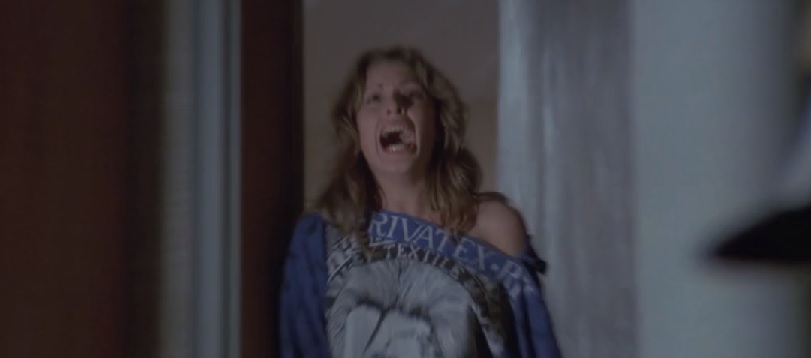
Happy Birthday to Me (1981)

Directed by J. Lee Thompson [Other horror films: Eye of the Devil (1966), The Reincarnation of Peter Proud (1975)]

Often considered a classic slasher of the early 80’s, Happy Birthday to Me was a movie I very much looked forward to seeing again. I’ve seen it once before, though it’s been quite a while, so I was eager to revisit it. Overall, I do think it’s a solid movie, but I can’t say I exactly love the finale.

Oh, parts of the finale are great – a character walks into a macabre scene of bodies and insanity, and it’s an appropriately-somber sequence – but we’re also given a twist that feels somewhat silly. Of course, most plot twists that involve a latex mask tend to feel that way, but there you go. It’s still a decent finale, memorable in it’s somber feel (even having a solid song, “Happy Birthday to Me” by Syreeta, playing us out), but that twist probably could have been executed differently.

It’s also worth mentioning that the movie is around an hour and 50 minutes. That in itself isn’t a bad thing, but I don’t really know if this movie earns the right to be that long. Sure, we theoretically have something like 12 characters to play around with, but many of them (Steve, Greg, Amelia, Rudi, and Maggie) don’t really get that much in the way of focus.

Honestly, that might be my personal pet peeve with this movie, keeping in mind I still enjoyed it. Virginia (Melissa Sue Anderson) is part of a high school clique named the Top Ten – the others being Maggie (Lenore Zann), Bernadette (Lesleh Donaldson), Etienne (Michel-René Labelle), Greg (Richard Rebiere), Rudi (David Eisner), Ann (Tracey E. Bregman), Amelia (Lisa Langlois), Steve (Matt Craven), and oddball Alfred (Jack Blum). I get that Anderson’s the main character, but very few of these others seemed to get any depth, and I found that odd, especially when this movie could have given some of them something.

As it is, Melissa Sue Anderson (Little House on the Prairie; Midnight Offerings) made for a decent lead, although I’d say she’s not exactly memorable. Playing her father was Lawrence Dane (Scanners, Behind the Wall, Rituals, Of Unknown Origin, The Clown Murders) had some moments toward the finale that stood out. I sort of thought Glenn Ford’s character would have a bit more to do, but he was decent also.

Of the Top Ten, I did like David Eisner (Phobia), Lisa Langlois (The Nest, Fire Serpent, Deadly Eyes), Matt Craven (Till Death Do Us Part, The Intruder Within), and Jack Blum, but like I said, none of them really got a lot in the way of character. Others, such as Lesleh Donaldson (Deadly Eyes, Funeral Home, Curtains) and Lenore Zann (Prettykill, Visiting Hours, the voice of Rogue in the 1990’s X-Men animated series) had potential. Tracey E. Bregman (of soap operas Days of Our Lives, The Young and the Restless, and The Bold and the Beautiful) could have tightened up a few scenes, but her performance is decent.

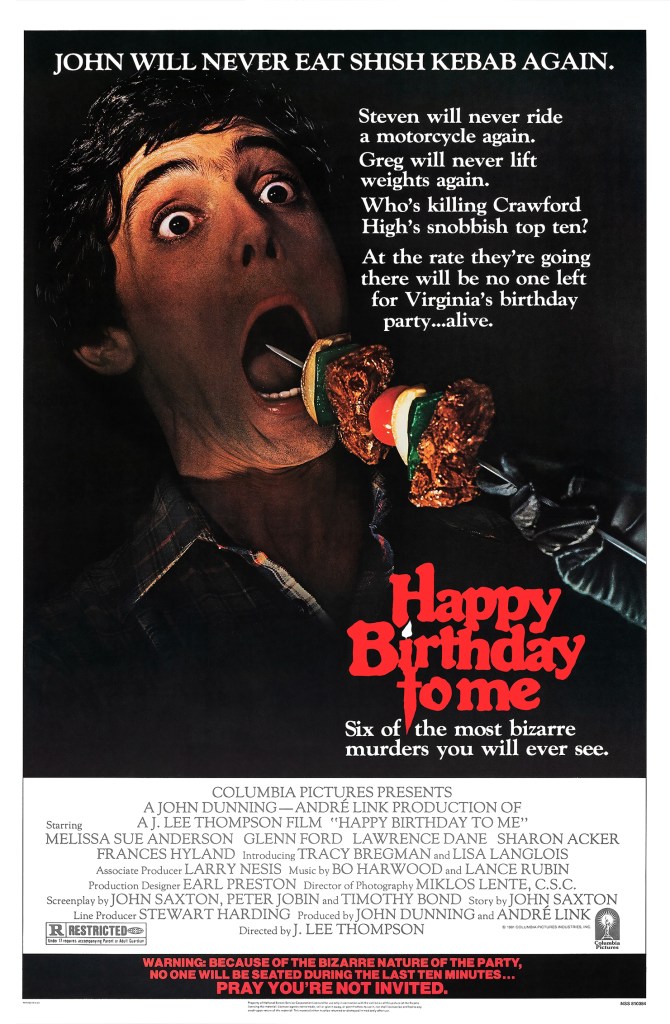
The gore here isn’t too heavy. Certainly there are a few scenes that stand out, such as someone getting skewered with a kebab, or someone getting weights dropped on their throat, or even a few slit throats, but there’s not that much in the way of blood here, which I think is okay. The movie is on the longer side, but I never felt it was lacking from gore, and overall, the special effects are solid.

There’s a psychological element to Happy Birthday to Me that I can’t say I love. The main character, due to a terrible accident some years past, lost some of her memories, and throughout the film, we get some flashes of images as she begins to remember what happened to her and her mother. I can’t exactly say why these elements didn’t do much for me, but it almost felt unnecessary, and the ludicrous nature of the finale didn’t help with this perception.

Overall, I do think that Happy Birthday to Me is a strong movie. I don’t think it’s amazing, but it’s pretty solid. The finale definitely could have been better, though, and if ever a plot twist needed some work, this one did. Still, the film has a good atmosphere and okay gore, along with decent characters (when they deign to focus on them), so though it’s not what I’d call fantastic, I do think it’s a perfectly solid slasher.

7.5/10
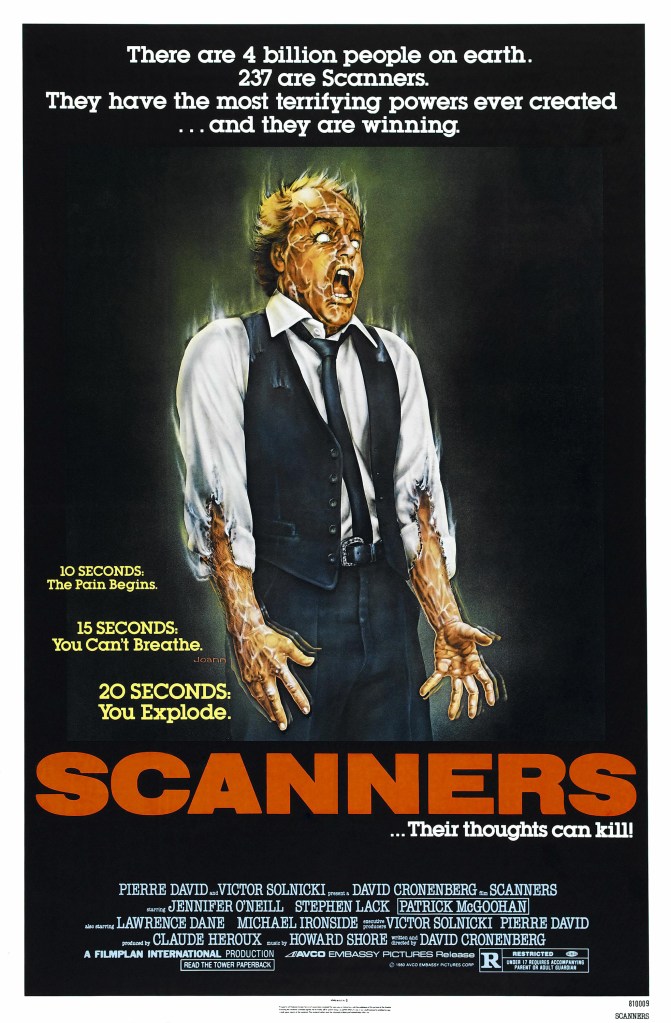
Scanners (1981)

Directed by David Cronenberg [Other horror films: Shivers (1975), Rabid (1977), The Brood (1979), Videodrome (1983), The Dead Zone (1983), The Fly (1986), Dead Ringers (1988), Naked Lunch (1991), eXistenZ (1999), Crimes of the Future (2022), The Shrouds (2024)]

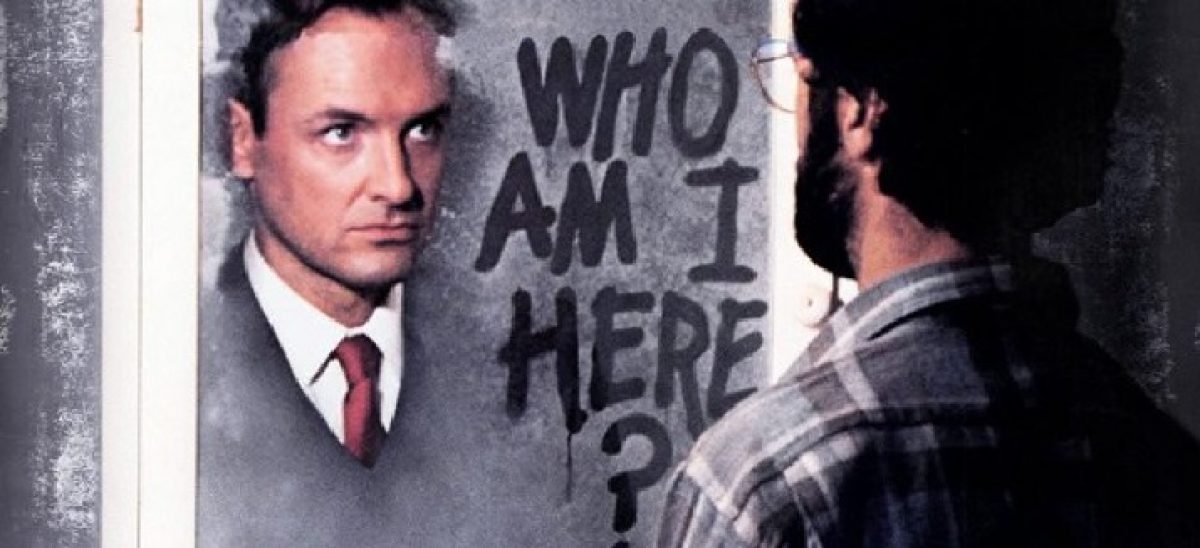
David Cronenberg has always been a director I’ve had a bit of a mixed record with. While it’s true I enjoyed films such as Shivers and Rabid, others, such as The Brood and Videodrome, are ones I found it difficult to dig into. Scanners is a classic I’ve never had the urge to see, partially due to that mixed record, but after having seen it, I do think it’s one of his better films.

By no means, though, do I find it fantastic – it’s a pretty solid story with a wide scope (not dissimilar to Videodrome, albeit infinitely more sensible), quality action sequences, an interesting idea, and, of course, very solid special effects.

I knew the basics of the story going in, and I have to admit to being pleased that I could actually follow everything along. Some of Cronenberg’s films can veer toward the complex, such as Videodrome and The Brood, and while this one does deal with large topics, pretty much everything makes sense, which is a relief (as it was a worry of mine, and one of the reasons I put off watching this for so long).

Admittedly, the horror aspects here are couched heavily in science fiction, which probably isn’t a surprise, but it is worth mentioning. Many of the more action-packed sequences feel like, well, an action movie, or perhaps a thriller, as opposed to horror, and in fact, I think it’s by the quality special effects alone that allow this entry into the genre.

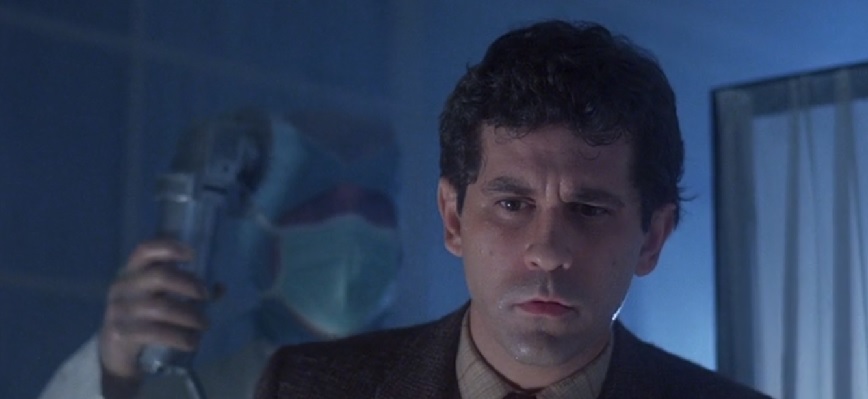
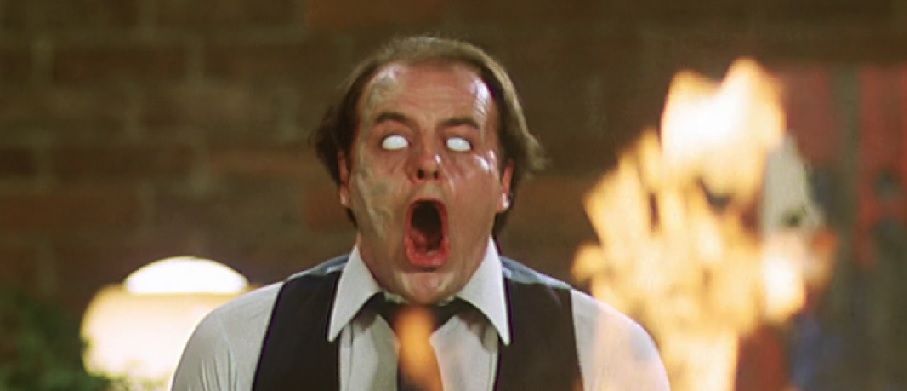
Everyone, and I mean everyone, knows about the scene in which someone’s head explodes. Even before I was born, I knew about the scene, and I think it’s fair to say that even if people don’t realize what movie it’s from, or recognize the name ‘Cronenberg,’ they know the scene too. And it’s a good scene, but what’s great about Scanners is that it’s not even the most gruesome scene – the telepathic duel, of sorts, during the finale was some grisly stuff, and led to a final moment that I rather liked, so there’s some good stuff here.

To be fair, much of the other action tended to be more generic and tame, even scenes that you might expect a bit more from (such as the shotgun massacre). Again, it feels like it’s an action movie at times, which is fine, because it works with the story, but disappointing even so. However, I did really enjoy the computer sequence, in which Stephen Lack’s character scans ConSec’s computers – that was some enjoyable, explosive action.

Somewhat amusingly, I don’t think Stephen Lack is the stand-out here. His performance was decent, but by the nature of his character, he sort of lacked many expressive capabilities. Patrick McGoohan, on the other hand, played a pretty complex character, and while it wasn’t easy to get a read on him, I loved his performance.

As for the other performances worth mentioning, Michael Ironside (Hello Mary Lou: Prom Night II, Visiting Hours, The Next Karate Kid) was solid, though not as in-focus as you might think, Jennifer O’Neill (The Psychic, The Reincarnation of Peter Proud) seemed almost pointless, but otherwise did fine, and Lawrence Dane (Of Unknown Origin, Rituals, The Clown Murders, Happy Birthday to Me) made for a solid character with an exciting end.

I’m surprised that I enjoyed Scanners as much as I did, but it’s certainly a pleasant surprise. It’s not exactly the type of movie I’d generally go out of my way to see, but it was pretty enjoyable at the time, and from the action to the special effects, it’s definitely a movie worth seeing for a nice mix of genres.

7.5/10

Hospital Massacre (1981)

Directed by Boaz Davidson [Other horror films: N/A]

Known in some parts as X-Ray, Hospital Massacre is a serviceable slasher. It does have a bit of a cheap feel, but it also hits most of the notes well enough. I don’t think it’s anywhere near one of the greats, and on the whole, might lean more toward below average, but if you’re a fan of slasher films, it’s at least worth one whirl.

I’ve seen this either once or twice, and I enjoyed it well enough. In part, that’s due to it combining the location of a hospital (as Halloween II and Visiting Hours did) with the holiday of St. Valentine’s Day (My Bloody Valentine). This movie doesn’t feel quite as good as Halloween II or My Bloody Valentine, of course, but it’s at least better than Visiting Hours.

One problem I have with this film is just how aggravating the focal plot is. A woman (Barbi Benton) goes into a hospital to pick up some test results, but a mysterious individual switches the results out, causing the doctors to think that she’s deathly ill. She has no symptoms, but they effectively keep her there against her will, refuse to disclose what they believe is wrong with her, and act as though she’s having seizures when she becomes understandably annoyed.

It’s almost like Bedlam, actually, only nowhere near as dramatic or aggravating, but even so, the fact that none of the doctors even came close to disclosing the results of her tests just bugged the hell out of me. Even if you’re sick, hospitals can’t force you to stay; you can leave without the physician’s approval (the exception, I imagine, being rather contagious diseases). But apparently she didn’t get those rights, and it just bugged me something awful.

Naturally, I appreciate how this movie clearly shows that it’s the good ole’ days. Not only does a character smoke in the hallway of a hospital, but she also smokes in a hospital room as a patient. Never once is she asked to put the cigarette out, and it just goes to show that it really was a different time. Oh, and they were also fumigating a floor, but still had patients on the floor beneath, which also felt rather odd.

Another thing that I sort of liked, while rather unrealistic, was the setting. Being a horror film, the hospital was laughably empty. A woman could go running and screaming down a couple of hallways, and no doctors, nurses, patients, or other administrators seemed to be nearby to ascertain what the nature of her displeasure was. I get it – a lot of slasher movies do this – but it just felt ridiculous. Still, horror films set almost entirely in hospitals, which are creepy places to be even in the best of health, have a charm to them.

This might just be me, but another ridiculous aspect was how every character was treated as a suspect. There’s the ex-husband, who has been playing with a switchblade all day, who is mysteriously missing when Benton’s character calls him. There’s a janitor leering creepily at her. There’s a doctor with some scaples in his drawer, and it’s just all so silly and over-dramatic.

Get this: the killer has heavy breathing, which has been demonstrated throughout the film. When one of the doctors is looking through records, and he hears a noise, using his flashlight, he looks around the dark room (this, on a side-note, is one of the darkest hospitals I’ve seen, and I’ve seen The Power). It’s quiet, until he turns around and – all of the sudden – there’s heavy breathing and a hatchet to his head. Again, while the kill was okay, it just felt silly.

In fact, I’ll give the film credit for decent kills overall, even the final one, which had okay effects. None of the kills are really Tom Savini level, but there’s the hatchet to the head, someone gets drowned in chemicals (reminding me a little of the boiling water in My Bloody Valentine), another gets had with an electric orthopedic saw. There’s a bit of blood splatter, but it’s never really gory. Even so, the kills weren’t half bad.

To be honest, I can’t say any of the performances wowed me. Barbi Benton made for an okay lead, but I never felt that strongly one way or the other about her. Jon Van Ness (Tourist Trap) wasn’t really that important, Charles Lucia (Syngenor) was sort of generic, Jimmy Stathis (The Black Room) virtually pointless. I’ll give you that John Warner Williams has a presence to him, and Bill Errigo (who apparently died in 1988 at the age of 37) could wear a bowtie with the best of them, but otherwise, the cast was just okay.

In the right situation, I think that Hospital Massacre (or X-Ray, if you prefer) would make for a fine viewing. I don’t think it’s special, but I also don’t think it’s that harmful. A bit of the plot set-up does annoy me, but I can also admit that if I were in a different mood, this might come across as a better movie.

For the time being, though, I think I’ll rate it just a bit below average. It’s not bad, but a bit weak in it’s execution, and when you compare it to other slashers from around the same time, I don’t know if it would really stand out that well.

6.5/10

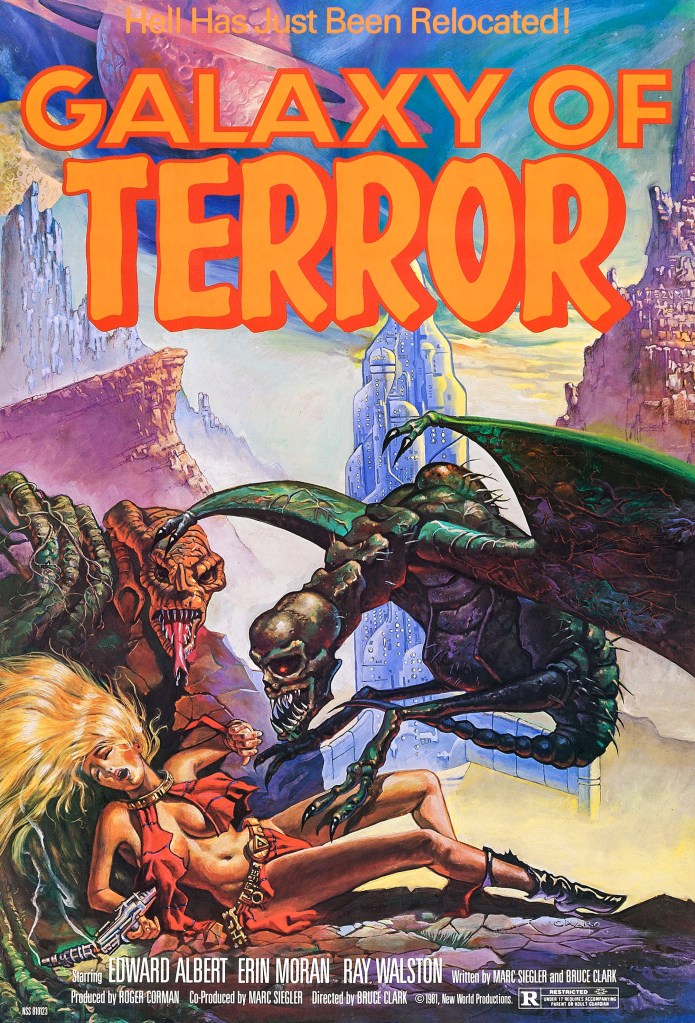
Galaxy of Terror (1981)

Directed by Bruce D. Clark [Other horror films: N/A]

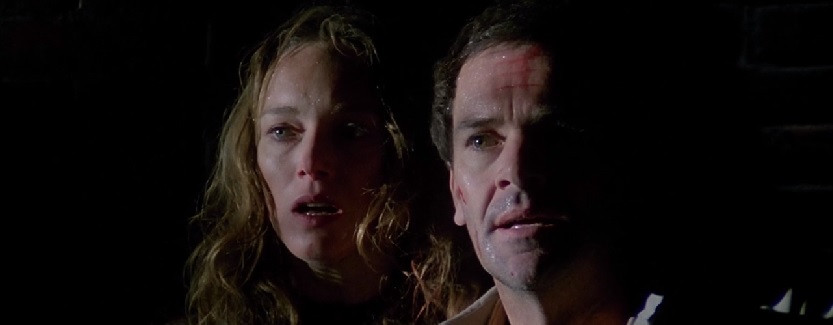
I can’t say that I overall care a lot about Galaxy of Terror, but I do appreciate that it had heart, and while the final product isn’t great, I can dig what they were going for.

Most of the small problems work themselves out. For instance, throwing us headfirst into a strange world with no context and characters with odd names (we have Trantor, Baelon, Cabren, Alluma, Quuhod, Kore, Dameia, Ilvar, Cos, and Ranger) and no real introductions, it can be tough, but after a while, the characters get differentiated nicely, and before long, you can tell a Quuhod from a Dameia in no time.

The larger problem is the conclusion to Galaxy of Terror. It’s unsatisfactory, yes, but more than that, I don’t know how much sense it makes, at least with what I was able to gather. Parts of it, such as the origin of the pyramid, were sort of cool, but other aspects just felt too unexplained.

Aside from the final ten minutes, though, the film is pretty decent. There are some pretty memorable kills: a dismembered arm kills the person it came from with a crystal star, someone has their stomach slit open and is thrown down a rather long chasm, and another poor soul is crushed to death, and it looks like their head explodes. Oh, and there’s also a rather gruesome alien rape scene that I’d rather not think too much about. Truth be told, that’s a scene I could have done without.

The performances were largely solid too. To be honest, I didn’t think too much of Edward Albert (The House Where Evil Dwells, Sea of Fear, Killer Bees, Demon Keeper), but it’s not as though he were a bad lead. It’s just that this film also has Sid Haig (House of 1000 Corpses, A Dead Calling) and Robert Englund (A Nightmare on Elm Street, Kantemir, Eaten Alive), so it’s difficult for Albert to stand out. It could be fairly said that neither Haig nor Englund do much, but I did like’s Haig’s character, as I don’t know many people who live and die by the crystal, and Englund had surprisingly high staying power.

Regardless, those three were among the most memorable, but I also thought Bernard Behrens, Ray Walston (The Stand), Grace Zabriskie and Erin Moran did well. The best of these four would probably be Walston, but I can’t say I loved where his story went, and Behrens was a rather more likable individual.

It’s a shame, really. I went into Galaxy of Terror with the hopes of singing it’s praises. It’s a film I’ve seen before, and I remember it a bit more fondly. I think I probably spaced out toward the end, or perhaps it’s because the movie feels like it should be better. It’s not the earliest space-based horror (even discounting Alien, you have both Planet of the Vampires and It! The Terror from Beyond Space), but it seems to me that it should be one of the funnest, and I just don’t know if it personally hits that level with me.

All-in-all, I didn’t have a bad time revisiting this movie. I really didn’t care for the finale, though, and unfortunately, as okay as the rest of the movie could sometimes be, I think the film falls a bit below average, at least for me.

6/10

…E tu vivrai nel terrore! L’aldilà (1981)

Directed by Lucio Fulci [Other horror films: Una lucertola con la pelle di donna (1971), Non si sevizia un paperino (1972), Il cav. Costante Nicosia demoniaco, ovvero: Dracula in Brianza (1975), Sette note in nero (1977), Zombi 2 (1979), Paura nella città dei morti viventi (1980), Gatto nero (1981), Quella villa accanto al cimitero (1981), Lo squartatore di New York (1982), Manhattan Baby (1982), Murderock – Uccide a passo di danza (1984), Aenigma (1987), Zombi 3 (1988), Il fantasma di Sodoma (1988), Quando Alice ruppe lo specchio (1988), La casa nel tempo (1989), La dolce casa degli orrori (1989), Un gatto nel cervello (1990), Demonia (1990), Hansel e Gretel (1990), Voci dal profondo (1991), Le porte del silenzio (1992)]

Commonly known as The Beyond, Lucio Fulci’s …E tu vivrai nel terrore! L’aldilà is definitely a slice of Italian horror worth seeing, if only for the goriness alone. I don’t personally find it an amazing movie, but it can be decently fun if you’re a fan of Fulci’s work.

I’ve seen The Beyond before, but it’s been a long time. I’ve only seen it the one time, and I can’t quite fathom exactly how long ago that would have been, so coming into this one again was a treat. I was slightly hesitant – when I revisited The House By the Cemetery in recent times, I wasn’t blown away – but this film has more going for it, at least in my eyes.

The story, such as it was, isn’t too bad, dealing with a hotel placed on one of the Seven Gateways of Hell. It’s the second part of Fulci’s Gates of Hell trilogy, sandwiched between City of the Living Dead and The House By the Cemetery. Luckily, there’s not much reason to watch them in order, as they stand alone perfectly fine, and like I said, I found this a bit better than The House By the Cemetery.

For a certainty, it’s not for the plot, which is a bit janky. I mean, let’s be honest, most people don’t come into a Fulci movie for the plot, so that’s not a big problem, and the main point – a woman inherits a hotel, and soon terrifying things start happening – gets across just fine. And since most probably come for the gore, they certainly came to the right place.

It’s hard to say what my favorite scene here was – part of me wants to say either the final scene, which was quite creepy (if not a bit nonsensical), another part when the characters leave the hotel, but in the light, we see plenty of souls through the windows – that scene was shot quite beautifully.

As far as the gore goes, though, I’m a sucker for eyes. So are tarantulas, apparently, as a paralyzed man has one of his eyes punctured and torn from his head by a tarantula. Another one takes a portion of his lip; another, his tongue. As someone with mild arachnophobia, that was a harsh scene. There was also a great shotgun blast to the head, along with someone’s head shoved through a spike, causing, you guessed it, her eye to come out. A woman got her ear and throat torn off by a dog, and a woman’s face got melted by acid. All around, a film for the whole family.

Only two performances come close to mattering, and I’m not sure that they really do, as they don’t really impact much that happens in the film. Catriona MacColl (City of the Living Dead and The House By the Cemetery) was perfectly adequate as the lead, though her character can be a bit of a dick, I feel. David Warbeck (Miami Golem, Rat Man, and The Black Cat) was more well-rounded, but his character also wasted a lot of bullets in the last twenty minutes, so I can’t love him too much.

Speaking of which, the final twenty minutes of this one does contain an all-out zombie attack. To be honest, I forgot that happened in this film, but the zombies themselves (while not looking particularly great – Burial Ground zombies were totally more awesome) were appropriately creepy, and it led to a solid finale. Also, the score in this one was fantastic – that piano theme (as sampled in Necro’s “As Deadly As Can Be”) was simply gorgeous – so I can’t be too unhappy.

And that’s really how I feel about the movie as a whole – it was an enjoyable rewatch. It’s not my favorite Fulci movie, as both Don’t Torture a Duckling and The New York Ripper exist, but it is a fun slice of supernatural and zombie horror.

7.5/10

Dark Night of the Scarecrow (1981)

Directed by Frank De Felitta [Other horror films: Trapped (1973)]

Easily among one of the finest made-for-television horror movies I’ve seen, Dark Night of the Scarecrow has a strong reputation, and for good reason, as it’s a fantastically-made and suspenseful film.

Not only that, but it’s rather emotional, in a tragic way. In fact, the first 25 minutes of the film have to be among the most emotional sequences in a movie, as a mentally-challenged man is killed by four vigilantes, but these good ole’ boys lie about the circumstances, and in an affront to justice, are released from police custody.

Luckily, the movie becomes far more wholesome from there, as they start being killed off in mysterious circumstances, possibly by a charming scarecrow chap.

The casting of this movie is great. Playing the four murderers are Charles Durning (Sisters and When a Stranger Calls), Robert F. Lyons (The Strange Possession of Mrs. Oliver), Lane Smith (Prison), and Claude Earl Jones (Bride of Re-Animator), and all four do a great job. I don’t think Lane Smith gets a whole lot of time to make an impression, but he does well with what time he has, and the other three, especially both Jones and Durning, were a lot of fun.

Larry Drake (Dr. Giggles) did an amazing job playing Bubba, the mentally-handicapped man killed at the beginning. He was a likable character, and it was just depressing to see him killed how he was, especially since he was innocent of any wrong-doing whatsoever. Playing his mother was Jocelyn Brando, who did a fantastic job with an emotional role. Tonya Crowe, who played a friend of Bubba’s, did really well also, which is something I don’t generally say when it comes to younger performances.

Being a television movie, there’s nothing in the way of gore, but the suspense makes it so that such doesn’t matter. The way some of these individuals die is gruesome enough even without seeing the aftermath – one guy falls into woodchipper, another drowns in grain in a silo (worst hiding place ever, on a side-note), and another almost gets ran down by a plowing machine, only to run into the business end of a pitchfork.

Oh, as for the scarecrow? This is the first scarecrow-centric horror film, but the scarecrow barely appears at all, save for the final minute or so. Personally, I’ve never minded this, as it gives a sort of psychological feeling to the movie – are the men really being killed by a scarecrow, or is it related to a manifestation of the guilt they feel? – though I, of course, love the final scene. Another favorite scarecrow film of mine, Scarecrows, certainly makes up for the perceived lack of straw bois in this one, should that be a concern.

Dark Night of the Scarecrow is a classic, and I think that most in the horror community know that. I know that in the past, I’ve thought the movie was a bit sluggish, but seeing it again, I was enjoying every moment, so if you want an idea of made-for-TV horror done right, then this is a movie I highly recommend you view.

8/10

Die Säge des Todes (1981)

Directed by Jesús Franco [Other horror films: Gritos en la noche (1962), La mano de un hombre muerto (1962), El secreto del Dr. Orloff (1964), Miss Muerte (1966), Necronomicon – Geträumte Sünden (1968), The Blood of Fu Manchu (1968), Der heiße Tod (1969), Marquis de Sade: Justine (1969), The Castle of Fu Manchu (1969), Paroxismus (1969), De Sade 70 (1970), Il trono di fuoco (1970), Nachts, wenn Dracula erwacht (1970), Les cauchemars naissent la nuit (1970), Vampyros Lesbos (1971), Sie tötete in Ekstase (1971), Jungfrauen-Report (1972), Drácula contra Frankenstein (1972), Der Todesrächer von Soho (1972), La fille de Dracula (1972), Dr. M schlägt zu (1972), Les démons (1973), La comtesse noire (1973), La maldición de Frankenstein (1973), La nuit des étoiles filantes (1973), Los ojos siniestros del doctor Orloff (1973), Al otro lado del espejo (1973), La noche de los asesinos (1974), Les possédées du diable (1974), La comtesse perverse (1974), Les gloutonnes (1975), L’éventreur de Notre-Dame (1975), Sexorcismes (1975), Frauengefängnis (1976), Jack the Ripper (1976), Un silencio de tumba (1976), In 80 Betten um die Welt (1976), Die Marquise von Sade (1976), Greta – Haus ohne Männer (1977), Die Liebesbriefe einer portugiesischen Nonne (1977), Die teuflischen Schwestern (1977), Der Ruf der blonden Göttin (1977), El sádico de Notre-Dame (1979), Mondo cannibale (1980), El caníbal (1980), La tumba de los muertos vivientes (1982), La mansión de los muertos vivientes (1982), Revenge in the House of Usher (1983), El tesoro de la diosa blanca (1983), Macumba sexual (1983), Sola ante el terror (1983), Sangre en mis zapatos (1983), Mil sexos tiene la noche (1984), El siniestro doctor Orloff (1984), Lilian (la virgen pervertida) (1984), La esclava blanca (1985), Faceless (1987), Killer Barbys (1996), Tender Flesh (1997), Mari-Cookie and the Killer Tarantula (1998), Lust for Frankenstein (1998), Vampire Blues (1999), Dr. Wong’s Virtual Hell (1999), Helter Skelter (2000), Vampire Junction (2001), Incubus (2002), Killer Barbys vs. Dracula (2002), Snakewoman (2005), La cripta de las mujeres malditas (2008), La cripta de las mujeres malditas II (2008), La cripta de las condenadas (2012), La cripta de las condenadas: Parte II (2012)]

Commonly known under the title Bloody Moon, Die Säge des Todes is a tedious film. Aspects of it are worth seeing, such as the generally decent kills, but boy, do the plot and characters really grate on me after a time.

There are so many plot issues that it’s hard to fully delve into. For instance, a young woman is running and screaming that a killer is after her, and her friends laugh it off. Or that same girl running from the killer again, only to see a silhouette figure in front of her – she should know it’s not the killer, as, well, the killer is behind her. So you would think she would run to the figure for potential safety.

She doesn’t.

So part of the issue is that the central character, Angela (played by Olivia Pascal) very quickly becomes hysterical at everything. She sees a friend get murdered, but when she tries to show someone else the body, it disappears, so for a time, she was convinced she was dreaming. She spends much of the next day searching for the murdered girl. Then someone saves her from a snake, but because she didn’t see the snake, only a bloody pair of shears, she’s convinced that guy is the murderer.

My point is that it doesn’t take long for this character to become scared and suspicious of every little thing, and it sort of gets old, especially when it leads to terrible, illogical decisions that keep happening throughout the movie. It’s hard to state just how many times in the movie I was bothered by plot points like this, and that goes a long way to making this not as fun an experience as you might hope.

I can’t hold that too much against Olivia Pascal. I’m sure she did what she had to do with her role. Nadja Gerganoff was a more interesting character, but we never really get to understand that much about her. It’s similar with Christoph Moosbrugger, and while Peter Exacoustos’ character was perhaps one of the most sensible in the movie, even he made more mistakes than you’d hope for.

Obviously, this isn’t a problem with this movie alone, as plenty of horror films have characters that make bad decisions. It just seemed so much more prominent here, and it’s quite possible that wasn’t helped by shoddy dialogue and a somewhat poor dubbing job. On the plus side, the setting of this movie is rather beautiful. I’m not sure where this was filmed, but it had a unique look to it, and the scenes on the dock were quite lovely.

What the film tries, and mostly succeeds, in doing right would be the kills. Centerpiece among them, I’d argue, would be the decapitation of someone with a saw blade (and in fact, the original title of this film translates to Saw of Death). It looked excruciatingly fake, but that’s half the fun. Someone was stabbed through the neck, another stabbed through the chest, and even another killed with a power saw (or at least that’s what I think it is – think an ultra-thin chainsaw). The kills here are decent, and if that’s your main interest, then Bloody Moon is worth seeing.

And personally, this is a movie that I’ve wanted to see for a long time. Being a Jesús Franco movie, I wasn’t necessarily expecting much, and ultimately, I may have ended up enjoying it about as much as I thought I would. Because of plot elements and characters that drove me up the wall (not to mention the least-surprising ending I’ve ever seen in a movie), it’s not a film I liked that much, but at least for the gory elements, it’s worth experiencing once.

6/10

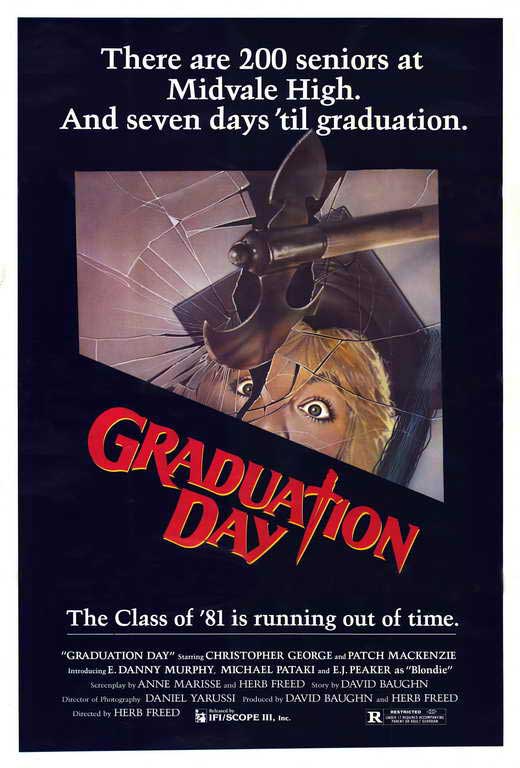
Graduation Day (1981)

Directed by Herb Freed [Other horror films: Haunts (1976), Beyond Evil (1980)]

When I first saw Graduation Day, I found it underwhelming, but quickly forgot about it. I can’t say that I’ll remember it much better with this revisit, but I can at least say that it’s somewhat watchable, though far from a good movie.

One thing I did particularly enjoy about this one is the sheer amount of potential suspects. There’s a lot of characters here, and while the answer to who’s behind the killings isn’t an overly creative one, at least they had potential to do more with it.

What’s mildly more impressive is the amount of performances that I actually liked. It’s not just Christopher George (Pieces, Mortuary, and City of the Living Dead) and Patch Mackenzie (who was kick-ass in her moderately short screen-time); we get some decent acting from E.J. Peaker, Michael Pataki (of Grave of the Vampire; also worth mentioning, one of his scenes just cracked me up), Denise Cheshire, all along with a semi-early appearance of Linnea Quigley (Night of the Demons, Silent Night, Deadly Night, The Return of the Living Dead, and hundreds of others). It’s true that E. Danny Murphy’s performance falters at times, but even so, he was still at least okay.

Also, somewhat surprisingly, some of the sequences here were filmed in somewhat interesting ways. The first five minutes of the movie seem like some sports documentary, what with all of these impressive sporty things (pole vaulting, track-and-field type stuff) and concluding with a traumatic death during a run. There’s also a few other scenes, such as Cheshire’s character doing bar-hopping (I’m not remotely a sports guy – there’s these two elevated bars, and she’s jumping from one to the other in impressive fashion) or a juxtaposition toward the end of Mackenzie’s character running from danger to the opening death of her character’s sister. These are just small touches, but they do feel special, especially in comparison to the rest of this movie.

What isn’t impressive, and this is certainly problematic, are the kills. While there’s a decent body count, there are only three kills I’d personally label decent, and one is just barely counted, being a somewhat weak decapitation. There was a character stabbed through the throat with a fencing sword, though, that looked pretty decent, and another character who practices some pole vaulting and lands on some cleverly-placed spikes. None of the kills here are great, though, which is a damn shame, as the movie did have some things going in other departments.

Another problem is that the film, at an hour and 36 minutes, does occasionally feel padded. This might not have mattered had some of the kills been done better, or maybe less time was spent on red herrings (though I do personally love the cop who hides a joint in the barrel of his service weapon – quality guy), but as it stands, it just felt like it was dragging at times.

All-in-all, Graduation Day wasn’t a bad time. It wasn’t a great time, or even that good, but it was fine for a lower-budget Troma-released slasher. If you’re a slasher fan, I’d recommend giving it one viewing, but for most people, this isn’t something I’d really recommend them taking the time to see.

6/10

The Evil Dead (1981)

Directed by Sam Raimi [Other horror films: It’s Murder! (1977), Crimewave (1985), Evil Dead II (1987), Army of Darkness (1992), The Gift (2000), Drag Me to Hell (2009)]

Probably one of horror fandom’s more beloved movies, The Evil Dead succeeds in possessing a strong atmosphere and special effects that go beyond, far beyond, expectations. So of course, in typical Jiggy fashion, it’s never been a movie I’ve ever been overly fond of.

Which isn’t to say that it’s not okay. I could sort of see myself watching this one every couple of years (though at what point in my life I’ll be revisiting a movie that often, I really couldn’t say), and it definitely has enough going for it to be a movie that horror fans should at least give a shot once, but from the first time I saw it, it’s never been my particular cup of tea.

Part of this (and an admittedly small part) might be because, while I find Ash’s character development sort of interesting, he’s not a character that really stands out to me. Sure, he seems the everyman that you’d expect, sometimes too scared in tense situations to jump into action (I certainly can’t blame him there), but even when he really starts fighting back (about an hour or so into the movie), I just don’t feel much in the way of interest for him.

Another thing is that while this movie is primarily a dark story of demonic forces possessing and thus torturing the last remaining character, there are some occasional lighter elements thrown in (the demonic mocking, over-the-top violence at times). Now, this is upped to 11 in the second film, but the amusing thing is that it felt more consistent in the second movie, and I personally find myself gravitating more toward that one than I ever did this.

But like I said, none of this is to say the movie is by any means bad. It’s obviously a film that has a place in the heart of a lot of people, and I certainly respect what Raimi and Campbell were able to due with a limited budget (those gore scenes themselves, from the pencil stabbing to the epic finale, were well-worth watching the movie for), and again, the atmosphere is great.

As for the cast, the only name that really need be mentioned is Bruce Campbell, who starts off as a pretty unassuming character but, of course, over the course of the film becomes more willing to stand up and fight. Campbell was in a variety of films after this point (such as Maniac Cop, Moontrap, and Sundown: The Vampire in Retreat), and you can see why. If there was anyone else who might deserve a mention, it’d be Ellen Sandweiss, who was my personal favorite character, and it’s a shame she went the way she did (especially after that tree rape).

And speaking of that tree rape, what a disturbing scene. It’s not even all that explicit (though it does provide one of the two scenes of nudity in the film), but it is a scene that stands out and probably remains one of the more unforgettable sequences of the film.

I do admit to finding the ending a bit of a cop-out, but I won’t deny that it has an element of charm to it. Which can really be said for the whole of the film – though it’s not and never has been a movie I really cared for, it’s still charming, and it does enough right to merit it’s status. It’s just that The Evil Dead doesn’t do near as much for me as it does so many others.

6.5/10

The Burning (1981)

Directed by Tony Maylam [Other horror films: The Sins of Dorian Gray (1983), Split Second (1992)]

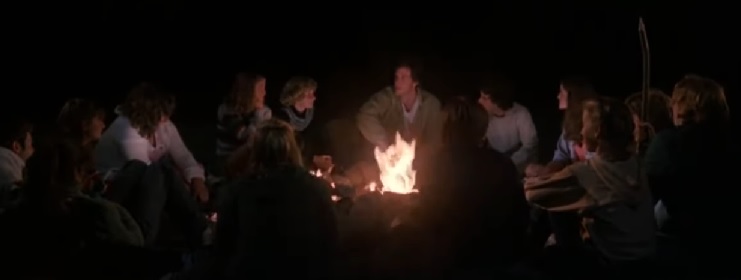
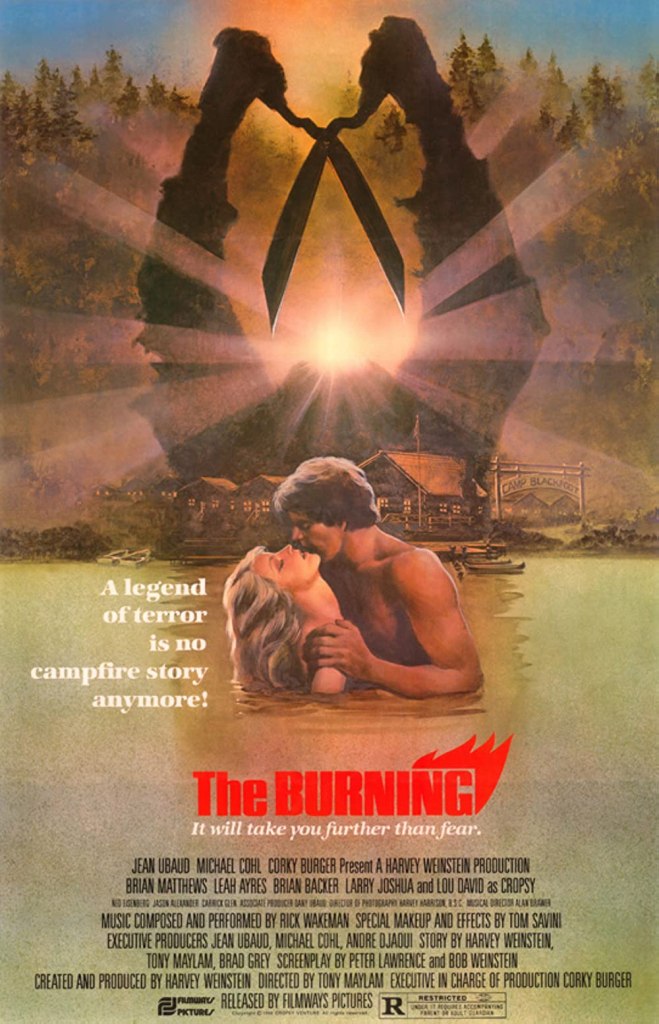
For a long time, this has often been one of the first slashers I recommend when asked by someone who doesn’t have a background in 80’s classics, as I’ve always found The Burning a very solid film. I still do, and though it may not be spectacular, it’s very much worth a look.

It has that classic slasher feel that fans of 80’s horror would love – a pretty solid opening origin, memorable special effects (that raft scene is the most referenced sequence in this film for a reason), and a pretty good antagonist in Cropsy (and Cropsy’s choice of weapon – garden shears – was inspired).

To an extent, I do think many performances are of the more forgettable variety. True, Dave (Jason Alexander, known mostly for a long-running role on Seinfeld) was pretty solid, defending both Alfred (Brian Backer) and Woodstock (Fisher Stevens) on multiple occasions. Glazer (Larry Joshua) definitely feels like a dickish bully (I love how he tries to drown Alfred, and flaunts it to the girls on the raft), and Alfred (who amusingly reminds me of a younger David Krumholtz) is okay in his own awkward way, but everyone else is either undercooked or merely average.

Admittedly, I did like Todd (Brian Matthews), but I don’t know if he stands out that well, and it’s the same with a lot of the women, such as Michelle (Leah Ayres) and Karen (Carolyn Houlihan, who graces us with one of the few nude scenes in the film). I wish I could have liked Eddy (Ned Eisenberg) a bit more, and I wish we had more scenes with Tiger (Shelley Bruce) and Sally (Carrick Glenn, who gave us a quick nude shower scene), so there was some room for improvement.

The raft scene in the film is great, with quality tensions and fantastic special effects, with fingers being cut off and the like. It’s easy to see why it stands out – while the other kills are decent, Cropsy’s massacre of five, what with the cinematography, was glorious (and of course, a lot of credit also goes to Tom Savini). This said, the ax to the face at the end is quite good also.

It might also go without saying, but the music – a sort of funky electronic style that wouldn’t feel out of place in an Italian film – is on point, especially during the opening credits.

As far as camp-based slashers, The Burning doesn’t reinvent the wheel by any means. I always enjoyed it more than Madman, but it doesn’t have the same pull as many of the Friday the 13th films. Still, it’s a solidly-made slasher that hits many of the right spots, and is definitely worth a watch if you’re a fan of classic slasher films.

7.5/10

This is one of the films covered on Fight Evil’s podcast. Listen below as Chucky (@ChuckyFE) and I discuss this classic slasher.