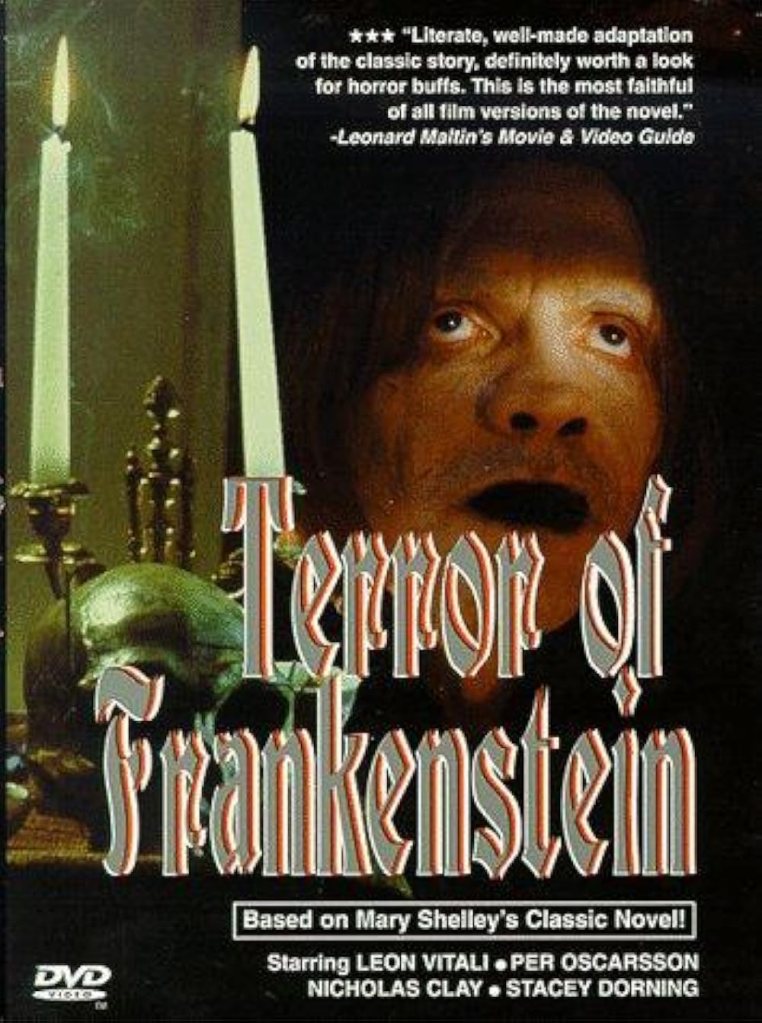
Victor Frankenstein (1977)

Directed by Calvin Floyd [Other horror films: Vem var Dracula? (1974), The Sleep of Death (1980)]

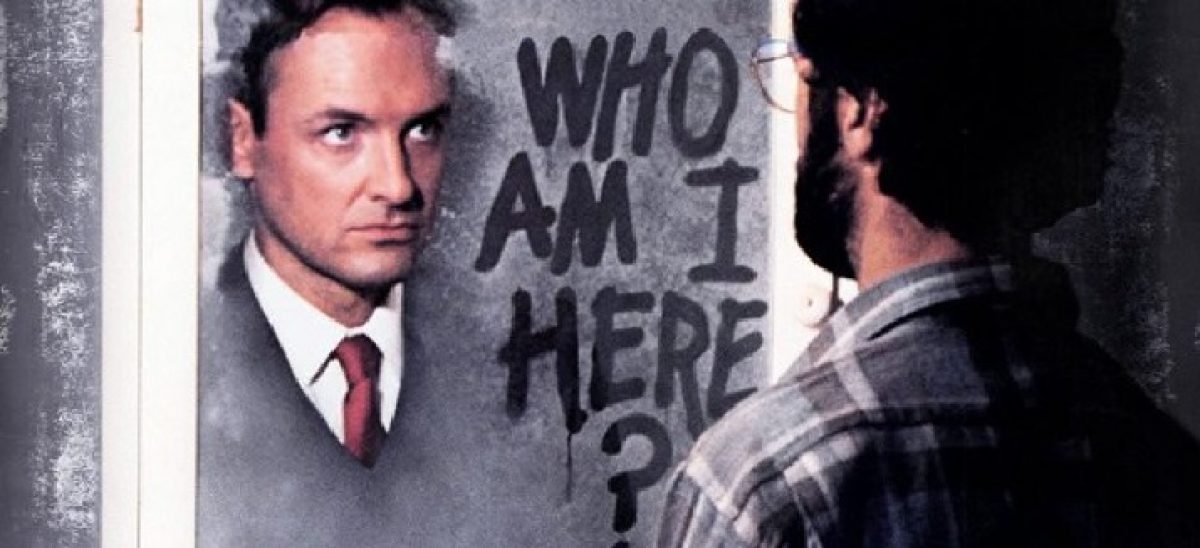
More than anything, Victor Frankenstein feels like a television movie, portraying the events of Mary Shelly’s novel as accurately as possible. Certainly that’s an admirable goal, but it’s also true that the movie just feels a tad too stagey to make a great impact.

I should note, though, that when I say Victor Frankenstein (or, as it’s sometimes better known, Terror of Frankenstein) attempts to accurately follow the original story, I’ve not actually read the original story. Bits and pieces, perhaps, but when it comes to early horror or gothic literature, I’m woefully ill-equipped. Still, I’ve heard that this is among one of the more accurate movies out there, and I’ll take their words for it.

If your only experience with Frankenstein is the 1931 Universal classic, or perhaps the 1957 Hammer edition, then I think you’ll find this quite a bit different. The structure is largely the same – a young man attempts to discover the secret of life, and his experiments go awry – but where the differences develop become clear in the Creature.

Here, Frankenstein’s Monster is capable of developed speech. He can hold conversations, hold awareness of his surroundings, and even plot revenge. In fact, there’s a sequence in the film where the Creature is explaining to Victor Frankenstein about his experiences after being brought to life. After the story (which is told in a 15 minutes or so flashback), he tells Frankenstein that he wants him to make him a woman, so he won’t be so lonely.

And here’s the kicker – the Creature straight-up blackmails Frankenstein. If Frankenstein doesn’t consent to make him a mate, the Creature says that he’ll kill all of Frankenstein’s family and friends, one-by-one. That is a promise that he holds onto pretty well, too.

So what we have is a Creature who generally seems pretty human-like. Sure, he has black lips and a dead face, but he can hold conversations, can plot revenge, can blackmail, and can generally tend to his needs. In fact, toward the end, he even gets a bit philosophical, in what has to be among the best lines of the film (“When the world was new to me, I would have wept to die. Now death is my only consolation, because in death, I cease to be a monster and a man.”)

Per Oscarsson (Traumstadt, The Night Visitor, The Sleep of Death) plays a fascinating version of the Creature. It’s not something I’m used to, but I can appreciate it here. Leon Vitali does great as Victor Frankenstein, an amoral young man far more interested in discovery than his love interest, played by Stacy Dorning. I also liked Nicholas Clay (The Night Digger) here, especially toward the beginning, where his friendship with Frankenstein was most fully on display.

In terms of scares, it probably doesn’t surprise many to learn that they’re somewhat scarce and spread out, when they do make an appearance. We see a young boy killed, but perhaps the best sequence is a somewhat tense scene focusing on a mountain climber who runs amok of the Creature.

I highly doubt Victor Frankenstein (or Terror of Frankenstein, should you prefer) will be long in my memory as a movie, but as a rendition of the Creature, I do think that this film will make a lasting impression. It wasn’t exactly a fun time, but I enjoyed how the story was framed. Still, it felt quite stagey, and while impressive on some levels, and certainly worth a look if you’re into the original novel, it wasn’t entirely my thing.

6/10

Tentacoli (1977)

Directed by Ovidio G. Assonitis [Other horror films: Chi sei? (1974), There Was a Little Girl (1981), Piranha Part Two: The Spawning (1982)]

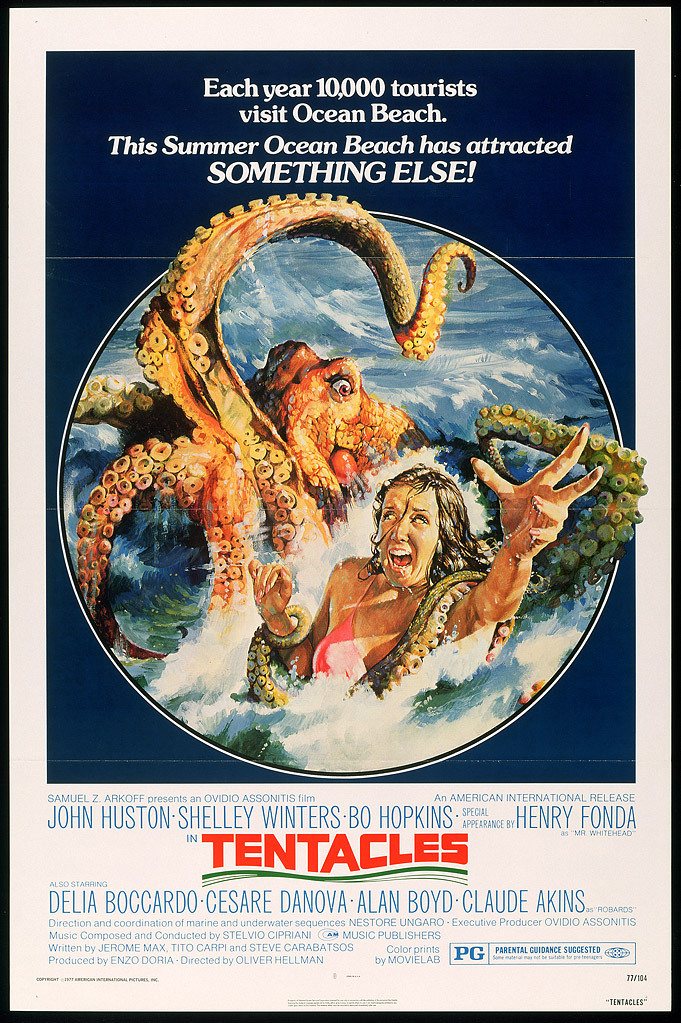
Commonly known in the USA as Tentacles, Tentacoli is a movie that could have been better. As it is, it’s not a bad time, but it can be a bit dry, and perhaps there’s not enough action to bolster it.

I first heard of this film in a rather unconventional way. See, I’m a big music guy – I listen to pretty much everything (save blues and jazz), and some of what I listen to is quite out of the mainstream. There’s a band called Tentacle PornMonster, sort of a pornogrind/goregrind mix, and their song ‘The End Of The Tentacle Orgy On The Beach’ starts off with a trailer for this movie, finishing off with calling it the ‘most gripping suspense you will ever experience.’

Since that point, I’ve wanted to see it, and some years later, I did. I can’t really remember much about what I thought about Tentacoli the first time I saw it – certainly I recall the regatta sequence – but while I find it a decent time, I can’t say that there weren’t quite a few times when the film wasn’t that engaging.

There’s no doubt in my mind the best scene is the aforementioned junior regatta. A bunch of young kids go out on a yacht race, but something else (and by ‘something else,’ I mean a giant octopus, not Marjean Holden) wants to join in on the festivities. It’s a good sequence from the beginning parade with the jaunty music to the flash-freezes used throughout, followed by the action in the water and the tragic premature conclusion of the regatta. It’s good stuff.

Another thing I really enjoyed about this was the music. There was a bunch of funky music throughout the film – it was sometimes suspenseful, it was sometimes jaunty – and it was always fun. I’m not sure why Italy’s movies of the 1970’s and 1980’s has more noticeable music than the United States counterparts, but in my personal view, they do.

Bo Hopkins (Night Shadows, Sweet Sixteen, A Crack in the Floor) was pretty good. I liked his relationship with the whales, and in fact, his little speech to the whales toward the end was pretty emotional. John Huston (The Visitor) was fun, though he doesn’t really have anything to do in the latter portions of the film. Henry Fonda was okay, but his character never got the comeuppance he was due, not by a long shot.

Others, such as Delia Boccardo (A Black Ribbon for Deborah), Claude Akins (The Norliss Tapes, Monster in the Closet, Where Evil Lives, The Curse, Tarantulas: The Deadly Cargo), and Shelley Winters (Poor Pretty Eddie, The Mad Room, Whoever Slew Auntie Roo?, The Initiation of Sarah, The Devil’s Daughter) all did decent, but none of them added that much to the movie as a whole.

I think the biggest problem with this, aside from it sometimes being a bit dull, is that the finale, the final battle between the giant octopus and two killer whales, just isn’t that engaging at all. I mean, it’s about five minutes of them fighting underwater (as one can expect) while Hopkins’ character tries to escape the fray and survive. It just wasn’t an interesting finale, and I think it probably could have been done better.

Naturally, this is, in many ways, a rip-off of Jaws, but in typical Jiggy fashion, I do tend to enjoy it more. Partially, as I mentioned in It Came from Beneath the Sea, it’s due to the fact I enjoy octopi, and the octopus here was pretty fun when he popped up.

Even so, I can’t say the movie is great. It’s entertaining at times, but other times it can be a bit of a struggle to sit through, and the fact it’s an hour and 42 minutes doesn’t help matters. Some sequences were really fun, such as the regatta, but overall, I tend to find this around average.

7/10

Death Bed: The Bed That Eats (1977)

Directed by George Barry [Other horror films: N/A]

Having seen this oddity once before, I was looking forward to revisiting this one. I had to anyway, of course, but I wanted to see if this was as odd as I remembered it being. And certainly, after seeing it with fresh eyes, I can say that it is.

Most horror fans probably know the story behind this movie. After being filmed, the director George Barry wasn’t able to get it distributed or released on video, but a bootleg VHS was created, and it wasn’t until 2001 that Barry found out that anyone save him and those involved in the movie knew this existed. It finally made it onto DVD officially in 2003, and the rest is history.

Death Bed: The Bed That Eats might sound, based on the title, to be a goofy movie, but I don’t really think that’s the case. There are some mildly amusing parts, or some pieces of dialogue that are sort of funny, but there’s very little in here that seems to actually be played for laughs. Really, as ludicrous as the plot is, the movie feels more fantasy than it does comedy.

The reason for that, of course, being that one of the characters in the film is sort of the spirit of one of the bed’s victims who is trapped in a painting. He witnesses all of the atrocities the bed comments, and through his narration, we learn of the bed’s creation and history, with a particularly dry segment detailing some of the bed’s previous victims.

Of course, he’s not the only narrator in this movie. There’s a lot of internal first-person monologue here, which might not be a surprise, given it’s a 70’s film (Let’s Scare Jessica to Death did the same thing), but I almost feel there’s more internal monologue than there is actual conversations here. It’s an odd way to make a film, but given the story this has, which is somewhat bare-bones, perhaps it makes sense.

Only five performances matter here, and that may be a stretch. While the man trapped in the painting is played by Dave Marsh, his monologue is voiced by Patrick Spence-Thomas. Spence-Thomas has a dramatic delivery that adds to the amusement, though much of it may not be intended (‘You [potential victims] gaze at me as a painting on the wall, and I see you as a serving upon some monstrous silver platter’). Even so, it’s good stuff.

Most of the characters, played by Rosa Luxemburg (no, not the revolutionary socialist and Marxist philosopher), Julie Ritter, Demene Hall, and William Russ (Dead of Winter), weren’t really that important. I mean, Luxemburg’s was, but either way, none of them got a whole lot of what you’d actually call character.

Even so, this is a mildly fascinating movie. It’s digestible (see what I did there?), and the special effects can sort of be cool. See, when the bed consumes something, it sort of takes it into it’s digestive fluids. Perhaps one of the more memorable scenes is a man who’s hands get dissolved to the bone before he’s able to pull them out of the bed. There’s also a whole dreamlike atmosphere that permeates much of the movie, which makes sense, as the idea of this film apparently came from a dream of the director.

Those effects paired with the fantasy-feel of the narration and whole of the story make for a rather different movie. It’s not a good one, but it definitely feels unique, and related, totally 70’s. I can’t say it’s a movie I’d watch too often, but it is a somewhat wild ride that should be seen to be believed.

6/10

Orca (1977)

Directed by Michael Anderson [Other horror films: Dominique (1979), Murder by Phone (1982)]

I’ve seen Orca once before, and found it a pretty solid experience. Seeing it again confirms that. While I wouldn’t call the movie great, I would argue it possesses a pretty solid story, and even more, a primal example of man versus nature.

Naturally, I have to applaud Richard Harris (Silent Tongue), who starts off as a rough, unlikable character, only to grow into a man accepting of his own fate. It’s a very solid transformation, and Harris does a great job with it. Doing some scant narration is Charlotte Rampling’s (Angel Heart, Asylum) character, which provides a good atmosphere for this. While admittedly a stereotypical portrayal of a Native American, Will Sampson (Poltergeist II: The Other Side) does well too, though I was somewhat surprised by his character near the end.

Smaller roles are provided by Peter Hooten (Night Killer), Robert Carradine (I Saw What You Did, Slumber Party Slaughter, 1996’s Humanoids from the Deep, Attack of the Sabretooth, Massacre at Central High), Bo Derek, and Keenan Wynn (The Devil’s Rain, Piranha, The Dark). Hooten probably stands out most among all of these performances, and he does become an intense character come the finale.

The story is one of pure revenge – off the coast of a small village in Nova Scotia, Harris’ character accidentally slaughters an orca’s mate and child, and because orcas have an intelligence near that of humans, it seeks it’s revenge. I don’t know the science behind that, but I do know the revenge was solid – the orca destroys other ships in the small, coastal town this takes place in, blows up what looks to be some type of power plant, even decimates Harris’ house and eats the leg off one of his subboardanants. It’s a quality time.

Actually, I forgot how long it took to get to the finale that I remembered – Harris’ character sailing north, following the Orca to the end of the earth (well, perhaps not that far, but there were plenty of icebergs in the water, and it sure looked mighty cold) – not that I’m complaining. The build-up was a bit slow, but all of it was fun. At least to watch, that is, as the movie had (as many 70’s movies do), a rather somber feel to it.

More than that, though, I was fascinated by the finale. I was when I first saw the movie, and I still am. Seemingly giving into the killer whale, Harris and his crew follow the whale as its leads them further and further north. Even the sequence they begin sailing out is great, as the townspeople are crowded on the docks, watching his boat sail off.

It has a really inevitable feeling to it. Ever since Harris truly understood the atrocity of his actions, I think he knew that he didn’t really have much of a choice but pit himself against the whale, especially given what we learn about his character’s background. In some ways, it’s a good character study, and though I’ve only seen this movie twice now, I doubt that I’ll ever forget the finale to this one.

Most of the violence is what you might expect from aquatic horror. A couple of people get consumed by a killer whale, a character gets one of their legs torn off, someone dies due to being buried by falling ice. Well, that last one might not be the first thing that comes to mind, but you get my drift. Sure, some people call this one of the many rip-offs following Jaws, but as I enjoy this more, and find it far more digestible, I can only say that the action here is all pretty top-notch.

I enjoyed Orca when I first saw it, and I enjoy it still. It’s not an overly special movie, but it is a very solid movie, and despite the reputation this has in some people’s minds, I personally think it has a lot to offer.

8/10

Shock Waves (1977)

Directed by Ken Wiederhorn [Other horror films: Eyes of a Stranger (1981), Dark Tower (1987), Return of the Living Dead: Part II (1988)]

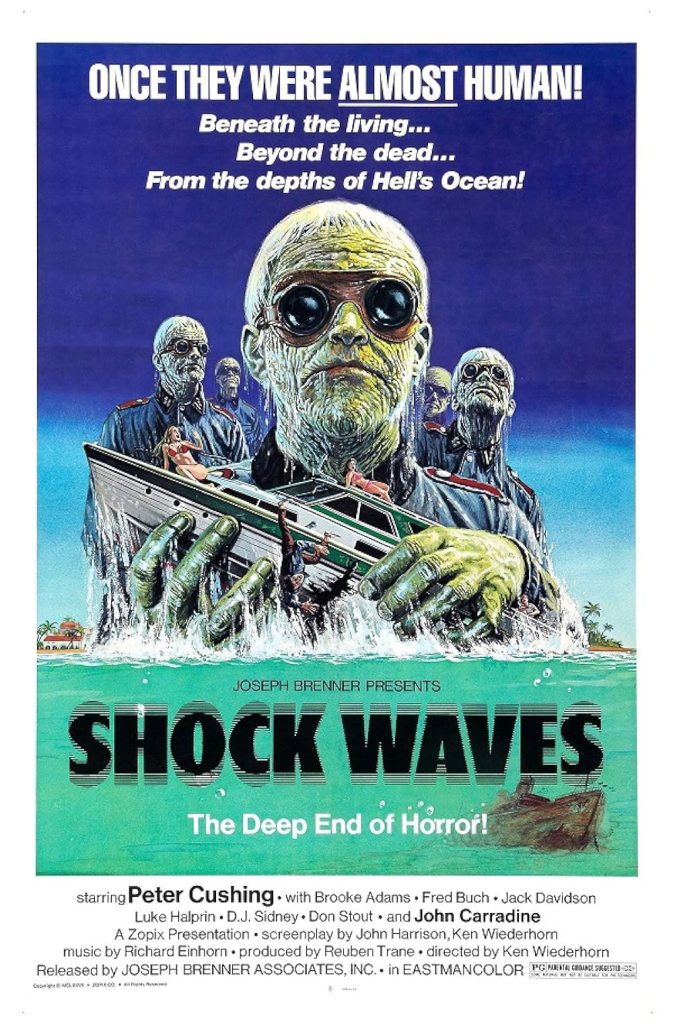
I’ve known about Shock Waves for over ten years now, and I’ve heard generally good things about it in that time. After seeing it, though, I think it’s at best okay, and I don’t personally know if it’s really a movie that will really stand out in the long run.

Like some 70’s movies, Shock Waves does move a bit sluggishly. That said, while most of the action isn’t going on until the final half hour, it’s a pretty atmospheric, and somewhat bleak, movie. It’s somber, and feels totally like the 1970’s atmosphere that I tend to expect.

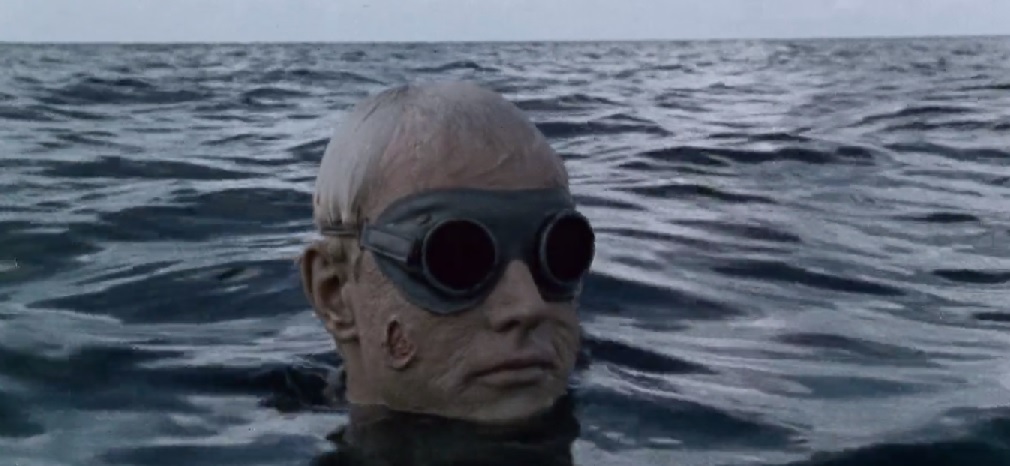
Despite having Nazi zombies, I don’t think that this movie has quite the character of other 70’s zombie films, such as Tombs of the Blind Dead, Let Sleeping Corpses Lie/The Living Dead at the Manchester Morgue, and Sugar Hill. Certainly the movie does some things well, such as the atmosphere, but it just can’t pull everything past the finish line alone.

Neither Peter Cushing (The Gorgon, Scream and Scream Again, The Hound of the Baskervilles, Island of Terror, The Flesh and the Fiends, Night of the Big Heat, Dracula, The Creeping Flesh) nor John Carradine (Bluebeard, The Unearthly, House of Dracula, The Mummy and the Curse of the Jackals, Horror of the Blood Monsters) get a lot of screen-time, but obviously, both are icons of the genre, and as a personal fan of Peter Cushing, it’s always a pleasure to see him.

The real focal points are Brooke Adams (The Unborn, The Dead Zone, Sometimes They Come Back, Invasion of the Body Snatchers) and Luke Halpin, but unfortunately, neither one has much character. We literally learn nothing about either one of them; they’re just empty vessels being chased by zombies, and that’s it. Fred Buch did have character, and as such, was one of the more interesting characters, while Jack Davidson played one of the more annoying characters I’ve seen recently, but that’s not really enough to bring life to the film.

That might be the biggest issue – it’s a decent movie, but it’s just dry at times, reminding me of Death Ship every now and again, and when I’m reminded of Death Ship, that’s a problem. Most of the time, zombies just drown people, so it’s not some gore-fest like Zombi 2 either. It has atmosphere, and it’s somber, but that’s really all it has.

I’m not saying that Shock Waves is a bad film. I personally think it’s a bit below average, but it definitely has some charm. Others seem to enjoy it a bit more than I did, and I would say that if you’re into zombie movies, Shock Waves may be worth checking out, but it didn’t personally wow me by any stretch.

6/10

Whiskey Mountain (1977)

Directed by William Grefé [Other horror films: Sting of Death (1966), Death Curse of Tartu (1966), Stanley (1972), Impulse (1974), Mako: The Jaws of Death (1976)]

Aside from some nice scenery and a rather disturbing rape sequence, Whiskey Mountain doesn’t really have a lot to offer. It’s an okay backwoods exploitation movie, but it’s rather short on the horror aspects, and I don’t know if the action during the end is really enough to boost this movie up.

It does look nice, though. Apparently filmed in North Carolina (at least according to IMDb, and who knows how accurate that is), the scenery is quite beautiful. We got a lot of shots of the mountain and the forests, lakes and rivers, and it looks quite peaceful, aside from the murdering and raping pot dealers and corrupt police force, but that’s just how it’s done in south, apparently.

If Whiskey Mountain tells you anything, it’s that we should just go ahead and legalize marijauna nationwide. We should have done it back in the 1950’s. If we did, then there would be no need for the marijuana growers in this film to take four people captive, as it could just legally be grown and sold. That’s what anti-marijuana laws get you, alas.

Seriously, though, Whiskey Mountain is a movie that I wish I liked more, and in fact, I did like more when I first saw it. It’s quite possible, though, that I was just so stoked to see it way back when I did (I’m pretty sure when I first saw this, Whiskey Mountain had under 60 votes on IMDb – now it has 265 and is widely available on Tubi), and didn’t pay attention to the actual movie. It’s even more likely that was in October, a month when I watch so many movies, it’s not always easy to get an honest and accurate reading on them in the moment.

The problem here is two-fold: for one, it’s a bit slow throughout, and when things to start going in a more action-oriented direction, I can’t say it’s the most exciting stuff (save for the motorcycle jump – that was pretty cool), and two, while I have no problem calling Whiskey Mountain horror, the horror elements are quite scarce. They pop up in a scene or two, but it’s by no means a strong part of the film.

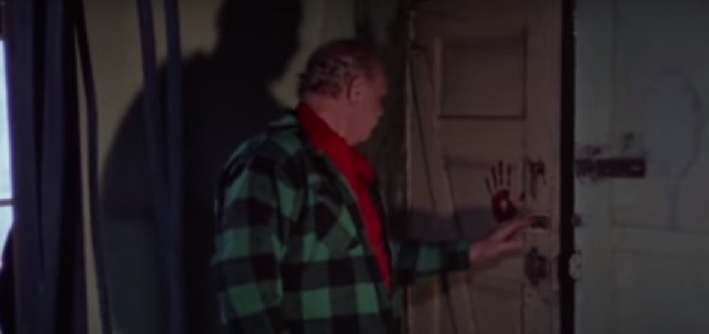
Of course, it is always nice to see Christopher George (Grizzly, Day of the Animals, City of the Living Dead, Graduation Day, Pieces, and Mortuary), and he does well here, as do the other three central stars, being Preston Pierce, Linda Borgeson, and Roberta Collins. John Davis Chandler (Phantasm III: Lord of the Dead and Mako: The Jaws of Death) made for a solid antagonist, though I wish he had a better resolution.

They’re not the only stars, though. Y’all know Charlie Daniels, I’m betting. Well, the Charlie Daniels Band did the theme for this film, surprisingly titled “Whiskey Mountain.” It pops up during one of the scenic portions at the beginning, and again during the credits, and it’s not a bad song. Not as catchy as “The Legend of Wooley Swamp” or “The Devil Went Down to Georgia,” but then again, what is?

If there’s one thing that people are apt to remember about Whiskey Mountain, it would be the rape sequence. Mercifully, we don’t actually see anything, but what we do see is haunting in it’s own way. Pictures are being taken of the two women – polaroids that we see darken – and as the screams continue in the background, we see more pictures – forced kissing, then the women in their underwear, and then just a face in pain. The morning after the rapes is haunting too, and this whole sequence is probably the most striking in a movie that’s otherwise quite tame.

Whiskey Mountain is a movie that I wish I got more out of, but life doesn’t always give us those gifts. It’s not a bad movie for seeing motorcycles, mountains, and men with guns, but if you want some really good southern hospitality, check out Hunter’s Blood.

5.5/10

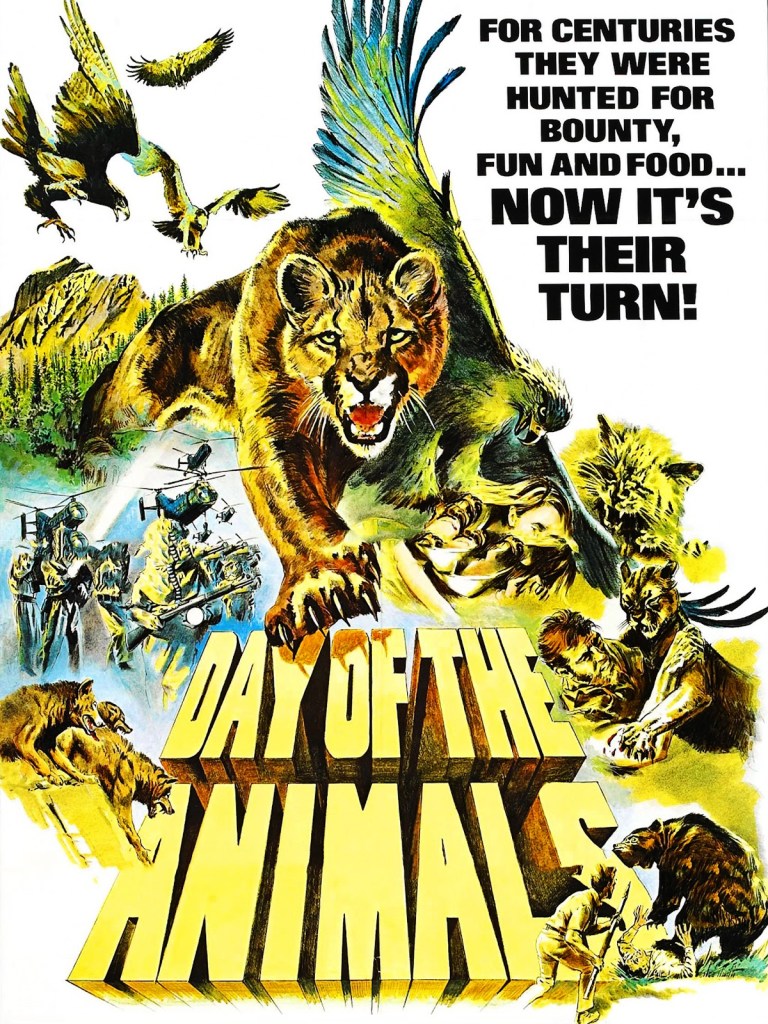
Day of the Animals (1977)

Directed by William Girdler [Other horror films: Three on a Meathook (1972), Asylum of Satan (1972), Abby (1974), Grizzly (1976), The Manitou (1978)]

I fundamentally think Day of the Animals is a fine movie. It’s not quite as action-packed as I personally would have hoped, and the build-up at the beginning takes a bit, but it’s an okay film. I don’t think it’s a necessarily good movie, but for what it is, it’s okay.

I think what really took a bit to get used to is that despite having a variety of animals going wild to a depletion of the ozone layer, there’s not really that many animal attacks. Sure, there’s a wolf, a bear, some snakes, big cats, and birds, but it’s not quite as quick-paced as you might hope. That might make sense, though, given William Girdler directed this one, and he was also behind Grizzly, which I also found a tad on the sluggish side.

The story’s not bad, with a bunch of people going on a guided hike and coming across the wild and dangerous behavior of the animals, which of course causes some dissent in the group in the form of Leslie Nielsen’s character. It’s almost sociological in it’s approach at times – if man loses all sense of law and order, what horrors might they commit? It’s not heavy in that type of thing, but from Nielsen’s character, is does come up.

I’ll say that Neilsen (Prom Night, Dark Intruder, Creepshow) played a horrible character pretty well, and when he got #mauled, I can’t say I wasn’t glad (though I do wish it were a lot more violent, with screaming and limbs being torn off in gory agony and the like). I think the best character here, without much hesitation, would be Michael Ansara (Abbott and Costello Meet the Mummy, The Manitou, Dear Dead Delilah), who is a great guy, and has to deal with racism (he’s Native American) along with the killer animals. Both Christopher George (Graduation Day, City of the Living Dead, Pieces) and Lynda Day George (Beyond Evil, It Happened at Lakewood Manor, Fear No Evil) were fine, but neither one was that memorable.

And despite the premise of the film, I don’t think many of the animal attacks were that memorable, either. You had the white water rafting with wolves (technically dogs, but I liked the alliteration I had going) at the finale, which was fun, and there was a good scene in which someone’s getting into a car without noticing the nest of snakes on the seat behind them, which was playful, but that’s virtually it. There was a bird attack early on – the victim fell to their death in amusingly fake fashion – and I guess that was okay, but overall, I was sort of expecting more.

Day of the Animals is a movie I’ve wanted to see for a while, and I’m happy I did, despite not having loved it. It’s certainly better than some other 70’s creature films, such as The Food of the Gods, but when movies like The Swarm and The Pack exist, it’s hard to really go out of my way to recommend this one.

6.5/10

The Pack (1977)

Directed by Robert Clouse [Other horror films: Deadly Eyes (1982)]

I don’t remember too much from the first time I saw this film, but revisiting it was quite the pleasant experience, as The Pack does pack a nice punch, and while dry at times, has some solid action come the final thirty minutes.

Based on a novel of the same name by David Fisher, the story is decently simple, and features a bunch of people on a small island trying to survive when a pack of wild dogs starts going after their previous best friends. Being a 70’s film, it can be dry at times, and it can be quite somber, but it’s actually not as hard to watch as other dog-related horror (White Dog is what immediately comes to mind), and the final scene is quite heart-warming (and it freezes on that frame as the credits start rolling).

The suspense is done quite well here, as are the multiple dog attacks. It’s not a violent film, but we do see the aftermath of one attack, in which a man loses all the fingers on one of his hands, most of the fingers on the other, and his eyesight. It’s pretty brutal, and I dug it. Also, while trying to avoid the pack, another individual takes a dive off a cliff, and though we don’t see the impact, we do see how successful the landing was, which also looked brutal.

Only a couple of performances really matter. Joe Don Baker (Wacko) makes a strong lead, and though I don’t really know the actor, I thought he definitely did well. Richard B. Shull has his moments, and R.G. Armstrong (who I recognized quickly from Children of the Corn) was a strong addition also.

Truth be told, there’s not too much to The Pack. It’s a solidly-made film, and though it takes a little bit to get going, it’s not near as dry as other films from the period can be (when I recalled it took place on an island, I got horrible flashbacks to The Food of the Gods, but luckily, The Pack is so much better).

With an exciting finale, plenty of good dog vs. human action, and quality suspense at times, The Pack has a decent amount going for it. It’s not an amazing movie, but it is pretty good, and certainly worth a watch.

7.5/10

The Hills Have Eyes (1977)

Directed by Wes Craven [Other horror films: The Last House on the Left (1972), Stranger in Our House (1978), Deadly Blessing (1981), Swamp Thing (1982), Invitation to Hell (1984), The Hills Have Eyes Part II (1984), A Nightmare on Elm Street (1984), Chiller (1985), Deadly Friend (1986), The Serpent and the Rainbow (1988), Shocker (1989), The People Under the Stairs (1991), New Nightmare (1994), Vampire in Brooklyn (1995), Scream (1996), Scream 2 (1997), Scream 3 (2000), Cursed (2005), My Soul to Take (2010), Scream 4 (2011)]

I’ve not seen this one in a long while, and given that I’ve also only seen this one once, I was quite excited to watch The Hills Have Eyes again. It’s not the most gritty or violent horror film of the 1970’s, but even so, Wes Craven made a winner here following his success with The Last House on the Left.

In many ways, this feels reminiscent of The Texas Chain Saw Massacre, what with the desert and the cannibal family. Obviously this takes a different approach to things, which I believe works in it’s favor (and makes this a more enjoyable film than The Texas Chain Saw Massacre, on a side-note), but I just love how Craven paid homage to Hooper’s successful film – it’s nice to see these directors’ stuff from the 1970’s feel somewhat interconnected.

And no doubt, the setting here is great. Along with being quite isolating, it’s just nice to see the environment play a large part in the story, be it things like the heat, tarantulas (in a scene that I definitely could have done without), lack of food and intense heat. It gives a more realistic sense of danger even aside from the cannibal homebois in the hills, and I find that aspect enjoyable.

At first, I wasn’t going to spend that much time on the performances, and I probably still won’t, but I did want to say that pretty much everyone did well. Robert Houston had some shaky moments, and Susan Lanier did get to become a bit much as the movie went on, but given what her character went through, I can’t really blame her.

Martin Speer (Killer’s Delight) was decent toward the end, but it did take his character a little while to get there. Virginia Vincent really shined after her husband (played by Russ Grieve) got #barbecued. John Steadman and Dee Wallace (The Howling, Critters, and Cujo) both add some flavor. Of the cannibal family, it’s James Whitworth, Janus Blythe (Eaten Alive), and Michael Berryman (Deadly Blessing, Mask Maker, and Cut and Run) should get the most credit, but again, everyone does decently.

Like I said, this isn’t really that violent of a film. Sure, a dog attack leaves a man’s foot in a less-than-ideal condition, and another character is burned alive, but it’s more of an emotional scene than it is graphic. There is a painful stabbing also, but Last House on the Left, at least from what I remember, was more disturbing than this one was, and certainly the 2006 remake upped the violence too.

Some of this movie is pretty dark, as one could potentially expect from 70’s horror. It seems almost no one is spared from being killed off, and there are some pretty tense and moderately disturbing scenes here, which would probably be true of any horror film in which a character’s family was slowly being killed off around them. This movie, as I said, packs an emotional punch at times (even if the performances can’t necessarily carry that), so I appreciate that.

Really, there’s not much here that I didn’t care for. Sometimes the film focuses more on the point-of-views of the cannibal family (which I think is a good way to almost compare and contrast the two family units), which felt sort of jarring, but it didn’t happen often, and when it did, it sometimes led to quality canine attacks, so I can’t really complain about that.

Oh, and the final scene is quite sudden (and I mean sudden as though it was a 50’s monster movie), but it was sort of jarring, in that event horizon way, so that wasn’t much of an issue.

The Hills Have Eyes has a lot going for it. It doesn’t match the grittiness of The Texas Chain Saw Massacre at all, nor does it match the violence of many of the other horror films coming out around the mid-to-late 1970’s, but it does have a pretty good story with quality performances and a great sense of dread, so if this is a Craven movie you’ve been skipping, I’d ask that you perhaps reconsider. Either that, or I’ll eat the brains of your kids’ kids.

8.5/10

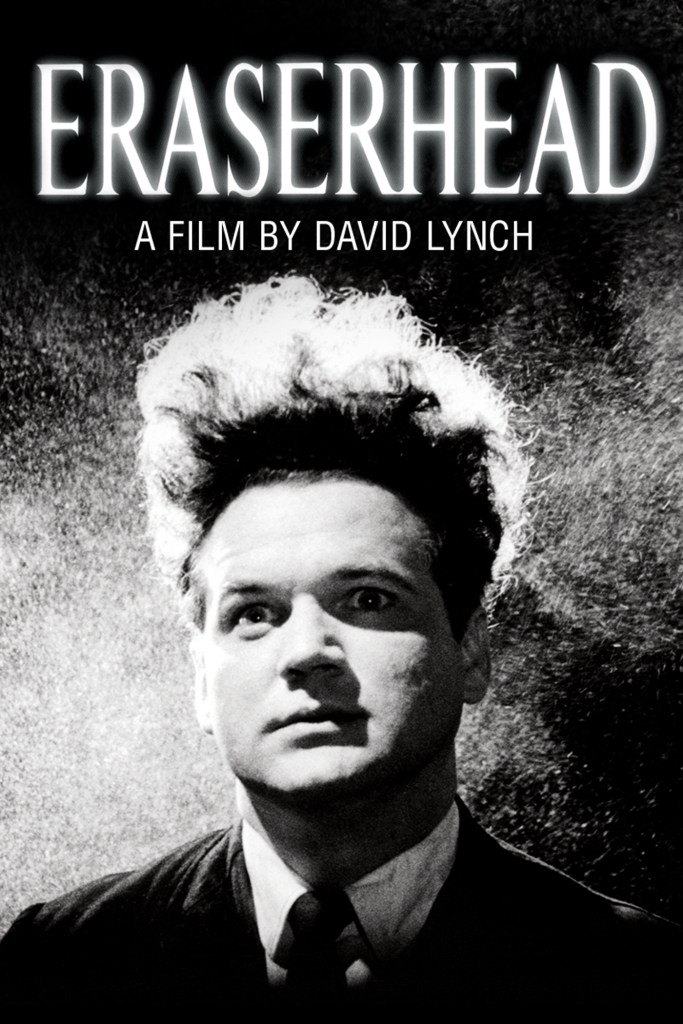
Eraserhead (1977)

Directed by David Lynch [Other horror films: Twin Peaks: Fire Walk with Me (1992), Twin Peaks: The Missing Pieces (2014)]

I think I’m somewhat forthcoming about my dislike of more experimental films, and many of them I see (with a few exceptions, such as Hausu) I end up disliking. I’ve seen Eraserhead once before (hated it), and seeing it with fresh eyes, I still hated it.

This isn’t something I want to spend much time on, mainly for the same reason I didn’t want to spend much time on My Boyfriend’s Back – this film isn’t aimed at me, and I knew that going in, so I don’t feel particularly great about giving it a low score (and believe me, Eraserhead is getting a low score). I know it’s not my type of thing, but it’s also a movie that I had seen before, and as such, had to rewatch, so here we are.

I’ll give this film props for a dark atmosphere, banging background score, unsettling imagery, and befuddling ideas. I found much of it repulsive and didn’t enjoy almost a second of it, but it was certainly trying something different, which is something I guess you can trust Lynch to do.

Of course, I can imagine that there are a hell of a lot of interpretations for this movie out there, and I’d guess that most of them are equally valid. I have no idea what this movie was trying to say, if anything, but as to not be left out in the cold, I’d just argue that it tries to expose what working-class isolation in a post-industrial society, following the results of an Atomic bomb dropped by a Western African nation in the grips of an unending civil war, can do to a man’s fragile psyche. Sounds close enough.

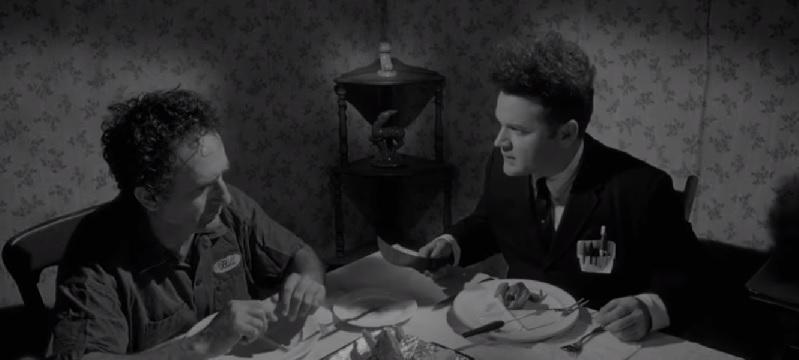
Jack Nance had an interesting look to him. Charlotte Stewart (who later popped up in Tremors, of all places) was certainly something. Allen Joseph could smile creepily with the best of them. And that’s pretty much it for the cast.

The story was disjointed and moderately confusing, including dream sequences about pencils and some hideous mutant child and a woman who lives in a radiator, which is also Heaven, maybe, or something like that.

Yeah. Eraserhead has a 7.4/10 on IMDb as of this writing, and I just don’t understand it. From my perspective, while elements of this surrealistic film are interesting, it doesn’t make it good, and I had a thoroughly unenjoyable time with this, and if I’m lucky, I’ll never have to sit through this trash again. It’s not my type of movie, which is good riddance, as far as I’m concerned.

1/10