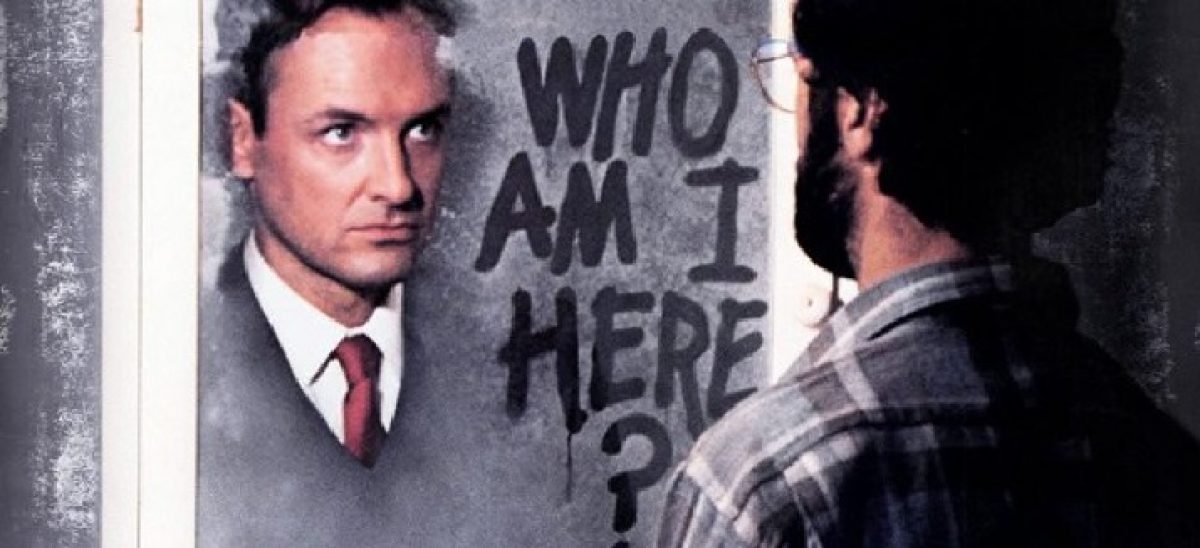
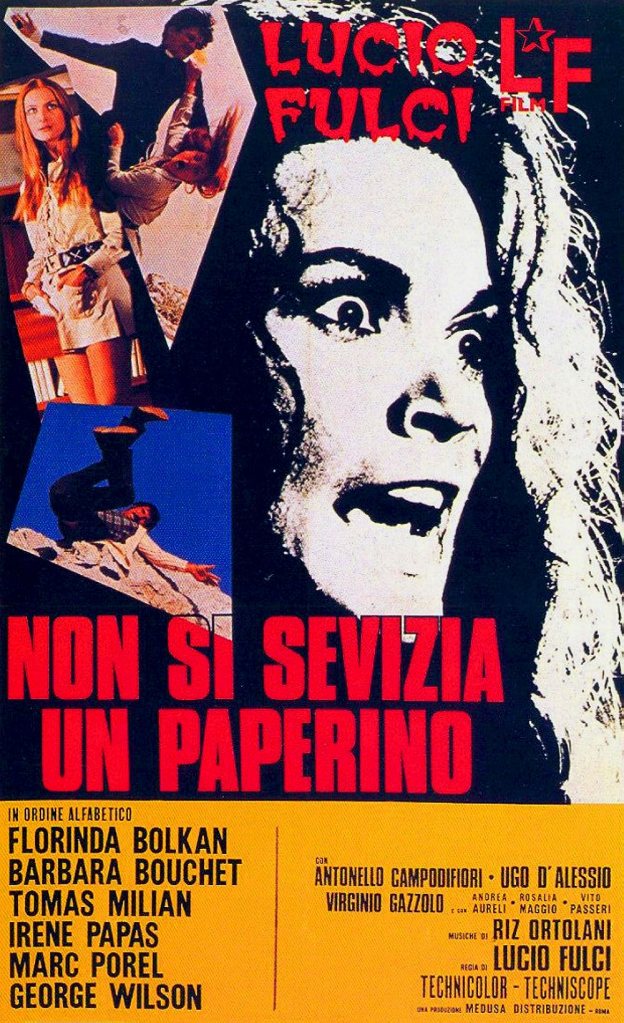
Non si sevizia un paperino (1972)

Directed by Lucio Fulci [Other horror films: Una lucertola con la pelle di donna (1971), Il cav. Costante Nicosia demoniaco, ovvero: Dracula in Brianza (1975), Sette note in nero (1977), Zombi 2 (1979), Paura nella città dei morti viventi (1980), Gatto nero (1981), …E tu vivrai nel terrore! L’aldilà (1981), Quella villa accanto al cimitero (1981), Lo squartatore di New York (1982), Manhattan Baby (1982), Murderock – Uccide a passo di danza (1984), Aenigma (1987), Zombi 3 (1988), Il fantasma di Sodoma (1988), Quando Alice ruppe lo specchio (1988), La casa nel tempo (1989), La dolce casa degli orrori (1989), Un gatto nel cervello (1990), Demonia (1990), Hansel e Gretel (1990), Voci dal profondo (1991), Le porte del silenzio (1992)]

For a long time, Don’t Torture a Duckling (the well-known English title of this giallo) has been among my favorite Lucio Fulci films. That’s probably still true, as it’s a pretty solid giallo, and while not overly violent, has a decent amount going for it.

The story is fun, and somewhat atypical as far as gialli goes. The victims are almost exclusively young boys, and while their deaths aren’t violent (they mostly seem to be strangled or suffocated), there is a certain pleasure in seeing a younger victim range, as not too many films deal with dead kids.

I also love the setting, being a rather rural and small Italian town. It’s filled with superstitious people, which unfortunately plays a part later on in the film when some confessed killers come out of the woodworks. There’s a lot of mob mentality in the film, kept in check partially by the mostly logical police force.

Most of the central performances were pretty good. Tomas Milian was a bit generic, but he was more interesting once he began working with Barbara Bouchet’s (The Black Belly of the Tarantula, The Red Queen Kills Seven Times) character. The main faces we see from the police force were all fun – especially Virgilio Gazzolo, but both Antonello Campodifiori and Ugo D’Alessio were solid also. Marc Porel (who died at the young age of 34 in 1983) was great here, and Florinda Bolkan had quite the tragic story to her.

Unlike later Fulci films, this movie is pretty tame as far as the violence goes, with two exceptions. There’s a sequence in which a woman is beaten with a chain – if you remember the opening to The Beyond, it’s quite similar. It looks hella painful to get chain whipped across the face, so I may avoid that part of Italy. Also, there’s a character who falls off a mountain at the end, and their face bumps and scrapes against the mountain. The thing falling is obviously a dummy – it looks incredibly fake. Even so, the sequence is quite fun.

In fact, the finale is quite great overall. During the scene in which the character is falling to their death, we’re given flashbacks as to explain the reasoning behind the revealed killer’s actions, why they went out of their way to kill kids. It’s even a bit emotional, with soft music playing in the background, and it’s a finale, despite the dummy, that has always stuck with me.

Like I said, this has been my favorite Fulci film for a long time, and I think that’s still pretty true. I finally watched The New York Ripper earlier this month, and I quite liked it, and it might be fair to say that Don’t Torture a Duckling is on par with that one. Even so, I think this one is a bit better – the mystery is mildly more interesting, and the finale is definitely a bit stronger.

I don’t think Don’t Torture a Duckling is perfect. Unlike Dario Argentino with Deep Red, Fulci’s been unable to amaze me quite that much. Even so, Don’t Torture a Duckling is quite a good film, and definitely a giallo that’s worth seeing.

8/10
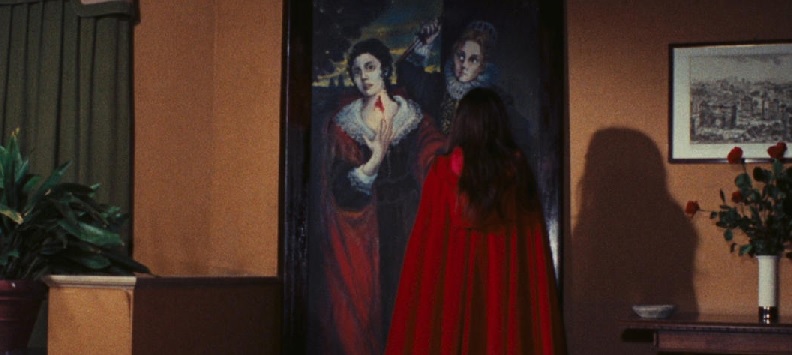
La dama rossa uccide sette volte (1972)

Directed by Emilio Miraglia [Other horror films: La notte che Evelyn uscì dalla tomba (1971)]

Known under the evocative title The Red Queen Kills Seven Times, La dama rossa uccide sette volte is a giallo that has a decent amount going for it. Possessing a great mystery, fun plot, and memorable killer, it’s a very solid film, and one of the better gialli I’ve seen.

Firstly, I love the set up and the legend of the Red Queen, based on the painting seen in the opening. The Red Queen is killed by her sister, the Black Queen, and so the Red Queen returns from the dead to get her revenge, killing six innocent people, and for the seventh and final victim, the Black Queen, her sister. All of which is a long way to say that, indeed, The Red Queen Kills Seven Times.

It’s quite possibly among one of my favorite titles of a giallo.

In other news, the plot largely revolves around mysterious murders involving some sisters, a castle, a curse, a will, and some mixed-up identities, not to mention secret deaths and blackmail. It’s just a lot of fun all the way through, and like all great gialli, there’s a lot of viable suspects, and figuring out the mystery provides a good time. As it is, I don’t 100% love the finale – I wanted a little more oompf – but it was still quite well-done.

One thing this film succeeds in that few gialli really do is creating a memorable design of the killer. The Red Queen’s design is great – a woman in a red cape and hood, with a maniacal laugh every time she kills someone (and surprisingly, that laugh never once gets old). It’s a great killer, one that you’d expect from some 80’s slasher, and not that many gialli showcase great designs (as so many instead show black gloves and trenchcoats, which, to be fair, has it’s own charm).

Barbara Bouchet (The Black Belly of the Tarantula) made a solid lead, and had some great scenes, especially during her flashbacks. Really, though, most performances are solid, from Sybil Danning, Fabrizio Moresco, and Nino Korda to Ugo Pagliai, Marina Malfatti, and Pia Giancaro. Rudolf Schündler was nice to see, and while generic, Marino Masé (Contamination) certainly looked the part of a detective.

Directed by Emilio Miraglia (who also made the excellent The Night Evelyn Came Out of the Grave), The Red Queen Kills Seven Times isn’t a particularly gory giallo. There are some solid kills, such as a woman being tricked into climbing a fence, but then impaling herself on the spikes, or a good stabbing in the back of a van, but the kills here aren’t near as important as the mystery and occasional atmosphere, the same of which could fairly be said of The Night Evelyn Came Out of the Grave.

Also, portions here and there of the film take place in a castle. By no means is the castle necessarily central to the plot, but some of the better scenes take place in and around it, and it’s a very solid setting when it pops up, and gives the film a little Gothic spice, as Italian horror did often in the 1960’s.

The Red Queen Kills Seven Times was a pretty good movie. I don’t know if it’s good enough to make my top five gialli at the moment (with films like Deep Red, The Case of the Bloody Iris, and the early The Murder Clinic, it’s hard to crack the best of the subgenre), but it’s definitely a solid film, and with that great killer, isn’t a movie that’ll be forgotten.

7.5/10

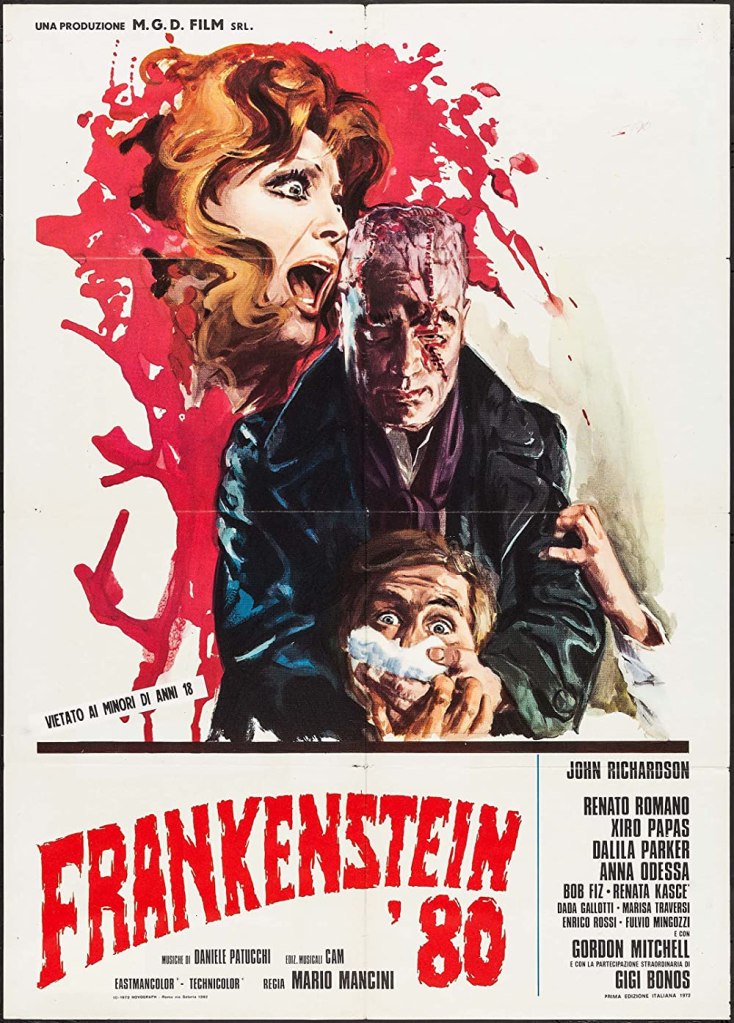
Frankenstein ’80 (1972)

Directed by Mario Mancini [Other horror films: N/A]

This Italian film isn’t really anything special, especially when you consider how rough the most common print of this film is. Even so, I’ve always found it on the more decent side of things, and though it probably doesn’t rise above average, Frankenstein ‘80 is a fun, trashy little movie.

Why it’s called Frankenstein ‘80, I don’t know. The ‘Frankenstein’ part makes sense – in the film a Dr. Otto Frankenstein creates a living being made of men, and christens it Mosaico (not a bad name, if I do say so myself). Where the ‘80 comes from, though, I’ve no idea. The body count is decent, but it’s not that high.

The print I own is from the Pure Terror 50 disc set from Mill Creek. It’s a rough print, as many of Mill Creek’s releases are – it’s sometimes blurry, the dubbing is so-so, and the aspect ratio may not be accurate (given the credits at the beginning of the film are cut off on both sides, which looks horrid). Even so, the nudity is intact, and the film itself isn’t too choppy, but this is a movie that might benefit from a higher definition release (and may already have one; I’m not exactly what you’d call up-to-date when it comes to Blu-ray releases).

Admittedly the story feels a little bit aimless for the final thirty minutes – at this point, Mosaico has escaped from the lab he was kept in and goes on a killing spree. Not that we don’t get kills throughout the movie, because we do, but it’s ramped up a bit, and throws in some more blood and nudity for good measure.

I liked John Richardson (Eyeball, Torso, and Black Sunday) as the lead, playing a reporter, and even more, I really liked how he was able to get the police chief, played by Renato Romano, on his side, and began working with him. Romano’s character even compliments him at the end of the film, which is a relationship I don’t see too often between police and reporters. Romano’s character was goofy at first, but I grew to like his irascible style, and I’m happy he finally got his cigarette in the final scene.

Gordon Mitchell (Dr. Frankenstein’s Castle of Freaks and Blood Delirium) did well as Frankenstein. We never really got much character from him, but we have enough background information to fill in the blanks. Playing the creature was Xiro Papas (The Beast in Heat, The Devil’s Wedding Night, and Sex, Demons and Death) who did a great job, especially given he wasn’t exactly the most emotive creature we’ve seen. Dalila Di Lazzaro (Flesh for Frankenstein) was probably the most generic of the main cast, but that’s mostly because at the end, her character annoyed me, as she was screaming as the monster was attacking a friend of hers, and instead of leaving the house to get help, she just stood there, screaming. Always a good use of one’s time in a situation like that.

None of the kills are the highest caliber, but for a Frankenstein movie, that can’t come as too much of a shock. Someone gets a hatchet to the face, others get strangled, someone gets their head bashed into a bathroom wall (which supplied some nice blood splatter), and another gets their throat slit. None of these are great scenes, but they’re mostly serviceable, and I can’t say any were bad.

That’s really how I feel about Frankenstein ‘80 as a whole. Even with the rough print, I enjoyed it the two times I’ve seen it, and though it’s by no means a stellar film, I do think it’s decent, and if you want an Italian horror from the early 1970’s that’s not a giallo, then check this one out.

7.5/10

Perché quelle strane gocce di sangue sul corpo di Jennifer? (1972)

Directed by Giuliano Carnimeo [Other horror films: Quella villa in fondo al parco (1988)]

Commonly known under the title The Case of the Bloody Iris, and perhaps sometimes known as What Are Those Strange Drops of Blood Doing on Jennifer’s Body?, this giallo is a great example of why I love the subgenre. There’s a fun story here with a lot of suspects and decent kills, and so Perché quelle strane gocce di sangue sul corpo di Jennifer? is a giallo done right.

It’s the mystery of the story that always drew me to gialli. I love slashers in which there are multiple reasonable suspects for who the killer is, but of course, not all slashers have that bent (such as The Slumber Party Massacre, Halloween, and Final Exam). Gialli, though, pretty much has to possess that element, and while it’s not always done well, when a giallo has all the pieces come together, it’s a damn good time.

Here, for instance, there’s no dearth of potential killers. When a young woman moves into an apartment building and multiple people around her start getting killed, sure, it could be the possibly gay photographer (Oreste Lionello), or maybe the mysterious man living in the nearby apartment, or the architect of the building (George Hilton) or the old professor (George Rigaud), or perhaps his lesbian daughter (Annabella Incontrera)? Oh, and let’s not forget the main character’s husband (Ben Carra), who is obsessed with getting her back.

The Case of the Bloody Iris has a pretty good mystery, and I was going back-and-forth on who I thought the killer might be (one of my guesses, though, was indeed correct), and when there’s not a clear-cut answer, I just love it. Come the finale, everything is pieced together nicely, red herrings are dealt with in reasonable and realistic manners, and everything just works.

Plenty of the performances here were great. There’s the lead, Edwige Fenech (from many Italian classics, such as Five Dolls for An August Moon, The Strange Vice of Mrs. Wardh, All the Colors of the Dark, Your Vice Is a Locked Room and Only I Have the Key, and Strip Nude for Your Killer), who did a very good job playing a character who feels as though she’s in constant danger. George Hilton (The Strange Vice of Mrs. Wardh, The Case of the Scorpion’s Tail, All the Colors of the Dark, and The Killer Must Kill Again) didn’t have a ton of personality, but made for a good suspect.

I loved Giampiero Albertini as the police commissioner, and his stamp-collecting antics, not to mention his conversations with subordinate Franco Agostini were of good quality. Paola Quattrini played a hilarious roommate of Fenech’s, and all her scenes were golden. Annabella Incontrera (So Sweet, So Dead and The Crimes of the Black Cat) was amusing as an overly seductive lesbian neighbor, and like Quattrini’s character, I enjoyed her everytime she was on screen. Ben Carra, Carla Brait (Torso), George Rigaud (Horror Express and Love Brides of the Blood Mummy), Maria Tedeschi, and Oreste Lionello (4 Flies on Grey Velvet) all gave the film some good extra flavor.

There are only a few what I’d call stand-out kills, and one of them was pretty mild, being a steam pipe being turned on as someone was walking by, and this caused some awful burn damage (and death). One of the better kills, though, was a quick stab to the stomach in broad daylight, and also in a crowd. Just filmed in a quality manner (with the killer’s POV), and I dug it.

I also dug the simple design of the killer, the typical black-masked look, complete with a hat, trench coat, and gloves. Even when the killer just popped up in the main character’s apartment without harming her, it was pretty creepy, so kudos there.

Admittedly, it did take The Case of the Bloody Iris about 15 minutes to really start making an impact, but once it did, and I felt more engagement, I found this giallo quite a rewarding experience, and would definitely recommend it, especially for that killer finale. #LovedIt.

8.5/10

Child’s Play (1972)

Directed by Sidney Lumet [Other horror films: N/A]

It’s been quite a long while since I’ve been blown away by a movie. Child’s Play isn’t amazing, and to be 100% honest, calling it a horror film may not be entirely accurate, but it is a movie that has an insanely heavy amount of creeping tension, and it’s not an experience I can describe easily.

In fact, it reminds me of films like The Wicker Man and Don’t Deliver Us from Evil. There’s an oppressive atmosphere that permeates the whole film, and the tension here just builds and builds (though arguably, it doesn’t necessarily lead to anything). The final scene still carries that tension wonderfully, and you want to see what happens next.

This was truly a nerve-wracking experience. I think the reason for that is it’s based on a play written by Robert Marasco. If you don’t know the name, I wouldn’t be surprised, but because I’m a large fan of the film Burnt Offerings, I know Marasco wrote the novel Burnt Offerings is based on. And like Burnt Offerings, which has a deep sense of uneasiness throughout the film, Child’s Play has the exact same thing.

Plot-wise, some ideas aren’t fully answered or explained, and there’s a bit of an open-ended conclusion here. I would have liked a little more input from some of the student characters, as most of the film focuses around the faculty of a Catholic school, but even with a few issues like this, it doesn’t change how striking the film is.

The cast is amazing. There’s really only three central performances, those of Robert Preston, Beau Bridges, and James Mason, and all three are absolutely amazing. Bridges is the most generic of the bunch, but that’s only because Mason and Preston are Gods among men. They put a lot into this movie, and it just makes the whole thing great. Smaller parts played by Ron Weyand and David Rounds (who plays character I quite appreciated) compliment the central actors nicely.

I need more time to fully digest this one. It’s rare I see a movie as unique as this, and though it’s definitely not a movie for everyone, I do think the experience is worth it. It’s not a fun movie at all; it’s a somber, oppressive mystery filled with a lot of drama and the trials of being a teacher, but it’s still an experience worth having.

8.5/10

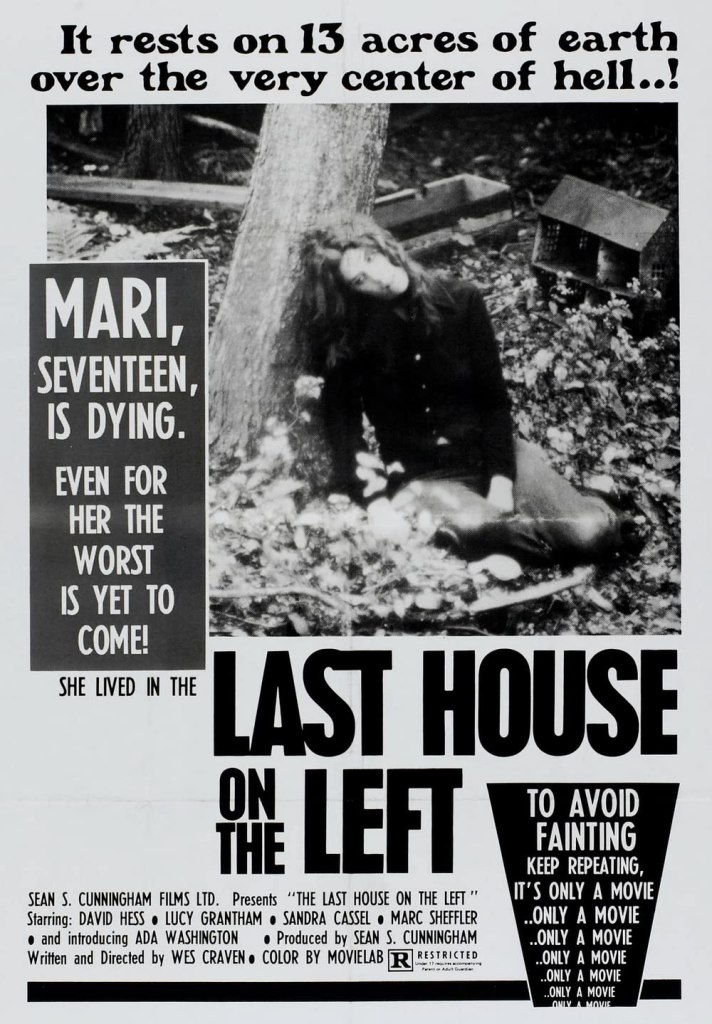
The Last House on the Left (1972)

Directed by Wes Craven [Other horror films: The Hills Have Eyes (1977), Stranger in Our House (1978), Deadly Blessing (1981), Swamp Thing (1982), Invitation to Hell (1984), The Hills Have Eyes Part II (1984), A Nightmare on Elm Street (1984), Chiller (1985), Deadly Friend (1986), The Serpent and the Rainbow (1988), Shocker (1989), The People Under the Stairs (1991), New Nightmare (1994), Vampire in Brooklyn (1995), Scream (1996), Scream 2 (1997), Scream 3 (2000), Cursed (2005), My Soul to Take (2010), Scream 4 (2011)]

No doubt a gritty and occasionally disturbing debut from Wes Craven, The Last House on the Left isn’t necessarily an easy movie to like, what with the occasional inappropriate comedic influences throughout, for instance, but I think that I tend to enjoy this more than I used to.

For most of the film, it’s not that violent. Though the rape and murder of the two young women is certainly disturbing, this isn’t I Spit on Your Grave, and while watching the two of them get dehumanized by Krug and his compatriots isn’t a walk in the park, it’s not near as bad as some later movies might be. Toward the end, we do get some increased violence, but it’s generally the type we can root for, which gives it a far more palatable taste.

The music throughout the movie sometimes feels a bit out of place, and part of that is due to the comedic influences with the two police officers trying to get to a soon-to-be crime scene, but most of the music works pretty well. The recurring “The Road Leads to Nowhere” is a perfect song for the movie, and during a death scene, we’re treated with “Now You’re All Alone,” a somewhat haunting melody (especially given the placement). David Hess (Krug) performed the music here, which shows a soft side to a rather brutish individual.

For the story, it’s pretty simple, but I do find it effective (and, on a side-note, a bit more relatable to the modern audience than 1960’s The Virgin Spring), and not only that, but I find it generally more enjoyable than what we might see from either I Spit on Your Grave or The Texas Chain Saw Massacre. Sure, watching Sandra Peabody’s and Lucy Grantham’s characters’ grueling torture isn’t fun, but knowing where it leads does take a small amount of the punch out.

Personally, I love the finale. In some ways, the reaction of the parents (Richard Towers and Cynthia Carr) might seem a bit sudden, but I think it makes for a quality final 15 minutes. Really, the two of them didn’t have a whole lot to do before then, so I think going the direction they did makes the film a bit more special.

Of course, I’d be amiss without mentioning what a quality scumbag David Hess plays. He’s popped up in later films, from House on the Edge of the Park to Body Count, but it’s this role that I think really shows his talents. This is the only role I know of Fred J. Lincoln, but I also found him somewhat fascinating. Neither Jeramie Rain (Sadie) nor Marc Sheffler (Junior) amazed me, but I did think Junior’s regret over the incident was close to touching.

The Last House on the Left isn’t what I’d call an amazing film, but I do think it’s a solid slice of exploitation, and I generally find that I enjoy it a smidge more than Texas Chain Saw Massacre (which may place me in the minority, but I’m used to it). It’s rough, it’s gritty, and it’s amateurish in some ways, especially in regards to that misplaced comedy, but it’s still worth seeing if 70’s horror is your thing.

7.5/10

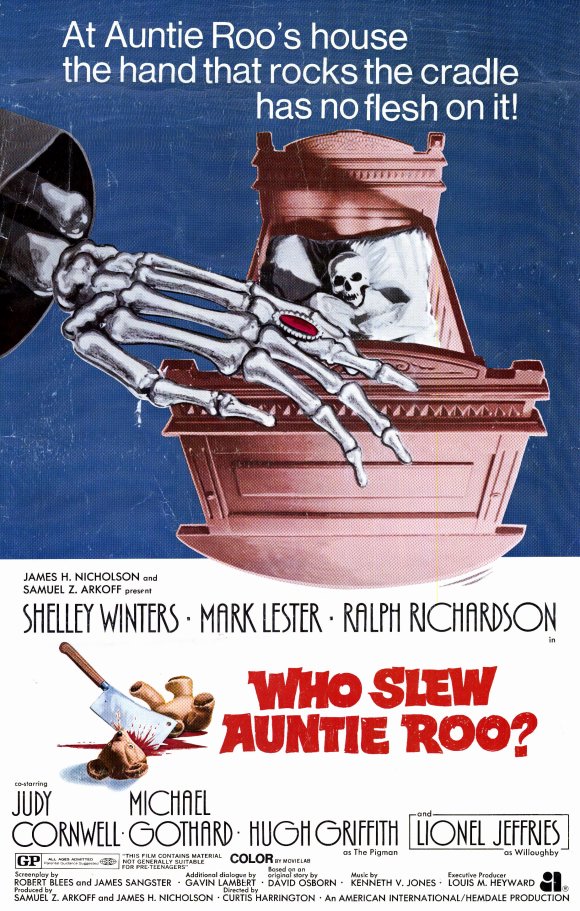
Whoever Slew Auntie Roo? (1972)

Directed by Curtis Harrington [Other horror films: Night Tide (1961), Queen of Blood (1966), How Awful About Allan (1970), What’s the Matter with Helen? (1971), The Killing Kind (1973), The Cat Creature (1973), Killer Bees (1974), The Dead Don’t Die (1975), Ruby (1977), Devil Dog: The Hound of Hell (1978), Usher (2000)]

I didn’t know a lot about this before I went into it, so it mostly came as a nice little surprise. Though it’s more subtle in it’s approach of horror, I thought the film had a decent amount to offer, so even though it’s not a classic, per se, it likely won’t be an easy movie to forget.

The plot here was so original, which helped a lot. Following a pair of orphans (brother and sister) as they encounter a mentally-unstable woman who thinks the girl is a reincarnation of her deceased daughter, plus it’s British? This movie was original and a decent amount of fun despite the somewhat dry feel.

For younger individuals, Mark Lester and Chloe Franks (The House That Dripped Blood, Tales from the Crypt) did a great job. Franks was probably more forgettable, but Lester got more screen-time anyways (plus he was marginally older), so that just makes sense. Shelley Winters (Tentacles, The Initiation of Sarah, The Devil’s Daughter, A Patch of Blue – guess which one doesn’t fit in?) was also superb in her role, and you felt sympathetic for her despite the fact she was bat-shit insane. Michael Gothard (Lifeforce) played a dick, and I loved it, and Ralph Richardson popped up again (I saw him earlier the very day I watched this one in The Ghoul from 1933), which was fun.

It’s a pretty tense story, and though you sort of know where it’s going to go, there’s still a level of uncertainty. Heck, I expected the kids to get out of it using a far different method from what actually happened, which goes to show that, to some extent, Whoever Slew Auntie Roo? can keep you guessing.

There’s also the occasional passages from Hansel and Gretel that Lester’s character reads during some voice-overs which really helps set the tone and give us some insight as to how, as a young kid, he sees this situation (not that Winters’ is simply insane, but also a witch). It’s a dark film in some ways, as you would expect a movie where kids are held against their will to be, but it’s not near as bleak as it could have been, which is probably a positive (I was even smiling at the end, happy with the conclusion).

I doubt this movie is going to make a big impact on many people, but it was a pleasant viewing, and even occasionally held a nice Christmas charm to it.

7.5/10

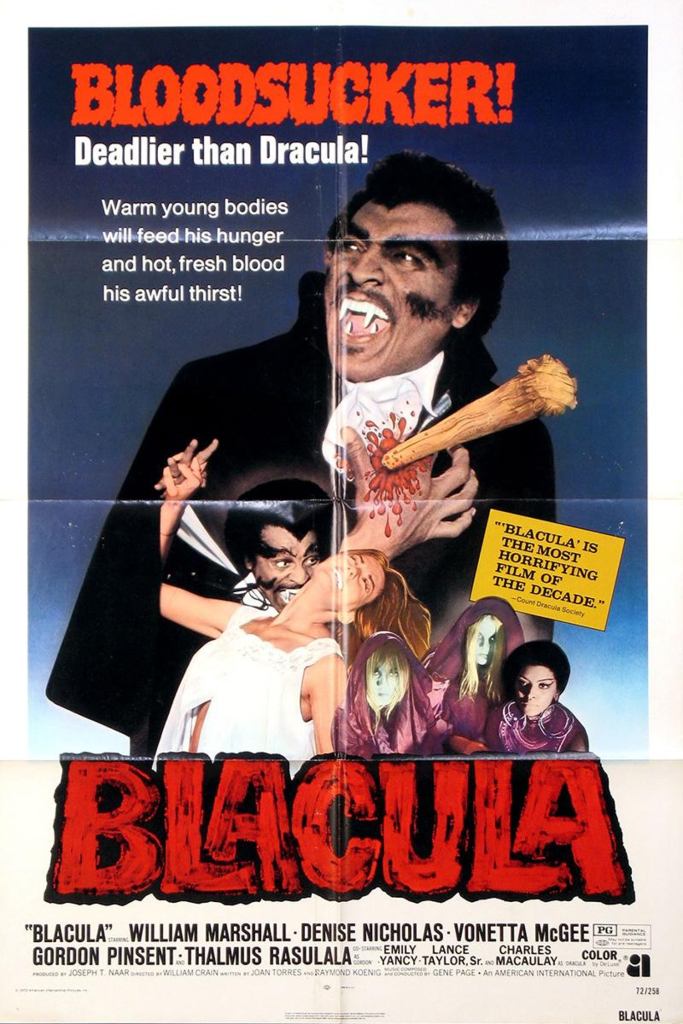
Blacula (1972)

Directed by William Crain [Other horror films: Dr. Black, Mr. Hyde (1976)]

Despite the ridiculous title, Blacula plays itself as straight as any other 70’s horror, and while the movie’s not great, it’s okay, and if you’re into vampire films and have overlooked this one, I’d recommend another look.

The story here is pretty interesting, and casts a very sympathetic light on William Marshall’s vampiric character. Attempting to stop the trade of Africans, William Marshall plays an African Prince who speaks to Count Dracula, who refuses and turns the Prince into a vampire. He returns 200 years later, and the snazzily-dressed Marshall goes after a woman who reminds him of his late wife.

Blacula, as it was shot on location in L.A., really has that 70’s feeling that I appreciate. There’s some socially conscious dialogue I appreciated (such as Rasulala’s mentioning that crimes against African-Americans aren’t focused on near as much as crimes against whites), though their depiction of a homosexual couple (which was progressive for the time, to be sure) was certainly cringe-worthy. Still, credit to Ted Harris and Rick Metzler for playing (however stereotypically) a biracial gay couple.

William Marshall does quite well as a vampire here. Like I said, you can sort of feel for his character, and while he does cause multiple deaths throughout the film, you can’t help but feel just a bit sorry for him, because you can tell from the beginning of the movie that he’s a good person. Marshall had a strong personality here, and it did wonders for the film.

Also doing wonders was the main protagonist, played by Thalmus Rasulala. A pathologist for the police department, his character really commanded his screen-time, and much like how you couldn’t help but feel bad for Marshall, I couldn’t have stopped myself from cheering for Rasulala for anything. He kicked ass, sucker-punched some vampires, and really put in his all.

While it’s true that the presence of Gordon Pinsent, Denise Nicholas, and Vonetta McGee are appreciated, the only other actor that stands out here is Elisha Cook. When I first saw this film, I immediately recognized him as Pritchard from House on Haunted Hill. He definitely looks a bit older here, but he has the same face, so it was sort of nice to see him 15 years older than I usually do.

I think that, if Blacula has a main problem, it’s the lack of scares. There was a pretty good graveyard sequence, and also a scene that took place in a warehouse in which twenty or so vampires jump the main characters, but otherwise, I didn’t really get a big feeling of dread here.

Even so, there’s some funky music here (just look at that animated title screen), and the songs we heard at the club (‘There He Is Again‘ and ‘I’m Gonna Catch You‘ are both performed by The Hues Corporation, a soul trio from the 1970’s) were just really catchy, despite it not really being the type of music I generally gravitate toward at all.

All-in-all, Blacula’s not a great movie, but it can be fun, and it gets the job done competently enough, along with possessing an interesting story. As far as blaxploitation horror goes, I have to suspect this is one of the better ones, and may well be worth a watch in spite of it’s flaws.

7/10

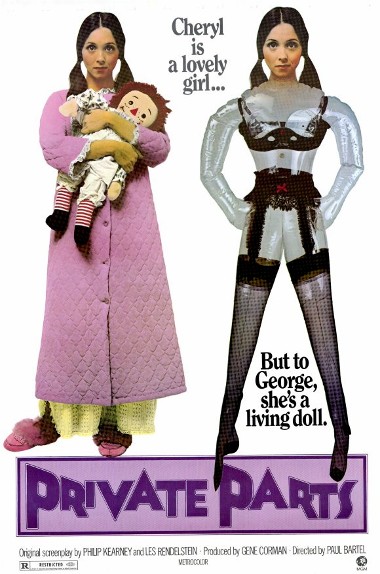
Private Parts (1972)

Directed by Paul Bartel [Other horror films: Eating Raoul (1982)]

I knew next to nothing when I started this one, and it ended up being a fairly odd film. The atmosphere was generally good, and I’d even say Private Parts can certainly be memorable, but I didn’t really enjoy a lot of it, and I’d place this below average.

The general story in Private Parts is decent, and at the very least, even if you don’t like the route it takes, you can tell it has potential. Ayn Ruymen did well playing a somewhat naïve young woman, but some of the things she does in the latter half of the movie sort of bother me. Lucille Benson did decent in her role, and was certainly threatening enough, and while Laurie Main didn’t really add that much to the movie, I did love every time his goofy character (a gay priest) was on-screen.

Problematically, John Ventantonio wasn’t memorable whatsoever, even with the surprising ending, which hurts as he’s the main antagonist in the film (if you don’t count Benson and her often standoffish behavior). Is he suitably creepy at times? Sure, but Ruymen’s character goes for him despite that (which is one of her decisions that rather bugs me), and I wasn’t really satisfied with where things went from there.

It could fairly be said that a lot of the plot happened due to sexual repression, and if some characters had been able to more appropriately express their sexual interests, none of this would have happened. I don’t think Private Parts was going all out in trying to make this a main message, but it’s something I certainly noticed.

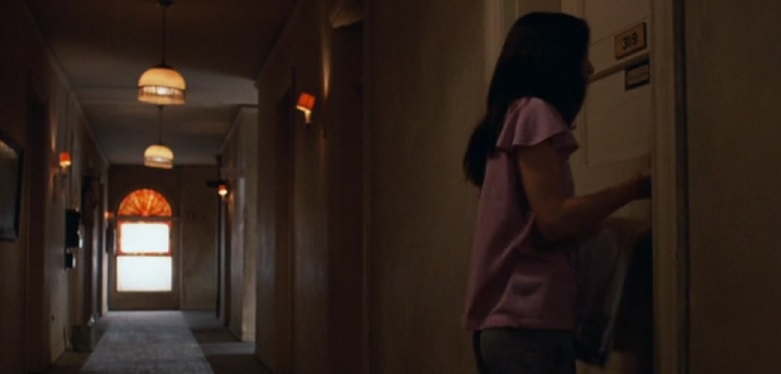
All-in-all, Private Parts is okay, and for the early 70’s, it’s certainly an interesting entry to the genre. I didn’t love it, though, and while the atmosphere and setting (an old hotel with quite a few screwball characters) were solid, elements of the story, and the route they took in the conclusion, didn’t much endear me to the film.

6/10

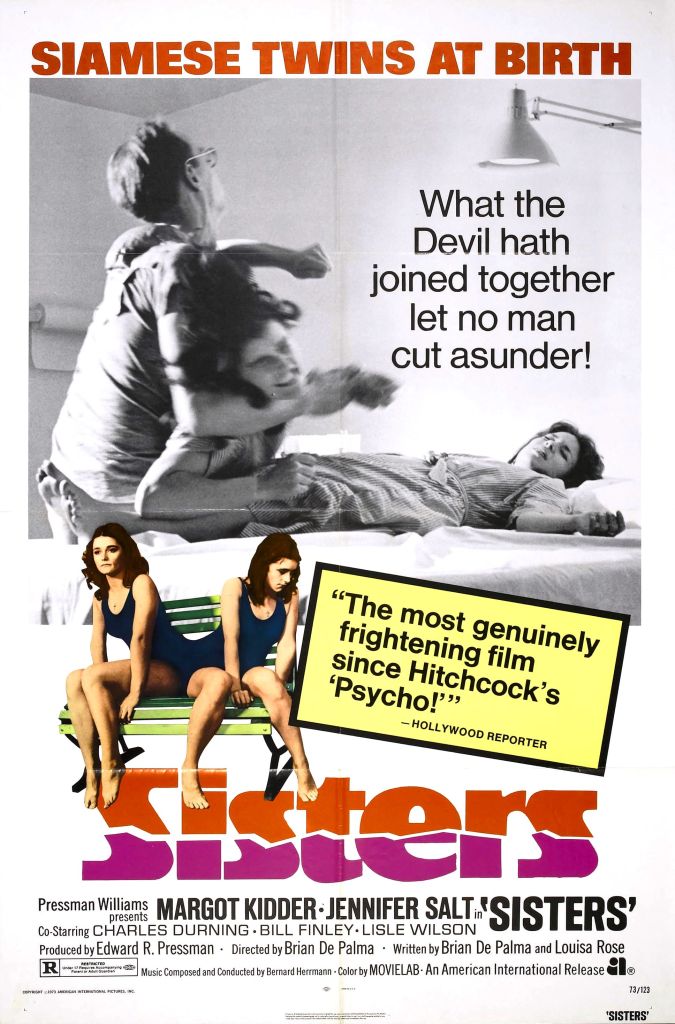
Sisters (1972)

Directed by Brian De Palma [Other horror films: Phantom of the Paradise (1974), Carrie (1976), The Fury (1978), Raising Cain (1992)]

Brian De Palma’s first real movie of note (shortly afterwards overshadowed almost entirely by the immensely popular Carrie), Sisters is a rather interesting and somewhat decent film, though it’s not necessarily altogether as enjoyable as I remember it being from my first experience viewing.

For the longest time, pretty much everything works out. You’ve a journalist (played by Jennifer Salt, an actress often used in De Palma’s earlier films) investigating a murder she witnessed (which the police don’t have enough evidence to look into) with the occasional help of private detective (Charles Durning). The murderer, Margot Kidder’s potentially psychotic character. For the first 50-odd minutes, I think Sisters is an enjoyably immersive movie.

There comes a point, though, about in hour in when there’s a bit of a turn taken that I didn’t entirely care for. Instead of a more clear-cut investigation, it turns more into a trippy, drug-fueled flick for ten, fifteen minutes, and that transition I didn’t care for. Also, while I really love the final shot in the film, I find the overall conclusion somewhat unsatisfactory.

Honestly, I’m not a big fan of Kidder’s performance here, but I did really enjoy both Charles Durning and Jennifer Salt. William Finley (who later appeared in such films as Hooper’s Eaten Alive and The Funhouse) also appeared, but much like Kidder, neither his character nor his performance, especially toward the end, did much for me at all.

Sisters does have a few positives going for it, of course, perhaps most notably a rather fun sequence involving split screen (which was also used briefly in De Palma’s later film, Carrie). The split screen sequence was really enjoyable, and brought with it a solid vibe. Also, the gore, while not a highlight of the film, by any means, is decent. Lastly, like I said, I really love the final shot of the film – not sure exactly why, but it always has a somewhat ominous feel to me.

I enjoyed Sisters a lot more the first time I saw it than I did this time around. Certainly aspects are well-done, and for a majority of the movie, I find myself having a good time, but the conclusion really didn’t work out for me, and while it’s likely still worth seeing, I actually find the film somewhat below average, at least this time around.

6.5/10