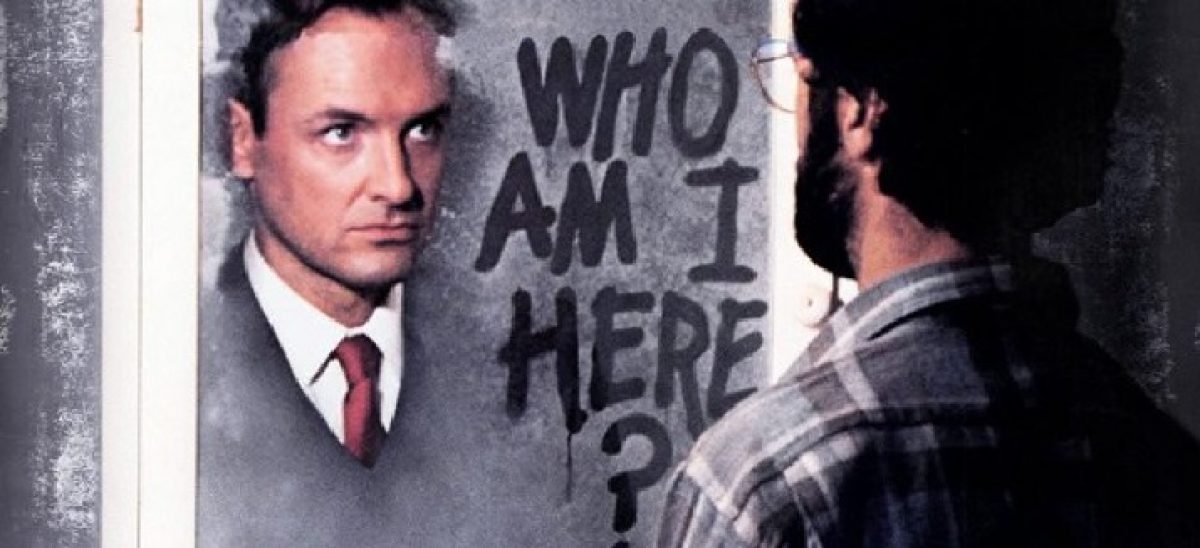
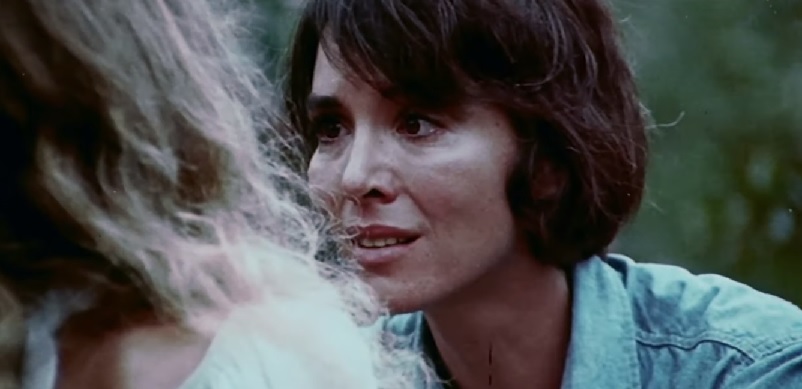
Let’s Scare Jessica to Death (1971)

Directed by John D. Hancock [Other horror films: N/A]

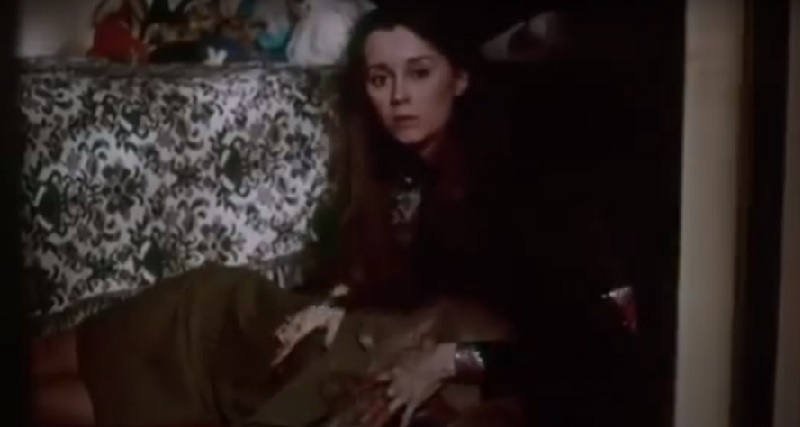
Though I’ve seen this cult classic before, it’s been quite some time, and truth be told, I didn’t recollect too much of it before going in. Let’s Scare Jessica to Death isn’t an easy movie to describe, and I’m not even sure if it’s fair to say I enjoy it, but I do think it’s a special little movie that may well be worth seeing.

In many ways, this movie really feels like a product of it’s time. It reminds me a bit of both Warlock Moon and Welcome to Arrow Beach, in that it just possesses the sensibilities of the early 1970’s. Now, true, I wasn’t born until 1993, so it’s quite possible I know little about the sensibilities of the early 70’s, but even so, this movie has it.

Honestly, though, this isn’t an easy film for me to write about. The story sort of feels free-form in some ways – the finale doesn’t explain much of what’s been going on – but in this case, I don’t think that’s a bad thing. In fact, I think it adds to the dreamy atmosphere of this one, and at times, I’m reminded a bit of Phantasm.

With that said, though, it’s more than that. This movie feels comforting, calming, relaxing. There are tense moments and uneasy scenes toward the finale, no doubt, but the overall aura of this one is almost soothing. Part of it has to do with the 70’s atmosphere of the film, some of it has to do with the way they approached the story, and some of it has to do with the soft, peaceful music that plays throughout; whatever combination of parts that makes this work, though, I just know it does, and I’ve rarely described a horror film as ‘peaceful,’ but I certainly am now.

And on that note, I’d argue it’s more the atmosphere and feeling of Let’s Scare Jessica to Death that causes it to stand out, as opposed to the story. The story is decently haunting at times (a few moments bring to mind Ghost Story), but it’s also true that it almost feels aimless, and it’s certainly slow. It doesn’t harm the film any, because it just adds to what ends up a rather soothing, captivating movie, but it is slow, and I sort of doubt those who are really into modern horror would fully understand the charm of this one.

In fact, I don’t fully understand the charm of this one. I just know I was engaged throughout the movie, and it had little to do with the performances, which I found somewhat average, or the story, which is never fully expanded on, or the first-person narration style the film’s presented in.

Zohra Lampert’s performance was okay. To be honest, it felt a bit shaky at times, but I think that has more to do with the fact I didn’t really get these characters rather than Lampert’s performance itself. Oh, and the fact her character was recently released from a psychiatric hospital may too play a part. Honestly, none of the other performances, be it Mariclare Costello, Barton Heyman, or Kevin O’Connor, did a lot for me, but again, I think it’s more the characters than anything else.

Another aspect that shouldn’t go overlooked is how Lampert’s character was dealing with some undefined mental illness, a fact that she thought about quite a lot during her narration. It’s possible that much of what we see and experience in the film isn’t actually what’s going on, and certainly her reaction at times does lend some potential credence to that idea, but it’s an ambiguous film, so if you’re expecting a clear-cut answer, you may want to look elsewhere.

This may be easy to tell, but this movie just sort of hits different. It’s vibe is something that I’ve rarely seen, and though I can’t say that I necessarily enjoyed the movie, I can say that it’s calming, soothing atmosphere was quite a balm in these trying days. Oh, and we got a little bit of blood toward the end, which was nice too.

Let’s Scare Jessica to Death isn’t an easy movie for me to write about, which may well be evidenced in my ramblings above. Like I said, I’ve seen it before, but it’s been a long while, so much of it felt new, and I definitely didn’t remember how unique the film felt. It’s not a movie that will work for everyone – aside from the story, it can be a bit slow and perhaps muddled – but I’ve not seen many movies that felt like this one, so that has to mean something.

7.5/10

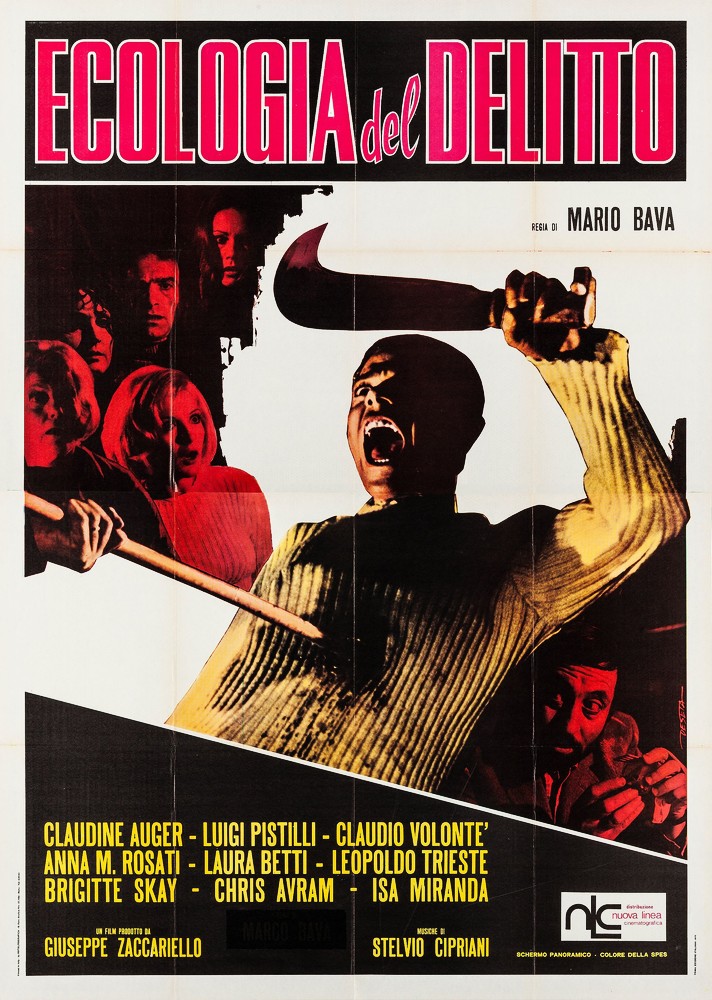
Ecologia del delitto (1971)

Directed by Mario Bava [Other horror film: I vampiri (1957), Caltiki il mostro immortale (1959), La maschera del demonio (1960), Ercole al centro della Terra (1961), La ragazza che sapeva troppo (1963), I tre volti della paura (1963), La frusta e il corpo (1963), 6 donne per l’assassino (1964), Terrore nello spazio (1965), Operazione paura (1966), 5 bambole per la luna d’agosto (1970), Il rosso segno della follia (1970), Gli orrori del castello di Norimberga (1972), Lisa e il diavolo (1973), The House of Exorcism (1975), Schock (1977)]

Likely better known under titles such as Bay of Blood and Twitch of the Death Nerve, this Mario Bava film has been a movie I’ve been wanting to see for a long time. I came into it trying to temper my expectations, because I didn’t want to be disappointed (and I’ve heard some less-than-stellar reviews of this one), and I came out quite fascinated.

My expectations were somewhat simple – a bloody giallo with a decent mystery. Well, I don’t know if the mystery itself is that great, but the approach to the story is what really sold it to me, and I don’t know how many movies I’ve seen that had such an interesting final thirty minutes.

It starts off normal enough, with some murders happening around a bay (a fantastic setting, but I’ll touch on that shortly), and we’re introduced to a lot of characters, each with their own objectives and goals, so it felt as most gialli do. Once we’re let in on some secrets in the final thirty minutes though, the whole film becomes quite kinetic in a way I’ve not seen before.

And what I mean by kinetic is this: there are a bunch of people at the bay – an insect lover (Paul) and his medium wife (Anna), another man (Albert) and wife (Rennie), a guy who lives in a shack on the bay (Simon), and another guy who has a house nearby (Frank) – and about halfway through, things start getting wild. Paul pops in on Albert’s car, asking where Anna went – his wife went down to the shack, to speak to Simon. Later, Albert sees Paul run out of a house where a body was, and Rennie was one of the potential victims.

Needless to say, I may not be able to explain things well, but the point is this: a lot of things are happening, and at that point in time, we keep switching to different characters, giving us different perspectives all in this very close-knit area (most of the film takes place very close together, and I loved that), and it just felt so energetic and fun.

It’s hard to talk about great performances, because I thought all of the central characters did well. My favorite two would have been Leopoldo Trieste and Claudio Camaso (who has an interesting, and rather tragic, personal history). Laura Betti (A Hatchet for the Honeymoon) struck me as a bit stereotypical in her medium role, but others, such as Chris Avram (The Killer Reserved Nine Seats, L’ossessa), Luigi Pistilli (The Iguana with the Tongue of Fire, Your Vice Is a Locked Room and Only I Have the Key, A White Dress for Marialé), and Claudine Auger (The Black Belly of the Tarantula) were all solid.

Naturally, a big talking point about the film would be the gore, and the gore is quite solid throughout. I loved the double impalement, along with some throat slittings and someone getting stabbed with a spear, but I think the finest moment was a beautifully-choreographed decapitation – I saw the set-up, and was quite happy with the follow-through. A Bay of Blood certainly has some fine violence in it, and I dug it.

This film isn’t really comparable to most gialli I’ve seen, as it’s shorter and a bit more base in it’s intent, feeling at times like a classic 80’s slasher. Flashbacks are used to great effect toward the finale, but the story still comes across less like The Case of the Bloody Iris and more like Friday the 13th, which isn’t a bad thing whatsoever, as I suspect this might be a more digestible film for those who don’t want to spend an hour and a half with a more complex story.

If I’m being honest, I sort of expected to be disappointed with A Bay of Blood, but I wasn’t. It started off a little shaky (as great as those first kills were, things felt a bit average for a period of time), but about halfway in, it really grabbed me, and I loved most things about the final thirty minutes (even the off-the-wall, hilariously random final sequence). Definitely a fun time.

8/10

Il gatto a nove code (1971)

Directed by Dario Argento [Other horror films: L’uccello dalle piume di cristallo (1970), 4 mosche di velluto grigio (1971), Profondo rosso (1975), Suspiria (1977), Inferno (1980), Tenebre (1982), Phenomena (1985), Opera (1987), Due occhi diabolici (1990, segment ‘The Black Cat’), Trauma (1993), La sindrome di Stendhal (1996), Il fantasma dell’opera (1998), Non ho sonno (2001), Il cartaio (2003), Ti piace Hitchcock? (2005), La terza madre (2007), Giallo (2009), Dracula 3D (2012), Occhiali neri (2022)]

Known primarily under the title The Cat o’Nine Tails, I had to say that this Dario Argento film started out strong, and remained strong for a good portion of the hour and 50 minute runtime, but aspects of the finale just didn’t sit well with me.

It’s a mostly engaging mystery – I love how a newspaper reporter (James Franciscus) and a blind man (Karl Malden) were working together in order to solve some mysterious deaths. I liked the relationship of respect they had, and of course, having a blind character working as a detective is a unique choice, and he did fantastically.

Following up on the nine leads was somewhat less than satisfactory. I guess my main problem is that of the five scientists (played by Emilio Marchesini, Tom Felleghy, Aldo Reggiani, Horst Frank, and Tino Carraro), only a couple of them got any real focus, and without a clear distinction of character, which I’m not sure we got all that well, distinguishing between some of these individuals is a bit more difficult, and also lacks somewhat of a personal touch, given we don’t know all of them, at least to any real degree.

That’s not to say that the mystery wasn’t good, but I have to say, I don’t think it was near as engaging or interesting as what we get from films like The Black Belly of the Tarantula, Deep Red, or The Case of the Bloody Iris. It just lacked a bit of the personal touch, so while time mostly flew by (which is good, given the film’s runtime), I don’t know if the finale was entirely worth it.

Regardless, that doesn’t take away from both Karl Malden’s (Phantom of the Rue Morgue) and James Franciscus’ (The Last Jaws) performances. I thought the both of them did a great job, especially Malden. I liked what we got from Horst Frank (The Head, Eye in the Labyrinth) and Emilio Marchesini, but I don’t think either character was that fleshed out, and we only got surface level stuff. I wasn’t overly fond of Catherine Spaak’s character, but at least Franciscus’ character liked her.

Part of the mystery here involved some genetics testing regarding unusual chromosome distribution. I don’t know the modern-day science behind this – it sounds as though it’s something that was debunked years ago. The movie doesn’t spend too much time on this, but it’s part of solving the mystery, and it was definitely unique, so I thought I’d mention it.

I also wanted to say that the sequence in which both of the main characters were almost killed was pretty solid. Technically Malden’s was off-screen, and we only learn about it from a phone call, but Franciscus’ milk gets poisoned, and we’re treated to some solid tension as to whether or not he’ll figure that out before drinking it.

Few of the kills here really did that much for me, and that’s primarily because this film lacks the flair of later Argento works. Most of the kills are competent, but few really stand out (save for someone being pushed in front of a train and one of the final scenes in which someone falls down an elevator shaft). Many of them are done through first-person view, which does give a little something extra, but they’re not always the most exciting (some just consist of simple strangling).

When all is said and done, The Cat o’Nine Tails is an okay giallo, but compared to so many others (including some of Argento’s own films, such as Deep Red, Four Flies on Grey Velvet, and Phenomena) around the time, it just felt sort of weak.

7.5/10

The Beast in the Cellar (1971)

Directed by James Kelley [Other horror films: La tua presenza nuda! (1972)]

This is a somewhat hard film to get a gauge on. It’s true that much of the film was a bit dry and dull, but there was a bit of charm to be had in this British movie. Even so, I need to err on the side of caution, and say this isn’t really a good film.

I did find the story somewhat interesting, despite the oft-dry tone. There’s a little mystery, some okay atmosphere, and a nice setting, so by no means is it the case the movie that has nothing to offer. Problematically, though, while we do see a couple of murders, saying The Beast in the Cellar picks up speed at any point is a hard case to make.

In the final thirty minutes, we get a lengthy story from Beryl Reid’s character that lasts a good portion of that thirty minutes. It’s told well, with plenty of emotion, and during this, we do see people out searching for the animal-like man that’s been out killing soldiers. But it’s hard to say that there’s any real tension save for perhaps the final five minutes, when the killer comes to the house in the pouring rain (which was nicely atmospheric, to be sure).

Beryl Reid (who I mostly know from Entertaining Mr. Sloane) gave the best performance of the film, and she worked beautifully with Flora Robson (The Shuttered Room), who played her sister. The two of them did great, though Reid gave the lengthy confession toward the end, and got some more emotional scenes in. Smaller roles, such as those provided by John Hamill and Tessa Wyatt, were perfectly good, but as Reid and Robson were the sole focus, no one else had a chance to really stand out.

The print I watched was a bit rough, I admit. I imagine it was a VHS rip, as it was quite scratchy and very dark during night sequences. I don’t think this negatively impacted the film aside from making some things a bit harder to discern (the kills were especially somewhat rough), and it could be said the print maybe even helped give the film a bit more of a grindhouse feel.

Produced by Tigon (who were also behind producing such films as Curse of the Crimson Altar, Witchfinder General, Virgin Witch, The Blood on Satan’s Claw, and The Haunted House of Horror), The Beast in the Cellar is an okay piece of lower budget British horror. It is quite dry, but the performances are compelling even if some of the finale isn’t. It’s not a good movie, but I can’t help but see the charm this one possesses.

6/10

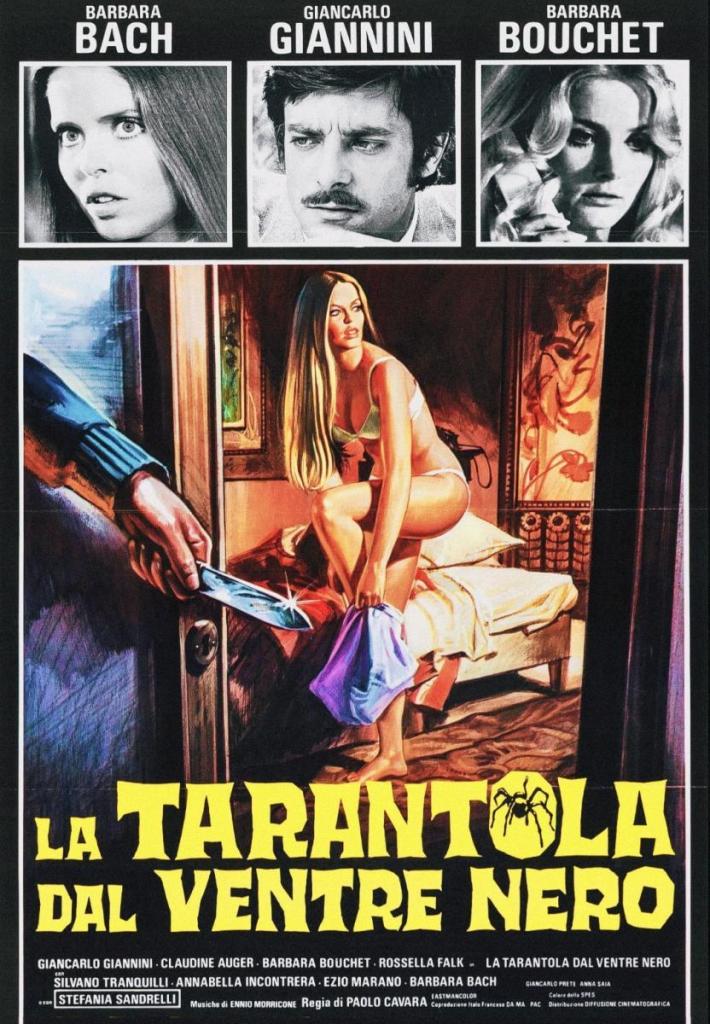
La tarantola dal ventre nero (1971)

Directed by Paolo Cavara [Other horror films: Mondo cane (1962), E tanta paura (1976)]

Giallo is one of those genres that I enjoy in small doses, and as such, there are still many quite well-known gialli that I’ve not yet seen. La tarantola dal ventre nero, better known as Black Belly of the Tarantula, is one such film, and I have to admit that, while it was decent, I was expecting a little more.

In part, I think this has to do with the lack of characterization some individuals get, not to mention a lack of as many suspects as one might hope for. There’s also elements that I don’t think are fully explained (what the link was between Giancarlo Prete’s character and Ezio Marano’s character, for instance), and the whole finale, while okay, was just that – okay, and largely unspectacular.

Admittedly this came as a surprise, as I have heard this is one of the more popular gialli out there, and perhaps one of the better ones not done by Mario Bava, Sergino Martino, Lucio Fulci, or Dario Argento. It’s a perfectly fine mystery, and the kills are decent, but even as a fan of these movies, I do feel that large portions were somewhat sluggish, and not getting the hang of the whole picture (at least as clearly as other films do, such as Deep Red) just made it feel weaker.

As far as the cast goes, the only ones who really stand out are Ezio Marano, Eugene Walter, and Giancarlo Giannini. I don’t think we really get that much information on Marano’s character, but he does well with the role. Eugene Walter had almost no relevance whatsoever to the plot, but his character appeared a few times, and he amused me. Giannini (who would pop up 30 years later as the Italian cop going after Lecter in Hannibal) was pretty solid as the lead, which is good, because otherwise, we wouldn’t have had much.

I’m always the type to enjoy mysteries mixed up with my murder, which is why giallo films appeal to me. They’re not always great (such as Mario Bava’s Five Dolls for an August Moon), but sometimes they can be quite good (Don’t Torture a Duckling and the aforementioned Deep Red). Black Belly of the Tarantula is an okay movie. It’s certainly not bad, even if it does perhaps drag a little. But there’s not enough here for me to think of the movie as necessarily good, and while I’ve wanted to see it for some time now, I can admit that it doesn’t do as much for me as I’d have hoped.

7/10

La notte che Evelyn uscì dalla tomba (1971)

Directed by Emilio Miraglia [Other horror films: La dama rossa uccide sette volte (1972)]

Commonly known as The Night Evelyn Came Out of the Grave, this Italian giallo is a very solid movie, providing you have the right print. It’s a movie I’ve seen before, but it didn’t make much of an impression, so seeing it again, in a quality copy, really allowed the film to shine.

I was first exposed to this film via the Mill Creek 50-movie pack titled Pure Terror – while the copy there is perhaps serviceable (I don’t remember much from my first viewing, but I didn’t hate it, at least), it’s video quality is quite bad, and the film’s dubbed. With this new viewing, I caught it on Shudder – I can’t express how much better the film looks. Also, the Shudder version is Italian with English subtitles, which is always my preference. Definitely makes a rewatch for this one worth it.

The story isn’t anything mind-blowingly new, and if anyone is familiar with the tenets of both Italian giallo and gothic movies, maybe some of the elements here will feel pedestrian, but I think everything blended together beautifully and made The Night Evelyn Came Out of the Grave work very well.

I’ve always loved gialli, and I think the reason is easy to understand – I also loved those old dark house horror films of the 1920’s and 1930’s (The Last Warning, The Cat and the Canary, The Monster Walks, and The Bat Whispers, for instance). I love mystery mixed in with my horror, and when we’re thrown multiple suspects, as many gialli do, I have a great time trying to figure out who the killer is, and why they’re committing these crimes. And it’s no different with this movie.

At times, I will admit it felt a bit like films such as The Screaming Skull and Diabolique, and it’s pretty clear early on that there’s no true supernatural elements here, and that a plot is afoot. The question then becomes who is the plot aimed at, who’s doing the plotting, and why is the plotting being done, and as with all great gialli (though to be sure, this film is moderately unique in that it throws in a supernatural facade for the giallo-centric murders), there’s a lot of possible combinations that make perfect sense.

The best part about all of this? It’s been so long since I’ve seen this movie, I completely blanked on the finale, and so when we got to the final 15 minutes, where we get a lot of revelations, I was overjoyed and having the blast of my life.

I can’t say that anyone in the cast stood out, but pretty much everyone did a good job. Anthony Steffen made for a solid lead, and Enzo Tarascio probably played one of the more interesting characters, but the rest, from Marina Malfatti, Roberto Maldera, and Giacomo Rossi Stuart to Umberto Raho, Joan C. Davis, Erika Blanc, all performed well.

If I did have one complaint, and to be sure, it’s a mild one at that, but the fact that the central character’s wife’s infidelity didn’t play into the film. We saw the flashback of his wife and a mysterious man making love in a garden, and I was guessing that the man would somehow matter later on, but it just didn’t swing that way. I can’t tell if that’s just me seeing too much from the flashback, or an intentional red herring, but I did find it a little annoying.

Other than that, The Night Evelyn Came Out of the Grave is a very solid movie, and if you have access to a quality print of it, it’s an Italian movie that’s certainly worth seeing, especially if Italian horror from the 1970’s is a preference of yours.

8.5/10

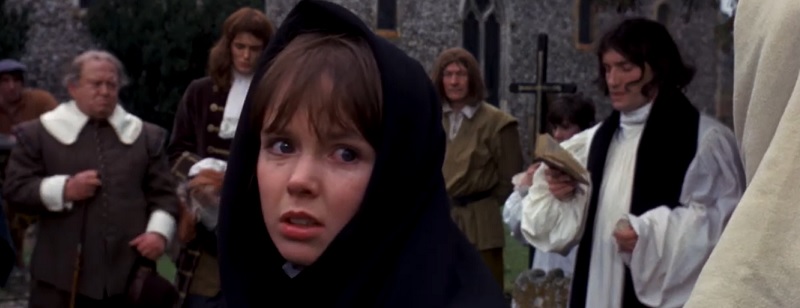
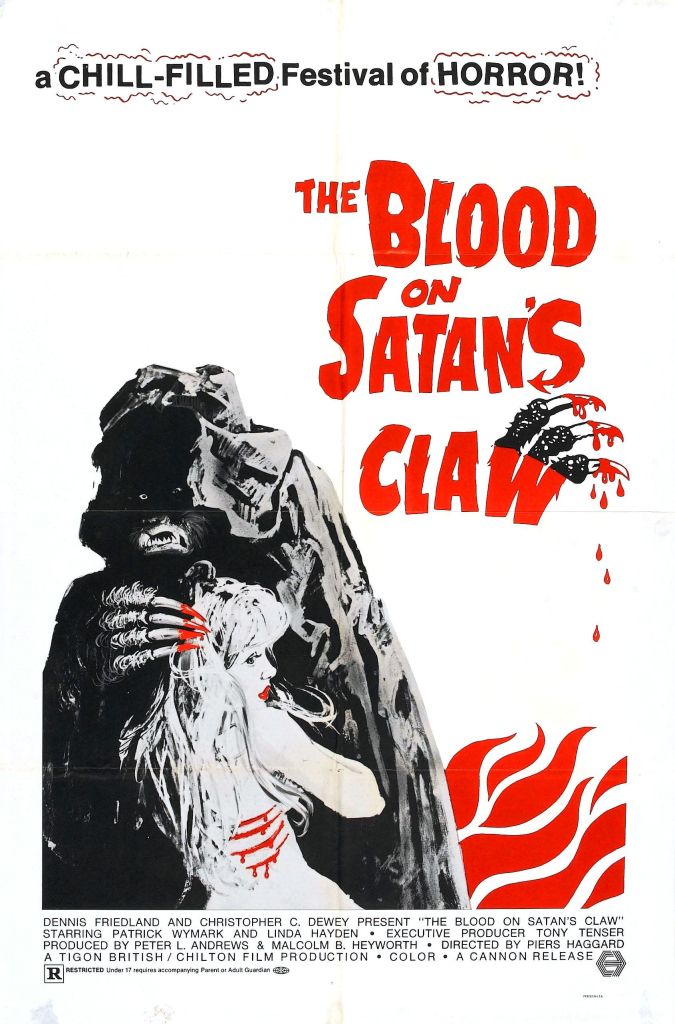
The Blood on Satan’s Claw (1971)

Directed by Piers Haggard [Other horror films: Venom (1981)]

While this British film certainly possesses some elements that are, on the whole, enjoyable, after seeing it twice, I have to admit that it feels somewhat aimless in it’s goal, and though I do enjoy good portions of this, overall, I’m not sure it’s as strong as it could have been.

The rather small setting – a little hamlet in jolly Olde England – works well with this story, and the production is decent enough to give everything a viable enough feeling of that time period. That doesn’t help the movie feel any more focused, but it does ring true, and that counts for a lot given this is a period piece.

I think much of the meandering tone can be best explained by the fact that originally, the movie was supposed to be three separate stories, an idea that was dropped to just a singular story, but I get the sense that, while things are still connected, they didn’t entirely lose that original mindset. And in a way, this is sort of unique, but even so, it doesn’t always make for the most enjoyable viewing experience.

Patrick Wymark (The Skull and The Psychopath) takes a little to grow on me, but he eventually does, especially when he comes back toward the finale. Linda Hayden (of Taste the Blood of Dracula and Madhouse) was fun to see anytime she was on-screen. Not too many others stood out, though, aside from perhaps Simon Williams (of Remembrance of the Daleks, perhaps on of Sylvester McCoy’s most memorable stories during his stint as the Doctor) and James Hayter.

The special effects, when they pop up, are decent. You get some quality claws, a dismembered hand, and a few other surprises, but despite the title of the film, it’s not as though there’s a lot of gore to be had here. Think any average Hammer movie, and that’s pretty much what you’re in for (though to be clear, this is from Tigon).

The Blood on Satan’s Claw isn’t a bad movie, and those in the horror community know that it’s generally well-respected. It’s a movie I’ve seen twice now, though, and as much as I wish I could like it more, elements just fall flat for me, and the quasi-disjointed nature of the story irks me. It’s not bad for a watch every five years, maybe, but it’s far from a preferred 70’s film of mine.

6/10

Werewolves on Wheels (1971)

Directed by Michel Levesque [Other horror films: N/A]

Werewolves on Wheels? Sounds like a fun time. Instead, this is an ultimately dull and really forgettable experience with very little going for it.

And I do mean little. Most of the movie is tedious bike-riding or just the bikers chilling, not doing much of anything aside from arguing about the validity of tarot cards. The werewolf attacks are fine, but there’s only two in the first hour and ten minutes, and the ending, which certainly increases the death toll, is virtually incomprehensible.

What hurts Werewolves on Wheels most is that none of the characters, and I mean none of them, are memorable in any way. I didn’t feel anything for any one of them, aside from Donna Anders, who had a nude scene with the Satanic monks (not as exciting as it sounds, I’m afraid to report).

I’m not saying that Werewolves on Wheels didn’t have potential, because, I mean, it’s called Werewolves on Wheels. But for most of the film the story dragged something awful, and there’s very little here that’s worth remembering or seeing the movie again for.

4/10

Death by Invitation (1971)

Directed by Ken Friedman [Other horror films: N/A]

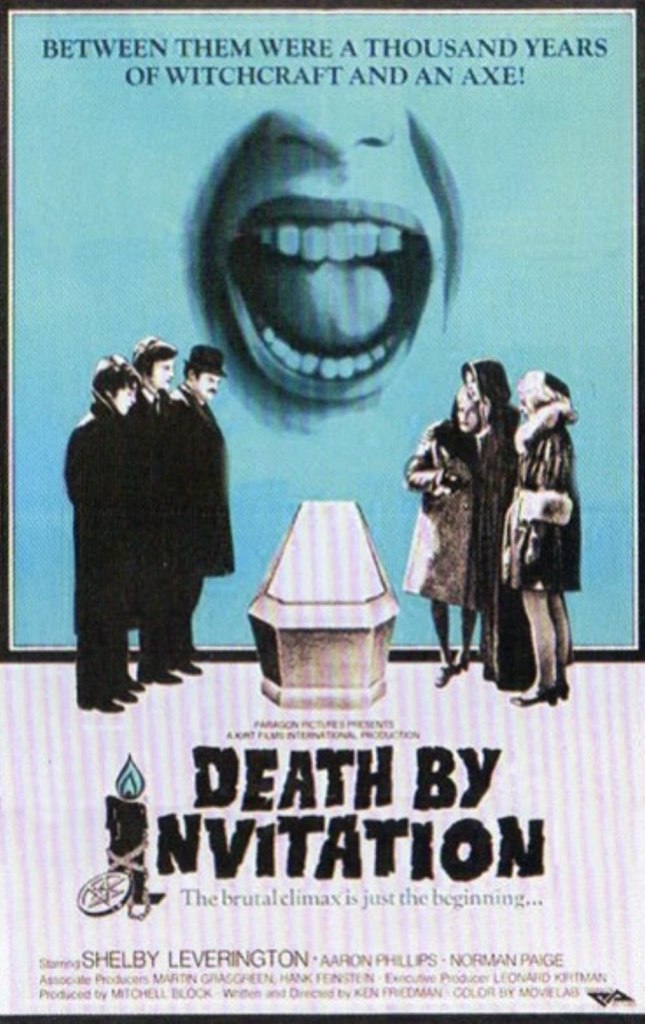
Every Christmas season, you can find a Yule Log channel or video, with some solid crackling and dancing flames, to give you a feel of an authentic fireplace. I never really understood the appeal, but after seeing Death by Invitation, I think that’d easily be a more enjoyable alternative.

Could Death by Invitation have worked? It’s certainly possible, and I won’t take away from the potential the story had, if only the execution had been better. What we got here instead was just dull and tedious, with really boring conversations and not much else.

Well, in the movie’s defense, there was one solid scene, in which a character cuts off the head of another character and holds it up to a younger sister, appropriately startling her. But that was something like an hour into the movie, and that was the only scene to me that was worth seeing. Unless, of course, you like hearing a young woman talk about some Native American tribe where the women did the hunting and the men greased the women up, but they had to be on their knees, so the women… (This story is luckily only told once, which is good, as it was just six minutes of a woman talking slowly while a man watched her, expression either astonished, aroused, or afraid – I could never tell which – but it was threatened to be told again toward the end, and I legitimately groaned at the time).

The movie eventually connects the death of the witch at the beginning of the film to the events that befall an unfortunate family in present day, but it was never clear to me that it clicked to any of the characters, and while there were a bunch of three-second flashbacks to the judgment and execution of the suspected witch, I think that was more for the audience than the characters, which is ultimately a bad choice, as the audience didn’t really need nor want it.

Was Shelby Leverington attractive? Indeed she was. Was there ever any nudity, despite the fact her character seduced two men? Not once. And this is the 1970’s we’re talking about. ‘Tis shameful, as is the movie as a whole. Even worse, it’s just so damn dull.

3/10

Sometimes Aunt Martha Does Dreadful Things (1971)

Directed by Thomas Casey [Other horror films: N/A]

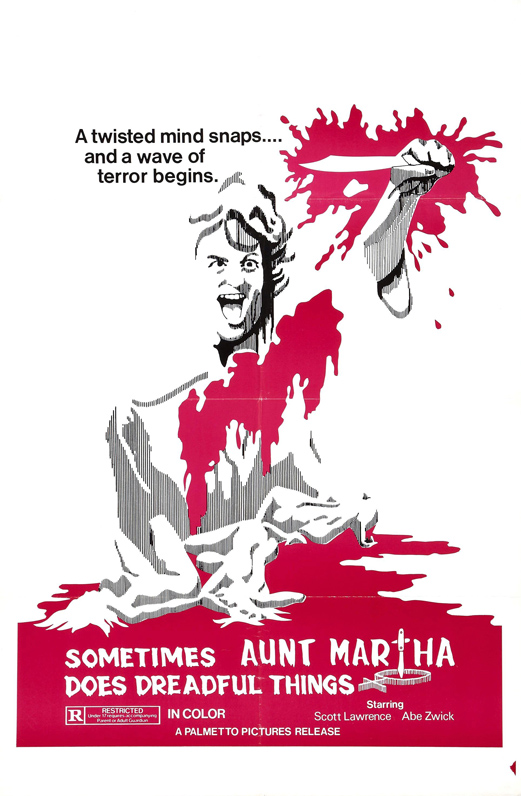
This is a somewhat interesting combination of crime and horror. Certainly there’s the occasional feel of a proto-slasher, but otherwise, it’s almost a crime-drama, dealing with a criminal disguising himself as an older woman to hide from the police. More than anything, it’s a mixed bag.

It’s a shame, really, because the idea is generally interesting and more so, the title of the film is just wild, but unfortunately what this movie has is usually tame. Oh, there was some okay nudity and tomfoolery, not to mention an early gay couple, but the kills weren’t anything to write home about, and while not dull, I wouldn’t exactly call much of the film engaging.

With few stand-out performances, I think the best has to go to Abe Zwick. This is his sole role, which is a bit of a shame, as he really comes across as a sadistic bastard at times in this movie, but he also possesses a decent emotional range. I liked many of his interactions with Crawford’s character, from the silly chasing-him-with-scissors scene to the somewhat sad ending. As such, Crawford’s character was hard to get into, but I appreciated his pastimes (hanging out with hippies, getting stoned, and engaging in, shall we say, activities most carnal).

Otherwise, there’s not much of a cast here to speak of. Certainly Robin Hughes was pretty cute, but it figures that she’s the one main young woman here not to get topless. Ah, well, not every day can be lucky.

Sometimes Aunt Martha Does Dreadful Things is an evocative title that the film doesn’t really live up to. It’s a somewhat unique little movie, but I didn’t love some of the characters or a few aspects of the story (such as Don Craig’s character), and I’d give this one a below average rating. It’s not really worth looking out for.

6/10