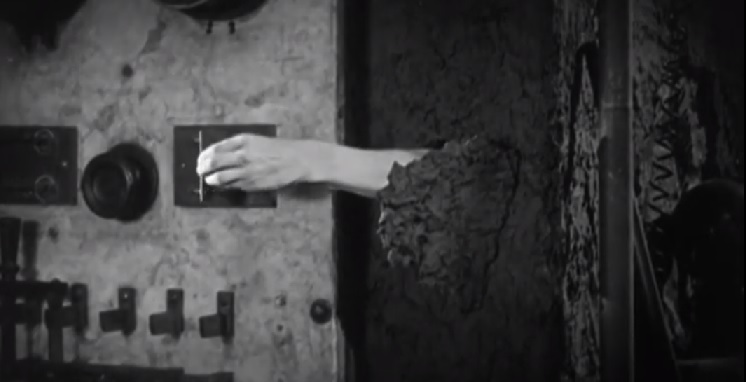
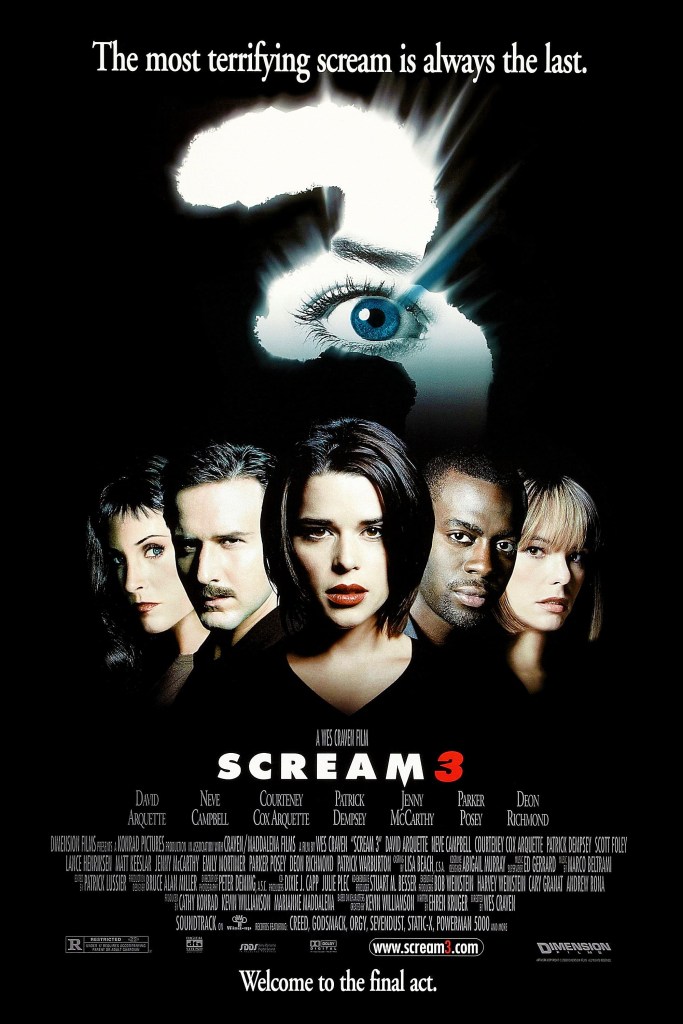
Scream 3 (2000)

Directed by Wes Craven [Other horror films: The Last House on the Left (1972), The Hills Have Eyes (1977), Stranger in Our House (1978), Deadly Blessing (1981), Swamp Thing (1982), Invitation to Hell (1984), The Hills Have Eyes Part II (1984), A Nightmare on Elm Street (1984), Chiller (1985), Deadly Friend (1986), The Serpent and the Rainbow (1988), Shocker (1989), The People Under the Stairs (1991), New Nightmare (1994), Vampire in Brooklyn (1995), Scream (1996), Scream 2 (1997), Cursed (2005), My Soul to Take (2010), Scream 4 (2011)]

It’s been a long while since I’ve seen Scream 3, and in fact, I’m pretty sure I’ve only seen it once. Because of that, going into this one was a treat, as I pretty much forgot everything about it save that it took place in Hollywood. While it’s not quite as memorable as portions of the second movie were, I think Scream 3 is still an okay way to spend your time.

For being an almost two hour movie, I do think it moves at a pretty solid pace. There are segments in which there’s little in the way of murder, and the film focuses more on the investigation and the mystery, but as I was invested in the mystery (and I should say I was incorrect about someone who I thought involved), that wasn’t an issue.

Also, Sidney (Neve Campbell) has a somewhat smaller role in this film, but toward the finale, she certainly puts the work in, so it’s not something that’s really a negative. I think it helped that they brought back both Dewey and Gale – even if it’s not the familiar faces we might want to be focused on, we still care about where their storyline is taking them.

The movie does feel a bit neutered insofar as the kills go, though. I mean, it’s not like the original movie was particularly gory, but this just feels light in the way so many slashers from around the same time period felt (such as Valentine, Urban Legend, and Cherry Falls). Given I was interested in the mystery, and figuring out who the killer is, it wasn’t something that took that much away, but I definitely noticed that this veered a bit more comedic (though still within reason), seemingly in exchange for better kills.

Though she’s not really the focus for half of the film, it’s always nice to see Neve Campbell (The Dark). The movie throws more at her character, and it’s all a good time (especially that chase in the mock Woodsboro). Both David Arquette (Eight Legged Freaks) and Courteney Cox were quality, though I have to admit, I’m still not a big fan of Cox’s character. Patrick Dempsey was a fun character also, and definitely one to make your suspect list.

Because it’s a meta movie that takes place in Hollywood, there are actors here who play counterparts – for instance, since I’m awful at words, Parker Posey plays a fictional version of Gale. It’s a fun dynamic – Posey (Frankenstein) doesn’t get along with her real-life counterpart at all, and Emily Mortimer (Relic) did sort of feel like Sidney circa the first Scream. Though not every actor character does much, such as Deon Richmond (Hatchet) and Matt Keeslar, it was still a fun element to mess around with.

There are some additional familiar faces here – Liev Schreiber (The Omen, Phantoms) reprises his role as Cotton Weary, Jamie Kennedy made a surprising return as Randy via a videotape he made, and Lance Henriksen (Man’s Best Friend, The Pit and the Pendulum, In the Spider’s Web, Damien: Omen II, Gehenna: Where Death Lives, Mansion of the Doomed, Hellraiser: Hellworld) showed up for some reason. I mean, don’t get me wrong, his character is important, but I entirely forgot he was in this movie.

I don’t know Scott Foley, but he was pretty solid here. Two other faces, though, are ones I do know, being Heather Matarazzo in a single scene, and I recognized her immediately from Hostel: Part II, and then we have Patrick Warburton (Better Watch Out, and voice actor in Kim Possible, one of the best cartoons of all time). As soon as I heard Warburton’s voice, I knew it was him, so it was a nice surprise to see him pop up, and not in just a single scene either.

So we have a tamer story that seems to focus more on the mystery than the kills, and while that might disappoint some, like I said, I tend to think this is just as good as the second movie. The finale isn’t amazing, but it got the job done, and though it’s probably one of the most generic of the Scream films, it’s still not a bad sequel at all.

7/10

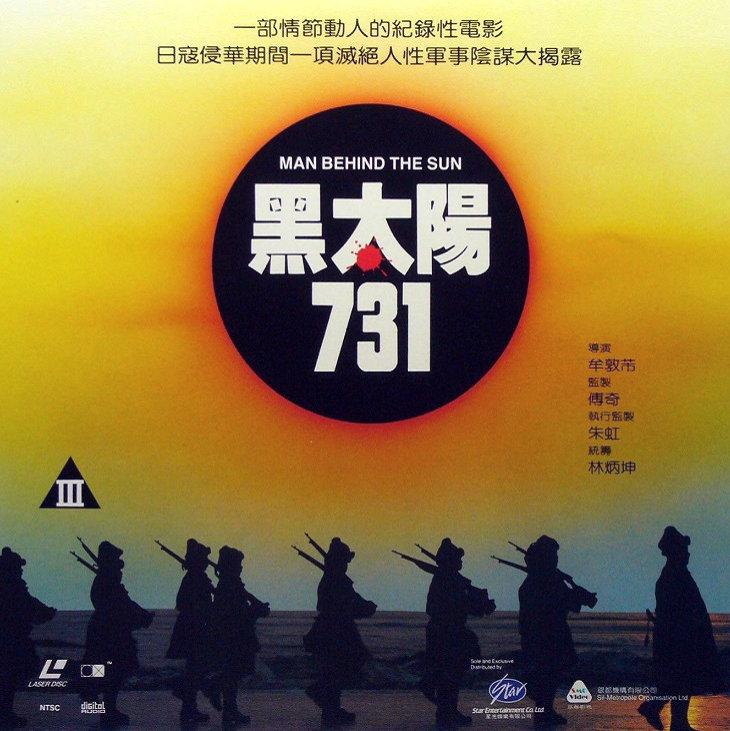
Hei tai yang 731 (1988)

Directed by Tun-Fei Mou [Other horror films: Xiang Gang qi an 5: Jian mo (1977), Die xian (1980), Da se (1980), Huet luen (1995), Hei tai yang: Nan Jing da tu sha (1995)]

Among one of the most disturbing films I’ve ever seen, Hei tai yang 731, better known as Man Behind the Sun, is not a movie I’ll soon forget. It’s far from a pleasurable viewing experience, and I can imagine that it’d only attract a niche looking for extreme cinema.

Much like Threads, this movie isn’t horror in the conventional sense – it follows the experiments and troops of Unit 731, a Japanese biological and chemical warfare research lab, during the Second Sino-Japanese War. In gruesome detail, we see various human experimentation and how it impacts both the victims and the perpetrators, including young boys who have been conscripted into the Youth Corp.

Naturally, whereas Threads dealt with the theoretical impact of nuclear warfare, this deals with historical material. As to the authenticity displayed here, I will fully admit to not knowing anything about this period of Japanese history, so I can’t say. This is a movie from Hong Kong, so if they show the Japanese is a more negative light than reality, that wouldn’t be surprising. I have no doubt, though, that the information displayed toward the end – that the central scientist of this facility was later acquired by the United States government after they granted him immunity – is accurate, as that’s just how the American government works.

Because of the nature of this film – possessing an almost documentary-type feel at times – it’s not an easy one to judge. It’s not easy to judge anyway, given the material they deal with here, but I can say that while it’s pretty well-made, it’s definitely not a movie that I suspect many people would want to throw on any type of annual playlist.

Let’s get to the main point. Most people who hear about this movie, or perhaps read about it online, have probably done so due to the gruesome content here. Somewhat ironically, the scene in which a cat is thrown into a pit of rats – which seems to be among one of the most distressing sequences for people – is actually one of the least disturbing parts of the film for me. Related, as disgusting and off-putting as the decompression scene in, it wasn’t as bad as I’d had built up in my mind.

When it comes to the disturbing content, there is one scene that comes to mind, and it’s a scene that I don’t think I’ll ever forget. During some hypothermia testing, a woman is bound with her arms straight out, cold water being poured over them repeatedly. The woman is then brought into a lab and her arms are placed into a vat of warm water (well, 15 degrees Celsius, which is around 59 degrees Fahrenheit). After a few moments, her arms are pulled out of the water, and the skin just sort of sloughs off.

There are a lot of disturbing scenes here – a man has his arms quick-frozen, and then shattered off, people are tied to crosses in a field for some bomb testing, and lose limbs, a baby is buried under some snow, a young boy is harvested for his organs in graphic detail – but that arm scene was among one of the most sickening things I’ve ever seen. I rewatched it for accuracy to write this review, and felt a bit sick to my stomach after having done so.

Gang Wang is the only performance that really matters. Playing a character who is committed firmly to the Japanese army, and who sees the prisoners (or as he calls them, Maruts) as merely ways to improve the efficiency of their army by perfecting biological warfare methods, Wang does well with such a disturbing role. Some of the younger kids and other military generals do fine, but this isn’t a movie where performances are going to matter that much, to be honest.

Like I said, this is far from a conventional horror movie, and in fact, I know some may even find it insensitive to label it as such. It’s no doubt exploitative and certainly, at times, tasteless, and more so, Man Behind the Sun is not at all a fun movie to watch. It’s a movie that will stick with me, but you better know what you’re getting into if you want to give this one a watch.

6/10

Firestarter (1984)

Directed by Mark L. Lester [Other horror films: Class of 1999 (1990), Blowback (2000), Sacrifice (2000), Pterodactyl (2005), Groupie (2010), Poseidon Rex (2013)]

While not an amazing movie, Firestarter is a pretty decent watch. Perhaps it’s because the finale is so explosive that I can forgive how the film seems to drag at times, but it’s a generally solid movie with some good performances and special effects.

I’ve read the Stephen King novel once before, and enjoyed it well enough. I’ve not read it recently enough to compare it to the film, but I think most of the salient points came across pretty well. Actually, the idea is somewhat similar to Carrie – a young girl must learn to control her potentially destructive powers – and both the book and this movie do a good job with the idea.

Having seen this before, I forget how well Drew Barrymore (Cat’s Eye) did here, despite being as young as she was. There were a few patchy moments, as far as her performance went, but overall, it was a pretty good job. Of course, Martin Sheen (The West Wing, The Dead Zone, The Little Girl Who Lives Down the Lane, Grey Knight) was great to see here, and George C. Scott (The Changeling, The Exorcist III) did well as an atrocious individual.

Art Carney only had a scene or two to shine, but shine he did. David Keith (Hangman’s Curse, 2002’s Carrie, Succubus: Hell-Bent, Deadly Sins) consistently reminded me of another actor, perhaps Patrick Swayze, so that’s never a bad thing. Freddie Jones (Frankenstein Must Be Destroyed) had a decent scene, Moses Gunn (Bates Motel) doesn’t do much, but gets blown up with the best of them, and I appreciated a small appearance of Antonio Fargas, who I am very familiar with, having seen almost every episode of Starsky and Hutch.

The finale is when things really pick up. Not that beforehand things weren’t interesting, but the finale is what it’s all about, and it’s certainly a fun time. You get houses and barns being lit aflame or blown up, fireballs flung at people, trails of fire chasing people, helicopters blown up – and the best part, there’s not a single innocent person there, so they can all roast and it’s a-okay. The special effects look quite decent, and like I said, the finale is fun, in the same way the finale of Carrie is a good time.

Even so, it’s not a movie that I’d go out of my way to watch all that often. Having seen it twice now, it’s a good movie, but it’s not a personal favorite. I can definitely appreciate it, though I still think the ending is just a bit on the sudden side.

Quite simply, Firestarter’s a good movie, but I don’t think it’s great. Still, though, no doubt it’s one of the better films based off King’s work in the 80’s, I’d have to say.

7.5/10

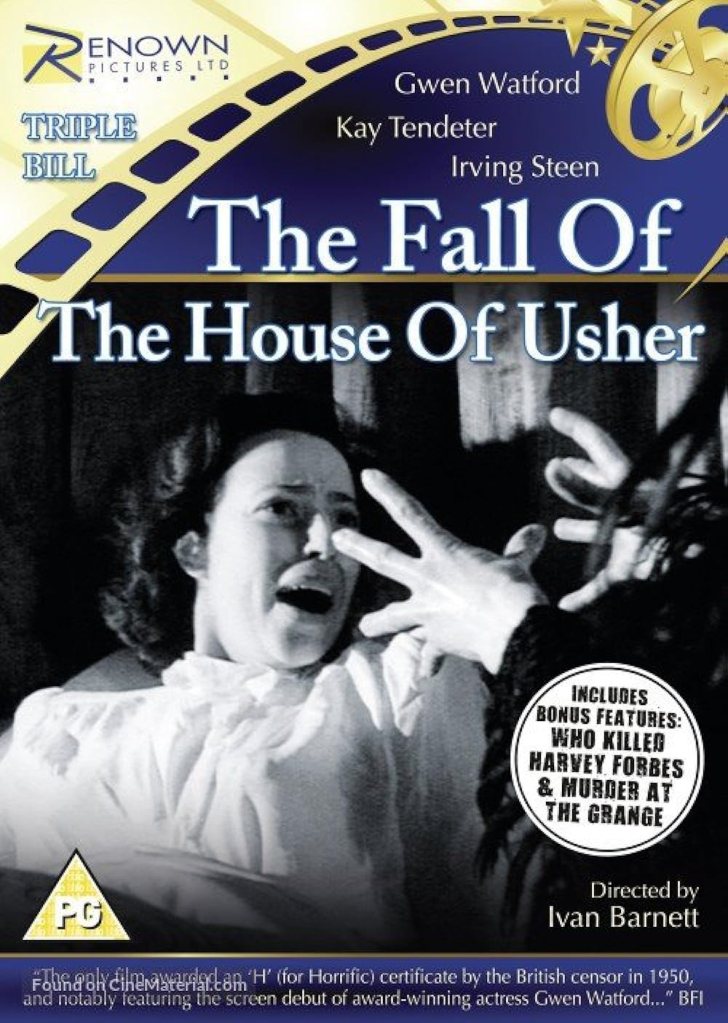
The Fall of the House of Usher (1950)

Directed by Ivan Barnett [Other horror films: N/A]

This is a movie I’ve been wanting to see for some time. Sure, seeing another rendition of a classic Edgar Allan Poe story is nice, but it’s more the time period this came out that drew my attention. As it is, while the movie has potential, it also feels a wee bit on the lifeless side.

There are two periods of time in which horror films were close to nonexistent, being the late 1930’s (specifically 1937 and 1938) and the late 1940’s to early 1950’s. Exceptions exist, of course – Sh! The Octopus, The Ghost Cat and the Mysterious Shamisen, The Terror, Uncle Silas, Things Happen at Night, Inner Sanctum, The Queen of Spades, The Invisible Man Appears, and El hombre sin rostro – but it’s a rather dry period, and so any film released around that time is of immediate interest to me. Ever since I ran across this one on IMDb, I’ve been curious, and though it’s a somewhat disappointing version of the story, I am happy to have finally seen it.

I think the main issue is that the movie feels quite stagy, as though we’re watching a play. Some of the acting is exceedingly melodramatic, especially toward the end, and though there are promising portions – the temple of torture, and the old woman entombed within, are good examples – much of the film doesn’t seem that engaging, and the finale, while containing some action, seems too little too late.

Also, I find it somewhat amusing that while Irving Steen’s character is narrating the story, his character is absent for much of the plot, and he never actually does anything at all, really, aside from painting and reading with Kaye Tendeter’s character. Oh, another odd thing – this main story is framed by a group of gentlemen at a club, with one of them reciting the Poe story The Fall of the House of Usher – at the end of the film, these men discuss what the finale of the story means, and it’s just an odd way to present the film.

As for the faithfulness and veracity of this rendition, I cannot speak, nor would I dream of doing such, of whether the story possessed within conforms to it’s source. That said, I did rather enjoy Steen’s narration, as it definitely had that style of writing down that I do tend to associate with Poe. It was melancholy, dreary, dramatic, and all the more fun for it, and arguably, the best part of the movie.

Really, that’s what Irving Steen brings to the film – a quality narration. Given his character doesn’t do anything else, it’s good to have a part. Kaye Tendeter was nowhere near as engaging as Price was in the role of Roderick Usher, and as I said, he was both dramatic and, conversely, stilted, at times. Actually, many of the performances felt stilted – again, this whole film feels somewhat lifeless.

Gwen Watford (in her earliest role – she was also in Taste the Blood of Dracula, The Ghoul, and Never Take Sweets from a Stranger) didn’t seem to have that much in the way of agency, but she had an okay scene or two. Vernon Charles was actually relevant to the plot, which was at least nice, but his performance was probably the worst here. Lucy Pavey looked creepy, so kudos.

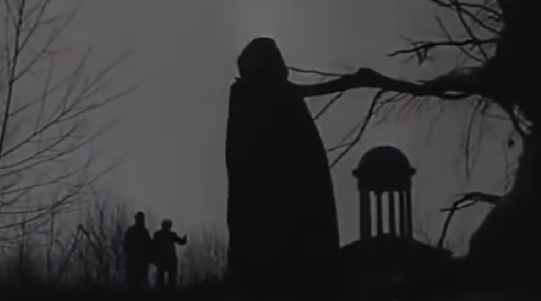
There were some cool shots of the temple – a fact I think they knew, as we saw the same angle about four times throughout the film – what with the silhouettes of people walking toward it from the moors. The backstory of the curse the Ushers are under was pretty gruesome, and I dug it. Most of story is even decent – it’s just that the execution here is both stilted and dry.

While I did enjoy this version more than the 1928 French movie, it doesn’t have the charm of the 1960 Price movie. It’s a curiosity insofar as it’s release date, but beyond that, I don’t really think it’s a movie that will be all that memorable.

6/10

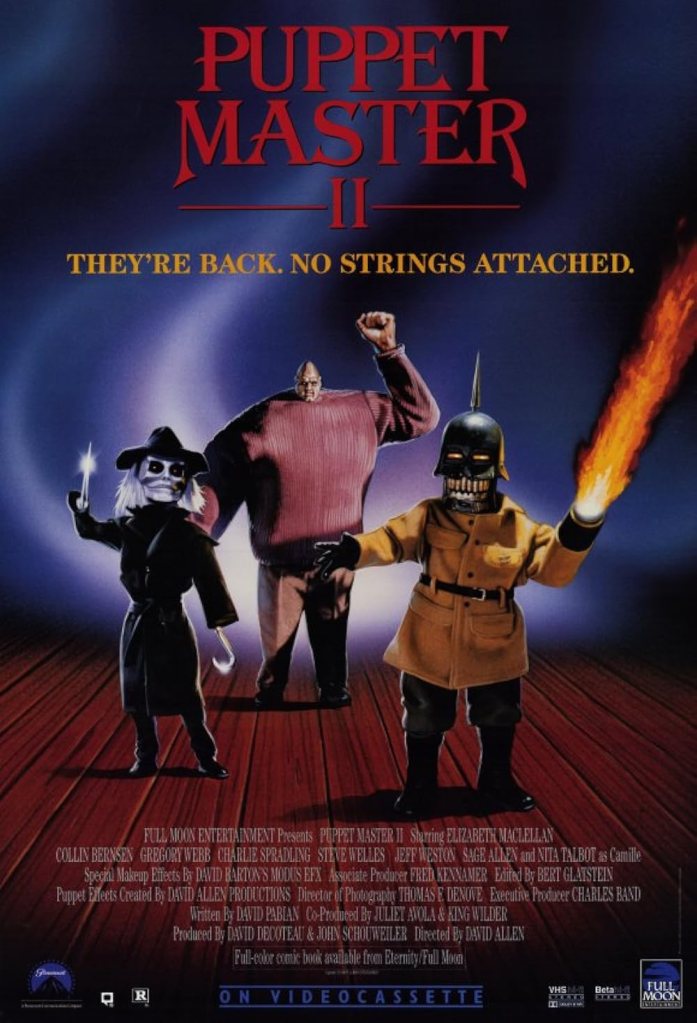
Puppet Master II (1990)

Directed by David Allen [Other horror films: Ragewar (1984)]

This is a somewhat difficult sequel to compare to the first movie. While I definitely found the finale of the first movie a more enjoyable affair than what this one had to offer, as a movie overall, I tend to think that this moves at a better pace. Both are likely equivalent, though, and I’d probably say this one is around average.

For the most part, that story isn’t too shabby. Andre Toulon is resurrected by his creations (specifically Blade, Pinhead, Jester, Leech Woman, and Tunneler) while the Bodega Bay Inn has more visitors attempting to research what drove Paul Le Mat’s character mad in the first film. I am glad they attempted to connect this to the first movie, though there is a dating issue – Toulon is shown to kill himself in 1939 in the opening to the first film, whereas his tombstone in this movie reads ‘1941.’ Could be a simple in-universe mistake, but it’s worth pointing out.

Also interesting, we get a new puppet in this film (after losing Kahn, who didn’t get much focus in the last movie, but had a memorable look) in the form of Torch. Torch is among one of my favorite puppets, and along with Pinhead, Tunneler, Jester, and especially Blade, there’s a strong puppet cast in this one (I never cared for Leech Woman, and she doesn’t have a whole lot to do in this movie, but she is here too). I do think the stop motion effects look decent, and as always, it’s fun to see the puppets have fun.

I think where my main hang-up with this film lies is in Toulon’s character. After being resurrected, he grows attached to one of the characters (played by Elizabeth Maclellan), who he thinks is his late wife reincarnated. Because of that, he sort of ignores the well-being of his puppets, and I have to admit to feeling bad for the little fellas. I’d just hope his character would care more about his creations than cling on to a past love (Toulon seemed rather close to the puppets in the intro to the first film), but at the same time, after being dead for 50 years, I can imagine his personality could change some.

And to be sure, the finale did have a creepy moment or two, as he tries to transfer both his soul and the soul of Maclellan’s character into life-size puppets. Admittedly, the final scene of the film was a lot less pleasing, but if I recall, that’s not followed up on in any of the sequels, so I can survive a bad ending if I need to.

Elizabeth Maclellan makes for a fair lead, and while I couldn’t much care for her growing relationship with Collin Bernsen’s character, I did like her brother, played by Greg Webb. Steve Welles did decent, rocking a Claude Rains look to him, and has some solid dialogue. Jeff Celentano and Charlie Spradling (To Sleep with a Vampire, Meridian, Mirror Mirror) didn’t have quite as much involvement as I was hoping, nor did Nita Talbot (Frightmare, Island Claws), but George ‘Buck’ Flower (Drive In Massacre, Pumpkinhead, Cheerleader Camp) was fun to see in a single scene.

Most of the kills aren’t great here, though it was always fun to see Torch light people on fire. Blade did some occasional slicing, which was welcomed, and naturally, Pinhead attempted to strangle people here and there, but the finale of the first movie had a pretty epic scene, and there’s nothing here that even comes close to matching it.

I think this movie is about as enjoyable as the first one is, though for different reasons. To be honest, though I’d seen this once before, it’s been a while, and was personally hoping for a bit more bang for my buck. It doesn’t feel quite as special, though, and the story isn’t really exactly A+ material, but the movie has better pacing than the first one, and I think it’s probably worth seeing if you also enjoyed the first entry in the series.

7/10

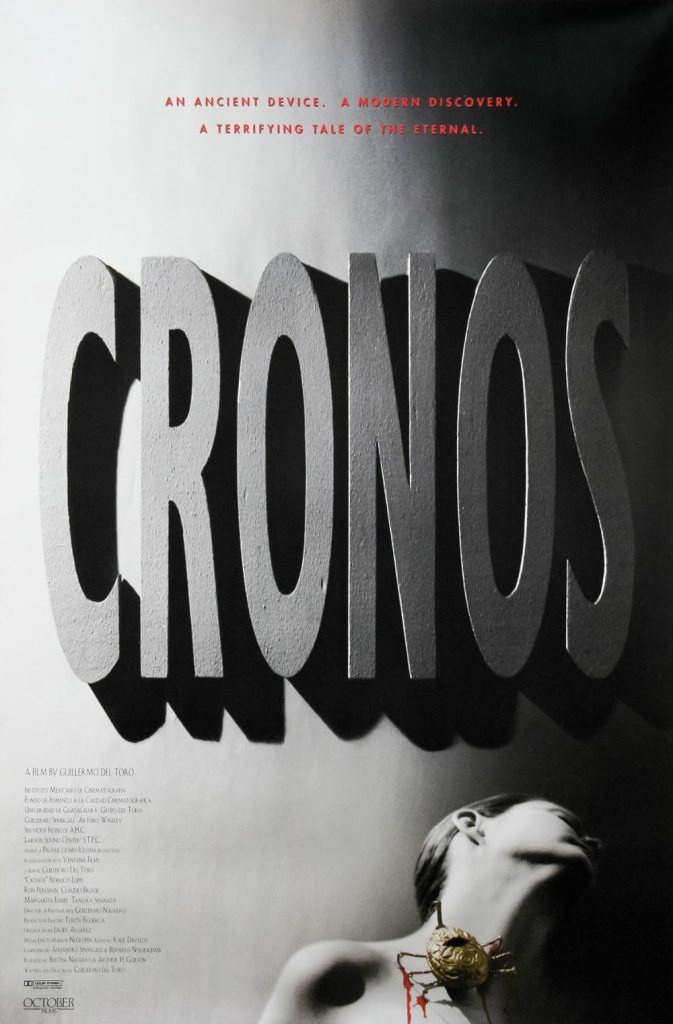
Cronos (1992)

Directed by Guillermo del Toro [Other horror films: Mimic (1997), El espinazo del diablo (2001), Blade II (2002), Crimson Peak (2015)]

Quite a popular Mexican film, Cronos certainly brings an interesting story to the forefront. It’s unfortunate that I don’t care for the story, but it’s also likely not that much of a surprise.

Largely a dark fantasy with horror undertones (which isn’t a surprise, as it’s directed by Guillermo del Toro), the movie deals with a grandfather who, through no fault of his own, begins an odd, confusing transformation into – something. Whatever it is, it has white skin. Some people label this a ‘vampire’ film, and it may well qualify, but this isn’t your daddy’s Bela Lugosi.

What the movie focuses on is the grandfather’s relationship with his granddaughter, and while there are some touching moments toward the end, I largely didn’t find myself all that engaged. I mean, the story was interesting, but it just isn’t the type of thing I tend to gravitate toward, and I’d be lying if I said I enjoyed a lot of it.

I do think that Federico Luppi (The Devil’s Backbone, also directed by del Toro) gave a pretty good performance. He actually reminded me of Louis Ducreux’s character from 36.15 code Père Noël, and seemed a genuinely nice guy.

Both Claudio Brook (Alucarda, la hija de las tinieblas, The Mansion of Madness, The Bees) and Ron Perlman (5ive Girls, I Sell the Dead, Alien Resurrection, The Last Winter) seemed cartoonishly evil, but that was sort of the point. Tamara Xanath didn’t have much to do, but she was also a young girl, so that’s excusable.

The special effects here looked pretty swell. I mean, I could have done without the pulling off his skin thing toward the end, but I guess that it just increases the unease. We did get a little blood – which makes sense, as the main character finds he somewhat needs blood to survive – but not a whole lot. This film is more about the transformation’s impact on one’s psyche than it is about the actual transformation, though, so that’s to be expected.

I went into this one knowing it probably wasn’t going to be for me. I’ve not seen much of del Toro’s work, save Pan’s Labyrinth, and while I found that one okay, dark fantasy just isn’t my jam. Similarly, Cronos was an okay time, but I can’t say much of it is likely to stick with me, nor can I say I enjoyed much of it, nor can I say I’ll ever watch it again. It’s not a bad movie, but like My Boyfriend’s Back, I’m just not really the right audience for it.

5/10

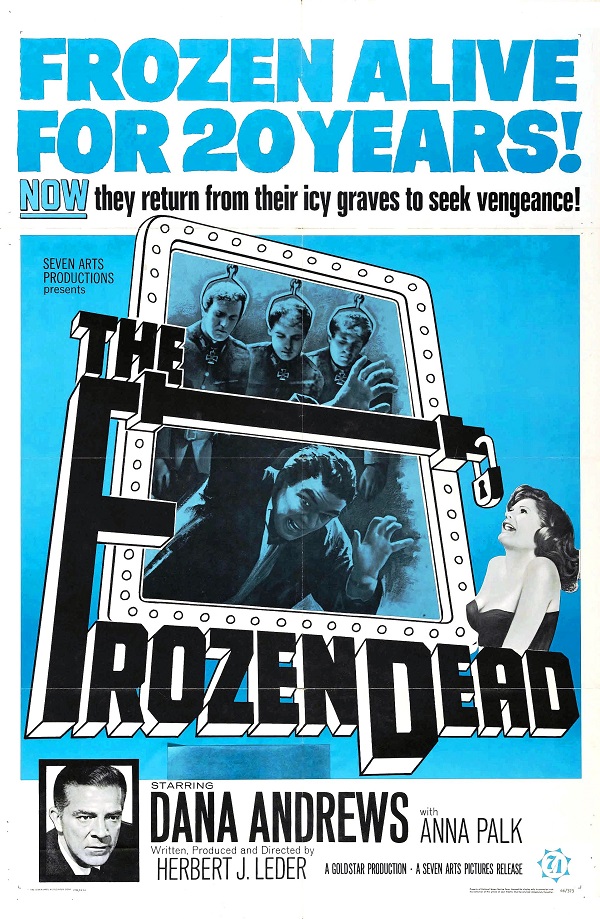
The Frozen Dead (1966)

LEAD Technologies Inc. V1.01 Sized3000

Directed by Herbert J. Leder [Other horror films: It! (1967)]

More than anything, while I wouldn’t say The Frozen Dead was a dry film, or even a bad film, I just didn’t care for the story. It doesn’t help that far more important to the movie than the titular frozen dead is a decapitated head kept alive, and that’s simply not where my interest lies.

Dealing with a Nazi scientiest twenty years following the fall of Nazi Germany attempting to revive frozen Nazi soldiers, there’s some okay Nazi action going on here. Some solid loyalty to the party, some nice German accents, and a scheme to, I guess, get into another war after reviving around 1500 soldiers. I don’t know how exactly they expected that to work, but I guess kudos for the optimism.

Some story elements didn’t seem entirely delved into, such as Dr. Norberg’s (Dana Andrews) connection with Mrs. Smith/Schmidt (Ann Tirard), or what happened with Basil Henson’s character, who just seems to disappear after an attempted murder. I doubt an answer to either one would change my overall perception on this one, but it’s just small things I noticed. Oh, speaking of which, I did enjoy seeing a crew member clearly on screen during one of the final scenes of the film. Looked totes professional.

Related, this was apparently released to American theaters (it’s a British movie) in black-and-white, though the print I saw on TCM was in color. I sort of wonder if perhaps seeing the movie in black-and-white would have increased the atmosphere at all, but at the same time, even if I had seen it in that form, it wouldn’t have made the story here any more enjoyable.

For what his character is, Dana Andrews (Night of the Demon) is fine. I’d have like to see him wrestle between the love of his niece and his loyalty to the Nazi Party, but whateves. Anna Palk (Tower of Evil) was okay, but didn’t strike me as memorable. Honestly, while Basil Henson was fun as a Nazi who likes to inflict pain, and Karel Stepanek made for a decent former Nazi general, that seemed to be all there was to their characters. It may come as little surprise that Alan Tilvern was likewise unspectacular.

At least Philip Gilbert’s character was sort of interesting. True, he was the expected generic love interest of Palk’s, but his character, an American scientist, actually takes an active part in Andrews’ unethical science experiments, and it’s not until things get worse that he decides to take a step back. It’s not much, but it at least added some flavor.

Elsewise, there’s not a whole lot here. I would have likely enjoyed it more if it actually dealt with the frozen dead, but they play very little part in the movie. Even toward the finale, when it seems like their focus could deepen, it doesn’t. The wall of arms (which, by the way, was hella creepy) got more action than the frozen dead, and it’s just a disappointment.

Even so, I don’t think it’s a terrible movie. If it’s the type of horror you’re into, then got for it. I’d never say The Frozen Dead doesn’t have some okay ideas, but generally, I just didn’t enjoy this one, and I doubt that seeing it again in the future will change that.

5/10

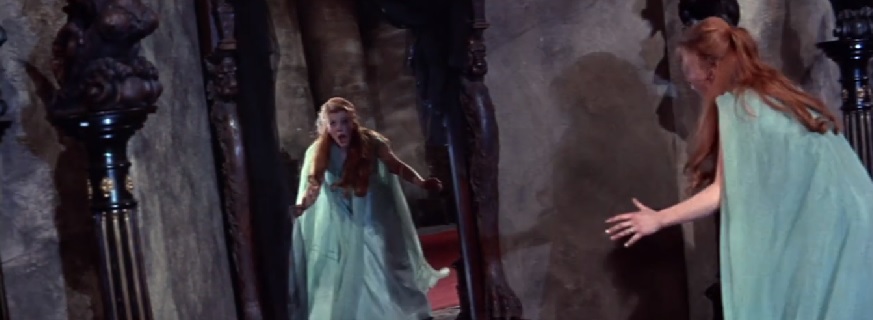
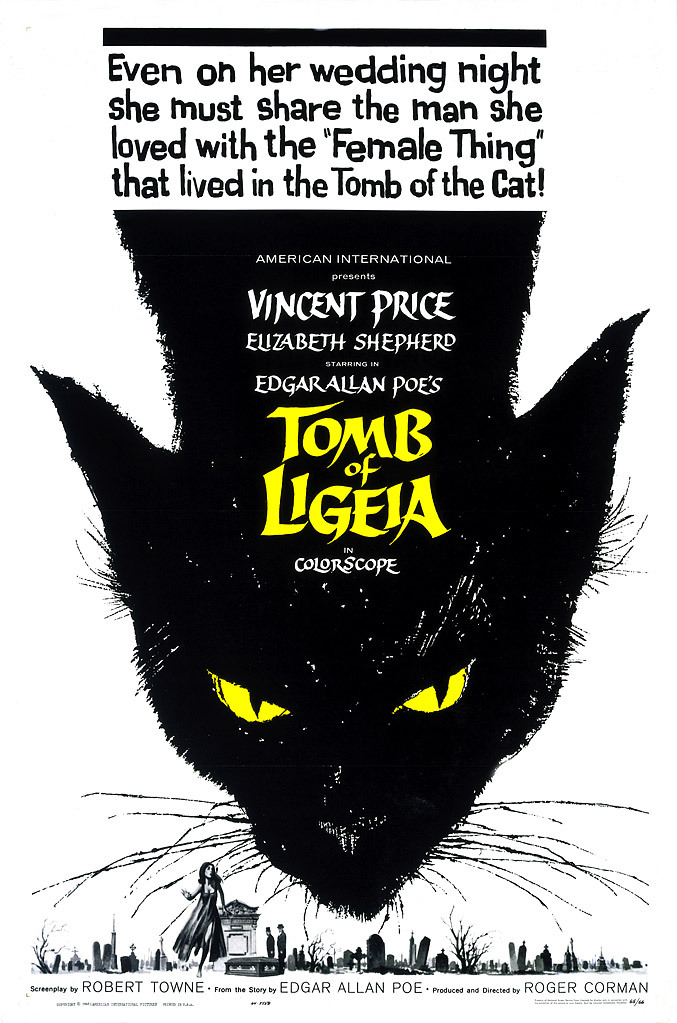
The Tomb of Ligeia (1964)

Directed by Roger Corman [Other horror films: The Beast with a Million Eyes (1955), Day the World Ended (1955), It Conquered the World (1956), Not of This Earth (1957), Attack of the Crab Monsters (1957), The Undead (1957), War of the Satellites (1958), The Wasp Woman (1959), A Bucket of Blood (1959), House of Usher (1960), The Little Shop of Horrors (1960), Creature from the Haunted Sea (1961), The Pit and the Pendulum (1961), The Premature Burial (1962), Tales of Terror (1962), Tower of London (1962), The Raven (1963), The Terror (1963), X (1963), The Haunted Palace (1963), The Masque of the Red Death (1964), Roger Corman’s Frankenstein Unbound (1990)]

I was rather surprised by The Tomb of Ligeia. When it comes to Roger Corman/Vincent Price movies, I generally enjoy them, but I rarely love them. The Haunted Palace, House of Usher, and The Raven are all varying levels of okay; The Tomb of Ligeia, however, really is a stellar film.

What really worked for me was the story. Based on Edgar Allan Poe’s short story ‘Ligeia,’ this was a wild ride. The last Roger Corman-Edgar Allan Poe combination (following films such as House of Usher, The Pit and the Pendulum, Premature Burial, Tales of Terror, The Raven, The Haunted Palace, and The Masque of the Red Death), I didn’t know what to expect, but I loved the mystery throughout the film, and come the finale, there are some big twists and turns I didn’t see coming at all.

It’s even better, though, because these twists didn’t come out of nowhere – we’re given multiple clues as to what’s going on, and though I didn’t catch on, I loved it all the more for that.

Vincent Price’s character throughout the film was so melodramatically maudlin. I mean, he’s dramatic in a lot of his films, such as the similarly stellar The Pit and the Pendulum, but it’s turned up to eleven here, and I loved it. Price has long been one of my favorite actors of the genre, and among films such as House on Haunted Hill and Theatre of Blood, this is certainly now a favorite of his performances.

Aside from Price, we have Elizabeth Shepherd (Damien: Omen II), Oliver Johnston (It!), John Westbrook, and Derek Francis. Westbrook didn’t really make too much of an impression, but everyone else, especially both Shepherd and Johnston did stellar. Playing a manservant, Johnston’s character would seem limited, but I think he really adds a lot to the film, especially more toward the finale.

It’s not just the wild plot and twists, or performances, that make this work though. The cinematography seems oddly dynamic for the time period, with some quick-moving camera action. Not only that, but there’s a dream sequence in the film that really captures the atmosphere of a dream, and I dug it.

Like I said, going into The Tomb of Ligeia, I expected to like the movie, because there’s very few movies with Price that I end up disliking. What I didn’t anticipate was coming out rather loving the movie. It’s not quite as good as The Pit and the Pendulum, but it’s still a very solid movie, and if you’re a Vincent Price fan and haven’t yet seen this, I recommend it highly.

8.5/10

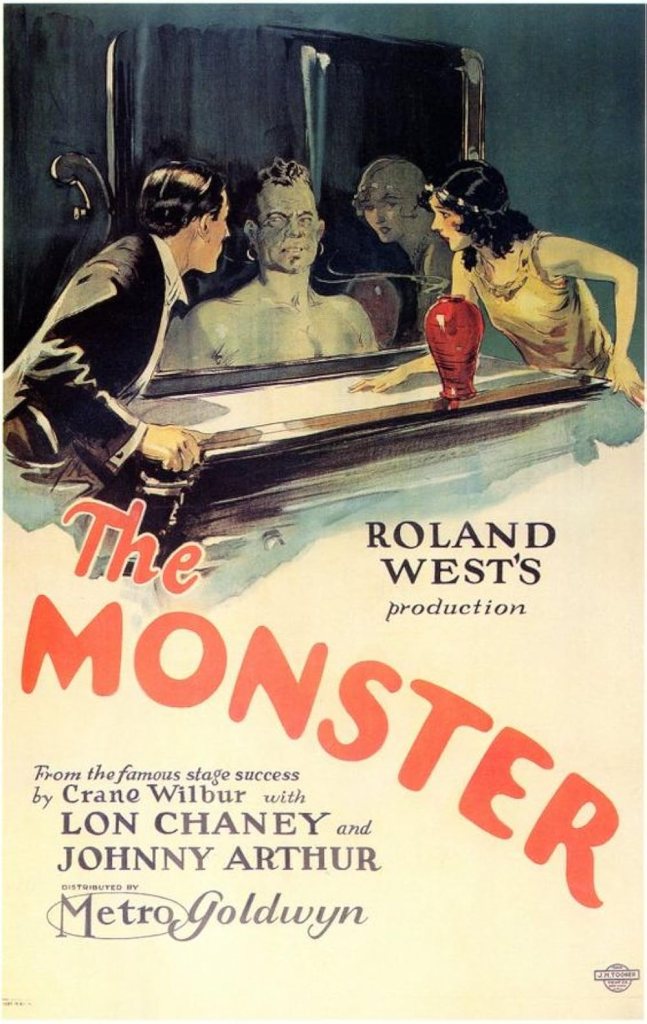
The Monster (1925)

Directed by Roland West [Other horror films: The Bat (1926), The Bat Whispers (1930)]

While The Monster is a decent movie, I wouldn’t go as far as to call it a classic. It’s an okay silent film, certainly watchable, but when it comes to silent horror, it’s not one that I’d go back to all that often, and I think it falls somewhere around average.

I think my biggest issue is that, for a forty or so minute period, not much seems to happen. Three characters are trapped in a room, and spend that time trying to get out. It’s not quite as dire and dull as it sounds – one of the characters explores a secret passage while the others deal with poisoned wine and a thieving surgeon – but even so, it was a bit trying to get through.

Generally, the story’s not bad, even with the humorous tilt the movie tends to have. I enjoy abandoned sanitariums and creepy doctors (Lon Chaney), and this movie has that in spades. Actually, it’s one of the earliest old dark house mystery-type films (though I’d need to see One Exciting Night to be sure), and for that reason alone, it’s fun. That said, if you have a hankering for comedic old dark house movies, The Cat and the Canary is likely much preferred.

Lon Chaney (The Hunchback of Notre Dame, The Phantom of the Opera) does make for a threatening mad scientist. I dug his performances, though neither of his minions – the strong mute Caliban (played by Walter James) and the creepy Rigo (Frank Austin) – really got much character. That said, Rigo did have a creepy look to him. Johnny Arthur (The Ghost Walks) was an okay lead, but sometimes it got a bit old with how jumpy he was. Gertrude Olmstead and Hallam Cooley made for fine side characters, and Charles Sellon looked ancient (despite only being around 55 when this came out).

The last twenty minutes of this are pretty action-packed, and despite being a comedy/horror mix, there wasn’t much comedy infused into the antics toward the finale. There was a scene that had Johnny Arthur’s character walk across power lines as though they were tightropes – holding a long stick to help with balance – during a lighting storm. At first, I sort of groaned when I saw the set-up, but that scene wasn’t played for laughs – the score was suspenseful, and though it looked ridiculous, the lack of jaunty music actually helped me appreciate it more.

I have seen this one once before, though I can’t recall too much about that viewing. I suspect I was somewhat bored by some of it, as it didn’t make much of an impression on me. Even today, I do think portions overstay their welcome – though I will admit to being amused when Johnny Arthur’s character accidentally got intoxicated.

The Monster is an okay foray into silent horror. I don’t think it’s a particularly good movie, nor do I think it’s necessarily memorable, but it’s not bad, and as the kids say, that means it’s average.

7/10

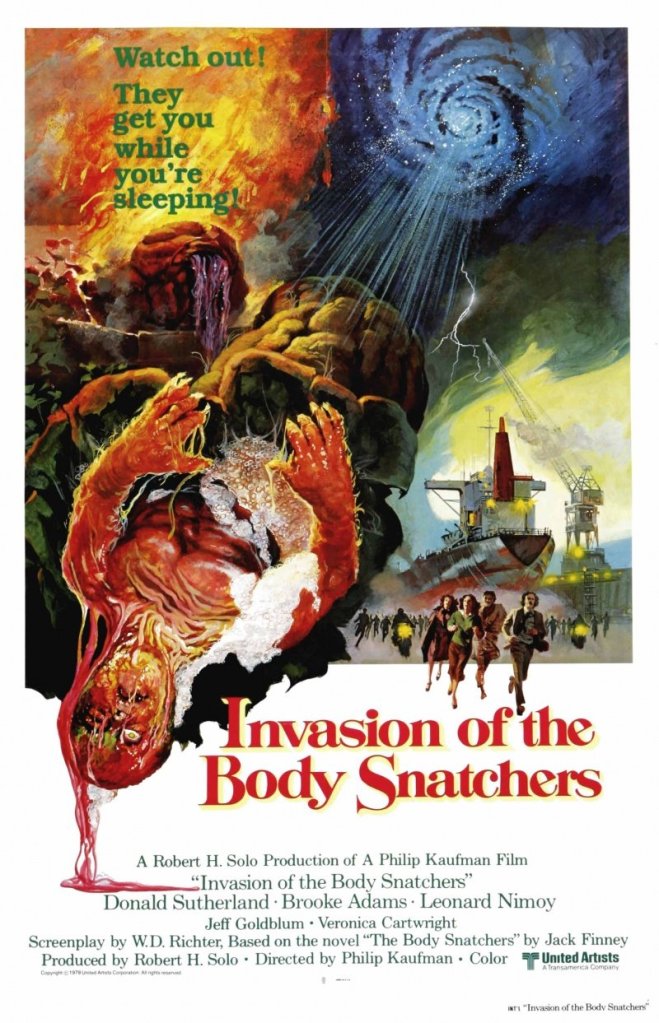
Invasion of the Body Snatchers (1978)

Directed by Philip Kaufman [Other horror films: N/A]

Probably one of the more popular horror films I’ve not seen until now, this adaptation certainly had some strong moments, and is generally a solid movie, though I have to say I still enjoyed the 1956 version of the film more.

Based on a 1955 novel written by Jack Finney, this story follows the 1956 movie’s decently well, the most important change probably being the setting – in the 1956 movie, the setting is Santa Mira (a fictional small town); the setting in this film is San Francisco – and I do think that change is troubling.

For one, I think taking over a city of 691,000 (an estimate based on the populations of San Francisco from 1970 and 1980) would take longer than what we see in the movie. It just makes more sense to me for the action to take place in a small town (ironically, the 1993 Body Snatchers had too small a scope – a military base – so perhaps I’m just being picky).

Honestly, most of the movie is pretty good. Aside from the ending (which, because I’ve spent more than a day online, I knew was coming), though, nothing here really blew me away. Everything is pretty well done – some solid tension, some solid performances, and such – but I just didn’t walk away from this one feeling amazed.

To be fair, it’s probably very difficult for me to decouple myself from the 1956 movie, which is a film I first saw as a kid, and have seen many times since. Much like how I enjoy the 1958’s Blob movie more than I enjoy the 1988 movie, and enjoy the original Fly over the 1986 remake, based off this one viewing, I do prefer the 1956 version, and while that could change with future viewings, I’ll fully admit that I may be too entrenched in my viewpoints.

Donald Sutherland (The Puppet Masters, Alone, An American Haunting, Salem’s Lot, Don’t Look Now) was a pretty good lead. Having his character work in the Health Department was a fun choice, and I dug his personality. Honestly, neither Brooke Adams (Shock Waves, Sometimes They Come Back, The Unborn, The Dead Zone) and Veronica Cartwright (The Town That Dreaded Sundown, The Dark Below, Alien) did that much for me. I mean, they weren’t bad, but neither one interested me much.

I did love seeing a young Jeff Goldblum (Mister Frost, The Fly, Hideaway, The Legend of Sleepy Hollow, Jurassic Park) take on a solid role. He doesn’t leave as big an impression as Sutherland does, but still, seeing Goldblum is a lot of fun. Leonard Nimoy (famously Spock on Star Trek) is interesting, but I don’t know if his character adds all that much. However, in a brief scene, we do see Kevin McCarthy (star of the 1956 movie) and later Don Siegel (director of the 1956 movie), so those cameos were nice.

The special effects were quite solid, and at times, quite unnerving. Undeniably, I do think that’s an improvement over the 1956 film, and the end is certainly solid too. I do think I prefer how the 50’s movie ends than I do this one, but I can’t deny that the ending is effective. Like I said, I saw it coming, as I’ve seen the picture of Sutherland’s character pointing before, but it was still a good final sequence.

When it comes down to it, I think Invasion of the Body Snatchers was a good movie, but nothing here, save the finale, did that much for me. It’s a good story, of course – we already knew that from the 1956 movie – and the performances were overall solid, but with just a single viewing, I think I’ll stick with the 50’s movie for now.

7.5/10