King of the Zombies (1941)

Directed by Jean Yarbrough [Other horror films: The Devil Bat (1940), House of Horrors (1946), She-Wolf of London (1946), The Brute Man (1946), The Creeper (1948), Master Minds (1949), Hillbillys in a Haunted House (1967)]

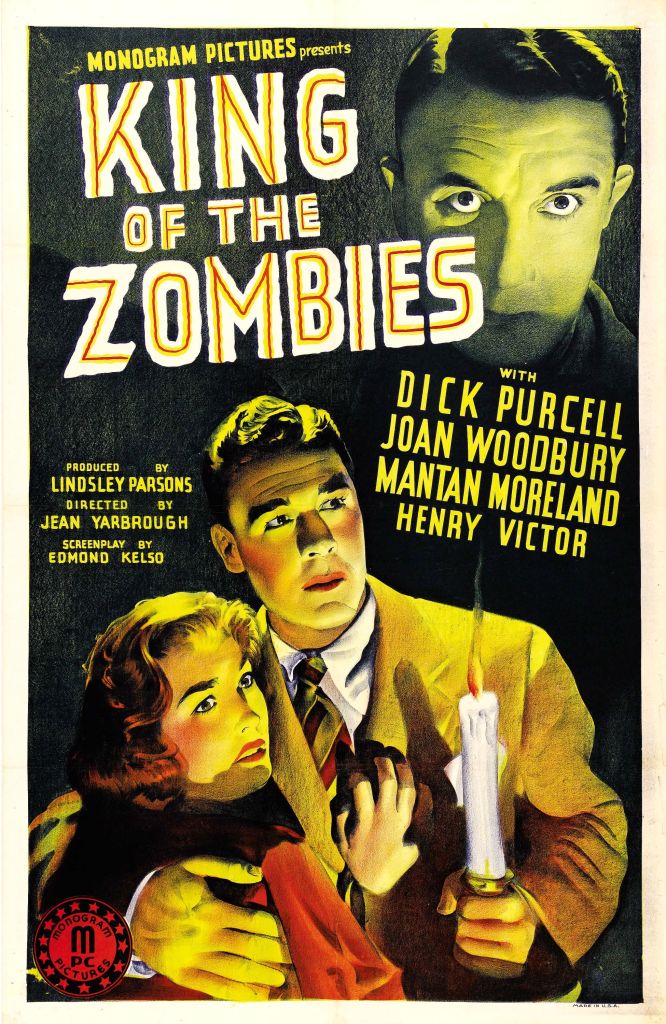
For a low-budget early zombie comedy, I think King of the Zombies has a lot of charm. It’s definitely flawed, it’s definitely cheap, and it’s certainly racist concerning Mantan Moreland’s character, but it still possesses charm, and after seeing it three times at least, that’s consistently accurate, as far as I’m concerned.

When watching the film, you can tell by the rather limited sets and general quality that the film didn’t have the highest budget, but I don’t think it’s as bad as some other films from around the same time period, and at the same time, the somewhat scratchy version we have now feels somewhat more enjoyable because of it.

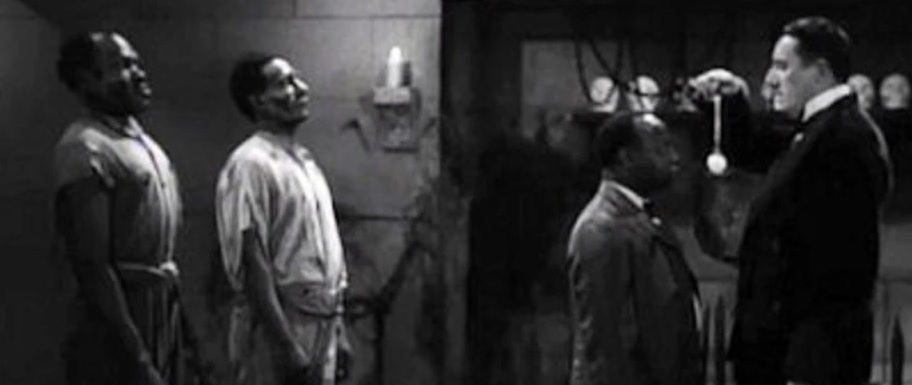
The plot’s not too dissimilar from other horror films, what with a mystery in a mansion, various different parties sneaking around (though to be fair, we pretty much know from the beginning who the truly bad individual here is), and secret passageways, only they threw in zombies of the voodoo variety, hypnotism, and hit-and-miss comedy.

Personally, I find a fair amount of Moreland’s lines amusing, perhaps the one that tickled me the most being about how his feet ‘done took root.’ The ending line (“If there’s anything I wouldn’t want to be twice, a zombie’s both of them”) always got me also, but it’s obvious that Moreland’s jittery persona is rife with racist undertones (perhaps overtones), so it’s somewhat a challenge to watch from today’s perspective. Still, Moreland’s performance is pretty solid, and while occasionally his antics are a bit over-the-top, he’s more mellow than others around the same time (such as Willie Best’s character from The Monster Walks).

Other actors worth mentioning include Henry Victor, who played a competent, yet somewhat uninspired, antagonist, John Archer, who played a more action-orientated protagonist, and the main character, Dick Purcell (though I’d argue that Archer’s character was more likable). Joan Woodbury (who was previously in The Rogues’ Tavern) was decent, though I didn’t think the story gave her that much to do. Marguerite Whitten was pretty good as a sassy cook, playing well off Moreland, and Leigh Whipper definitely had a pretty imposing presence, though it’s rarely used to great effect.

As it is, King of the Zombies clocks in at just about an hour and eight minutes, so if it’s not your cup of tea, at least you’re not losing that much time. That said, I’ve consistently had a solid amount of fun with it, though I think I’ve somewhat cooled on it with this most recent re-watch, because while I do think it’s above average, I don’t think it’s much more than that. Worth a look if one is into early zombie flicks, if only to see how far they’ve come.

7.5/10

You’ll Find Out (1940)

Directed by David Butler [Other horror films: N/A]

While generally inconsequential, this rarely-spoken about film is a lot of fun, and it’s cast alone definitely makes it one that any fan of classic horror should set some time aside for, as You’ll Find Out has a damn good cast.

The story isn’t anything overly new – large mansion, stormy night, a young woman (Helen Parrish) facing constant danger from mysterious would-be killers (they don’t stay mysterious long, and truth be told, I was going to reveal their identities later in the review), it’s pretty typical of 30’s and 40’s horror. The musical and comedic additions add a bit more zest, but fundamentally, the plot isn’t worth writing home about.

What they did, though, with the plot, no matter how derivative it is, was pretty fun. The seance sequences were great, and I personally loved the second seance, what with the protagonists attempting to set a trap for the antagonists, not knowing the antagonists are anticipating it. I had a lot of fun with it, and thought it was pretty swell, as they’d say in those days.

So much of this tired plot works due to the inclusion of actors Bela Lugosi, Peter Lorre, and Boris Karloff, all of whom are involved in criminal conspiracy to kill Parrish’s character. None of this is really kept under wraps, so it’s not that much a surprise, and because of that, we got a few scenes of two or three of these masters scheming together, which was a treat.

All three of these people, Lugosi, Lorre, and Karloff, are extraordinarily important to the horror genre. I won’t list the extensive resumes, but Lugosi is perhaps best well-known for his portrayal of Dracula, the Universal classic. Likewise, Karloff portrayed Frankenstein’s monster in Frankenstein, one of my personal favorite Universal movies. Peter Lorre, while many might recognize more from The Beast with Five Fingers (1946) or M (1931) starred in the criminally underrated Mad Love (1935), a movie I absolutely, dare I say, love madly. The three of them starring in this film brought to it far more flair than You’ll Find Out otherwise would have dreamed of attaining.

None of that is to say that the other performances were under par, but none of them have the star power of those three legends. Kay Kyser was a bandleader and radio personality during the 1930’s and 1940’s, and while I’m not familiar with him or his music, I’m not a stranger to big band/swing, as I give Glenn Miller and his orchestra a whirl or two somewhat often. As such, Kyser was often a bit too peppy for me, but he did grow on me as the film went on (and given his almost Woody Allen appearance, made for an interesting protagonist).

The twice aforementioned Helen Parrish was a pretty face for the role, and did a good job with what she had to work with, but ultimately didn’t leave a huge impression on me either way. The same could be said for Dennis O’Keefe, who was the far more typical protagonist of these types of films, and while certainly not a bad actor, it’s not his efforts here that made the film memorable.

What did help with that, though, were the musical pieces. Like I said, I’ve occasionally listened to big band music before, and this stuff was certainly catchy and enjoyable, though I personally prefer more vocals in my music. Luckily, we have some vocal pieces, and the two that stood out most positively were ‘I’d Know You Anywhere’ and ‘I’ve Got a One Track Mind,’ both sung by Ginny Simms. Simms’ isn’t someone I’m familiar with, but I personally got an Ella Fitzgerald feel from her, and really loved her singing. ‘The Bad Humor Man’ was another piece that stood out, because it’s just as much a theater play as a song, and I thought that was pretty cool.

You’ll Find Out isn’t the type of movie that would wow people who go in looking for cheap thrills, as there aren’t a whole lot of them here. Sure, there were some good detective scenes in multiple hidden passages, and the seances were both somewhat spooky (in a very hooky way), but the comedy somewhat emasculates any of the real potential terror to be felt in this flick, and I admit, the music doesn’t do a lot to help either. Still, with the star power in this movie, I thought it was a lot of fun, and definitely a movie that was worth seeing.

8.5/10

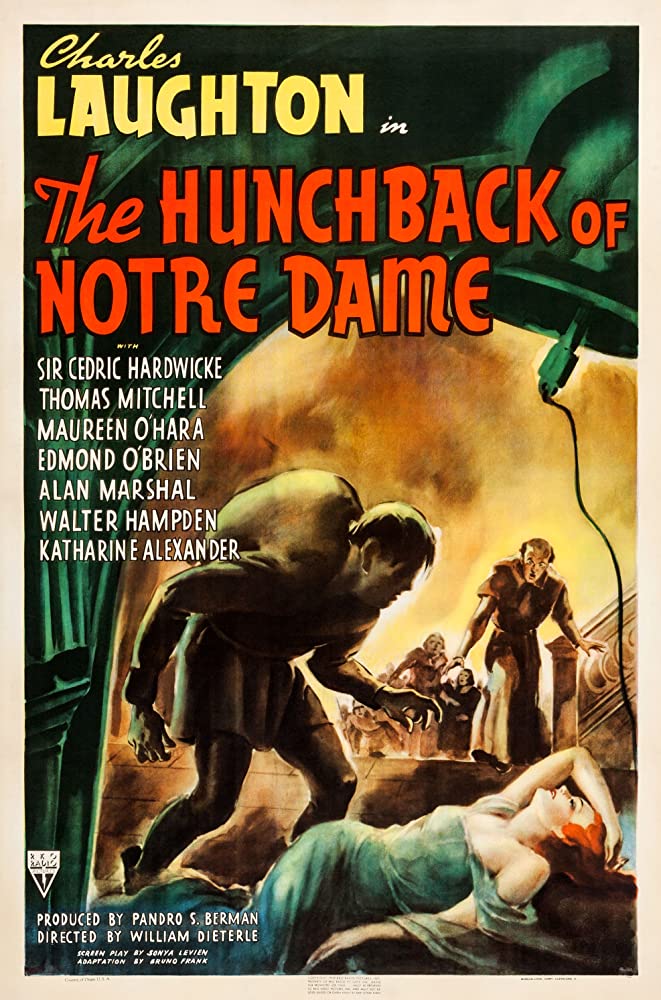
The Hunchback of Notre Dame (1939)

Directed by William Dieterle [Other horror films: 6 Hours to Live (1932)]

Whether this one is horror is someone’s personal decision. I think there’s a decent amount of dark sequences and the like to throw this in, allowing that it’s included with the caveat that it’s primarily a drama.

And what a damn good drama it is. The story is overly engaging (I’ve not actually read the original novel, but I do own it, so perhaps that’s something I’ll endeavor to do within the next fifteen years), and it gets somewhat involved toward the end (both groups at the church, the Beggars and the Craftsmen, basically wanted the same thing, yet utilized different methods), and the characters here are really complex, especially for a time that many might consider more simple in terms of plot.

Obviously, without a doubt, Charles Laughton’s performance as Quasimodo is the stand-out here, and it’s an emotional roller-coaster of a flick, watching Quasimodo get whipped for reasons beyond his comprehension, to see him save another in a most heroic fashion, only to end with a great line, ‘Oh why could I not be made of stone as thee,’ when speaking to a gargoyle. Laughton is no stranger to horror films, appearing in classics such as The Old Dark House, Island of Lost Souls, and The Strange Door (1951), and his dramatic performance here is just amazing.

There’s a lot of great actors and actresses here aside from Laughton, though. Cedric Hardwicke was amazing as the rather devious and horrid Frollo. Blaming and allowing another person to be tortured because he’s too weak to admit his culpability in a crime, Hardwicke definitely was a worthy antagonist in the film. Playing King Louis XI, Harry Davenport played his character with such ambiguity. At times, he was a progressive, forward-thinking monarch, at others, latching onto archaic, meaningless tradition (that courtroom sequence killed me a little).

I can’t say much about Maureen O’Hara, but she did a great job too. Her character was appropriately sympathetic, and during the latter half of the film, your heart really goes out to her. Admittedly, I didn’t love Edmond O’Brien here, as his character was a bit too flighty for me, but he did make some strong points toward the conclusion of the film. Lastly, both Thomas Mitchell and Walter Hampden were both greatly enjoyable, and Hampden in particular was a character worth remembering.

Near the end of the film, there’s a somewhat large battle that breaks out, culminating in the Hunchback not only tossing heavy rocks and large pillars from atop the cathedral, but also dumping quite a bit of molten metal onto the crowd below. I’ve seen this film before, to be sure, but I’m pretty sure I audibly gasped during that act, as I forgot just how brutal the Hunchback was during that sequence (and unnecessarily so, if you realize that pretty much everyone’s on the same side). There were scenes earlier of the Hunchback being whipped (him crying out for water, only to be ignored and jeered at, was exceedingly haunting), and some brief torture of O’Hara’s character. All of this, along with a sequence reminiscence of Freaks, in which beggars pop out of nowhere in a dark and seemingly-deserted alleyway, all lead me to understand the horror label some people throw onto this one.

9/10

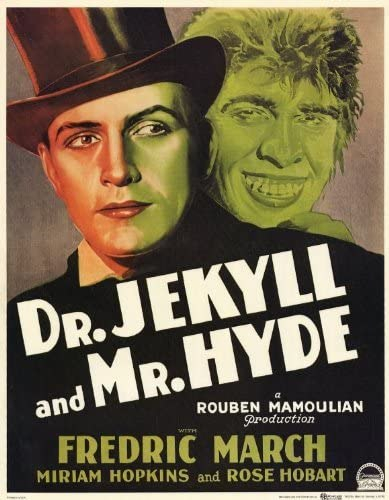
Dr. Jekyll and Mr. Hyde (1931)

Directed by Rouben Mamoulian [Other horror films: N/A]

It has been quite some time since I’ve last seen this, at least ten years, so seeing it again was a bit of a treat. I’ve never been overly fond of the base story, but I certainly think this is a well-done film and, while not my favorite early 30’s horror flick whatsoever, stands out rather nicely.

The amount of melodrama in this movie is rather high, but much of it is actually both compelling and somewhat tragic. The utter struggle that Jekyll has to deal with due to an strung out engagement with Muriel (due to her father’s traditional ways) is shown well whenever both Fredric March and Rose Hobart share a scene. While the horror was quite decent, it’s this very tragic feel (coupled with a somber conclusion) that allow the film to stand out more.

That isn’t to say the cast doesn’t help, though. Dr. Jekyll and Mr. Hyde’s cast all do a commendable job, with Fredric March and, of course, Rose Hobart taking the top spot. The two worked fantastically together, and I definitely felt the sorrow both of them dealt with in due to their constantly postponed marriage. Related, Halliwell Hobbes did good as Hobart’s father, though his character was, to me, rather unlikable. Mariam Hopkins was fantastic in her role, and arguably more memorable than Hobart. Lastly, while his role was minor (the manservant to Dr. Jekyll), I really enjoyed Edgar Norton, who brought surprising emotion to the film.

For a movie from this time period, Mr. Hyde was a well-done, despicable character. Not only does he whip Miriam Hopkins’ character (while the action itself isn’t shown, it’s alluded to), but therein lies also heavy hints of rape and other sexual abuse. Due to his violent and cruel nature, Mr. Hyde definitely stands out as a great counterpart to the rather focused, yet kind-hearted, Dr. Jekyll. I also rather enjoyed his increased agility (especially toward the end – him jumping all over the place and attacking police officers was rather fun), all of which combines to make him a memorably dark, yet occasionally fun, antagonist.

Like I said, I’ve never been a big fan of the story (in part, the idea that science should limit itself to traditional modes of study strikes me as oxymoronic), but this is a good adaptation of a story I’m not overly fond of. The drama and performances come together to create a compelling and pretty captivating movie that I think any fan of classic horror would tend to enjoy.

8/10

Karma (2018)

karrma

Directed by Nick Simon [Other horror films: Removal (2010), The Girl in the Photographs (2015), 2 Lava 2 Lantula! (2016), Truth or Dare (2017), Untitled Horror Movie (2021)]

For a Syfy release, Karma’s okay. It’s not particularly good, and I suspect it won’t be particularly memorable in the months to come, or even weeks, but it’s nowhere near as bad as other Syfy films such as Dead in the Water and Grave Halloween.

Story-wise, it reminded me a bit of It Follows, where, instead of a dark force following someone after sex, it follows them after they commit a terrible act. It’s not really original, but I liked some aspects of what Karma tried to do with it, though, and this perhaps wouldn’t come as much a surprise, the jump scares struck me as mostly unnecessary.

When it comes to concerns, there are quite a few that Karma poses. For instance, only three of the performances in the film really stand out (being Tim Russ, despite his horrible character, Mandela Van Peebles, and Brytni Sarpy, who was also in the likewise unmemorable 2017 Syfy flick Truth or Dare). None of the other actors and actresses do particularly bad, but they’re just sort of there. And much could be said for the story itself – like I said, I enjoyed some of the aspects (such as Peebles’ attempts at removing the curse from himself during a feel-good montage), but ultimately, Karma felt pretty bland.

Once everything’s said and done, that’s the biggest problem with the movie – it was completely unremarkable. It did boast one death sequence I rather enjoyed (involving a saw blade and a hammer, in a very Final Destination fashion), so it wasn’t completely without gore, but generally, there was little of interest here, and the conclusion felt a bit off, along with being somewhat anticlimactic.

Syfy has so many better movies, such as House of Bones, Neverknock, Cucuy: The Boogeyman, and even Stickman. Karma isn’t the worse that they’ve done, but it is both tepid and ultimately forgettable, which is the main issue. I’d pass on this one.

5.5/10

Toxic Shark (2017)

toxic shark

Directed by Cole Sharpe [Other horror films: N/A]

Yet another silly Syfy shark movie. Toxic Shark, as it is, probably isn’t the worst shark film Syfy’s done in recent years, and honestly, I had more fun with it than I thought I would (and this is especially true as I’ve now seen it twice). There were elements I didn’t care for, and make no mistake, the film’s below average, but it’s nowhere near as bad as crap like 2-Headed Shark Attack and related films.

For a movie like this, much of the main cast was somewhat enjoyable. Kabby Borders and Bryce Durfee bickered a bit too much for my liking, but both were still likable characters. Michelle Cortés also puts in a solid performance, perhaps even better than Borders. I rather liked Quinn Bozza too, though admittedly he’s a bit generic. Eric Etebari was somewhat fun as an over-the-top resort manager (at least until he was dispatched), and while Jaime Wallace didn’t do much for me insofar as her performance went, she did have the cutest ass (which, in a movie in where every single woman is wearing a bikini, is somewhat of an accomplishment).

Plot-wise, it’s pretty bleh, but honestly, that can’t really come across as much of a surprise. The CGI was utterly atrocious, particularly during the times when the toxic shark sprayed a green toxic spew, which looked so awful. It didn’t help that the CGI clipped a few times, which looked so amateurish. There was also a bit of a zombie component (in the form of an infection from the toxicity of the shark) that I didn’t care for, and felt overly unnecessary. Lastly, that ending was just terrible. What a shitty conclusion.

If you’re going out of your way to watch a Syfy production called ‘Toxic Shark,’ though, I know you’re not going in with high expectations. Obviously, it’s not that great of a film, but I do think it’s more enjoyable than plenty of other Syfy films. It doesn’t get to that rare list of Syfy films that come out above average, but it is better than I first thought it would be when I saw it a couple of years back. If you’re looking for an okay way to spend an hour-and-a-half, you could do better, but you could definitely do worse.

6/10

Prophecy (1979)

propgecy

Directed by John Frankenheimer [Other horror films: The Island of Dr. Moreau (1996)]

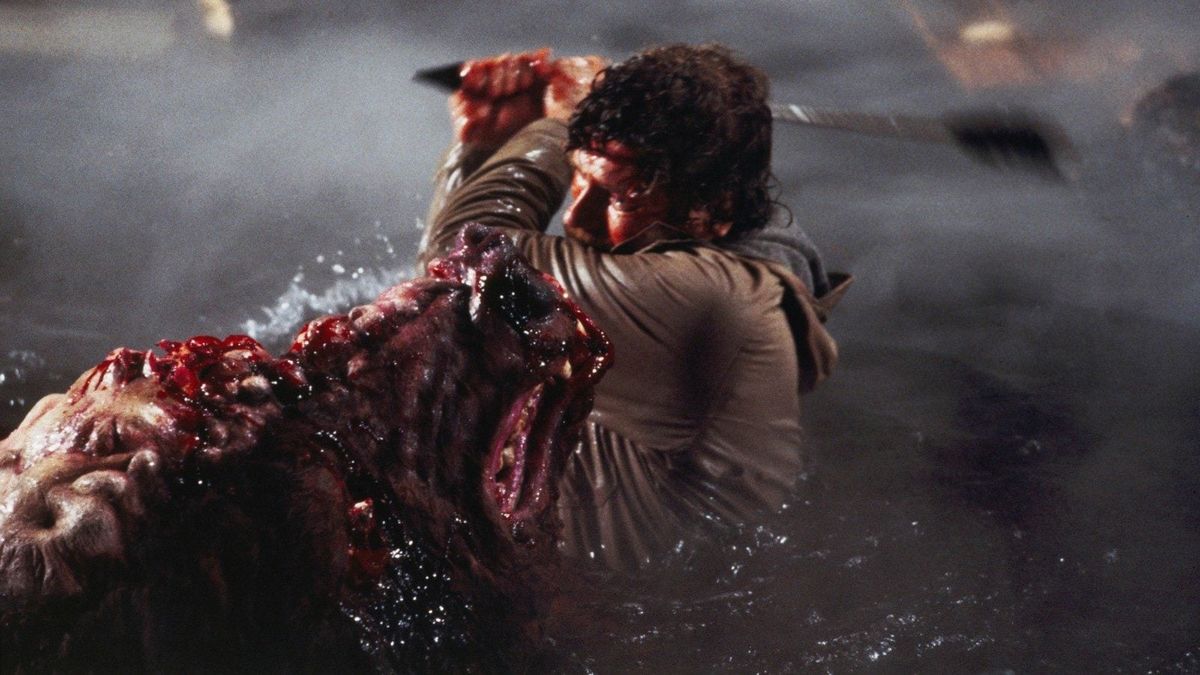
I knew next-to-nothing about this late 70’s ecological horror film before I started it. In fact, I didn’t even know it was ecological, so you know I was going in blind. I like a lot of stuff about this film, but a few factors keep it from being an overly solid movie, such as some special effects issues and the run-time.

Robert Foxworth (The Devil’s Daughter, It Happened at Lakewood Manor, Deathmoon, and Damien: Omen II) did great as the main character, and I rather liked most things about him. Talia Shire (Connie from The Godfather movies), playing his wife, rather humanized him at times, and also did well in some emotional scenes. Armand Assante was fun too, playing a Native American of strong conviction. Lastly, Richard Dysart was also solid, though his character wasn’t particularly likable.

There’s a lot going on in this one that needs to be unpacked a bit. A dying Native American community in Maine dealing with the racist attitudes of the management of a paper mill and, of course, the authorities who back the prominent businessmen as opposed to the minority community. Also, ecological damage done by the paper mill to cut the costs of operation, which happens every single day in the USA. This, along with the casual racism (and toward the beginning of the film, poor black communities in rat-infested tenements, and the racist, greedy landlords who owned them was taken aim at also) show this a movie of strong social conscience, which I deeply appreciated.

Problematically, the horror aspects weren’t all well-done. The design for the mutated bear didn’t do that much for me, but worse still was it’s overly jerky, fake movements. When it didn’t move, it was almost tolerable, but in action, I thought it looked rather ridiculous. Also, the movie, at about an hour and forty minutes, feels too long. I suspect some would say the beginning is boring, but I was pretty engrossed in all that went down (including the look into the paper mill, which I found rather interesting). It wasn’t until the horror really started up as the focus that I felt like it was dragging, as ironic as that sounds. If ten minutes were cut, and they shorted the somewhat disappointing conclusion, I think it would have ran a lot smoother.

Kudos to the scenes, though, in which the main characters are searching for clues at a murder scene in a heavy downfall of rain. I really liked that sequence, and though there was no horror present, it did feel rather suspenseful in it’s own way. That, and the paper mill sequence, felt pretty unique to this era of movies in my opinion.

There are a lot of things I find in Prophecy to enjoy, and overall, it’s definitely a film I could see myself watching again, but it doesn’t quite get to the level I wish it did. As the movie stands, I’d probably say that Prophecy is somewhere around average, but depending on your particular tastes, it may waver from below average to just above. Unfortunately, I don’t think it’d get much higher, but you never know.

7/10

Creepshow (1982)

Creepshow

Directed by George A. Romero [Other horror films: Night of the Living Dead (1968), Hungry Wives (1972), The Crazies (1973), The Amusement Park (1975), Martin (1976), Dawn of the Dead (1978), Day of the Dead (1985), Monkey Shines (1988), Due occhi diabolici (1990, segment ‘The Facts in the Case of Mr. Valdemar’), The Dark Half (1993), Bruiser (2000), Land of the Dead (2005), Diary of the Dead (2007), Survival of the Dead (2009)]

Creepshow’s an interesting movie to me, because while I actually only love two of the stories in this one (‘Something to Tide You Over’ and ‘The Crate’), I think overall the movie’s pretty excellent, and definitely excels in creating that comic book feeling, which so few movies can properly do.

‘Father’s Day’ and ‘The Lonesome Death of Jordy Verrill’ are both lacking in different ways. I certainly like the revenge aspect of the former, and I do enjoy the final scene, but it just doesn’t do it for me. As for the latter, I love the concept, and think the plant life looks rather creepy (and the ending is pretty good on multiple counts), but the overly comedic style of the story wasn’t something I’m fond of.

The final story, ‘They Creep Up on You’, is my third favorite, my main issue being that I felt they could have added in something along the lines of either the recent widow or the ghost of her husband somehow being connected to the onslaught of roaches (which would have worked well, since three of the past four stories in this movie have been about revenge in some form or another). I think it’s a fine story with solid effects, but it could have been better.

‘Something to Tide You Over’ isn’t a complex story, but I think it’s rather fun, mainly because of Leslie Nielsen’s great performance. His eccentric character is fun, and I love the final line (“I can hold my breath for a looooooonngg time”), and I reference it often. No one in ‘The Crate’ is as fun as Nielsen (though I do rather like Hal Holbrook), but it’s probably a better story overall.

There are some solid performances throughout. Obviously, I love Nielsen’s role, and he stands out as perhaps my favorite character. Hal Holbrook (who appeared in other classics such as Rituals from 1977 and The Fog from 1980) did great in his role also. E.G. Marshall, while his character is despicable, does great, as expected. Others who stood out positively include Tom Atkins, Ted Danson, and Viveca Lindfors. I love Stephen King’s writing, but his acting here, while intentional in it’s campiness, didn’t really work for me.

As far as anthology horror films go, there are better examples than Creepshow, such Tales from the Crypt (1972). Still, Creepshow is arguably much funner, and is a damn good example of a campy anthology done right. It’s not perfect, but there’s a lot to like about it, from the performances, to the animation, from the framing story (with a rather satisfactory ending), to the soundtrack. Not every story hits the mark, but it’s still a movie well-worth watching.

8.5/10

And this was also covered on Fight Evil’s podcast on the very first episode. Listen as Chucky (@ChuckyFE) and I discuss the film.

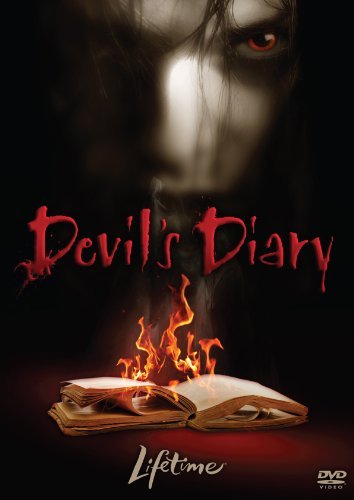
Devil’s Diary (2007)

diavle

Directed by Farhad Mann [Other horror films: Nick Knight (1989), The Lost Treasure of the Grand Canyon (2008)]

This Canadian made-for-television horror film definitely feels like it’s on the lower spectrum of movies. Devil’s Diary isn’t really terrible, but it does feel overly generic and derivative, and personally, while some scenes were fun, I don’t think I’d go out of my way to watch it again.

You can really tell that there was a limited budget on this, and you can obviously tell it’s a television production, what with the hideous commercial cuts (screen flashes red) apparent in the film. The special effects, such as they were, were somewhat laughable, though we did get a few scenes that bordered on decent (such as the slow-motion car sequence as a vehicle slammed into someone’s legs).

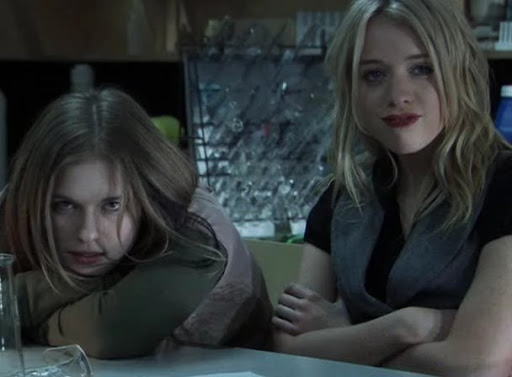
If there’s any high point to the film, it’s in the performances. Alexz Johnson and Magda Apanowicz, when together, reminded me a lot of Brigitte and Ginger (Emily Perkins and Katharine Isabella from Ginger Snaps), and I rather liked their friendship. Johnson’s character herself (Dominique) was actually pretty sympathetic, with a recently-deceased father and a borderline sexually abusive stepfather (there’s a scene in which she’s talking to her father’s gravestone, which I found particularly touching), though she loses a little bit of sympathy as the movie drags on.

While I abhorred their characters and everything they stood for, Laura Carswell, Deanne Casaluce, and Mariam McDonald all did great as the stereotypical bitchy cheerleader types, so much so that I hated their very existence from virtually their first scene. The three of them take somewhat interesting routes through the film, but I don’t think any of them come out particularly redeemed for their bullying. Brian Krause, as a priest, didn’t really leave an impact on me, but for a character who appeared only a few minutes total, I did like Malcolm Scott. Andrea Brooks’ character had a lot of potential, but they never really did much with her.

Plot-wise, I do appreciate how they threw in a few turns, and the movie did sort of shift gears around halfway though (I’m not overly pleased with the resulting scenes, but at least they tried). At the end, they sort of threw in a twist that came as a surprise, but I wish that more time was spent on why it exactly happened. Also, I really didn’t care for the enchantress powers one of the characters gained toward the back-half of the film, in which every guy desired this girl, and went to foolish lengths to make her happy. Still, generally-speaking, I think the plot’s okay, just not great.

The biggest issue I really have with this is that it feels like the type of film that could have been made much earlier, and feels a lot like fellow television movie Satan’s School for Girls (2000). There’s nothing terribly unique about this film, and the deaths and accidents are mostly bland and forgettable (a strangling being perhaps the worst, an attempted crucifixion the best). For a television movie, I think it’s okay, bordering on bad. Ultimately, though, despite some potentially bold routes the film took, I think most people would forget this one shortly after finishing it. Oh, and the ending was pretty awful, which is probably to be expected.

6/10

The Devil Bat (1940)

Devil Bat

Directed by Jean Yarbrough [Other horror films: King of the Zombies (1941), House of Horrors (1946), She-Wolf of London (1946), The Brute Man (1946), The Creeper (1948), Master Minds (1949), Hillbillys in a Haunted House (1967)]

Having seen this low-level classic around four times now, I have to say that, while definitely hokey, The Devil Bat is a lot of fun, much of it coming from the somewhat ludicrous plot and Bela Lugosi’s great performance.

Of course, Bela Lugosi, even by this point, was an old hand with the genre (before this film, he appeared in at least 15 other horror films), and it’s clear to see why. I utterly love his mad scientist routine here – his facial expressions and exuberance crack me up.

There’s a running gag here, in which after the doctor gives some shaving lotion to an intended victim (the lotion in question, due to it’s properties, will attract an over-grown bat to attack the wearer) in which the to-be victim says “Good night, doctor.”

And Lugosi’s reply, every single time? “Goodbye.” The first time, it was funny. The fourth time, I was laughing my ass off, as his tone was just perfectly somber (and almost no one caught on). So I love Lugosi in this film, and if you’re a Bela fan, I’d recommend seeing this for his presence alone.

Everyone else does pretty admirably also, though. Dave O’Brien (who, on IMDb, racks up an impressive 243 acting credits) did great as the lead protagonist (despite not appearing until around 18 minutes into the movie), and given that he had flaws (such as concocting that stupid fake bat picture), came across as a multi-layered character, which I appreciated. Donald Kerr (who has an even more impressive 511 credits) gave some good comic relief, and Suzanne Kaaren did just as good as you could expect, given actresses’ often-limited roles in these movies.

The revenge plot of Lugosi’s is so absurdly fun that it makes up for the failure of the special effects (close up, there’s a real bat squeaking, but from far-off, it’s one of the fakest-looking animals you’ll ever see), but honestly, when it comes to movies from around this time, I think most of the questionable special effects can be brushed off, especially if you’re getting a kick out of the movie regardless.

Director Jean Yarbrough did fantastic for only his third full-length feature, and actually did a lot for horror, as he later directed, among others, films such as King of the Zombies (1941), House of Horrors (1946), The Brute Man (1946), The Creeper (1948), and Master Minds (1949). I’ve only seen a handful of these (King of the Zombies and House of Horrors), but generally, I know many of these, while not overly well-known, are enjoyed by other fans of the genre.

There’s not necessarily a lot to this movie (though at an hour and eight minutes long, it’s a bit lengthier than some other flicks from this time), but what we do get is pretty good. The Devil Bat has long been a favorite of mine, and while overall, I think the 1940’s is probably one of the worst decades for the horror genre, this will always be one of those classics I go back to.

8.5/10