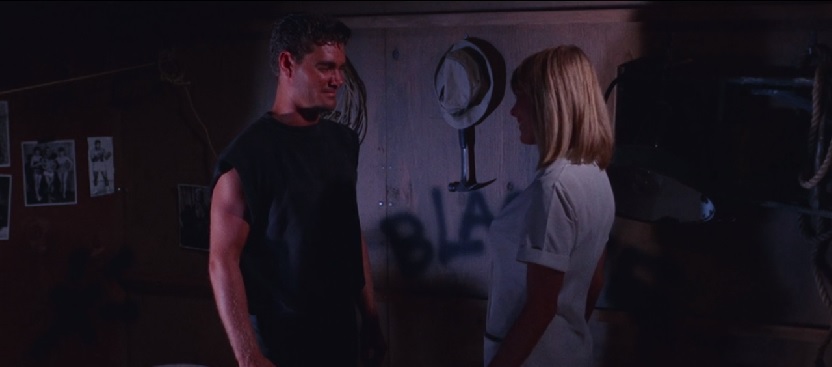
La casa dalle finestre che ridono (1976)

Directed by Pupi Avati [Other horror films: Balsamus l’uomo di Satana (1970), Thomas… …gli indemoniati (1970), Tutti defunti… tranne i morti (1977), Zeder (1983), L’amico d’infanzia (1994), L’arcano incantatore (1996), Il nascondiglio (2007), Il signor Diavolo (2019), L’orto americano (2024)]

I have to admit that, though I expected a decent amount from this giallo, given the positive reception I’ve heard as long as I’ve known about the movie, La casa dalle finestre che ridono struck me as more than a little disappointing.

Commonly known as The House with Laughing Windows, this Italian movie definitely had some charm to it, not to mention tension and a pretty foreboding atmosphere, but I also don’t know if they explained everything as well as they could have.

And I don’t like saying this, either. The movie currently has a 7/10 on IMDb (with 5,394 votes), and since finishing it, I’ve read theories and ideas on some of the things in the film, such as how it’s a take on Italy’s cowardice during Mussolini’s reign. A lot of these ideas are interesting, but I usually expect gialli to lay at least a decent amount of it out, and that’s not what happened here.

Sure, there’s a shocking scene at the end. Anyone who’s seen this movie knows the scene I’m talking about. But what does it mean? I have no trouble buying that there’s a mass culture of silence in the community (as it’s pretty clearly stated in the movie), but there’s so many unanswered questions that, no matter how atmospheric and oppressive the movie is, I’m bothered by it.

The performances weren’t the issue here – Lino Capolicchio (Il signor Diavolo) made for a perfectly fair lead, Francesca Marciano an acceptable love interest, Giulio Pizzirani was good while he appeared, and Pietro Brambilla, while odd, was okay. Vanna Busoni’s character appears for five minutes, but then entirely disappears, which was an interesting choice.

The red herrings throughout weren’t bad ideas, but some of them (such as the watch Fransesca Marciano’s character has) seem to be set up, only to never be mentioned again. The whole movie, on a side-note, seems to move pretty quickly, but there were times when I was wondering what exactly was worrying the characters, as little we’d seen up to that point really seemed worth being frightened over.

Not everyone needs answers, and obviously, plenty of people enjoyed this one quite a bit. I was hoping to be one of them, but I just can’t. Maybe I can grow to appreciate this one with future watches, but the fact that so much is left unclear rubs me the wrong way. If I wanted an artistic allegory about post-fascist Italy, I wouldn’t be a horror fan, and this one, while it has it’s strong elements, just felt off to me.

6/10

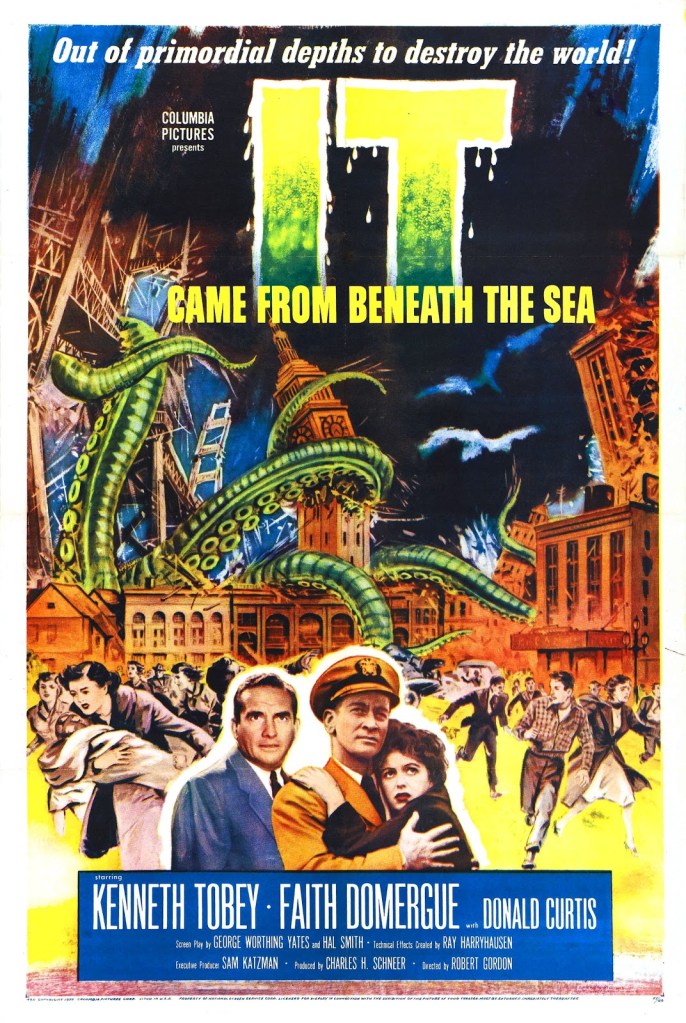
It Came from Beneath the Sea (1955)

Directed by Robert Gordon [Other horror films: Black Zoo (1963)]

I’ve said before that when it comes to giant monster movies, I’m not the biggest fan. I don’t think this one was great either, but I have always liked octopi, and it’s in that spirit that I found this a bit more tenable, despite having a creature with somewhat limited ranges of attack.

Largely, I’ve come to the conclusion that the reason I’m not as enamored with movies of this type is because of it’s attention. And by that, I mean in this film, the whole of the United States Navy knows about the creature (and I imagine much of the military), and then, of course, the general public. Everyone knows about it. In slashers, the killer might be going after just a handful of people, but in movies like this, everything’s a public affair.

From Them! to The Black Scorpion, from The Giant Claw to The Beast from 20,000 Fathoms, it’s always the military and scientists working together to find a way to destroy the creature. It just gets so repetitive, no matter how good the special effects are, or what the creature happens to be. Not only that, but they often throw in romantic subplots, and rarely does that do anything particularly interesting.

In this movie’s case, I will give you that the romantic subplot felt more like a confused love triangle at times, so it was at least a little different, and I did tend to actually like Faith Domergue’s character, but the point remains that throwing in a love story doesn’t automatically make the movie better, or the characters involved more interesting.

Of the three important performances, I do think Faith Domergue (Cult of the Cobra, The House of Seven Corpses, This Island Earth) was the best. It’s true that I liked her character the most anyways, but I also thought she had the most going for her. Kenneth Tobey (The Thing from Another World, The Vampire) felt like generic military guy 101, and while Donald Curtis (Earth vs. the Flying Saucers) was okay, but I feel like I never got a great hang of his character.

Again, I enjoy cephalopods – I think it’s the tentacles I’m enamored with. Which means, naturally, I felt bad about the harm people caused it throughout, especially as it had little other choice but to look for a new food group. I think the most painful was the flamethrowers – certainly that scene looked great, but my sympathy for the octopus was at it’s zenith.

Speaking of good-looking scenes, the sequence in which the octopus attacks the Golden Gate Bridge was pretty fun. I’ve never been to San Francisco, but if I could see a giant octopus destroying a famous bridge on my visit, then that would be a vacation worth remembering.

All-in-all, It Came from Beneath the Sea was an okay affair. It’s pretty much how I feel about most of these giant monster movies, which just aren’t usually my cup of tea. No doubt it was an okay watch, and the movie is well made, but it’s also not one that I’d think I’d watch too often in the future.

7/10

Tempus Adolpha (2010)

Directed by Shaun Robertson [Other horror films: N/A]

Some movies are almost beyond explanation, and Tempus Adolpa is one of those types of films.

The story is pretty simple – a gay couple is attacked by a gang of werewolves, and one of them survives to become a time-traveling werewolf out to avenge the death of his lover. Well, I don’t know how simple it is, but while it’s definitely a campy comedy/horror mix, it can be an enjoyable experience. The time-travel aspect does lead to some okay ideas also, though nothing that I think would surprise many.

I’ve got to talk about the presentation, though. Look, I’ve said before that I don’t know anything when it comes to behind-the-scenes editing, or anything about how people actually make movies. According to the video description on YouTube, this is “The last film to be filmed with a hi-8 camcorder!” I don’t know what a hi-8 camcorder is, or how hard it would be to make a movie on it, but what I can say is that it seems pretty much every scene was recorded in front of a green screen.

By that, I mean that all the actors have sort of a fuzzy, shimmering lines around them, and it’s obvious the background images are static, and not actual locations the scenes are being filmed at. It’s extraordinarily amataur, as you can imagine, and I’ve never seen anything like it, but I can’t deny there’s both charm and gall in making a movie like that.

There’s no way I can describe this movie and do it justice. As one of the characters uses a watch to go back in time, a black-and-white portal (that looks like it was found on Google Images) pops up, and he goes through it. Well, by ‘goes through it,’ I mean he walks toward it and disappears instantly, cause that’s how portals do.

You have to see this for yourself, because again, I don’t have the right vocabulary to describe this experience. I can say that the werewolf transformations are absolutely abysmal, and I loved them. I can also say that one of the scenes in the movie – a dream a character is having about a werewolf singing ‘Beauty School Dropout’ from Grease – is just beautiful. But talking about these scenes and seeing them are two different things.

The performances are all awful, but it’s a campy comedic movie about a gay, time-traveling werewolf that takes place in the United Kingdom, so I largely cut them a lot of slack. Jack Gardner did just fine as the main character, and his camp gay personality is amusing. Lee James Rosher actually has an emotional scene toward the end, so while he wasn’t in the movie much overall, he definitely stood out. Jasmine Atkins-Smart and Tom Cruz could have done with more personality, but at least Atkins-Smart was occasionally fun.

Some of the music here was decent. True, I could have done without that version of ‘Beauty School Dropout,’ but the song that starts during the finale and plays through the credits, ‘Just Go’ by Nick Celino, was actually quite nice. ‘No Regret’ by Tony Gardner was rough (reminding me of low-budget classic Linkin Park), but I actually thought it showed a lot of potential. You have a band called 3 Daze Lost who perform a song ‘Win Win Situation’ as a gang of werewolves are slaughtering people on the dance-floor, so that was fun also.

The special effects here are, well, not great. But like I said, what this movie lacks in budget, quality, and common courtesy, it makes up for in heart and gall. It’s a terrible movie, and I’ve suspected that ever since I first heard about this one, but it’s truly an experience that I won’t forget. And again, I really do find the ending rather sad.

Tempus Adolpha isn’t a movie that many people would care for. On IMDb, this has under 5 votes, and it’s been available on YouTube in full for years, so I have that idea on good authority. However, as atrocious as it can be, it’s a 63-minute movie that I did have fun watching, so I can dig it.

7/10

Spider Baby or, the Maddest Story Ever Told (1967)

Directed by Jack Hill [Other horror films: The Terror (1963), Blood Bath (1966), Mondo Keyhole (1966), Fear Chamber (1968), House of Evil (1968), La muerte viviente (1971), The Incredible Invasion (1971)]

This is a pretty well-known movie, and while I’d consistently heard decent things about it, it’s never been one I’ve really been dying to check out. Because of it being labeled a horror-comedy mix, I didn’t know if it would be my type of thing. After seeing it, it’s true that the movie isn’t really my type of movie, but even with that caveat, I think it was pretty decent.

The story is certainly interesting, dealing with three siblings of subnormal mental status and their caretaker having to contend with the intrusion of distant relatives into their lives. Actually, I briefly thought that this movie is what House of 1000 Corpses would have been if it were made in the 1960’s (even more so because Sid Haig is here). It’s not really my idea of a fun story, but it’s done pretty well.

It also moves at quite a decent pace. It’s not a long movie to begin with, and while there are portions in which the action is less prevalent, Spider Baby keeps us engaged pretty well. No doubt the solid performances help a lot in that aspect.

Lon Chaney Jr. (La casa del terror, The Wolf Man, House of the Black Death, Pillow of Death, Son of Dracula) gave a great performance. He never stood out to me as much as Bela Lugosi, Boris Karloffe, or Peter Lorre, but Chaney Jr. here did really well, and even threw an emotional scene in. Beverly Washburn and Jill Banner also stand out as solid with their performances.

Because of the nature of his character, Sid Haig (Galaxy of Terror, A Dead Calling, Brotherhood of Blood, The Aftermath, Hanukkah) doesn’t have much personality, but he was fun to see. Karl Schanzer, Mary Mitchel (Panic in Year Zero!, Dementia 13), and Quinn K. Redeker all had their moments, and it was nice to see both Carol Ohmart (House on Haunted Hill) and Mantan Moreland (King of the Zombies).

There is a bit of proto-slasher attitude in this one – in the opening, someone is stabbed multiple times, and though it’s off-screen, it looks painful. Someone was about to have their foot cut off, had another character not intervened. It’s not much – this isn’t H.G. Lewis, and related, this was in black-and-white – but there’s a bit here that was encouraging.

Like I said, the story wasn’t really for me, but I did sort of like the vibe of this one. It felt a decent amount different from many other films I’ve seen in the late 1960’s, and again, the addition of some emotional material from Chaney Jr.’s character was a pleasant surprise.

I don’t think Spider Baby or, the Maddest Story Ever Told is ever a movie I will love, but it is a decent movie, and is worth watching for something a bit different.

7.5/10

House of the Long Shadows (1983)

Directed by Pete Walker [Other horror films: Die Screaming Marianne (1971), The Flesh and Blood Show (1972), House of Whipcord (1974), Frightmare (1974), House of Mortal Sin (1976), Schizo (1976), The Comeback (1978)]

Despite the stellar cast of this one, I didn’t care that much for House of the Long Shadows when I first saw it. Well, I thought it was okay, but I didn’t think it was particularly great. I generally feel the same way now – it’s a solid movie in many aspects, and again, the cast is stellar, but I also think it runs a bit long, and it’s not a movie I’d revisit all that often.

Based on a 1913 novel by Earl Derr Biggers titled Seven Keys to Baldpate (which was later turned into a play, and made into multiple movies), the story follows Desi Arnaz Jr.’s character’s attempt to write a book to win a bet in the deserted mansion at Bllyddpaetwr (Welsh for the win), though he finds that the mansion is not quite as deserted as he was told. It’s a decent idea, but like I said, I feel like it’s a bit long (the movie runs for an hour and 42 minutes), and though the story is okay, I don’t know if it’s enough to carry the film.

Look at that cast, though – true, Desi Arnaz Jr. is the main star, and you could argue Julie Peasgood is a co-star, and neither one is particularly well known (though both do perfectly fine), but look at the others: Peter Cushing (The Abominable Snowman, The Masks of Death, The Skull, The Creeping Flesh, Frankenstein and the Monster from Hell), Vincent Price (Witchfinder General, The Tomb of Ligeia, The Fly, Tower of London ’39 and ’62, Cry of the Banshee), Christopher Lee (I, Monster, The Two Faces of Dr. Jekyll, The Virgin of Nuremberg, Curse III: Blood Sacrifice, Circus of Fear), and John Carradine (Crowhaven Farm, The Nesting, The Unearthly, Curse of the Stone Hand, Revenge of the Zombies).

Obviously, all four are giants of the genre – I’ve long been a fan of Vincent Price and Peter Cushing, and both Lee and Carradine are always decent too. In this movie, I actually do think that Christopher Lee’s character is the most interesting, but Price gives a lot to the movie also. Peter Cushing is a little more limited here, and John Carradine (who was around 77 at the time this was filmed), while fun, doesn’t have that much to do either. Still, it’s great to see the four of them in a single movie, despite the fact I don’t think the movie’s great.

Other performances worth mentioning include Sheila Keith (Frightmare, House of Whipcord), Richard Todd, Louise English, and Richard Hunter. I don’t think any of them add as much as Price, Cushing, Carradine, or Lee, but then again, how could they?

The story is reasonably fun. It’s worth mentioning, at this point, that the movie does have a somewhat light-hearted tone to it. The finale is almost whimsical, and while the humor is never over-the-top, the light-hearted nature is obvious throughout. And speaking of the finale, while I don’t know if it was executed entirely well, I can sort of appreciate it. It does seem a little bit ludicrous, but at least it was different.

As far as the kills go, there were two that I thought stood out – in one, a woman is washing her face, but unfortunately the water in the basin was replaced with corrosive acid, and that doesn’t do wonders for the woman’s complexion. In another, a character is killed with a battleax – we don’t see the kill, but we do see the attack through silhouettes, which looked pretty damn cool. The movie harkens back to the old dark house mystery days, but there are a few scenes here that does remind us it takes place in the 1980’s.

For the cast alone, I think it’s a movie worth watching, and generally, it’s regarded pretty well. Having seen it twice, it’s not something I personally love, but I suspect many would be happy with this one, and they’re not without reason.

7/10

Creature from the Haunted Sea (1961)

Directed by Roger Corman [Other horror films: The Beast with a Million Eyes (1955), Day the World Ended (1955), It Conquered the World (1956), Not of This Earth (1957), Attack of the Crab Monsters (1957), The Undead (1957), War of the Satellites (1958), The Wasp Woman (1959), A Bucket of Blood (1959), House of Usher (1960), The Little Shop of Horrors (1960), The Pit and the Pendulum (1961), The Premature Burial (1962), Tales of Terror (1962), Tower of London (1962), The Raven (1963), The Terror (1963), X (1963), The Haunted Palace (1963), The Masque of the Red Death (1964), The Tomb of Ligeia (1964), Roger Corman’s Frankenstein Unbound (1990)]

I can’t imagine this will take that long to explain, because there’s not really that much here.

We have a story of Cubans trying to steal money from Cuba after the revolution (on a side note, the best part of this movie is being reminded of the Cuban Revolution – throwing off the USA-backed government and creating a socialist system) and then being killed by fake and real monsters. I was going to try to describe the film better, but I realized that if they didn’t put that much effort into making this movie, I’m not going to put much effort in reviewing it.

The idea of killing off people and claiming it was done by a sea monster is at least a little interesting, but you have to understand that this film is a comedy/horror mix (as evidenced from the very beginning, during the opening animated credits), and the comedy is generally awful, and none of the characters (and I mean none) are of any interest whatsoever.

You have Robert Towne playing a clueless American spy who narrates the movie (‘It was dusk. I could tell because the sun was going down’ is the pinnacle of his humor), Beach Dickerson, who can imitate animal sounds (and by ‘imitate,’ I mean he opens his mouth and the roar of a lion is dubbed over), which is great, because he meets a woman (Blanquita Romero) who can do the same thing, and they make animal sounds together because it’s love and I hate this fucking movie.

Other people who appear include Antony Carbone (A Bucket of Blood), Betsy Jones-Moreland, Esther Sandoval, and Sonia Noemí González. It doesn’t matter, as none of them do anything to make the movie any more bearable, but they do indeed appear.

Here’s the thing – this is not my type of comedy. There was one amusing line in the movie, and that’s it. Everything else was just awful. And what makes this worse is that Creature from the Haunted Sea is a short movie – the version I saw was an hour and three minutes. Despite that, it was still a struggle to get through. It’s a painful movie, and not one I have any fun with.

Some people can probably get a kick out of this movie. I’ve enjoyed plenty of Roger Corman movies, even loved a few (The Pit and the Pendulum and The Tomb of Ligeia, for instance), but Creature from the Haunted Sea is just a bad time.

3/10

Yotsuya kaidan (1949)

Directed by Keisuke Kinoshita [Other horror films: Shinshaku Yotsuya kaidan: kôhen (1949)]

Yotsuya kaidan is not an easy movie to talk about. Part of this is because it’s the first movie in a two film series, and so seems to be primarily set-up to the conflicts in the second part. It’s not that things don’t happen, but most of the action here takes place at the end. It’s also barely horror, which is problematic.

I guess if you want to get technical, there is horror in trying to poison your wife, and a character getting their face disfigured by scalding hot water, or a woman needing to deal with the unwanted attention of a man, or being stuck in a loveless marriage while there are potentially better opportunities out there. Admittedly, this paragraph started off as glib, because while some of this could conceivably be horror, it’s not the easiest case to make.

Here’s what I can say: after a character’s face gets burned by some water, there’s a suspenseful scene toward the end as the character keeps asking for a mirror, but a horrified servant doesn’t want to give them one. It’s a pretty tense scene, and when we do finally see the face, it’s certainly disfigured, so that’s horror enough to count, amiright??

Mostly, though, Yotsuya kaidan (also known as The Yotsuya Ghost Story and The Ghost of Yotsuya: Part I, and apparently also The Yotsuda Phantom – you can see why I also use the original foreign titles over any re-titles) is a romantic drama. It’s a dark drama at times – there’s a character who consistently tries to get a character to kill his wife so he can move up in the world – but it’s still mostly a drama.

It’s well-done. Some of the acting is quite melodramatic, but that might partially be due to the Japanese culture, which, at least as presented here, seems quite reserved. Instead of having a conversation about important topics, someone’s wife just wails and proclaims that they ‘must never speak of it again.’ Because that works, I’m sure.

The performances are pretty good, though. Ken Uehara’s moral struggles are palpable here, and even toward the end, he has only so much agency insofar as things go. Osamu Takizawa’s slimy character was solid. Keiji Sada (who died in a car crash at the young age of 37 in 1964), who I thought was going to be the main character, was perhaps one of the most moral characters here. Kinuyo Tanaka (who plays two roles here) was a bit dramatic at times, but again, that may be the Japanese culture. Lastly, there’s Hisako Yamane, who didn’t really get that much character here, but that may change with the second part.

And that’s the main thing. Like I said, plenty of emotional things happen in this movie, but it ends on a cliffhanger (think the end of Hatchet, only far less dramatic), so it’s not an easy movie to judge on it’s own. Certainly it’s a moody, black-and-white picture with some issues of dark morality, but I’m far more interested in where the story is going – likely with some supernatural ghost action – than the focus we got in this movie.

Yotsuya kaidan isn’t a bad movie, but it’s also not particularly easy for me to say it’s a good movie. If you’re into dramas, or Japanese period pieces, it may well be worth seeing, but if you’re coming into this from the perspective of ‘I want to see some classic Japanese horror,’ this may not provide the best time. It’s an okay watch, but I want to see where the story is going before anything else.

6/10

Death Bed: The Bed That Eats (1977)

Directed by George Barry [Other horror films: N/A]

Having seen this oddity once before, I was looking forward to revisiting this one. I had to anyway, of course, but I wanted to see if this was as odd as I remembered it being. And certainly, after seeing it with fresh eyes, I can say that it is.

Most horror fans probably know the story behind this movie. After being filmed, the director George Barry wasn’t able to get it distributed or released on video, but a bootleg VHS was created, and it wasn’t until 2001 that Barry found out that anyone save him and those involved in the movie knew this existed. It finally made it onto DVD officially in 2003, and the rest is history.

Death Bed: The Bed That Eats might sound, based on the title, to be a goofy movie, but I don’t really think that’s the case. There are some mildly amusing parts, or some pieces of dialogue that are sort of funny, but there’s very little in here that seems to actually be played for laughs. Really, as ludicrous as the plot is, the movie feels more fantasy than it does comedy.

The reason for that, of course, being that one of the characters in the film is sort of the spirit of one of the bed’s victims who is trapped in a painting. He witnesses all of the atrocities the bed comments, and through his narration, we learn of the bed’s creation and history, with a particularly dry segment detailing some of the bed’s previous victims.

Of course, he’s not the only narrator in this movie. There’s a lot of internal first-person monologue here, which might not be a surprise, given it’s a 70’s film (Let’s Scare Jessica to Death did the same thing), but I almost feel there’s more internal monologue than there is actual conversations here. It’s an odd way to make a film, but given the story this has, which is somewhat bare-bones, perhaps it makes sense.

Only five performances matter here, and that may be a stretch. While the man trapped in the painting is played by Dave Marsh, his monologue is voiced by Patrick Spence-Thomas. Spence-Thomas has a dramatic delivery that adds to the amusement, though much of it may not be intended (‘You [potential victims] gaze at me as a painting on the wall, and I see you as a serving upon some monstrous silver platter’). Even so, it’s good stuff.

Most of the characters, played by Rosa Luxemburg (no, not the revolutionary socialist and Marxist philosopher), Julie Ritter, Demene Hall, and William Russ (Dead of Winter), weren’t really that important. I mean, Luxemburg’s was, but either way, none of them got a whole lot of what you’d actually call character.

Even so, this is a mildly fascinating movie. It’s digestible (see what I did there?), and the special effects can sort of be cool. See, when the bed consumes something, it sort of takes it into it’s digestive fluids. Perhaps one of the more memorable scenes is a man who’s hands get dissolved to the bone before he’s able to pull them out of the bed. There’s also a whole dreamlike atmosphere that permeates much of the movie, which makes sense, as the idea of this film apparently came from a dream of the director.

Those effects paired with the fantasy-feel of the narration and whole of the story make for a rather different movie. It’s not a good one, but it definitely feels unique, and related, totally 70’s. I can’t say it’s a movie I’d watch too often, but it is a somewhat wild ride that should be seen to be believed.

6/10

Last Night in Soho (2021)

Directed by Edgar Wright [Other horror films: Shaun of the Dead (2004)]

I had consistently heard positive things about Last Night in Soho, but tried to go into this one without expecting too much. As it turns out, I found the film absolutely stellar, and I pretty much loved everything about it.

Given the movie is almost two hours long, it’s sort of hard to know where to start. I suppose the story is as good a place as any – a somewhat naive girl with a love for the 1960’s goes off to London to attend a fashion school, and things happen.

I have heard it said that while the movie is visually stunning (and it is – I’ll talk about this later on) – the story is sort of weak. Honestly, I get where those type of comments are coming from, because you can definitely see some things coming from a mile away, but even with that fair critique, I still dug the hell out of the film.

A lot of it is Thomasin McKenzie’s character. When she gets to London and the student housing, she’s out of place – while most others are interested in getting wasted, going out, having sex, and listening to shit music, all her character wants is a quiet room so she can listen to high quality tunes.

And to be fair, I’m biased. When I went to college, I felt very out of place myself. I never drank before college, never did drugs, never had sex. Hell, I pretty much never drove. So trying to form connections with people at college was awkward and difficult. In fact, I have a clear memory of talking to some guy at breakfast, and he was looking forward to the weekend for the parties, and I told him that I’d never drank nor been to parties.

Pretty sure I never spoke to that guy again.

My point is that I felt very connected to McKenzie’s character, and her performance of said character was absolutely fantastic. I haven’t seen McKenzie in anything else, but she does a lot for this movie. In her final role before her death, Diana Rigg (Game of Thrones, Theatre of Blood) was great to see, and she did fantastic as well. It’s a true shame she died before the film came out. Matt Smith (Doctor Who, His House, Patient Zero) was a pleasure to see also, despite his rather awful character.

Naturally, Anya Taylor-Joy (The VVitch, Split, The New Mutants, Marrowbone) is a household name by now, and she did great here too. Her character isn’t necessarily fully delved into, but no doubt she’s one stylish lass. Michael Ajao took a bit to appear in detail, but his character was one of the good ones. Terence Stamp (who I only know randomly from Yes Man; also in Spirits of the Dead, Mystery on Monster Island, and Link) was good, though his character seemed sort of easy to get a hold on.

Other performances that merit a mention include Synnove Karlsen and Rita Tushingham. Karlsen did well as the sort of stereotypical mean girl, and Tushingham, as McKenzie’s grandmother, added a lot of additional emotional resonance into the film.

Visually, there’s no doubt the movie was stunning. During the 1960’s portions, it seemed rather authentic. Of course, I was born in 1993, and no nothing about how authentic it actually was, but it definitely had that swinging vibe I’d expect. There were great uses of visual effects throughout, be it the cinematography or the use of colors. Toward the end, as a character is climbing some stairs to get away from someone – well, the way I write that doesn’t sound like much, but the way the scene is filmed is simply stellar.

And I can’t say enough how amazing the soundtrack was. Most of the songs here are by artists from the 1960’s – you have The Searchers (‘Don’t Throw Your Love Away’), Cilla Black (‘You’re My World’ and ‘Anyone Who Had a Heart’), The Walker Brothers (‘Land of 1000 Dances’), Dusty Springfield (‘Wishin’ and Hopin’’), Peter and Gordon (‘A World Without Love’), Sandie Shaw (‘(There’s) Always Something There to Remind Me’), and Dave Dee, Dozy, Beaky, Mick and Tich (‘Last Night in Soho’).

My favorites, though, were ‘Starstuck’ by The Kinks, ‘There’s a Ghost in My House’ by R. Dean Taylor, and ‘Eloise’ by Barry Ryan. I have to admit, somewhat shamefully, that I didn’t know any of these songs, but I did listen to plenty of 60’s music growing up, so I definitely loved a lot of this. I do know Cilla Black, for instance, but just her song ‘Everything I Touch Turns to Tears,’ and I of course know ‘Downtown,’ but the version I know, by Mrs. Miller, doesn’t have quite the impact the one in the film does.

Actually, there is one last song I have to mention. See, most of the music in the film are songs from the 1960’s, but there is a scene in a club, where McKenzie’s character is trying to block out the horrors and confusion that she’s facing, and though the song as she enters the club is ‘There’s a Ghost in My House,’ it soon turns to Siouxsie and the Banshees’ ‘Happy House.’ I admit, I only know Siouxsie and the Banshees’ first album (The Scream), but I’d know those vocals anywhere, and though the song is so different from most everything else, it fit in beautifully.

The mystery here may not be as engaging as the music or visual styles, and while I was surprised by some things during the finale, again, I saw some of it coming far earlier on. Even so, this movie was so unique, and so moving (I loved the final scene), that I loved it quite a bit, flaws and all. I don’t think the movie’s perfect – I can’t quite go that far – but I do think it’s very good, and definitely one that I’d want to see again in the future.

9/10
She Freak (1967)

Directed by Byron Mabe [Other horror films: The Bushwhacker (1968), Mystic Mountain Massacre (1971)] & Donn Davison [Other horror films: Honey Britches (1971), The Legend of McCullough’s Mountain (1975)]

Do you all remember Freaks? It’s a pretty classic movie with a generally solid story and a shocking finale for the time. It’s not a personal favorite of mine, but it’s a pretty solid movie.

As for She Freak, though, which is largely based around the same idea, the best word to describe it is ‘ghastly.’

Quite similar to Freaks in multiple ways, it follows one of the most unlikable protagonists in the history of cinema as she leaves her boring life as a waitress to join a carnival, and try to find her riches there. She’s a terrible character – not only is she okay with getting married to a guy just because he’s rich, and then cheating on him multiple times, but she also has zero sympathy for those in the carnival’s ‘freak show,’ and just sets herself up as a terrible person.

To be fair, Claire Brennen does fine in the role. Lee Raymond doesn’t have much in the way of character aside from being eye candy for the ladies, but Bill McKinney actually had some depth to him (though it took a while to find that out). Felix Silla (Cousin Itt from the classic Addams Family and the Polka Dotted Horse from H.R. Pufnstuf) only has a couple of scenes, but I liked him. Lastly, there’s Lynn Courtney, who wasn’t really relevant whatsoever, but she existed, at least.

If you’re wondering why I found this abysmal, though, it doesn’t have much to do with the likability of Brennen’s character. I mean, it wasn’t ideal, but by far the largest problem here is how insanely dull the movie is. It’s not until the final five minutes that we really feel much in the way of tension, and to be honest, tension is a bit strong.

A lot of the film seems to be devoted to showing off the carnival – not only customers walking by or riding the rides, but also setting up and taking down the carnival. Don’t get me wrong – I’m insanely impressed by traveling carnivals, and how they can do that set-up in the time they have – but it doesn’t make for an interesting horror movie. Might make a good documentary, though.

She Freak is a very boring movie. It’s dull, and the characters don’t generally help that much. The ending (which is completely taken from Freaks) isn’t worth the build-up, and the whole of the film is likely to send you into a stupor unless you’re of strong will-power.

There were two scenes I thought were good – in one, there’s a scuffle between two characters, and one of them gets stabbed in the hand with a screwdriver (providing the only blood in the movie). In the other scene, filmed in what I imagine was a helicopter, we get an overhead view of the carnival at nighttime – the neon lights on the rides, just the atmosphere of a busy carnival season – it looked quite beautiful. Honestly, if it weren’t for that scene, they could have just released this in black-and-white, because nowhere else does the addition of color do the movie wonders.

I can sit here and call the movie boring, but unless you see it, you probably won’t fully grasp just how dull so much of this is. And I certainly wouldn’t recommend you do so, but if you enjoy carnival-based horror, maybe this is worth a shot. It’s not remotely a good movie, though, and I’d just stick with Freaks were I you.

3.5/10