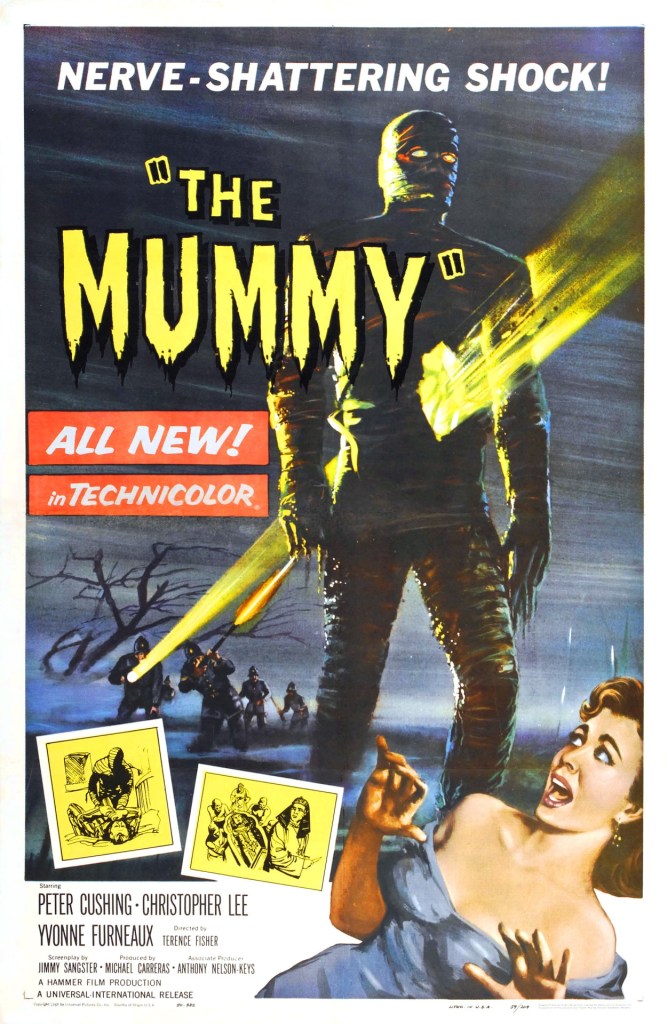
The Mummy (1959)

Directed by Terence Fisher [Other horror films: Three’s Company (1953, episodes ‘The Surgeon’ & ‘ Take a Number’), The Curse of Frankenstein (1957), Dracula (1958), The Revenge of Frankenstein (1958), The Hound of the Baskervilles (1959), The Man Who Could Cheat Death (1959), The Stranglers of Bombay (1959), The Brides of Dracula (1960), The Two Faces of Dr. Jekyll (1960), The Curse of the Werewolf (1961), The Phantom of the Opera (1962), The Horror of It All (1964), The Gorgon (1964), The Earth Dies Screaming (1964), Dracula: Prince of Darkness (1966), Island of Terror (1966), Frankenstein Created Woman (1967), Night of the Big Heat (1967), The Devil Rides Out (1968), Frankenstein Must Be Destroyed (1969), Frankenstein and the Monster from Hell (1974)]

Confession time – I’m a big fan of Universal horror films, and in fact, it’s probably the fact that I was largely raised on movies like Dracula, Frankenstein, Creature from the Black Lagoon, and The Invisible Man that I’m a horror fan today, and a lover still of the Universal classics.

I never could get into The Mummy, though, and to this day, I don’t know if I can honestly say I’ve sat through the whole thing without losing either my focus or consciousness.

Luckily, Hammer came around 20-some years later and gave us a new version, and it’s one I’ve seen a couple of times now and find quite a bit more palatable. Now, to be fair to the 1932 version, I don’t think there are any scenes in Hammer’s rendition that are near as classic or memorable as the opening to Universal’s story (the ‘he went for a little walk’ scene, with that slow, dragging hand, always kicked things into gears that just couldn’t be sustained), but overall, I find the Hammer version an easier movie to get into and enjoy.

Definitely the cast has to do with that. Peter Cushing is one of my favorite classic horror actors (Vincent Price is preferred, but Cushing is a close second), having starred in some damn fantastic movies such as Horror Express, Dracula (1958), The Flesh and the Fiends, The Curse of Frankenstein, The Hound of the Baskervilles, and The Abominable Snowman, and he’s no less great here. I love how, despite his character’s leg injury, he’s able to get some decent action in toward the end, and his back-and-forth with George Pastell’s character near the conclusion was top-notch stuff.

Pastell isn’t an actor I’m widely familiar with, but I really liked him here. Obviously, Christopher Lee played the titular Mummy (doing so much like how Karloff played Frankenstein’s Monster in the 1931 classic), and while his more muscular design wasn’t quite as good, or as classic, as the original version, I loved how he just burst through doors and went to town on people. Definitely a quicker-moving and more action-packed mummy, and I can’t complain about that.

Some aspects, or perhaps better said, the only aspect of Yvonne Furneaux’s character seemed to come in a bit late into the story, and it felt somewhat cliché (and in fact, it was done before in previous Universal Mummy movies), but it still led to some quality scenes. Eddie Byrne was solid too as an inspector who was actually open to the possibility of a mummy walking around and committing murders, so kudos to him.

There is a 13-minute flashback about halfway through the film that does drag a little (most of this is the history of the mummy and Egyptian stuff that you can find in every mummy horror film), mostly during the funeral procession lineup, but it’s the only time in the film we can really see Christopher Lee outside the decaying bandages, so it comes with it’s pros.

Being a Hammer film, the color here does help bring the film more to life, and the film, at least to me, rarely feels as dry as my experiences with the 1932 version. After seeing this twice, I still enjoy it, and while it’s not quite as good as Hammer’s Curse of Frankenstein or Horror of Dracula, it is perhaps one of the few Hammer films that, to me, outdoes the original Universal counterpart.

7.5/10

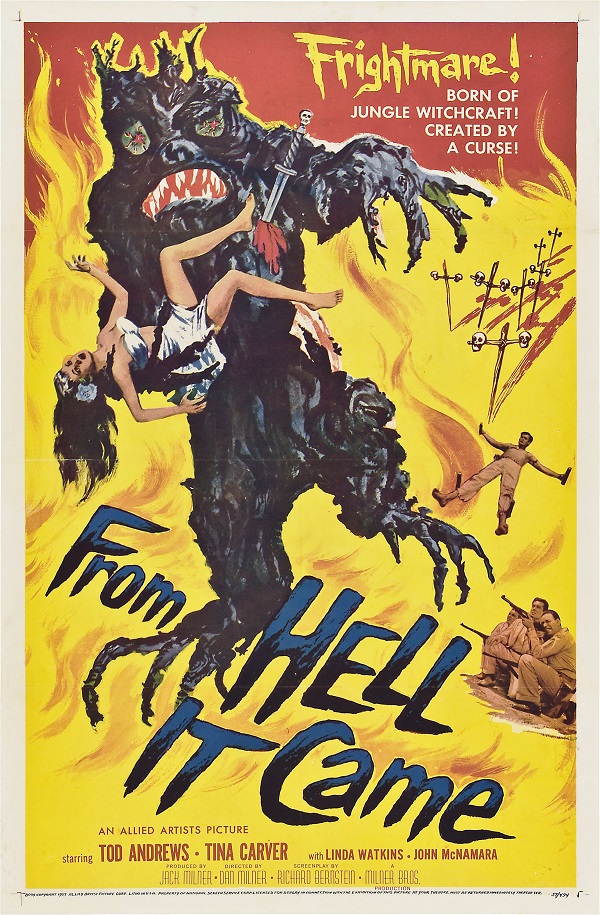
From Hell It Came (1957)

Directed by Dan Milner [Other horror films: The Phantom from 10,000 Leagues (1955)]

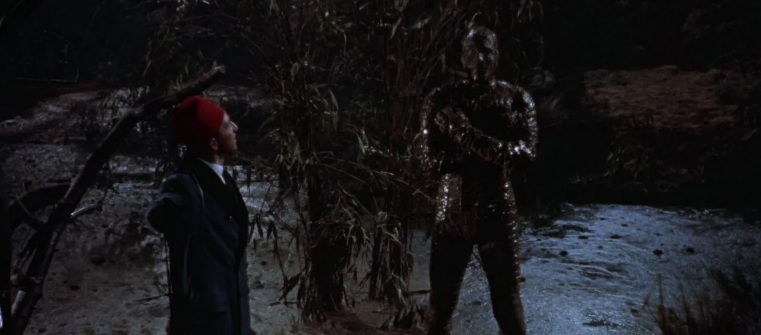
So a member of an island tribe is killed, and he comes back for revenge as a murderous tree? Good stuff, good stuff.

To be honest, while the monster itself is beyond goofy (the design for the tree creature just looks incredibly silly), I thought a good portion of this was at least enjoyable, and I definitely didn’t have a poor time with it.

Some of this is due to the setting, being a small island filled with restless natives while American scientists are trying to research a localized plague. To be fair, the plague doesn’t really play into the story at all, but I did like the idea of the scientists being worried about being overtaken by the natives, given that there’s only three of them and God knows how many members of the island tribe. It gives off almost a tense vibe at points (though I noted that those poison darts also never came into play).

None of the leads were particularly impressive, though. I think John McNamara was the most interesting, as Tod Andrews’ character rubbed me the wrong way with some sexist remarks and Tina Carver, despite being a scientist, still came across as second best to the other doctors. At least we got some humor from Linda Watkins, who’s British commentary cracked me up (and worth mentioning that Watkins was born in Massachusetts, so I wonder if she spent some time abroad to get that accent).

I can understand why this movie’s gotten rather negative reception, but I found much of it more charming than disappointing. I don’t think by any means From Hell It Came was a good movie – it’s still below average in my eyes – but I did personally have fun with it at times, if only for it’s ludicrous story, so take that for what you will.

6/10

The Alligator People (1959)

Directed by Roy Del Ruth [Other horror films: The Terror (1928), Phantom of the Rue Morgue (1954)]

Years and years ago, I saw this film on AMC. I’ve not watched movies from AMC for almost a decade, so you can probably tell just how long it’s been since I’ve seen this, and because of that, I was rather excited to finally sit down and see this again.

Sure, it’s not a great movie. The story is pretty much a combination of The Fly (1958) and The Maze (1953), so it’s not all that original. Even so, it has that fantastic classic horror feel that you get from 1950’s horror that livens the film up even though the trajectory of the film isn’t that unique. It can also be said the framing of the story – much of it being told in flashback – was reminiscent of Invasion of the Body Snatchers.

A big positive for this film is the setting, being a swamp. I always thought that swamps were an underutilized setting for horror, so whenever one pops up prominently in a movie, even one that’s not that great (such as 2005’s Venom), it’s nice to see. Here, it made a great centerpiece and led to some pretty solid scenes, and brought a quality atmosphere to the film.

Beverly Garland (It Conquered the World and Not of This Earth) made a fine lead, though as with most actress leads at the time, she was somewhat limited in character. Same could be said of Frieda Inescort, who had some interesting scenes and a somewhat enjoyable character arc, but at the same time, she didn’t add a whole lot come the finale of the film. Perhaps most importantly, Lon Chaney Jr. (The Wolf Man) was present also, though his character didn’t really matter until the end. Still, he was sort of fun, and occasionally sleazy.

Perhaps most memorable about The Alligator People is the ridiculous design of the Alligator Person (despite the title, only one singular real “alligator person” appears), which is somewhat unfortunate, but as bad as it looks, there’s not much screen-time for it, and it almost has a hokey charm, so I don’t think it harms the film all that much.

If you’re a fan of 1950’s horror, I don’t think you’ll have a bad time with this one anyways. Sure, the story isn’t all that new, but it takes a well-loved route competently enough, and personally, I find the film a fun watch. It’s not great, but The Alligator People is a good time.

7.5/10

This is one of the films covered by Fight Evil’s podcast, amazingly. Listen below as Chucky (@ChuckyFE) and I discuss The Alligator People.

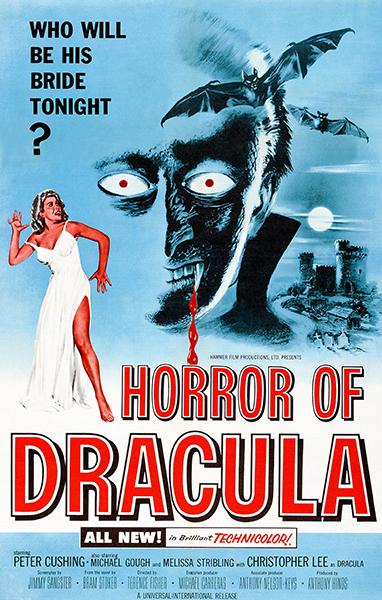
Dracula (1958)

Directed by Terence Fisher [Other horror films: Three’s Company (1953, episodes ‘The Surgeon’ & ‘ Take a Number’), The Curse of Frankenstein (1957), The Revenge of Frankenstein (1958), The Hound of the Baskervilles (1959), The Man Who Could Cheat Death (1959), The Mummy (1959), The Stranglers of Bombay (1959), The Brides of Dracula (1960), The Two Faces of Dr. Jekyll (1960), The Curse of the Werewolf (1961), The Phantom of the Opera (1962), The Horror of It All (1964), The Gorgon (1964), The Earth Dies Screaming (1964), Dracula: Prince of Darkness (1966), Island of Terror (1966), Frankenstein Created Woman (1967), Night of the Big Heat (1967), The Devil Rides Out (1968), Frankenstein Must Be Destroyed (1969), Frankenstein and the Monster from Hell (1974)]

Horror of Dracula, sometimes known as just Dracula, is one of Hammer’s earlier ventures into horror, following both The Curse of Frankenstein and The Quatermass Xperiment. It’s a decent film with some great performances, but it’s never been a favorite of mine.

Part of it may have to do with the fact I grew up on the 1931 Universal classic version of this story, and so even to this day, when I hear ‘Dracula,’ I immediately think ‘Bela Lugosi.’ Maybe that’s not fair, but it is true. Christopher Lee, of course, is a great actor, but when it comes to Dracula, he never really possessed the suave, almost je ne sais quoi, quality that Lugosi did. Lee is perhaps more frightening, and certainly more action-packed, but I’ve always been on Team Lugosi.

Even so, I’m not blind to the flaws of the 1931 film. I do tend to prefer it – while it may feel far more stagey than Horror of Dracula, I think it has far more classic scenes and lines which this version lacks – but at the same time, I don’t think it’s vastly superior to this movie. In fact, the story here is probably a bit more crisp and tragic, with some occasionally creepy vibes (such as a vampire leading a young girl through a forest at night), and of course, the fact that this movie’s in color helps out a bit.

It’s by no means a bloody film. There is one decent scene of a stake being driven into someone that looks good, but there’s no splatter whatsoever. Late in the film, we do see some quality special effects – think the conclusion of Fright Night only done 27 years prior – but on a whole, I think The Curse of Frankenstein probably stands out a bit more than this one in terms of pushing the boundaries.

I’ve always been a huge Peter Cushing fan. From his wide horror catalogue (The Hound of the Baskervilles, The Gorgon, The Curse of Frankenstein, The Mummy, and The Abominable Snowman), he’s never failed to entertain me, and I quite enjoy his serious character here. I especially enjoy seeing him work side-by-side with Michael Gough (who I know as Alfred from the Batman movies, but he was also in Horrors of the Black Museum, Curse of the Crimson Altar, Berserk, Black Zoo, and Trog), who perhaps plays the most tragic character of the film.

We get a good twenty or so minutes with Jonathan Harker, played here by John Van Eyssen. He’s not that memorable, but I rather liked the approach to setting the story up. Neither Carol Marsh nor Melissa Stribling did much to leave an impression, but the more humorously-inclined scenes with George Benson were fun at times.

As far as Christopher Lee goes, his performance as Dracula is fine. Like I said, I personally prefer Lugosi, but both bring something different to the role. Lee (The Wicker Man, The City of the Dead, and I, Monster) is a great actor, and though he doesn’t have a lot of screen-time here, he does make a solid and threatening impression when he does pop up, and I certainly can’t find fault in that.

I think my biggest issue with the film – which may be overstating it, as I don’t think the film is bad whatsoever – is that I’m just so familiar with the Universal classic. The story here may be better, like I said, but it doesn’t feel anywhere near as classic to me. There’s no scenes that stand out as great, no quotes that stand out as stellar, and aside from Gough and Cushing, no performances which blow me away. I’ve always found Horror of Dracula a perfectly fine movie, but really, no more than that.

None of this should take anything away from the film. If I had seen this before the 1931 version, I’d likely enjoy this one more. It’s a good way to spend your time, and things pick up very nicely come the finale, which includes some solid special effects, but when it comes to classic Hammer horror, I’d personally prefer spending my time with The Curse of Frankenstein or The Mummy.

7/10

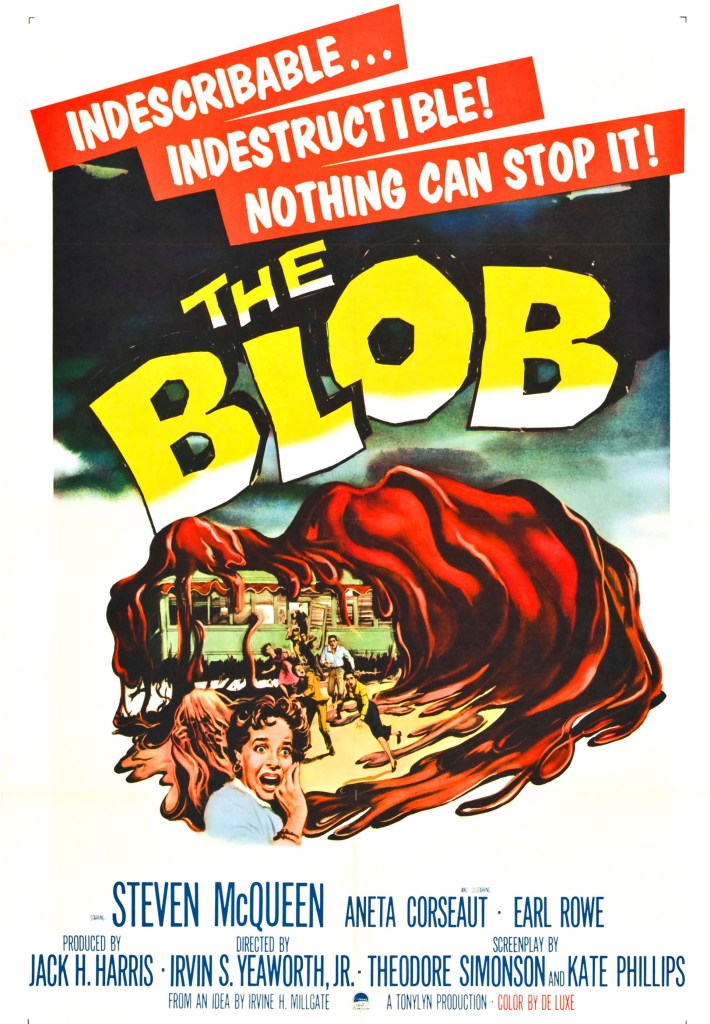
The Blob (1958)

Directed by Irvin S. Yeaworth Jr. [Other horror films: 4D Man (1959)] & Russell S. Doughten Jr. [Other horror films: N/A]

Few movies are as nostalgic for me as The Blob. Ever since I was a kid, my family has owned this one on an old Goodtimes VHS tape, and I cannot even begin to guess how many times I’ve seen it. I won’t pretend that to a modern-day viewer the film wouldn’t have problems (one of them being that Steve McQueen doesn’t much look like a teenager here), but to me, the movie’s perfect.

Watching this now, after seeing much more that the genre has to offer, the first thing that strikes me is the fact that it’s in color, and it’s even pretty decent color. Most American horror movies didn’t switch over to color until the 1960’s, so the fact that this one was color just impresses me more than it might others who already prefer the 1988 remake.

Another thing – the catchy number at the beginning. The credit to the song goes to The Five Blobs (which is a funny artist name to begin with), and while I understand that a song like that might not seem appropriate before a horror flick, I always thought it was a lot of fun, and that song has graced my iTunes for many years now.

The story here isn’t that different from other alien invasion movies of the 1950’s, the only real difference being that the alien here is an amorphous blob as opposed to some type of bipedal humanoid. Design-wise, the blob is pretty simple, but I always liked that purpleish-pinkish shade, and the fact that it’s pretty unstoppable is also impressively horrifying.

Steve McQueen (who famously screwed himself when taking $2,500 for the film, as opposed to 10% of the film’s profits) may not be the best-cast here, but I still love what he brings to the film, and his sometimes overly-dramatic performance (“He was just gone. Just gone”). Aneta Corsaut wasn’t necessarily special here, but I still love her for her unending concern of the old man’s dog.

Earl Rowe and John Benson both brought something to their roles, Benson an authoritarian, teen-hating cop, and Rowe a cop with a bit more of an understanding nature. Their mild conflicts throughout the film were interesting (more so when we found out Benson’s character was in the war, most likely Korea), and Robert Fields’ (Tony) story about moving a friend’s car was pretty funny also (I never quite understood the exact nature of McQueen’s and Field’s relationship, but it always had charm).

I understand that some of my views are purely nostalgia, and I suspect that some people might not be able to take me seriously as a reviewer given I’m perfectly okay with allowing nostalgic value to help guide my rating (though if they’ve been reading my reviews for a while, this definitely isn’t the first time nostalgia has played a role). I maintain that there’s not an issue with that, though – most people have those movies that they’ve loved since childhood, and I certainly have loved this one for a long time.

A great piece of 50’s horror, The Blob has been a long-time favorite of mine, and I’m not the least bit guilty for giving this one the highest of ratings.

10/10

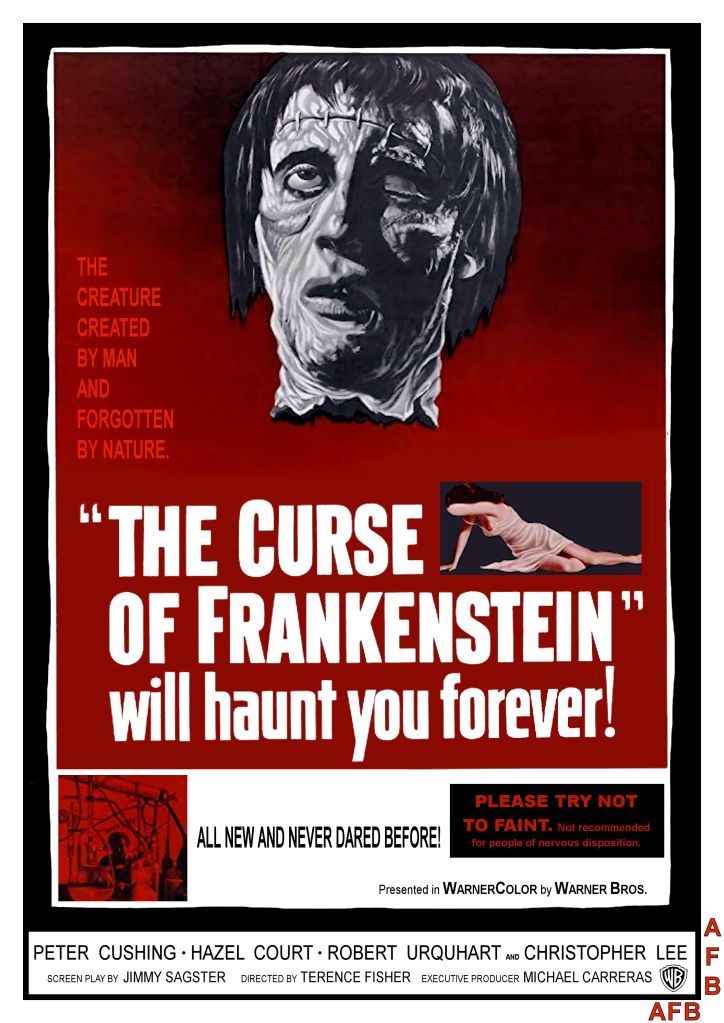
The Curse of Frankenstein (1957)

Directed by Terence Fisher [Other horror films: Three’s Company (1953, episodes ‘The Surgeon’ & ‘ Take a Number’), Dracula (1958), The Revenge of Frankenstein (1958), The Hound of the Baskervilles (1959), The Man Who Could Cheat Death (1959), The Mummy (1959), The Stranglers of Bombay (1959), The Brides of Dracula (1960), The Two Faces of Dr. Jekyll (1960), The Curse of the Werewolf (1961), The Phantom of the Opera (1962), The Horror of It All (1964), The Gorgon (1964), The Earth Dies Screaming (1964), Dracula: Prince of Darkness (1966), Island of Terror (1966), Frankenstein Created Woman (1967), Night of the Big Heat (1967), The Devil Rides Out (1968), Frankenstein Must Be Destroyed (1969), Frankenstein and the Monster from Hell (1974)]

The Curse of Frankenstein is a classic that I don’t really have that much to say about. It’s not as classic a movie as 1931’s Frankenstein, but this Hammer production is still one of the best renditions of the story.

A large part of this is the very solid cast, and who could expect differently coming from a Hammer movie. Peter Cushing is a favorite of mine, and he’s been in so many movies of the genre that it’s really hard to narrow down his best performances. Playing Frankenstein here, Cushing was fantastic, and his sole focus on his work (at the expense of his fiancé, Hazel Court) was, as always, fun to watch.

Playing his long-time mentor and eventual foe, Robert Urquhart did a great job, and during their many arguments about the morality of Frankenstein’s experiments, Urquhart and Cushing really get into it, and you can really see his disappointment in Frankenstein toward the end of the film. These two are easily the most important, but Christopher Lee brings a lot as the Creature, playing a very different version than Karloff did, and Hazel Court too was a nice, although somewhat unimportant, addition.

I also really liked the layout of the story, with the bulk of the horrors occurring via flashback told by a condemned Cushing. The ending was somber, and truthfully I felt pretty bad for Frankenstein, though I certainly think he had his problems when it came to approaching his experiment (though the base of the experiment, I thought, was perfectly valid).

This is a Hammer classic, and I enjoy it more than the following year’s Horror of Dracula. Both are good movies, quality re-imaginings of classics, and I’d easily recommend the both of them to fans of classic horror.

8/10

Gojira (1954)

Directed by Ishirô Honda [Other horror films: Gojira no gyakushû (1955), Jû jin yuki otoko (1955), Godzilla: King of the Monsters! (1956), Sora no daikaijû Radon (1956), Godzilla (1957), Tokyo 1960 (1957), Bijo to ekitai ningen (1958), Daikaijû Baran (1958), Half Human: The Story of the Abominable Snowman (1958), Gigantis: The Fire Monster (1959), Mosura (1961), Varan the Unbelievable (1962), King Kong vs. Godzilla (1963), Matango (1963), Mosura tai Gojira (1964), Uchû daikaijû Dogora (1964), War-Gods of the Deep (1965), Furankenshutain tai chitei kaijû Baragon (1965), Furankenshutain no kaijû: Sanda tai Gaira (1966), Gezora, Ganime, Kameba: Kessen! Nankai no daikaijû (1970), Gojira tai Hedora (1971), Godzilla (1977), Godzilla 1985 (1985), Gojira vs. Desutoroiâ (1995), Gojira tai Megagirasu: Jî shômetsu sakusen (2000)]

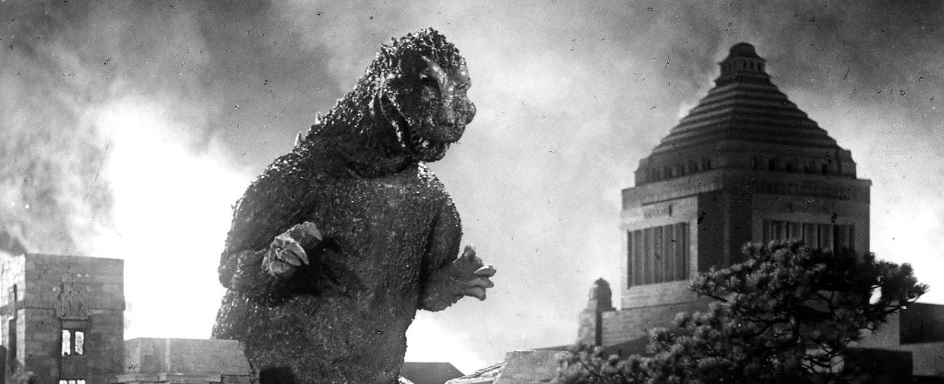
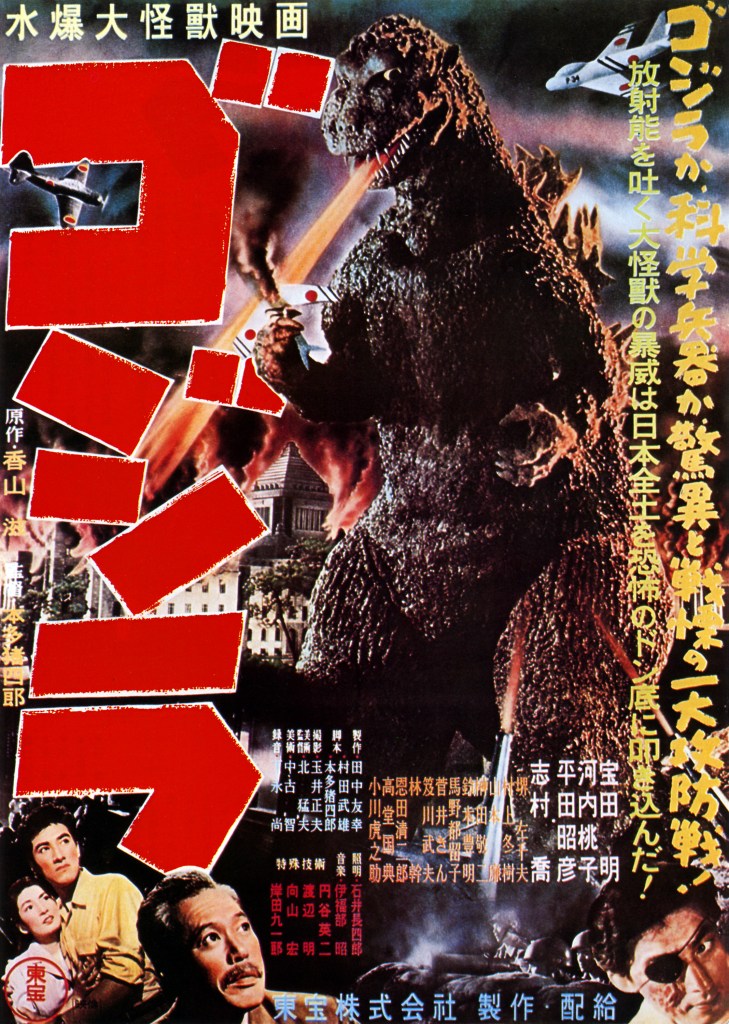
Very much a political statement against nuclear weaponry (a statement I entirely agree with), this is a classic movie that I’ve seen bits and pieces of before, but never the whole thing at once. To the modern eye, Gojiria may not seem that special, but it’s still a decent amount of fun and overall a well-made monster movie.

You can definitely get an epic scope from the destruction that Godzilla causes during his rampages. How many people were dislocated, how much property damage, how many killed? These questions apply both to the lizard monster, and also to the U.S.A.’s dropping of nuclear bombs on two Japanese cities. It’s utter destruction, and the only viable solution is an idea that a scientist doesn’t want to share, for the sole reason that he knows it’ll be weaponized in the future.

Godzilla has a lot to say about the state of war, and I think it says it well. I found the distinction between approaches interesting (Takashi Shumura’s desire to study the creature vs. Akira Takarada’s agreement with the military to destroy it), and I see the validity behind both points (in a way, it reminds me of Day of the Dead). Takashi Shumura made for a very compelling character, and when he threw Akira Takarada’s character out (in front of Shumura’s daughter, who Takarada was hoping to marry), talk about dramatic.

I think the most interesting character here, though, is Akihiko Hirata’s, the scientist with an idea to destroy the threat of Godzilla, but the unwillingness to share with the military (for good reason). The very moral arguments that he had with himself would have been difficult, as again, you can sort of see both sides of the argument. When this opportunity is made clear to Momoko Kôchi’s character on the promise of silence, she eventually breaks her word to let Takarada know, and that leads to perhaps my favorite scene in the film.

Much more than just a giant monster causing untold death and dismay, Godzilla is a moderately deep and pretty moving story. I can’t personally say it’s one that I’d watch again and again, but I thought they did really well with the issues at hand, and I’m happy that I’ve finally seen this, despite taking me this long to get here.

7.5/10

House of Wax (1953)

Directed by André De Toth [Other horror films: Terror Night (1989)]

One of the earliest 3D horror films, House of Wax (a remake of Mystery of the Wax Museum) is well-made and quite memorable. The 3D is a bit showy at times (that yo-yo scene was clearly there only because of the 3D aspect), but the story here is solid, and of course, an early horror appearance of the legend that is Vincent Price.

Oh, it’s also in color, which is a nice change of pace, especially for a 1950’s American flick.

The whole idea of using dead bodies as the base of wax figures is hella creepy, and though there’s not a whole lot in the way of violence, the film still occasionally feels brutal at times, especially toward the end, when the heroine is about to have boiling wax poured over her nude body (of course, the nudity being tastefully hidden). It helps that Price’s character, while the antagonist, is still pretty sympathetic, and the opening to this film is heart-breaking in it’s own right.

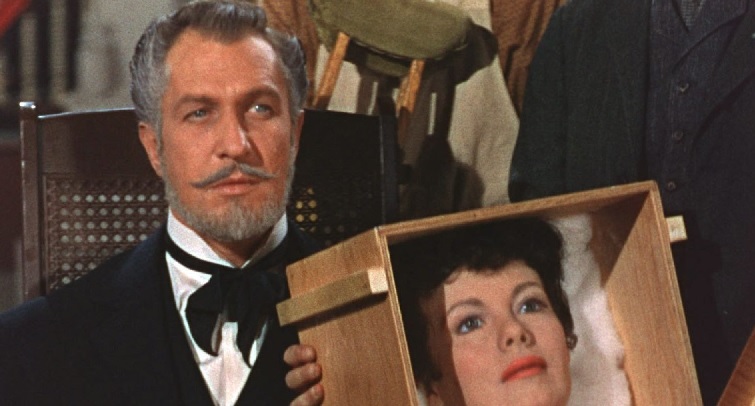
Without a doubt, Price makes this movie as special as it is. The 3D never really mattered much to the plot, but Price’s performance is something that can’t be denied. His passionate portrayal of a man driven somewhat mad was great, and you can definitely tell why he later starred in so many great horror films (such as House on Haunted Hill and The Pit and the Pendulum). Phyllis Kirk was never really a star, but she did pretty good here, especially during the final scenes with Price (such as the great revealing sequence). Another name worth noting is Charles Bronson, who plays a mute assistant of Price’s. Personally, I don’t think I’ve really seen a film Bronson starred in (I’ve seen both The Dirty Dozen and The Great Escape, but that’s it), but even so, he seems to be an actor worth mentioning.

There are times when I felt House of Wax could have been more to the point – the whole of Paul Picerni’s character seemed moderately like needless padding – but even so, this is a classic during a time when not too many horror movies were coming out (the late 40’s to early 50’s is a dead man’s zone when it comes to the genre), so House of Wax is very much worth watching. I’ve seen it plenty of times before, and while I will admit to possibly enjoying Mystery of the Wax Museum a little more, Vincent Price, along with the fact that the movie’s in color, brings a lot to this rendition of the story.

7.5/10

Night of the Demon (1957)

Directed by Jacques Tourneur [Other horror films: Cat People (1942), I Walked with a Zombie (1943), The Leopard Man (1943), The Comedy of Terrors (1963), War-Gods of the Deep (1965)]

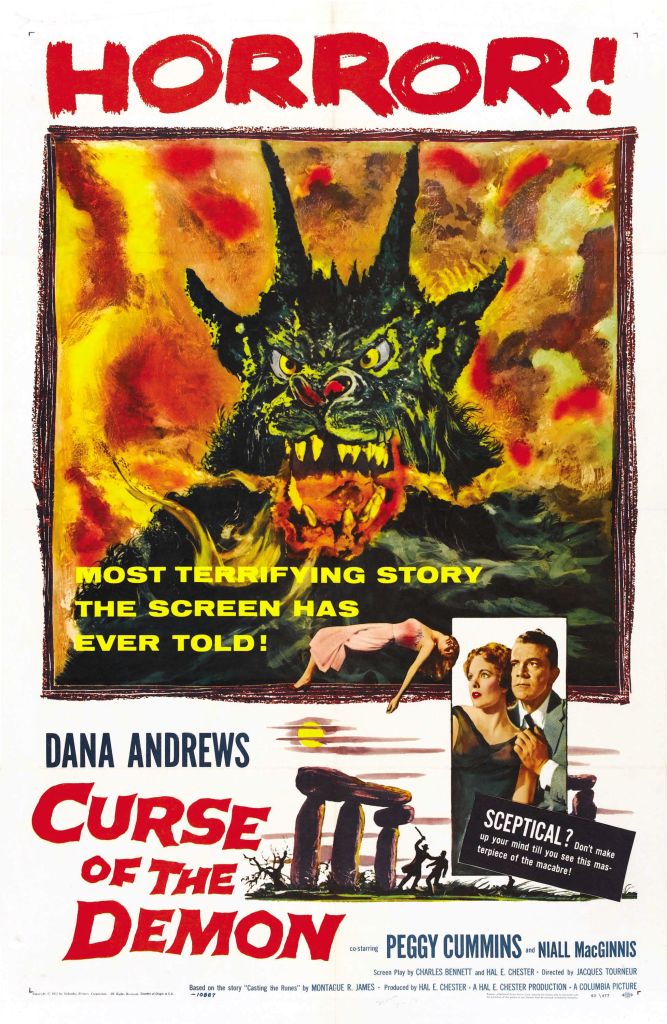
It’s twice now I’ve seen this one, and maybe it’s me, but I don’t think it’s that great. Night of the Demon (or Curse of the Demon, depending on your location) is good, and it has a solid atmosphere, but I don’t see it as much more.

What I like about this one (which, by the way, is based off an M.R. James story) is the undeniably dense atmosphere. It’s a black-and-white film, which goes a long way to allow some scenes to work really well, especially during the fog-drenched sequences, which were very appealing. The titular demon doesn’t pop up that often, but that also had charm (despite the fact the demon doesn’t necessarily look amazing).

Dana Andrews does decently well here, though the skepticism he portrays is a bit much. I’m an atheist, but when presented with evidence of a God or gods, I’d be willing to believe. But no matter how much Andrews’ character sees, it takes him a long time to make that leap. Any skeptic worth his or her salt would, upon receiving evidence, accept a claim. I don’t blame him for mocking the seance (that was not a controlled experiment whatsoever, and as such, of course a man of scientific learning shouldn’t be expected to buy that), but past a certain point, he should have been more willing to accept that something’s going on.

Peggy Cummins and Niall MacGinnis are both good additions, especially MacGinnis. I don’t think I’d go as far as to call him amazing, but I really did like what he brought to the film (though of course, I don’t see why Satanists are portrayed in such a negative light as they generally have a peaceful religion). Others who I enjoyed, though neither one was that important, include Liam Redmond and Peter Elliott.

If there’s one thing about the movie I think is close to flawless, it’d be the finale, which takes place on a train. Talk about tense – that moment was very much the engaging story I wish the first eighty minutes had been. Not that the story here wasn’t worth it, but it really shined during the conclusion in a way it didn’t for me leading up to it.

Night of the Demon isn’t a movie I love, but I do like some things about it. Ultimately, I’d place it around average, and though I don’t personally like it near as much as many others tend to, I’d still suggest it for those looking for a piece of 50’s British horror that might make an impact.

7/10

It Came from Outer Space (1953)

Directed by Jack Arnold [Other horror films: Creature from the Black Lagoon (1954), Revenge of the Creature (1955), This Island Earth (1955), Tarantula (1955), The Incredible Shrinking Man (1957), Monster on the Campus (1958)]

I can appreciate a good alien invasion movie from the 1950’s, and It Came from Outer Space is decent, but compared to others I’ve seen (The Thing from Another World, Invasion of the Body Snatchers, and hell, The Blob), this falls a bit flat.

The cast is fine, and I’ve no complaints. Richard Carlson (also in The Maze and Creature from the Black Lagoon) is pretty fun as the main character, a bit of an odd-ball who no one in town believes when he spouts off stories of crashing spaceship. Playing his opposite in many ways is Charles Drake, who has a (pardon the pun) more down-to-Earth view of things, and sort of becomes antagonistic and paranoid toward the end (though certainly with reason).

Even so, I wasn’t really taken in by the story. I sort of like the paranoid feeling Drake’s character starts feeling near the end, but It Came from Outer Space doesn’t nearly have as good a vibe as does Invasion of the Body Snatchers a couple of years later. At the same time, I did quite like a setting, being a small Arizona town surrounded (of course) by desert.

This isn’t a movie I take pleasure in shooting down, nor is that exactly what I’m doing. It’s still a decent movie, but it’s not a movie I could see myself watching that often or really going out of my way to recommend to others, especially when there are so many better movies in the same decade. For the time being, I’d say this is worth one watch, and past that, maybe not so much.

7/10