Son of Frankenstein (1939)

Directed by Rowland V. Lee [Other horror films: Tower of London (1939)]

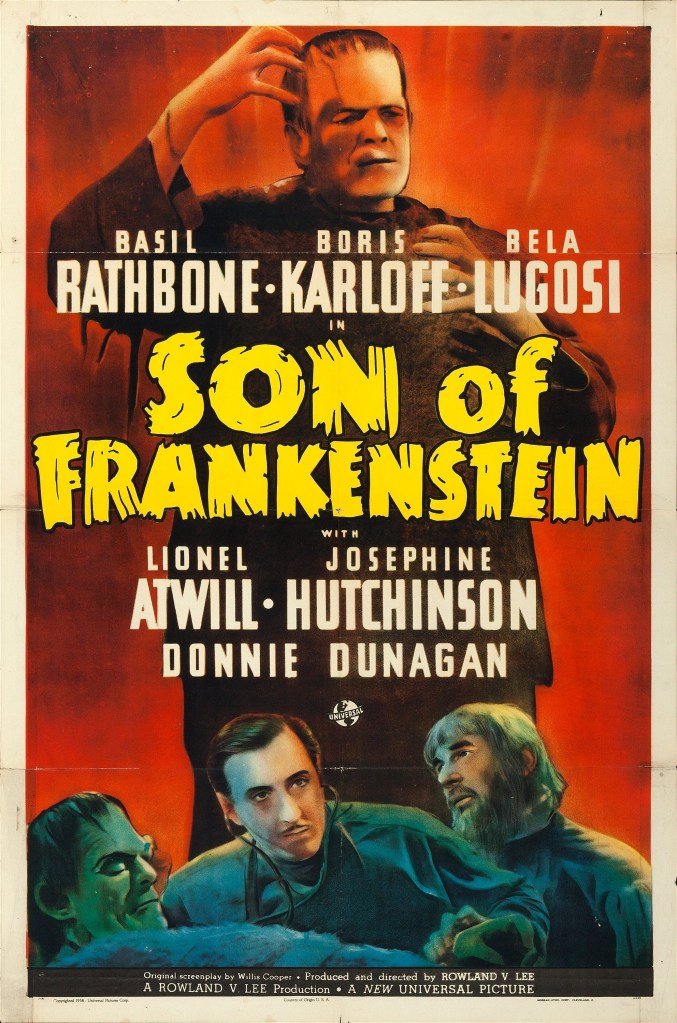
In truth, I can’t swear that I didn’t see bits and pieces of this growing up. My parents raised me on Universal classics, so I wouldn’t be surprised if I’d seen fleeting moments of this one. To my knowledge, though, this is my first time watching Son of Frankenstein, and I have to say that it was a bit of a treat.

For further context, I’ve never been a big fan of Bride of Frankenstein, for a variety of reasons. I was wondering if this would disappoint me, and when I saw the runtime was an hour and 40 minutes, I got more hesitant. I’m happy to say that such worries were all for naught, though, as Son of Frankenstein turned out a fine movie.

The opening was chock-full of atmosphere – the son of Henry Frankenstein (from both the 1931 classic and Bride), Wolf von Frankenstein (Basil Rathbone) returns to his family’s castle, and with him returns the dangers of the monster, albeit far more due to Ygor’s actions than Frankensteins’ own. It’s a very classic horror film in structure, and though it lacks much of the charm of the first movie in the series, it still has quite a bit.

It also has a surprisingly high level of tension. Things ratchet up throughout the film, and especially in the last 25 minutes, as Wolf von Frankenstein is increasingly worried for his family’s safety, and cracking under the suspicions of Inspector Krogh (Lionel Atwill) – for a movie of it’s time, I was pleasantly surprised by just how much I was still engaged come the end (especially given that there were portions in the middle of the film that I began to feel my interest waning).

Basil Rathbone (Queen of Blood, The Black Cat, The Hound of the Baskervilles, The Black Sleep) was great here, and his portrayal of a Frankenstein trying to redeem his family’s name was sympathetic. As Inspector Krogh, Lionel Atwill (Mystery of the Wax Museum, Mark of the Vampire, Doctor X, Man Made Monster, Secret of the Blue Room) was hella intense, and I really dug his character. Bela Lugosi (Murders in the Rue Morgue, The Devil Bat, Black Friday, Night Monster, Bela Lugosi Meets a Brooklyn Gorilla, The Return of the Vampire, The Body Snatcher) did great with a character who sort of popped out of nowhere (as Ygor is likely a replacement for Fritz), and he was certainly a dick.

Josephine Hutchinson, as expected, didn’t really have a ton to do in this movie, not to mention a lack of agency. Edgar Norton (Dr. Jekyll and Mr. Hyde, Dracula’s Daughter) was great here, as he usually is, and playing the Monster was again Boris Karloff (The Devil Commands, Frankenstein 1970, Voodoo Island, Grip of the Strangler, Bedlam, The Black Room, Curse of the Crimson Altar, The Walking Dead, Snake People, Die, Monster, Die!), and he did just as well as you’d expect him too.

I was never expecting to dislike Son of Frankenstein, but I have to admit that I didn’t know if I’d actively enjoy it, and was pleasantly surprised to find out that I did. It’s a fun movie, and the aspect of Ygor using the Monster as a form of revenge without the knowledge of Frankenstein adds a little spice to the film. I also loved that reference at the beginning – about how “nine out of ten” refers to the Monster simply as ‘Frankenstein.’ As someone who finds that constantly bothersome (though I understand the counterpoints), I appreciated that piece of dialogue.

No doubt that Son of Frankenstein is a strong Universal classic – one that I personally find superior to Bride of Frankenstein – and though I think many might be turned off by a third movie in a franchise, I think that if they take the time with this one, as I did, they’d have a pretty good time too.

8/10

Jeepers Creepers (2001)

Directed by Victor Salva [Other horror films: Clownhouse (1989), The Nature of the Beast (1995), Jeepers Creepers 2 (2003), Rosewood Lane (2011), Haunted (2014), Jeepers Creepers 3 (2017)]

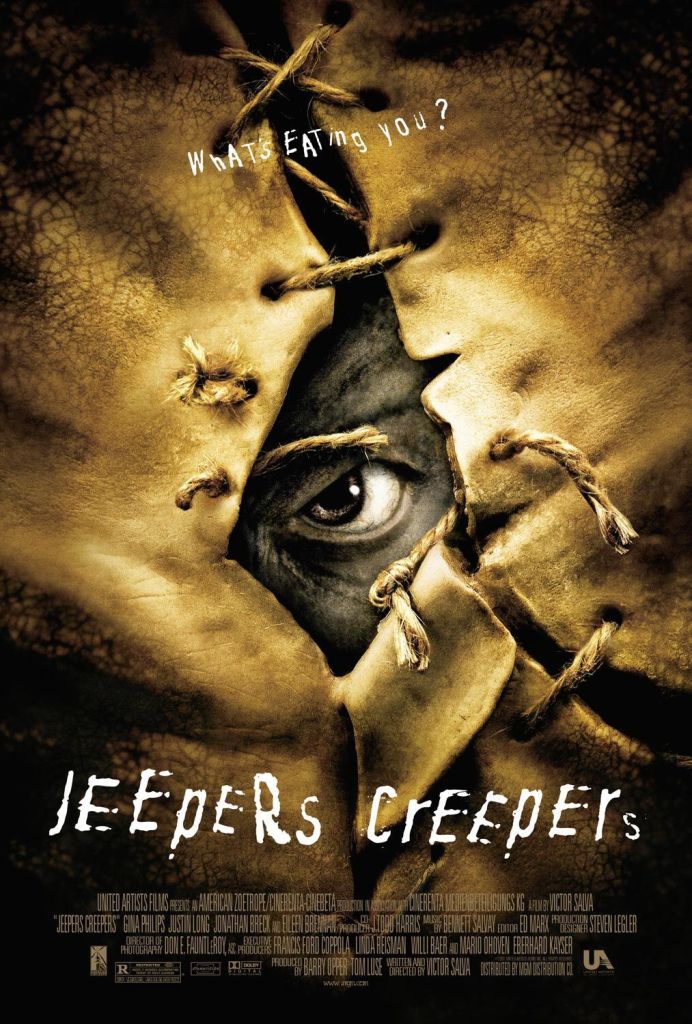
I’m not quite sure what it is about Jeepers Creepers that consistently works for me, I just know that it consistently does.

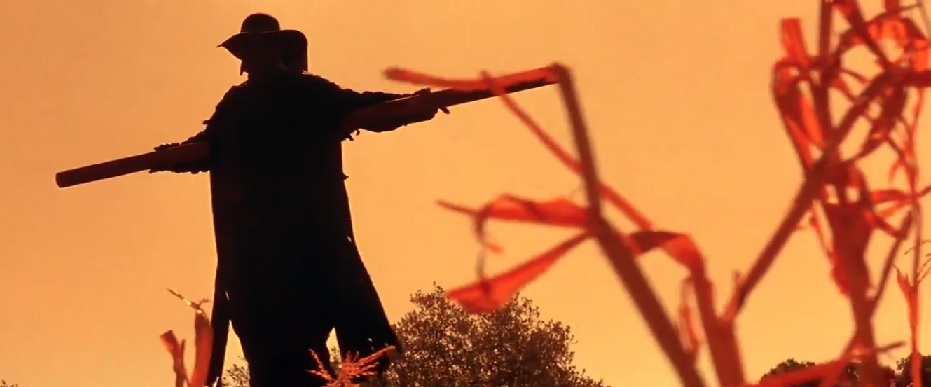
Certainly the first forty minutes or so are insanely tense, and that scene in which Trish (Gina Philips) and Darry (Justin Long) are driving past the Creeper as he’s throwing a body down a pipe is perfection. There’s a lot of suspense in the first half of the film, and they did a great job with it.

When the film moves to a more fantastic creature-feature type route, I still think the movie keeps things moderately decent, though it’s also fair to say that the latter half of the film isn’t always as interesting as the first half. The good thing, though, is that the movie is well-paced, and it really feels like it flies by, making the movie all the more digestible.

It’s also a decently original plot. The idea of some inhuman creature stalking people in order to eat parts of their body isn’t something you hear about every Sunday. The whole “every 23rd spring in every 23 years” thing could be a reference to Pennywise from It (and hey, the main lead even has the name “Darry,” which is close to “Derry”), and I imagine many would compare the beginning of the film with Duel, but for the most part, Jeepers Creepers tends to have an original feeling.

I also think that is was a great idea to feature siblings as the main characters. I can’t begin to tell you how utterly sick I am of every other movie having some romantic stuff thrown in, sometimes under the most ridiculous circumstances, so focusing instead on a brother and sister was great, and I really buy that relationship insofar as their performances go.

Justin Long (Drag Me to Hell, Barbarian) was pretty good here. Again, I bought his relationship with Gina Philips. Philips (The Sickhouse, Deadly Invasion: The Killer Bee Nightmare, Ring Around the Rosie, Jennifer’s Shadow) herself had a lot of emotional material to contend with, and she did well too. I wish we learned a bit more about Patricia Belcher’s character, but she was fun, and Jonathan Breck’s portrayal of the Creeper was the stuff of dreams.

There are a few grisly moments in the movie, but this is all really pretty tame. The suspense is what keeps things going throughout, and though there is some violence at times, that’s never really the point. Late in the film, we even have a somewhat action-packed showdown at a police station, which was a nice sequence.

Worth mentioning also are those fade-to-black cuts. They happened throughout the movie, and felt out of place. Honestly, I thought it felt like something you’d see in a TV movie, and not a feature film like this one. It didn’t hurt the movie or anything so drastic, but it was notable, and just seemed odd to me.

Naturally, I’ve seen Jeepers Creepers before, though I admit it’s been a hell of a long time. It’s a movie that I’ve enjoyed plenty of times in the past, and I imagine I’ll enjoy plenty more times in the future. It’s not a perfect movie, nor is it really a game-changer, but it does feel unique, and I can see why it’s largely lauded as a quality film in the horror community.

8/10

The Mummy’s Hand (1940)

Directed by Christy Cabanne [Other horror films: One Frightened Night (1935), Scared to Death (1946)]

I’ve never been the biggest fan of The Mummy, but that’s not to say that other films in the series can’t be enjoyable (and to be sure, it’s not like the 1932 movie isn’t okay either). In the case of The Mummy’s Hand, though, I can say that it suffers from a painful comic relief character, and though it’s not terrible, I can’t say I had a great time with it.

However, it might be possible to say that this at least has a better pace than the 1932 movie. I should also mention that despite the fact some may think this is a sequel, it’s not – the Universal Mummy series (the 1932 original, this one, The Mummy’s Tomb, The Mummy’s Ghost, and The Mummy’s Curse) isn’t as disjointed as the Halloween franchise is, but from my understanding, the first movie is stand-alone, and the other four, starting with this one, comprise of the Kharis mummy tetralogy.

The actual plot isn’t shabby. If you’ve seen one mummy movie from the 1940’s, though, you’ve probably seen them all, so I don’t know if this really stands out, and if it does, it’s likely because of Wallace Ford’s comedic relief character. To be fair, he can sometimes have amusing quips, and I appreciate that he at least made the film feel as though it was moving at a faster pace than the snail’s crawl that is the 1932 movie, but even so, I never saw the point of his character here.

Dick Foran (Horror Island) made for a solid straight lead. Like many leading men, I don’t think he really stands out, but he was good at the time. Again, I couldn’t stand a lot of Wallace Ford’s (The Rogues Tavern, The Ape Man, Night of Terror) dialogue, but that’s not on him. Cecil Kellaway (The Beast from 20,000 Fathoms, Hush…Hush, Sweet Charlotte) was a lot of fun as a magician, though.

George Zucco (The Mad Ghoul, Dead Men Walk, The Flying Serpent, Fog Island) was pretty sinister in his role, as he usually is. Though he had a limited time to make an impression, Charles Trowbridge (Valley of the Zombies) was solid. Playing the generic love interest was Peggy Moran (Horror Island), who had a little more of an action feel than I usually get from actresses at the time.

Oh, and the Mummy here was played by Tom Tyler, who did well, though he’s no Boris Karloff. And speaking of the Mummy, he didn’t even appear until 40 minutes into this 67 minute movie. Again, this isn’t as slow as the 1932 Mummy is, but things aren’t exactly moving at lightning speed either. That may not come as a surprise – in my experience, a fast-paced mummy movie is almost impossible to make – but worth noting nonetheless.

What else is there to really say about The Mummy’s Hand? It’s not a bad movie, and though it was better paced than the 1932 classic, I don’t think that makes it more enjoyable, especially as it doesn’t have any of that film’s charms. Worth a watch if you’re into the Mummy craze, but otherwise, not up to much, in the end.

6/10

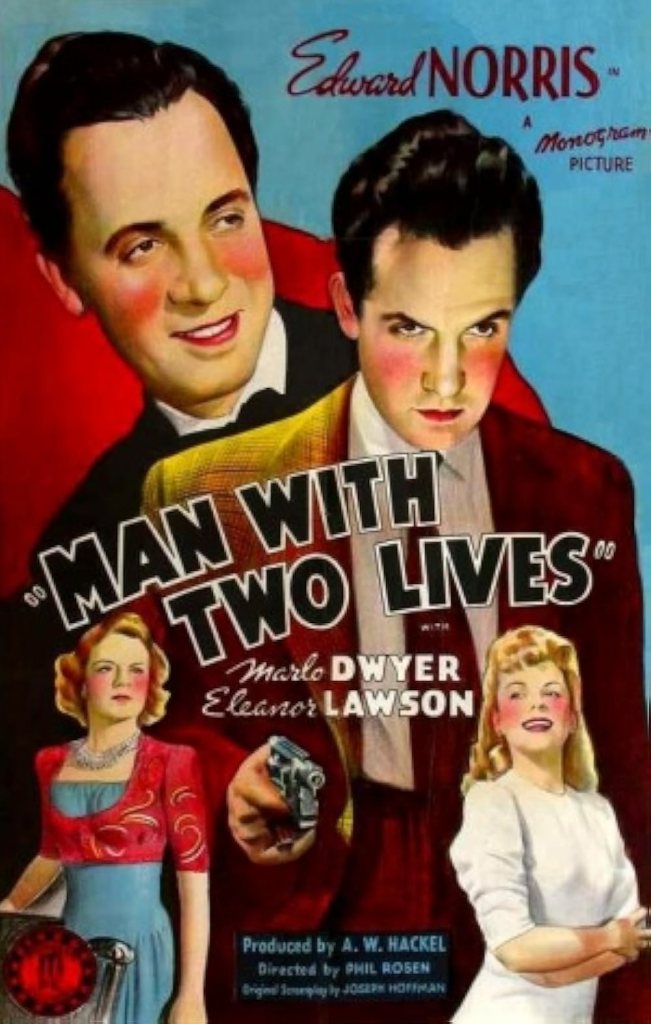
Man with Two Lives (1942)

Directed by Phil Rosen [Other horror films: Spooks Run Wild (1941), Mystery of Marie Roget (1942), Return of the Ape Man (1944), Black Magic (1944), The Jade Mask (1945)]

This is an interesting one. Man with Two Lives can be a pretty decent movie – if you’re into the classics – but I do think that if you’re a fan of classic horror specifically, and come into this one expecting something like The Walking Dead, you’ll be a bit disappointed.

The thing is that the means of the story are couched in what you’d expect from a horror film, but the final product generally feels more like a crime movie than anything else. I guess before I go on, I should get into the plot and explain what I mean.

Man with Two Lives follows recently-engaged Philip Bennett (Edward Norris) as he has a car accident, and dies. Luckily, a family friend, Doctor Clark (Edward Keane) has been doing experiments regarding bringing hearts back to life after death, and after Philip’s father and brother (Frederick Burton and Tom Seidel) plead with him, and against the warnings of another family friend, Professor Toller (Hugh Sothern), Clark does just that.

Troubles arise, though, when it turns out that this experiment – bringing Philip back to life – happens at the exact same time the violent gangster Panino is executed for his crimes. When Philip does regain consciousness, he has no memories of his life, and begins exhibiting violent, gangstery qualities unbecoming of a young man from means, including going to shady bars, taking over a gang, and killing police officers just because it brings him joy.

As you can potentially tell by my description, much of Man with Two Lives follows a man who’s leading a gang. The way this man came to be in control of the gang – a possible migration of the soul – may be rooted in what you’d expect from some horror, but the outcome feels like a crime film throughout large portions.

None of this is to say that the film isn’t good or without suspense. In fact, the finale is extraordinarily tense in a way that no previous portion of the film has been. Sure, we see a character get strangled earlier on, but we also get the sense that that specific character definitely wasn’t long for the world, so I wouldn’t call that sequence suspenseful. The finale, though, which is sort of a culmination of the family’s investigations into where Philip disappears to days on end, is fantastically done.

I will say that Edward Norris did great with his double-role, of sorts. As a gangster, he was pretty solid, and it was fun to watch. After Norris, I think the most important cast members become Edward Keane and Frederick Burton, both of whom spend time trying to figure out why Norris’ character is acting so differently after being brought back to life.

Some aspects of Hugh Sothern’s character were hard to like – his insistence, for instance, that there is in fact such a thing as a soul because all religions and philosophies agree on its existence – but that’s on his character, not the performance, which I thought was good. Others who don’t really impact things as much as you may think include Marlo Dwyer, Eleanor Lawson, Tom Seidel, and Addison Richards (The Mummy’s Curse, Strange Confession), though Richards does have a strong sequence near the end.

As you could expect, the film also goes into the whole “man should not get involved in what’s best left to the Creator” tripe that was all-too-common in movies from that time period, such as Frankenstein. It was a different time, and perhaps back then people didn’t understand that before you make the claim that man shouldn’t interfere with God’s will, they first need to prove the existence of a God, along with a way to determine what his ‘will’ is, neither of which has been done to this day.

Overall, though, Man with Two Lives is a solid film. For someone looking for a traditional horror film of the 30’s and 40’s, I don’t think this will hit the right spot, but if you’re into something a bit different, with a nice crime feel permeating throughout, Man with Two Lives may well be worth a watch.

7/10

The Invisible Man’s Revenge (1944)

Directed by Ford Beebe [Other horror films: The Phantom Creeps (1939), Night Monster (1942)]

I found myself feeling somewhat lukewarm toward The Invisible Man Returns, and I have similar feelings for this one. The Invisible Man’s Revenge isn’t without some decent ideas, but especially toward the end, I find myself losing interest.

Part of this is because I found myself on the Invisible Man’s side. Played by Jon Hall (and not becoming invisible until something like 20 minutes into the movie), he was cheated out of money by a wealthy couple (Lester Matthews and Gale Sondergaard), and despite a signed agreement, they refuse to pay him back. To be sure, Hall’s character wasn’t the most stable, but he did have rights to some of the money, and so we’re supposed to root against him?

It wasn’t so much Matthews’ character that bothered me as it was Sondergaard’s – she obviously had no intention of paying back any owed money to the man, and would have been happy to kill him herself if she had any plausible way to get away with it. When the so-called antagonist is in the right, it just sometimes makes movies harder to play ball with.

There were also a few moments of amusing mirth that I probably could have done without. Most of Leon Errol’s dialogue pegged him for comic relief, and he was good at it. He cracked me up a handful of times, and he was good fun. The scene in which he wins at darts, though – with the help of the Invisible Man, who’s running the darts from his hand to the bullseye – went on too long and felt wholly unnecessary. The first time was sort of funny, but he threw three more darts in increasingly improbable ways, and at that point, the fun was draining from the sequence.

I do think, though, that Leon Errol was one of my favorite characters, though. Jon Hall (The Beach Girls and the Monster) was a decent lead, but Errol was simply more fun. It was also fun seeing John Carradine (Voodoo Man, Revenge of the Zombies) here – his scientist character had charm, though I have to say that his house – which held a bunch of invisible animals – also felt a bit on the silly side.

I couldn’t stand Gale Sondergaard’s (The Spider Woman Strikes Back, Savage Intruder, The Cat Creature, The Climax) character – she was just awful, and deserved to get got. Lester Matthews (Werewolf of London, The Mysterious Doctor, The Son of Dr. Jekyll, The Raven) was more bearable, but I personally thought that both Alan Curtis and Evelyn Ankers (Jungle Woman, Captive Wild Woman, The Mad Ghoul, Son of Dracula, The Frozen Ghost) were shallow, and neither, in my eyes, added a lot to the film.

Certainly the special effects here were decent, and perhaps more advanced than they have been in previous films, but there’s also not really that much of interest, as far as the story goes, in the second half of this. I mean, the Invisible Man’s titular revenge lasts just 15 minutes or so, and then he becomes visible again, and it just wasn’t doing it for me.

I don’t think it’s a terrible movie, but it definitely lacks the charm of the 1933 classic. Also, given that Vincent Price doesn’t appear as he did in The Invisible Man Returns, we don’t have his charm to fall back on either. It’s fine, I guess, but I doubt it’ll be watching it again in the next 50 years, and it doesn’t seem to me that it’ll really stand out in my memory.

6.5/10

Indestructible Man (1956)

Directed by Jack Pollexfen [Other horror films: Monstrosity (1963)]

I’m not sure why, but I’ve always felt an affinity toward this movie. The story is at least a decade out of time, and certainly it’s not an easy case to make that the movie’s actually good, but I’ve seen this four times or so, and have always had a fun time with it.

The idea of a man being brought back to life only to seek revenge on those who’ve wronged him has been done before, in films like The Walking Dead and The Man They Could Not Hang. It’s not an original idea, but I liked the execution here. To be sure, the story in The Walking Dead was far more emotional, but again, this had a good sense of fun to it.

Part of that may be the Dragnet-type style. The film’s narrated by Max Showalter’s character, and though it’s not really a big thing, it does give the film a different vibe, almost like a crime documentary of sorts, reminding me of later films like The Town That Dreaded Sundown and Drive-In Massacre.

You also have the Los Angeles setting, which, despite being in black-and-white, comes across as vibrant and alive. You even have an appearance of the Angels Flight railway (and I have to admit, the first three times I watched this movie, I had absolutely no idea what that was), which just adds to a regional flavor.

Lon Chaney Jr. (Pillow of Death, The Ghost of Frankenstein, Bride of the Gorilla, The Haunted Palace) wasn’t given the most interesting material to work with, but I still thought it did a solid job as a threatening antagonist. Max Showalter (The Monster That Challenged the World) felt sort of generic, but he’s also a police detective in a 50’s movie, so who could blame him? Ross Elliott (Tarantula) had a solid, slimy feel to him, and Marian Carr was okay in the limited capacity she was given.

As one could imagine, special effects here aren’t that relevant, but there were two scenes in the last handful of minutes that were pretty solid. Most of the time, though, it felt pretty simple, and most of the people who were killed died either by strangling or being picked up and thrown (which was always fun, admittedly).

There’s little that’s really special in Indestructible Man, but I enjoy it, perhaps in a similar way to how I deeply enjoy The Monster Walks despite its rather negative reception. Indestructible Man is a fun movie, though, and one that I’d not hesitate to watch again in the future.

7.5/10

Zombies of Mora Tau (1957)

Directed by Edward L. Cahn [Other horror films: Creature with the Atom Brain (1955), The She-Creature (1956), Voodoo Woman (1957), Invasion of the Saucer Men (1957), It! The Terror from Beyond Space (1958), Curse of the Faceless Man (1958), The Four Skulls of Jonathan Drake (1959), Invisible Invaders (1959), Beauty and the Beast (1962)]

I’ve seen this late 50’s zombie movie once before, and while I remember enjoying it a bit more that first time around, I still think it’s a decent little movie. Nothing stellar, and nothing to upend what we all consider the pre-Night of the Living Dead zombie classics, but a perfectly fine film.

Zombies of Mora Tau follows a group of people going after diamonds, but these diamonds have some undead protectors. Naturally, many in this group are largely skeptical, and if there’s one thing in the movie that bothered me, it’s how long many of these people just disbelieved the claims of those who’ve lived in this area for years out of hand, even after experiencing astonishing events, such as a man being stabbed without showing any pain.

That type of disbelief isn’t uncommon in horror, but after a few experiences, you’d think that something would give. Here, though, even the granddaughter (or great-granddaughter, I forget) of an older woman who’s known of zombies most of her life doesn’t seem to take her great-grandmother’s words seriously until the very end. It’s slightly off-putting.

The aquatic zombies here (for the diamonds are on a coast in a shipwreck) are fun, though I have to say that none of the underwater scenes really thrilled me. To be sure, few of the scenes that took place on land thrilled me either, but we’re talking about a pretty old zombie movie, and one that doesn’t exactly move with a brisk pace.

Something also has to be said about how weak the zombies were. Sure, if they get their hands on you, you might be screwed (though if you’re underwater, evidence shows that you’ll survive 90% of the time), but all you need is an open flame or a flare gun, and you’ll be golden. These mothas move slowly, and they’re not exactly what I would label as threatening.

Both Gregg Palmer (The Creature Walks Among Us) and Autumn Russell were fine, if not generic. Speaking of generic, Allison Hayes (The Unearthly, The Hypnotic Eye, The Disembodied, The Undead) had that annoying trait of fainting whenever she was scared. I don’t blame Hayes’ for it, and she did get one of my favorite lines in the film (“You’re already dead, you just don’t have the decency to lie down”), but neither of the women in this movie have the chance to give it their all.

Well, young women, that is, because I really liked Marjorie Eaton (Monstrosity, The Attic, Night Tide) here. She was a feisty woman, and pretty much in the right about everything. I would have liked to see her have a bit more to do, but in a way, she’s like the oracle who warns people off a path, only to know that they’ll do exactly what she says they shouldn’t. Morris Ankrum (Half Human: The Story of the Abominable Snowman, Giant from the Unknown, Beginning of the End, Earth vs. the Flying Saucers, The Giant Claw) and Joel Ashley both appeared, Ankrum being the more interesting of the two, but neither one really stood out that well to me.

I mean, Zombies of Mora Tau can be a bit sluggish, and I don’t think any part of the film comes close to being as enchanting as portions of I Walked with a Zombie did, but it’s not a bad way to spend an hour and ten minutes. It’s a digestible zombie movie that follows the expected path, and if you want a taste of some pre-Romero zombies, giving this a go isn’t likely to ruin your life.

7/10

Weekend of Fear (1966)

Directed by Joe Danford [Other horror films: N/A]

Okay, this is an interesting one.

Weekend of Fear has a pretty generic plot – a young woman (Mikki Malone), following an argument with her fiancé (Tory Alburn), finds that she’s being stalked by a mysterious man (Kenneth Washman). And that’s it – it’s a short film, running at about 65 minutes, and much of it is Malone’s character trying to hide from Washman’s, all the while wondering what the threatening man wants.

Based on that plot, Weekend of Fear doesn’t have much going for it, that is, unless it was overly suspenseful, and I hate to say it wasn’t. It’s the execution of that plot that makes the movie stand out more. It doesn’t make the movie good – it just makes it noteworthy.

What’s also noteworthy is the fact that this was a lost film for a long time. I watched what seemed to be a VHS rip on YouTube, so how this was released on VHS at one point, yet was lost for decades, is beyond me, but there you go. So lost was this film that, even now, after it’s been unearthed since June 11th, 2021 (the date of said YouTube video), it has only 22 votes on IMDb, and watched by only 19 members of Letterboxd.

So we have a previously-lost black-and-white film with a somewhat basic plot, and the way they chose to do the dialogue gives it an extra notable feature. See, most of the dialogue here is first-person narration, being the thoughts of the main character (Mikki Malone). A couple of other characters have their thoughts examined, but it’s 98% Malone’s.

What dialogue isn’t first-person thoughts is obviously dubbed afterwards, and it’s always awkwardly done. There’s a “conversation” at the end of the film that doesn’t feel remotely like a real conversation because of this.

It’s an odd, clearly lower-budget film. I appreciate that it has a regional feel, and seems to have been filmed in California, but that doesn’t make the film itself any better. Even at 65 minutes, it felt like it was dragging, and the suspense definitely felt muted, partially, perhaps, because of the way they went with audio (not that there was much in the way of dialogue, and without first-person narration, this could have been a silent film).

Even another thing worth noting – while I do think this can classify as a horror film, it’s also very much a psychological thriller. Technically, I know there are people out there who don’t think Psycho is horror, which I think is a stretch, but this movie is one that I could see that case being made with better justification. I think some of the sequence with the woman hiding from the man, and portions mostly in the latter half of the film, can move the needle a bit toward horror, but as always, it’s up to each individual viewers (and for what it’s worth, IMDb currently labels this ‘horror,’ whereas Letterboxd labels it ‘thriller/mystery.’

And speaking of which, the mystery behind why this man is stalking the main character is laughably ridiculous. We find out toward the end of the film exactly what’s going on in a lengthy monologue by a character we didn’t even know up to that point, which is always a good sign. It just felt goofy, and even goofier is that final sequence, and a quick camera zoom and freeze-frame to play us out.

Mikki Malone (in her sole role before a string of pornos in the 1990s) does okay here. She certainly looks frightened at times. Other times, though, she looks bored, and if I had to read the script for this one multiple times, I can understand that. I’ll give it to Kenneth Washman that he looks threatening with a knife. Ruth Trent did add some amusement toward the end, but that’s not to say it was a great performance.

Weekend of Fear is a fascinating little movie, but I don’t think it’s a good one. To be fair to the film, I don’t hold it against them that they didn’t want to film a traditional people-talking-to-each-other movie, and veered in another direction, but it’s also fair to say that I don’t know if that was a stylistic choice or a choice made for them by some sort of budgetary constraints.

It doesn’t really matter – Weekend of Fear, even at it’s short runtime, just drags too much. It’s not exactly terrible, but I think calling it an underwhelming experience is more than fair.

5.5/10

The Hand of Night (1968)

Directed by Frederic Goode [Other horror films: N/A]

I have to admit that I didn’t expect to care much for this one, but came out pleasantly surprised. While it’s not a great film, and perhaps ultimately just around average, I do think The Hand of Night is a decent little piece of forgotten cinema.

Taking place and filmed in Morocco (a county I know extraordinarily little about), The Hand of Night (or, alternatively, Beast of Morocco) follows a depressed man (William Sylvester) as he becomes enchanted by encounters of a mysterious woman (Aliza Gur) who is potentially a vampire, albeit not in the stereotypical sense. It’s a story that sounds simple, and I guess it is, but they approach it with good style.

The opening is particularly striking, and almost psychotronic, showing a bunch of random images that have no context (naturally, as the movie goes on, we learn more about what we see). I have to also add that I’m a big fan of the dialogue in this movie – plenty of the lines seemed snappy to me, like something I’d expect from films back in the 1930’s or 1940’s, giving this film sort of a classy feel.

Something also has to be said for the editing. The special effects here generally aren’t relevant (though there was a pretty cool bit near the end), but the shots and editing used did strike me as quite nice. This movie definitely had some production value behind it, and while some could argue that the movie isn’t exactly the most memorable film out there, it does seem a shame to me that many don’t seem to know this one at all.

As it is, I do think it lost a bit of steam near the finale. The last sequence I really enjoyed was Sylvester and Diane Clare’s characters running into William Dexter’s in a type of bazaar. Well, I guess that technically leads into another solid sequence, dealing with the history of the mysterious woman, but even so, the last ten minutes or so, sadly, feel the most pedestrian of the entire movie.

William Sylvester (Devils of Darkness, Devil Doll) was great here, as he had some emotional material to deal with, and he did so with heart. Diane Clare (The Haunting, The Plague of the Zombies, Witchcraft), in her final acting role, was solid too, and worked well with Sylvester. Edward Underdown had a lot of heart, and though he only had one scene of real import, William Dexter cracked me up in most of the scenes he appeared in. Technically, Aliza Gur is also here, but I honestly don’t think the story gave her enough to do to properly stand out.

It’s a real shame that the finale has such a familiar feel, because the rest of the movie, while not great, was generally engrossing. To be fair, The Hand of Night isn’t a movie that I’m likely to watch again soon, or even in the next ten years, but it was a very competent and surprisingly philosophical film at times, with some good dialogue and an interesting enough story.

Most horror fans might take a pass at this one, and I don’t even know how easy it is to find (I watched it from a shady Russian site, myself), but fans of classic horror, 60’s British horror, or Morocco, may find this one to be of interest.

7/10

Lemora: A Child’s Tale of the Supernatural (1973)

Directed by Richard Blackburn [Other horror films: N/A]

I’ve seen Lemora: A Child’s Tale of the Supernatural before, and I didn’t care for it. The fact that I was a teenager probably had something to do with that, and I likely wasn’t in a place where I could appreciate a slower, more sensitive movie like this one.

Well, after revisiting it, I have to say that I still don’t particularly care for it. It’s true that I can at least admit that I appreciate what it was going for, and certainly, I know the movie has its fans and generally positive reception (insofar as much as I hear this one being brought up), but I can’t say that I had a good time with it, because I didn’t.

Honestly, while the movie’s interesting, and the basic idea of a young girl going to a creepy town filled with vampires and seduction is one potentially worth exploring, I find much of the film so damn tedious. I wasn’t exactly falling asleep or nodding off, but more than once, I felt myself trailing off. That may say more about me than it does the film, but either way, this just isn’t my vibe.

I do like the end, though. To clarify, by end, I mean the final two sequences. That random all-out battle between the vampires and the werewolf/vampire things done in almost flash-freeze style was off-putting to the extreme, but afterwards, for the final couple of minutes I thought the movie showed promise that I’d not seen much of up to that point.

To be fair, I do think that Cheryl Smith (Laserblast) does a good job as a naive, religious kid. I certainly don’t fault her performance for my dislike of the film. I didn’t entirely care for Lesley Gilb, but that has far more to do with her character than it does her performance. The only other moderately relevant performance is that of Richard Blackburn’s (also the director of this film), and I think they could have done a bit more with his character had they wanted to.

There’s no doubt that this movie would definitely appeal to some. It’s not exactly a coming-of-age film, at least not in my mind, but it definitely has elements of that, and portions of the film can be quite creepy. The whole movie, in fact, feels dream-like, and the atmosphere is generally on point.

Despite all that, I keep going back to the fact I was bored for a lot of the film, and dangerously close to becoming disinterested. I can definitely understand why I didn’t care for the film the first time I saw it, as it’s an acquired taste, and after revisiting it with fresh eyes, I can say that it’s a taste I’ve still not acquired.

5/10