Dark Tower (1987)

Directed by Freddie Francis [Other horror films: The Brain (1962), The Day of the Triffids (1963), Paranoiac (1963), Nightmare (1964), The Evil of Frankenstein (1964), Dr. Terror’s House of Horrors (1965), Hysteria (1965), The Skull (1965), The Psychopath (1966), The Deadly Bees (1966), They Came from Beyond Space (1967), Torture Garden (1967), Dracula Has Risen from the Grave (1968), Mumsy, Nanny, Sonny & Girly (1970), Trog (1970), Gebissen wird nur nachts – das Happening der Vampire (1971), Tales from the Crypt (1972), The Creeping Flesh (1973), Son of Dracula (1973), Tales That Witness Madness (1973), Craze (1974), Legend of the Werewolf (1975), The Ghoul (1975), The Doctor and the Devils (1985)] & Ken Wiederhorn [Other horror films: Shock Waves (1977), Eyes of a Stranger (1981), Return of the Living Dead: Part II (1988)]

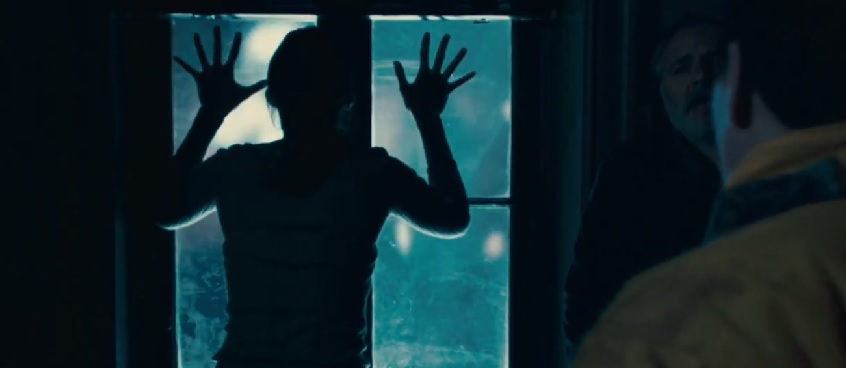
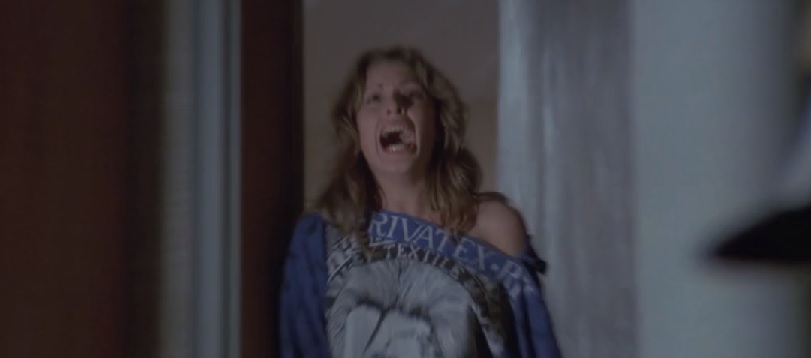
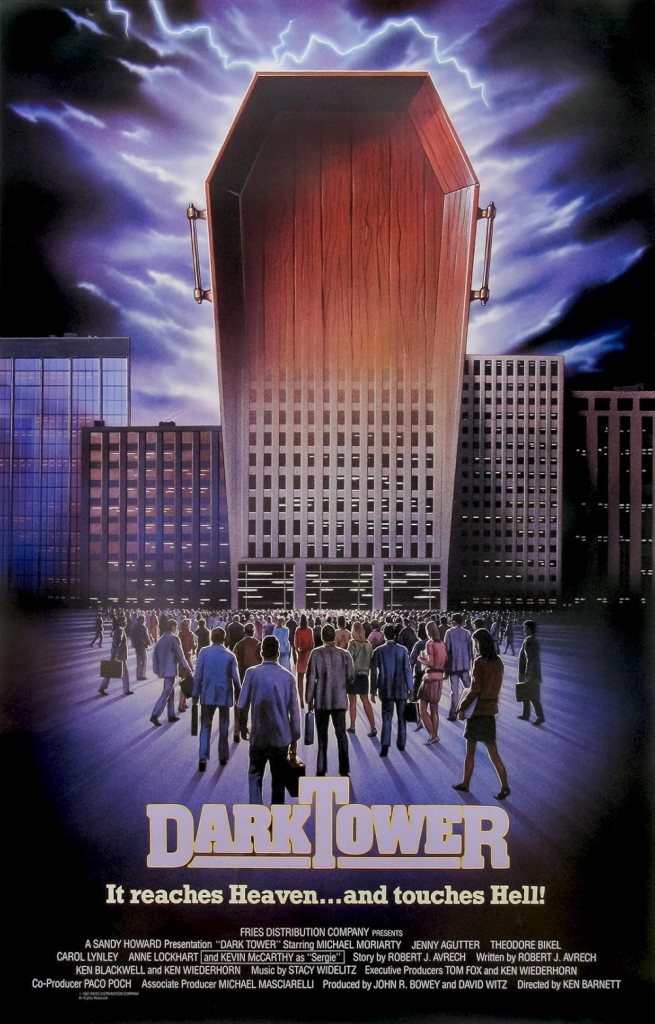
I’ve wanted to see Dark Tower for some time now. The idea of a haunted high-rise appeals to me, and I thought it might be an interesting idea to play around with. Sadly, though, I don’t think that Dark Tower is the best execution of this idea.

This is likely known by those involved with the movie, too. I’m not someone who delves into behind-the-scenes information, but I did notice that the original director of this one (Ken Wiederhorn) was replaced by well-known Freddie Francis. And yet, when the movie starts playing, we’re told it’s directed by Ken Barnett; apparently Francis wanted his name removed from the film because he was dissatisfied. I should also mention that he never again directed another movie.

It’s not all bad, though – Dark Tower was filmed in Barcelona, Spain, so anytime we see outside shots, we see some beautiful structures and buildings older than the hills. Despite being in English, the film does possess a foreign flavor throughout, which is nice. It doesn’t make the film altogether that much more interesting, but it’s nice all the same

And while many of the deaths here aren’t too memorable there’s always potential. Early on in the film, a window wiper falls from his scaffolding, perhaps pushed by a malevolent spirit. After being possessed by the same spirit, another takes part in a mass shooting, which was at least filmed well. On the other hand, there was a very weak elevator death – I’d personally stick with De lift or Damien: Omen II.

In the finale, we did see someone get electrocuted, and another get impaled. Well, technically, we didn’t see this individual get impaled, but even so. Unfortunately, though, the finale – or, if I’m being honest, the last twenty minutes – seemed a bit of a mess. Here’s just a small example – three characters go to the haunted building (Michael Moriarty, Kevin McCarthy, and Theodore Bikel), and for some forsaken reason, they split up. No reason was given – we see these three characters enter an elevator, and the next we see of them, they’re in completely different rooms (if not floors).

I liked the idea of this movie, but it definitely felt a bit choppy at times. I appreciated aspects of the finale, and while there’s not really a twist, we do learn more about Jenny Agutter’s character. I had thought that it might have gone in the direction it did, and I was happy that they did so. It didn’t really make the ending much better, but it was at least good in concept.

At first, I did think the movie would follow Jenny Agutter (The Survivor, Child’s Play 2, Dominique), but instead we largely followed Michael Moriarty (A Return to Salem’s Lot, Troll, Blood Link, The Stuff, Q). I was surprised, but okay, with this – it’s not that Agutter wasn’t decent, but Moriarty was more interesting to me (though at times, I have to say that his delivery wasn’t stellar).

I think that Theodore Bikel (I Bury the Living) is easily the most enjoyable performance in the film – despite the movie seeming somewhat lifeless, all of his scenes had character. Lastly, Kevin McCarthy (The Sleeping Car, Piranha, Invasion of the Body Snatchers) appeared, but we never really got a great hang on his character.

Dark Tower can be an okay movie to watch, but it’s definitely a far cry from good, and while aspects were at the very least interesting, I can’t say it’s a movie that will really stick out in my mind, at least not with the rather lack-luster execution managed with this movie. Just a shame, in my view.

5.5/10
Dagon (2001)

Directed by Stuart Gordon [Other horror films: Re-Animator (1985), From Beyond (1986), Dolls (1986), Daughter of Darkness (1990), The Pit and the Pendulum (1991), Castle Freak (1995), Bunker of Blood: Chapter 5: Psycho Sideshow: Demon Freaks (2018)]

Dagon’s a film that’s gotten quite a bit of respect within the horror community, and after revisiting it, it’s not hard to see why. It’s certainly not a perfect movie, but the atmosphere here is top-notch, as are some of the performances, and if you want a dark story based on some H.P. Lovecraft goodness, Dagon’s a movie worth seeing.

I believe I’ve only seen this one once before, perhaps on the Sci-Fi channel (though I can’t swear to that). What I primarily remembered was the people with fishlike attributes and that much of the film seemed to be in Spanish, without subtitles. As I revisited this, my memory was right on both counts. Though I admit the Spanish sans subtitles was annoying, the whole of the film is quite a solid experience.

Despite pulling ideas from the short story Dagon, the movie’s more based on the novella The Shadow over Innsmouth. I’ve read Dagon once before, though have not read The Shadow over Innsmouth (when it comes to classic horror literature, I admit, I’ve not read much), but after seeing this movie, it certainly sounds like a story I’d like to spend time with.

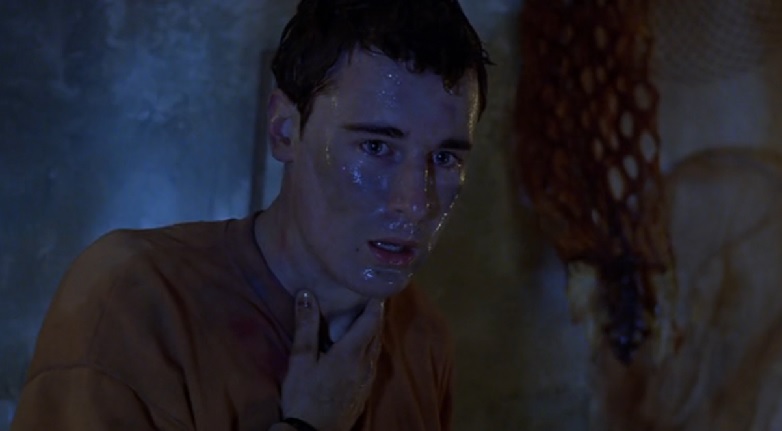
What’s really striking about this film is the atmosphere. There’s a small, coastal village in Spain that the characters find themselves trapped in. The streets are cramped, it’s raining non-stop, and the villagers have fishlike attributes – sometimes just gills or webbed fingers, other times tentacles – and most can merely shuffle at a slow speed. It’s a dark location steeped in hysterics, a great flashback told by Francisco Rabal’s character explaining the reasons the town’s gone fish. The set-up here is stellar, and then it’s actually executed well, which was great to see.

To be honest, I didn’t think much of Ezra Godden (Soul Reaper) as the lead at first. He just seemed like a whiny little bitch. Still, he grew on me pretty quickly (reminding me of Jeffrey Combs at times), and he had some quite amusing dialogue, which was nice, given that the film is tonally dark; getting a bit of humor was welcomed. Francisco Rabal (who died a few months before the film came out; this movie was dedicated to him) made for a solid character too. I don’t know Rabal (Nightmare City, Exorcism’s Daughter, Hotel Fear), but his character added a lot.

Godden and Rabal are the most important characters by far, but others come into play. Raquel Meroño (The Mark) was decent, Macarena Gómez (Shrew’s Nest, The Black Gloves) creepy, Ferran Lahoz (The Lost) also creepy, and, oh, José Lifante (who was a simple hotel receptionist with minimal dialogue) was creepy too. I really liked Alfredo Villa’s character, and he brought a lot to the flashback, which was already quite good.

There are some disturbing things in this film. Sure, the townsfolk are half-fish/half-human, and they have a alarming quality to them (which, again, helps beautifully with the atmosphere), and given this was directed by Stuart Gordon, certainly these elements of body-horror make sense. More so, we see flesh hanging up like a coat, and someone’s face getting removed in a somewhat graphic scene (which made me flash back to Faceless). It’s a creepy movie anyway, and the violence adds to the charm.

If you’ve not seen Dagon, I recommend that you do. It’s a dark movie, it’s a bleak movie, but it’s also a well-made one. Even the CGI doesn’t hurt the film much, and I found most of the finale, which is where movies can easily lose me, quite decent, almost dreamlike. Dagon’s a good movie, and definitely worth a look if you enjoy the sea and what resides within.

8/10

Quarantine (2008)

Directed by John Erick Dowdle [Other horror films: The Poughkeepsie Tapes (2007), Devil (2010), As Above, So Below (2014)]

A remake of the Spanish movie [Rec], Quarantine is a movie I’ve seen before. I likely thought it was okay, but that’s really all it is. I can’t say I actually liked the original more – it’s been a while since I’ve seen [Rec] – but I can say that Quarantine strikes me as competent, and little more.

Found footage is always an interesting style. It works for this movie – things move at a quick pace, but on the flip-side, due to the shaky camera, it’s pretty difficult to see some of the horrors that go on. Well, mostly – there was a young girl who was sick, and possibly with the same infection others have, but she didn’t actually display any violent tendencies until the very moment that the camera-man focused on her, because that didn’t feel forced at all.

Of course, the story is decent. Shows the evil of the government decently enough. Well, technically, you could make a case that the government has every right to enforce a quarantine on the building, but they gave the people trapped absolutely zero explanation, and went on television claiming the building had been evacuated, so no one can seriously blame the people inside the building for fighting to find a way out. The government’s reaction was wrong, just as the government’s reaction was wrong in The Stand (and it’s worse in that case, as the whole thing was the government’s fault to begin with).

I can’t say I remember a lot about [Rec], but I do remember the ending seeming to bring some type of potential religious origin into it, which is entirely avoided here. Theoretically, that’s something that I’d agree with, but I’d need to see [Rec] again before I can actually say what origin of the disease I liked more. This one doesn’t go deep into it, save a room some characters look through at the end, but it all seemed plausible, which is more than what I can say for religious origins.

Only three performances really matter, being Jennifer Carpenter, Steve Harris, and Jay Hernandez. Hernandez, of course, is a familiar face, having been the star of Hostel, and though he’s not the most important character here, he’s nice to see. Steve Harris (The First Purge) played the camera-man, so we rarely saw him, but his voice was occasionally soothing, and while Jennifer Carpenter (The Exorcism of Emily Rose) was a bit hysterical at times, who in her situation wouldn’t be?

Honestly, I don’t know if there’s a lot more to say about this one. It’s just an okay found footage movie with very little in it that stands out. That finale, while tense, wasn’t enough to make up for the somewhat annoying shaky camera we had to deal with for the previous hour, and while Quarantine’s not a bad movie, I’d struggle to say it’s actually good, or even all that preferable to the original movie.

7/10

Slugs, muerte viscosa (1988)

Directed by Juan Piquer Simón [Other horror films: Escalofrío (1978), Misterio en la isla de los monstruos (1981), Mil gritos tiene la noche (1982), Los nuevos extraterrestres (1983), The Rift (1990), La mansión de los Cthulhu (1992)]

Slugs, muerte viscosa, commonly shortened to Slugs, is a pretty fun movie. There’s not many mollusk-based movies out there, and this Spanish addition probably does as much as can be done to make the plot palatable, and it’s worth seeing.

This is a movie I’ve heard about for years (though I never knew it was based on a book from 1982 titled Slugs, written by Shaun Hutsun, until I watched this one), and reception tends to be positive, which I can understand. It’s a quick-paced movie, it doesn’t take long at all to get into the slug action, and there’s more than a few enjoyable sequences spread throughout the film.

The finale here, for instance, had a pit of water filled with slugs which, of course, someone unfortunately fell into. A bedroom floor was covered with slugs, which led to some more deaths. A greenhouse blew up – quality explosive sequence, and in fact, there’s a lot of explosions toward the end, and it’s just a lot of fun.

While I wouldn’t call the movie overly gory, there are a few sequences which might be more disturbing, such as a man’s lunch being ruined by some parasites because he accidentally ate a slug. It’s a glorious sequence. The special effects throughout are all quite strong, actually, so Spain definitely came to play when they made this.

Most of the performances aren’t particularly noteworthy, though. Michael Garfield and Philip MacHale were fine, but they didn’t make that large an impression. John Battaglia was amusing at times, and Santiago Álvarez came through at the end, but again, no real lasting impressions. I did think that Kim Terry was a bit weak, but she didn’t appear too often, so that’s not a problem.

Oh, and a character wanted to declare a health emergency, and the reply he got was “You ain’t got the authority to declare ‘Happy Birthday.’ Not in this town.” I laughed quite a lot at that, and there were a few other humorous moments (“And what exactly do you do?”), but a lot of the film is played straight, which you might not necessarily expect from a killer slug movie.

As I always say, if it’s not mollusk, it’s not right, and Slugs is mollusk. It’s not a great movie, but it does have a lot going for it. I personally prefer the wormy goodness of Squirm, but Slugs is a solid movie worth experiencing at least once if you’re a fan of 80’s horror.

7.5/10

Die Säge des Todes (1981)

Directed by Jesús Franco [Other horror films: Gritos en la noche (1962), La mano de un hombre muerto (1962), El secreto del Dr. Orloff (1964), Miss Muerte (1966), Necronomicon – Geträumte Sünden (1968), The Blood of Fu Manchu (1968), Der heiße Tod (1969), Marquis de Sade: Justine (1969), The Castle of Fu Manchu (1969), Paroxismus (1969), De Sade 70 (1970), Il trono di fuoco (1970), Nachts, wenn Dracula erwacht (1970), Les cauchemars naissent la nuit (1970), Vampyros Lesbos (1971), Sie tötete in Ekstase (1971), Jungfrauen-Report (1972), Drácula contra Frankenstein (1972), Der Todesrächer von Soho (1972), La fille de Dracula (1972), Dr. M schlägt zu (1972), Les démons (1973), La comtesse noire (1973), La maldición de Frankenstein (1973), La nuit des étoiles filantes (1973), Los ojos siniestros del doctor Orloff (1973), Al otro lado del espejo (1973), La noche de los asesinos (1974), Les possédées du diable (1974), La comtesse perverse (1974), Les gloutonnes (1975), L’éventreur de Notre-Dame (1975), Sexorcismes (1975), Frauengefängnis (1976), Jack the Ripper (1976), Un silencio de tumba (1976), In 80 Betten um die Welt (1976), Die Marquise von Sade (1976), Greta – Haus ohne Männer (1977), Die Liebesbriefe einer portugiesischen Nonne (1977), Die teuflischen Schwestern (1977), Der Ruf der blonden Göttin (1977), El sádico de Notre-Dame (1979), Mondo cannibale (1980), El caníbal (1980), La tumba de los muertos vivientes (1982), La mansión de los muertos vivientes (1982), Revenge in the House of Usher (1983), El tesoro de la diosa blanca (1983), Macumba sexual (1983), Sola ante el terror (1983), Sangre en mis zapatos (1983), Mil sexos tiene la noche (1984), El siniestro doctor Orloff (1984), Lilian (la virgen pervertida) (1984), La esclava blanca (1985), Faceless (1987), Killer Barbys (1996), Tender Flesh (1997), Mari-Cookie and the Killer Tarantula (1998), Lust for Frankenstein (1998), Vampire Blues (1999), Dr. Wong’s Virtual Hell (1999), Helter Skelter (2000), Vampire Junction (2001), Incubus (2002), Killer Barbys vs. Dracula (2002), Snakewoman (2005), La cripta de las mujeres malditas (2008), La cripta de las mujeres malditas II (2008), La cripta de las condenadas (2012), La cripta de las condenadas: Parte II (2012)]

Commonly known under the title Bloody Moon, Die Säge des Todes is a tedious film. Aspects of it are worth seeing, such as the generally decent kills, but boy, do the plot and characters really grate on me after a time.

There are so many plot issues that it’s hard to fully delve into. For instance, a young woman is running and screaming that a killer is after her, and her friends laugh it off. Or that same girl running from the killer again, only to see a silhouette figure in front of her – she should know it’s not the killer, as, well, the killer is behind her. So you would think she would run to the figure for potential safety.

She doesn’t.

So part of the issue is that the central character, Angela (played by Olivia Pascal) very quickly becomes hysterical at everything. She sees a friend get murdered, but when she tries to show someone else the body, it disappears, so for a time, she was convinced she was dreaming. She spends much of the next day searching for the murdered girl. Then someone saves her from a snake, but because she didn’t see the snake, only a bloody pair of shears, she’s convinced that guy is the murderer.

My point is that it doesn’t take long for this character to become scared and suspicious of every little thing, and it sort of gets old, especially when it leads to terrible, illogical decisions that keep happening throughout the movie. It’s hard to state just how many times in the movie I was bothered by plot points like this, and that goes a long way to making this not as fun an experience as you might hope.

I can’t hold that too much against Olivia Pascal. I’m sure she did what she had to do with her role. Nadja Gerganoff was a more interesting character, but we never really get to understand that much about her. It’s similar with Christoph Moosbrugger, and while Peter Exacoustos’ character was perhaps one of the most sensible in the movie, even he made more mistakes than you’d hope for.

Obviously, this isn’t a problem with this movie alone, as plenty of horror films have characters that make bad decisions. It just seemed so much more prominent here, and it’s quite possible that wasn’t helped by shoddy dialogue and a somewhat poor dubbing job. On the plus side, the setting of this movie is rather beautiful. I’m not sure where this was filmed, but it had a unique look to it, and the scenes on the dock were quite lovely.

What the film tries, and mostly succeeds, in doing right would be the kills. Centerpiece among them, I’d argue, would be the decapitation of someone with a saw blade (and in fact, the original title of this film translates to Saw of Death). It looked excruciatingly fake, but that’s half the fun. Someone was stabbed through the neck, another stabbed through the chest, and even another killed with a power saw (or at least that’s what I think it is – think an ultra-thin chainsaw). The kills here are decent, and if that’s your main interest, then Bloody Moon is worth seeing.

And personally, this is a movie that I’ve wanted to see for a long time. Being a Jesús Franco movie, I wasn’t necessarily expecting much, and ultimately, I may have ended up enjoying it about as much as I thought I would. Because of plot elements and characters that drove me up the wall (not to mention the least-surprising ending I’ve ever seen in a movie), it’s not a film I liked that much, but at least for the gory elements, it’s worth experiencing once.

6/10

Al filo del hacha (1988)

Directed by José Ramón Larraz [Other horror films: Whirlpool (1970), Deviation (1971), La muerte incierta (1973), Scream… and Die! (1973), Emma, puertas oscuras (1974), Symptoms (1974), Vampyres (1974), Estigma (1980), La momia nacional (1981), Los ritos sexuales del diablo (1982), Descanse en piezas (1987), Deadly Manor (1990)]

Most commonly known as Edge of the Axe, this Spanish slasher was an interesting movie to revisit. I generally thought it was okay, though I have to admit that I think the finale was a bit on the weak side.

For the most part, I find the story here somewhat strong. I mean, don’t get me wrong, there’s nothing special about it – a mysterious bout of murders is plaguing a small town – but there’s a plethora of suspects and characters, and a decent mystery. Problematically, the conclusion doesn’t use these elements to the best of their ability, but at least the set-up was solid.

Barton Faulks was okay as a central character, and I actually felt his budding relationship with Christina Marie Lane’s character was sort of cute. Fred Holliday as the Sheriff took a little bit to grow on me (especially as he really seems like a dick in the first half of the film), but I ended up enjoying him during his appearances.

I also appreciated most of the potential suspects (not that the Sheriff wasn’t a potential suspect, or Faulks’ character, but these were more ‘appear a few times to arouse suspicion’ types) such as the priest, played by Elmer Modlin, or the random organist Jack Taylor. Joy Blackburn and her relationship with Page Mosely seemed just thrown in there, but both of them were fine. Patty Shepard (who probably has the most experience of the cast) was nice to see.

The kills were honestly just okay. The opening scene in a car-wash was probably the most memorable, but there’s a character later on who gets a few fingers cut off, which may have been one of the better spots of gore in the movie. That said, for being named Edge of the Axe, there’s not a whole lot of violent axing here. Most of the kills were competent, but not really anything that’d come across as too memorable.

Where the movie truly falters, though, would be in the finale. Throughout the film, we’ve been given plenty of different potential suspects who could be the murderer, and when we find out who’s behind the crimes, I have to admit that it just didn’t feel right. I sort of liked the idea of it – I mean, I’ve seen this movie before, but I forgot who the killer was, and I was 100% surprised by the identity – but the execution seemed a bit weak, and it was followed by a conclusion that feels somewhat cliché (at least nowadays; maybe back then, it was fresher).

Despite the weak conclusion, though, I did like a lot of this. It had quality atmosphere, and though the movie definitely takes some missteps, I dug the vibe. It’s not a movie that’s fantastic, nor is it really good, but I liked it well enough, so rating it around average strikes me as fair.

7/10

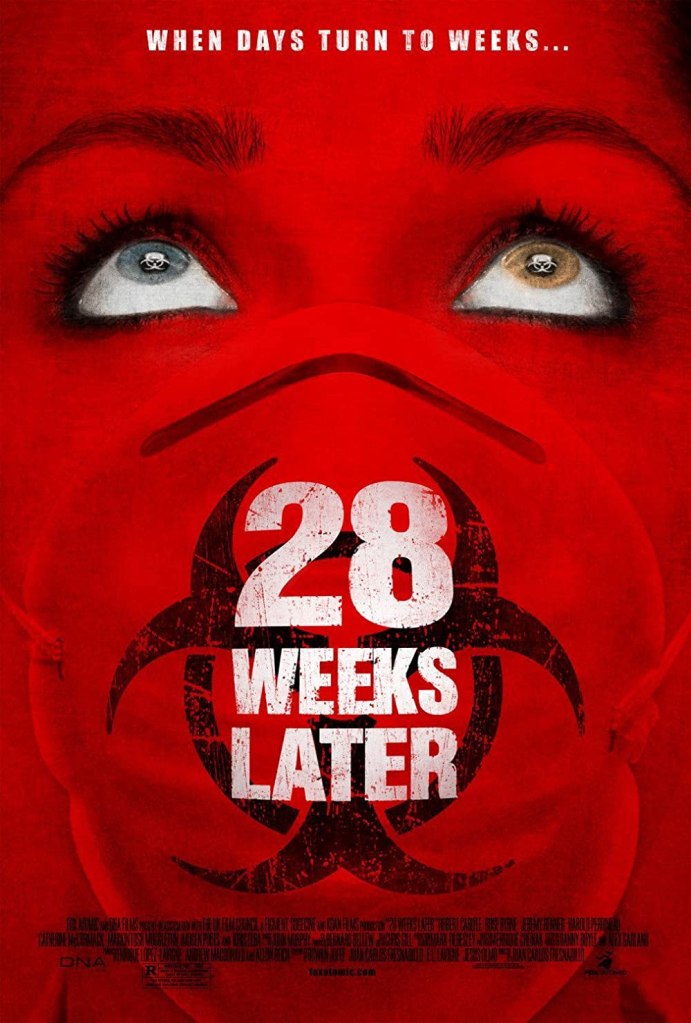
28 Weeks Later (2007)

Directed by Juan Carlos Fresnadillo [Other horror films: Intruders (2011)]

When I revisited 28 Days Later…, I was surprised by just how much I enjoyed it. Revisiting this one didn’t have the same outcome, alas. Not that 28 Weeks Later is terrible or anything, but I just never found it in me throughout the film to get too excited. Some interesting ideas, and I’ll touch on those, but overall, it’s almost bland in comparison to the first movie.

I’ll give it to the main cast, though, who are all decent (save for perhaps Robert Carlyle). Rose Byrne (Insidious) was decently fine, though I admit that it would have been nice to learn maybe a little more about her. Jeremy Renner (The Avengers) may have made some questionable decisions, but I rather enjoyed his character, and I personally don’t have a problem with him going AWOL. What moral person wouldn’t in his situation? Imogen Poots wasn’t really special, but despite her atrocious decisions, I thought she had more heart than Mackintosh Muggleton, who played her younger brother.

The story, though, was somewhat hard for me to get into. I don’t really mind the asymptomatic idea, but the fact that they (military and scientists both) left her entirely unguarded is utterly laughable. And when they’re gathering up all the civilians into a “safe area,” that “safe area” has more than one exit, and one of the exits isn’t guarded, so, well, infected individuals get in, and all hell breaks loose.

Past that point, it’s entirely on the military what happens to the population, as small as it was, in London. When the snipers get orders to start shooting everyone, infected or otherwise, it may be the logical choice, but you can’t fault anyone getting shot at for attempting to escape in any way possible. At that point, as far as I’m concerned, the military screwed up, and void all right to authority over anyone on the ground.

I mean, really, I’ve never served a day in uniform, and never would, if given the choice, but apparently I’m more intelligent than the commanders in this situation. Collecting all the civilians into one location in order to keep them safe is fine. It’s a good idea. Having multiple exits is, of course, a good idea. But why does only one of the exits have guards? With that easily avoidable mistake, they infected pretty much the world (because there’s no way a second outbreak isn’t reaching mainland Europe).

When there’s a lot of questionable set-up before the primary action, it becomes hard to really get too invested. Sure, I was rooting for Renner’s character when he left his sniping of innocent people and instead went to help them escape, but the whole situation was ridiculous to begin with, and realistically, I don’t think it’d ever happen.

Here’s another thing –  Robert Carlyle’s character is a caretaker of one of the buildings. Pretty much, he keeps things running smoothly. That’s all fine and well. His key-card grants him access to any place in the building, which makes sense. The problem is it also grants him access to purely military installations. Why? Why not just allow him access to his job locations, and restrict access to, you know, parameters outside of his employment?

An asymptomatic woman is found. She’s infected, but is still mostly normal. She’s not crazy, nor does she desire to eat flesh. Carlyle’s character is her husband. Because his key-card was idiotically keyed, and because the woman wasn’t guarded, Carlyle’s character was able to get to her, kiss her, and start the infection up again.

I don’t blame Carlyle’s character at all. If your wife was found, of course you’d want to get to her. Who can blame him for that? It’s entirely possible he didn’t even know she was infected, because I don’t believe he was told. If his key-card hadn’t granted him access to her, none of this would have ever happened.

This is what I’m talking about. It’s not the character’s faults, as far as I’m concerned. Even the military probably weren’t the ones who designed the architecture of the facility, nor the ones who came up with the emergency plans in case of a new outbreak. Because of the foolishness that went into these aspects, though, it just comes across as pretty bad.

28 Weeks Later is still a thrilling and decent zombie film, make no mistake. There’s some pretty cool scenes (though one of the most-talked about sequences, being the helicopter one, was just too much), and of course the budget here came to play. The story itself, though, was faulty, and that can’t just be excused, especially after how spectacular the first movie was.

6.5/10

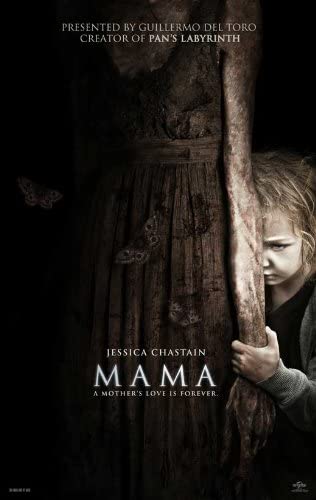
Mama (2013)

Directed by Andy Muschietti [Other horror films: It (2017), It Chapter Two (2019)]

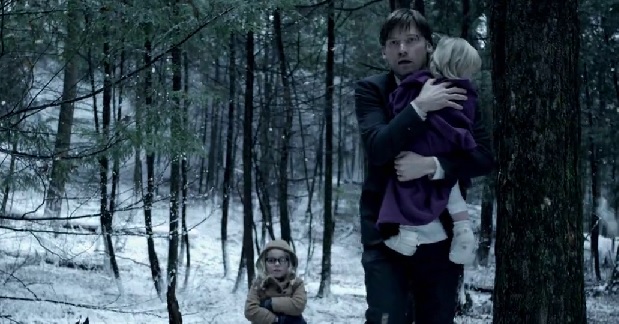
This isn’t a film I had much interest in seeing, but given it’s directed by Andy Muschietti (who later went on to do It Chapters 1 and 2), I was holding out hope that it could transcend the typical Hollywood ghost story. As it turns out, while there were a few things in Mama to enjoy, it wasn’t really able to do that.

Off the bat, the first thing I noticed was Nikolaj Coster-Waldau was one of the stars. Now, I know him only from Game of Thrones, but I still thought it was sort of cool seeing him here. Jessica Chastain I know only from the aforementioned It Chapter 2, and she was pretty good here also. I really liked her punk look, and the fact that she was thrown into the role of a mother was pretty heart-wrenching. I really liked Coster-Waldau and Chastain together – they made a cute couple here, only to be ruined by the children, though Megan Charpentier, who played the older kid, was pretty decent.

The only other character that really made an impact (aside from Mama, of course) was Dr. Dreyfuss (played by Daniel Kash). It’s through him that we, the audience, discover the story behind Edith, the woman who becomes the ghostly Mama. Her story isn’t without interest or tragedy, but to be blunt, I didn’t find myself caring that much.

There is a really solid scene about thirty minutes into the film, where the camera shows both the hallway and the kid’s room, and something happens there that I thought was pretty cool. It was expected, no doubt, but I still liked the execution. I bring that up because otherwise, I didn’t think there were that many noteworthy things in the film. There was an okay dream sequence, and the emotional ending was solid, but otherwise, it was just generic ghost movie #1523.

Mama had potential, and I wish the final product was better. The design for Mama wasn’t great, in my opinion, but what helped the film avoid a worse rating was the feeling the film occasionally possessed. Seeing Charpentier slowly warm up to Chastain’s character was nice, and the ending, like I said, packed a decently emotional punch. Mama isn’t a great movie, and I do think it’s below average, but I could probably see myself giving it another go in the future, and perhaps if I’m in a better mood, the movie will come out slightly more enjoyable.

6.5/10

Il trono di fuoco (1970)

Directed by Jesús Franco [Other horror films: Gritos en la noche (1962), La mano de un hombre muerto (1962), El secreto del Dr. Orloff (1964), Miss Muerte (1966), Necronomicon – Geträumte Sünden (1968), The Blood of Fu Manchu (1968), Der heiße Tod (1969), Marquis de Sade: Justine (1969), The Castle of Fu Manchu (1969), Paroxismus (1969), De Sade 70 (1970), Nachts, wenn Dracula erwacht (1970), Les cauchemars naissent la nuit (1970), Vampyros Lesbos (1971), Sie tötete in Ekstase (1971), Jungfrauen-Report (1972), Drácula contra Frankenstein (1972), Der Todesrächer von Soho (1972), La fille de Dracula (1972), Dr. M schlägt zu (1972), Les démons (1973), La comtesse noire (1973), La maldición de Frankenstein (1973), La nuit des étoiles filantes (1973), Los ojos siniestros del doctor Orloff (1973), Al otro lado del espejo (1973), La noche de los asesinos (1974), Les possédées du diable (1974), La comtesse perverse (1974), Les gloutonnes (1975), L’éventreur de Notre-Dame (1975), Sexorcismes (1975), Frauengefängnis (1976), Jack the Ripper (1976), Un silencio de tumba (1976), In 80 Betten um die Welt (1976), Die Marquise von Sade (1976), Greta – Haus ohne Männer (1977), Die Liebesbriefe einer portugiesischen Nonne (1977), Die teuflischen Schwestern (1977), Der Ruf der blonden Göttin (1977), El sádico de Notre-Dame (1979), Mondo cannibale (1980), El caníbal (1980), Die Säge des Todes (1981), La tumba de los muertos vivientes (1982), La mansión de los muertos vivientes (1982), Revenge in the House of Usher (1983), El tesoro de la diosa blanca (1983), Macumba sexual (1983), Sola ante el terror (1983), Sangre en mis zapatos (1983), Mil sexos tiene la noche (1984), El siniestro doctor Orloff (1984), Lilian (la virgen pervertida) (1984), La esclava blanca (1985), Faceless (1987), Killer Barbys (1996), Tender Flesh (1997), Mari-Cookie and the Killer Tarantula (1998), Lust for Frankenstein (1998), Vampire Blues (1999), Dr. Wong’s Virtual Hell (1999), Helter Skelter (2000), Vampire Junction (2001), Incubus (2002), Killer Barbys vs. Dracula (2002), Snakewoman (2005), La cripta de las mujeres malditas (2008), La cripta de las mujeres malditas II (2008), La cripta de las condenadas (2012), La cripta de las condenadas: Parte II (2012)]

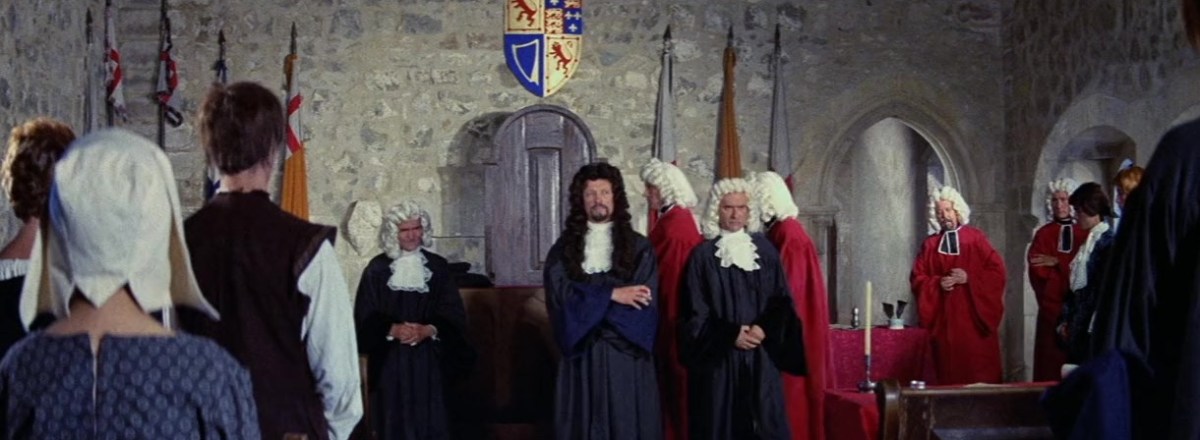
This Jesús Franco film didn’t really do a whole lot for me. While there are some solid scenes of torture every now and again, much of the film came across as a historical drama, and were it not for Christopher Lee (playing the sinister Judge Jeffries), I would have liked this film a lot less.

Widely known as The Bloody Judge, I really appreciate, as a moderate student of history (a minor of mine in college) the historical nature of the film, though I am slightly put off by how it overshadows any and all of the horror aspects (which come primarily from the torture sequences).

Of course, this film isn’t without it’s positives. Christopher Lee does great in his role (though I don’t think the conclusion insofar as Jeffries was concerned was that satisfactory), and Hans Hass Jr., Milo Quesada, and Maria Rohm stand out also. Also, there was a solid sequence at the end once William of Orange came ashore. Alas, the ending played out somewhat quickly, which gave it a somewhat anticlimactic feel.

Personally, I think the biggest problem with this film is it’s meandering plot. The basic plot, in which the son of a Lord is looking to get married to the sister of a woman killed for being a witch and escape out of England is all well-and-good, but at an hour and forty minutes, I will admit to having stopped caring past a certain point. Loved the torture sequences (though none were overly over-the-top), and every scene with Lee, but much of the film just wasn’t my cup of tea.

As it is, when it comes to historical horror films, I already have the 1968 Witchfinder General to fill the void. If you see this for any reason, it should be Lee’s solid performance as a despicable judge killing innocents in the name of God and country. Truth be told, I was hoping for more than I got from this. The Bloody Judge may work for you, but it didn’t do a lot for me.

5.5/10

El orfanato (2007)

Directed by J.A. Bayona [Other horror films: N/A]

This Spanish flick (better known as The Orphanage) might be a lot better for fans of more emotional ghost stories as opposed to more horror-tinged tales, but it’s still quite well done with some fantastic mystery, an enjoyable back-story, and a memorable (if not potentially anticlimactic) conclusion.

El orfanato’s setting is great, taking place at an old orphanage on the seaside, overlooked by an old, defunct lighthouse. With the ocean constantly rustling and rainstorms no stranger to the area, it sets things up as rather dismal, which helps sustain the tone as the movie goes on.

So, onto a lot of Spanish names that I definitely don’t know.

As the lead, Belen Rueda did well and played a very sympathetic character, and despite the fact that she’s not really been in that many things before this (though she was in a TV series that ran for around five years called Periodistas, so she’s not a no one), she shined pretty much throughout the film. Fernando Cayo was good also, but I wish he was a bit more prevalent to the story than he ended up being. Others that I enjoyed include Geraldine Chapin, Edgar Vivar, Andres Gertudix, and Montserrat Carulla.

What really helped this movie along, because honestly, it’s not really my type of thing, is the mystery behind the disappearance of one of the characters. I like how that’s resolved, and though it took supernatural means for Rueda’s character to come to find out what happened, I was okay with it, as we discover some interesting (and somewhat morbid) things out along the way.

As decent as El orfanato is, it’s not the type of film I really go out of my way for. The conclusion didn’t quite pack the punch I was hoping for, though it was a tad more emotional than one might expect. Still, it’s definitely a well-made movie with an engaging plot, and certainly worth a watch, but if Spanish ghost movies aren’t your cup of tea, you may find this film a bit more average than others.

7.5/10

This was covered on Fight Evil’s podcast, so if you want to hear Chucky (@ChuckyFE) and I discuss this one, go ahead.