Shinshaku Yotsuya kaidan: kôhen (1949)

Directed by Keisuke Kinoshita [Other horror films: Yotsuya kaidan (1949)]

Now this is what I’m talking about.

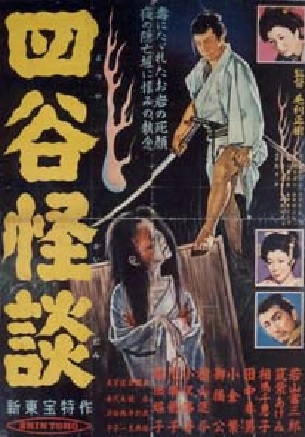
Shinshaku Yotsuya kaidan: kôhen, best known as The Ghost of Yotsuya: Part II, follows the first part and continues the tragic stories of those involved. I was lukewarm toward Part I, because it felt largely like a drama, with little in the way of what I’d consider horror. Here, though, the action is amped up, and there are some really great sequences here.

The whole finale, for instance, was great. Not only was it action-packed – a lot of fights taking place in a house that’s burning down – but there was some great emotional resonance from Ken Uehara’s character, especially taking into consideration what the crowd was saying the following moment (another stellar scene). And even a bit before the finale began, we got revealed a twist that I certainly didn’t see coming from Osamu Takizawa, and I loved it.

Osamu Takizawa is probably the star here. His sleazy portrayal of a man who will do anything and everything to get ahead is great, and his manipulations of Ken Uehara, Haruko Sugimura and Aizo Tamashima were classy. Ken Uehara does fantastic also, suffering from a guilty conscience most of the movie following what he did in Part I. The ending, as I said, really brought a lot to his character, moral and otherwise.

I did think both Kinuyo Tanaka and Daisuke Katô would be more involved with the story, but while they do appear from time to time, they’re not really that entwined with everything going on, aside from Tanaka’s failed attempt to speak with Uehara. Oh, and the same could be said for Hisako Yamane – save a few sequences, she was pretty much invisible, despite the fact that everything Uehara’s character did in Part I was so he could get married to her. I did like seeing Chôko Iida come back, and Aizo Tamashima got some prominent time on screen, which was nice.

I still don’t think the movie’s amazing, though. Sure, Uehara’s character had some visions and acted insane a lot of the time, but I sort of expected more supernatural phenomena as opposed to a guilty conscience playing tricks on someone (à la The Bells or The Avenging Conscience). It’s possible that there were supernatural events going on, of course, but it was more subtle than you might expect.

Still, The Ghost of Yotsuya: Part II was better than the first part, and I also really do find the ending quite good. Overall, I’d say it’s a better-than-average movie, but not one that I’d revisit often. For early Japanese horror, though, this was fun to watch.

7.5/10

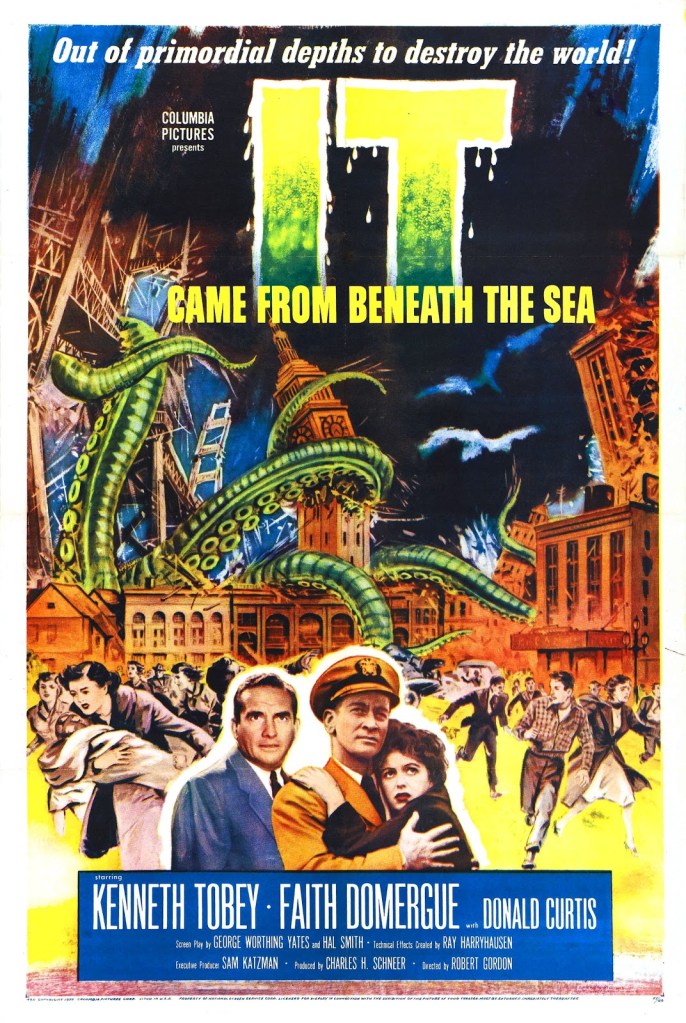
It Came from Beneath the Sea (1955)

Directed by Robert Gordon [Other horror films: Black Zoo (1963)]

I’ve said before that when it comes to giant monster movies, I’m not the biggest fan. I don’t think this one was great either, but I have always liked octopi, and it’s in that spirit that I found this a bit more tenable, despite having a creature with somewhat limited ranges of attack.

Largely, I’ve come to the conclusion that the reason I’m not as enamored with movies of this type is because of it’s attention. And by that, I mean in this film, the whole of the United States Navy knows about the creature (and I imagine much of the military), and then, of course, the general public. Everyone knows about it. In slashers, the killer might be going after just a handful of people, but in movies like this, everything’s a public affair.

From Them! to The Black Scorpion, from The Giant Claw to The Beast from 20,000 Fathoms, it’s always the military and scientists working together to find a way to destroy the creature. It just gets so repetitive, no matter how good the special effects are, or what the creature happens to be. Not only that, but they often throw in romantic subplots, and rarely does that do anything particularly interesting.

In this movie’s case, I will give you that the romantic subplot felt more like a confused love triangle at times, so it was at least a little different, and I did tend to actually like Faith Domergue’s character, but the point remains that throwing in a love story doesn’t automatically make the movie better, or the characters involved more interesting.

Of the three important performances, I do think Faith Domergue (Cult of the Cobra, The House of Seven Corpses, This Island Earth) was the best. It’s true that I liked her character the most anyways, but I also thought she had the most going for her. Kenneth Tobey (The Thing from Another World, The Vampire) felt like generic military guy 101, and while Donald Curtis (Earth vs. the Flying Saucers) was okay, but I feel like I never got a great hang of his character.

Again, I enjoy cephalopods – I think it’s the tentacles I’m enamored with. Which means, naturally, I felt bad about the harm people caused it throughout, especially as it had little other choice but to look for a new food group. I think the most painful was the flamethrowers – certainly that scene looked great, but my sympathy for the octopus was at it’s zenith.

Speaking of good-looking scenes, the sequence in which the octopus attacks the Golden Gate Bridge was pretty fun. I’ve never been to San Francisco, but if I could see a giant octopus destroying a famous bridge on my visit, then that would be a vacation worth remembering.

All-in-all, It Came from Beneath the Sea was an okay affair. It’s pretty much how I feel about most of these giant monster movies, which just aren’t usually my cup of tea. No doubt it was an okay watch, and the movie is well made, but it’s also not one that I’d think I’d watch too often in the future.

7/10

Yotsuya kaidan (1949)

Directed by Keisuke Kinoshita [Other horror films: Shinshaku Yotsuya kaidan: kôhen (1949)]

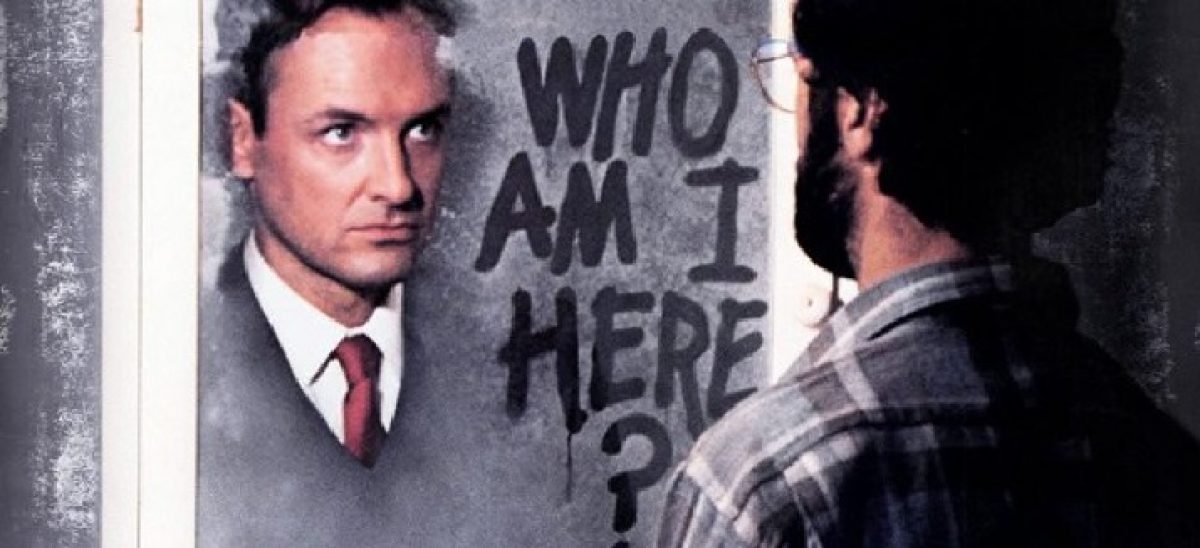
Yotsuya kaidan is not an easy movie to talk about. Part of this is because it’s the first movie in a two film series, and so seems to be primarily set-up to the conflicts in the second part. It’s not that things don’t happen, but most of the action here takes place at the end. It’s also barely horror, which is problematic.

I guess if you want to get technical, there is horror in trying to poison your wife, and a character getting their face disfigured by scalding hot water, or a woman needing to deal with the unwanted attention of a man, or being stuck in a loveless marriage while there are potentially better opportunities out there. Admittedly, this paragraph started off as glib, because while some of this could conceivably be horror, it’s not the easiest case to make.

Here’s what I can say: after a character’s face gets burned by some water, there’s a suspenseful scene toward the end as the character keeps asking for a mirror, but a horrified servant doesn’t want to give them one. It’s a pretty tense scene, and when we do finally see the face, it’s certainly disfigured, so that’s horror enough to count, amiright??

Mostly, though, Yotsuya kaidan (also known as The Yotsuya Ghost Story and The Ghost of Yotsuya: Part I, and apparently also The Yotsuda Phantom – you can see why I also use the original foreign titles over any re-titles) is a romantic drama. It’s a dark drama at times – there’s a character who consistently tries to get a character to kill his wife so he can move up in the world – but it’s still mostly a drama.

It’s well-done. Some of the acting is quite melodramatic, but that might partially be due to the Japanese culture, which, at least as presented here, seems quite reserved. Instead of having a conversation about important topics, someone’s wife just wails and proclaims that they ‘must never speak of it again.’ Because that works, I’m sure.

The performances are pretty good, though. Ken Uehara’s moral struggles are palpable here, and even toward the end, he has only so much agency insofar as things go. Osamu Takizawa’s slimy character was solid. Keiji Sada (who died in a car crash at the young age of 37 in 1964), who I thought was going to be the main character, was perhaps one of the most moral characters here. Kinuyo Tanaka (who plays two roles here) was a bit dramatic at times, but again, that may be the Japanese culture. Lastly, there’s Hisako Yamane, who didn’t really get that much character here, but that may change with the second part.

And that’s the main thing. Like I said, plenty of emotional things happen in this movie, but it ends on a cliffhanger (think the end of Hatchet, only far less dramatic), so it’s not an easy movie to judge on it’s own. Certainly it’s a moody, black-and-white picture with some issues of dark morality, but I’m far more interested in where the story is going – likely with some supernatural ghost action – than the focus we got in this movie.

Yotsuya kaidan isn’t a bad movie, but it’s also not particularly easy for me to say it’s a good movie. If you’re into dramas, or Japanese period pieces, it may well be worth seeing, but if you’re coming into this from the perspective of ‘I want to see some classic Japanese horror,’ this may not provide the best time. It’s an okay watch, but I want to see where the story is going before anything else.

6/10

Chakushin ari (2003)

Directed by Takashi Miike [Other horror films: Ôdishon (1999), Tennen shôjo Man next: Yokohama hyaku-ya hen (1999), Tajuu jinkaku tantei saiko – Amamiya Kazuhiko no kikan (2000), Bijitâ Q (2001), Koroshiya 1 (2001), Katakuri-ke no kôfuku (2001), Gokudô kyôfu dai-gekijô: Gozu (2003), Sam gang 2 (2004, segment ‘Box’), Aku no kyôten (2012), Kuime (2014), Kamisama no iu tôri (2014), Gokudô daisensô (2015), Terra Formars (2016)]

Honestly, I have to say I’m a bit surprised by this one, and in this particular case, it’s not a positive surprise. This Japanese movie, despite the plenty of decent things I’ve heard about it over the years, just strikes me as a rather average film. It’s okay, it’s certainly watchable, but is it special? I don’t see it.

Chakushin ari, perhaps better known as One Missed Call, feels like Japanese ghost movie 101. It’s based on a novel by Yasushi Akimoto, and has plenty of what you’d expect from a Japanese ghost movie, such as a long-haired child spirit, some mystery behind the spirit and why the spirit is wreaking havoc, and the same jump scares you’ve likely seen before.

None of this makes this movie bad, but it does feel a little generic. It is true, also, that I’m not a big J-horror fan – honestly, I could probably count the modern Japanese horror films I’ve seen on two hands, and that’s after a finger or two gets lost in the garbage disposal. To be fair, I do rather love Dark Water, but this is directed by Takashi Miike of all people, so I sort of expected a little more.

I was mostly able to follow this story along though – sometimes Asian horror films confuse the hell out of me (such as A Tale of Two Sisters or Ju-on), but this one seemed pretty simple. I didn’t really care for the ending, but still, at least the story was okay. It even added spices of dark subject matter such as parental abuse into the mix, which of course is always good fun.

Only two performances really mattered here, and that’d be Kô Shibasaki (Battle Royale, Kakashi / Scarecrow, and Kuime / Over Your Dead Body) and Shin’ichi Tsutsumi. The amusing thing is, I wasn’t sure of the name of Tsutsumi’s character until the final twenty minutes or so. Shibasaki does solid with the role she has, and Tsutsumi is a comforting character at times, but neither one is particularly note-worthy.

What is sort of odd is that I got the sense I knew where this film was going – we open with a group of six friends eating together at a restaurant, and I was expecting a Final Destination-type thing in which each of these six friends would have to deal with the cell phone curse, but after it passes through three of them, the other two just disappear, and we’re left with Ko Shibasaki’s character, which felt sort of odd.

Actually, on the whole idea of the curse, in which someone gets a call from themselves in the future, sort of foretelling of when they’ll die, this movie does have an aged technological feel to it, as everyone is carrying around flip phones. What’s amusing about this, in my perspective, is that I’m an old-fashioned guy, and in fact, I still use a flip phone to this day, so that added an extra element to the movie, and at least personalized it.

Even so, One Missed Call just felt on the generic side to me. There wasn’t much of an emotional impact toward the end – I mean, they tried, but it just didn’t hit me in the same way the end of either Black Rat or Dark Water hits me – and while I can appreciate the song during the credits, I still think the movie comes out to about average. Not bad, just average.

Like I said, though, I’m not the biggest fan of J-horror, so it’s quite possible that it will do more for those who are than it ever would have for me.

7/10

Kaibyô nazo no shamisen (1938)

Directed by Kiyohiko Ushihara [Other horror films: Nijiotoko (1949)]

There was generally a dearth of horror films in the late 30’s, and some of the films I personally count as horror, others don’t (such as Sh! The Octopus, The Terror, and Riders of the Whistling Skull), so to come across a late 30’s Japanese film, beautifully subtitled on YouTube, was a treat that’s hard to beat.

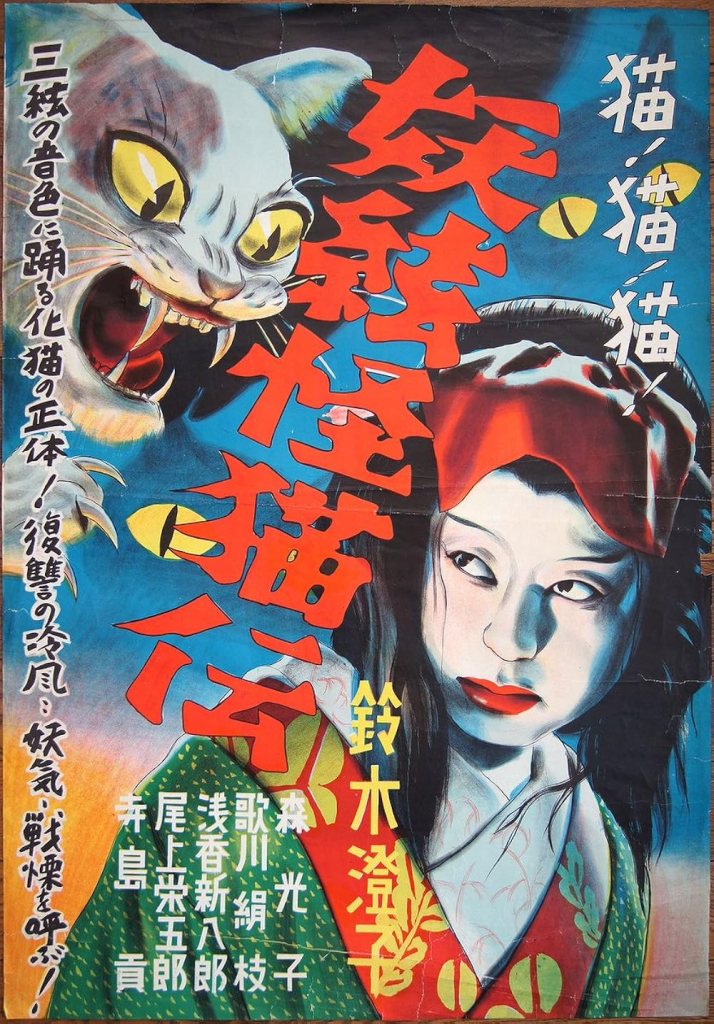
Known as The Ghost Cat and the Mysterious Shamisen, the story here strikes me as somewhat engaging. A jealous woman (Sumiko Suzuki) kills a cat, along with a young woman (Kinue Utagawa), because she’s awful (the jealous woman, to be clear; I’m sure the cat was kind). Of course, things in Japan never stay truly dead, and revenge strikes like a monkey’s dance.

Which makes more sense if you’ve seen the finale of this one.

First off, I guess I should mention that I had absolutely no idea what a shamisen was until I watched this. It’s a traditional Japanese musical instrument, sort of like an acoustic guitar, only infinitely different. The instrument plays a big part in this movie, as Shinpachirô Asaka’s character plays one, and gives the prized instrument to Kinue Utagawa’s character before her untimely demise. And like the cat that came back, the instrument slowly finds it’s way to the hands of Mitsuko Mori, who played the sister of Kinue Utagawa’s character.

Some scenes aren’t that easy to fully gauge – not only is the movie from 1938, but the print is rather scratchy at times – and I didn’t understand the final scene whatsoever, but it seems like both the spirit of the cat that was killed, along with the spirit of the woman, come back for revenge. At times it almost seems like the cat is the woman – or the woman is the cat; however it went, that wasn’t clear.

What was clear were the solid performances. Shinpachirô Asaka wasn’t quite as in focus as I expected, and even his part toward the finale seemed limited, but he definitely did well with his character. Playing a highly jealous and awful woman, Sumiko Suzuki did stellar, and though I never cared for her character, her performance throughout was good.

The stand-outs, though, would be both Mitsuko Mori and Kinue Utagawa. I honestly wasn’t expecting Mori to take a more central role, but toward the end, she does, playing a huge part in an act of revenge against Suzuki’s character. More to the point, there’s a conversation that Mori and Utagawa have that’s quite emotional, and that showed great promise.

The finale here is rather tense. It lasted around 15 minutes, all during a play-type deal, and though it felt a little rushed and hectic just at the moment where I’d have preferred more clarity, it was a solid finale, even possessing a few interesting camera tricks that I don’t have the vocabulary to describe.

Perhaps the most memorable scene would be when a cat’s face is sort of superimposed on a woman’s face, which was decently effective. I mean, none of the scares here are like to amaze most modern-day audiences, but there was a scene or two that had a solidly spooky atmosphere, such as the first time the ghost cat arises, so there is fun to be had.

One of the earliest Japanese horror films I’ve seen (aside from the silent A Page of Madness, which I abhor), The Ghost Cat and the Mysterious Shamisen isn’t an amazing movie, but it was perfectly adequate. I can say I thought it was almost special. What it really is, though, is an old Asian horror film many probably haven’t heard about, and it’s an okay watch, so if it sounds like your type of thing, give it a go.

7/10

Katakuri-ke no kôfuku (2001)

Directed by Takashi Miike [Other horror films: Ôdishon (1999), Tennen shôjo Man next: Yokohama hyaku-ya hen (1999), Tajuu jinkaku tantei saiko – Amamiya Kazuhiko no kikan (2000), Bijitâ Q (2001), Koroshiya 1 (2001), Gokudô kyôfu dai-gekijô: Gozu (2003), Chakushin ari (2003), Sam gang 2 (2004, segment ‘Box’), Aku no kyôten (2012), Kuime (2014), Kamisama no iu tôri (2014), Gokudô daisensô (2015), Terra Formars (2016)]

Known as The Happiness of the Katakuris, Katakuri-ke no kôfuku is a movie I’ve long wanted to see. I’ve never been the biggest fan of Japanese cinema, but I thought this looked quite interesting from the first time I heard of it.

And certainly it is an interesting movie; a memorable one, too. Portions of the film were quite decent and occasionally innovate, but I can’t say I actually enjoy that film that much, truth be told.

I think the main reason for this is that the story is more steeped in comedy than I thought it would be. It’s not always over-the-top stuff, but there’s a lot more humor here than horror, and while there were some standout scenes and sequences, for the hour and 53 minute runtime, I don’t know if there were enough.

At times, it almost feels like an Indian movie, what with all the songs popping up. I liked the concept – there are plenty of Indian movies I enjoy – but here, a lot of the songs don’t strike me as that catchy. Some certainly are, such as the final song, but even that karaoke potion felt sort of weak, though again, I liked the idea.

So here’s a movie with many songs I don’t personally find catchy along with more comedy than I’d have liked, and the fact that it is as long as it is only stretched out my relative disinterest. It’s not fair to say I ever became disengaged – the story of the movie is interesting throughout – but past a certain point, I didn’t think the movie was able to truly capture my appreciation, and that happened something like halfway through once I got a better idea of what this film was.

The characters are all reasonably fun. My favorite performances are those of Tetsurô Tanba and Shinji Takeda, especially Takeda, who got some strong scenes near the end. I never really felt that Kenji Sawada’s character came into his own, but he still did fine, and the other central performances, from Keiko Matsuzaka to Naomi Nishida, were good. I can’t say Tamaki Miyazaki’s narration did that much for me – she barely had a role in the events of the film – but it was an interesting touch.

So too were the moderately hideous claymation portions. They were impressive, and I can imagine that it took a while to do, but boy, did they look ugly (I imagine partially by design). The opening claymation didn’t seem to mean too much, but the final use of the style was decent, and it had story relevance, so I can’t complain there.

I would imagine few people really know what they’re getting into when they start The Happiness of the Katakuris up. I was expecting the musical portions – in fact, looking forward to them – but the movie is so much more than that. It’s partially a drama, partially horror, largely comedic, occasionally tragic; it’s all over the map, and while a lot of people enjoy that, especially given Takashi Miike directed this, it wasn’t really my cup of tea.

By no means did I have a horrible time with the film, though. It kept me entertained, and I was consistently curious as to what would happen next. I just expected a little more from it, and while I appreciate some things about the film, it’s simply not as enjoyable as I wish it were.

5.5/10

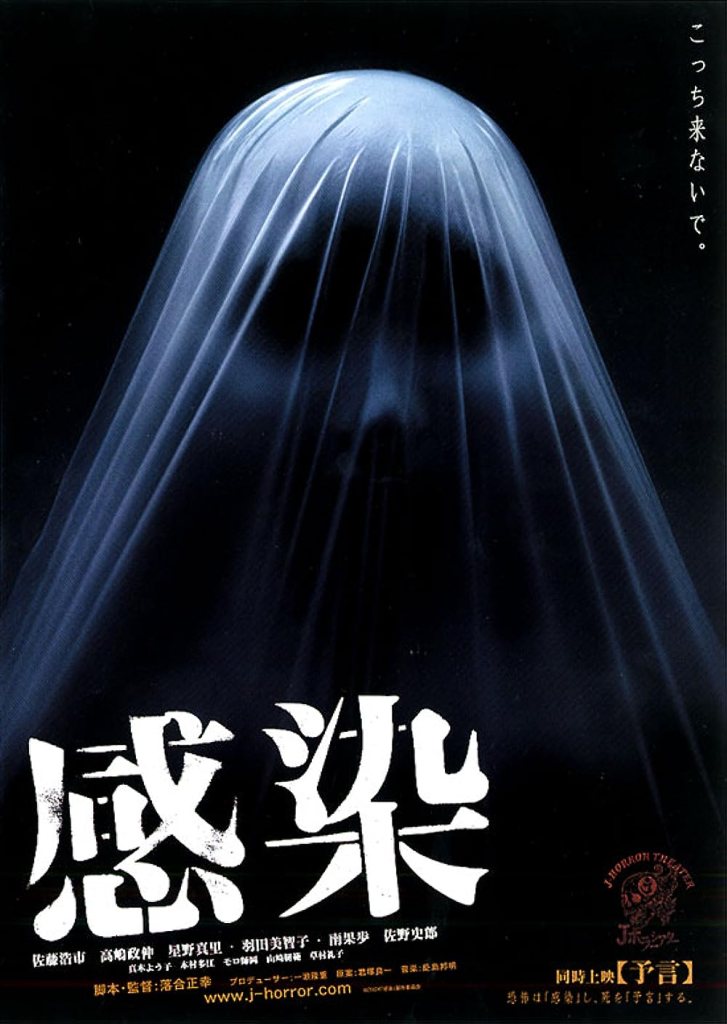
Kansen (2004)

Directed by Masayuki Ochiai [Other horror films: Yonimo kimyô na monogatari: Haru no tokubetsu hen (1991), Parasaito Ivu (1997), Yonimo kimyô na monogatari: ’97 haru no tokubetsu hen (1997, segment ‘Tobira no saki’), Saimin (1999), Yonimo kimyô na monogatari – Eiga no tokubetsu hen (2000, segment ‘Samurai Cellular’), Yonimo kimyô na monogatari: Haru no tokubetsu hen (2001, segment ‘Shinzô no omoide’), Yo nimo Kimyou na Monogatari: 2003 Spring Special (2003), Yo nimo Kimyou na Monogatari: 2003 Fall Special (2003), Suiyô puremia: sekai saikyô J horâ SP Nihon no kowai yoru (2004, segment ‘Yokan’), Shutter (2008), Gekijô-ban: Kaidan resutoran (2010), Gakkou no kaidan: Noroi no kotodama (2014), Ju-on: Owari no hajimari (2014), Ju-on: Za fainaru (2015)]

Known in the USA as Infection, this Japanese movie is a bit of a favorite of mine. I can’t say the finale entirely makes sense to me – a few things still aren’t quite clear – but the atmosphere and tense nature of the film make Kansen a movie definitely worth seeing.

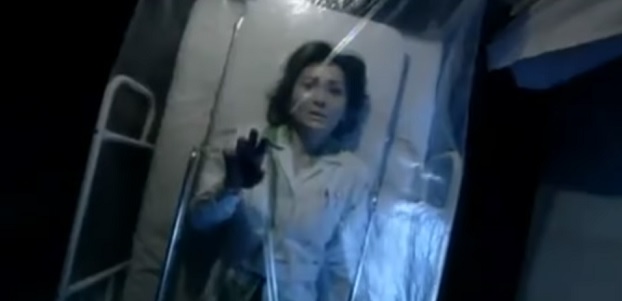
The setting is great, taking place in an understaffed hospital with overworked doctors and nurses. They’ve stopped receiving pay, they’re running out of medical supplies, but they’re still trying their best to care for the patients they have. And during an overnight shift, more goes wrong than one could imagine.

Somewhat psychological in it’s approach, Kansen can definitely be a spooky movie. A dark hospital, limited staff, sick and dying patients, a deadly infection raging that liquifies organs, it’s not a good time. Of course, watching the film is a different matter, as it’s a lot of fun, even if some elements that come up at the end don’t seem entirely sensical. It’s definitely a movie that’ll have you reading theories after it concludes, which isn’t always a good thing, but here, I can make a slight exception.

Kôichi Satô and Masanobu Takashima make for fair leads here. Shirô Sano doesn’t have much in the way of personality, but that’s partially the point. Among those who played the nurses, I think both Kaho Minami and Mari Hoshino stood out the best. I also liked the elderly patient – she’s not credited on IMDb nor Wikipedia, but she was good, and it was amusing seeing Isao Yatsu pop up a bit, as I just saw him a few days back in Dark Water.

I wouldn’t say Kansen is an overly violent film, but it can be a bit gruesome at times. There’s an infection that, as I said earlier, liquifies the organs. We never see this in detail, but we do see plenty of green gloop (the remainder of the infected), which can be disgusting. There’s a few disturbing sequences – a woman plunges her hands into scalding hot water, and there’s a corpse rotting under intense heat (it makes sense in context), with bandages and I imagine skin sloughing off. All of this is to say it’s not an overly gory film, but it can be gruesome.

Again on the finale – when I first saw the film, I probably liked it a bit more. Maybe I was young and impressionable, but whatever the reason, it’s not quite as strong now. I don’t mind leaving a few things up to interpretation, and plenty of the film can make sense under a certain lens, but I just wish we got a little more explanation in the final ten minutes than what we did. Either way, the locker sequence at the end was quality, along with a fact we learn from a news report, so it’s not as if the finale doesn’t have something to appreciate.

Despite the fact that I don’t entirely love the conclusion to Kansen, I still think it’s quite a strong film, and it remains among my personal favorite Asian horror films. Hopefully future viewings will clear a few things up, but on the positive side, at least this is a film I would easily watch again in the future, which is definitely not true for many others.

8/10

Batoru hîtâ (1989)

Directed by Jôji Iida [Other horror films: Kikuropusu (1987), Tokyo Babylon 1999 (1993), Naito heddo (1995), Rasen (1998), Anaza hevun (2000), Hoshi Shin’ichi Mystery Special (2014)]

Known as Battle Heater, this Japanese film deals with a kotatsu heater that goes around and kills people. It’s not a bad movie for it’s sort of goofy niche, but therein lies the problem for me, which is that the movie is just a bit goofy for me.

Sometimes that doesn’t matter. Hausu is a pretty silly movie, but not only do I rather enjoy that, but I consider it a classic of Japanese horror. Bio-Zombie (or Sang faa sau see) is still fun despite how goofy it can be. Tokyo Zombie (Tôkyô zonbi) is the same way, though I do think that one trends more toward average.

My point is that sometimes I can deal with goofy elements in my movies, but at other times, it just comes on way too strong, and Battle Heater is an example of that. It’s okay in it’s niche, but from the goofy characters to the silly set-up, it’s not really my type of thing. From a giant rock hitting a character to indicate the end of the film (the rock says ‘end,’ so it feels like Monty Python) to an electrical-based superhero suit being made to battle the heater, it’s humor is highly silly.

I can appreciate portions of the film, though. A killer kotatsu is a wild concept, and for those who don’t know (myself included before I started the film), a kotatsu is a type of electric heater used almost exclusively in Japan. It looks sort of comfy, and deciding to make that thing some type of homicidal entity is amusing in of itself.

Also, some of the comedy is okay. There’s a scene early on in which two characters stare at each other for a ridiculously long time. At first it was just awkward, but as it spanned into a longer scene, it was just amusing, and had me laughing come the end of it. There’s also a miscommunication regarding a map, which leads to a bunch of crying Japanese high school girls winding up at a low-budget apartment complex for a concert. It’s random, but funny.

Out of the performances, I’d say the best ones were Pappara Kawai and Gorô Kishitani. Kishitani is probably the straightest character, and I appreciated that, but he’s also a bit of a dick, so that takes some enjoyment away. Pappara Kawai does grow on me over the course of the film, as he starts off quite shaky, but he does sort of grow into himself.

This is a pretty obscure movie, and I sense that the right audience would definitely enjoy this movie. It’s a film I’ve wanted to see for a while, though I knew I probably wouldn’t be in the audience this was directed toward. It’s not my type of thing, but if you like Asian horror, especially wacky Asian horror, than you should definitely check this out.

5/10

Honogurai mizu no soko kara (2002)

Directed by Hideo Nakata [Other horror films: Honto ni atta kowai hanashi: Jushiryou (1992), Joyû-rei (1996), Gakkô no kaidan F (1997), Ringu (1998), Ringu 2 (1999), Sotohiro (2000), The Ring Two (2005), Kaidan (2007), Chatroom (2010), Inshite miru: 7-kakan no desu gêmu (2010), Kuroyuri danchi (2013), Gekijô rei (2015), Satsujinki o kau onna (2019), Sadako (2019), Jiko Bukken: Kowai Madori (2020), Sore ga Iru Mori (2022)]

I can’t say for sure whether I saw the 2005 remake before this original Japanese version, but I can say that I’ve always loved the story in Dark Water. Honogurai mizu no soko kara may well be one of my favorite examples of J-horror, and it packs enough creepy and emotional scenes to make me happy.

As it is, I don’t have a lot of exposure to J-horror. I’ve never seen any of the Ringu movies (be it the 1995 TV movie, the 1998 Rasen, the 1998 Ringu, or the randomly South Korean Ling from 1999), I’ve not seen Pulse (or Kairo), I’ve not seen One Missed Call (or Chakushin ari), and it’s entirely possible I’ve never seen The Grudge (Ju-on, and to be specific, either the popular 2002 or the lesser-known 2000 movie). I’m not a big supernatural horror fan, so J-horror hasn’t been my go-to, but Dark Water definitely has a lot going for it, and it makes me rethink my attitude toward what Japan has to offer.

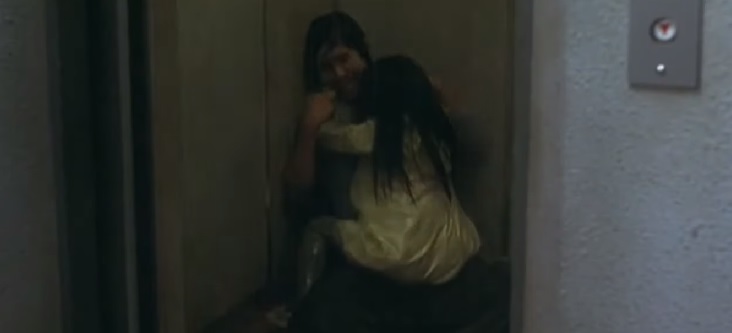
Taking place in perhaps the most depressing apartment complex I’ve ever seen in my life, the story is a simple one, with a struggling woman going through a divorce trying to give her young daughter a good life, in the face of potentially supernatural occurrences. It’s an easy plot to get into, there’s not many characters, and the apartment building is spooky enough even before the ghostly girl pops up, yellow raincoat and all.

In fact, it’s probably one of the best settings I’ve seen in a little while. It’s such a dark building, and whether the scene takes place in the elevators or the roof, it’s just creepy. That scene toward the end when the main character is climbing the water tower, for instance, is just a fantastic sequence, and I loved the whole set-up of this.

It’s also a bit of an emotional ride. The main character (played by Hitomi Kuroki) is going through a hard time, dealing with a lot of feelings of insecurity and a tough divorce. She’s close to an emotional break-down most of the time, and I can’t help but feel for her, especially in that dreary apartment she’s forced to raise her daughter in. It’s a gloomy situation all around, and the fantastically emotional final scene, a ten years later sequence, is just icing on the cake.

As such, Hitomi Kuroki did an amazing job with her character, and her portrayal of a mother going through hard times was fantastic. Playing her daughter was Rio Kanno, and she did quite well for a young actress. And though she really only gets one scene, Asami Mizukawa was stellar.

Because it’s a supernatural Japanese film, it’s not a gory movie, and it’s also not particularly rife with special effects. You see a ghostly girl a few times, but she never does any extreme acrobatics (à la The Ring). Even so, there’s plenty of low-key and subtly creepy scenes here, and despite not being a fan of supernatural films, I definitely thought this had enough going for it.

Also, the mystery here, dealing with the missing girl Mitsuko Kawai, was pretty good. I sort of wonder about one of the flashbacks – when she’s getting on an elevator – but it may have been an unintentional red herring. Still, the mystery is fun, and I love how things are slowly pieced together.

Dark Water is a film I’ve seen before, but I forgot how hard it hit you emotionally. In fact, the finale reminded me a bit of the 2007 Spanish film The Orphanage, and I wouldn’t be surprised if that film was moderately influenced by this one. Dark Water was definitely a great movie to see again – from the depressing opening to the ending credits, with the beautiful “Aozora” by Suga Shikaro – and it’s certainly worth seeing.

8.5/10

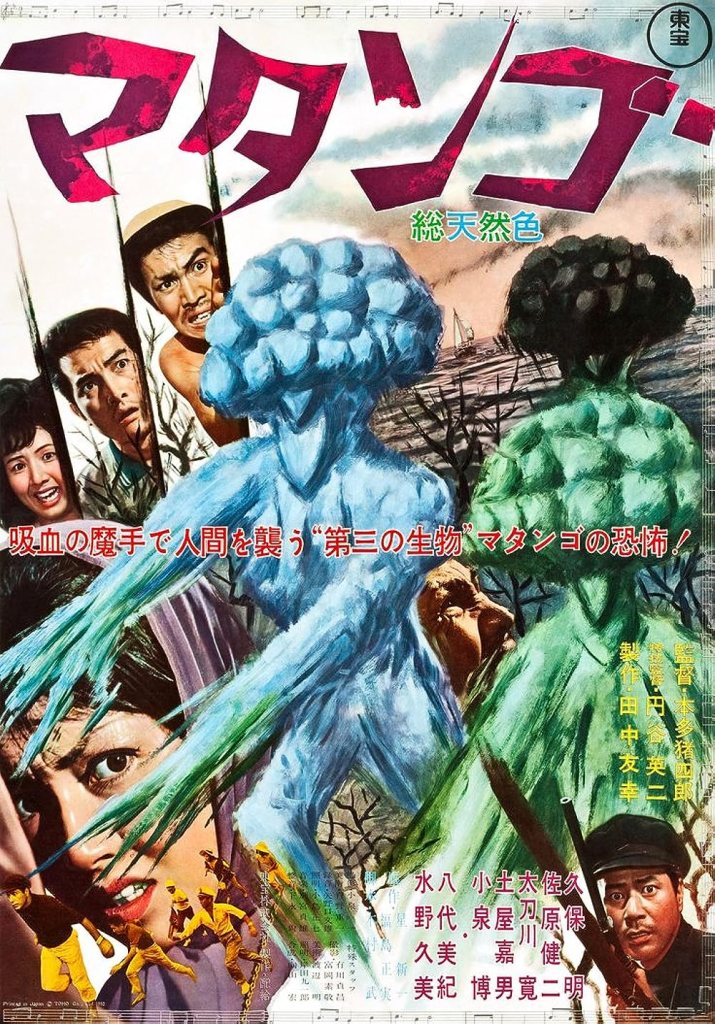
Matango (1963)

Directed by Ishirô Honda [Other horror films: Ishirô Honda [Other horror films: Gojira (1954), Gojira no gyakushû (1955), Jû jin yuki otoko (1955), Godzilla: King of the Monsters! (1956), Sora no daikaijû Radon (1956), Godzilla (1957), Tokyo 1960 (1957), Bijo to ekitai ningen (1958), Daikaijû Baran (1958), Half Human: The Story of the Abominable Snowman (1958), Gigantis: The Fire Monster (1959), Mosura (1961), Varan the Unbelievable (1962), King Kong vs. Godzilla (1963), Mosura tai Gojira (1964), Uchû daikaijû Dogora (1964), War-Gods of the Deep (1965), Furankenshutain tai chitei kaijû Baragon (1965), Furankenshutain no kaijû: Sanda tai Gaira (1966), Gezora, Ganime, Kameba: Kessen! Nankai no daikaijû (1970), Gojira tai Hedora (1971), Godzilla (1977), Godzilla 1985 (1985), Gojira vs. Desutoroiâ (1995), Gojira tai Megagirasu: Jî shômetsu sakusen (2000)]

Matango, or Attack of the Mushroom People (which is a pleasantly provocative title) is a quality Japanese movie, rife with beautiful colors and people horrifically transformed into mushrooms. It’s never been a favorite of mine – I think it moves a bit slow for much of the runtime – but the final twenty minutes or so are hauntingly nightmarish, and it’s worth the watch for that.

Based on a short story by William Hope Hodgson titled ‘The Voice in the Night’, the film follows a group of people who shipwreck their yacht, and are trapped on an island filled with mist and mushrooms, and little else. It should go without saying that the mushrooms may not be the healthiest thing in the world to eat, but given their desperation and hunger, they don’t have a lot of choice, and some succumb to the springy-textured temptation.

Before that point, though, we’re treated to a lot of infighting amongst the group – the captain is getting on peoples’ nerves, one of the women is actively flirting with multiple men, putting people on edge, and there are power struggles popping up as to who should lead the group, and what their plan of action should be.

It’s not uncommon in a movie like this, and in fact, it reminded me of Goke, Body Snatcher from Hell, which I saw earlier this month. In that Japanese movie, much like this one, a group of people find themselves in a desperate situation, and morals break down, leading to danger and tension throughout.

For a sociological look at things, that approach is fine. You can also see much the same type of things in various zombie movies (28 Days Later… comes to mind), and it’s certainly realistic. I don’t mind it here, but I do think the film moves terribly slow, and it’s not until about 35 minutes in that I’m really intrigued. Once they find an old shipwreck covered in fungus, things improve, but getting there is a little bit of a struggle.

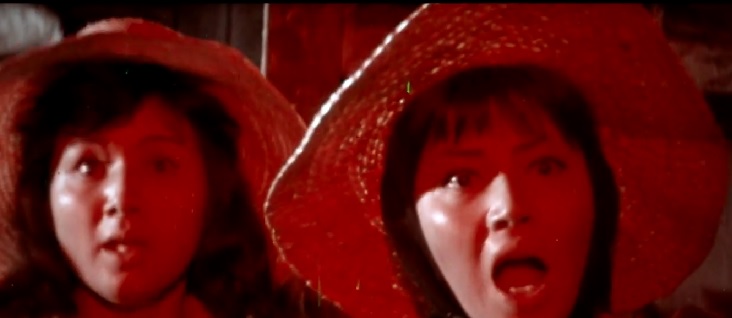
Honestly, none of the performances really stood out to me. I sort of liked Miki Yashiro’s character, and she had a creepy scene at the end, but saying she added much would be a hard case to make. Akira Kubo was perfectly fine, albeit generic. Yoshio Tsuchiya was fine as an antagonist, but again, he doesn’t particularly stand out.

What makes Attack of the Mushroom People worth seeing it the slow, creeping atmosphere and the eeriness of the concept. I didn’t read much of the Odyssey back in school, but the story of the lotus eaters always freaked me out, and that’s the type of thing this movie has to offer. Once people consume the mushrooms, they slowly transform, and never want to leave the island. Oh, and they live in this creepy mushroom-filled area – it’s color, it’s atmopshereic, and it’s, as the kids say, creepy as fuck.

Attack of the Mushroom People has never been a movie I loved, but that’s not because it’s bad. It’s just that much of the human element before the titular Mushroom People come about doesn’t interest me that much. Their drama is just not my cup of tea. Once things get moving, though, it’s a really good film, and the final twenty minutes are fantastic. Definitely a Japanese classic worth checking out.

7.5/10