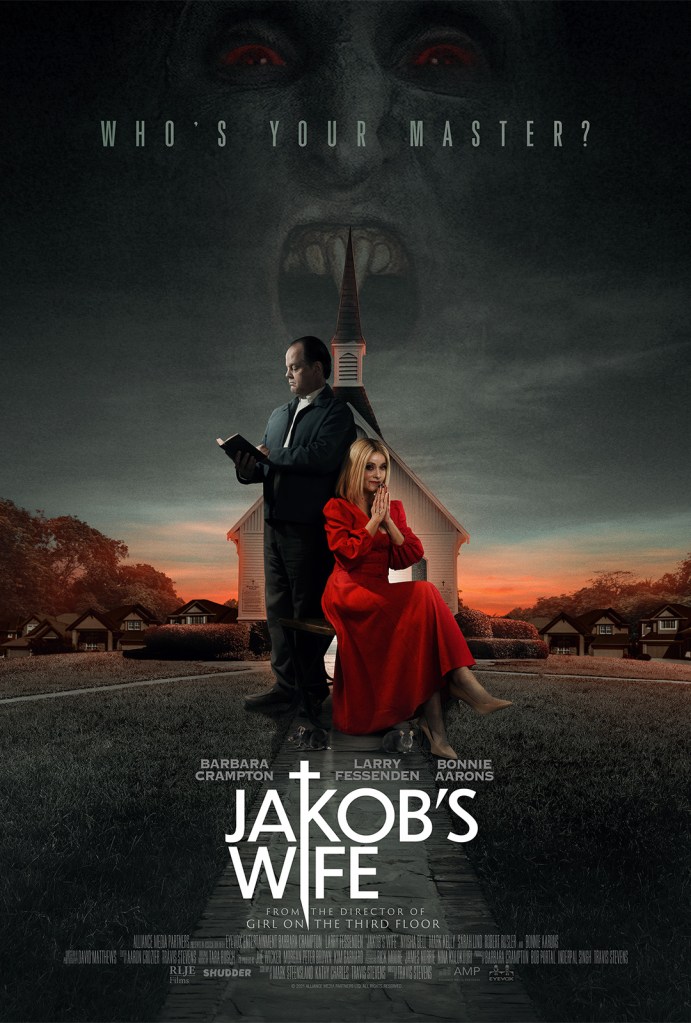
Jakob’s Wife (2021)

Directed by Travis Stevens [Other horror films: Girl on the Third Floor (2019), A Wounded Fawn (2022)]

This isn’t the easiest review I’ve had to write in recent times. Jakob’s Wife is a pretty well-made film, and I definitely see what they were going for, but it wouldn’t be truthful if I said I enjoyed it. On the surface, this may well sound rather tepid as far as criticisms go, but now is a good time to get into the psychology of Jiggy, so hold onto your hats.

I don’t like giving movies negative reviews. Even movies I personally hate, such as The Greasy Strangler and 1408; I know they may have their fans, and I don’t like possibly pissing people off. It’s especially bad for lower-budget movies – when a movie doesn’t have all the resources a higher-budget movie does, and I give it a low rating, I sometimes feel, as ridiculous as this may sound, a bad person.

It’s not just low-budget films, though, that I find hard to sometimes review with 100% honesty – when I get requests to watch films from those who made a movie, or just film recommendations from other fans, a large part of me wants to make them happy and perhaps bend my feelings a bit in a more positive light, which plays a mild part here, because someone requested I watch Jakob’s Wife, with the idea I’d enjoy it, and I just hate to say it wasn’t accurate.

Honestly, it’s not always easy giving my opinions on movies, especially movies that I know so many people love that I personally just don’t. Jakob’s Wife is a minor example – while many reviews have been positive, it has a more lukewarm overall reception. There are other films, like Halloween Kills, that I sometimes feel I may have put kiddie gloves on before reviewing, for these same concerns.

All I can say, before I get into my review proper of Jakob’s Wife, is that I do my best to be perfectly honest about my feelings. It’s worth noting that I am just a single guy from northeast Indiana, and I certainly don’t think my views on films supersede anyone else’s. I didn’t care for Jakob’s Wife, and that’s the simple truth.

Well, perhaps not that simple. I certainly thought the finale was pretty solid, almost emotional in a way, though I also think the final freeze frame was sort of disappointing. Not the song that popped up, being “Church” by Kitten (a song that will soon find it’s way onto my iTunes), but just the idea that as close as Jakob and his wife had become over the events of the movie, it might all have been for naught.

Before the finale, though, I was struggling, and most annoyingly, I can’t exactly explain why. Certainly the movie is primarily a horror film with occasional smatters of comedy thrown in, but not much of the comedy is overly goofy, so I don’t know if I can really blame the comedic undertones of some scenes on my overall feelings of the movie.

Perhaps it’s the somewhat aimless sense I got from it. Certainly there’s a plot – a somewhat mousy woman (played beautifully by horror icon Barbara Crampton) gets turned into a vampire, and has to figure out her life from that point forward. There’s a story, but it’s not always engaging, and while a couple of elements stood out, I can’t say I was really into the movie until the final thirty minutes or so.

Certainly the cast isn’t to be blamed for this. Barbara Crampton (From Beyond, Re-Animator, Castle Freak) did quite well, and Larry Fessenden (Habit, I Sell the Dead, We Are Still Here), while not a particularly enjoyable character, had a great performance. Though a smaller role, I liked Jay DeVon Johnson, and while she doesn’t get time to shine until the end, Bonnie Aarons (The Nun) had some strong elements.

When it comes to the positives, I’m pretty much stuck with two things. For one, I loved the gore – when people got bitten by a vampire, it wasn’t a small bite, these people literally got their necks ripped open, splatters of blood following. It was beautiful.

Secondly, the design of the lead vampire (played by Bonnie Aarons) was highly reminiscent of Nosferatu’s Count Orlok, with a bald head, freakishly long fingers, and to add to the effect, long fingernails. It was a great traditional look, and I loved it (at least from afar – up close, it felt sort of silly).

Otherwise, though, I found that much of the movie dragged, and when I said it was a struggle to get through this, I mean that. I kept pausing due to disinterest, and rather unlike me, it took three days to fully sit through Jakob’s Wife. I just wasn’t engaged at all save for the finale, and I can’t really put a finger onto why that was.

I imagine part of it is just the nature of the story. I don’t mind vampire movies, as there are some great ones out there – look at Fright Night, Sundown: The Vampire in Retreat, and John Carpenter’s Vampires, not to mention personal favorites like The Night Flier and Heartstopper (the 1989 movie) – but in Jakob’s Wife’s case, I just didn’t care for much of the story.

Ultimately, while I know this film has gotten a decent amount of praise among the horror community, I honestly just didn’t like it. I don’t think it was a particularly poor movie, and it was certainly filmed beautifully, but I can’t really see myself giving this another chance anytime in the next 15 years, which is a bit of a shame, especially given my mild hopes when starting the film up.

5.5/10
Howard’s Mill (2021)

Directed by Shannon Houchins [Other horror films: N/A]

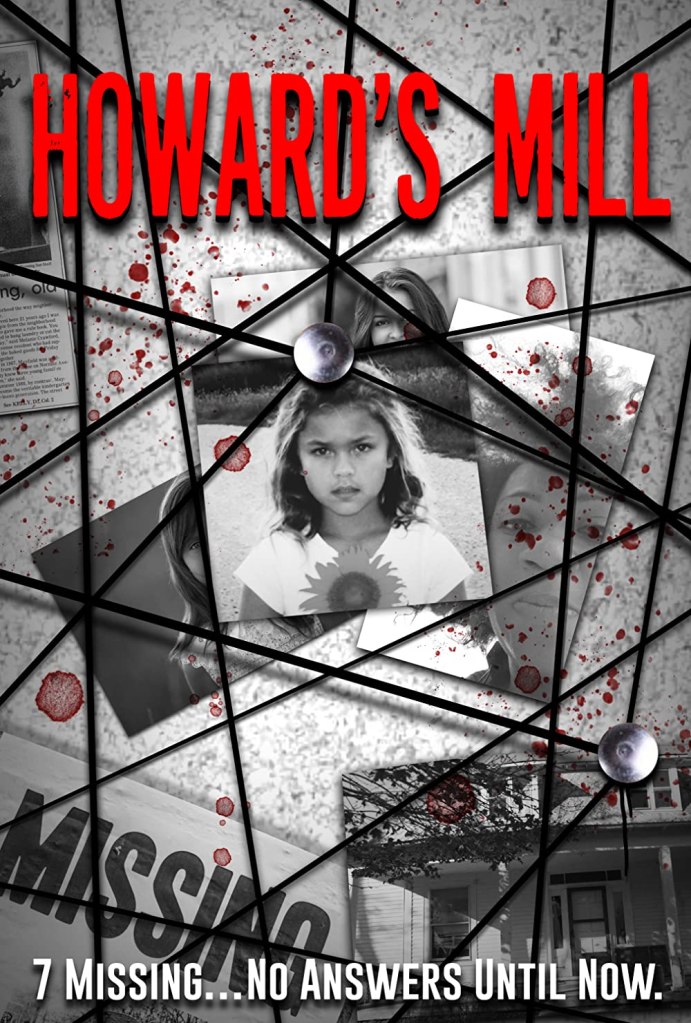
So I will admit that I found Howard’s Mill a rather solid film for the type of movie it is.

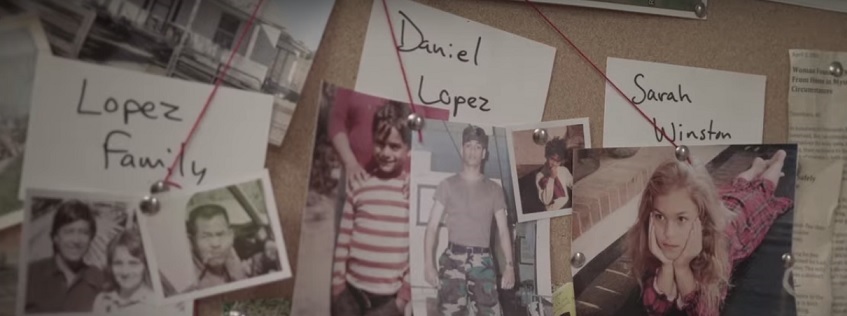
Done in the vein of Hell House LLC, We Are the Missing, and The Poughkeepsie Tapes, Howard’s Mill plays itself up as a real documentary about multiple individuals who go missing over the course of a hundred years, starting off with just a single case, and turning quickly into a sprawling and rather mesmerizing film.

It has the same problems you might expect from films like The Poughkeepsie Tapes – occasionally some of the interviews don’t feel quite authentic, and we’re not really presented with a clear, concise answer come the finale (which is a similarity shared with We Are the Missing), but even with some small flaws, personally, I found myself really pulled into the mystery.

And it certainly goes all over the place. It’s pieced together realistically enough, slowly introducing new pieces, previously unknown history, different angles, all that jazz. Once some skeletal remains start showing up toward the latter half of the film, we even get an interview with a physicist talking about the possibility of time travel, and perhaps a hint of extraterrestrial activity even later on. And the best part of it is, all of it works, and I bought every moment.

Part of the reason is that this isn’t explicitly supernatural, like We Are the Missing is. Sure, there’s some quotes about the lands that Howard Mill’s placed on as ‘taking people’, and there are certainly odd circumstances of lost time and memories for a few individuals, but more than anything, this is just a mystery that isn’t fully solved, and I really enjoyed how cemented in reality it was, especially the somewhat moving conclusion, as Dwight Nixon (played by Reegus Flenory) contemplates the fate of his missing wife, the disappearance of which he was initially blamed for, and what set up this whole documentary (in-universe, of course).

There’s not a full cast listing on IMDb, and the credits of the film just list the characters in the movie as if this were a real documentary, which makes sense, of course, but means I don’t have access to everyone in the cast.

Of those I can identify properly, I wanted to give a lot of props to the aforementioned Reegus Flenory, as he struck me as pretty believable. Josefina M Boneo isn’t always the best documentary host, but she had some strong moments. Others I can name include Jeremy Childs (The Dead Center), who shines toward the finale, Jessejames Locorriere, Ashley Shelton, Steve Wedan, and Danny Vinson.

Naturally, there are some smaller performances I wanted to point out – one is a character who appears briefly named Allison Steinquest, who reminds me oddly of Judy Greer. Another is a principal of the local high school, a character with a few great scenes named David Buchanan. A farmer near the questionable land named Ken Allen popped up throughout, and I dug his low-key style. Lastly, and I thought these two were perfect for the movie, we have an older couple named the Moody’s, who give us a little more insight into the strange goings-on.

Now, unlike Hell House LLC or The Poughkeepsie Tapes, there’s nothing overly shocking or scary in the movie. It’s more like building up to a better understanding of how so many people have gone missing, and what the time discrepancies that pop up actually mean. There are some more suspenseful moments – an older woman talking about mysterious figures she called ‘the Watchers’ or the discovery of a child skeleton in a hidden room, but Howard’s Mill is generally more subdued.

I think it works – Hell House LLC is a great movie, and I’d say it’s better than this, but this movie does amazing with the style and presentation of the topic, and I truly do applaud it.

Howard’s Mill surprised me. Only in rare cases do I get a lot out of faux-documentaries. The Poughkeepsie Tapes is okay, but not great, and some of the best ones, including Hell House LLC and Ghostwatch, are certainly the exception as opposed to the rule. I really enjoyed Howard’s Mill, and it may not be a movie for everyone, but I found it captivating and well-pieced together.

If you’re into these types of films, I’d highly recommend you give it a watch.

8/10

In the Earth (2021)

Directed by Ben Wheatley [Other horror films: Kill List (2011), The ABCs of Death (2012, segment ‘U Is for Unearthed’), A Field in England (2013), Meg 2: The Trench (2023)]

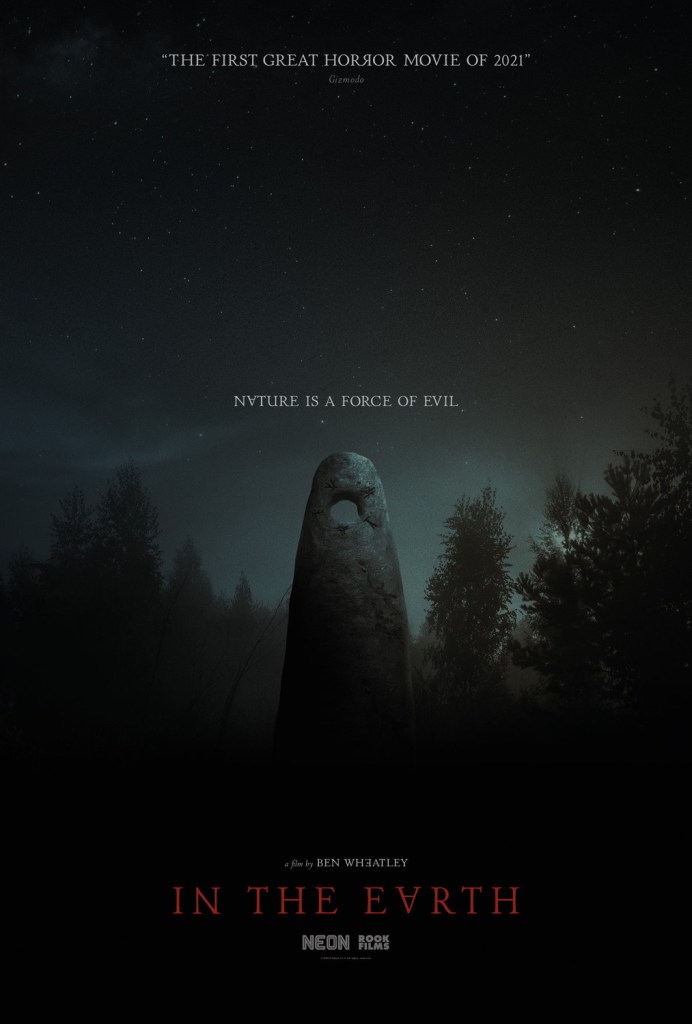
There are times when a movie is less a movie and more of an experience, and I think that In the Earth might qualify for that.

Not too dissimilar from films like Midsommar and Apostle, In the Earth is a folk horror which largely defies description. It starts off innocently enough, but by the thirty minute mark, you can sort of tell you’re in for a ride.

Now, personally, I didn’t think the ride was that enjoyable. For one, the movie is an hour and 47 minutes, and the last forty or so had semi-constant strobe lighting and discordant sounds, making for a singularly unpleasant viewing experience. The film can also be quite trippy during the latter half – there’s a charm to it, and it fits with the story, but it also lacks what I’d consider a good conclusion.

It’s sort of hard, really, to express my feelings. I love the idea of the film – individuals sort of stuck in a forested area by some sort of Mother Gaia-type organism/standing stone – and I can’t even fault the execution, as the movie looks beautiful as far as the cinematography goes. Portions may not be enjoyable to watch, but I suspect that’s rather the point.

At this juncture, it’s worth mentioning that In the Earth is directed by Ben Wheatley, and if that name sounds familiar, he’s also the one who directed Kill List, from 2011. Kill List is a movie that has a very odd vibe to it, and while I found In the Earth even odder, it’s not hard to imagine that the same mind was behind both projects.

Joel Fry (who I know from a brief role in Game of Thrones) and Ellora Torchia (who was actually in Midsommar) were solid as the leads, despite their many stilted conversations. It was harder to get into Hayley Squires’ and Reece Shearsmith’s performances, as their characters were rather out there, but it’s partially the point. Squires felt a little over-the-top at points, and the same could be said for Shearsmith (The Cottage, some episodes of P.R.O.B.E.), but given their situations, I rather think that can be excused.

Like both Apostle and Midsommar, there are also a few rather violent scenes in the film, especially if you enjoy feet. One individual gets a gnarly gash on their foot, and it’s rather inexpertly sewn up later on. Also, some toes get cut off with an ax, a wound that later has to be cauterized (the cauterization isn’t too bad, but the scene in which the toes are cut off is, as the kids say, tense as fuck).

Violence, though, takes a backseat to whatever the hell the rest of the movie was. Really, it was all types of odd. I loved portions of it – the appearance of the Malleus Maleficarum (or Hammer of Witches), the idea that the local folklore of Parnag Fegg being more a process than a being, and even whatever the hell mycorrhiza is added something interesting. It’s a bizarre film, and it does get sluggish, but I can appreciate the ideas they were playing around with.

If you look at the title screen, which screams 1970’s, or how the credits are displayed at the end, you can see that In the Earth has a very specific, sometimes bleak, style and presentation to it. It’s not an easy movie to enjoy, in my view, but it’s definitely a movie that will have some fans for the themes it deals with, esoteric as they may well be.

I can easily imagine divided reaction to this one. I wish I personally liked it more, but some movies just aren’t easy to enjoy. Aspects of this one are great, but overall, I might need to let some other elements, along with the somewhat lackluster conclusion (beast trippy sequence aside) sink in a bit.

6/10

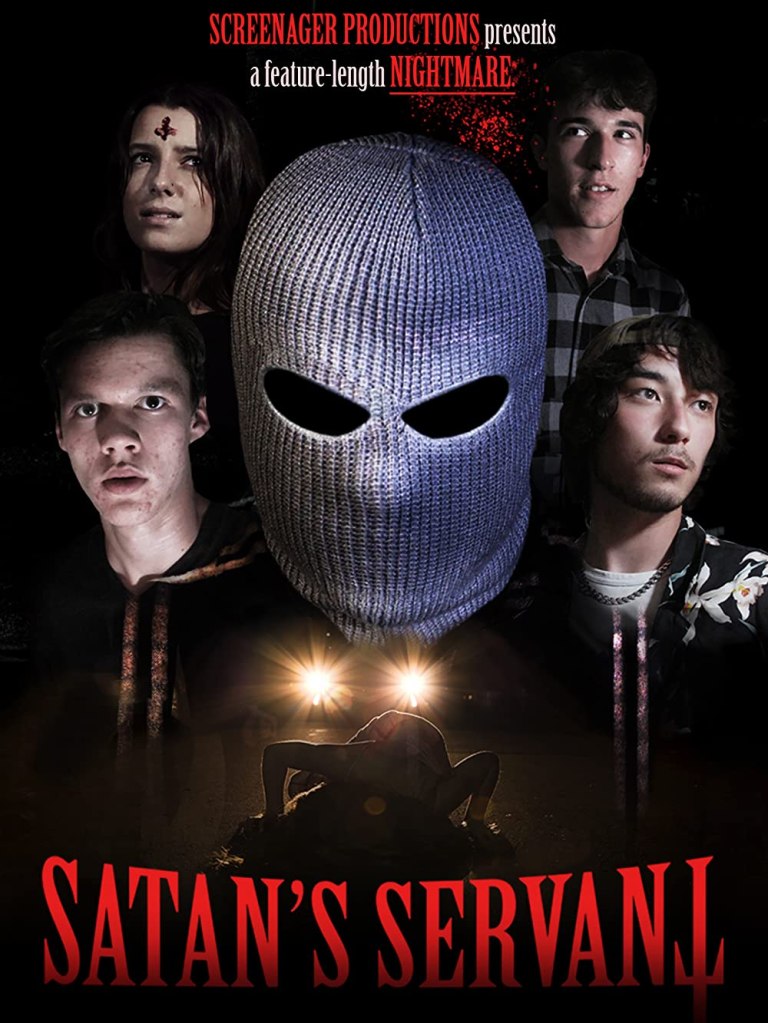
Satan’s Servant (2021)

Directed by Ethan Gomez Zahnley [Other horror films: Welcome Week: A College Horror Anthology (2024, segment ‘Welcome Week’)] & Jack McDermott [Other horror films: Welcome Week: A College Horror Anthology (2024, segment ‘Welcome Week’)]

I have to admit to having rather mixed feelings about this lower-budget film. On one hand, I appreciate some of the performances and dialogue in Satan’s Servant, for all it’s awkward glory, but on the other, I really wish I loved the base story a bit more.

Certainly I find the film a bit of a mixed bag. Still, considering the extraordinarily low score on IMDb (at the time of this writing, it boasts a 2.5/10 with 126 votes), perhaps such a mixed reaction should be seen in a positive light. I mean, compared to some films I saw from 2020 (such as Tokyo Home Stay Massacre, Wolfwood, and I Think We’re Alone Now), this was downright spectacular.

Also, I won’t lie – I had fun with a lot of the first three-fourth’s of the film. It’s labeled on Prime as a ‘coming-of-age slasher’, and while I don’t buy that description, it does deal primarily with teenagers, meaning we get uber-beast teen slang (such as the word ‘sus’ and ‘swear’, as in ‘Swear, what’s the move now?’). Also, ‘damn near the move’, ‘bust the mission’, and ‘vibing’.

I’m not making fun of the film – I’m guessing this is what modern-day teens talk like, and I found it fascinating, along with a little amusing. I mean, I say ‘bro’ and ‘brah’ a lot, and sometimes use ‘hella’ ironically, but it almost feels like a third of the words used here.

So yeah, I found a lot of the film fun just for the fact it centered around some teenagers in California (this was likely filmed near Kensington, California, on a side-note, given how Kensington Hilltop Elementary School was seen in a couple of scenes). I’m almost 30, so I have no idea if it’s a realistic portrayal of teens nowadays, but did I have fun? Yes, sir.

The performances were, as you can imagine, shaky. Some definitely lacked the appropriate emotion for the situation. That said, there was only one performance I actually disliked, being Emily Maya Keyishian, who was just a bit over-the-top comedic at times for me to fully buy into.

Ironically, the younger actors and actresses here all kept me entertained. I absolutely loved Sean Okimoto’s character, who spent most of the night trying to fight Satanists while faded as fuck. I dug that performance a lot. Josephine Thompson had some weak moments, but I generally thought she did pretty well. Though she had shorter screen-time, the same can be said for Erin Wynden. Carlos Noreña didn’t seem to have as much character as Okimoto, but he was an okay lead, and Garrett Bush had a moment here and there.

Also, while the gore here isn’t great, they at least try. Someone gets their arm ripped off, and a throwing knife flung at their skull. Another unfortunate soul gets stakes through their wrists. There are two different decapitations, along with a slit throat. None of these scenes are great, but I admit, I did like seeing someone get their arm torn off, so no complaints.

What I did find more problematic was the comedy. Sometimes, it totally worked, such as the scene in which James (Carlos Noreña) and Tyler (Sean Okimoto) were discussing how to get past a lock. Other times, though, I didn’t think it landed. Mostly, this happened toward the finale, which I found overall rather unsatisfactory, if I’m being honest, and that purification scene (“You’re in the splash zone”) was particularly painful.

I don’t doubt that many would look at the lower-budget nature of the film and write it off, which I don’t find particularly fair. I definitely had some issues with Satan’s Servant, but for what they had, I thought they did an admirable job. Oh, and the fact they could film at 2:00 am without pissing off their neighbors is quality praxis.

Satan’s Servant isn’t likely to make many people’s must-watch list, but I definitely found it largely serviceable. I do think it ultimately falls below average, if only because the story sort of loses my interest about half-way through (to be fair, that’s true for many movies with a Satanic subplot), but it was a damn fine attempt, and I had a good time with a lot of it.

6/10

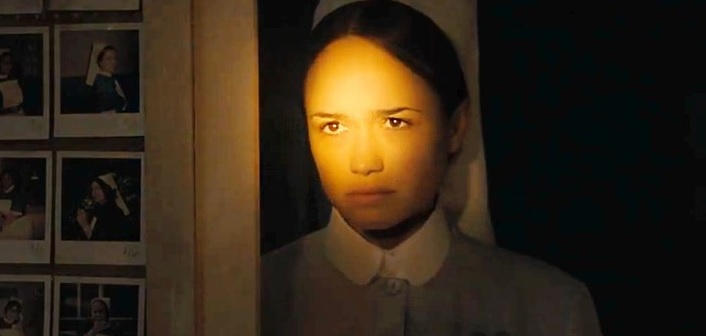
The Power (2021)

Directed by Corinna Faith [Other horror films: N/A]

I went into this British movie pretty blind, fingers, of course, crossed that it’d be decent. As it is, The Power is an okay film, but given the themes they were working with, not to mention the pretty solid production quality the movie had, I personally sort of hoped it would have made a bit more of an impression.

From the first five, perhaps ten, minutes of the movie, it’s not too difficult to see where the movie’s going. It throws in a few turns here and there, such as potential possession and other supernatural goodness, but for the most part, I think a lot of people could tell exactly how the movie would play out.

Certainly I did appreciate how the final twenty minutes sort of dealt with the aftermath of the main action, taking place the morning after. Little in that twenty minutes surprised me, and I’m somewhat lukewarm about the finale as it was executed, but I did appreciate it, at the very least.

The central cast were all pretty solid. Rose Williams had some solid sympathy behind her at times and Charlie Carrick (Trench 11), for his short screen-time, had some good charisma. Playing a character you can’t help but hate at first, Diveen Henry had some strong moments. Young actress Shakira Rahman got some time to shine come the final twenty minutes or so, and while she was never the most important performance, I did rather enjoy Gbemisola Ikumelo here.

Also, a lot has to be said for the atmosphere. The movie is set in 1974, during the power blackouts in the United Kingdom, giving the film a good reason to drench characters in almost utter darkness, with only weak lanterns to help light their ways. The Power knows what it’s doing with the cinematography, and it looked nice throughout. On the surface, the movie might seem a bit light insofar as the plot is concerned, but it definitely had some strong elements.

Most of my personal pet-peeves comes from the story, specifically the more supernatural elements (if they were indeed supernatural elements – a case could be made that much of what seemed supernatural would have a natural explanation). A lot of this happens in the middle portion of the film (after the first third of the film gets going after a slow crawl), and it had a character blacking out multiple times, and dreams/visions/confusing images were the masters of creation. The story itself wasn’t bad, but I would have preferred a cleaner execution.

And again, I feel like the finale had a problem here and there also. I largely enjoyed it – especially since it gave Diveen Henry’s character a strong scene – but elements just didn’t sit well with me, and seemed largely open to interpretation, something I don’t think the film really had to do.

Thematically, I think it’s easy early on to tell where the movie is going, and I certainly think they hit hard on what they were aiming for. Elements could have been more clear-cut, to be sure, but the themes aren’t in any question once the credits start rolling, and I rather dug both what this moving was tackling, along with the double meaning of the title.

Even so, I found The Power ultimately serviceable. As strong as some characters and scenes were, I don’t think the movie ever quite felt great at any point in time. I don’t think it’s a bad movie, of course, but I did find it a little bit below average. It looked nice, and it might have some things going for it upon a future rewatch, but for now, it just wasn’t stellar.

6.5/10

Halloween Kills (2021)

Directed by David Gordon Green [Other horror films: Halloween (2018), Halloween Ends (2022), The Exorcist: Believer (2023)]

Perhaps one of the most-hyped horror films in the last couple of years, I have to say that I wasn’t one of those all that excited for this. I think I was probably correct in that stance, because while parts of Halloween Kills are fun, a lot of it just feels like filler.

The 2018 Halloween was a movie I thought was okay. Sure, I have it rated an 8/10 on here, but if I’m being honest, that’s probably too high. I’ve only seen the 2018 movie once, and I thought it was good, but it’s one of those films that, having seen once, I was in no real desire to see it again anytime soon.

I considered refreshing my memory before getting into Halloween Kills by revisiting the 2018 movie, but I opted out. I doubt that made much of an impact – most of the characters introduced in the 2018 movie came back to me without too much difficulty. Even so, I just don’t know if the story in this film was really all that interesting.

Aimless isn’t really the word I’d use to describe the film, though I suspect some people would. To me, it just felt primarily like filler for the upcoming Halloween Ends. That’s not to say there weren’t some good scenes, because of course there were, but for a movie that’s an hour and 45 minutes, it’s oddly difficult to list what actually happened in the film, because the status quo didn’t change much from the end of the 2018 movie to the end of this one. In fact, I don’t think anything changed, aside from more people in Haddonfield being deceased.

I appreciated the flashbacks they gave that took place in 1978, especially the ones that had Loomis (played by Tom Jones Jr.), as they got a guy who looked pretty much just like him. Those flashbacks, at least the ones focused around the Myers house, were sort of fun, but I can’t say any of the Lonnie stuff interested me.

For performances, I don’t even know what to say. Most of the central cast (Jamie Lee Curtis, Judy Greer, Andi Matichak, Will Patton, and Anthony Michael Hall) were fine, but as for their characters, I feel like a lot of foolish mistakes were made, and those foolish mistakes sometimes made it quite difficult for me to really care about their characters.

Far more noteworthy to me are Kyle Richards, Nancy Stephens, and especially Charles Cyphers, all three of whom are returning characters from the 1978 classic (and seeing Cyphers back really brought a smile to my face). Two other characters were brought back (Lonnie and Tommy), but the original actors, Brent Le Page and Brian Andrews, were replaced by Robert Longstreet and Anthony Michael Hall. Well, I guess three out of five ain’t bad.

Oh, and though these characters weren’t even close to important, I liked Scott MacArthur and Michael McDonald in their roles as a gay couple living in what used to be the Myers house. They were at least somewhat fun.

I don’t mind that they brought back the characters they did – Marion (the nurse that Myers stole a car from) was sort of random, but the fact they brought back three old faces was nice, especially Charles Cyphers as Brackett (and I liked him a lot in this movie). At the same time, I don’t know if any of these characters were really utilized that well, and aside from bringing back familiar faces, I don’t know if it really made a difference whatsoever.

One of my main complaints about the 2018 movie was the gore. I don’t have a problem with gore, of course – H.G. Lewis and Nathan Schiff are, as the kids say, the shit. It’s just that the 2018 movie had a retro thing going for it, and I was hoping they’d focus more on suspense and creepy scenes (as the original Halloween did) as opposed to violence, but of course they didn’t.

This movie is much the same. I love the slaughtering that takes place here, but I also can’t help but wish they had gone for a classier aesthetic. I loved the opening to this film, which maintained a retro aura, but when you go from that to slaughtering a group of firefighters, it sort of loses me. Trying to please both crowds isn’t going to work, because it doesn’t feel genuine, at least not to me.

Look, I had a good time watching Myers go berserk on the firefighters – it was a lot of fun. And there’s a scene toward the end where a similar situation occurs, and I enjoyed that too. A lot of the violence here, such as the fluorescent light in the throat, or the guy who had his head banged against the stairwell until he was likely paralyzed (not that it mattered for long), was fun. The violence looked great, but I still personally would have preferred a different approach.

There’s a large portion of the film that deals with the horrors of a mob mentality. It’s like Halloween 4: The Return of Michael Myers on steroids, because instead of a group of drunk guys with shotguns in trucks (which made pretty good sense to me), you have pretty much the whole town bloodthirsty, and chasing down people who may or may not be Myers because of a couple of speeches. I’m not saying those scenes in the hospital didn’t have their moments, but the whole situation personally felt a little ridiculous.

Also, I’ve got to mention a small scene that bothered me. Toward the finale of the film, three individuals are under the impression that Myers went back to his old house, and go there after him. Despite being in contact with other characters who expressed interest in hunting Myers down, they didn’t tell anyone they were going to the house. I can’t say just how stupid I thought that set-up was – why wouldn’t they just call or text other people? They really thought three people – two of whom were quite young – could take on Myers after he destroyed the Haddonfield fire department? It was so fucking stupid, and it didn’t make a lick of sense to me.

It might sound as though I had a bad time with Halloween Kills, but that’s not accurate. I was entertained throughout, despite feeling that much of the film just felt like filler. I didn’t love a lot of it, but it was an entertaining time. Maybe once I watch this again, I can re-evaluate some of it, but for now, I’ll just say the film is somewhere pretty close to average.

7/10

Malignant (2021)

Directed by James Wan [Other horror films: Stygian (2000), Saw (2004), Dead Silence (2007), Insidious (2010), The Conjuring (2013), Insidious: Chapter 2 (2013), The Conjuring 2 (2016)]

Being only the fourth movie I’ve seen from 2021 (the first three being the Fear Street movies), Malignant came out of nowhere and took Twitter by storm. I saw so many reactions to this movie in such a short span of time, and though I don’t usually jump into seeing new movies that quickly, I did have the opportunity to watch this, and definitely found it worthwhile.

I don’t think I can call it a great movie. There are plenty of very well-done elements, to be sure, but at best, I think it’s just quite good. It can be a wild ride, especially if you go in with very few preconceptions (as I did, as luckily, most of what I saw online was quite vague). I didn’t know what I was going into, and I definitely had a blast trying to figure out exactly what was going on, which always makes for a good experience.

Reaction has been somewhat mixed – generally, I see positive comments, but it seems that those who disliked the movie disliked it quite a bit, and I can sort of see that. Toward the end, there were portions I wasn’t particularly fond of myself, and if someone sits through an almost two hour movie to reach an unsatisfactory conclusion, I get why that might leave a bad taste in your mouth. Personally, I dug enough of the film, and found much of it interesting, that I had a pretty good time, but I think I can understand those who didn’t.

Even if someone didn’t like it, though, if there’s one thing Malignant excels in, it’s having an engaging story. You’re trying to figure out the whole story along with the characters, and are having a good time doing so. Some of the cinematography is absolutely stunning (such as the overhead point-of-views during a chase sequence), some of the scares superb (the washer scene, for instance), and the atmosphere quite strong. Some feel it’s reminiscent of classic giallos, and I myself (who watched this with online friends) saw Argentino’s name pop up a few times. I don’t personally know if I’d go that far, but I can say that this movie carries with it a very unique vibe.

The somewhat amusing thing is, as much as I enjoyed portions of the movie, none of the performances wowed me. Make no mistake, I think that both Annabelle Wllis and Maddie Hasson are decent, and their performance as sisters believable, but I don’t think either one stood out. George Young was someone I was sort of expecting more from, but his character was never really given much to do, so again, there’s no much here to watch for as far as performances go.

That’s probably okay, though, as a brunt of the entertaining scenes deal with utter violence and rampage. Things go somewhat slowly during the first half of the film – I was interested and engaged throughout, don’t mistake me – but when things pick up in the last thirty minutes, they really pick up. Some expected yet still well-done revelations and violence galore (my favorite perhaps being a face being crushed on the floor, but a chair being thrown was another quality scene), and it’s just a hell of a lot of fun.

Related, the special effects (much like the camera-work) are fantastic. There are some body horror elements that look quite disturbing, and the movements of the killer have a creepy jerky look to them (which is explained in story, which is nice). The violence that plays the movie out is just a lot of fun – arms being cut off, faces being smashed, throats being slit – I don’t doubt that they knew what they were going for when they threw these action-packed sequences in, and they did a damn good job on them.

I do think the story could have been a little stronger at times, and there are some things not answered by the plot, but I did love the mystery here, and though Malignant isn’t a movie I’d call perfect, I do say freely that it’s a refreshing movie, and definitely one I’m eager to revisit in the future.

8.5/10

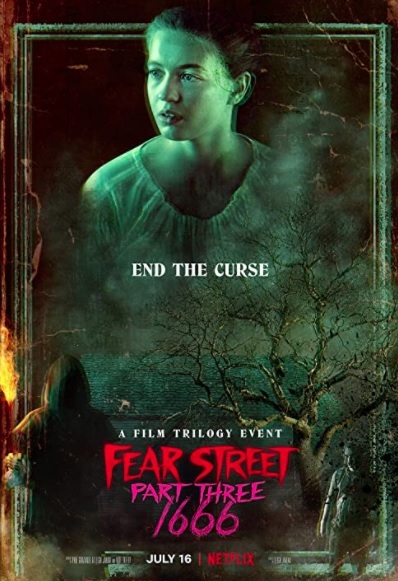
Fear Street: 1666 (2021)

Directed by Leigh Janiak [Other horror films: Honeymoon (2014), Fear Street: 1994 (2021), Fear Street: 1978 (2021)]

I will admit to being surprised by how well I felt this film closed the Fear Street series. No doubt I was expecting a decent movie, but this borders on spectacular. While it’s not a perfect film, this was a highly satisfying movie, and a great conclusion for Fear Street.

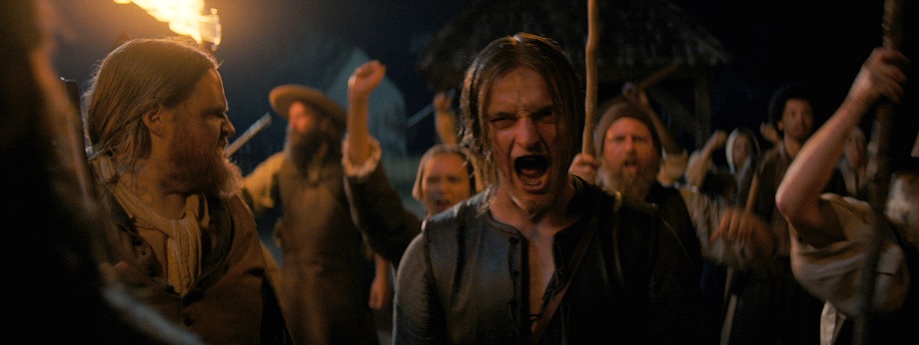
In some ways, this really feels like two movies (and in fact, is sort of treated like it) – the first half shows us the true tragic story of Sarah Fier, and the second transports us back to 1994 as Deena and her clan attempt to end the evil for good. It’s a simple story-telling technique, but it was done fantastically, and the movie never once feels like it’s running on too long (despite totaling an hour and 52 minute runtime).

Of course, I love movies that show the dangers of religious extremism (such as Apostle, End of the Line, The Mist, and The VVitch), and so the first half of this film, after Sarah was accused of being a witch, deeply appealed to me. I don’t know how realistic a potential lesbian relationship would have been in a close-knit community in 1666, but I felt they did a good job mixing real emotional drama with the religious hysteria that always seems to follow.

What’s even better is what this portion of the film reveals about the Goode and Fier families. It’s nothing that would likely blow anyone away, but I do think they did a great job handling some of these surprises, and while the finale of the film may not feel quite as amazing, the story the first half tells is just stellar, with amazing performances throughout.

Because of the nature of the film (the first half uses actors from the present-day 1994 story as characters in 1666), a lot of the big players here did double duty, and I think that it solidifies Kiana Madeira as a damn good actress. She was good throughout the film, but really shined in the first half, and especially the conclusion of the first half, dealing with a lot of emotional material, and making it damn convincing.

Others who stood out include Benjamin Flores Jr. (who didn’t really do that much during the first half, but really won me over by the finale), Olivia Scott Welch (sort of a vice-versa situation, as she didn’t do that much in the second half, but shined beautifully in the first half), and Sadie Sink and Emily Rudd (just seeing the pair of them again, even in smaller roles than what they had in 1978, was great).

I want to give a special mention to Ashley Zukerman, who played Solomon Goode and Nick Goode. While I didn’t love Nick Goode’s characterization, I thought that Solomon Goode was one of the most fascinating characters I’ve seen in recent times. I can’t get into anything specific without potentially spoiling something, but I just thought Zukerman was fantastic as Solomon, and I’d easily watch this one again just for him.

Michael Chandler did well as a one-scene wonder (he had more scenes than one, but I think the horrors of the meeting house really showed his menace), as did Rachel Doman, who played a character hinted at back in 1994 (and I thought would be more important to the story), but I still loved how she eventually popped up toward the end.

It’s not just about a solid story and great performances, though. Let’s talk horror, brahs. Perhaps one of the best scenes in this movie, and perhaps of the series as a whole, would be the meeting house murders, done by a pastor who lost his way. It’s not in-your-face brutal like the bread-slicer scene from 1994, but it was well-shot, and led to a great shot of bodies laid out in front of the building (the same kind of shot we saw in 1978, of course).

There’s also quite a few painful injuries, the worst being a hand rather mutilated by a blade. That did not at all look fun, but it was damn good special effects. Other scenes that warrant a mention include an eye-stab toward the finale and a brawl between the multiple killers (which seemed a little silly, but not so much that it took away from the movie). While the violence here probably won’t be noted near as much as the brutality of the finale of 1978, or the soon-to-be-famous bread-slicer scene from 1994, this movie still came to play.

Like I said at the beginning, I was surprised by how good this was. To be honest, I was expecting to be underwhelmed (I was hoping I wouldn’t be, but I knew it was certainly possible), but I was definitely mistaken in that assumption, because 1666 not only stands out as a better movie than both of the previous Fear Streets, but one of the strongest horror movies I’ve seen from the last couple of years.

9/10

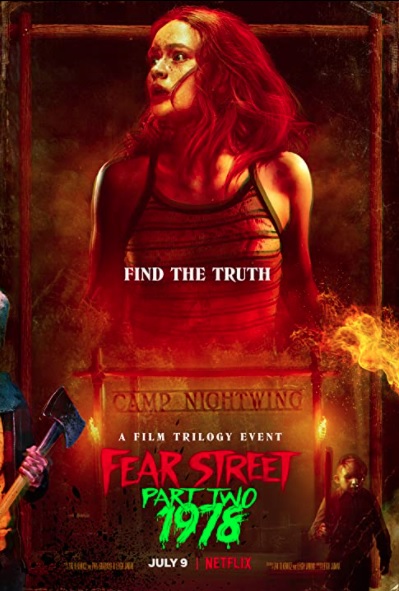
Fear Street: 1978 (2021)

Directed by Leigh Janiak [Other horror films: Honeymoon (2014), Fear Street: 1994 (2021), Fear Street: 1666 (2021)]

Much like the first movie of this trilogy, I didn’t love 1978, but I did enjoy this a bit more. Maybe it’s because I’m more a 70’s guy than a 90’s, or maybe it’s because camp-based slashers are, as the kids say, “for the win,” but I found this a pretty enjoyable film, and definitely well-used to expand the story of the witch, Sarah Fier.

In comparison to the first film, it could be fairly said that this film lacks some of the strong punches (or kills), but where I think it makes up from that (and to be fair, there’s only so much they have to make up, as plenty of the kills here are pretty decent, especially toward the ending) is the atmosphere and well-done 70’s aura.

Much like the first film, we were somewhat overloaded with music, only this time around, I appreciated the music a bit more (this is more my time period of music than what the first movie gave us), and as such, we got classic songs such as “Brother Love’s Travelling Salvation Show” [Neil Diamond] and “(Don’t Fear) the Reaper” [Blue Öyster Cult]. It doesn’t make the movie better, but it does add to the 70’s feel.

I had few problems with the characters from the first movie (who mostly appear here also, as the central story here is an extended flashback being told to the 1994 characters), but I really enjoyed the characters in this one, especially the sisters Cindy and Ziggy, played by Emily Rudd and Sadie Sink. Emily Rudd had that good girl act down fantastically, and on the flip-side, Sink was great as more of an outcast. I also enjoyed her budding relationship with Ted Sutherland’s Nick Goode, and I thought all three of these individuals did stellar.

While she took a little to really grow on me, Ryan Simpkins’s Alice became a pretty interesting character. I never 100% loved her personality, but I can definitely sympathize with it, and her broken friendship with Rudd’s character, while it didn’t get a lot of focus, was certainly worth seeing.

It can also be said that some of the performances, such as McCabe Slye, Jordana Spiro, and Sam Brooks, didn’t do much for me, but I think that has to do far more with their lackluster characters than anything else, and I certainly don’t begrudge them for it.

Of course, the camp setting was nice, and reminiscent of classics such as Sleepaway Camp, The Burning, and Friday the 13th. Part of the reason I enjoyed this one more than the first is likely because I just connected the setting to slashers that I love, so while I didn’t care so much about someone getting possessed and going on a killing spree, I can still appreciate it a bit more given where it took place.

The various connecting lore was all pretty decent. Nothing special, really, but we get a few more details about what’s going down, and I appreciated that tree from the Shadyside Mall (from the first movie) coming back into prominence, as it just felt like something important at the time.

One last thing that I have to mention, though, is the scene toward the end with the sisters taking a last stand against the multiple killers, which was just fantastically tense and emotional. Not to mention, of course, damn brutal. There’s a couple of small twists at the end, and though I saw one of them coming, I still think it played out pretty well.

I enjoyed 1978 more than 1994, and that seems to not be an altogether uncommon opinion. This one just felt more what I’m used to, and the fact that there’s less exposition here helped out quite a bit. It’s not perfect, but I did think this was quite a good film.

8.5/10

Fear Street: 1994 (2021)

Directed by Leigh Janiak [Other horror films: Honeymoon (2014), Fear Street: 1978 (2021), Fear Street: 1666 (2021)]

Released to quite a bit of excitement and hype, I found Fear Street a decent movie. Not great – no doubt it had potential – but pretty good, and I think that it’ll stand out primarily for being one of the biggest supernatural slashers in the last couple of years. I sort of wonder, though, how memorable the film will be years down the line.

The story was pretty solid. Since this is the first movie of a planned trilogy, there were pieces of set-up that weren’t fully touched on (such as the events of Camp Nightwing and C. Berman’s story), but in a case like this, I think that’s fine. I’m not overly fond of the idea of a witch sending out deceased previous killers, as I’m more the down-to-Earth slasher type, but as far as the story is concerned, it made sense, and the killers that popped up (especially the Nightwing camp killer) looked good. Also, the central, Skeleton costumed killer, was quality.

Lead Kiana Madeira (The Night Before Halloween, Neverknock) did a fantastic job, from the action sequences to the more emotional moments, and I was surprised how well she worked with Olivia Scott Welch (who also did great). I didn’t really get Julia Rehwald’s character, and for that matter, the same can be said for Fred Hechinger, but both gave perfectly good performances. Benjamin Flores Jr. took a bit to grow on me, but grow on me he did. Ashley Zukerman was a bit on the ehh side, but I think that’s more due his character being a bit of a blank slate as opposed to anything else.

For a movie based off a R.L. Stine series for teens, Fear Street does have pretty solid gore. The opening sequence was a nice portent of things to come, and throughout the film, we get some slit throats, axes to heads, gut stabs, and most impressively, someone has an unfortunate mishap with a bread slicer, to gory effect. That was the goriest kill, to be sure, but I think my favorite would be a slow-motion death near the beginning. The movie doesn’t hit you over the head with gore, of course, but if that is something you look for in a movie, you should have a home here.

To an extent, I do think that it could be said the movie ran on a bit longer than necessary. At an hour and 47 minutes, this isn’t a quick romp through the park, and though it mostly keeps you engaged throughout, and rarely feels as though it’s dragging, I don’t really know if the 107 minute runtime was justified. Luckily, I don’t think it really impacts the film that much.

What has a lot of people happy is the nostalgic feel of the film, since the story takes place in 1994. The music is totally 90’s, which, if you’re a fan of 90’s music, might be a good time. Personally, I could take or leave the soundtrack, but I do think it at least fit the movie. Even ignoring the music, the movie had a style to it, and while some of the quick cuts felt a bit silly, like the music, I thought it went well with the movie.

One thing that I personally liked, and didn’t know beforehand, was how some of the central characters are a lesbian couple. Given the Fear Street books are from the 1990’s, they feature as heteronormative a cast as you could possibly imagine, so the fact that we get a same-sex relationship, and not only that, but a believeably-flawed one, was a nice touch, and something I appreciated, and I can imagine plenty of others will appreciate also.

There are points toward the second half of the film where I’m not entirely sure where things are going, or a bit worried about how they’d finish the story off, especially with a few different moments where it seems the story might end at, but I’m generally happy with the conclusion. At the very least, the next Fear Street movies will pick up some of the unanswered questions, so I think it’ll likely end up satisfactory.

I wouldn’t say that Fear Street is a great movie. I did have a reasonable amount of fun with it (though small things, such as the amount of information shoved into those opening credits, sort of bug me), and I thought the characters, even the ones I didn’t really get, were solid. Like I suggested earlier, I’m not entirely sure that this movie will end up being that memorable in the coming years, but it worked a decent amount this time around, and hopefully the sequels will make things even better.

7.5/10