
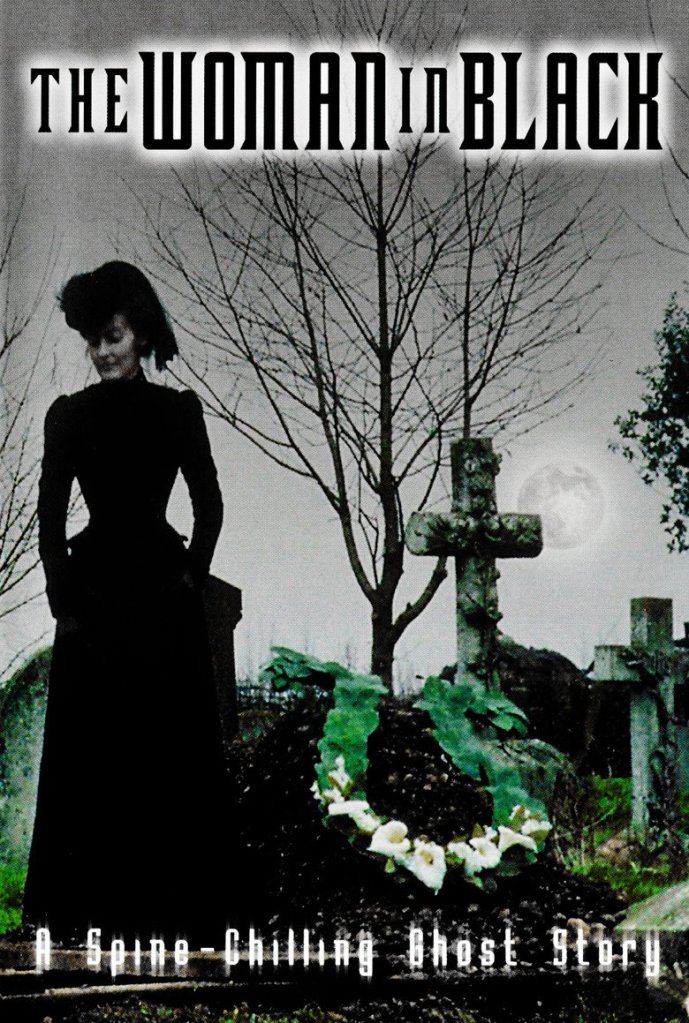
Directed by Herbert Wise [Other horror films: N/A]
Many consider The Woman in Black among one of the better television horror films, certainly when it comes to those that aired in the late 1980’s. For it’s specific classic ghost story, period piece niche, I do think The Woman in Black is quite decent. However, I also have to admit that I suspect many modern-day audiences would find it a tad sluggish, and I don’t think that’s without good reason.
Based on a 1983 novel of the same name written by Susan Hill, the plot follows that of a very traditional ghost story – think The Uninvited, with some sprinklings of The Changeling. It’s not a story that possesses much in the way of surprise or anything – it’s just a mildly tragic ghost movie that reminded me at times of films like The Orphanage and Mr. Wrong.
It’s a rather methodical story, too. It’s not bogged down in details or anything, but the movie can be quite slow. There’s what seems to be a two-and-a-half minute scene of a man going around a large house, looking around the rooms, and turning lights on. It just feels quite sluggish at times, and while it can pick up nicely during some well-placed scares, and the finale itself is decently well paced, I do personally think the film could have been trimmed a bit.
Insofar as the scares are concerned, being a more classy ghost movie (not to mention made-for-television), The Woman in Black is more subtle, largely speaking. There’s maybe four scenes that I’d classify as meant to be scary, and only two actually got much of a reaction from me (and to qualify this, I should say that I’ve seen this movie once before, and had vague memory of it, but it’s been so long that much of it felt fresh).
There is a scene in a small cemetery that works quite nicely, though, along with perhaps the most famous sequence in the movie during the main character’s sickness toward the end. It’s a scene I knew was coming, but still came out very effectively. No doubt the movie, to many modern-day audiences, would feel beyond slow, but a case could be made that it’s that fact that makes the spooky scenes stand out all the more.
Oh, and the ending is rather grim, too. Nothing unexpected whatsoever, but grim nonetheless, and I can see why this frightened so many people when it first aired on that cold Christmas Eve so many years ago in the UK.
Adrian Rawlins (2000’s Blood) made for a likable, if moderately forgettable, lead. He was a pleasant-enough character, but I don’t know if there was necessarily a lot to him. Perhaps one of the other few important cast members was Bernard Hepton, who had some solid moments toward the latter half of the film, and John Cater (The Abominable Dr. Phibes) was decent too. Otherwise, though, the cast here didn’t really hold much a candle to the atmosphere.
Even with the atmosphere, though, the movie runs for about an hour and 42 minutes. I fully think some scenes are great, but to get to those scenes, there’s a lot of material that’s not exactly my idea of engaging. Because of that, it’s sort of a hard movie to tackle – I definitely appreciate what it was going for, and I largely think it succeeded, but it still just feels quite sluggish to me, and it’s a hard case for me to make to call this stellar.
All-in-all, I do think The Woman in Black is a good movie. I just can’t personally see myself watching it all that often, as it’s the type of slow-moving period piece that you’d definitely have to be in the mood for.
7/10





 Jiggy's Horror Corner