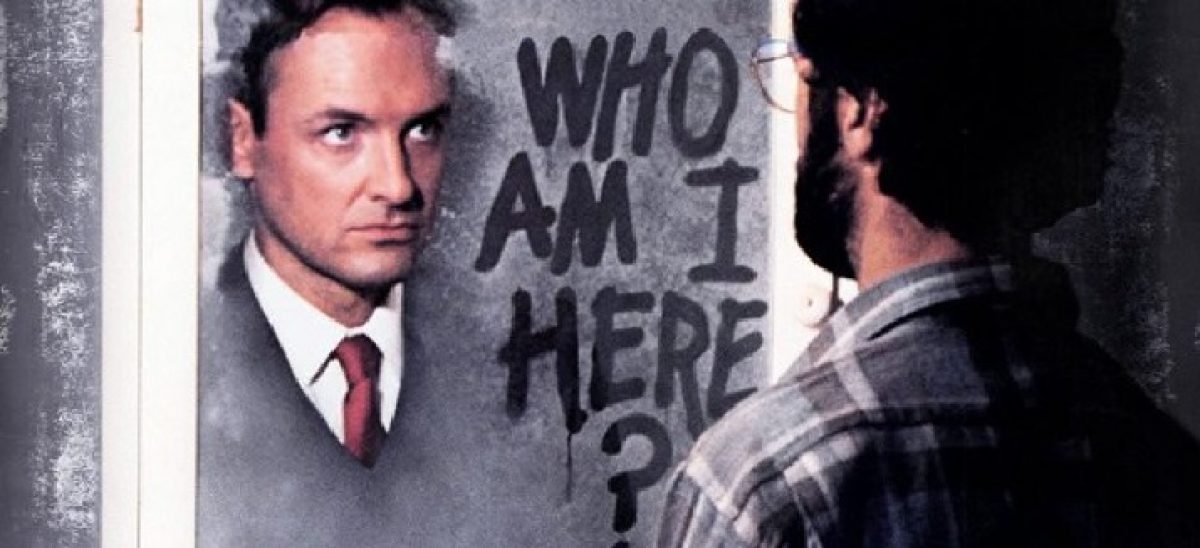
Nightmares (1983)

Directed by Joseph Sargent [Other horror films: Jaws: The Revenge (1987)]

Nightmares is an anthology that I’ve always been fond of. Which is actually somewhat surprising, given I only really like two of the four stories. Like most anthologies, it’s uneven, but even so, the good outweighs the bad here.

Of the four stories (‘Terror in Topanga,’ ‘The Bishop of Battle,’ ‘The Benediction,’ and ‘Night of the Rat’), I think two of them shine, being ‘Terror in Topanga’ and ‘The Bishop of Battle.’ Because of my affinity toward the Bishop of Battle, as a character (‘I am the Bishop of Battle. I am the master of all I survey,’ is a quote I use too much in real life despite surveying little), and the killer special effects, I’ve always said this story was my favorite, and it still is.

‘Terror in Topanga’ takes a more classic look at thrills, and while it’s the shortest story of the bunch, I think it’s pretty damn effective. If you’ve seen Urban Legend, you might know where the story is going, but that doesn’t mean it packs any less of a punch. It opens the film with a lot of promise, and while not all of the stories fulfill that promise, it still makes one hell of a first segment.

My biggest qualm with ‘Night of the Rat’ is how the rat looks. It reminds me of The Food of the Gods – just a normal rat that’s enlarged and superimposed in the scene, and it just doesn’t look great. Honestly, the story’s not too shabby before then – though I wish that Albert Hague’s character was more involved – which is good, as this story’s around 35 minutes. Up until we actually see the rat, it’s not a bad time at all.

More than anything else, I find ‘The Benediction’ annoying. A priest loses his faith, fails to get any answers to his questions by others in the church (big shock, I know), and on his way to a new life, gets attacked by what seems to be a demonic truck. That scene in which the truck flies out of the ground is pretty cool, but as someone who isn’t at all religious, I was rooting for Lance Henriksen’s character to make a clean break from the cloth (of course knowing he wouldn’t).

As it is, despite not caring for the story, Lance Henriksen (The Horror Show, The Manger 2, Pumpkinhead) might be one of the best performances here, and certainly one of the most emotional. Cristina Raines (The Sentinel) wasn’t the most likable character, Emilio Estevez (Maximum Overdrive) certainly wasn’t likable, and Veronica Cartwright (Alien, The Birds) tended to annoy me a bit (despite the fact she was right about the problem her husband was facing).

Others who stood out, no matter how small their role, including Albert Hague, Anthony James (Burnt Offerings), Richard Masur (The Thing, It), Tony Plana (Slayer), and of course James Tolkan (Back to the Future) for voicing the Bishop of Battle.

And on the Bishop of Battle, again, those special effects (computer generated enemies from an arcade game) were quite cool. To the modern-day eye, they may not look like much, but I found them charming, and like I said, I’ve always rather liked this story. Some classic hustling of a Latino gang, some classic arcade action – it’s like the whole of the 80’s rolled into a single story, and it’s beautiful. Plus, it has the Bishop of Battle, master of all he surveys.

Overall, it’s true that Nightmares is mixed insofar as the stories go, but as much as ‘The Benediction’ and ‘Night of the Rat’ don’t do much for me, I really enjoy the first two stories, so based off that, I do think this movie is a bit above average.

7.5/10

House of the Long Shadows (1983)

Directed by Pete Walker [Other horror films: Die Screaming Marianne (1971), The Flesh and Blood Show (1972), House of Whipcord (1974), Frightmare (1974), House of Mortal Sin (1976), Schizo (1976), The Comeback (1978)]

Despite the stellar cast of this one, I didn’t care that much for House of the Long Shadows when I first saw it. Well, I thought it was okay, but I didn’t think it was particularly great. I generally feel the same way now – it’s a solid movie in many aspects, and again, the cast is stellar, but I also think it runs a bit long, and it’s not a movie I’d revisit all that often.

Based on a 1913 novel by Earl Derr Biggers titled Seven Keys to Baldpate (which was later turned into a play, and made into multiple movies), the story follows Desi Arnaz Jr.’s character’s attempt to write a book to win a bet in the deserted mansion at Bllyddpaetwr (Welsh for the win), though he finds that the mansion is not quite as deserted as he was told. It’s a decent idea, but like I said, I feel like it’s a bit long (the movie runs for an hour and 42 minutes), and though the story is okay, I don’t know if it’s enough to carry the film.

Look at that cast, though – true, Desi Arnaz Jr. is the main star, and you could argue Julie Peasgood is a co-star, and neither one is particularly well known (though both do perfectly fine), but look at the others: Peter Cushing (The Abominable Snowman, The Masks of Death, The Skull, The Creeping Flesh, Frankenstein and the Monster from Hell), Vincent Price (Witchfinder General, The Tomb of Ligeia, The Fly, Tower of London ’39 and ’62, Cry of the Banshee), Christopher Lee (I, Monster, The Two Faces of Dr. Jekyll, The Virgin of Nuremberg, Curse III: Blood Sacrifice, Circus of Fear), and John Carradine (Crowhaven Farm, The Nesting, The Unearthly, Curse of the Stone Hand, Revenge of the Zombies).

Obviously, all four are giants of the genre – I’ve long been a fan of Vincent Price and Peter Cushing, and both Lee and Carradine are always decent too. In this movie, I actually do think that Christopher Lee’s character is the most interesting, but Price gives a lot to the movie also. Peter Cushing is a little more limited here, and John Carradine (who was around 77 at the time this was filmed), while fun, doesn’t have that much to do either. Still, it’s great to see the four of them in a single movie, despite the fact I don’t think the movie’s great.

Other performances worth mentioning include Sheila Keith (Frightmare, House of Whipcord), Richard Todd, Louise English, and Richard Hunter. I don’t think any of them add as much as Price, Cushing, Carradine, or Lee, but then again, how could they?

The story is reasonably fun. It’s worth mentioning, at this point, that the movie does have a somewhat light-hearted tone to it. The finale is almost whimsical, and while the humor is never over-the-top, the light-hearted nature is obvious throughout. And speaking of the finale, while I don’t know if it was executed entirely well, I can sort of appreciate it. It does seem a little bit ludicrous, but at least it was different.

As far as the kills go, there were two that I thought stood out – in one, a woman is washing her face, but unfortunately the water in the basin was replaced with corrosive acid, and that doesn’t do wonders for the woman’s complexion. In another, a character is killed with a battleax – we don’t see the kill, but we do see the attack through silhouettes, which looked pretty damn cool. The movie harkens back to the old dark house mystery days, but there are a few scenes here that does remind us it takes place in the 1980’s.

For the cast alone, I think it’s a movie worth watching, and generally, it’s regarded pretty well. Having seen it twice, it’s not something I personally love, but I suspect many would be happy with this one, and they’re not without reason.

7/10

The Demons of Ludlow (1983)

Directed by Bill Rebane [Other horror films: Monster a Go-Go (1965), Invasion from Inner Earth (1974), The Giant Spider Invasion (1975), The Alpha Incident (1978), The Capture of Bigfoot (1979), Rana: The Legend of Shadow Lake (1980), The Game (1984), Blood Harvest (1987)]

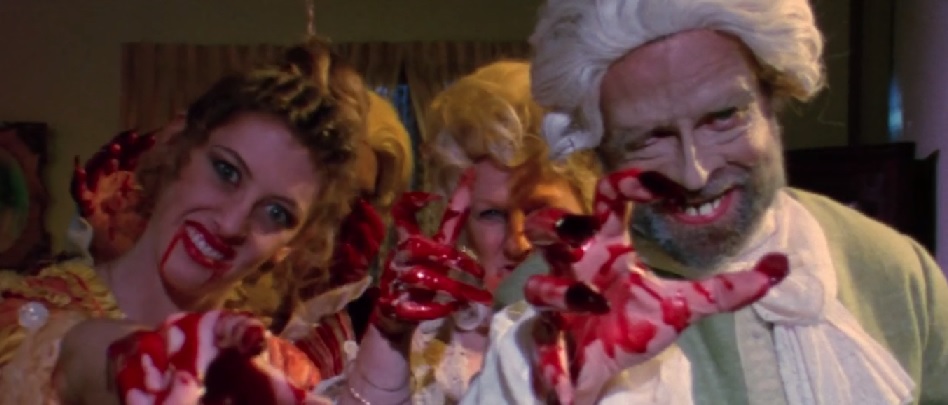
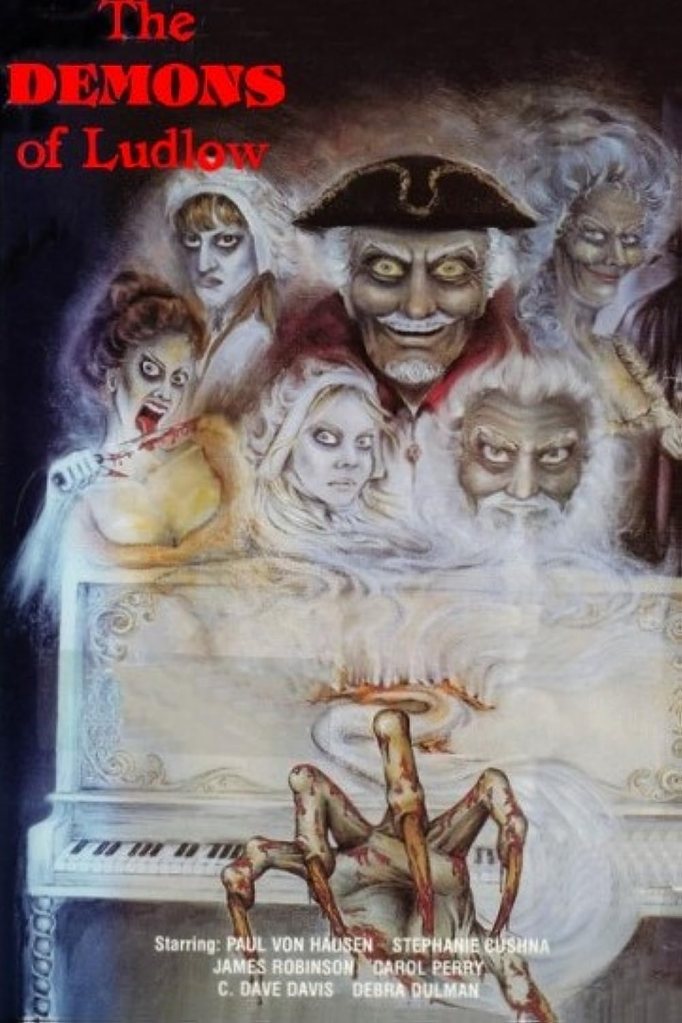
I’ve always had a soft spot for this rather low budget film. It’s a bit choppy at times, to be sure, but The Demons of Ludlow can be a decent amount of fun, and I rather like the story.

Taking place in a small town (and to specify, by small, I mean the population is a mere 47 people), the story revolves around a bicentennial celebration, town secrets long-thought forgotten, and a demon-possessed piano. It sounds wild, and it certainly can be once the action starts up.

And the action is fun, also. A couple who are enjoying each other’s company in a barn run amok of glowing green hands, and the same hands tear a hole through a woman’s ceiling later on and hang her. There are ghosts dressed as pilgrims that come around toward the end, and they wonderfully decapitate someone with a sword, and for another poor hombre, they cut both of his hands off.

Certainly the movie is a lower-budget production. If you’re familiar with director Bill Rebane (who, among other things, was behind The Cold, or The Game, The Giant Spider Invasion, and Blood Harvest), this may not come as a surprise. Related, the movie was filmed entirely in Wisconsin in the small, unincorporated community of Gleason. This northern Wisconsin community is also where films such as The Devonsville Terror, The Giant Spider Invasion, and Blood Harvest were made, and for good reason.

I love the small town feel of the movie. Only having a population of 47 people is just amazing, and I dig the vibe of the setting. In fact, it leads to a somewhat amusing line toward the end – the lead character (Stephanie Cushna) says to her work acquaintance (James R. Robinson) that it seems dead outside; that the town feels like a ghost town. I can’t imagine the night life of a community of only 47 souls ever seems overly excited, so every time I hear this line, it cracks me up. Also, being a northern Wisconsin community, there’s so much snow around town. It looks a dreadfully cold place to live.

And I have seen this movie more than a couple of times. This might only be my third viewing of the film, but given the generally negative reception the film has (when it has reaction at all – I tend to feel most people forget this movie exists), this goes a long way to show my differences of opinion with others. It reminds me of Drive-In Massacre, a film I rather adore, but is also somewhat of a terrible movie. I guess I’m odd that way.

As for the performances, I thought that Stephanie Cushna and Paul Bentzen (Invasion from Inner Earth and The Alpha Incident) were pretty good, especially once they got together near the end to work on figuring out the curse that Ludlow has fallen under. I also think that James R. Robinson should have a bit more to do with the finale, but he does good with what he has. Playing the mayor is C. Dave Davis, who does great with the small-town mayor aura, and playing a young woman with some mental health issues, I thought that Patricia J. Statz did fantastic. One a tragic note, this is the sole film Statz was in, and she later was killed on September 11th, 2001, as she was working at the Pentagon when the attack occurred.

Obviously, I probably enjoy The Demons of Ludlow a great deal more than is usual. I don’t know why this happens to be the case – even since I first saw it, I’ve always felt an odd affinity to it. It’s not a great movie – the finale is oddly rushed, and I’d have liked a bit more detail about exactly how things went wrong in Ludlow 200 years previous (the basis of the town’s curse), but even with those deficiencies, I’ve always enjoyed the vibe of this one.

It may just be me, and that’s fine, but I rather love The Demons of Ludlow, and I don’t think that will change anytime soon. I’ve seen it three times now, and still consistently have found it above average, and if it’s strange that I enjoy this far more then classic like Carrie and The Shining, so be it.

8/10

Sledgehammer (1983)

Directed by David A. Prior [Other horror films: Killer Workout (1987), Night Wars (1988), The Lost Platoon (1990), Night Trap (1993), Mutant Species (1995), Zombie Wars (2007), Night Claws (2012)]

I’m a simple man, and I didn’t have too many expectations going into Sledgehammer. I knew it’d be cheap – I’m no stranger to SOV horror – and as long as it had a guy killing people with a sledgehammer, I’d be happy.

Well, I’m not sure if I am happy, but there certainly was a man killing people with a sledgehammer. It was often in excruciatingly slow motion, but so was a good third of the film, so maybe that’s not a problem. Okay, it is a problem – I’ve never seen this much slow motion in one movie, and I sort of wonder if they had used the technique more sparingly, whether the movie be more around the 50-minute range as opposed to 85 minutes.

Of course, Sledgehammer is a bit of a classic, at least as far as shot-on-video horror goes, as it’s among the first ones made. And you can tell it’s rough – one of the stars, Ted Prior, is the brother of director David A. Prior (responsible for later films such as The Lost Platoon, Killer Workout, and Night Trap), and if IMDb trivia is to be believed, most of this movie was filmed in his apartment. If you’re watching this film, you probably went in knowing a lot of this, so it shouldn’t come off as too much a shock.

As such, a lot of the movie is tedious in ways that some SOV films tend to be. Luckily it’s nowhere near as bad as Blood Cult or Heavy Metal Massacre, but boy, all of those slow-motion portions are painful, and there’s so damn many. The kills aren’t terrible – ironically, one of the best ones might be a knife going through someone’s throat – but save for the opening scene (which, if you missed, is played again later during a retelling of the horrors of the house), there’s not really any great sledgehammer action. There is a terribly unappealing food fight, though.

If you’re familiar with SOV horror, you’ll probably know that performances aren’t often the highlight, and that holds true for this movie also. If I had to give a shoutout, it’d be to John Eastman, who at least looked different (that mustache was the bomb). Ted Prior didn’t really seem to have that much character, and while I wanted to root for Linda McGill (who was also in a film called Shape-Up for Sensational Sex, which sounds classy), it wasn’t an easy task.

Most people who come into Sledgehammer know full well what the movie is. It’s sort of fun at times – I actually rather like the heavy synth score that permeates the film – and it has that 80’s SOV nostalgic value, but it’s not a film I could see myself watching again anytime soon, and I’d really only recommend it to the horror fans who have likely already seen it.

5/10

Screamtime (1983)

Directed by Michael Armstrong [Other horror films: The Haunted House of Horror (1969), Hexen bis aufs Blut gequält (1970)] & Stanley A. Long [Other horror films: N/A]

This British anthology horror film may be cheap, but I think it has a lot of heart and occasional originality. It’s not the most polished movie, but Screamtime does have a decent amount going for it.

I’ve seen this one before, and I remembered a good portion of it (being the framing story, along with two of the three tales here). I remembered that I thought it was decent, but not great. That assessment is spot on, but that’s not at all damning. All three of the stories here are, at the very least, good, and when all the stories in an anthology horror film are good (which doesn’t happen very often), then you know you’re doing something right.

To be sure, the framing story here is laughably weak. It’s not as bad as Slices, but then again, what is? Here, two guys steal some videotapes from a store, and go to a friend’s apartment to watch them. Those tapes make up each of the three stories, being ‘That’s the Way to Do It,’ ‘Dreamhouse,’ and ‘Do You Believe in Fairies?’. Obviously, the set-up is utter weaksauce, but because I sort of like the movie, it doesn’t lose anything because of that.

Of the three stories, the one that comes closest to great is the last one, ‘Do You Believe in Fairies?’, This is partially due to quite an original story dealing with gnomes and fairies, and it’s just a lot of fun, especially with the performances of Jean Anderson and Dora Bryan. Both of the others are pretty fun too – ‘Dreamhouse’ is more a slow-burn about a woman seeing visions in her house, whereas ‘That’s the Way to Do It’ is decently solid throughout, about an older gentleman being put down by his family for running a Punch and Judy puppet show.

There are good performances in all of the stories (aside from the framing sequence, that is), which is nice. From the first segment, there’s Robin Bailey (See No Evil), whose performance reminds me a decent amount of Peter Cushing from his segment in Tales from the Crypt. Yvonne Nicholson wears the biggest pair of glasses I’ve ever seen in ‘Dreamhouse,’ and she’s believable throughout. And from the final story, as I mentioned you have the pair Dora Bryan and Jean Anderson. Both played the sweet older women nicely, and Jean Andersone reminded me of a mixture between Frances Bay (Happy Gilmore) and Myra Carter (Storm of the Century).

No doubt Screamtime is a cheap film. There’s not much in the way of special effects, and the framing sequence is never great (though I do love the utterly ridiculous ending). Even so, Screamtime has a lot of heart and originality, and I deeply applaud this British film for that. If you want an anthology horror film that’s worth seeing, give Screamtime a chance.

7.5/10

Mountaintop Motel Massacre (1983)

Directed by Jim McCullough Sr. [Other horror films: N/A]

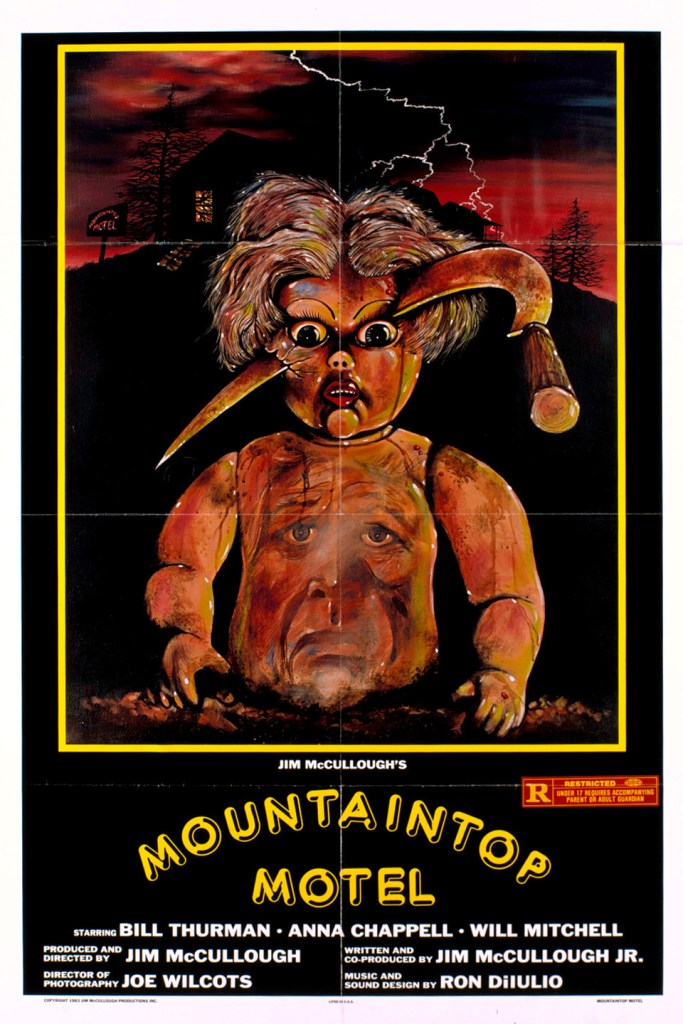
With a title like Mountaintop Motel Massacre (which is quality alliteration, by the way), I’d sort of expect the film to be a bit more cheesy. As it is, this film isn’t terrible, but it doesn’t feel at all like most 80’s horror, and almost possesses a bit of a somber feeling to it.

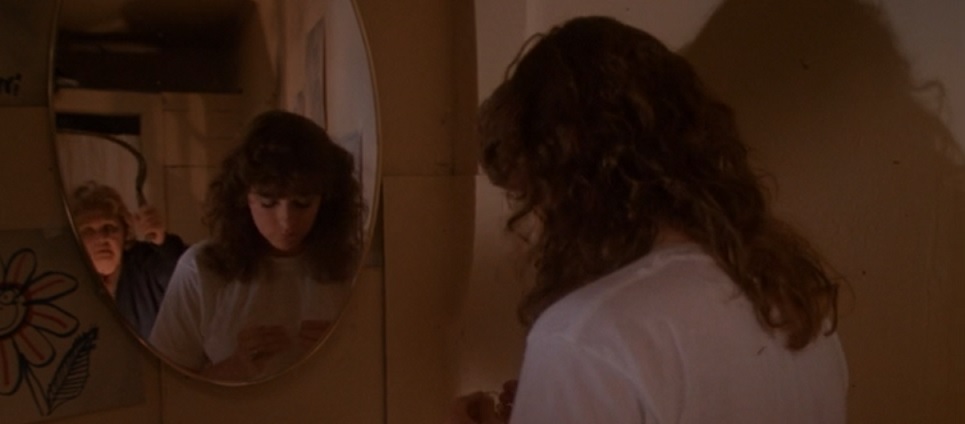
It also stands apart by not being the natural slasher that one might expect by reading the plot. There is some slashing, but beforehand, we’re given something like twenty minutes to get to know the killer, an older woman recently released from a psychiatric institution. It feels more like a character piece at the beginning, the horror not fully kicking in until would-be victims rent a cabin from her.

And because of that, things don’t really pick up until forty or so minutes into the film. It doesn’t help that, at the beginning, our insane woman is content with just scaring her many guests (by letting snakes, rats, and roaches into their rooms). It sort of helps with creating a dark atmosphere, what with her creeping around in underground tunnels and letting bugs loose into peoples’ cabins, but it’s not always the most enthralling material.

Anna Chappell was perfectly acceptable as a woman who’s lost it, but after a while, with little character insight, I can’t say she made an amazing impression. Most of the rest of the cast are in the same boat, sadly. Amy Hill and Virginia Loridans looked good in white, wet t-shirts, and Will Mitchell rocked a solid moustache, I guess. I did sort of like Major Brock in his sole movie role, and Bill Thurman did have some feeling, but these two are the only ones that really stand out.

If it weren’t for the sluggish nature of a lot of the film, I think I’d like the movie more. Once the killing starts, it’s not too shabby. Chappell’s character uses a sickle to kill, which is an inspired choice, and the special effects aren’t half bad. A woman gets badly struck in the face, someone loses a hand, another has their throat slit. When things actually start going down, they go down well. It’s just getting there that’s half the battle.

Now in this movie’s defense, I do appreciate how it attempts to stand out from many of the other horror films at the time by avoiding 80’s sensibilities, such as fun. That might sound like an insult, but it’s more me trying to say that this movie feels much more like a product of the late 70’s than it does the early 80’s. It’s not campy whatsoever, and while there’s an amusing line here and there, the whole atmosphere is somewhat oppressive and somber.

Even so, it’s not my piece of cake. When I first saw this one many years back, I think I was similarly befuddled, because I don’t recollect too much about my reaction, and seeing it with fresh eyes, I can get why a younger me would be confused. Mountaintop Motel Massacre is a movie that should be a cult classic, and perhaps it even is, but it’s not my thing. It’s still worth seeing, to be sure, but if you go in expecting a traditional 80’s slasher, you may not be in for a good time.

6/10

The Hunger (1983)

Directed by Tony Scott [Other horror films: N/A]

After reading the description to this film on my TV, I expected to hate it. No use denying it – I read the plot and immediately grew disinterested. I wasn’t entirely tuned out, though, and I watched the whole film, because I’m not going to ignore a movie simply because it’s not my cup of tea. It’s also a decently-rated film.

Still, I hated this.

The first ten minutes are horrible, the next hour is slow as fuck, brahs, and the rest is also horrible. I mean, sure, you have a few pretty good and emotional scenes (such as Miriam putting John to rest), and there was that almost-sensual lesbian scene (I say almost because I don’t find Catherine Deneuve that attractive), but for the most part, this was not my type of movie at all.

Deneuve (famous for her role in Repulsion) did okay as the vampire woman. I mean, she was obviously a terrible person, so I did enjoy the end (and in fact, that ending was perhaps one of the best parts of the film), but she did a good job in the performance. I don’t know Susan Sarandon that well, aside from the fact she endorsed Jill Stein in 2016, which is who I voted for, so maybe her heart’s in the right place, but here, I thought her character lacked, well, character. She had a nice chest, but a boring character.

Cliff De Young (Dr. Giggles) is only here so I can link Dr. Giggles in the future. Seriously, De Young was okay, but like Sarandon, I didn’t get a great sense of character from him at all. Beth Ehlers didn’t appear much, but she did give us another one of the few high-points in the film when her character meets a somewhat surprising death. Kudos there.

Also, I have to talk a bit about David Bowie. I know some people, when they read this, won’t believe me, but I can’t control what hypothetical people do or do not believe – I cannot think of a single song by David Bowie. I don’t know a thing about him. When I try to think of a Bowie song, I either think of Phil Collins or Elton John. Am I close? I don’t know – I’ve possibly never heard a David Bowie song in my life, and if I have, I definitely didn’t know Bowie was the artist.

All of that is to say that I have only this movie to judge him on, and you know what? His performance was pretty good. It was also easily the most emotional part of the film, and the aforementioned scene in which Deneuve’s character is saying her final goodbyes to Bowies’ an exceptionally strong scene in an otherwise waste of a movie.

Is this stated a bit strongly? I don’t know. This movie, for as long as I’ve known about it, has been rated well on IMDb, and I knew beforehand it might not be my type of movie, so maybe it’s unfair that I went into this one with the intention of rating it at the end. But I did, and I thought it was just awful, probably among one of my least favorite horror films of the 1980’s. Watch it if it sounds like your thing.

4/10

Videodrome (1983)

Directed by David Cronenberg [Other horror films: Shivers (1975), Rabid (1977), The Brood (1979), Scanners (1981), The Dead Zone (1983), The Fly (1986), Dead Ringers (1988), Naked Lunch (1991), eXistenZ (1999), Crimes of the Future (2022), The Shrouds (2024)]

David Cronenberg is a director I have a difficult time with. I respect much of the work I’ve seen from him, and Videodrome is no exception, but few of his movies are films I’d actually call enjoyable, and again, Videodrome is no exception.

It’s not for lack of trying, either – I’ve now seen Videodrome something like four, perhaps five, times. I’ve consistently not loved it, and though many of the visual elements are great, and certainly some of the ideas within the movie are worthy of praise, as a whole package, this movie feels more like a mess.

To be fair, much of this is due to the fact that I simply don’t understand exactly what’s going on. “Long live the New Flesh” is a fun saying and all, but what exactly is the “new flesh,” and how does Bianca O’Blivion’s “new flesh” differ from Barry Convex’s “new flesh”? Brian O’Blivion is interesting, no doubt, and I found his appearance on the talk show quite amusing, but his philosophical ramblings, devoid of any practicality, wasn’t my idea of a good time.

Certainly, science fiction that challenges the viewer with new and sometimes befuddling concepts isn’t something that need be a problem. Much like Triangle, though, I just don’t get exactly what’s going on in this movie (and especially toward the end, which I guess isn’t really the end for Woods’ character, just the end of his arc in his current flesh?), and when a movie has great special effects but a troublingly confusing story, that’s a bit of an issue for me.

Like I said, this isn’t something I went into blind – it’s a movie that I’ve seen multiple times. I was actually hoping for a bit more enlightenment this time around, since before now, I’ve not seen this one in quite a long time. Nothing doing, though, which, while that might be a shortcoming on a personal level, I can’t pretend that doesn’t impact my views on the film.

I don’t have that much to say about the performances. I think that James Woods is decent here (and during the talk-show about violence on television, I tended to agree with everything he was laying out), though not really a stand-out performance. Debbie Harry played one of the more interesting characters (for the screen-time she had), and I certainly wouldn’t have minded learning more about Jack Creley’s Brian O’Blivion, but others fell somewhat flat, such as Sonja Smits and Peter Dvorsky. Overall, there wasn’t much to be amazed by as far as the actors and actresses go, but that’s not really a big issue, as that’s not really what this movie was going for.

What it was going for, or at least by far the most memorable thing about the film, was the special effects, which were pretty solid throughout. Obviously there are some very striking scenes (such as a head going into a television screen, and a man poking his hand into a slit in his stomach), and it’s certainly impressive, but I can’t say that it necessarily made up for any of the perceived issues I had with the story.

In many ways, Videodrome is a cult classic that just never did it for me. I certainly respect the film, but like many of the Cronenberg movies I’ve seen (The Brood being the first that comes to mind), the focus on body horror just doesn’t appeal to me. In fact, I think it’s fair to say that the only Cronenberg movie I actually enjoyed was Shivers, also known as They Come From Within, though of course that may change once I finally get around to watching Rabid or Scanners.

Videodrome is a movie that’s worth checking out if you’re a fan of classic horror or science fiction, and especially if you enjoy off-the-wall movies that make you think. It’s just not something I’ve ever really liked, and as such, have to throw it a below average rating, no matter how much that damns me in the eyes of some.

5.5/10

This is one of the films covered by Fight Evil’s podcast. Listen below as Chucky (@ChuckyFE) and I discuss Videodrome.

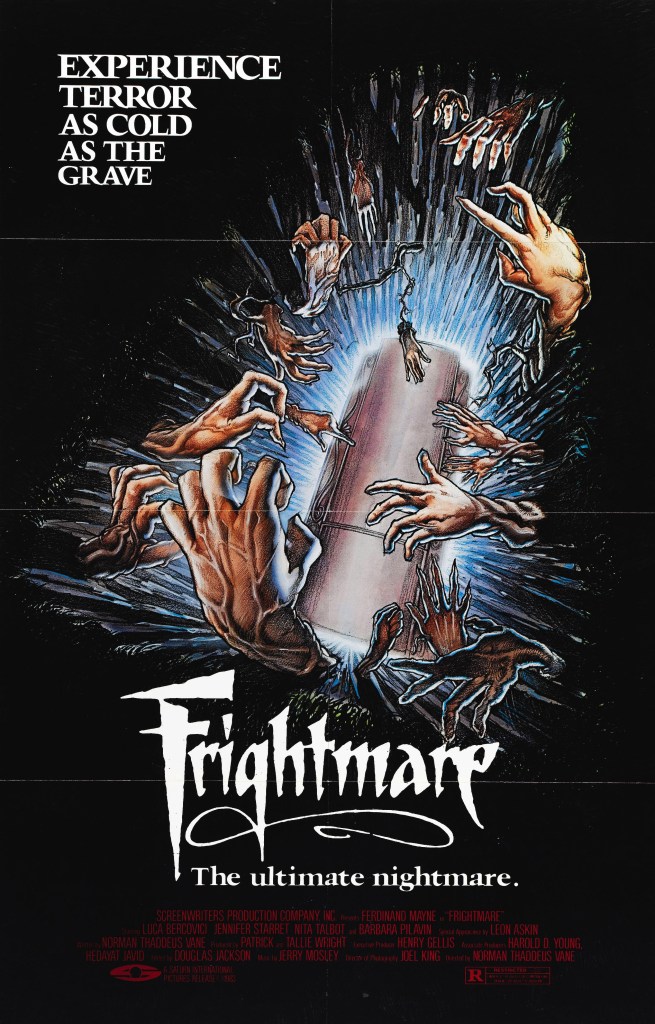
Frightmare (1983)

Directed by Norman Thaddeus Vane [Other horror films: The Black Room (1982), Midnight (1989), You’re So Dead (2007)]

Funny story – I saw this one once before many years back, but upon watching it for the second time, literally all of this seems new to me, which goes to show that I was either distracted when I first watched it or Frightmare is a pretty forgettable film. Truth be told, it’s probably a combination of the two.

The best thing about this one is a decapitation toward the end of the movie. Oh, also a young Jeffrey Combs (Re-Animator and From Beyond) appears. Otherwise, though, Frightmare is pretty much a mess with little going for it.

I can’t say that the atmosphere wasn’t okay at times, but there’s only so much an 80’s aura can do when the story itself suffers, and ultimately it didn’t help much here. It’s the weak story here that was the biggest problem, and boy, does it drag at times.

Also, it’s rather nonsensical. So, I sort of get why fans of a recently-deceased movie star would abduct his corpse, but – no, wait, I don’t get that. This might be unnecessary to say, but stealing the corpse of anyone seems pretty damn disrespectful, and these kids don’t seem interested in honoring the recently-deceased Conrad Radzoff whatsoever.

Once the action starts up, there’s not a whole lot in the way of memorable kills. Like I said, the decapitation is pretty solid, and there was a pyrokinetic kill, but the tongue scene wasn’t near as fun as you’d hope it’d be, and most of the others were just somewhat baffling (especially the way in which Scott Thomson’s death was cut).

Ferdy Mayne did a solid job as playing a hammy, Christopher Lee/Bela Lugosi rip-off, and he’s probably one of the few commendable performances here. Otherwise, we’re stuck with Luca Bercovici, Jennifer Starrett, and Donna McDaniel. Jeffrey Combs was nice to see, no doubt, but he didn’t particularly stand out here, and our eye candy in Carlene Olson is barely memorable at all.

This one may sound like an 80’s flick that might be worth checking out based on plot alone, but that is really not the case, as Frightmare is truthfully pretty forgettable. Obviously, see it for yourself, by all means, but I would really not go into this one expecting an unseen masterpiece.

5.5/10

This is one of the films covered on Fight Evil’s podcast – listen below as Chucky (@ChuckyFE) and I discuss Frightmare.

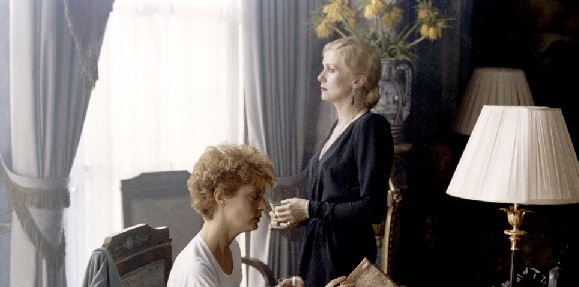
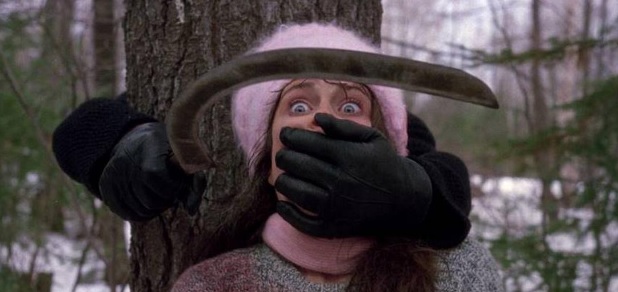
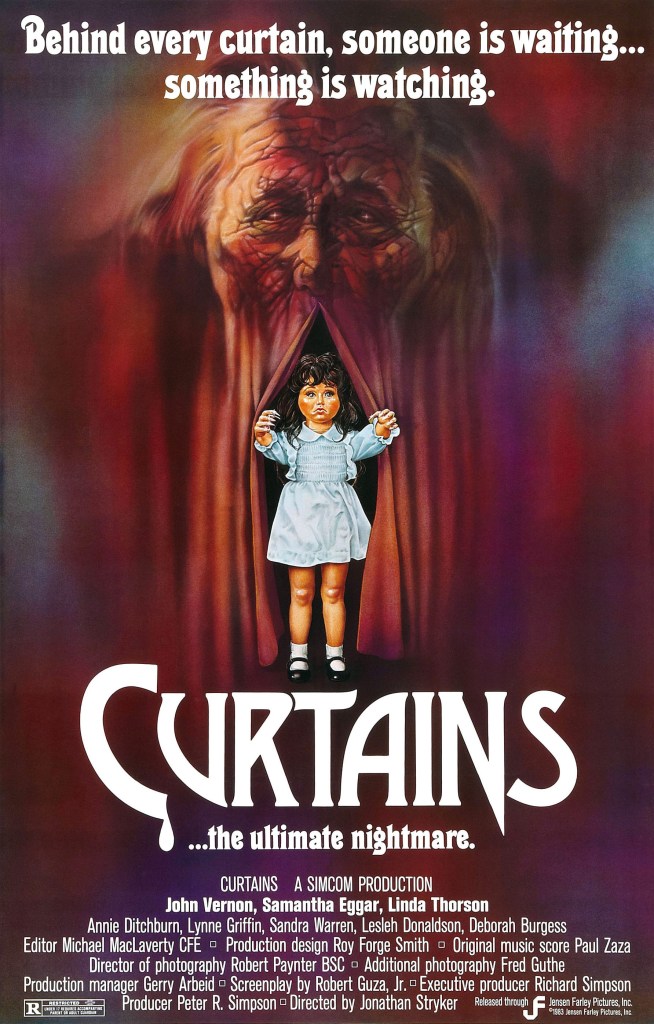
Curtains (1983)

Directed by Richard Ciupka [Other horror films: N/A]

I’ve seen Curtains perhaps three times now, and while I’ve liked it quite a bit in the past, I’m struggling to remember exactly why. There’s some solid scenes here, and there’s occasionally an atmosphere to be envious of, but overall, there are so many better slashers from the 1980’s that this Canadian movie really doesn’t have much a chance to compete.

Only two performances really stood out (John Vernon and Lynne Griffin), perhaps three (Samantha Eggar) if I’m really stretching. Vernon was a bit overbearing at times, but his performance as a strict director was decent. Eggar did pretty well, especially near the beginning during the asylum sequences. It’s Griffin who I really liked, because her ‘hide-my-personality-behind-comedy’ attitude was a lot of fun, and she had one of the better fleshed out characters there.

As far as kills go, there’s not that much that stands out. It’s true that the ice skating sequence is fun and memorable, and there was an okay throat-slitting toward the end, but Curtains isn’t really a movie that’s focused on the kills (partially because the director and producer apparently got into constant arguments about what route the film should take, whether an arthouse thriller or a straight-up slasher).

It’s the finale that I’ve always tended to remember fondly, and I still think it’s pretty solid and certainly bleak. The final scene in the film always stuck with me, and thought it’s okay, I definitely think there could have been ways to perhaps end it a bit better.

Curtains isn’t a great movie, and while that may not be the fault of the script itself, it certainly shows that this Canadian movie could have been more, especially with the setting and characters being what they were. It’s perhaps worth a handful of watches, but like I said, I used to like this one more than I do now, so going in gung ho may be unadvisable.

6.5/10

This is one of the films covered on Fight Evil’s podcast. To listen to Chucky (@ChuckyFE) and I discuss this one, check out the video below.