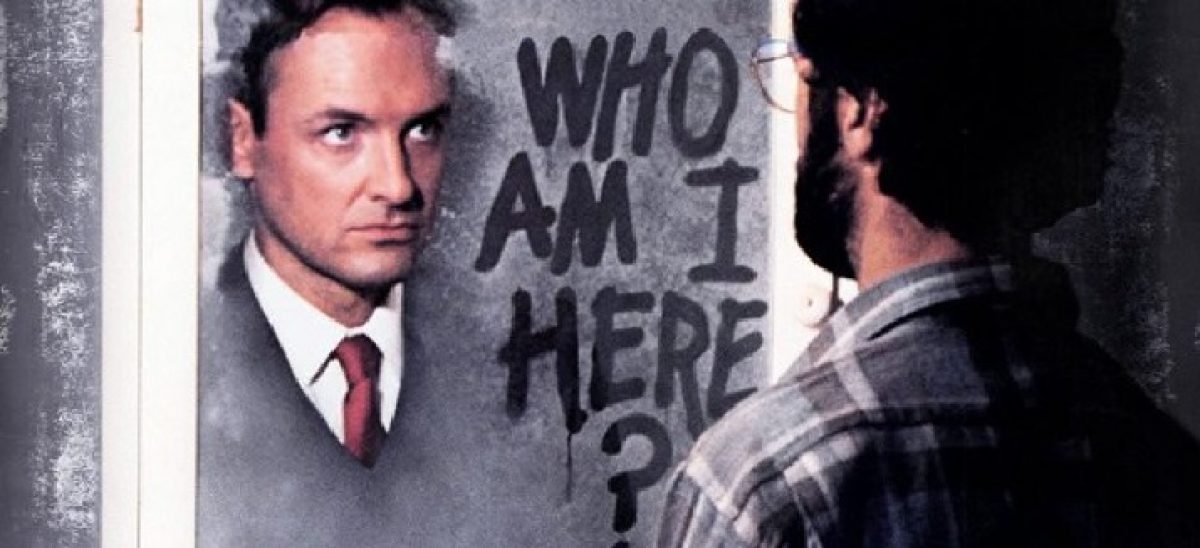
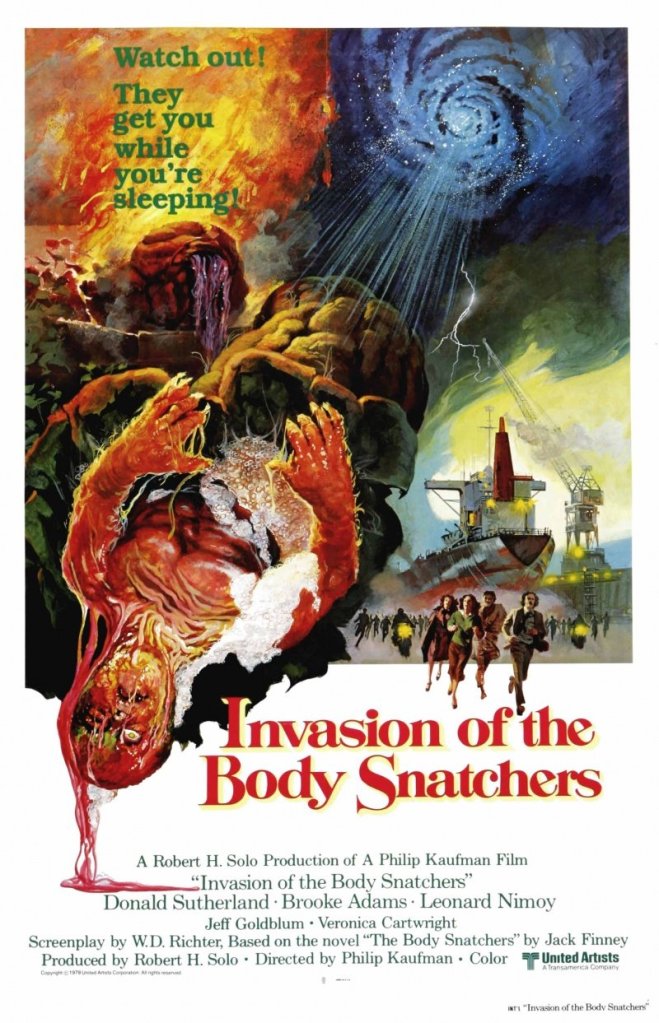
Invasion of the Body Snatchers (1978)

Directed by Philip Kaufman [Other horror films: N/A]

Probably one of the more popular horror films I’ve not seen until now, this adaptation certainly had some strong moments, and is generally a solid movie, though I have to say I still enjoyed the 1956 version of the film more.

Based on a 1955 novel written by Jack Finney, this story follows the 1956 movie’s decently well, the most important change probably being the setting – in the 1956 movie, the setting is Santa Mira (a fictional small town); the setting in this film is San Francisco – and I do think that change is troubling.

For one, I think taking over a city of 691,000 (an estimate based on the populations of San Francisco from 1970 and 1980) would take longer than what we see in the movie. It just makes more sense to me for the action to take place in a small town (ironically, the 1993 Body Snatchers had too small a scope – a military base – so perhaps I’m just being picky).

Honestly, most of the movie is pretty good. Aside from the ending (which, because I’ve spent more than a day online, I knew was coming), though, nothing here really blew me away. Everything is pretty well done – some solid tension, some solid performances, and such – but I just didn’t walk away from this one feeling amazed.

To be fair, it’s probably very difficult for me to decouple myself from the 1956 movie, which is a film I first saw as a kid, and have seen many times since. Much like how I enjoy the 1958’s Blob movie more than I enjoy the 1988 movie, and enjoy the original Fly over the 1986 remake, based off this one viewing, I do prefer the 1956 version, and while that could change with future viewings, I’ll fully admit that I may be too entrenched in my viewpoints.

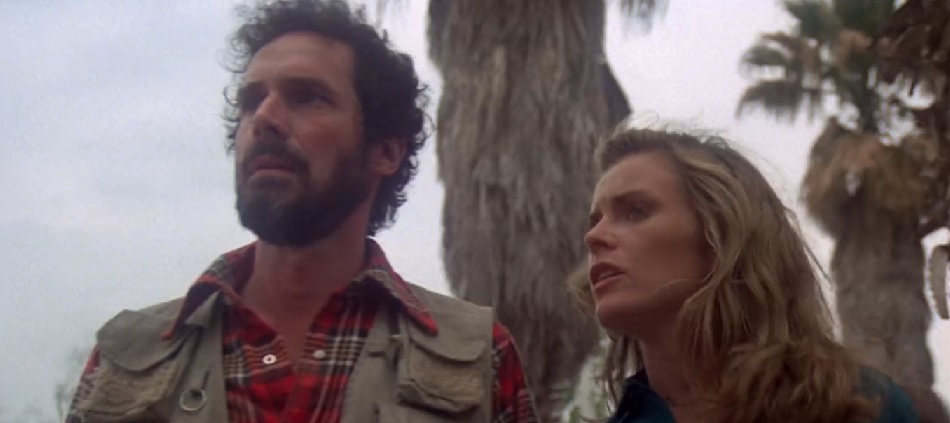
Donald Sutherland (The Puppet Masters, Alone, An American Haunting, Salem’s Lot, Don’t Look Now) was a pretty good lead. Having his character work in the Health Department was a fun choice, and I dug his personality. Honestly, neither Brooke Adams (Shock Waves, Sometimes They Come Back, The Unborn, The Dead Zone) and Veronica Cartwright (The Town That Dreaded Sundown, The Dark Below, Alien) did that much for me. I mean, they weren’t bad, but neither one interested me much.

I did love seeing a young Jeff Goldblum (Mister Frost, The Fly, Hideaway, The Legend of Sleepy Hollow, Jurassic Park) take on a solid role. He doesn’t leave as big an impression as Sutherland does, but still, seeing Goldblum is a lot of fun. Leonard Nimoy (famously Spock on Star Trek) is interesting, but I don’t know if his character adds all that much. However, in a brief scene, we do see Kevin McCarthy (star of the 1956 movie) and later Don Siegel (director of the 1956 movie), so those cameos were nice.

The special effects were quite solid, and at times, quite unnerving. Undeniably, I do think that’s an improvement over the 1956 film, and the end is certainly solid too. I do think I prefer how the 50’s movie ends than I do this one, but I can’t deny that the ending is effective. Like I said, I saw it coming, as I’ve seen the picture of Sutherland’s character pointing before, but it was still a good final sequence.

When it comes down to it, I think Invasion of the Body Snatchers was a good movie, but nothing here, save the finale, did that much for me. It’s a good story, of course – we already knew that from the 1956 movie – and the performances were overall solid, but with just a single viewing, I think I’ll stick with the 50’s movie for now.

7.5/10
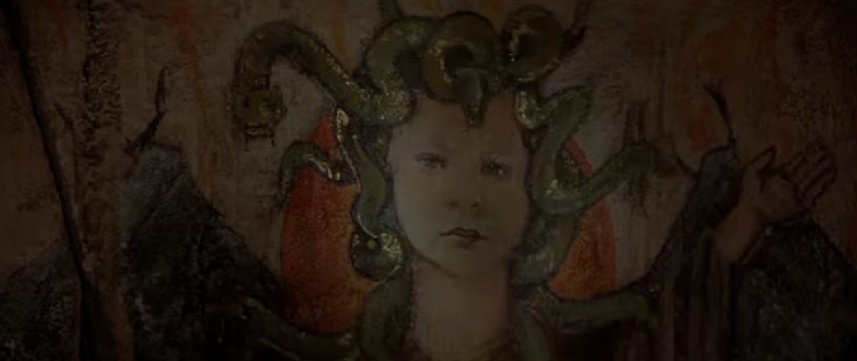
Damien: Omen II (1978)

Directed by Don Taylor [Other horror films: The Island of Dr. Moreau (1977)] & Mike Hodges [Other horror films: The Terminal Man (1974), Black Rainbow (1989)]

Much like the first movie, Damien: Omen II is a film I saw bits and pieces of quite often in my childhood. I can’t swear I sat through the whole thing, and if I did, I doubt I understood some of the subplots, but it’s a movie I always enjoyed, and actually tend to like more than the first movie.

A large part of that is because of the pacing. The first movie was a bit slow at times, which is amazing, as this movie, at an hour and 47 minutes, is only a little shorter than the first movie’s hour and 51 minute run-time, and yet, this one just seems to move quicker. There’s also the fact Damien is 12 years old, and has a decent amount more agency than he did in the first movie, including control of his awesome abilities.

I also love a lot of the deaths in this movie. I don’t think any match the glass plate decapitation in the first film, but there’s a lot of memorable sequences here. I think the most striking may be the elevator scene, in which someone’s body gets severed in half. A woman gets her eyes slashed at by a raven, and blindly runs into the road, getting hit by a semi. Some people drown in falling sand – an opening scene which I’ve never forgotten. And though not at all gory, someone gets impaled by a train. Even the guy drowning beneath the ice was A+ material. Plenty of quality scenes in this one.

Performances are solid too. Even smaller roles, such as those by Elizabeth Shepherd (The Tomb of Ligeia), Sylvia Sidney (God Told Me To, Death at Love House, Snowbeast, Beetlejuice), Meshach Taylor (Hyenas), Leo McKern (X the Unknown, along with being the only returning face from the first movie), Lew Ayres (She Waits, Donovan’s Brain, Salem’s Lot), and Nicholas Pryor (Brain Dead), all did reasonably well, and though some didn’t have much time to make an impression, I think most were able to do so.

At times, Jonathan Scott-Taylor seemed a little melodramatic as Damien, and Lucas Donat occasionally had the same problem, but for younger actors, I thought they worked well together. Lance Henriksen (Mansion of the Doomed, In the Spider’s Web, The Invitation, The Pit and the Pendulum, The Mangler 2) wasn’t really in the spotlight, but he was quality when he popped up. Robert Foxworth (It Happened at Lakewood Manor, Prophecy, Deathmoon, The Devil’s Daughter) had a good, dark aura to him.

William Holden made for an engaging character, and I could buy him as Gregory Peck’s brother. Especially toward the end, as he was learning more and more about Damien’s backstory, he really had time to shine. Likewise, while Lee Grant (The Spell, Visiting Hours) doesn’t make much of an impression until the finale, she really does make an impression come the finale, and even has a somewhat surprising story arc.

Again, I really liked the performances in this movie. It’s a fun story with plenty of interesting deaths and a solid finale, all with quality performances and moving at a quick pace. Admittedly, I’m probably one of the few who enjoys it more than the first movie, but I do, and though I don’t think it’s a significantly better film, it is one that I’ll never have a problem revisiting.

8/10

Piranha (1978)

Directed by Joe Dante [Other horror films: The Howling (1981), Twilight Zone: The Movie (1983, segment ‘It’s a Good Life’), Gremlins (1984), The ‘Burbs (1989), Gremlins 2: The New Batch (1990), Trapped Ashes (2006, segment ‘Wraparound’), The Hole (2009), Burying the Ex (2014), Nightmare Cinema (2018, segment ‘Mirari’)]

Sometimes considered one of the better Jaws rip-offs, Piranha is a decently fun movie. It feels at times sluggish, and at times repetitive, but even with those mild drawbacks, there’s no doubt to me it’s an entertaining film with some good political messaging.

If anything, this film is further points out that we never should have gone to Vietnam. It was one of the biggest foreign policy atrocities in the history of the USA, and given the USA’s history, that’s certainly impressive. On August 4th, 1964, the USA claimed that North Vietnam attacked some US ships. It never happened, and led to a pointless war that killed millions of Vietnamese innocents, not to mention innocents from our own country, and why? Because communism was so scary to the USA that they had to attack those who preferred that system.

Wait, what? That might sound like a tangent, but it’s not. The fish in this film were made specifically to be dumped into North Vietnamese rivers in order to kill innocents and end a war the USA themselves started, and they wanted to kill these innocents (as they do to this day) all in the name of “defense.” Oh, and “the American way,” because the American way is to kill innocents, as both Republicans and Democrats have shown for the last hundred years.

To make my personal politics clear, I’m a socialist. I vote third party, and generally encourage others to look into doing the same. Most of the time, though, my politics don’t matter when it comes to horror. I might mention them every now and again, but horror films are generally about escapism, and Piranha is no doubt a largely fun movie.

But when you consider the origins of the fish to begin with, which sounds entirely inline with something the USA might do, it’s hard to laugh, especially as this abomination of a country has killed so many innocents abroad, and continue to do so to this day (our support of Israel, for instance, is disgusting).

This isn’t entirely about my politics, though – let’s talk some Piranha. Solid political messages aside, this film does take a little bit to get going. Things do pick up nicely around the halfway point, to be sure, but when they do, and the piranha begin attacking people in the lake, I can’t say it doesn’t feel a tiny bit repetitive. It’s all still fun, but even so, repetitive.

There are some great scenes – the raft scene early on is probably one of the more suspenseful raft scenes in horror (up there with The Burning and Creepshow 2), and it was well-done. Both the attack on the summer camp, as well as the water park, were great, and though we never really got too much in the way of gore, there was blood here and there, and you could see there were a hell of a lot of injuries from both attacks.

Bradford Dillman (Moon of the Wolf, The Mephisto Waltz, Fear No Evil) and Heather Menzies (Sssssss) make pretty solid leads. They’re entirely different people, but before long, they work together pretty well. Barbara Steele (Lo spettro, Nightmare Castle, Black Sunday) and Bruce Gordon make for good antagonists, and of course, you also get some appearances from familiar faces, such as Dick Miller (Gremlins, A Bucket of Blood), Belinda Balaski (The Howling), and Paul Bartel (Eating Raoul), all of whom add a little something.

Even with the fine performances and generally decent story, I can’t say Piranha has ever been a true favorite of mine. It’s a well-made movie, and things come the conclusion are pretty solid, but when it comes to the late 70’s, there’s so many other films I’d rather spend time with (Halloween, Phantasm, Alien, Orca, The Swarm, and Damien: Omen II all come immediately to mind).

Piranha is still a decent movie. It may even be a little above average, but it’s close. It’s a fun film, but being fun isn’t all a movie needs (at least in this case), and though it’s a film I definitely recommend, it’s not one I go back to all that often.

7/10

Coma (1978)

Directed by Michael Crichton [Other horror films: N/A]

For as long as I’ve known about this film, IMDb has labeled it as a ‘horror’ film (other genres are drama and mystery); of course, today, that label is now missing. It’s a mystery and drama, no doubt, but while there are horror elements, going as far as to call the whole of the film horror is a bit of a stretch, even for someone with as liberal a definition of horror as I do.

I’ll count it though – there’s a sequence, decently suspenseful, too, where a killer is chasing someone (though to be fair, it’s more an assassination attempt than a slasher, but hey, someone’s getting killed, so that counts?), but to be fair, this is much more of a medical-focused mystery dealing with a wide-ranging conspiracy. If people want to label this horror, who am I to complain?

And since it is considered horror by some, it becomes one of the two horror films with Michael Douglas (the other being an early 1970’s TV movie titled When Michael Calls). A few years before this, he was in the cop crime show The Streets of San Francisco, and this may be one of his first bigger films, so that’s somewhat fun. His character is mixed – it’s the typical “I don’t believe in any conspiracy despite the proof, you’re paranoid” type, but his character grows later on.

The main character, though, is played by Geneviève Bujold (would reminded me amazingly of Famke Janssen throughout the film), and she did a great job playing a woman simply trying to get at the truth despite the obstacles in front of her. Rip Torn (A Stranger Is Watching and Dolly Dearest) and Richard Widmark (Blackout and To the Devil a Daughter) were both decent playing the old-fashioned, somewhat chauvinistic doctors of the past.

There are some solid scenes in this film, and also some quite striking scenes (such as the first time we set eyes upon the seemingly-empty Jefferson Institute), but I suspect a lot of people might not find quite the horror they were hoping for. There were some small drops here and there, which is why I personally can see it as such, but if someone saw purely a conspiracy movie, I couldn’t blame them.

Whether or not this is horror doesn’t matter, though, as the movie’s still good. It has plenty of thrilling scenes (when Bujold is climbing the ladder, for instance, or when Douglas is trying to save someone’s life at the end), and it’s a movie that’s recommended. And if it sweetens the deal any, it’s based off a novel written by Robin Cook, and the film’s directed by Michael Crichton.

7.5/10

Magic (1978)

Directed by Richard Attenborough [Other horror films: N/A]

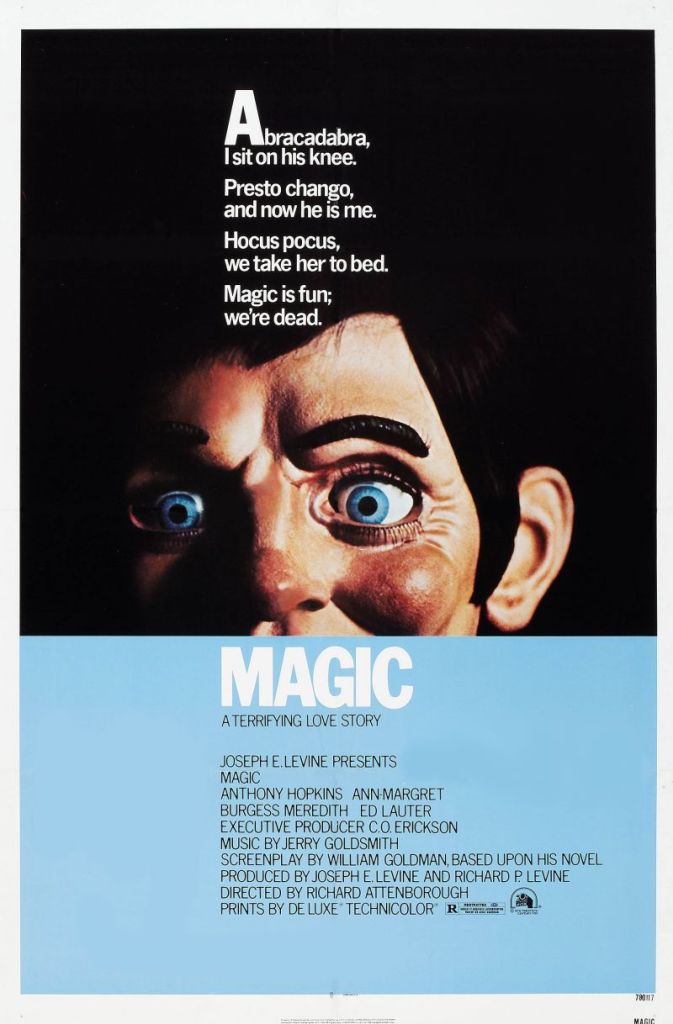
Certainly a well-known film, and for good reason, Magic is a fantastic psychological horror film with some solid actors, a good story, and great tense scenes.

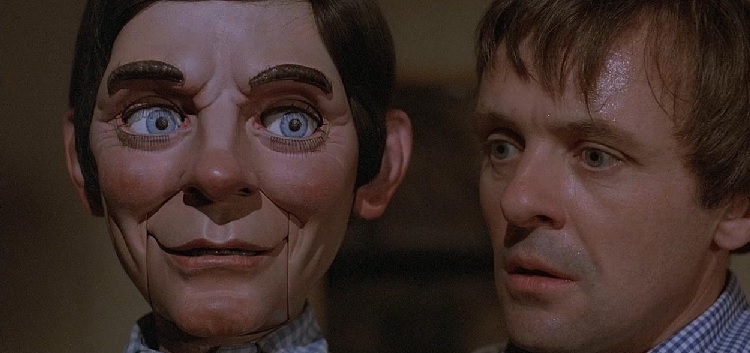
Obviously, Anthony Hopkins here is just amazing. When it comes to high-caliber actors, he’s not really at the top of my list (though I’ve loved him in plenty of movies, from the action-adventure The Edge to the court-based thriller Fracture), but he does fantastic here, and his tense character is both uncomfortable to watch yet almost impossible to look away from. Burgess Meredith (here two years following a small appearance in Burnt Offerings) is great too, in his chummy agent way.

The scene the two share in which Meredith’s character confronts Hopkins’ about his mental problems is pretty fantastic from beginning to end, and within possesses one of the tensest scenes in the film, where Meredith challenges Hopkins’ to shut up the dummy, Fats, for five minutes. We pretty much know he’s going to break at some point, but even so, it’s a great scene, and Meredith looks like his heart breaks when he sees just how far gone Hopkins is.

Ann-Margret is good here too, of course, and I’ll even give some kudos to Ed Lauter, but really, Burgess Meredith and especially Anthony Hopkins steal the show.

Because the film is based more around the mental decline of a character than anything else, there’s not a whole lot of gore here, but the few murders we get are all decently solid (though I don’t think any of them are really all that memorable, as little as that really means). Certainly the highlight of the film works out great, and even the conclusion is oddly emotional given the situation.

I don’t think that Magic will ever top my list of the 1970’s, because there were so many fantastic and enjoyable films from the decade, but this is definitely a film that’s worth seeing, especially if you want a little something different in your horror, and more so, if you’re a fan of Hopkins.

8/10

This is one of the films covered by Fight Evil’s podcast. Listen below as Chucky (@ChuckyFE) and I find the magic in Magic, brahs.

The Toolbox Murders (1978)

Directed by Dennis Donnelly [Other horror films: N/A]

Certainly a movie that’s steeped in the 1970’s, The Toolbox Murders has a pretty fun idea and I think it does an okay job with it, but it’s possibly not the type of movie that people might be expecting.

At first, much of the film follows a standard slasher route, what with a  killer dispatching multiple women in bloody ways. The killer’s wearing a ski mask, and it almost seems a mystery as to who he is. But The Toolbox Murders isn’t that type of movie, and before long, we find out who the killer is and why they do the killing, with the rest of the film being a brother investigating the disappearance of his sister.

That might not sound like a great tonal shift, but honestly, I think it works out fine. We got some pretty solid kills in the first thirty minutes or so, so when it switched over to a girl being held captive by the killer, it felt natural enough. The killer was certainly pretty well-acted, and his religious mania was nicely laid out (in fact, he has a five minute dialogue – just him rambling on – which really shows where his mind’s at).

Not all of the acting is that great, though. I thought that Nicolas Beauvy and Wesley Eure were reasonable, and Eure added something a bit unique toward the end of the film, but neither were going to win awards over this. Cameron Mitchell (who starred in many horror films, such as Blood and Black Lace, Haunts, and The Demon) was pretty solid throughout, of course, but playing the abducted woman, Pamelyn Ferdin didn’t really feel alive until the finale.

The finale itself was interesting, though, with a few story shifts added in. I wouldn’t call any of them terribly shocking, but it did give the movie a bit of a jolt following twenty or so minutes of somewhat dry drama. Certainly, being this is a 70’s film, everything here is played straight, even the sillier stuff in the end that maybe shouldn’t haven been, but you have to appreciate the decade for sticking to it’s guns.

One notable thing I really liked here was the music, much of it of the country vein, but still pretty good. “Pretty Lady”, a duet sung by George Deaton and an unidentified woman, worked beautifully during a scene in which a woman was about to be killed off. It lent the film something special, especially given how cheap much of the movie feels anyway.

I know that some people out there find The Toolbox Murders a classic, and though I wouldn’t go that far, I do think it’s a pretty good movie, and it stands up about as well as it did the first time I saw it years back. Some quality gore, an interesting conclusion (and in fact, that lengthy, final shot of someone walking was actually quite moving in a way, believe it or not), nice music – I’m definitely a fan.

7.5/10

This is one of the films covered by Fight Evil’s podcast. Listen below as Chucky (@ChuckyFE) and I discuss The Toolbox Murders.

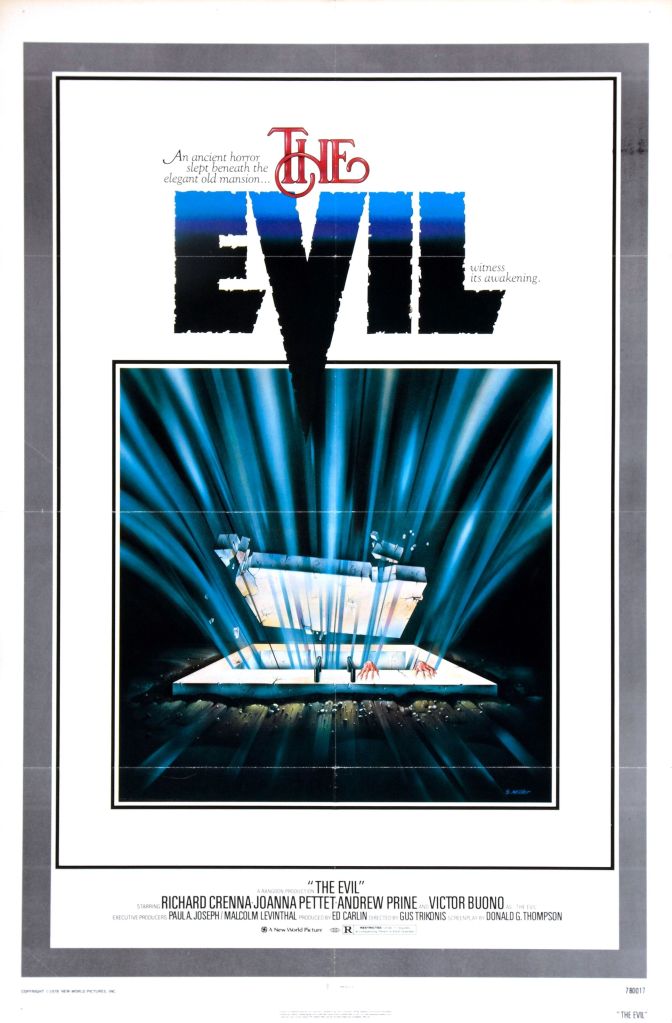
The Evil (1978)

Directed by Gus Trikonis [Other horror films: The Darker Side of Terror (1979), She’s Dressed to Kill (1979), Dance of the Dwarfs (1983)]

I’ve seen The Evil once before, but to be entirely honest, it’s been so long that almost all of this seemed new to me. There was only a single scene I even marginally remembered, which was perhaps one of the better scenes in the film, but otherwise, I don’t think The Evil really turned out that great a movie.

The main problem here was that the film was rather dry and none too exciting. I liked the idea behind the plot (as generic as haunted houses tend to be), but when the excitement starts up, very little of it really makes that much of an impact on me. I think that without the saw blade scene and the finale, this would be a lot more forgettable, but even with those two sequences representing, there’s not a whole lot going here.

Victor Buono makes a small appearance toward the end, and I sort of liked him here, but given the short amount of time we spend with him, he can’t lift the whole of the film up. Richard Crenna (who also starred in the similarly dry Death Ship) reminded me of John Ritter throughout the movie, which was nice, but otherwise, I didn’t find him that engaging a main character. Both Joanna Pettet and Mary Louise Weller stood out decently, Pettet playing a strong female lead, and Weller being the eye candy (especially in that red shirt).

Otherwise, there’s a bunch of people here who make virtually no impression, and we don’t really get to learn that much about any of these people. If you can keep their names straight, more power to you, but as most of them die throughout the film (and the exact people you expect to survive do so), I don’t know if that really accomplishes much.

I wish I remembered my feelings toward this one when I first saw it. Personally, I’d guess that I probably found it worse this time around, as the story and setting (a creepy, rather large mansion) do possess a small amount of charm, but I was pretty bored during this one. The Evil had potential, and I think that the film could have been good, but this final product is very much a lackluster one, no matter how fun Buono or the saw blade scenes are.

5.5/10

This is one of the films covered on the Fight Evil podcast. If you want to hear Chucky (@ChuckyFE) and I discuss this one, look no further:

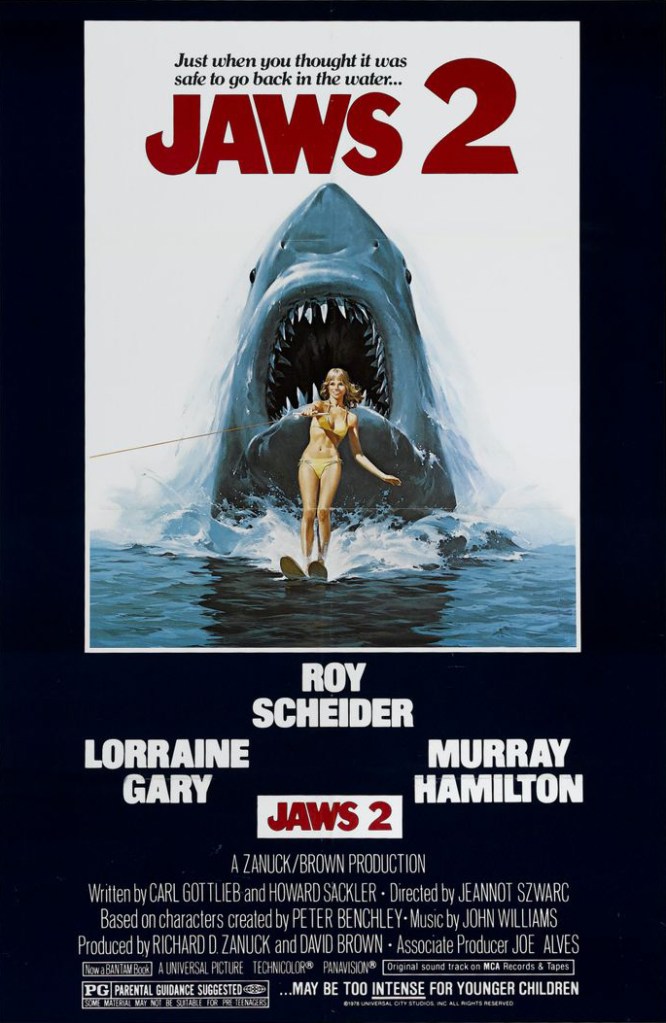
Jaws 2 (1978)

Directed by Jeannot Szwarc [Other horror films: The Devil’s Daughter (1973), Bug (1975), The Murders in the Rue Morgue (1986)]

GODDAMN, SON, THAT’S HOW YOU KILL A FUCKING SHARK!

Personally, I enjoyed this film a lot more than the first Jaws, and I’m not entirely sure why. Whereas the first often felt dry and almost procedural, Jaws 2 generally feels a lot more soulful and tense. This isn’t to say the second half of the first film wasn’t great, but Jaws 2 was fun all-around fun, and the drama was top-notch.

One of the best scenes in the film has to be when Roy Scheider’s character comes home drunk after getting fired as police chief. He’s drunkenly telling jokes and making toasts while his wife and second-in-command have some of the saddest eyes I’ve ever seen. That scene really blew me away with how touching it was, and while there was nary a fin in sight, this was the highlight of the film.

There’s solid shark frenzies, though, especially that first one with the sailing teenagers. Talk about carnage and utter tension. Even when things wind down, the scene of the kids trying to help out the young boy (in-movie, Schieder’s youngest), was rather touching.

And that ending? Read the first line of the review again to see my enthusiasm toward the fantastic finale.

Roy Scheider’s pretty much the only performance that matters here, and he does a great job. From the breakdown on the beach to that city council scene, Scheider did just amazing here, and you really felt for his character. I know I did, especially after he was fired. And while he’s not there a whole lot, Murray Hamilton, who also appeared in the first movie, was nice to see again, though his character, that of the mayor, was pretty atrocious.

Jaws 2 hit the spots in a way the first movie was unable to, and I really got a kick out of this one. Pretty much a fun ride from beginning to end, this is a sequel that did it right.

8.5/10

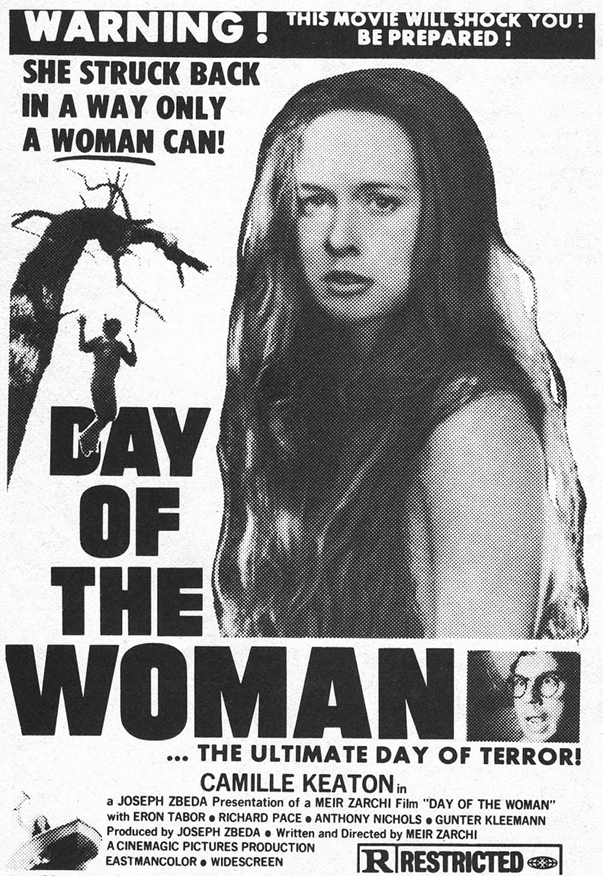
Day of the Woman (1978)

Directed by Meir Zarchi [Other horror films: Don’t Mess with My Sister! (1985), I Spit on Your Grave: Deja Vu (2019)]

This classic in the rape-and-revenge subgenre of exploitation film, generally known under the far-better title I Spit on Your Grave, is oftentimes a difficult movie to watch. Due to the fact it’s a 70’s film, it has that dead serious, gritty vibe that you would expect, making I Spit on Your Grave an awfully grueling viewing experience at times.

While the rape sequences were a bit much (and probably more disturbing than Last House on the Left from six years earlier), the revenge sequences were a lot of fun (and very well-deserved – if you don’t think those men deserved the painful deaths they got, I’d really question your sense of right-and-wrong), the best being a castration. A strong argument could be made that Richard Pace’s mentally-disabled character should have gotten some mercy, but there you go. Definitely gory when it needs to be, more often than not, I Spit on Your Grave just sticks with a bit of build-up and a quick blow, especially near the end.

Camille Keaton does well as a messed up victim of rape, and there was no point in the film in which I didn’t sympathize with her. The four rapists were all well-played too, and while Richard Pace’s Matthew was somewhat hard to hate, the other three (Eron Tabor, Anthony Nichols, and Gunter Kleeman) were as despicable as you can imagine. The only shame is that their deaths weren’t longer. Worth noting, none of the four male actors have been in any other film, before or after, which I found interesting.

The film can be quite tedious. After the first horrific rape, Keaton’s character is raped twice more, and it’s only after she begins to get her revenge that I really feel comfortable watching the film, as it goes more into a proto-slasher feel. Otherwise, the rape sequences were, understandably, deeply unpleasant, and possessed a very desperate, degrading quality to them.

Personally, though I’ve seen this film twice now, I think that I Spit on Your Grave is a hard movie to love. I certainly find the revenge satisfactory, but that doesn’t happen until about an hour in, and dealing with the rape sequences is a bit much. I still find the last forty minutes enjoyable, but it’s a grind getting through the first hour. Probably a movie worth watching, but while it’s certainly good at times, it’s not one that I’d watch multiple times for enjoyment.

7/10

This is one of the films covered on Fight Evil’s podcast, and what coverage it was. If interested, check out below as Chucky (@ChuckyFE) and I discuss and laugh inappropriately at this film.

Mardi Gras Massacre (1978)

Directed by Jack Weis [Other horror films: Crypt of Dark Secrets (1976)]

This is a movie that I’ve long wanted to see, and for the longest time, I’ve pretty much known it wasn’t going to be that great, which is certainly accurate after finally having seen it.

In many ways, I was reminded of the classic H.G. Lewis flick Blood Feast from 1963, from a sacrificial killer to decent gore, only it wasn’t near as engaging (Blood Feast, on a side-note, isn’t really an amazing movie, but in many ways, it blows this out of the water). The main problem was that this was so repetitive, almost to the point of parody.

Step one, the killer enters a bar and asks for someone evil. Step two, the evil woman accompanies him back to his apartment. Step three, the killer offers some wine. Step four, they go to a room where oil is rubbed on the evil woman’s nude body before she’s tied up and stabbed through the hand, sliced on the sole of her foot, and lastly, slit from her gut upward. This happened three times in the movie with minimal variation. The first time was fine, and the gore is decently gruesome (or it tries), but God, is it as dull as it sounds? Is it ever.

It doesn’t help that the main protagonist of Mardi Gras Massacre is a woman-hitting cop (which isn’t surprising, as a rather high amount of cops beat their spouses) with the sympathy level of a KKK Grand Wizard, played by Curt Dawson. None of his investigation was particularly interesting or noteworthy, and when he slaps his girlfriend (Gwen Arment) twice, I hoped for a painful death that he never got. Instead, the girl apologized to him and they got back together. Fantastic character arc – love it. The killer, played by William Metzo, did the best of everyone, and possessed a certain charm, so if you see this one for any reason, do it for Metzo.

Also worth noting, I’m not opposed to disco. I love me some Bee Gees, Tavares, KC and the Sunshine Band, and a handful of others, but when your whole soundtrack is composed of generally generic disco, I’m going to have a problem, which I did. It was sort of funny, but boy, just like the repetitive nature of the plot, the soundtrack got really old.

With a title like Mardi Gras Massacre, I personally think people would expect a movie more wild and fun, but this is neither. It’s not a great film whatsoever, and it’s pretty close to being too dull to classify as a ‘so-bad-it’s-good’ film. The best I can say is that the gore is decent, but even that can’t make up for the unlikable characters or the dull nature of the film.

4.5/10

This was discussed on Fight Evil’s podcast. Listen to Chucky (@ChuckyFE) and I discuss this below.