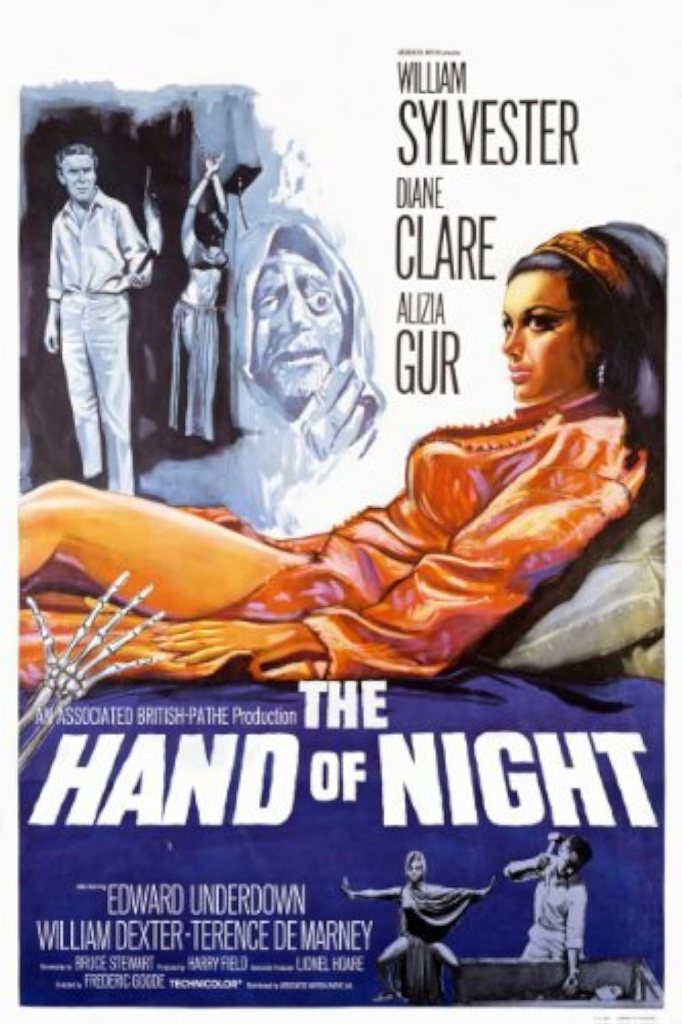
The Hand of Night (1968)

Directed by Frederic Goode [Other horror films: N/A]

I have to admit that I didn’t expect to care much for this one, but came out pleasantly surprised. While it’s not a great film, and perhaps ultimately just around average, I do think The Hand of Night is a decent little piece of forgotten cinema.

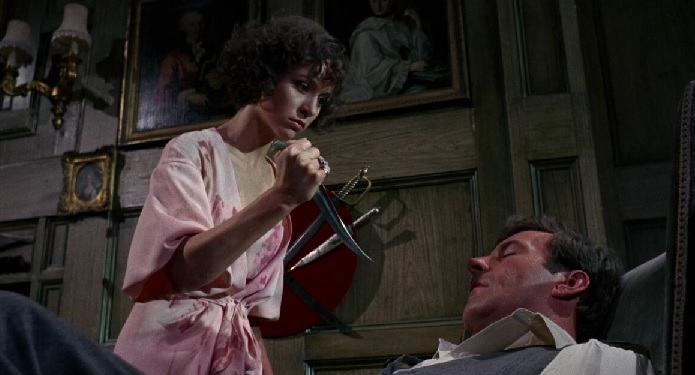
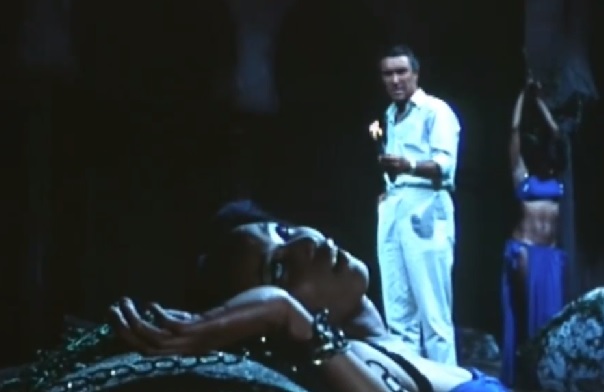
Taking place and filmed in Morocco (a county I know extraordinarily little about), The Hand of Night (or, alternatively, Beast of Morocco) follows a depressed man (William Sylvester) as he becomes enchanted by encounters of a mysterious woman (Aliza Gur) who is potentially a vampire, albeit not in the stereotypical sense. It’s a story that sounds simple, and I guess it is, but they approach it with good style.

The opening is particularly striking, and almost psychotronic, showing a bunch of random images that have no context (naturally, as the movie goes on, we learn more about what we see). I have to also add that I’m a big fan of the dialogue in this movie – plenty of the lines seemed snappy to me, like something I’d expect from films back in the 1930’s or 1940’s, giving this film sort of a classy feel.

Something also has to be said for the editing. The special effects here generally aren’t relevant (though there was a pretty cool bit near the end), but the shots and editing used did strike me as quite nice. This movie definitely had some production value behind it, and while some could argue that the movie isn’t exactly the most memorable film out there, it does seem a shame to me that many don’t seem to know this one at all.

As it is, I do think it lost a bit of steam near the finale. The last sequence I really enjoyed was Sylvester and Diane Clare’s characters running into William Dexter’s in a type of bazaar. Well, I guess that technically leads into another solid sequence, dealing with the history of the mysterious woman, but even so, the last ten minutes or so, sadly, feel the most pedestrian of the entire movie.

William Sylvester (Devils of Darkness, Devil Doll) was great here, as he had some emotional material to deal with, and he did so with heart. Diane Clare (The Haunting, The Plague of the Zombies, Witchcraft), in her final acting role, was solid too, and worked well with Sylvester. Edward Underdown had a lot of heart, and though he only had one scene of real import, William Dexter cracked me up in most of the scenes he appeared in. Technically, Aliza Gur is also here, but I honestly don’t think the story gave her enough to do to properly stand out.

It’s a real shame that the finale has such a familiar feel, because the rest of the movie, while not great, was generally engrossing. To be fair, The Hand of Night isn’t a movie that I’m likely to watch again soon, or even in the next ten years, but it was a very competent and surprisingly philosophical film at times, with some good dialogue and an interesting enough story.

Most horror fans might take a pass at this one, and I don’t even know how easy it is to find (I watched it from a shady Russian site, myself), but fans of classic horror, 60’s British horror, or Morocco, may find this one to be of interest.

7/10

Kyuketsuki Gokemidoro (1968)

Directed by Hajime Satô [Other horror films: Kaidan semushi otoko (1965), Kaitei daisensô (1966)]

Commonly known under the catchy title Goke, Body Snatcher from Hell, this Japanese film is a vibrant and occasionally interesting movie. It has solid anti-wars themes, and a fantastic ending, but it’s also not the most engaging film out there.

I’ve seen this one twice now, and I guess one of my main issues with the film isn’t even entirely with the film itself. The production company, Shochiku, have certainly made worse films (X from Outer Space) and less coherent films (The Living Skeleton), so this one is certainly a palatable movie. Comparing it to other Japanese movies from the time, though, such as Matango from just five years earlier, and even The H-Man from ten years earlier, and it just doesn’t hold up.

No doubt the story has some strong elements, but I don’t think one of them is the space vampire. The special effects around the silvery slime using human beings as hosts is great, and the way to get into the body (via a vertical slit in the forehead) is classy, but that was really the least interesting portion of the film.

More so, the movie’s about what people will do when placed in an exceptionally stressful situation. To be sure, it was stressful before the alien – people on an airplane have to deal with both a hostage takeover and an unrelated bomb threat (talk about getting on the wrong flight), and that was all during the ten minute cold open before we even get the movie’s title. And so we have this group of people from different walks of life trying to survive from threats on multiple sides.

Of course, some of these individuals are more antagonistic, such as the hijacker (Hideo Kô) and this asshole of a politician (Eizô Kitamura), and others are more the generic hero, such as co-pilot (Teruo Yoshida). Others are the flies in the ointment, such as the psychiatrist (Kazuo Katô) who is more interested in seeing how people react to the situation than anything else.

Performances all around are pretty decent. Like I said, Teruo Yoshida tends to be a bit on the generic side, but there’s others, such as Kazuo Katô, Hideo Kô, Masaya Takahashi, Nobuo Kaneko, and Kathy Horan who bring plenty of flavor to the film.

What’s more striking is the somewhat heavy-handed anti-war message the film carries. There’s an American woman who is going to pick up her dead husband from Vietnam, and she does occasionally get emotional about the stupidity of war. Another suggests that because of mankind’s tendencies to fight unnecessary wars, it’ll attract the attention of alien lifeforms, making us an easier target (reminding me of the Nine Inch Nails song ‘The Warning’, which is a banger).

At the same time, I like to think that most people would be against war. I mean, obviously not those who support capitalism – capitalism without war is untenable – but most people, I think, wouldn’t have a problem saying that war is a negative thing, and if it can be avoided, it should be. I suspect few knew that better than Japan, as they were still recovering from the devastation the USA caused their country with the atomic bombs in Nagasaki and Hiroshima.

I also want to add that, without giving anything away, I loved the hell out of the conclusion. I’ve seen this before, as I said, but I honestly didn’t remember much in the way of details, and so the finale here really hit the right spot in about three different ways (none of which I can fairly expand on). It was the finale that kept on giving, and the final shots were A+.

Goke, Body Snatcher from Hell is a nice-looking movie. The color schemes, especially during the opening (an airplane flying in a blood-red sky is rather striking). It’s just that, funnily, the so-called “Body Snatcher from Hell” is the least-interesting portion of the film, and while there’s enough here to keep things going at an okay pace, and the message is a solid one, when I think of other Japanese horror films, it’s just not quite as good or as memorable.

7/10

Curse of the Crimson Altar (1968)

Directed by Vernon Sewell [Other horror films: Ghost Ship (1952), House of Mystery (1961), The Blood Beast Terror (1968), Burke & Hare (1972)]

One of the many cult-themed horror films from the late 1960’s, Curse of the Crimson Altar is an okay film with a decent amount of classic faces involved.

The story is about what one might expect, following a man (Mark Eden) attempting to locate his missing brother, tracking him to Craxted Lodge in the small village of Greymarsh. It’s a classy set-up, and the mystery, though perhaps not surprising, is pretty solid. I probably could have done without some of the more trippy elements (such as the silly looking Satanic stuff that pops up a few times – luckily it’s nowhere near as ridiculous or constant as The Witches), but overall, the story is quite crisp.

What makes it crispier are the recognizable individuals involved. While I could take or leave Barbara Steele (Castle of Blood, Nightmare Castle, Terror-Creatures from the Grave, and The Pit and the Pendulum), you have some great performances from Christopher Lee (The Wicker Man), Michael Gough (Trog), and one of the last roles of Boris Karloff (The Walking Dead). Mark Eden did well as the lead, and Virginia Wetherell provided some somewhat surprising nudity, so that can’t be bad.

There are perhaps times when I think the film was running a bit long, as the pace is occasionally slow, but for the most part, Curse of the Crimson Altar had a good head on it’s shoulders, and given it’s a Tigon movie (The Beast in the Cellar and Witchfinder General), that might not be a surprise.

I definitely enjoyed this a bit more than I sort of thought I would going in. That said, it’s far from great. I don’t think it’s a bad piece of Satanic flavor, but it’s likely just below average.

6.5/10

Yabu no naka no kuroneko (1968)

Directed by Kaneto Shindô [Other horror films: Onibaba (1964)]

Largely known as The Black Cat, Yabu no naka no kuroneko started off a decent movie, but I have to say that, after thirty minutes or so, I thought it began to drag, and it never really fully picked up steam again.

The film has a beautiful setting, taking place near a bamboo forest, and it looks quite stunning in black and white (which actually, on a side-note, surprised me, as many Japanese movies I’ve seen from the late 1960’s, and even before, have been in color), and the story has some emotional resonance to it also, to be sure.

For the first thirty minutes, showcasing the two women who are raped and killed, and then coming back as vengeful spirits to get revenge on all samurai, the movie was pretty solid. I thought they were going through their revenge pretty quickly, but that’s because their focus wasn’t there yet (a newly-appointed samurai who they both knew in their previous life), so that’s fine.

And the story that follows isn’t too bad, either, and like I said, even carried with it some emotional scenes, not to mention suspenseful scenes, such as the precursor to the final battle. I just personally found much of it boring beyond belief.

Kichiemon Nakamura was solid as the peasant farmer who, due to valor in battle, moved up to become a samurai. He was a good character, through-and-through, and him finding out that, after three years of being away from home due to his forced conscription, his house had burned down and family missing, was effective and saddening. I just wish I could say that either Nobuko Otowa (Onibaba) or Kiwako Taichi could have made more an emotional impact past the opening scene, but at least Kei Satô provided a little amusement.

Certainly this film had some moments that should have been a bit more of a tug on the heart, but they just didn’t hit me that way. Even toward the end, when Nakamura’s character figures out how to destroy the spirit of his mother, I just wasn’t getting that depressing vibe that you’d sort of expect out of the situation.

Regardless of that, though, the fact that I found the film boring is probably what’s most damning. Others may not see the film that way (many others, given the high rating this sports on IMDb), but I definitely did, and really, given the story rarely got me invested, I’ll have to admit to being disappointed with this Japanese film; it’s no doubt solid and moody at times, but I was just more bored than anything else.

5.5/10

The Devil Rides Out (1968)

Directed by Terence Fisher [Other horror films: Three’s Company (1953, episodes ‘The Surgeon’ & ‘ Take a Number’), The Curse of Frankenstein (1957), Dracula (1958), The Revenge of Frankenstein (1958), The Hound of the Baskervilles (1959), The Man Who Could Cheat Death (1959), The Mummy (1959), The Stranglers of Bombay (1959), The Brides of Dracula (1960), The Two Faces of Dr. Jekyll (1960), The Curse of the Werewolf (1961), The Phantom of the Opera (1962), The Horror of It All (1964), The Gorgon (1964), The Earth Dies Screaming (1964), Dracula: Prince of Darkness (1966), Island of Terror (1966), Frankenstein Created Woman (1967), Night of the Big Heat (1967), Frankenstein Must Be Destroyed (1969), Frankenstein and the Monster from Hell (1974)]

Better known under it’s American title The Devil’s Bride, this is a classic Satanist film that certainly has it’s place, but apparently, after seeing it twice, it’s place isn’t with me.

The movie’s not a bad movie. I just don’t care about a lot of it. Trying to keep two people safe from a Satanic cult has the potential to be a good movie, no doubt, but I was, more than anything, somewhat bored sitting through this, which is a shame given the film looks quite nice and has a solid cast.

Christopher Lee as the main character was a nice touch, and I sort of enjoyed his regal outrage at a friend who got into Satanism. He hates religious freedom it seems, but it was still nice to see such a popular face here. Charles Gray was fine as the lead Satanist, but I never got an overwhelming thrill from him.

Leon Greene was pretty good as a loyal friend of Lee’s and I thought he character played well off Lee’s as a more action-oriented individual. Patrick Mower (who plays the young friend that gets involved in some Satanic bois) was okay, but I wanted to know a bit more about him, and we never really do. Nike Arrighi was also decent, but again, we didn’t really know her character, so it made it hard to really care about after a certain point.

The special effects are okay. Perhaps the best scene is when four of the protagonists are protected within a circle and various visions are being flung at them, hoping to scare or coax them out of the protection, including a little girl being attacked by a giant tarantula, a horseman of death or something like that, and a knocking on the door from a supposed friend. Lee keeps his head throughout the scene though, and it doesn’t really keep that suspenseful feel going.

Overall, this just isn’t a film that much impresses or amuses me. I was probably a little lenient on it the first time I saw it, but after seeing it again, The Devil Rides Out just doesn’t do it for me.

5.5/10

The Green Slime (1968)

Directed by Kinji Fukasaku [Other horror films: Fukkatsu no hi (1980), Makai tenshô (1981), Chûshingura gaiden: Yotsuya kaidan (1994), Batoru rowaiaru (2000), Batoru rowaiaru II: Chinkonka (2003)]

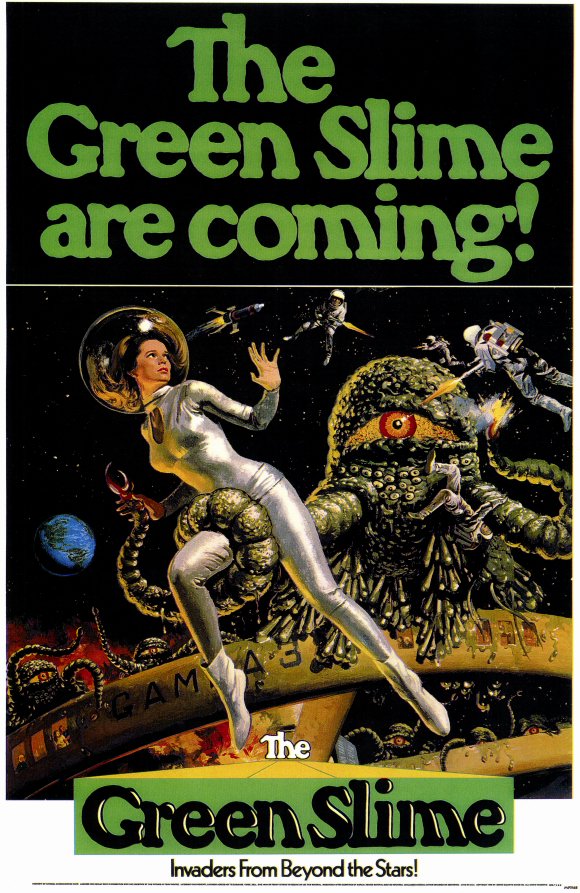
Here’s another of the many movies that I’ve seen before but remember virtually nothing about. In this case, it’s possibly because there’s honestly not that much to remember about The Green Slime, and the whole of the movie just comes off generically and easy to let go.

It’s a cheap science-fiction/horror that has a few okay ideas, but it lacks the heart of other movies around the same time (such as the Italian Planet of the Vampires), and it comes across as somewhat soulless. The actors and actresses put in fine performances (I guess the three best being Robert Horton, Richard Jaeckel, and Luciana Paluzzi), but their characters are just boring tropes, and so is much of the movie.

As to what could have been done to make the movie better, I couldn’t say. While watching this, I was vividly reminded of Queen of Blood, a 1966 science-fiction/horror starring John Saxon. Queen of Blood was also boring and torturous to sit through, so the fact that I found this a reminder did not at all bode well. I was about to say that the only thing better about this film was that it was in color, but after double-checking that, Queen of Blood was also in color. Maybe in three years, I’ll get to thinking this was black and white too.

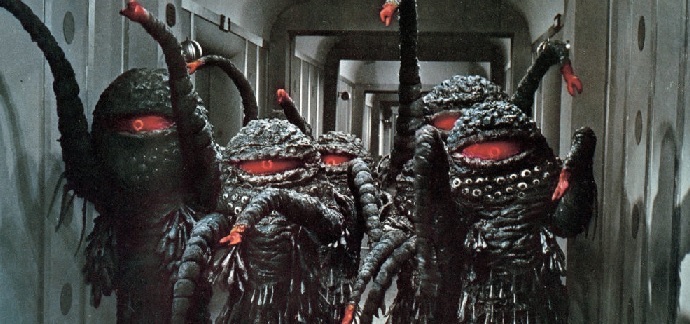
To be sure, The Green Slime has some fun ideas. I think the design of the green organisms are delightful in an early Doctor Who special effects way. If they had been featured in a Patrick Troughton-era Doctor Who story, I may even have liked it. But in an hour-and-a-half film, I was just bored, and found the movie somewhat lifeless and dull. 

But hey, it does have a funky song titled “The Green Slime” played at the beginning and the credits, so that’s cool.

5/10

Kyûketsu dokuro-sen (1968)

Directed by Hiroki Matsuno [Other horror films: N/A]

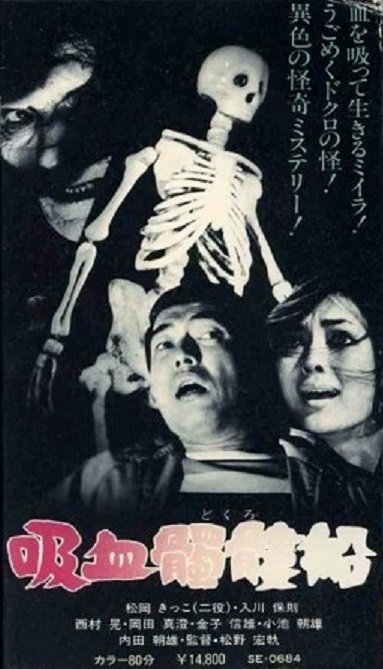
Though at times incoherent, this Japanese film, commonly known under the title The Living Skeleton, has a creepy vibe and seems to be a movie worth seeing at least once, although it may not be the most enjoyable time.

It’s somewhat hard past a certain point to keep up with who’s who, and that’s what causes much of the potential confusion toward the latter half of the film, but even so, there’s enough here to keep the viewer engaged, especially as the movie draws to a close and there’s even a pretty fun twist thrown in there.

The skeletons in the water may not have the most realistic look, but I did enjoy it when they popped up. What’s less engaging was the focus on some Japanese gangsters, but they don’t last all that long, and hell, it is a movie of ghostly revenge from the watery grave, so it works fine.

Being a black-and-white movie (which certainly isn’t a given for a late 1960’s Japanese flick), The Living Skeleton had a lot of atmosphere, and though the story itself wasn’t always the most clear, the fog throughout the film, along with the coastal town and characters attempting to locate a friend gone missing, do make this an atmospheric, beautiful film, and possibly an influential one for Carpenter’s The Fog.

Really, no characters stood out that much to me, but the story, if you can keep up with the names and faces, was still worth watching, and though this would be far from the first recommendation when it comes to classic Asian horror, The Living Skeleton still merits a look, albeit a tepid one.

6.5/10

Konchû daisensô (1968)

Directed by Kazui Nihonmatsu [Other horror films: Uchû daikaijû Girara (1967)]

I’ve not seen that many Japanese horror films from the 1960’s, so I wasn’t entirely sure what to expect from Konchû daisensô, better known as Genocide, but I was pretty happy with it come the conclusion.

The plot here isn’t really that stellar, but the consistent anti-war message throughout was certainly welcomed (and, from a post-World War II Japan, logical), and one of the characters references both the arms race between the U.S.S.R. and the U.S.A. as foolish, along with both the Superpowers being arrogant, which is a nice sentiment to see (and largely accurate).

With topics like this, not to mention the horrid experiences Jewish people, and others, went through in Germany, or issues of environmental concern, it’s probably not a surprise that Genocide (even the title’s invocative of a dismal story) has a somewhat nihilistic conclusion. Not that it’s entirely dark, but certainly it’s probably one of the more depressing endings I’ve seen in recent times.

The cast is generally solid, though not perfect. In particular, I think Kathy Horan was a bit over-the-top at times, which didn’t feel right for this movie. Most main performances, though, such as Emi Shindô, Yûsuke Kawazu, and Keisuke Sonoi, all do commendably enough.

Like I said, I’ve seen only a few Asian horror films from this time period, and to be honest, I was thinking that this would be a lot cornier than it even came close to being. I won’t go as far as to call the movie ‘amazing,’ but I had a fun time watching it, and would certainly recommend it, especially if they want a slice of horror that deals with more serious topics.

7.5/10

Vargtimmen (1968)

Vargtimmen

Directed by Ingmar Bergman [Other horror films: Jungfrukällan (1960)]

I’m not a big fan of experimental films. Antichrist was a film I rather disliked. Most of what I’ve seen from Cronenberg and Lynch, not to mention Tsukamoto, I’ve not particularly enjoyed. The same goes for this Ingmar Bergman classic. When I first saw it, I just had a massive headache afterward. This time around, I’ve grown to appreciate a bit more what it was going for, and they did that job well, but I still rather would have watched something a bit more coherent.

The story is simple: A man and his wife go to their small cottage on an island, and the man slowly begins losing it. He begins seeing bizarre people and experiencing intense paranoia. And he snaps.

Like I said, this movie does a very good job at showing us the bizarre spirits haunting our main character. Many of the scenes, while not outright terrifying, have an ominous, creepy atmosphere about them. And I truly do appreciate that.

What I cannot abide, however, are the random scenes cobbled up, not to mention the dialogue, much of which doesn’t make sense. Indeed, such is a well-done portrayal of losing it on an isolated island, but it’s not something I enjoy at all. On a positive note, I did enjoy how this movie was put together – the wife is being interviewed about her husband and her experience on the island, and so the majority of the story takes place as a flashback. It gave a pretty documentary feel to it, and I thought it came across as sort of cool.

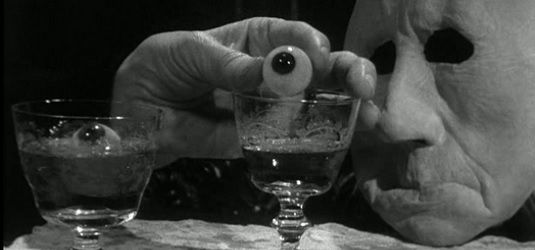
That said, this isn’t a film I enjoy, and while there are the occasional cool scenes (a man removing his eyes, for instance), it doesn’t strike me as worth it. Despite being a Swedish classic, Vargtimmen (or Hour of the Wolf), probably isn’t something I’d soon watch again.

5.5/10