Bride of Frankenstein (1935)

Directed by James Whale [Other horror films: Frankenstein (1931), The Old Dark House (1932), The Invisible Man (1933)]

There is a sizable constituency out there that believes Bride of Frankenstein to be one of the best sequels ever made, and not only that, but believes the film to be better than the 1931 classic. I never understood this. The movie is okay, but I don’t think it even cracks average. It’s not a bad film, but it pales in comparison to the first movie.

So with that blasphemy out of the way, I’ll try to explain why.

For one, the first forty or so minutes of the film feel quite aimless. Frankenstein’s monster survives being burned down in the windmill, travels the countryside, gets caught, escapes, and travels the countryside again, while Henry Frankenstein, healing from his injuries sustained at the end of the 1931 film, is goaded into working with Doctor Pretorius after the good doctor shows him some small people in jars.

It’s at that scene, I should add, that my disinstest grew. I understand the mechanics, however impossible, of Frankenstein’s creation – just stitch together body parts of multiple dead people, and add electricity to make the heart beat and the creature live. I get it. Apparently Pretorius used cultures from a seed to grow those small people (or homunculi).

Do those homunculi have any self-awareness or agency? The king was lusting after the queen, and the clergyman was chiding the king for doing such, but is that actually the extent to what those people are? Can they write books? I understand the science, such as it is, behind Frankenstein’s creation of the creature, but I don’t get Pretorius’ experiment at all. Where did he get the seed he used for the cultures from? I just didn’t see any relation between what he accomplished and what Frankenstein accomplished – they created two fundamentally different things.

Is that nitpicky? I don’t know, but I can’t take Pretorius’ character seriously as I fail to see the science in what he did. Overall, he’s a fun character, and I got a kick of his using Frankenstein’s creation against him, forcing the scientist to work with him, but those fantasy/comedy homunculi always felt so damn out of place to me, and took me away from the movie entirely.

Of course, things do pick up with the final twenty minutes. Really, the finale is strong, and we also finally get to see the titular character (for all of a minute or so) and her interactions with the creature. It’s tragic, and it leads to a good conclusion, but it’s not enough.

The only part of the film that I’d say was nailed would be the creature’s slowly becoming more humanized after being socialized by a blind hermit (O.P. Heggie). I thought those scenes were quite touching, and I got a kick out of the hermit teaching the creature to both smoke and drink. The hermit was such a good character, and I loved him and his sequences.

O.P. Heggie in fact is my favorite performance in the film. No doubt I think Boris Karloff did great, and though I didn’t get his character, Ernest Thesiger was solid as Pretorius. It was nice seeing both E.E. Clive (Dracula’s Daughter, The Invisible Man) and Una O’Connor (The Adventures of Robin Hood, The Invisible Man) not to mention Dwight Frye (The Vampire Bat, Dracula), but Valerie Hobson (replacing Mae Clarke as Elizabeth) and Colin Clive were just sort of there, and didn’t do much for me.

The 1931 Frankenstein is iconic in so many ways. Aside from the hermit and his growing connection with the creature, which was heart-warming, I don’t really see anything iconic here. I loved the design of the new female creature – those white stripes in the hair a nice choice – but she never got any time to really do anything aside from hiss and shriek, and overall, I can’t pretend I think this is anywhere near as good as the first movie.

6.5/10

Mark of the Vampire (1935)

Directed by Tod Browning [Other horror films: The Unknown (1927), London After Midnight (1927), Dracula (1931), Freaks (1932), The Devil-Doll (1936)]

Having seen this twice now, I wish that I could like it more. The problem is, though, that the finale seems to come out of nowhere, and there’s a certain incoherence when it comes to the ending of the film. Many comment that it seems some scenes where removed, and it’s easy to see why.

Ignoring that for now, the rest of the movie is decent. The atmosphere is solid, what with a decrepit mansion (it doesn’t look too dissimilar from the mansion in Dracula, from four years earlier), some mystery, a village afraid of vampires, and all that stuff.

The cast is solid, but generally unmemorable. You have big names such as Lionel Barrymore (1926’s The Bells and 1936’s The Devil-Doll), Bela Lugosi (Dracula, The Black Cat, and many others), Lionel Atwill (Doctor X, The Vampire Bat, Mystery of the Wax Museum, Secret of the Blue Room, and others), and a few unknown names who did decent also, such as Elizabeth Allan, Henry Wadsworth, and Carroll Borland.

Problematically, because of the mess of the plot, I don’t really think many of these actors really get to shine. Lugosi, of course, is good, but while I appreciated Atwill and Barrymore, neither really blew me away.

Apparently this film was originally an hour and 15 minutes, but 15 minutes were cut, which was, from my understanding, mostly comedic additions. If, instead of an hour, this had been 75 minutes (with the additional 15 minutes being plot-orientated, finale information), Mark of the Vampire wouldn’t feel as disjointed as it sometimes does. Make no mistake, this isn’t as bad as Vampyr, but most definitely this could benefit from some explanation, given how the ending, again, seems to come out of nowhere, and felt utterly convoluted.

A final note, this is generally considered a talkie remake of the unfortunately-lost London After Midnight from 1927. That film, too, had something of a surprise ending, but I suspect it was probably laid out better than it was here. There was a reconstruction using still photographs by TCM, released in 2002, so in some form, the original story is out there.

As for Mark of the Vampire, I appreciate some of what it was going for, but otherwise, having seen it twice, I find it underwhelming.

6/10

Ye ban ge sheng (1935)

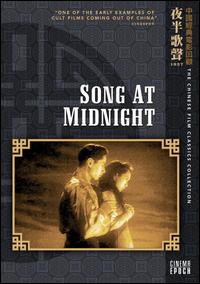
song at midnight

Directed by Weibang Ma-Xu [Other horror films: Ye ban ge sheng xu ji (1941), Wu ye jing hun (1956), Du mang qing yuan (1961)]

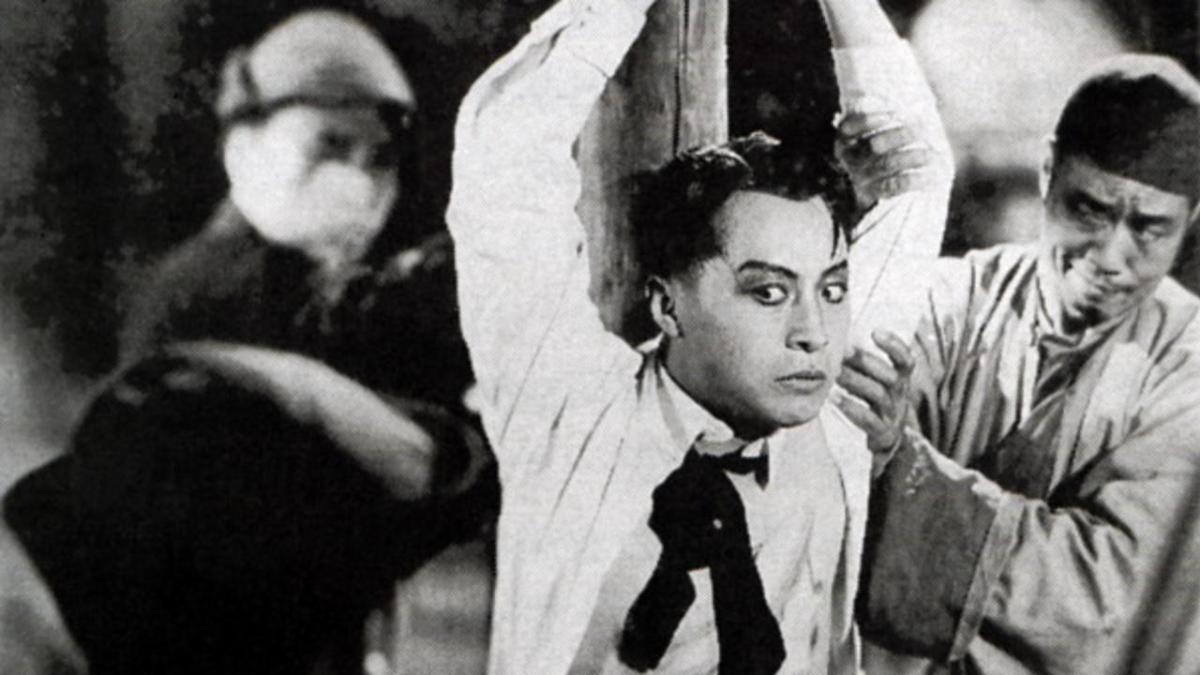
Often considered China’s first horror film, Ye ban ge sheng (or Song at Midnight, as it’s commonly known) is a piece of history in many ways. This Chinese adaptation of The Phantom of the Opera has much of the tragedy and suspense you’d hope to see, but it’s also muddled due both to the worn print and lengthy run-time.

To be honest, when I first saw this one years back, I don’t remember what I thought. Part of this may be because it was during October, and getting a feel for an individual horror film in a month where I watch at least thirty to forty (or as many of two hundred and seventy-five) can be difficult. Suffice it to say I didn’t remember all that much about this one before watching again, which may have helped temper my expectations.

The biggest problem with the movie itself is the almost two hour run-time. The first fifteen minutes of this movie were borderline incomprehensible, even with English subtitles. Easily, fifteen to twenty five minutes could have been cut, and I think it’d have brought a better sense of pacing to the movie.

Though not the film’s doing, the commonly-available print of this film has really been through the wringer. Audio issues, visual issues, odd cuts, it can sometimes be a hassle to get through. Once the story starts picking up around twenty minutes in, things tend to come across more comprehensively, but then a subplot later on sort of loses me a bit.

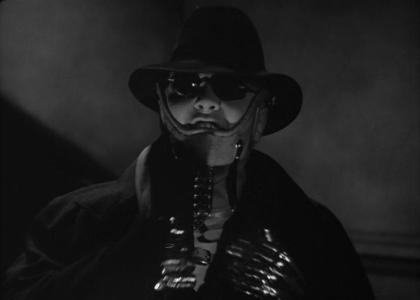
Given that this movie isn’t that well-documented, I can’t much point out performances I thought were good. The individual playing the Phantom of the Theater House was extraordinarily solid, and probably stole the show. Others, including the younger protegee, were good, but none captured the utter tragic existence of the Phantom (a twenty-minute flashback explaining how he came to be, each minute more heartbreaking than the last, stood out as one of the best segments of the film).

Really, the story could be riveting at times. There’s also some creepy scenes to keep us going (an early one with a troupe of actors exploring a rather decrepit theater house stands out, along with the unmasking), and some good revenge at the end. At times, the film felt a bit more like a silent film than American peers at the time, and the fight sequence toward the end felt weak, but generally speaking, this is a good film.

Sadly, what probably holds Ye ban ge sheng back the most is the atrocity of the print. I think that even those who are fans of classic horror would struggle with much of it, and that can certainly lead to a more negative feeling about the story. This movie is a classic, but I just don’t think it holds up as well as it should, not through much fault of it’s own. Just below average sounds about right, sadly.

6.5/10

Mad Love (1935)

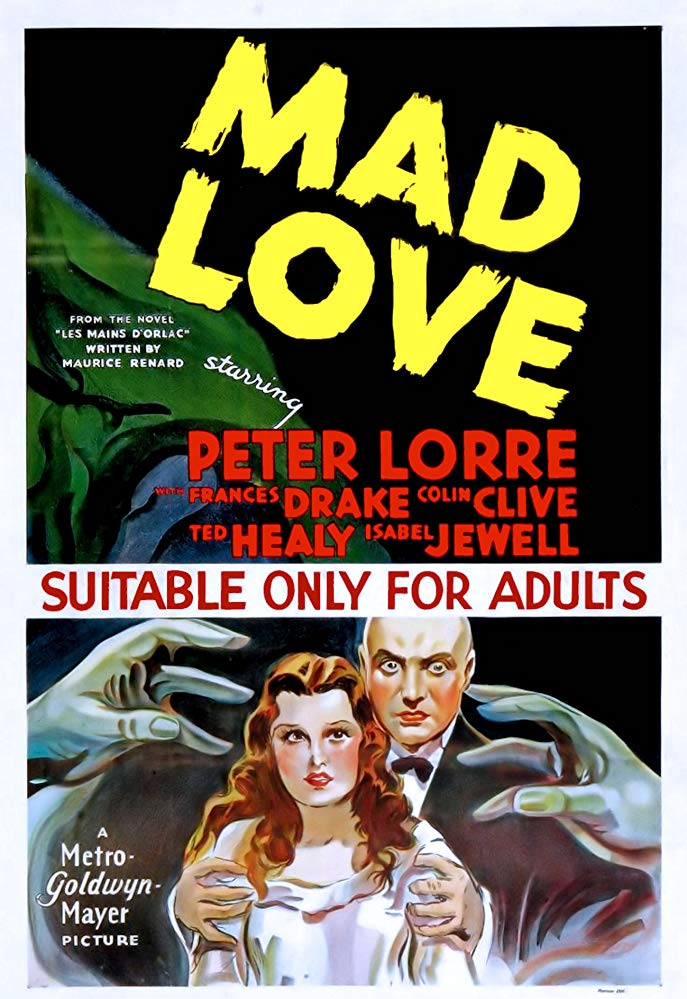
Mad Love

Directed by Karl Freund [Other horror films: Dracula (1931), The Mummy (1932)]

This is a classic of 30’s horror, and a definite recommendation to any other fans of the golden era of the genre.

Based off the French novel Le Mains d’Orlac (in English, The Hands of Orlac), this movie may be short (just around an hour and eight minutes), but it carries with it a lot of suspense and solid acting. The story works better here than other adaptations or rip-offs of the novel I’ve seen (such as Hands of a Stranger from 1962) because it focuses more on the crazy surgeon as opposed to the character who got a hand transplant.

Peter Lorre is the reason that this works so well – his character is so utterly insane that it’s rather amazing watching his onscreen performance (especially the conclusion). How he attempted to mess with Colin Clive’s character was both creative and rather creepy. Lorre’s by far one of the best reasons to watch this, which is saying something, as it’s already a really good film. Clive (who played Henry Frankenstein twice before his early death in 1937) was solid here too, as was Frances Drake, but Lorre, unsurprisingly, blew them out of the water.

One of the actresses was used almost purely for comedic relief, and was the one real downside of the film. Admittedly, when she said, referring to a wax statue, “it went for a little walk,” I laughed quite a bit. The director of this film, Karl Freund, also directed The Mummy, which is where that line originates from, so hearing it pop up again was pretty funny.

Mad Love is one of those films that might not seem as though it’s in the same league as Frankenstein or Dracula, or even Freaks, but it’s a shining light during the 30’s horror output. 1935 was also one of the last decent years for horror until 1941 or so, which only helps it’s case. Certainly the story is well-crafted, and the conclusion rather suspenseful, showing Lorre’s full madness, so if you’re a fan of the classics of the genre, and you’ve not yet given this a watch, I’d recommend doing so, as it’s just as spectacular now as when I last saw it.

8.5/10