Barbarian (2022)

Directed by Zach Cregger [Other horror films: Weapons (2025)]

Ever since the trailer first dropped for Barbarian, I was intrigued. It’s not often that modern horror trailers do much for me – I’m not much of a theater-going guy, so trailers aren’t really something I focus too much on. Still, the trailer for this one looked decent, and so I went into this movie – luckily having avoided all spoilers – with higher-than-normal hopes.

As it is, aspects of this film are no doubt impressive. The base story isn’t exactly stellar, but the narrative structure certainly stands out. About halfway through the film, we’re propelled two weeks forward, following an entirely new character without much in the way of context. Later on, we’re given a flashback explaining a little bit of the origins of the house so much of this film takes place in.

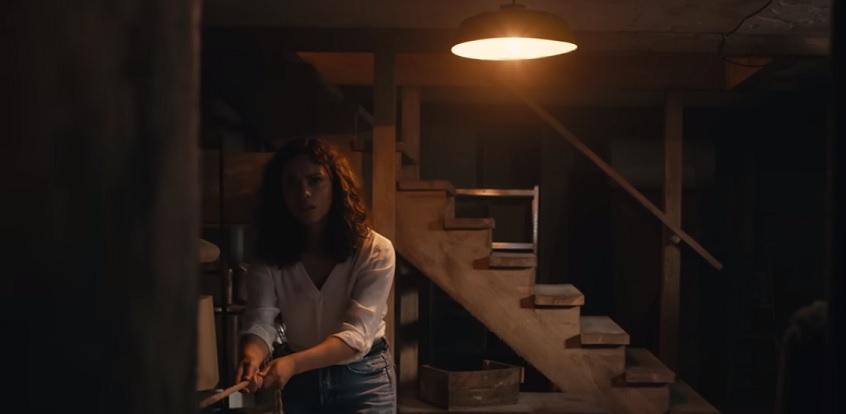
Where my doubt begins to rear its head is the antagonistic force. I don’t entirely object to the idea we’re presented with, but with the solid set-up, I was truthfully expecting something a bit more. I mean, the set-up was great – a mysterious underground passage in a house, the house in question being the only livable-looking house in an overly dilapidated neighborhood, a room with just a bed, bucket, and video camera. Barbarian really started out strong, and the suspense was real.

I don’t know Georgina Campbell (All My Friends Hate Me), but she did quite well here, and made for a solid focal point. Though he didn’t appear all that often, Bill Skarsgård (It) made for an okay, awkward presence. Similarly, Richard Brake (Outpost, The Dare, Perkins’ 14, Tremors: Shrieker Island, Batman Begins) doesn’t appear much, but makes an impression when he does.

Oh, and here’s something somewhat amusing. We’re introduced to a new character about halfway through the film, as I said – an actor who’s accused of rape, which leads him to the house of horrors – who I thought looked a lot like Justin Long. I wasn’t sure who the actor was, so I already had it in-mind to call him the ‘Justin Long look-alike’ in my review.

Turns out it’s actually Justin Long. faceslap, or whatever it is the kidz are saying nowadays

Justin Long (Jeepers Creepers, Lavender, Drag Me to Hell, House of Darkness) is a face I never expected to see in this movie. His character was arguably quite an asshole, but he was definitely the funnest thing here. In fact, there’s a sequence in which he’s trying to measure the creepy hidden rooms and tunnels in the basement, in order to sell the house for a higher amount (as it’d add square footage). Completely oblivious to how creepy these tunnels are, he’s going all in to measure them, and that was hella funny brahs.

Still, I don’t care for the main antagonist. I just found the scenes in which characters were dealing with it the least captivating of the movie, and given that final 15 minutes or so dealt exclusively with that, I wasn’t enamored with the finale. Aspects were okay, such as the sequence on the water tower, but I sort of cringed during Jaymes Butler’s reassurance immediately being proven false – that particular scene just felt too anticipated.

We do get a little gore here, though, which is always fun. Early on, someone’s head is repeatedly slammed into a wall, getting devastated. Someone’s arm is torn off, and the poor fella is then beaten to death with his own arm. Another lucky individual gets their eyes gouged out and their head pulled apart. Barbarian isn’t exactly a gory film, but it can be striking when it wants to be.

Oh, and here’s a random tidbit – while portions of the film were filmed in Brightmoor (a neighborhood of poor condition in Detroit), much of the movie was filmed in Bulgaria, a fact that becomes very obvious if you watch the credits roll by. I noticed that Todor Chapkanov was the First Assistant Director – Chapkanov is the director of some Sci-fi/Syfy films, such as True Bloodthirst, Ghost Town, and Copperhead – so seeing his name in a movie of this caliber amused me.

Ultimately, though, while aspects of this film really did shine, I can’t say Barbarian will end up being that memorable. No doubt that its charms worked for many people – much of the reception I’ve seen has been pretty positive. I do tend to think the film is above average, even though I definitely don’t find it anywhere close to amazing. Still, it’s a decent slice of modern horror, and no doubt one could do much worse than this. I just don’t think it’ll stick out that well in the years to come.

7.5/10

Diabolique (1996)

Directed by Jeremiah S. Chechik [Other horror films: N/A]

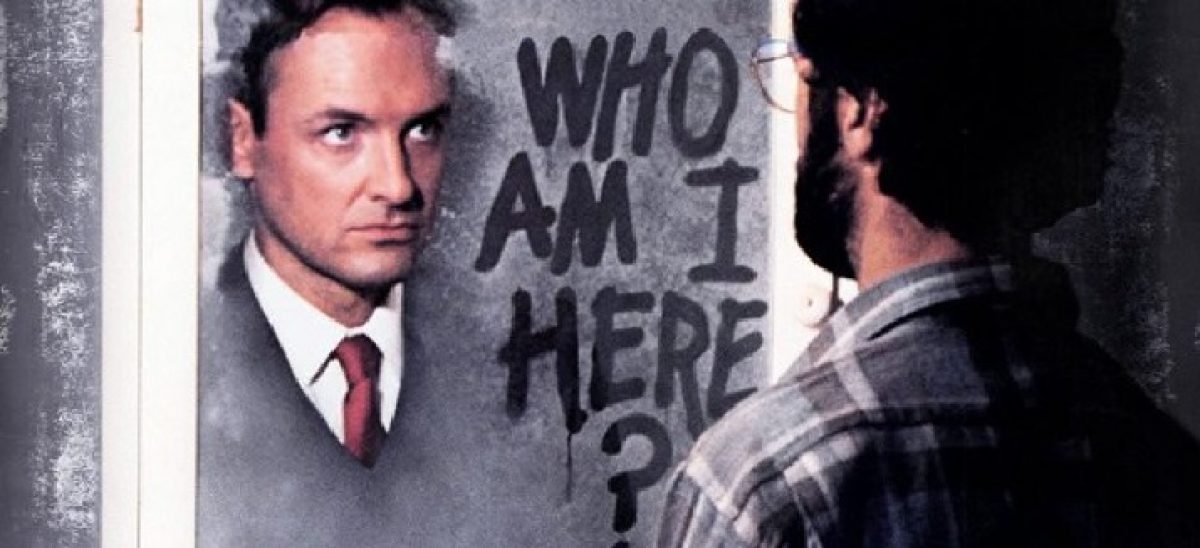
So I’ve never been the biggest fan of the 1955 French classic this film’s a remake of. The story is fine, but I just think it’s a bit slow. I didn’t expect to care for this any more than the original, but though I hate to say it, if I’m being honest, I do think I marginally preferred this one.

I still think the film overall is around average, but I did find it more palatable. If I had to watch either this or the 1955 movie again in the next ten years, I’d lean toward this one. Things move a bit quicker, there’s a bit more suspense at times, the finale is more to my taste, and though this might not be fair, it’s nice seeing faces I know.

I’m not even talking about the leads Sharon Stone and Isabelle Adjani. Both of them were pretty decent, and I think Adjani did a great job. Chazz Palminteri did well as an asshole, and Kathy Bates added some great humor at times (“what is this, a piece of the true cross?”). In fact, I really liked Bates’ character, and it was a nice update from what Charles Vanel did in the original. It’s other small roles that surprised me – Adam Hann-Byrd (the kid who played Alan in Jumanji), Donal Logue (Gotham), and J.J. Abrams (producer of Cloverfield). Even for smaller roles, recognizing faces does a lot for me.

And it helps that the story isn’t a scene-by-scene remake (as Psycho did two years later) – there’s some scenes added here, scenes they chose not to use from the original, and a more thrilling finale, one that I tend to like a bit more. It’s still a longer film – though it’s ten minutes less than the original movie – but it doesn’t feel quite as bad, as we’re given something both up-to-date and new to chew over.

Even though I did enjoy this more than the original, though, it’s still not the type of movie I’d usually recommend. I think it’s decent, and I personally would rewatch it more often than the 1955 version, but it’s still only average in my eyes. Bates’ character and the finale both add a lot to this, and I don’t take that lightly. Not a great film, but honestly, not near as bad as I was expecting.

7/10

The Magician (1926)

Directed by Rex Ingram [Other horror films: Black Orchids (1917)]

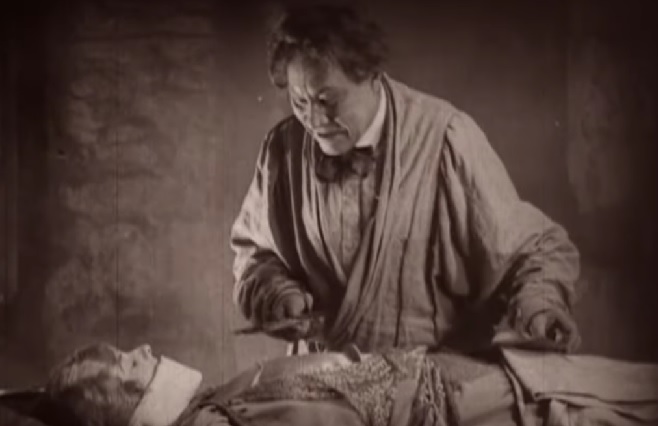
Ah, the good old days dealing with the horrors of hypnotism. The Magician is a pretty solid silent film, and while it’s a bit slow with the set-up, it’s quite a good experience come the finale, and overall is a good film.

Dealing with a somewhat mentally unhinged man who hypnotizes a woman to follow him (and eventually be his victim in a sacrifice to bring forth life with the black arts), The Magician does take a little bit to really get going, and the first thirty minutes or so can occasionally tend to be a bit sluggish.

Once you’re past the point, though, things fly by nicely. You have this crazy guy dragging a woman around (and of course, she has no will to fight back) and the woman’s fiance trying to save her. Toward the end, the magician takes her to an old sorcerer’s castle (which looks remarkably similar to the castle featured prominently in Frankenstein). There’s some thrilling scenes near the conclusion, and it’s a fun time.

The performances here are pretty good, especially Paul Wegener (The Golem), who does great as the evil magician Haddo. He has great facial expressions, and comes across as quite threatening. Alice Terry did well as his victim, and Iván Petrovich did well also as the love interest of Terry’s.

Oh, and I have to mention a title card that got me laughing. There’s a small sequence when, under the influence of the magician, Alice Terry’s character is playing roulette. Before that scene, we get this catching saying (definitely not at all written by the gambling establishment): “This is the song of the wheel that spins / Who loses To-day – To-morrow wins!” Just classy.

For a film that’s not quite as well known, the score of this was pretty good. There’s plenty of recognizable classical pieces here, most noticeably being Pyotr Ilyich Tchaikovsky’s Swan Lake. It’s peaceful and intense, and so works quite well in this film when it does pop up.

Hypnotism isn’t the most interesting subgenre of horror – movies like Svengali, while okay, aren’t particularly my cup of tea. Back then, though, this stuff was popular. The 1894 novel Trilby, written by George du Maurier, was quite well-known, and while nowhere near as well-known, the 1908 book The Magician, written by W. Somerset Maugham, was likely popular too. Early horror is always interesting – I’ve only seen hypnotism done in a horrific manner a handful of times, and this probably doesn’t count – even so, this is a pretty fun film.

When I first saw The Magician, I had a pretty solid time with it. Among other silent horror films, I don’t think this one is quite a classic, but if you’ve an interest in classic silent horror, then The Magician is well worth a look. With a great score, a nice-looking print, and an enjoyable story, then this film is something you should see.

7.5/10

Sweatshop (2009)

Directed by Stacy Davidson [Other horror films: Domain of the Damned (2007)]

I wasn’t impressed with Sweatshop the first time I saw it. Aside from the gore, it has nothing going for it. Seeing it again, well, I pretty much feel the same, and though I do think a bit more highly of it (Sweatshop has some really solid gore effects), I still don’t think it’s a particularly good movie.

Primarily this is due to the plot and characters. I don’t even have anything against the spirit of the plot, to be honest. It’s bare-bones, but that doesn’t matter near as much as the fact that there are no likable characters. Like, none. Literally zero. Some people might not care, as that means you can see people dispatched with gory glory and not shed a tear, but I still like to have someone to root for, and there was no one you could really do that for in this movie.

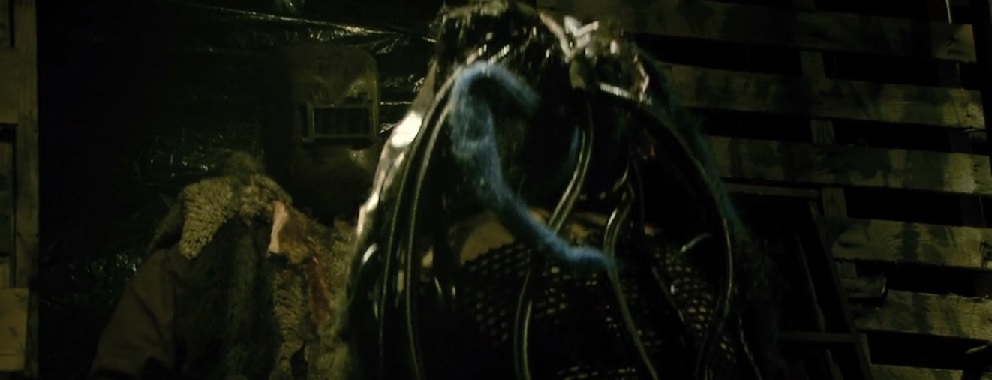
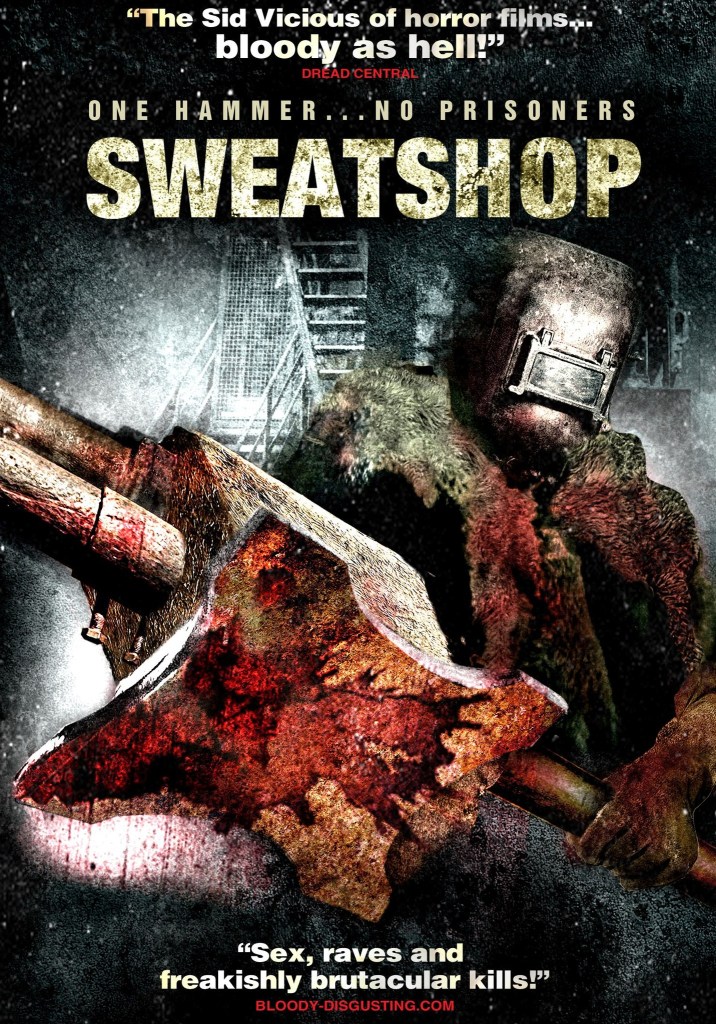
Also, I would have liked some backstory on the killers. There’s three or so – one is a huge, hulking hombre who wears a welder’s mask and carries around what I’ll call a hammer (it’s not a hammer, but I literally have no idea what it is, and so I’ll just refer to it as a hammer, as the poster does), and also some demons. I mean, they’re probably not demons. They’re disfigured women who act exactly like the possessed from The Evil Dead, so I’m guessing off-screen, someone read the Necronomicon Ex-Mortis.

I just wanted something. Even some half-assed scene where one of the characters finds a newspaper clipping about a giant kidnapping two girls 25 years ago would have been something. But we don’t get any explanation at all about the nature of these killers. If it was just the huge, hulking guy, I probably wouldn’t care that much, but adding in some supernatural elements with the demon girls demands some type of explanation, and it bothers me they didn’t even try.

As for the performances, well, given that none of the characters are likable, it’s not easy for individuals to stand out. Some did, of course, but I’ll preface this by saying their characters were mostly horrible. It’s Peyton Wetzel who made the biggest impression on me, and that’s largely because he looks very similar to Jensen Ackles’ character in Ten Inch Hero (among one of my favorite non-horror films). Naika Malveaux looked cool, Danielle Jones looked cute in glasses, and Brent Himes played a redneck with perfection. Melanie Donihoo was also okay.

It’s not the plot, characters, or performances that anyone is coming to Sweatshop for. It’s the gore. And for a lower-budget film, the gore is damn good. For a little taste, you have a couple of decapitations, people smashed with the hammer-thing, some impalement, a glowstick in the eye, some fingers cut off (one by one), and some legs being smashed with aforementioned hammer-thing. I think the best piece of gore here is someone’s jaw being ripped off. It showed great detail, and it doesn’t look fun.

There’s also a bit of a massacre at the finale. See, the primary group of characters were setting up for a rave party-thing, and the party does indeed occur. There’s another guest, though, being the hulking hombre, and so much like Jason introducing himself to the teens in Freddy vs. Jason, the hulking hombre (who is referred to as The Beast, but that doesn’t seem strong enough), just absolutely massacres them. A lot of great gore just in that scene alone, and it’s a good time.

Obviously, there’s a lot about Sweatshop I don’t like, and great gore can only do so much to improve the film’s disposition. If you want to see great gore, though, give Sweatshop a watch. If you want memorable characters or an interesting take on the horror genre (à la You Might Be the Killer or Hush), then look elsewhere.

6/10

Curse of the Crimson Altar (1968)

Directed by Vernon Sewell [Other horror films: Ghost Ship (1952), House of Mystery (1961), The Blood Beast Terror (1968), Burke & Hare (1972)]

One of the many cult-themed horror films from the late 1960’s, Curse of the Crimson Altar is an okay film with a decent amount of classic faces involved.

The story is about what one might expect, following a man (Mark Eden) attempting to locate his missing brother, tracking him to Craxted Lodge in the small village of Greymarsh. It’s a classy set-up, and the mystery, though perhaps not surprising, is pretty solid. I probably could have done without some of the more trippy elements (such as the silly looking Satanic stuff that pops up a few times – luckily it’s nowhere near as ridiculous or constant as The Witches), but overall, the story is quite crisp.

What makes it crispier are the recognizable individuals involved. While I could take or leave Barbara Steele (Castle of Blood, Nightmare Castle, Terror-Creatures from the Grave, and The Pit and the Pendulum), you have some great performances from Christopher Lee (The Wicker Man), Michael Gough (Trog), and one of the last roles of Boris Karloff (The Walking Dead). Mark Eden did well as the lead, and Virginia Wetherell provided some somewhat surprising nudity, so that can’t be bad.

There are perhaps times when I think the film was running a bit long, as the pace is occasionally slow, but for the most part, Curse of the Crimson Altar had a good head on it’s shoulders, and given it’s a Tigon movie (The Beast in the Cellar and Witchfinder General), that might not be a surprise.

I definitely enjoyed this a bit more than I sort of thought I would going in. That said, it’s far from great. I don’t think it’s a bad piece of Satanic flavor, but it’s likely just below average.

6.5/10

The Pack (1977)

Directed by Robert Clouse [Other horror films: Deadly Eyes (1982)]

I don’t remember too much from the first time I saw this film, but revisiting it was quite the pleasant experience, as The Pack does pack a nice punch, and while dry at times, has some solid action come the final thirty minutes.

Based on a novel of the same name by David Fisher, the story is decently simple, and features a bunch of people on a small island trying to survive when a pack of wild dogs starts going after their previous best friends. Being a 70’s film, it can be dry at times, and it can be quite somber, but it’s actually not as hard to watch as other dog-related horror (White Dog is what immediately comes to mind), and the final scene is quite heart-warming (and it freezes on that frame as the credits start rolling).

The suspense is done quite well here, as are the multiple dog attacks. It’s not a violent film, but we do see the aftermath of one attack, in which a man loses all the fingers on one of his hands, most of the fingers on the other, and his eyesight. It’s pretty brutal, and I dug it. Also, while trying to avoid the pack, another individual takes a dive off a cliff, and though we don’t see the impact, we do see how successful the landing was, which also looked brutal.

Only a couple of performances really matter. Joe Don Baker (Wacko) makes a strong lead, and though I don’t really know the actor, I thought he definitely did well. Richard B. Shull has his moments, and R.G. Armstrong (who I recognized quickly from Children of the Corn) was a strong addition also.

Truth be told, there’s not too much to The Pack. It’s a solidly-made film, and though it takes a little bit to get going, it’s not near as dry as other films from the period can be (when I recalled it took place on an island, I got horrible flashbacks to The Food of the Gods, but luckily, The Pack is so much better).

With an exciting finale, plenty of good dog vs. human action, and quality suspense at times, The Pack has a decent amount going for it. It’s not an amazing movie, but it is pretty good, and certainly worth a watch.

7.5/10

Uzumaki (2000)

Directed by Higuchinsky [Other horror films: Nagai yume (2000)]

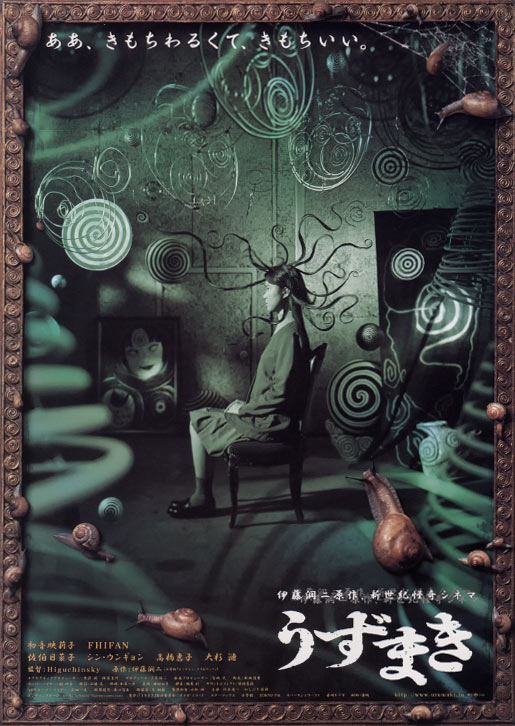
Based on a manga, this Japanese film is quite different. It’s not a film I can easily compare to others, and while I don’t think it really transcends into greatness, I can say that Uzumaki is an experience worth having at least once.

Known as Spiral, I first heard of this one via Wizard magazine. See, along with being a fan of horror movies, I’m also a comic book collector, and back in the day, I’d pick up the odd issue of Wizard. In one of these, there was a countdown of 25 scariest scenes from comics books, and the magna Spiral was referenced. It sounded intriguing, but not being a magna guy, I didn’t expect to ever read it. Shortley thereafter, I found out there was a movie based on it, and so I was interested from hello.

As such, I’d have expected the movie to feel a little more unsettling. Certainly the base plot is, being a small town is slowly taken over by an obsession with spirals (or as a character say, the town is cursed by spirals). Things start slowly at first, such as collecting items that possess spirals, or videotaping snails (their shell patterns are all the rage), but as the film goes on, it gets to the truly bizarre, as some of the kids design their hair in impossible spiral patterns, a woman cuts off her fingerprints (spirals, man), and humans slowly turn into snails for some reason.

There are potential answers hinted at, at least in the vaguest sense, but an unfortunate accident befalls the individual with the answers (which, at least in part, revolve around a nearby lake, called Dragonfly Pond), and so everything is left open-ended. To be honest, I don’t know if the finale here is entirely satisfactory – no doubt it’s creepy at times, but satisfactory? Not so much. Even so, which such a unique plot, it’s hard not to feel at least a little bit charmed by it.

Only four performances ultimately really matter, and all of them did well. Leads Eriko Hatsune and Fhi Fan did well, and I thought they complimented each other throughout (I particularly enjoyed Fan’s character’s serious disposition). Masami Horiuchi’s character gets the closest to figuring things out, but he doesn’t get the chance to let others know, and for the creepy factor, Ren Ôsugi did great.

As you might be able to tell, Uzumaki is a bizarre movie. I don’t know if it’s as bizarre as it could have been, and things do move quite quickly toward the ending, but it’s still creepy, and has a pretty good atmosphere, along with, of course, a memorable idea.

I’ve not read the manga, and let’s be honest – I probably never will. Magna’s just not my thing. At least we have this, though, and while Uzumaki isn’t a great movie, and again, I don’t think the finale really gives the whole film justice, but it is a movie I won’t soon forget, and I at least think the idea here is among one of the most interesting ideas I’ve seen in a horror film.

7/10

Bride of Frankenstein (1935)

Directed by James Whale [Other horror films: Frankenstein (1931), The Old Dark House (1932), The Invisible Man (1933)]

There is a sizable constituency out there that believes Bride of Frankenstein to be one of the best sequels ever made, and not only that, but believes the film to be better than the 1931 classic. I never understood this. The movie is okay, but I don’t think it even cracks average. It’s not a bad film, but it pales in comparison to the first movie.

So with that blasphemy out of the way, I’ll try to explain why.

For one, the first forty or so minutes of the film feel quite aimless. Frankenstein’s monster survives being burned down in the windmill, travels the countryside, gets caught, escapes, and travels the countryside again, while Henry Frankenstein, healing from his injuries sustained at the end of the 1931 film, is goaded into working with Doctor Pretorius after the good doctor shows him some small people in jars.

It’s at that scene, I should add, that my disinstest grew. I understand the mechanics, however impossible, of Frankenstein’s creation – just stitch together body parts of multiple dead people, and add electricity to make the heart beat and the creature live. I get it. Apparently Pretorius used cultures from a seed to grow those small people (or homunculi).

Do those homunculi have any self-awareness or agency? The king was lusting after the queen, and the clergyman was chiding the king for doing such, but is that actually the extent to what those people are? Can they write books? I understand the science, such as it is, behind Frankenstein’s creation of the creature, but I don’t get Pretorius’ experiment at all. Where did he get the seed he used for the cultures from? I just didn’t see any relation between what he accomplished and what Frankenstein accomplished – they created two fundamentally different things.

Is that nitpicky? I don’t know, but I can’t take Pretorius’ character seriously as I fail to see the science in what he did. Overall, he’s a fun character, and I got a kick of his using Frankenstein’s creation against him, forcing the scientist to work with him, but those fantasy/comedy homunculi always felt so damn out of place to me, and took me away from the movie entirely.

Of course, things do pick up with the final twenty minutes. Really, the finale is strong, and we also finally get to see the titular character (for all of a minute or so) and her interactions with the creature. It’s tragic, and it leads to a good conclusion, but it’s not enough.

The only part of the film that I’d say was nailed would be the creature’s slowly becoming more humanized after being socialized by a blind hermit (O.P. Heggie). I thought those scenes were quite touching, and I got a kick out of the hermit teaching the creature to both smoke and drink. The hermit was such a good character, and I loved him and his sequences.

O.P. Heggie in fact is my favorite performance in the film. No doubt I think Boris Karloff did great, and though I didn’t get his character, Ernest Thesiger was solid as Pretorius. It was nice seeing both E.E. Clive (Dracula’s Daughter, The Invisible Man) and Una O’Connor (The Adventures of Robin Hood, The Invisible Man) not to mention Dwight Frye (The Vampire Bat, Dracula), but Valerie Hobson (replacing Mae Clarke as Elizabeth) and Colin Clive were just sort of there, and didn’t do much for me.

The 1931 Frankenstein is iconic in so many ways. Aside from the hermit and his growing connection with the creature, which was heart-warming, I don’t really see anything iconic here. I loved the design of the new female creature – those white stripes in the hair a nice choice – but she never got any time to really do anything aside from hiss and shriek, and overall, I can’t pretend I think this is anywhere near as good as the first movie.

6.5/10

Tremors 3: Back to Perfection (2001)

Directed by Brent Maddock [Other horror films: N/A]

While not as strong a sequel as Aftershocks was, the third film in the Tremors series is okay. It definitely feels more average than either of the previous films, but there are some strong portions also, and is still worth seeing if you’re a Graboid fan.

Personally, I loved seeing Perfection again, with old faces (Charlotte Stewart, Ariana Richards, Tony Genaro, and Robert Jayne) and references (to Nestor, Rhonda, and of course the picture of Walter Chang). The setting of Mexico was fine in Aftershocks, but it’s great to be back to where it all started, and to bring back so many of the classic faces.

It’s certainly a cheaper movie, but I don’t think that really does much harm. The special effects are as decent and gooey as ever (that scene in which Burt is cut out of the graboid is just slimy af, as the kids say), and the design for the new creature in the cycle (appropriately labeled Ass Blasters) is decent, though it’s not too far removed from the Shriekers.

Of course, Michael Gross coming back as Burt is a big win. Honestly, he’s not as memorable here as he has been in previous films, and doesn’t have any quips that come to mind as the first and second movies provided, but he’s still that anti-government right-wing gun-nut you know and love, and Gross does beautifully with it.

I liked Susan Chuang, and I thought her Jodi made a good new character, but I have to say that Shawn Christian was more on the generic side. I guess that Christian is okay, but I sort of wish they used Grady (Chris Gartin) from the second movie instead of throwing another new character in. Still, he did okay, but I don’t think he’s near as memorable as Kevin Bacon or Chris Gartin.

Others who are worth mentioning have mostly been mentioned. Reprising their roles from the first film are Charlotte Stewart (Nancy) and Ariana Richards (Mindy), and you know what, I’m surprised they used the same actress for Mindy. It’s just really nice seeing as many returning faces as we got, especially since Tony Genaro (Migeul) got more screen time. What they did to Robert Jayne (Melvin) was an interesting choice, but not everything can be on the side of angels.

I also enjoyed the ending to this one. Being stuck in a junkyard and having to defend yourself with makeshift weapons, I always thought that was a fun situation. Much like the first two movies, I saw this one when I was a kid, and I always got such a kick out of the finale, not to mention seeing the unfortunate and ironic demise of Burt’s home.

For as cheap as Tremors 3 is, it’s still Tremors done largely right. I enjoyed the character additions for the most part, and though I don’t think it’s near as strong as the second movie (I would have loved a quick Fred Ward cameo), it’s still a lot of fun, and I personally dig it.

7.5/10

Tenebre (1982)

Directed by Dario Argento [Other horror films: L’uccello dalle piume di cristallo (1970), Il gatto a nove code (1971), 4 mosche di velluto grigio (1971), Profondo rosso (1975), Suspiria (1977), Inferno (1980), Phenomena (1985), Opera (1987), Due occhi diabolici (1990, segment ‘The Black Cat’), Trauma (1993), La sindrome di Stendhal (1996), Il fantasma dell’opera (1998), Non ho sonno (2001), Il cartaio (2003), Ti piace Hitchcock? (2005), La terza madre (2007), Giallo (2009), Dracula 3D (2012), Occhiali neri (2022)]

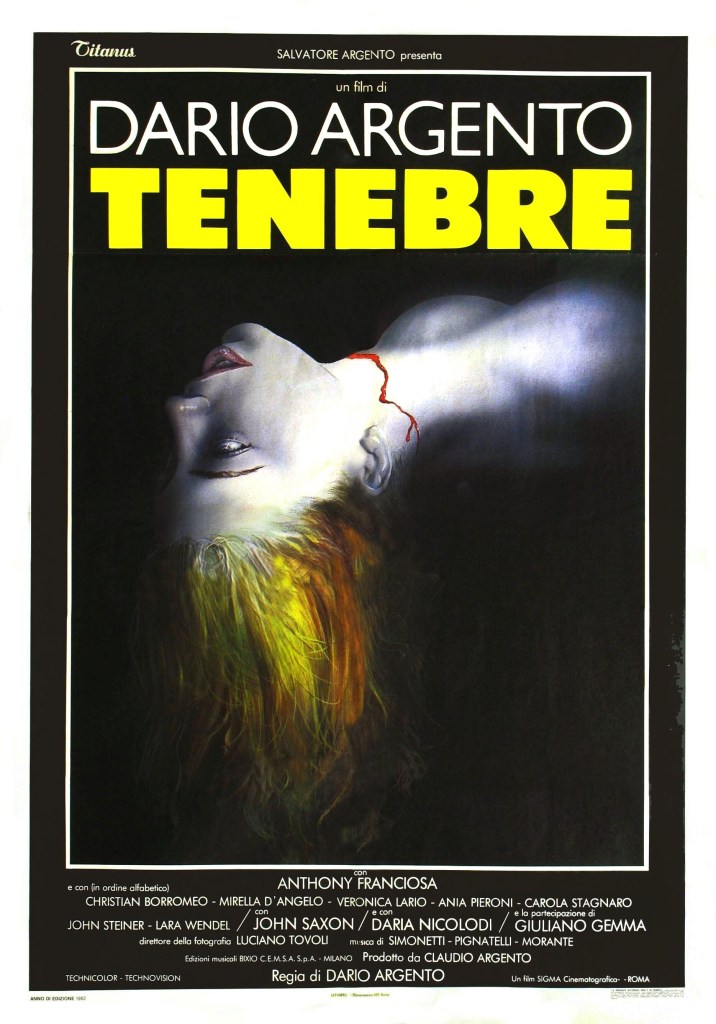
Dario Argento is a director that I’ve long appreciated, and while Tenebre isn’t the most famous work of his I’ve not seen up to this point (Phenomena is still a film I’ve not taken the time to witness yet), it is one of his bigger ones. Finally seeing it, I enjoyed quite a bit about it, but I also don’t think it’s quite up there with the big boys.

And by “big boys,” I primarily mean Deep Red, which is not only my favorite Argento movie, but among one of the 24 or so horror films I rate a 10/10. Tenebre isn’t that good – I feel the ending, while pretty solid, could have done with a bit more explanation, and I’d have liked to see a bit more information given on some of the characters – but it’s still a perfectly solid film.

I’ll say this much – I never guessed the killer. That took me completely by surprise. Maybe it shouldn’t have, but the fact that I can watch gialli and still be taken for a ride just shows how much I love this subgenre of horror, and Tenebre is a good giallo.

Anthony Franciosa (Curse of the Black Widow, Death House, and Julie Darling) isn’t a name I recognize, but he played a pretty strong lead, bolstered by quality performances from Giuliano Gemma and Daria Nicolodi (Phenomena, Le foto di Gioia, Schock, Paganini Horror). I was expecting a bit more from Christian Borromeo’s (La casa sperduta nel parco and Estigma) character, and Veronica Lario’s character didn’t quite connect to me, but whateves. Other good performances include John Saxon (A Nightmare on Elm Street, Black Christmas, etc.), Carola Stagnaro (Minaccia d’amore), Mirella D’Angelo (Maya), and Lara Wendel (Killing Birds: Raptors, I frati rossi, La casa 3).

Of course, the kills here were pretty good. Someone’s arm got chopped off, which caused quite the blood spray, which I found amusing at the time. Murders by straight razor and ax were the flavors of the day, and even attacks by terrifying dogs. Perhaps one of my favorites deaths, though, is one done in a public square – a quick stab to the gut. Reminded me of a kill in The Case of the Bloody Iris, and if something reminded me of that one, then that’s a point to the film’s favor.

Even so, as good as the kills were, as fun as the mystery was, and as bitching as the soundtrack was (apparently recorded by three of the four members of the then-disbanded Goblin), I still felt like something more could have been tacked on. I especially was hoping for more from Lario’s character. Part of the reason I love Deep Red is that if you pay attention during the beginning, you get an important clue. Here, I don’t know if there’s anything comparable. I’m not saying the finale comes out of nowhere, but I can’t imagine too many accurately guessed the answer to this one, so in that way, it’s a bit of a let-down.

Tenebre is still a great movie. I don’t think it’s Argento’s best, but I did enjoy a lot about it, and during future viewings, I’m wondering if more will click into place. As for now, it’s definitely above average, but I don’t think it’s quite as good as many others may think.

8/10