
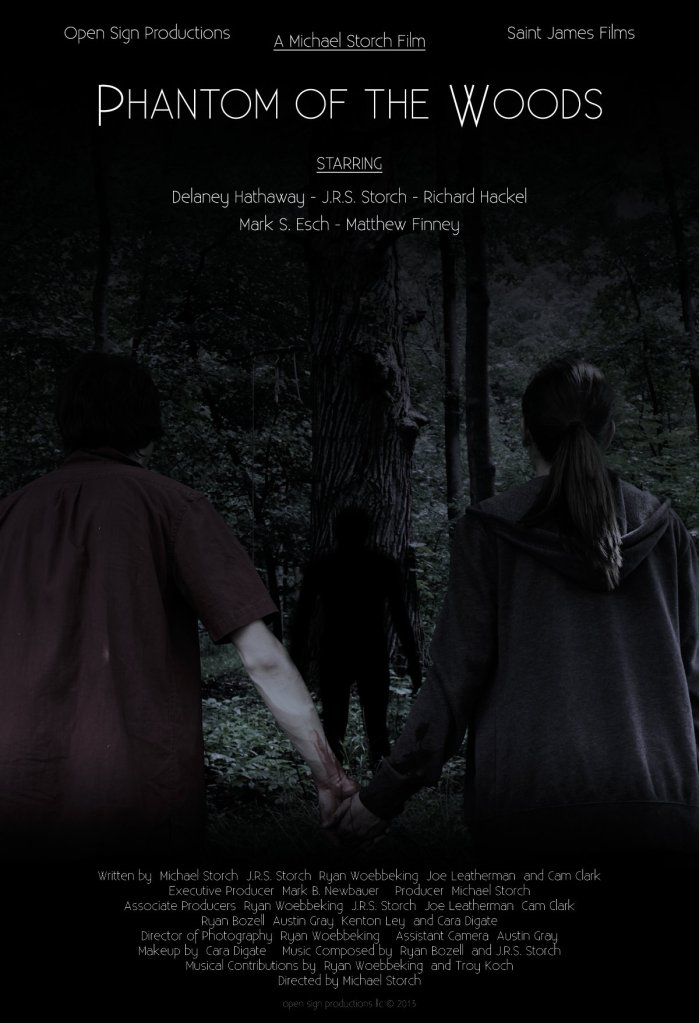
Phantom of the Woods (2013)

Directed by Michael Storch [Other horror films: Schism (2020)]

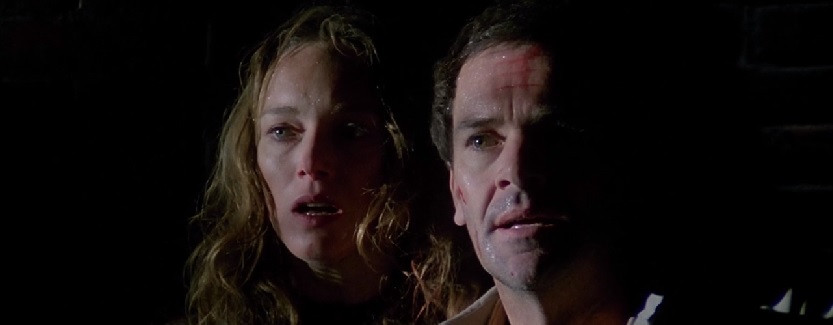
Rather psychological in its approach, Phantom of the Woods is a decent film. It’s actually quite a bit better than I expected, and while I still think it falls around average, I have to say that the film impressed me a bit.

One of the reasons I had this on my list of films to check out is that it’s filmed in Indiana. In fact, it was filmed in the Fort Wayne area, and as I live quite close by (Columbia City representin’), I was definitely interested in seeing this. There’s not many horror films from Indiana – a point I pontificate about in my review for Scarecrow County – so this one sounded like it had potential.

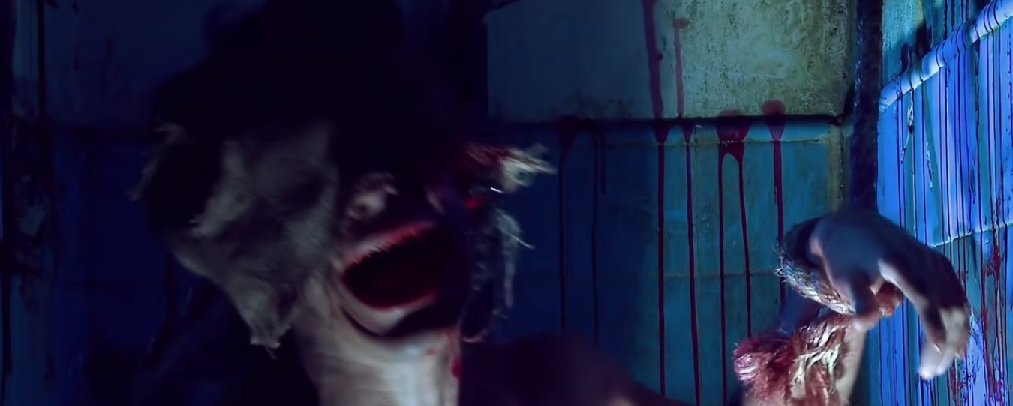
And I enjoyed how they tackled the story. There’s an entity out in the nearby woods, and it makes people see what they fear most – some teenagers and a cop get entangled in figuring out how to defeat it, and things go from there. It’s a lower-budget film, but the effects are generally decent, and while nothing really stands out as far as kills go (aside from maybe a scene involving a scarecrow), I was impressed with most of what I saw.

I was also quite impressed with the performances. I don’t know the budget for the movie, but this didn’t feel like The Night Before Easter or Don’t Go to the Reunion. It felt quite polished, and the performances are a good example of that. Both J.R.S. Storch and Delaney Hathaway did great, and I really enjoyed their budding friendship. Mark S. Esch was great as an old-fashioned Marine Corp police officer – I couldn’t stand him from his first scene, and I appreciated that. Richard Hackel and Matthew Finney were both quite good also.

More than anything, I wanted to like the movie more than I did, but the thing is, while I liked a lot of what they were going for, I question whether it really had to be an hour and forty minutes. The time generally went by quickly, and the pacing wasn’t a big issue, but even so, some portions probably could have been trimmed a bit.

For an ambitious film, though, Phantom of the Woods was a surprise. To be frank, I was expecting something a lot less polished than this, and this movie impressed me. It’s not really a film I think I’d watch all that often, but when it comes to Indiana-based horror, it’s certainly a movie that I’d recommend.

7/10
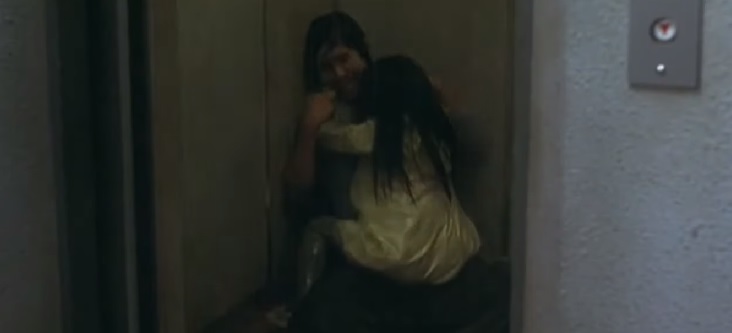
Honogurai mizu no soko kara (2002)

Directed by Hideo Nakata [Other horror films: Honto ni atta kowai hanashi: Jushiryou (1992), Joyû-rei (1996), Gakkô no kaidan F (1997), Ringu (1998), Ringu 2 (1999), Sotohiro (2000), The Ring Two (2005), Kaidan (2007), Chatroom (2010), Inshite miru: 7-kakan no desu gêmu (2010), Kuroyuri danchi (2013), Gekijô rei (2015), Satsujinki o kau onna (2019), Sadako (2019), Jiko Bukken: Kowai Madori (2020), Sore ga Iru Mori (2022)]

I can’t say for sure whether I saw the 2005 remake before this original Japanese version, but I can say that I’ve always loved the story in Dark Water. Honogurai mizu no soko kara may well be one of my favorite examples of J-horror, and it packs enough creepy and emotional scenes to make me happy.

As it is, I don’t have a lot of exposure to J-horror. I’ve never seen any of the Ringu movies (be it the 1995 TV movie, the 1998 Rasen, the 1998 Ringu, or the randomly South Korean Ling from 1999), I’ve not seen Pulse (or Kairo), I’ve not seen One Missed Call (or Chakushin ari), and it’s entirely possible I’ve never seen The Grudge (Ju-on, and to be specific, either the popular 2002 or the lesser-known 2000 movie). I’m not a big supernatural horror fan, so J-horror hasn’t been my go-to, but Dark Water definitely has a lot going for it, and it makes me rethink my attitude toward what Japan has to offer.

Taking place in perhaps the most depressing apartment complex I’ve ever seen in my life, the story is a simple one, with a struggling woman going through a divorce trying to give her young daughter a good life, in the face of potentially supernatural occurrences. It’s an easy plot to get into, there’s not many characters, and the apartment building is spooky enough even before the ghostly girl pops up, yellow raincoat and all.

In fact, it’s probably one of the best settings I’ve seen in a little while. It’s such a dark building, and whether the scene takes place in the elevators or the roof, it’s just creepy. That scene toward the end when the main character is climbing the water tower, for instance, is just a fantastic sequence, and I loved the whole set-up of this.

It’s also a bit of an emotional ride. The main character (played by Hitomi Kuroki) is going through a hard time, dealing with a lot of feelings of insecurity and a tough divorce. She’s close to an emotional break-down most of the time, and I can’t help but feel for her, especially in that dreary apartment she’s forced to raise her daughter in. It’s a gloomy situation all around, and the fantastically emotional final scene, a ten years later sequence, is just icing on the cake.

As such, Hitomi Kuroki did an amazing job with her character, and her portrayal of a mother going through hard times was fantastic. Playing her daughter was Rio Kanno, and she did quite well for a young actress. And though she really only gets one scene, Asami Mizukawa was stellar.

Because it’s a supernatural Japanese film, it’s not a gory movie, and it’s also not particularly rife with special effects. You see a ghostly girl a few times, but she never does any extreme acrobatics (à la The Ring). Even so, there’s plenty of low-key and subtly creepy scenes here, and despite not being a fan of supernatural films, I definitely thought this had enough going for it.

Also, the mystery here, dealing with the missing girl Mitsuko Kawai, was pretty good. I sort of wonder about one of the flashbacks – when she’s getting on an elevator – but it may have been an unintentional red herring. Still, the mystery is fun, and I love how things are slowly pieced together.

Dark Water is a film I’ve seen before, but I forgot how hard it hit you emotionally. In fact, the finale reminded me a bit of the 2007 Spanish film The Orphanage, and I wouldn’t be surprised if that film was moderately influenced by this one. Dark Water was definitely a great movie to see again – from the depressing opening to the ending credits, with the beautiful “Aozora” by Suga Shikaro – and it’s certainly worth seeing.

8.5/10

The Night Before Easter (2014)

Directed by Joseph Henson [Other horror films: N/A] & Nathan Johnson [Other horror films: N/A]

While The Night Before Easter isn’t a terrible offering of low budget horror, and certainly not that time-consuming, I have to say that I wasn’t overly enthralled. The basic idea is fun, but it seems there was far more drama than there was killing, and while that helped build some of the characters, I’m not sure it did the overall movie great favors.

The plot here, or more specifically, the setting (being a storage facility) reminded me a bit of another lower-budget film, The Murder Game (from 2006), which also took place in a similar setting. That had probably the same amount of characters as this one did, but I also thought the story was a bit more solid, and while this film does boast a killer in a bunny suit, I tend to think The Murder Game was more memorable also.

As it was, the kills here are okay. Someone gets a saw blade thrown into their back, another takes an ax to the face, leaving  gnarly gash. There’s a throat-slitting, along with a decapitated head, so there’s a bit here if that’s your main interest, but a lot of these kills don’t happen until the second half, and it’s not really until the final ten or so minutes that things really start going.

To be fair, the movie’s a short one. The Night Before Easter runs at just over an hour – 65 minutes total. It’s easily digestible, but even with the time spent building some of the characters (such as Kelly’s infatuation with Riley, or Riley’s opening of a comic book store, or Brooke’s drinking problem), I feel like some of the characters here just don’t get much spotlight, and either could have been cut or given a bit of a chance to explore their backgrounds.

As far as performances go, I think that April Sinclair was the most note-worthy, and her scenes with Alyssa Matusiak were perhaps the most interesting non-murder scenes of the movie. I thought both did quite well with troubled characters. Keldon Flint (“She called me Danti!”) was amusing at times, Bonnie Marilyn Jean played the stereotypically bitchy girl well, and Emily Chidalek had some strong moments early on. I do sort of wish we got a little more from Eric Wyatt – he was okay, but I definitely thought his character could have been fleshed out a bit more.

Otherwise, there’s not really a lot going for The Night Before Easter. It’s an okay lower-budget film, and it can be fun at times, but there’s a lot of other lower budget films from the same time-range I’d probably want to spend my time with instead (such as Don’t Go to the Reunion, Silver Cell, You’re Not Getting Out Alive, and Vampire Ticks from Outer Space), and I don’t know if this film will end up being all that memorable.

5.5/10

The Flesh Eaters (1964)

Directed by Jack Curtis [Other horror films: N/A]

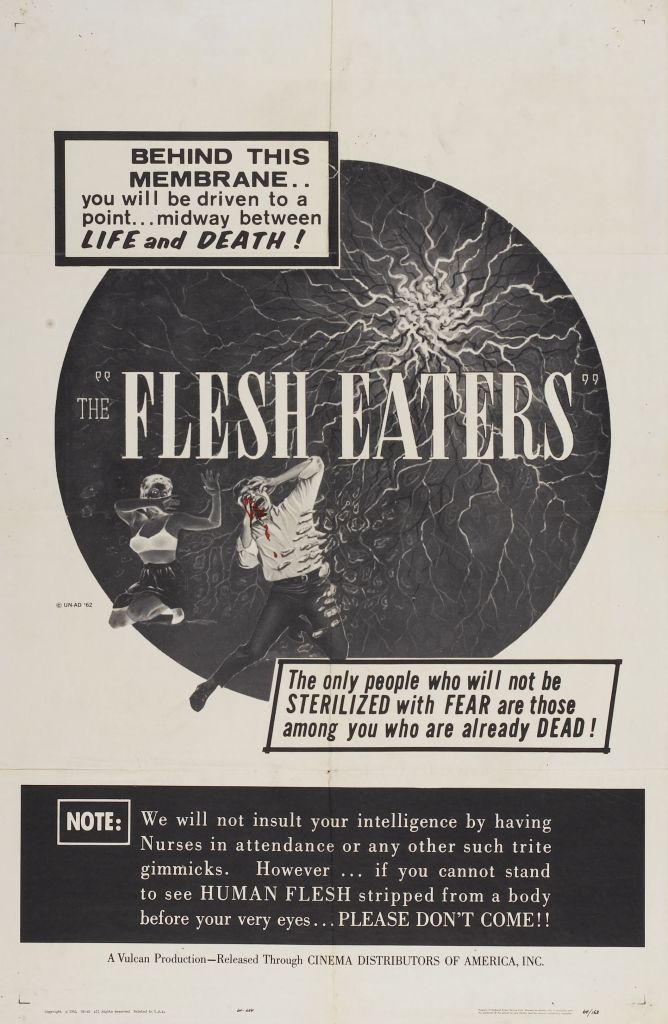
Though it pains me to say it, I don’t think The Flesh Eaters is a great film. It’s certainly notable in some aspects, and it can be reasonably fun, but the final third of the film never did much for me, and portions do drag. Even so, it’s worth seeing at least once for the special effects.

I have a little history with the film. Way back in the day, I saw this multiple times playing on AMC – I probably watched this two times, perhaps three, so it was a bit of an odd favorite. It’s not been unpleasant revisiting it, by any means, but I definitely don’t think it’s as strong as I used to.

I love the plot, though, dealing with glowing organisms in the water that can strip flesh to the bone, and people trapped on an island having to contend with the microscopic entities. This movie’s surprisingly gory at times – it’s in black-and-white, but even so, it can provide a good time.

During the pre-credit opening (definitely an earlier example of this), a couple goes for a swim that doesn’t end well. That’s a tame opening, but it’s a good portent of what’s to come. A man in a motorboat gets some water splashed on him, and his face rather melts, and there’s also a scene in which someone drinks a beverage with the microscopic organisms in it, and it eats out of him from his stomach, in beautifully gory fashion. Earlier films did have more gore than you might expect – look at Fiend Without a Face – but The Flesh Eaters is a surprisingly bloody film at times.

Otherwise, the special effects aren’t great, but that has more to do with the route of the story than anything else. See, for the first two-thirds of the film, the microscopic glowing organisms are all they have to deal with, but events occur that create a giant monster out of the organisms, so instead of millions of small things, there’s one large monster (technically, two, but I wanted to simplify things), and at that point, things feel a bit more on the generic side.

Byron Sanders made a solid lead, and he had that typical strongman physique. In fact, I’m sort of surprised he wasn’t a bigger name, as he had great looks. Barbara Wilkin made for a decent, inoffensive love interest, Rita Morley had some great scenes as her character was an alcoholic (in fact, Morley might be one of the strongest performances here), and as an antagonist force, Martin Kosleck (The Frozen Ghost and House of Horrors) was a bit generic, but overall decent.

Funnily enough, it’s the one with the least acting experience that I dug the most. Ray Tudor plays this random beatnik who rafts onto the island halfway through the film, and he has the kookiest dialogue, man. I mean, he speaks the word, man, about the power of love. You speaking my language, Max? That character was a hoot, and Ray Tudor did a great job with it.

Despite my nostalgia at seeing the movie again for the first time in a long time (for detailed context, I watched this on October 25th, 2021, and last saw it around 2010, if not earlier), I don’t think The Flesh Eaters is a great film. It’s decent, but it’s a bit slow at times, and the finale is a lot more generic than anything previous in the film. I think it evens out to about average, but I know plenty out there enjoy it more than I do, so if you’re into 60’s horror, this is definitely a movie to look into.

7/10

El Bosque de los Sometidos (2012)

Directed by Nicolás Amelio-Ortiz [Other horror films: N/A]

I wanted so much to like this Argentinian movie. Known as The Flaying, El Bosque de los Sometidos is a movie with plenty of potential, but I didn’t care much for where the story went, and while there are some good portions, I can’t say I overall enjoyed it.

I don’t have a whole lot of experience with Argentinian horror. I’ve only seen four others (Cold Sweat from 2010, Resurrection from 2015, Plaga zombi, and De que estamos hechos from 1987), and none of them wowed me. On a somewhat amusing side-note, I thought both La casa muda and Baby Shower were also from Argentina, but La casa muda’s from Uruguay, and Baby Shower is Chilean, so that shows my knowledge of South America.

The point is, I’ve not seen many films from Argentina, and I really wanted to like The Flaying. I sought it out specifically because I thought it sounded as though it had potential, and I’ll definitely say that it did. Four friends are traveling through Argentina, and come across an old, dilapidated castle, and then horrors begin. Don’t tell me that doesn’t sound fun.

What’s better is, that plot is something that easily could have been made as a found footage film. The set-up reminded me a bit of Germany’s Die Präsenz, Peru’s Secreto Matusita (2014), and Mexico’s Perdidos (2014), found footage films all. The Flaying easily could have been found footage, but they opted for a more traditional form of filming, and I really appreciated that.

Even so, while I enjoyed portions of the build-up, the build-up does take a decent while. Nothing particularly scary happens until 45 minutes in or so, and while I loved the dilapidated castle (and by dilapidated, I don’t mean it needed a light glow-up; it literally didn’t have a roof) and the surrounding forest, it wasn’t enough for me, and once the antagonist is revealed and the action begins, I just didn’t love how they went about it.

Of course, this is no fault of the performances. Juan Sebastian Alvarez Windey, Emilio Martin, Olivia Tykocki, and Celeste Subatin all did perfectly fine, and each of their characters had personality and their own individual characteristics. The setting and performances were strong, so that’s not the issue here.

We do get some gore toward the end – someone has a couple of their fingers cut off (this happens offscreen, but we do see the aftermath), and we see pieces of flesh hanging from the ceiling, but portions of the finale aren’t exactly clear to me, which sort of bothered me.

I think when it comes down to it, The Flaying is a pretty decent low budget attempt, but I don’t think the finale was really a great pay-off. Others may well think differently, and I’d still say the movie is worth a watch for a bit of foreign flavor, but I can’t say I thought it was that good.

5.5/10

Matango (1963)

Directed by Ishirô Honda [Other horror films: Ishirô Honda [Other horror films: Gojira (1954), Gojira no gyakushû (1955), Jû jin yuki otoko (1955), Godzilla: King of the Monsters! (1956), Sora no daikaijû Radon (1956), Godzilla (1957), Tokyo 1960 (1957), Bijo to ekitai ningen (1958), Daikaijû Baran (1958), Half Human: The Story of the Abominable Snowman (1958), Gigantis: The Fire Monster (1959), Mosura (1961), Varan the Unbelievable (1962), King Kong vs. Godzilla (1963), Mosura tai Gojira (1964), Uchû daikaijû Dogora (1964), War-Gods of the Deep (1965), Furankenshutain tai chitei kaijû Baragon (1965), Furankenshutain no kaijû: Sanda tai Gaira (1966), Gezora, Ganime, Kameba: Kessen! Nankai no daikaijû (1970), Gojira tai Hedora (1971), Godzilla (1977), Godzilla 1985 (1985), Gojira vs. Desutoroiâ (1995), Gojira tai Megagirasu: Jî shômetsu sakusen (2000)]

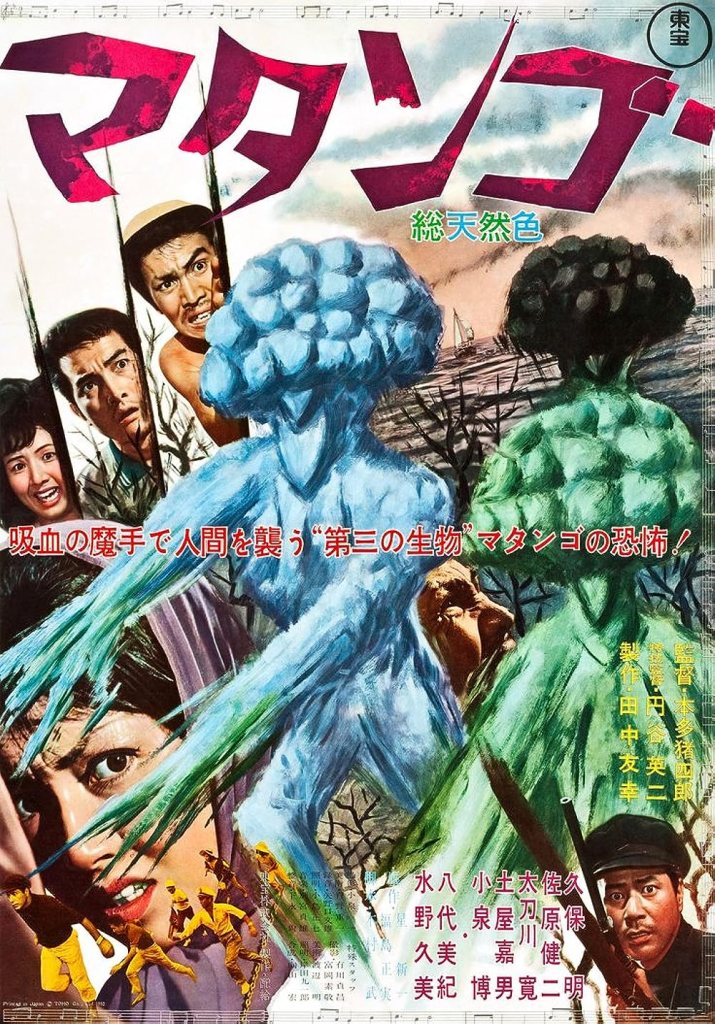
Matango, or Attack of the Mushroom People (which is a pleasantly provocative title) is a quality Japanese movie, rife with beautiful colors and people horrifically transformed into mushrooms. It’s never been a favorite of mine – I think it moves a bit slow for much of the runtime – but the final twenty minutes or so are hauntingly nightmarish, and it’s worth the watch for that.

Based on a short story by William Hope Hodgson titled ‘The Voice in the Night’, the film follows a group of people who shipwreck their yacht, and are trapped on an island filled with mist and mushrooms, and little else. It should go without saying that the mushrooms may not be the healthiest thing in the world to eat, but given their desperation and hunger, they don’t have a lot of choice, and some succumb to the springy-textured temptation.

Before that point, though, we’re treated to a lot of infighting amongst the group – the captain is getting on peoples’ nerves, one of the women is actively flirting with multiple men, putting people on edge, and there are power struggles popping up as to who should lead the group, and what their plan of action should be.

It’s not uncommon in a movie like this, and in fact, it reminded me of Goke, Body Snatcher from Hell, which I saw earlier this month. In that Japanese movie, much like this one, a group of people find themselves in a desperate situation, and morals break down, leading to danger and tension throughout.

For a sociological look at things, that approach is fine. You can also see much the same type of things in various zombie movies (28 Days Later… comes to mind), and it’s certainly realistic. I don’t mind it here, but I do think the film moves terribly slow, and it’s not until about 35 minutes in that I’m really intrigued. Once they find an old shipwreck covered in fungus, things improve, but getting there is a little bit of a struggle.

Honestly, none of the performances really stood out to me. I sort of liked Miki Yashiro’s character, and she had a creepy scene at the end, but saying she added much would be a hard case to make. Akira Kubo was perfectly fine, albeit generic. Yoshio Tsuchiya was fine as an antagonist, but again, he doesn’t particularly stand out.

What makes Attack of the Mushroom People worth seeing it the slow, creeping atmosphere and the eeriness of the concept. I didn’t read much of the Odyssey back in school, but the story of the lotus eaters always freaked me out, and that’s the type of thing this movie has to offer. Once people consume the mushrooms, they slowly transform, and never want to leave the island. Oh, and they live in this creepy mushroom-filled area – it’s color, it’s atmopshereic, and it’s, as the kids say, creepy as fuck.

Attack of the Mushroom People has never been a movie I loved, but that’s not because it’s bad. It’s just that much of the human element before the titular Mushroom People come about doesn’t interest me that much. Their drama is just not my cup of tea. Once things get moving, though, it’s a really good film, and the final twenty minutes are fantastic. Definitely a Japanese classic worth checking out.

7.5/10

Der Würger von Schloß Blackmoor (1963)

Directed by Harald Reinl [Other horror films: Die Bande des Schreckens (1960), Die unsichtbaren Krallen des Dr. Mabuse (1962), Der Teppich des Grauens (1962), Zimmer 13 (1964), Der unheimliche Mönch (1965), Die Schlangengrube und das Pendel (1967), Ein toter Taucher nimmt kein Gold (1974)]

Known as The Strangler of Blackmoor Castle in the USA, this German film was quite fun. It had a lot going for it, especially the mystery and the atmosphere, along with the setting, and it’s probably one of the better krimis out there.

I’ve known about krimis for a long time, though I’ve only seen one (1967’s Creature with the Blue Hand, or Die blaue Hand). Short for Kriminalfilm, it’s a subgenre of German crime movies, popular from 1959 to around 1972. Many of the movies are based on works by Edgar Wallace, and most, from my understanding, involve mystery of some sort. I suspect many of them aren’t horror – the first krimi, titled Der Frosch mit der Maske (Face of the Frog), sounds far more like a spy/crime film than anything else – but some definitely are, including this one.

The best way to describe krimis, I think, is comparing them to gialli – both generally involve mysteries, a lot of potential suspects, a masked killer with black gloves. Just like how that’s not true of all gialli, it’s certainly not true of all krimis, and to be sure, there are differences – krimis started a bit earlier (the first krimi was 1959, the first giallo 1963), the violence is a lot lighter, and it’s a lot less artistic.

All of this is to say that I’ve only seen two krimis, the first one (again, Creature with the Blue Hand) so long ago I barely remember it, but if The Strangler of Blackmoor Castle is any indication of other films in the genre, I’d say krimis are an untapped resource for horror fans, as this movie was great.

In many ways, it felt a bit like one of those old dark house mystery movies – something like The Bat Whispers, The Cat and the Canary, or Night of Terror. There’s murders being committed around a castle, a diamond-cutting conspiracy, a cache of long-missing diamonds, and secret passages galore. It has a lot of the staples I love, and it does it beautifully.

The killer looked a lot like the killer from Blood and Black Lace – he didn’t have the hat, but they wore a black ski mask and a nice coat. Also, the killer knew how to get things done – yes, as the title says, strangling does occur, but there’s also a healthy dose of decapitation, one scene in particular which was great (imagine a motorcycle and a wire strung out on a bridge, and you’ll get the picture). It’s a black-and-white film, and certainly not a bloody one, but entertaining all the same.

And speaking of entertaining, I thought many in the central cast were great. Walter Giller’s character in particular was a lot of fun (he played a Scottish lord, always wearing a kilt), but Karin Dor (Dark Echo, Hand of the Gallows, and Room 13) made a very solid lead, and Rudolf Fernau was great as her uncle. Dieter Eppler had a sinister aura, always sneaking about, Hans Reiser’s character popped up at all the right times to make him suspect, and Harry Riebauer made a good Scotland Yard detective.

The film is just fun throughout – toward the end, pretty much all of those who could be the murderer are in a single room when devastating news is revealed, which was a fun set-up. There’s a marsh that police officers are chasing the murderer through – they have to use planks and ladders to cross the murky lands. And there’s also one of the best hiding places I’ve ever seen for hidden valuables, which was fun also.

Krimis are a subgenre I’ll have to look into more. I’ve heard this may be the best one, which I can believe, but plenty of others, including The Door With Seven Locks (Die Tür mit den 7 Schlössern, 1962), The Sinister Monk (Der unheimliche Mönch, 1965), and The Hunchback of Soho (Der Bucklige von Soho, 1966), sound intriguing, and provided I can find them in German with English subs, I’ll need to give them a look.

If you’re a fan of the occasional giallo, or want to see what West Germany was up to in the 1960’s, I can scarcely think of a better way than to give The Strangler of Blackmoor Castle a chance.

8/10

…E tu vivrai nel terrore! L’aldilà (1981)

Directed by Lucio Fulci [Other horror films: Una lucertola con la pelle di donna (1971), Non si sevizia un paperino (1972), Il cav. Costante Nicosia demoniaco, ovvero: Dracula in Brianza (1975), Sette note in nero (1977), Zombi 2 (1979), Paura nella città dei morti viventi (1980), Gatto nero (1981), Quella villa accanto al cimitero (1981), Lo squartatore di New York (1982), Manhattan Baby (1982), Murderock – Uccide a passo di danza (1984), Aenigma (1987), Zombi 3 (1988), Il fantasma di Sodoma (1988), Quando Alice ruppe lo specchio (1988), La casa nel tempo (1989), La dolce casa degli orrori (1989), Un gatto nel cervello (1990), Demonia (1990), Hansel e Gretel (1990), Voci dal profondo (1991), Le porte del silenzio (1992)]

Commonly known as The Beyond, Lucio Fulci’s …E tu vivrai nel terrore! L’aldilà is definitely a slice of Italian horror worth seeing, if only for the goriness alone. I don’t personally find it an amazing movie, but it can be decently fun if you’re a fan of Fulci’s work.

I’ve seen The Beyond before, but it’s been a long time. I’ve only seen it the one time, and I can’t quite fathom exactly how long ago that would have been, so coming into this one again was a treat. I was slightly hesitant – when I revisited The House By the Cemetery in recent times, I wasn’t blown away – but this film has more going for it, at least in my eyes.

The story, such as it was, isn’t too bad, dealing with a hotel placed on one of the Seven Gateways of Hell. It’s the second part of Fulci’s Gates of Hell trilogy, sandwiched between City of the Living Dead and The House By the Cemetery. Luckily, there’s not much reason to watch them in order, as they stand alone perfectly fine, and like I said, I found this a bit better than The House By the Cemetery.

For a certainty, it’s not for the plot, which is a bit janky. I mean, let’s be honest, most people don’t come into a Fulci movie for the plot, so that’s not a big problem, and the main point – a woman inherits a hotel, and soon terrifying things start happening – gets across just fine. And since most probably come for the gore, they certainly came to the right place.

It’s hard to say what my favorite scene here was – part of me wants to say either the final scene, which was quite creepy (if not a bit nonsensical), another part when the characters leave the hotel, but in the light, we see plenty of souls through the windows – that scene was shot quite beautifully.

As far as the gore goes, though, I’m a sucker for eyes. So are tarantulas, apparently, as a paralyzed man has one of his eyes punctured and torn from his head by a tarantula. Another one takes a portion of his lip; another, his tongue. As someone with mild arachnophobia, that was a harsh scene. There was also a great shotgun blast to the head, along with someone’s head shoved through a spike, causing, you guessed it, her eye to come out. A woman got her ear and throat torn off by a dog, and a woman’s face got melted by acid. All around, a film for the whole family.

Only two performances come close to mattering, and I’m not sure that they really do, as they don’t really impact much that happens in the film. Catriona MacColl (City of the Living Dead and The House By the Cemetery) was perfectly adequate as the lead, though her character can be a bit of a dick, I feel. David Warbeck (Miami Golem, Rat Man, and The Black Cat) was more well-rounded, but his character also wasted a lot of bullets in the last twenty minutes, so I can’t love him too much.

Speaking of which, the final twenty minutes of this one does contain an all-out zombie attack. To be honest, I forgot that happened in this film, but the zombies themselves (while not looking particularly great – Burial Ground zombies were totally more awesome) were appropriately creepy, and it led to a solid finale. Also, the score in this one was fantastic – that piano theme (as sampled in Necro’s “As Deadly As Can Be”) was simply gorgeous – so I can’t be too unhappy.

And that’s really how I feel about the movie as a whole – it was an enjoyable rewatch. It’s not my favorite Fulci movie, as both Don’t Torture a Duckling and The New York Ripper exist, but it is a fun slice of supernatural and zombie horror.

7.5/10

Day of the Animals (1977)

Directed by William Girdler [Other horror films: Three on a Meathook (1972), Asylum of Satan (1972), Abby (1974), Grizzly (1976), The Manitou (1978)]

I fundamentally think Day of the Animals is a fine movie. It’s not quite as action-packed as I personally would have hoped, and the build-up at the beginning takes a bit, but it’s an okay film. I don’t think it’s a necessarily good movie, but for what it is, it’s okay.

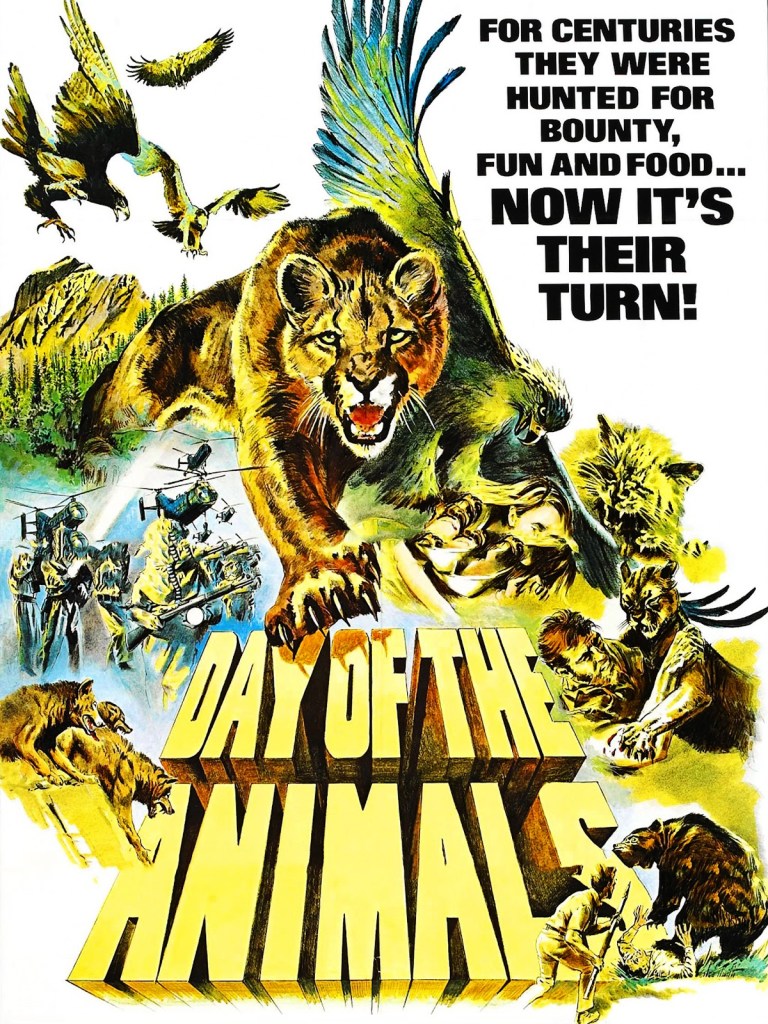
I think what really took a bit to get used to is that despite having a variety of animals going wild to a depletion of the ozone layer, there’s not really that many animal attacks. Sure, there’s a wolf, a bear, some snakes, big cats, and birds, but it’s not quite as quick-paced as you might hope. That might make sense, though, given William Girdler directed this one, and he was also behind Grizzly, which I also found a tad on the sluggish side.

The story’s not bad, with a bunch of people going on a guided hike and coming across the wild and dangerous behavior of the animals, which of course causes some dissent in the group in the form of Leslie Nielsen’s character. It’s almost sociological in it’s approach at times – if man loses all sense of law and order, what horrors might they commit? It’s not heavy in that type of thing, but from Nielsen’s character, is does come up.

I’ll say that Neilsen (Prom Night, Dark Intruder, Creepshow) played a horrible character pretty well, and when he got #mauled, I can’t say I wasn’t glad (though I do wish it were a lot more violent, with screaming and limbs being torn off in gory agony and the like). I think the best character here, without much hesitation, would be Michael Ansara (Abbott and Costello Meet the Mummy, The Manitou, Dear Dead Delilah), who is a great guy, and has to deal with racism (he’s Native American) along with the killer animals. Both Christopher George (Graduation Day, City of the Living Dead, Pieces) and Lynda Day George (Beyond Evil, It Happened at Lakewood Manor, Fear No Evil) were fine, but neither one was that memorable.

And despite the premise of the film, I don’t think many of the animal attacks were that memorable, either. You had the white water rafting with wolves (technically dogs, but I liked the alliteration I had going) at the finale, which was fun, and there was a good scene in which someone’s getting into a car without noticing the nest of snakes on the seat behind them, which was playful, but that’s virtually it. There was a bird attack early on – the victim fell to their death in amusingly fake fashion – and I guess that was okay, but overall, I was sort of expecting more.

Day of the Animals is a movie I’ve wanted to see for a while, and I’m happy I did, despite not having loved it. It’s certainly better than some other 70’s creature films, such as The Food of the Gods, but when movies like The Swarm and The Pack exist, it’s hard to really go out of my way to recommend this one.

6.5/10

Goremet, Zombie Chef from Hell (1986)

Directed by Don Swan [Other horror films: N/A]

This is one of those films that I have a hard time hating. Goremet, Zombie Chef from Hell isn’t a good movie, but the first half can be pretty amusing, and though the second half is a bit of a struggle, it’s still sort of fun in that ultra low-budget type of way.

At least the plot is unique – a man, Goza, is cursed by the Holy Order of the Righteous Brotherhood to live forever, feasting on the flesh of people to sustain himself. And so he does – he owns a seafood restaurant, and engages in killing people and practices cannibalism.

The first half of the film just sort of follows a few of the people who enter the establishment. A woman gets killed, and her boyfriend finds her ring in a hamburger. A health inspector gets killed after warning Goza he’d have to shut him down. A police officer finds hair in his beer and soup, and upon investigation, finds dismembered body parts, leading to the greatest scene in the film, in which his head is punched clean off his body.

It’s in the second half of this short film (it runs around 70 total minutes) that things become a little less interesting, though arguably more consistent. Members of the aforementioned Holy Order of the Righteous Brotherhood regret that they made Goza into what he is, and want to destroy the flesh-eating abomination that they created. With the High Priestess and loyal members, they fight back against the evil of Goza.

To be fair, it’s not a bad way for the story to go, but it felt far more fantasy to me than I personally care for, albeit in a very low budget form. Seeing people killed and chopped up into food is more interesting to me than seeing some Brotherhood strike back against Goza, but that’s because I come to a movie like this for the violence. It’s perhaps partially inspired by Blood Feast, and sometimes feels similar to Blood Diner (though this is a better movie, and I would die on that hill), but whatever went into creating this, boy, what a movie.

Theo Depuay, who played Goza, didn’t really have the suave personality you’d expect from a 600 year old cannibal. People didn’t seem to mind him too much (aside from this guy coming in for a short order cook job – this asshole played by Arnold William may have made one of the funniest scenes in the film), but boy, his personality needs work. There’s also Michael O’Neill, who does most of the killing, and has a solid, hulking menace vibe to him.

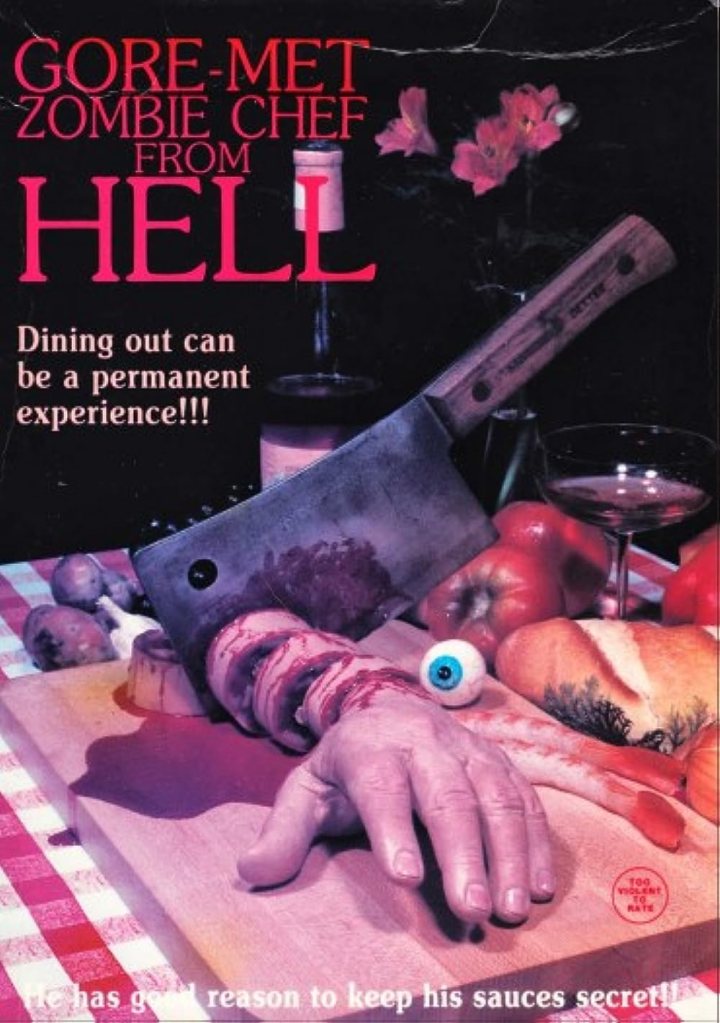
If you’re familiar with the VHS cover of this movie, you’ll see why this movie might stand out. Personally, I’ve always found it one of the most memorable covers for a horror film, and way back when I first heard about this movie and saw the cover, I knew I wanted to see it.

As such, it didn’t really impress me when I did finally see it, and I can firmly say it’s not a good movie after seeing it a second time, but that doesn’t mean Goremet, Zombie Chef from Hell can’t be an amusing film at times.

5.5/10