Lemora: A Child’s Tale of the Supernatural (1973)

Directed by Richard Blackburn [Other horror films: N/A]

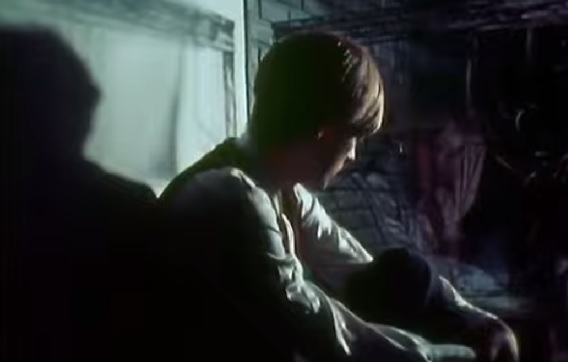
I’ve seen Lemora: A Child’s Tale of the Supernatural before, and I didn’t care for it. The fact that I was a teenager probably had something to do with that, and I likely wasn’t in a place where I could appreciate a slower, more sensitive movie like this one.

Well, after revisiting it, I have to say that I still don’t particularly care for it. It’s true that I can at least admit that I appreciate what it was going for, and certainly, I know the movie has its fans and generally positive reception (insofar as much as I hear this one being brought up), but I can’t say that I had a good time with it, because I didn’t.

Honestly, while the movie’s interesting, and the basic idea of a young girl going to a creepy town filled with vampires and seduction is one potentially worth exploring, I find much of the film so damn tedious. I wasn’t exactly falling asleep or nodding off, but more than once, I felt myself trailing off. That may say more about me than it does the film, but either way, this just isn’t my vibe.

I do like the end, though. To clarify, by end, I mean the final two sequences. That random all-out battle between the vampires and the werewolf/vampire things done in almost flash-freeze style was off-putting to the extreme, but afterwards, for the final couple of minutes I thought the movie showed promise that I’d not seen much of up to that point.

To be fair, I do think that Cheryl Smith (Laserblast) does a good job as a naive, religious kid. I certainly don’t fault her performance for my dislike of the film. I didn’t entirely care for Lesley Gilb, but that has far more to do with her character than it does her performance. The only other moderately relevant performance is that of Richard Blackburn’s (also the director of this film), and I think they could have done a bit more with his character had they wanted to.

There’s no doubt that this movie would definitely appeal to some. It’s not exactly a coming-of-age film, at least not in my mind, but it definitely has elements of that, and portions of the film can be quite creepy. The whole movie, in fact, feels dream-like, and the atmosphere is generally on point.

Despite all that, I keep going back to the fact I was bored for a lot of the film, and dangerously close to becoming disinterested. I can definitely understand why I didn’t care for the film the first time I saw it, as it’s an acquired taste, and after revisiting it with fresh eyes, I can say that it’s a taste I’ve still not acquired.

5/10

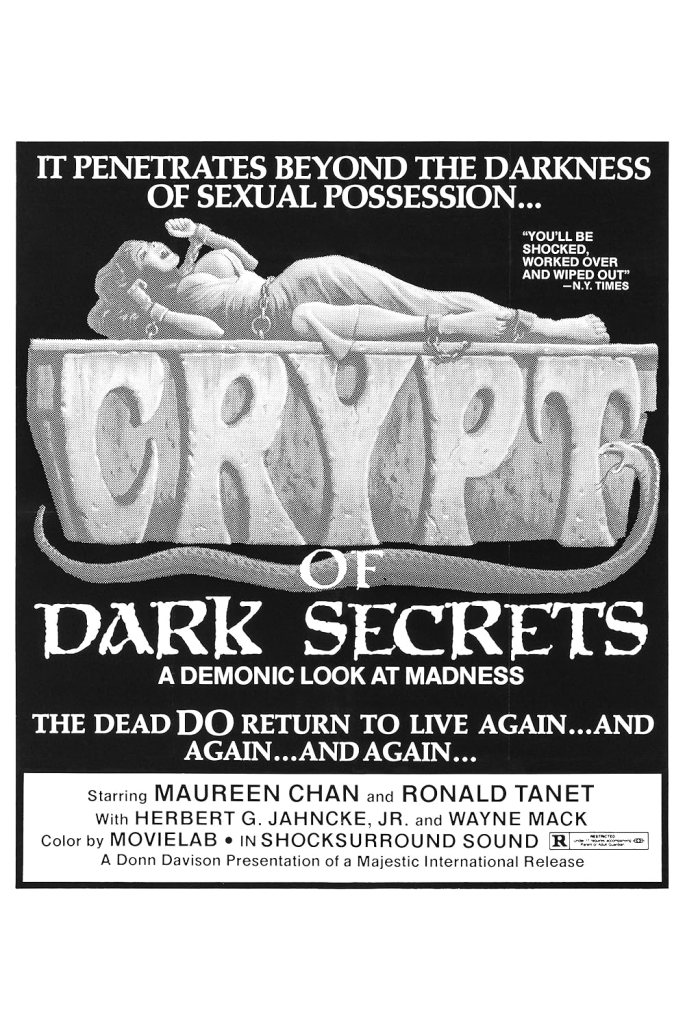
Crypt of Dark Secrets (1976)

Directed by Jack Weis [Other horror films: Mardi Gras Massacre (1978)]

I wanted to like Crypt of Dark Secrets, and aspects of it were decent, but large sections of the film were slow as all hell, and it was generally a bit of a slough to get through.

Here’s what I enjoyed, though, about the film: the setting, being the swamps of Louisiana, was great. I’ve said it before, and I’ll say it again – swamps are underutilized in horror. I imagine filming in a swamp would be a nightmare, but boy howdy, what beauty. Much of the film here takes place on a haunted island in the middle of a swamp, and if that doesn’t scream stellar setting, nothing else could.

I also appreciate how the basics of this film can’t help but remind me of “The Legend of Wooley Swamp” by the Charlie Daniels Band. See, in that song, an ornery old man, who had a bunch of money, lived alone in a swamp and was killed. Here, we have a younger man (though still with 15 years experience in the military, serving in both Korea and Vietnam), and when three people hear about the money he has stored up there, they go to kill him and take his riches. I’d argue that the song is a hell of a lot more fun, though.

At this juncture, I did want to briefly talk about one of the main characters, played by Ronald Tanet. As the guy living on a haunted island with a decent chunk of money, I was consistently amused by how little emotion this guy showed throughout the film. I sort of get it – if you’ve been a soldier for almost twenty years, I can imagine not having the capacity to care much about anything once you’re out, but this guy was like a blank slate. It may well have been intentional, but having a focal character with absolutely zero emotion was impressive.

Things take a turn in the second half of the film, though, after the three ne’er-do-wells (played by Butch Benit, Harry Uher, and Barbara Hagerty) successfully get the money they sought, and things slow to crawl. To be fair, it had been sluggish before, in the way that some 70’s films suffered from, but once we get the origin of the snake-woman Damballa (played by Maureen Ridley) in a drawn-out eight minute sequence, I was outtie.

Certainly some elements past that point are fine, but I have to admit I was a lot less invested, and it didn’t help that on two different occasions, we had scenes of a nude, or nearly nude, woman dancing for minutes on end. One of the final scenes was a three minute dance sequence, and I just didn’t really think that was necessary. I was painfully reminded of Snake People, and Snake People is a movie I try to think about as little as possible.

Wayne Mack was the closest thing to a traditional main character here, and I don’t really think he classifies. Still, his performance as a folksy police lieutenant was solid. I’ve already spoken a bit about Ronald Tanet; his performance was void of emotion, but that’s not all bad. I wasn’t wild about Maureen Ridley, but she could dance in the nude with the best of them. Really, the only other performance worth mentioning is that of Harry Uher’s, and it’s possible that Uher stood out solely for the fact that he’s Cajun, and had that Cajun accent I rarely hear in horror films.

It can also be fairly said that along with the movie being slow and occasionally torturous to get through, there’s not a ton of horror. There’s a lot of potential, of course – anytime you have a woman that can turn into a snake on a haunted island in the middle of a swamp, that’s called potential – but I don’t think the movie lived up to it at all, which was disappointing. There was some suspense toward the end, but much of the film seemed like conversation after conversation, and perhaps the best sequence was the literal blood money that briefly haunted the three punk bitches.

In summary, Crypt of Dark Secrets (which didn’t have a crypt in it, nor am I aware of what the dark secrets were, or who was keeping them) was a slow and tedious time with a handful of decent scenes. I do tend to think it’s better than Weis’ later film, Mardi Gras Massacre, but given the set-up, this is one that I wish I liked a lot more.

5.5/10

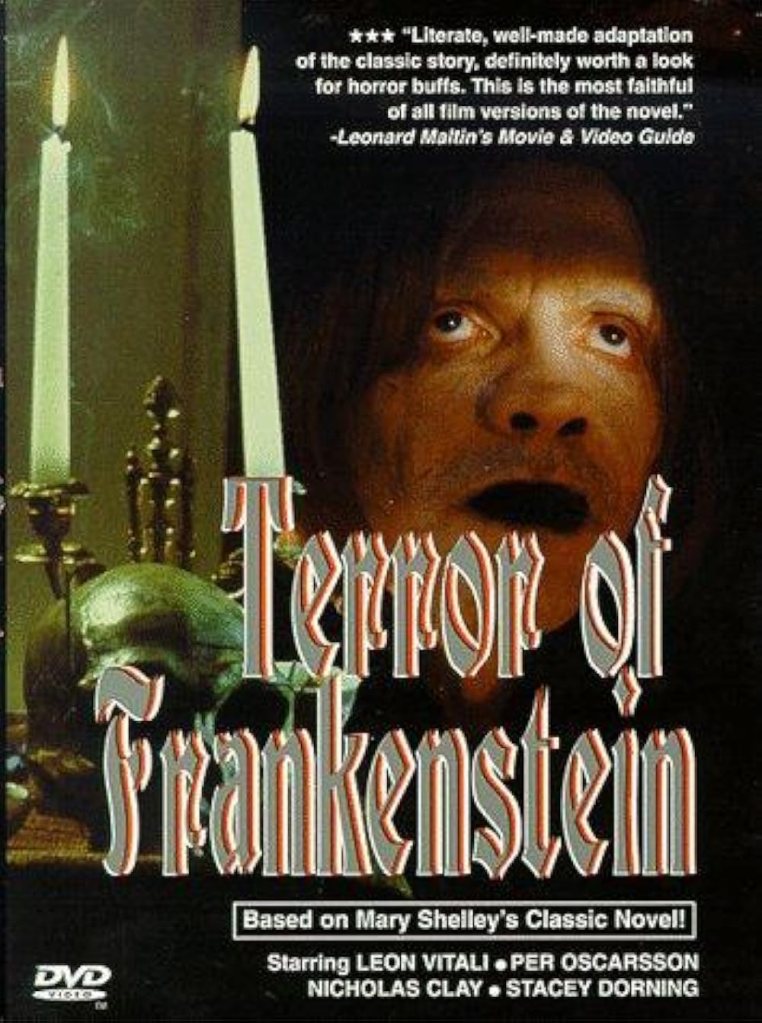
Victor Frankenstein (1977)

Directed by Calvin Floyd [Other horror films: Vem var Dracula? (1974), The Sleep of Death (1980)]

More than anything, Victor Frankenstein feels like a television movie, portraying the events of Mary Shelly’s novel as accurately as possible. Certainly that’s an admirable goal, but it’s also true that the movie just feels a tad too stagey to make a great impact.

I should note, though, that when I say Victor Frankenstein (or, as it’s sometimes better known, Terror of Frankenstein) attempts to accurately follow the original story, I’ve not actually read the original story. Bits and pieces, perhaps, but when it comes to early horror or gothic literature, I’m woefully ill-equipped. Still, I’ve heard that this is among one of the more accurate movies out there, and I’ll take their words for it.

If your only experience with Frankenstein is the 1931 Universal classic, or perhaps the 1957 Hammer edition, then I think you’ll find this quite a bit different. The structure is largely the same – a young man attempts to discover the secret of life, and his experiments go awry – but where the differences develop become clear in the Creature.

Here, Frankenstein’s Monster is capable of developed speech. He can hold conversations, hold awareness of his surroundings, and even plot revenge. In fact, there’s a sequence in the film where the Creature is explaining to Victor Frankenstein about his experiences after being brought to life. After the story (which is told in a 15 minutes or so flashback), he tells Frankenstein that he wants him to make him a woman, so he won’t be so lonely.

And here’s the kicker – the Creature straight-up blackmails Frankenstein. If Frankenstein doesn’t consent to make him a mate, the Creature says that he’ll kill all of Frankenstein’s family and friends, one-by-one. That is a promise that he holds onto pretty well, too.

So what we have is a Creature who generally seems pretty human-like. Sure, he has black lips and a dead face, but he can hold conversations, can plot revenge, can blackmail, and can generally tend to his needs. In fact, toward the end, he even gets a bit philosophical, in what has to be among the best lines of the film (“When the world was new to me, I would have wept to die. Now death is my only consolation, because in death, I cease to be a monster and a man.”)

Per Oscarsson (Traumstadt, The Night Visitor, The Sleep of Death) plays a fascinating version of the Creature. It’s not something I’m used to, but I can appreciate it here. Leon Vitali does great as Victor Frankenstein, an amoral young man far more interested in discovery than his love interest, played by Stacy Dorning. I also liked Nicholas Clay (The Night Digger) here, especially toward the beginning, where his friendship with Frankenstein was most fully on display.

In terms of scares, it probably doesn’t surprise many to learn that they’re somewhat scarce and spread out, when they do make an appearance. We see a young boy killed, but perhaps the best sequence is a somewhat tense scene focusing on a mountain climber who runs amok of the Creature.

I highly doubt Victor Frankenstein (or Terror of Frankenstein, should you prefer) will be long in my memory as a movie, but as a rendition of the Creature, I do think that this film will make a lasting impression. It wasn’t exactly a fun time, but I enjoyed how the story was framed. Still, it felt quite stagey, and while impressive on some levels, and certainly worth a look if you’re into the original novel, it wasn’t entirely my thing.

6/10

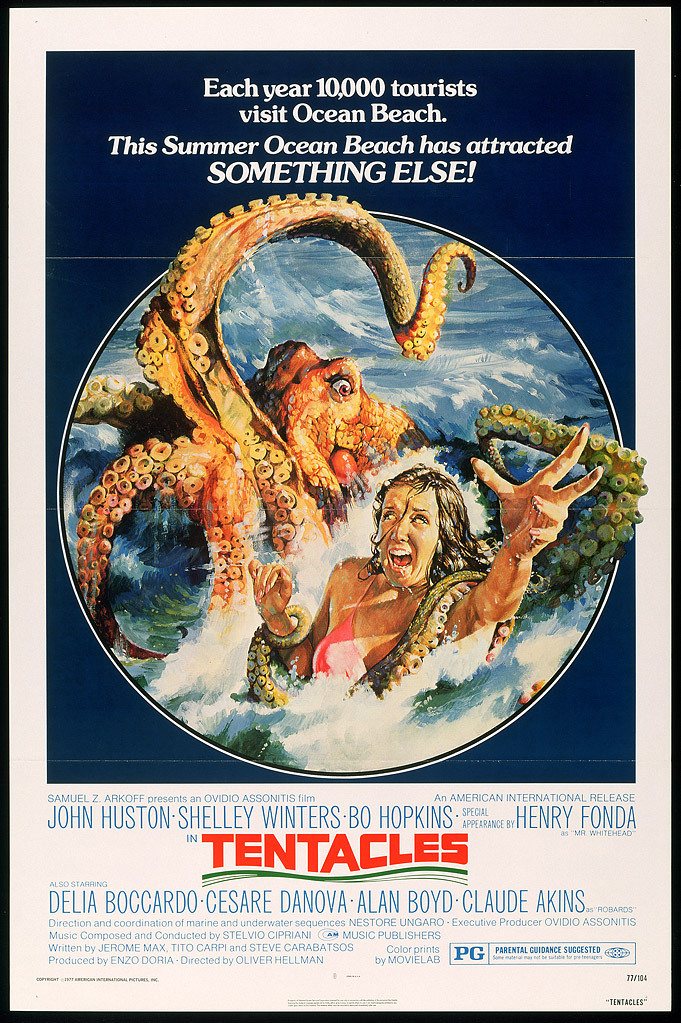
Tentacoli (1977)

Directed by Ovidio G. Assonitis [Other horror films: Chi sei? (1974), There Was a Little Girl (1981), Piranha Part Two: The Spawning (1982)]

Commonly known in the USA as Tentacles, Tentacoli is a movie that could have been better. As it is, it’s not a bad time, but it can be a bit dry, and perhaps there’s not enough action to bolster it.

I first heard of this film in a rather unconventional way. See, I’m a big music guy – I listen to pretty much everything (save blues and jazz), and some of what I listen to is quite out of the mainstream. There’s a band called Tentacle PornMonster, sort of a pornogrind/goregrind mix, and their song ‘The End Of The Tentacle Orgy On The Beach’ starts off with a trailer for this movie, finishing off with calling it the ‘most gripping suspense you will ever experience.’

Since that point, I’ve wanted to see it, and some years later, I did. I can’t really remember much about what I thought about Tentacoli the first time I saw it – certainly I recall the regatta sequence – but while I find it a decent time, I can’t say that there weren’t quite a few times when the film wasn’t that engaging.

There’s no doubt in my mind the best scene is the aforementioned junior regatta. A bunch of young kids go out on a yacht race, but something else (and by ‘something else,’ I mean a giant octopus, not Marjean Holden) wants to join in on the festivities. It’s a good sequence from the beginning parade with the jaunty music to the flash-freezes used throughout, followed by the action in the water and the tragic premature conclusion of the regatta. It’s good stuff.

Another thing I really enjoyed about this was the music. There was a bunch of funky music throughout the film – it was sometimes suspenseful, it was sometimes jaunty – and it was always fun. I’m not sure why Italy’s movies of the 1970’s and 1980’s has more noticeable music than the United States counterparts, but in my personal view, they do.

Bo Hopkins (Night Shadows, Sweet Sixteen, A Crack in the Floor) was pretty good. I liked his relationship with the whales, and in fact, his little speech to the whales toward the end was pretty emotional. John Huston (The Visitor) was fun, though he doesn’t really have anything to do in the latter portions of the film. Henry Fonda was okay, but his character never got the comeuppance he was due, not by a long shot.

Others, such as Delia Boccardo (A Black Ribbon for Deborah), Claude Akins (The Norliss Tapes, Monster in the Closet, Where Evil Lives, The Curse, Tarantulas: The Deadly Cargo), and Shelley Winters (Poor Pretty Eddie, The Mad Room, Whoever Slew Auntie Roo?, The Initiation of Sarah, The Devil’s Daughter) all did decent, but none of them added that much to the movie as a whole.

I think the biggest problem with this, aside from it sometimes being a bit dull, is that the finale, the final battle between the giant octopus and two killer whales, just isn’t that engaging at all. I mean, it’s about five minutes of them fighting underwater (as one can expect) while Hopkins’ character tries to escape the fray and survive. It just wasn’t an interesting finale, and I think it probably could have been done better.

Naturally, this is, in many ways, a rip-off of Jaws, but in typical Jiggy fashion, I do tend to enjoy it more. Partially, as I mentioned in It Came from Beneath the Sea, it’s due to the fact I enjoy octopi, and the octopus here was pretty fun when he popped up.

Even so, I can’t say the movie is great. It’s entertaining at times, but other times it can be a bit of a struggle to sit through, and the fact it’s an hour and 42 minutes doesn’t help matters. Some sequences were really fun, such as the regatta, but overall, I tend to find this around average.

7/10

The Beast Must Die (1974)

Directed by Paul Annett [Other horror films: N/A]

Though the idea behind The Beast Must Die is largely fun, I don’t think the execution really does the idea justice. Portions are solid, even tense, but more often, I tend to find myself somewhat bored with the presentation.

I did appreciation the addition of the werewolf break, though – see, this is a whodunit, and we’re directed, as an audience, to try and figure out who the werewolf is, and toward the end of the movie, a 30 second werewolf break is given to us, so we can make our final selections.

It’s the exact type of thing I’d expect out of a William Castle movie. Apparently the director of this one, Paul Annett, wasn’t too keen on the idea, but he got overrode by the producer. It’s nothing that really changes the movie any, but it’s sort of fun, and had the film overall be a bit more lively, it might have made for a solid addition.

The story here is decent, though. Based on a 1950 short story titled ‘There Shall Be No Darkness,’ written by James Blish, the movie revolves around a group of people being brought to a country mansion by a rich businessman, and as he suspects one of them is a werewolf, he hopes to figure out the identity and kill the beast.

Like I said, the plot’s fun on the face of things. And again, there are some decent scenes, such as a werewolf (which pretty much looks just like a wolf) attacks a man through a skylight, or a tense moment in which Calvin Lockhart’s character is facing down a charging werewolf at night in the forest. Still, I found much of the material here somewhat dry, and I’m pretty sure I felt the same way when I last saw this one.

Calvin Lockhart makes a solid, somewhat tense, lead. He’s not an easy character to understand, but Lockhart’s character is decent. Naturally, Peter Cushing (Captain Clegg, Scream and Scream Again, The Abominable Snowman) is great to see, and his character, an academic of werewolves, is fun. Though his screen time was limited, Anton Diffring (Circus of Horrors, The Iguana with the Tongue of Fire, The Man Who Could Cheat Death, the Sylvester McCoy Doctor Who story Silver Nemesis) was nice to see, and he was perhaps one of the best characters here.

Others were decent here. Charles Gray (The Devil Rides Out), Marlene Clark (Ganja & Hess, Black Mamba), and Michael Gambon (the guy who ruined Dumbledore) were all fine. I can’t say that either Ciaran Madden or Tom Chadbon (Duggan from Tom Baker’s Doctor Who story City of Death) made much of an impression, but they didn’t take anything away from the movie.

Again, the issue here is that the movie just feels so dry at times. It’s never a terrible time, but it’s just not always that engaging. I don’t doubt The Beast Must Die has a lot of potential, and I know the movie has it’s fans, but it’s not a movie I personally find that great, despite the fun whodunit element to the plot.

6/10

La casa dalle finestre che ridono (1976)

Directed by Pupi Avati [Other horror films: Balsamus l’uomo di Satana (1970), Thomas… …gli indemoniati (1970), Tutti defunti… tranne i morti (1977), Zeder (1983), L’amico d’infanzia (1994), L’arcano incantatore (1996), Il nascondiglio (2007), Il signor Diavolo (2019), L’orto americano (2024)]

I have to admit that, though I expected a decent amount from this giallo, given the positive reception I’ve heard as long as I’ve known about the movie, La casa dalle finestre che ridono struck me as more than a little disappointing.

Commonly known as The House with Laughing Windows, this Italian movie definitely had some charm to it, not to mention tension and a pretty foreboding atmosphere, but I also don’t know if they explained everything as well as they could have.

And I don’t like saying this, either. The movie currently has a 7/10 on IMDb (with 5,394 votes), and since finishing it, I’ve read theories and ideas on some of the things in the film, such as how it’s a take on Italy’s cowardice during Mussolini’s reign. A lot of these ideas are interesting, but I usually expect gialli to lay at least a decent amount of it out, and that’s not what happened here.

Sure, there’s a shocking scene at the end. Anyone who’s seen this movie knows the scene I’m talking about. But what does it mean? I have no trouble buying that there’s a mass culture of silence in the community (as it’s pretty clearly stated in the movie), but there’s so many unanswered questions that, no matter how atmospheric and oppressive the movie is, I’m bothered by it.

The performances weren’t the issue here – Lino Capolicchio (Il signor Diavolo) made for a perfectly fair lead, Francesca Marciano an acceptable love interest, Giulio Pizzirani was good while he appeared, and Pietro Brambilla, while odd, was okay. Vanna Busoni’s character appears for five minutes, but then entirely disappears, which was an interesting choice.

The red herrings throughout weren’t bad ideas, but some of them (such as the watch Fransesca Marciano’s character has) seem to be set up, only to never be mentioned again. The whole movie, on a side-note, seems to move pretty quickly, but there were times when I was wondering what exactly was worrying the characters, as little we’d seen up to that point really seemed worth being frightened over.

Not everyone needs answers, and obviously, plenty of people enjoyed this one quite a bit. I was hoping to be one of them, but I just can’t. Maybe I can grow to appreciate this one with future watches, but the fact that so much is left unclear rubs me the wrong way. If I wanted an artistic allegory about post-fascist Italy, I wouldn’t be a horror fan, and this one, while it has it’s strong elements, just felt off to me.

6/10

Death Bed: The Bed That Eats (1977)

Directed by George Barry [Other horror films: N/A]

Having seen this oddity once before, I was looking forward to revisiting this one. I had to anyway, of course, but I wanted to see if this was as odd as I remembered it being. And certainly, after seeing it with fresh eyes, I can say that it is.

Most horror fans probably know the story behind this movie. After being filmed, the director George Barry wasn’t able to get it distributed or released on video, but a bootleg VHS was created, and it wasn’t until 2001 that Barry found out that anyone save him and those involved in the movie knew this existed. It finally made it onto DVD officially in 2003, and the rest is history.

Death Bed: The Bed That Eats might sound, based on the title, to be a goofy movie, but I don’t really think that’s the case. There are some mildly amusing parts, or some pieces of dialogue that are sort of funny, but there’s very little in here that seems to actually be played for laughs. Really, as ludicrous as the plot is, the movie feels more fantasy than it does comedy.

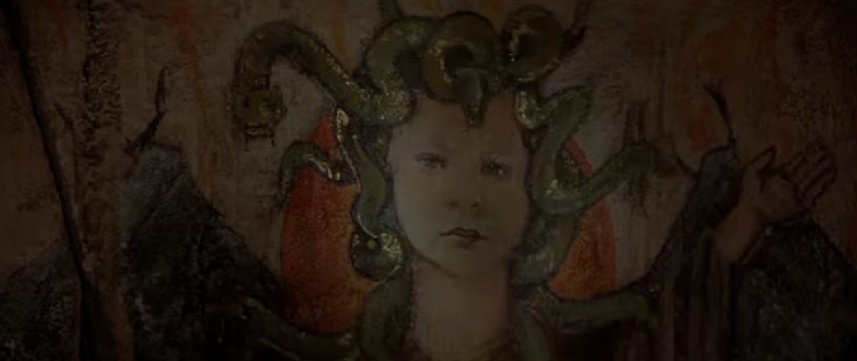
The reason for that, of course, being that one of the characters in the film is sort of the spirit of one of the bed’s victims who is trapped in a painting. He witnesses all of the atrocities the bed comments, and through his narration, we learn of the bed’s creation and history, with a particularly dry segment detailing some of the bed’s previous victims.

Of course, he’s not the only narrator in this movie. There’s a lot of internal first-person monologue here, which might not be a surprise, given it’s a 70’s film (Let’s Scare Jessica to Death did the same thing), but I almost feel there’s more internal monologue than there is actual conversations here. It’s an odd way to make a film, but given the story this has, which is somewhat bare-bones, perhaps it makes sense.

Only five performances matter here, and that may be a stretch. While the man trapped in the painting is played by Dave Marsh, his monologue is voiced by Patrick Spence-Thomas. Spence-Thomas has a dramatic delivery that adds to the amusement, though much of it may not be intended (‘You [potential victims] gaze at me as a painting on the wall, and I see you as a serving upon some monstrous silver platter’). Even so, it’s good stuff.

Most of the characters, played by Rosa Luxemburg (no, not the revolutionary socialist and Marxist philosopher), Julie Ritter, Demene Hall, and William Russ (Dead of Winter), weren’t really that important. I mean, Luxemburg’s was, but either way, none of them got a whole lot of what you’d actually call character.

Even so, this is a mildly fascinating movie. It’s digestible (see what I did there?), and the special effects can sort of be cool. See, when the bed consumes something, it sort of takes it into it’s digestive fluids. Perhaps one of the more memorable scenes is a man who’s hands get dissolved to the bone before he’s able to pull them out of the bed. There’s also a whole dreamlike atmosphere that permeates much of the movie, which makes sense, as the idea of this film apparently came from a dream of the director.

Those effects paired with the fantasy-feel of the narration and whole of the story make for a rather different movie. It’s not a good one, but it definitely feels unique, and related, totally 70’s. I can’t say it’s a movie I’d watch too often, but it is a somewhat wild ride that should be seen to be believed.

6/10

Invasion of the Body Snatchers (1978)

Directed by Philip Kaufman [Other horror films: N/A]

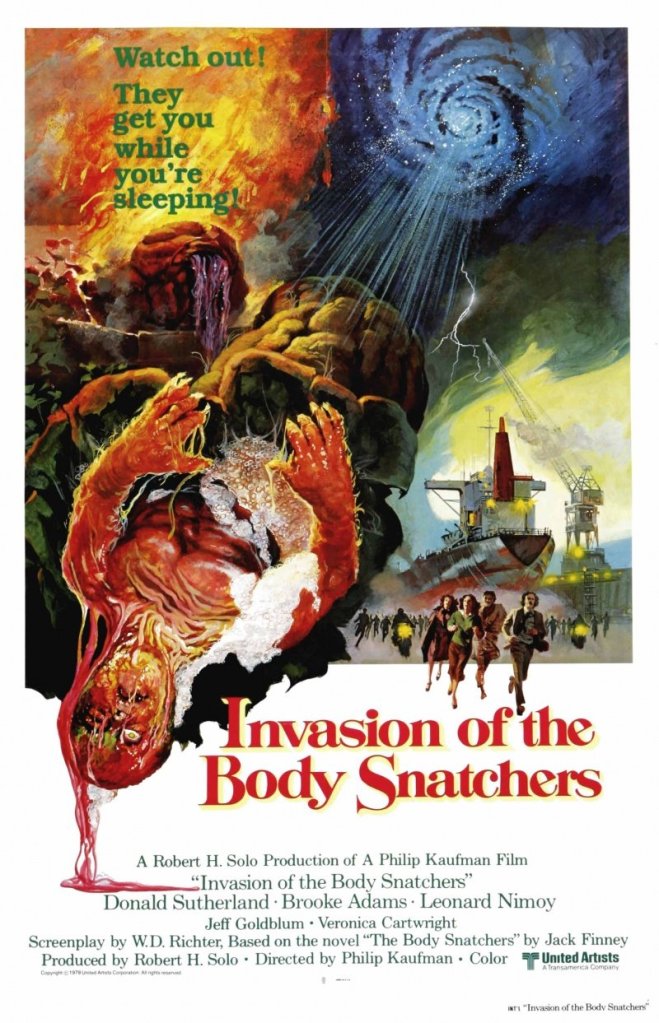
Probably one of the more popular horror films I’ve not seen until now, this adaptation certainly had some strong moments, and is generally a solid movie, though I have to say I still enjoyed the 1956 version of the film more.

Based on a 1955 novel written by Jack Finney, this story follows the 1956 movie’s decently well, the most important change probably being the setting – in the 1956 movie, the setting is Santa Mira (a fictional small town); the setting in this film is San Francisco – and I do think that change is troubling.

For one, I think taking over a city of 691,000 (an estimate based on the populations of San Francisco from 1970 and 1980) would take longer than what we see in the movie. It just makes more sense to me for the action to take place in a small town (ironically, the 1993 Body Snatchers had too small a scope – a military base – so perhaps I’m just being picky).

Honestly, most of the movie is pretty good. Aside from the ending (which, because I’ve spent more than a day online, I knew was coming), though, nothing here really blew me away. Everything is pretty well done – some solid tension, some solid performances, and such – but I just didn’t walk away from this one feeling amazed.

To be fair, it’s probably very difficult for me to decouple myself from the 1956 movie, which is a film I first saw as a kid, and have seen many times since. Much like how I enjoy the 1958’s Blob movie more than I enjoy the 1988 movie, and enjoy the original Fly over the 1986 remake, based off this one viewing, I do prefer the 1956 version, and while that could change with future viewings, I’ll fully admit that I may be too entrenched in my viewpoints.

Donald Sutherland (The Puppet Masters, Alone, An American Haunting, Salem’s Lot, Don’t Look Now) was a pretty good lead. Having his character work in the Health Department was a fun choice, and I dug his personality. Honestly, neither Brooke Adams (Shock Waves, Sometimes They Come Back, The Unborn, The Dead Zone) and Veronica Cartwright (The Town That Dreaded Sundown, The Dark Below, Alien) did that much for me. I mean, they weren’t bad, but neither one interested me much.

I did love seeing a young Jeff Goldblum (Mister Frost, The Fly, Hideaway, The Legend of Sleepy Hollow, Jurassic Park) take on a solid role. He doesn’t leave as big an impression as Sutherland does, but still, seeing Goldblum is a lot of fun. Leonard Nimoy (famously Spock on Star Trek) is interesting, but I don’t know if his character adds all that much. However, in a brief scene, we do see Kevin McCarthy (star of the 1956 movie) and later Don Siegel (director of the 1956 movie), so those cameos were nice.

The special effects were quite solid, and at times, quite unnerving. Undeniably, I do think that’s an improvement over the 1956 film, and the end is certainly solid too. I do think I prefer how the 50’s movie ends than I do this one, but I can’t deny that the ending is effective. Like I said, I saw it coming, as I’ve seen the picture of Sutherland’s character pointing before, but it was still a good final sequence.

When it comes down to it, I think Invasion of the Body Snatchers was a good movie, but nothing here, save the finale, did that much for me. It’s a good story, of course – we already knew that from the 1956 movie – and the performances were overall solid, but with just a single viewing, I think I’ll stick with the 50’s movie for now.

7.5/10

Damien: Omen II (1978)

Directed by Don Taylor [Other horror films: The Island of Dr. Moreau (1977)] & Mike Hodges [Other horror films: The Terminal Man (1974), Black Rainbow (1989)]

Much like the first movie, Damien: Omen II is a film I saw bits and pieces of quite often in my childhood. I can’t swear I sat through the whole thing, and if I did, I doubt I understood some of the subplots, but it’s a movie I always enjoyed, and actually tend to like more than the first movie.

A large part of that is because of the pacing. The first movie was a bit slow at times, which is amazing, as this movie, at an hour and 47 minutes, is only a little shorter than the first movie’s hour and 51 minute run-time, and yet, this one just seems to move quicker. There’s also the fact Damien is 12 years old, and has a decent amount more agency than he did in the first movie, including control of his awesome abilities.

I also love a lot of the deaths in this movie. I don’t think any match the glass plate decapitation in the first film, but there’s a lot of memorable sequences here. I think the most striking may be the elevator scene, in which someone’s body gets severed in half. A woman gets her eyes slashed at by a raven, and blindly runs into the road, getting hit by a semi. Some people drown in falling sand – an opening scene which I’ve never forgotten. And though not at all gory, someone gets impaled by a train. Even the guy drowning beneath the ice was A+ material. Plenty of quality scenes in this one.

Performances are solid too. Even smaller roles, such as those by Elizabeth Shepherd (The Tomb of Ligeia), Sylvia Sidney (God Told Me To, Death at Love House, Snowbeast, Beetlejuice), Meshach Taylor (Hyenas), Leo McKern (X the Unknown, along with being the only returning face from the first movie), Lew Ayres (She Waits, Donovan’s Brain, Salem’s Lot), and Nicholas Pryor (Brain Dead), all did reasonably well, and though some didn’t have much time to make an impression, I think most were able to do so.

At times, Jonathan Scott-Taylor seemed a little melodramatic as Damien, and Lucas Donat occasionally had the same problem, but for younger actors, I thought they worked well together. Lance Henriksen (Mansion of the Doomed, In the Spider’s Web, The Invitation, The Pit and the Pendulum, The Mangler 2) wasn’t really in the spotlight, but he was quality when he popped up. Robert Foxworth (It Happened at Lakewood Manor, Prophecy, Deathmoon, The Devil’s Daughter) had a good, dark aura to him.

William Holden made for an engaging character, and I could buy him as Gregory Peck’s brother. Especially toward the end, as he was learning more and more about Damien’s backstory, he really had time to shine. Likewise, while Lee Grant (The Spell, Visiting Hours) doesn’t make much of an impression until the finale, she really does make an impression come the finale, and even has a somewhat surprising story arc.

Again, I really liked the performances in this movie. It’s a fun story with plenty of interesting deaths and a solid finale, all with quality performances and moving at a quick pace. Admittedly, I’m probably one of the few who enjoys it more than the first movie, but I do, and though I don’t think it’s a significantly better film, it is one that I’ll never have a problem revisiting.

8/10

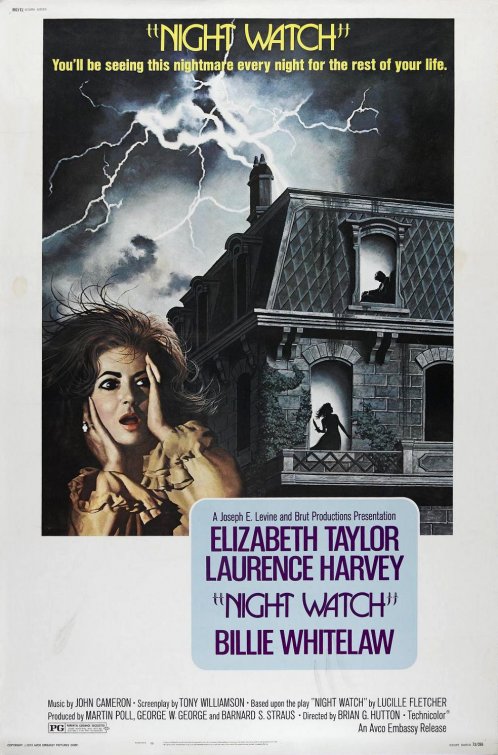
Night Watch (1973)

Directed by Brian G. Hutton [Other horror films: N/A]

A nice take on what could have been a rather unoriginal story, Night Watch is a movie with a lot going for it. You have an interesting mystery, some stand-out performances, a killer finale, and the joys of British weather. It’s not an amazing movie, but I’ve always liked it.

And when I say ‘always,’ I mean I’ve just seen it twice, but I found it a decent watch. I think I liked it a bit more this time around, perhaps because, while I’ve seen it before, I actually forgot how the film ended, and seeing the movie with more mature eyes probably led to a deeper enjoyment.

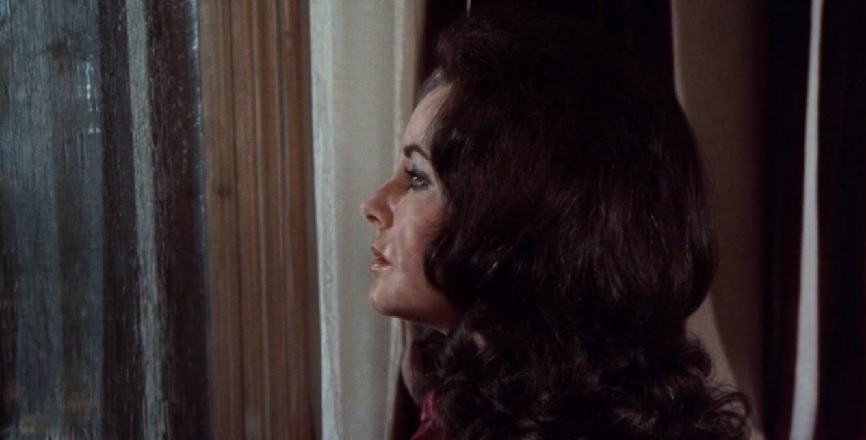
Even so, I don’t think the movie’s perfect, by any means. The film does well at building up the tension Elizabeth Taylor’s character faces after witnessing a murder, yet having no one – her husband, her friend, the police – believe her. It’s good, slow tension. The movie is about an hour and 40 minutes, though, and while it shines during the finale, getting there can be a bit of a drag.

Elizabeth Taylor (Doctor Faustus, Who’s Afraid of Virginia Woolf?) did pretty well in her role. There are a few moments when I’m not sure her acting entirely nails it, but overall, she does quite well. Laurence Harvey (Welcome to Arrow Beach, House of Darkness) had a suave, debonair aura to him, and he was quite fun.

Billie Whitelaw (The Omen, The Flesh and the Fiends, Murder Elite) was never quite trustworthy, but a solid character nonetheless. Others who warrant a brief mention include Bill Dean, Tony Britton, and Robert Lang.

Most of this movie is mystery and build-up, but during the finale, there is a solid murder or two by stabbing, which I appreciated. It’s a short scene, and a small part of what is a very solid finale, but certainly worth it.

All of this said, I don’t think that Night Watch is a movie I’d consider that great. It’s still above average, but because of how long the film sometimes feels, it’s not one I imagine I’d revisit all that often, especially when other movies of a similar nature, such as Endless Night, are a bit more enjoyable.

It’s a good movie, worth a watch or two, but it’s not a movie I personally consider too special.

7.5/10