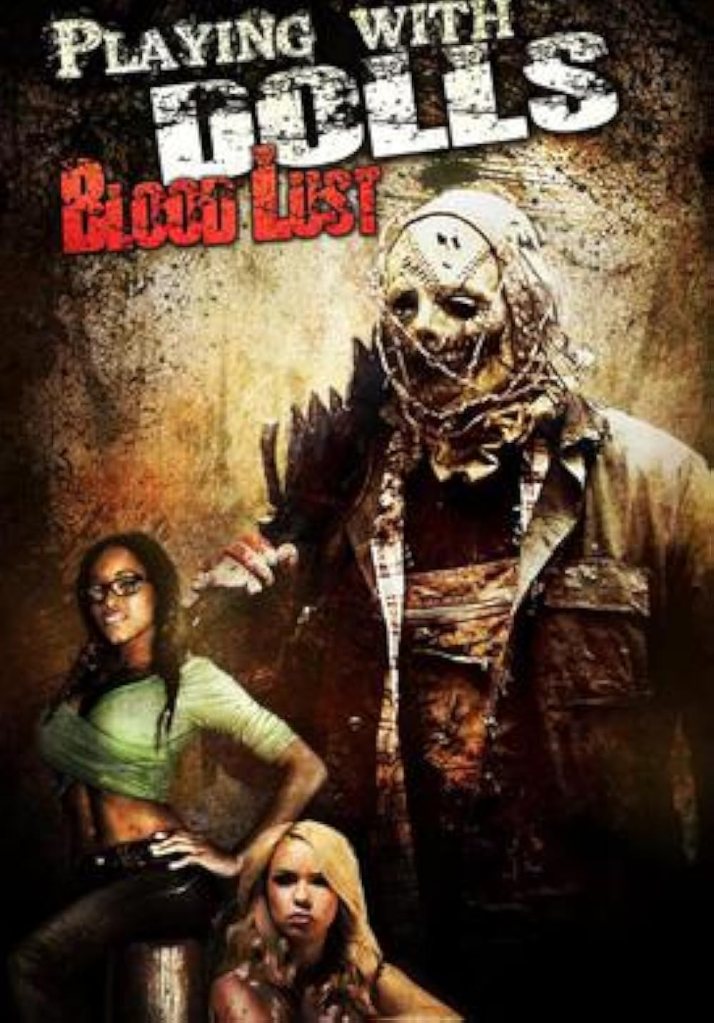
Playing with Dolls: Bloodlust (2016)

Directed by Rene Perez [Other horror films: The Dead and the Damned (2011), Demon Hunter (2012), Alien Showdown: The Day the Old West Stood Still (2013), The Snow Queen (2013), The Dead the Damned and the Darkness (2014), The Burning Dead (2015), Playing with Dolls (2015), Little Red Riding Hood (2016), The Obsidian Curse (2016), Playing with Dolls: Havoc (2017), From Hell to the Wild West (2017), The Dead and the Damned 3: Ravaged (2018), Cabal (2020), Cry Havoc (2020), Legend of Hawes (2022), The Vampire and the Vigilante (2024)]

Well, the first Playing with Dolls was utterly abysmal, and I can say that Bloodlust is a better movie. It’s not that much better, though – this is still a far cry from even average – and I wouldn’t think it’d appeal to too many people, regardless.

Unlike the first film, though, there’s something of a plot here – people are lured to an abandoned cabin to be part of a horror reality TV show. I have no idea if these people signed contracts, but if so, they’d have a good lawsuit on their hands, because this is one terrible reality TV show idea.

On a side-note, I’m not sure why most horror films that revolve around reality television tend to be absolutely terrible – I’m thinking movies like Reality Check, Cruel World, and, to a lesser extent, My Little Eye, which certainly wasn’t terrible, but was underwhelming. The only reality show-themed horror film I’ve ever cared for was Wrong Turn 2: Dead End, and that’s not even that great a movie.

Regardless of why this seems to be the case, Bloodlust certainly doesn’t help improve my view any, as it’s legit awful.

Sure, it does have more of a plot, and perhaps more importantly, more than one protagonist, but only one of the performances is decent, and we still don’t have context as to why any of this is happening. The same rich guy (Richard Tyson) is recording the same killer (credited as Prisoner AYO-886, because the movie’s trying to be cute) as he kills people, and apparently it’s because that’s the only truth. It’s that same type of philosophical rambling that makes absolutely no sense, and gives absolutely no insight into his character at all.

These movies just bug me. The gore here is okay – someone gets their head smashed in with a sledgehammer, someone gets their arm cut off, someone gets their leg cut off, someone gets one of their toes cut off (this movie is big into dismemberment apparently) – but gore without proper context doesn’t interest me, and as such, this didn’t do a hell of a lot for me.

I can’t stand Richard Tyson’s character, because, like in the first movie, he doesn’t have much of one. Karin Brauns (who died in 2022 at the age of 32) was pretty poor (her character had an accent, but unlike Natasha Blasick’s character from the first, there’s no in-universe reference to this), Elonda Seawood wasn’t particularly interesting, and Andrew Espinoza Long, despite potential, didn’t bring much to the table. I will admit to liking Colin Bryant here, and Marilyn Robrahn (who was also in the first film) had an okay moment or two, but for the most part, there’s little here to praise.

Oh, and it’s worth mentioning that there’s no ending to this film. Two characters are fighting each other, two other characters are watching, and then the movie ends. The first movie didn’t have much in the way of a conclusion either, but at least that one felt like it could have worked, whereas this was just pathetic in every way, which, honestly, is on point.

I’m sitting here and realizing just how much of a waste of time I found this. The worst part is, I’ll likely be watching the sequels (Playing with Dolls: Havoc and Cry Havoc), so I’ll have ample time to complain in the future. All I’ll say is that Bloodlust was better than the first movie, but not by much, and neither are movies I was glad to have seen.

4/10
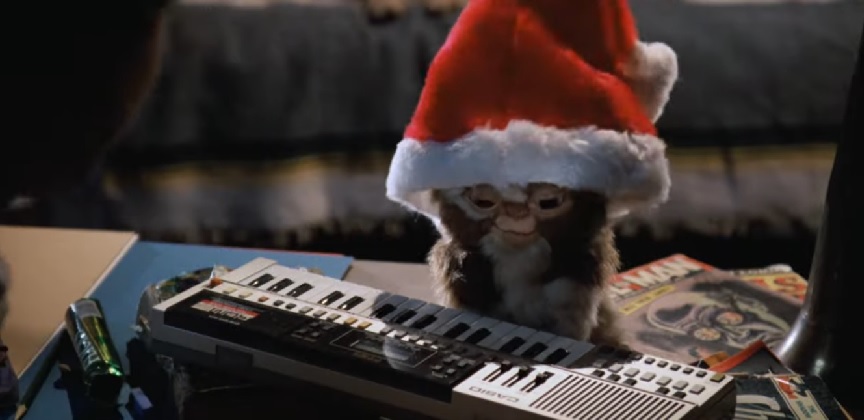
Gremlins (1984)

Directed by Joe Dante [Other horror films: Piranha (1978), The Howling (1981), Twilight Zone: The Movie (1983, segment ‘It’s a Good Life’), The ‘Burbs (1989), Gremlins 2: The New Batch (1990), Trapped Ashes (2006, segment ‘Wraparound’), The Hole (2009), Burying the Ex (2014), Nightmare Cinema (2018, segment ‘Mirari’)]

As with many people, Gremlins is a movie I first saw when I was a kid. I thought it was a great movie than, and very little of the magic has disappeared with the growing years.

There’s so many aspects of this film that are laudable. The small-town feel, the special effects, the characters, the music – there’s a lot here, so let’s #DigIn.

One thing that’s always captivated me about this film is the location of Kingston Falls. It feels like a 1950’s Norman Rockwell painting writ large, though the look and homey feel doesn’t varnish the reality that there are many poor and struggling people in the town. A woman and her children face prolonged hunger, people are out of work, and while everything looks great, there are problems here even before the gremlins decide to make the town and its citizens their bitch.

Still, the small town feel is great in this movie. It seems that everyone knows everyone. The main character, Billy, who’s long out of school, is still in contact with his old science teacher, which I’ve always found odd, and when Billy needs to take his mother for medical attention, they just walk down the street to where their family doctor lives. It’s a small town, and that vibe permeates throughout, which is great.

Naturally, the special effects are pretty good. Gizmo always looks cute (and actually, when I was young, I won a Gizmo doll at a carnival, and it was quite cuddly), the gremlins look moderately frightful, and throughout the film, there are some quality effects, such as the way the gremlins multiple by water. The lighting also plays a part in this – sometimes, the lighting is quite striking, and helps add to the effect.

I also love how at times, when it shows the whole of Kingston Falls, it’s a literal painting. That scene with the group of gremlins first walking into town from the YMCA was stellar. The final shot, with the man walking away with Gizmo, was beautiful. And God, the opening – what an atmospheric, beautiful opening on a busy, Chinatown street with narration by Hoyt Axton’s character. He also gets closing narration, and it’s just great (“before you call the repairman, turn on all the lights, check all the closets and cupboards, look under all the beds. Because you never can tell – there just might be a gremlin in your house.”)

Zach Galligan (Waxwork, Bad Candy, Nightbeasts, Psychic, Hatchet III) doesn’t always make the most engaging lead, but he’s fun enough. Obviously, Phoebe Cates can be overdramatic at times; still, it’s all in good fun. I absolutely adore Hoyt Axton (Buried Alive, King Cobra) – he seems like such a likable guy, and his narration, as I said, was on point. Despite limited scenes, Keye Luke (Dead Heat, The Cat Creature) was great, and playing Billy’s mother was Frances Lee McCain (Back to the Future), who killed four gremlins on her own, which was deff impressive.

Even the smaller characters are pretty good, though, and include some surprising faces. Judge Reinhold (Beverly Hills Cop, The Hollow) appeared only in two scenes, Jonathan Banks (Better Call Saul, Breaking Bad, Dark Breed) only a handful himself, and Corey Feldman (Friday the 13th: The Final Chapter, Voodoo, The Lost Boys) in a few places. All add something, though. I’d be remiss to not include the great Dick Miller (Chopping Mall, A Bucket of Blood, Piranha, Tales from the Crypt: Demon Knight), who is always of good quality, and Jackie Joseph (The Little Shop of Horrors), who got just one sequence, but was a lot of fun.

Oh, and there’s also Glynn Turman (J.D.’s Revenge), Polly Holliday as the quotable Mrs. Deagle (“It will be quick and painless compared to what I would do to him,”), and then let’s not forget the most important character, Barney, who was played by Mushroom (also in Pumpkinhead).

As anyone who’s seen the movie can attest to, the music here is stellar. Not only am I talking about the theme music composed by Jerry Goldsmith (which is officially titled “The Gremlin Rag”), but there’s also “Christmas (Baby Please Come Home)” by Darlene Love and Johnny Mathis’ rendition of “Do You Hear What I Hear?” which pops up in a memorable scene. The music in this film is on point, it’s on fleek, and it’s off the chain-hook dawgs.

I love Gremlins. Sure, I don’t think it’s perfect – not all the comedy works, Cates’ story about the death of her father feels sort of silly (“Now I have another reason to hate Christmas”), and we never see Judge Reinhold’s character torn into pieces – but I think it’s a very solid film, and a perfect onboarding tool to get younger audiences into horror.

8.5/10

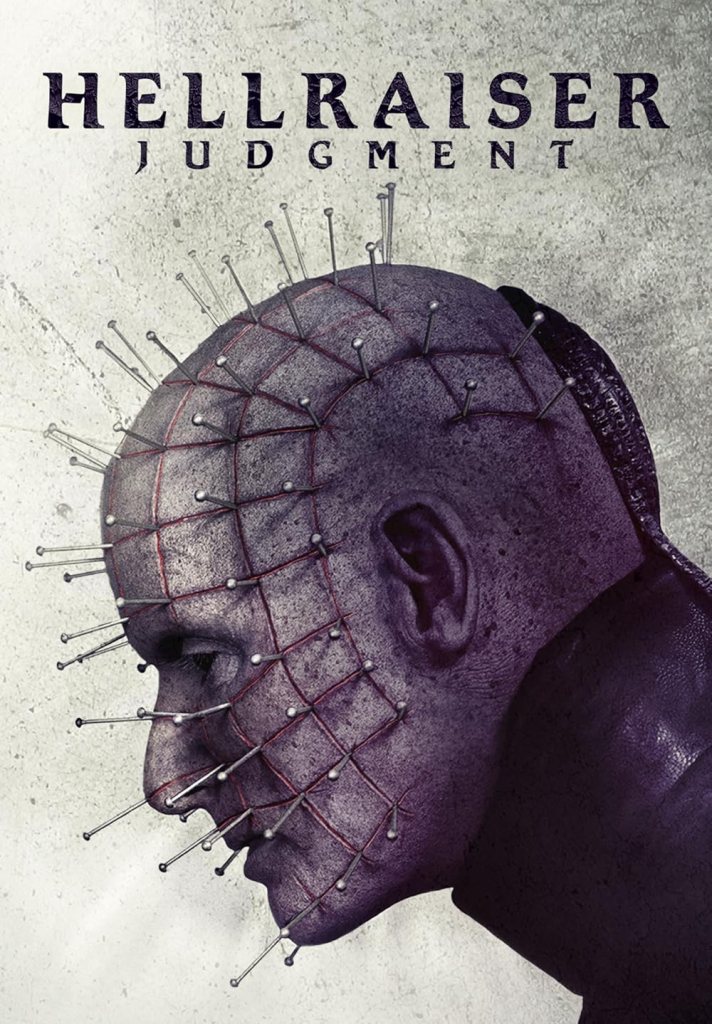
Hellraiser: Judgment (2018)

Directed by Gary J. Tunnicliffe [Other horror films: Within the Rock (1996)]

I’ve been curious about Hellraiser: Judgment ever since it came out. After Revelations, I was hoping the series could get back on track, and after watching the trailer to this one, I thought it had some potential. Well, I have some serious problems with Hellraiser: Judgment, but at the very least, I do think it’s mildly better than the previous entry, albeit not by a lot.

This doesn’t start out well, though, as I absolutely abhorred the first 12 or so minutes. In that time, we see Pinhead speaking to a character called the Auditor, which was fine (though I’d have liked some context as to who or what the Auditor was), and a man being lured to a house.

Once the man gets to the house, he meets the Auditor, who asks him questions about the man’s sins. Once those sins are written down, the man is sent to the Assessor (who looks completely human, on a side-note). The Assessor has a bottle of children’s tears, and combines that with the papers of the man’s sins, and eats them. He then throws the combination up into a pipe. That pipe leads down to the Jury. The Jury are three naked women with messed up faces who spread the vomit over their bodies to render a verdict. Once that verdit is rendered, the man is sent to the Butcher and the Surgeon (the Butcher a big, hulking hombre, and the Surgeon someone in a body-tight leather suit), who then do what they do best.

The whole thing feels like some dark, disturbing fantasy. As someone who doesn’t care for dark fantasy, I hated it. It reminded me of The School, in that it was trying to be as grimy and dirty as possible, and it came across as trying too hard. We get no information during this process – why is the Assessor the only human here? Is he human? Why are the Jury three nude women? Are they women? Why is the Butcher carrying around the Surgeon? Can the Surgeon walk?

We don’t get an answer to any of those questions. Not just during the first 12 minutes, but during the whole of the film. We never learn what these things are. Wikipedia says that they’re the Stygian Inquisition, which is a separate group from the Cenobites. Now, the movie never once mentions the word “Stygian” or “Inquisition,” so I have no idea if that’s accurate. If that’s the case, it would have been great if they mentioned that somewhere, because from my view, having a Hellraiser movie with only minimal Cenobite action, replacing that with random judgy things, doesn’t do much for me.

The reason I’m focused so much on this is because it had to be among one of the most unpleasant beginnings to a film I’ve seen in recent times, rivaling The Rage. During that time, I was thinking that if the movie continued on in that vein, I’d have absolutely no problem saying that Revelations is a better movie.

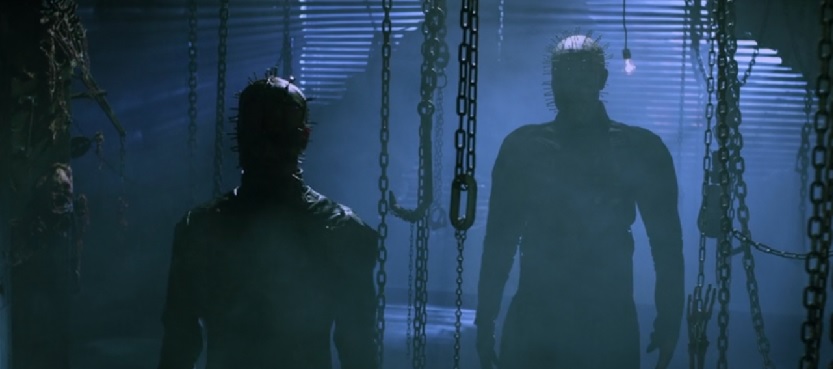
In fact, a good case could be made that while Judgment is certainly a better film insofar as budget is concerned, it’s a worse Hellraiser film than Revelations. Keep in mind, the focus of this film aren’t the Cenobites, it’s the Auditor. The movie doesn’t say what the Auditor is, but it’s clear that he and the process he follows has little to do with Pinhead, who seems to be an advisor (?) more than anything else. We do see a few other Cenobites, such as Chatterer (for brief moments) and some conjoined women, but we never get much of any of these, save Pinhead toward the end of the film.

Story-wise, I generally liked this one. It follows two detectives (who are also brothers) as they attempt to locate a religious serial killer. Throw in another detective, who is investigating, in part, one of the brothers, and the film feels almost like Se7en at times. I know some have complained about the procedural feel this sometimes has, but in truth, it never bothered me, and there’s a twist toward the end that I thought was actually decent.

Damon Carney (The Harrowing) and Randy Wayne (The Fun Park, Scar, Escape Room, The 13th Alley, Ghost Town, Hold Your Breath) made for somewhat believable brothers. I sort of expected more from Wayne’s character, but Carney was solid. Alexandra Harris (All Light Will End) appeared for a bit, but honestly didn’t stand out that well.

Playing Pinhead was Paul T. Taylor (Shifter), who did decently (though he was certainly no Doug Bradley). Director Gary J. Tunnicliffe himself plays the Auditor. Shame that this fact doesn’t give any more insight into his character. Lastly, playing an angel (I guess) is Helena Grace Donald.

I certainly don’t want to sound ungrateful, as I appreciated that Judgment tried to expand the mythos of Hellraiser. We have some ambitious, theological elements toward the finale, and I actually sort of liked that. I just wish they did a better job of explaining some of what we were seeing, such as the Auditor and his group’s relation to the Cenobites. The ending, too, was sort of unexpected, as Pinhead apparently went too far in his role.

Although I did want to touch on Pinhead, because again, I don’t think his character was done correctly. It’s my understanding that Pinhead is not a malevolent entity. In Hellbound, he stated that “It’s not hands that call us, but desire,” after a character was forced to open the box. In this film, two characters are forced to open the box at gunpoint, and Pinhead takes them anyway. I just don’t care for the more malicious characterization that Pinhead’s gotten in the last couple of movies, and I find it more interesting when he and the Cenobites are amoral as opposed to immoral.

Judgment’s a problematic movie. I was hoping that I’d like it a lot more than I ended up doing, but that doesn’t mean it’s not an improvement over Revelations. However, I can certainly understand why someone might prefer Revelations, if I’m being honest. Judgment was okay, but I really think if some things were cleaned up a bit, it could have possibly great. As it is, though, it’s nowhere close.

5/10

The Killer Shrews (1959)

Directed by Ray Kellogg [Other horror films: The Giant Gila Monster (1959)]

While calling The Killer Shrews a cult classic might be a bit strong, I do think it’s fair to say that this late 50’s film, despite some effects failures and less-than-stellar performances, is a decent amount of fun, although I also think it’s fair to say it can still feel on the average end.

It’s a pretty short film, at around an hour and ten minutes. Because it’s digestible, it doesn’t take too long to get moving, and given there’s only a handful of characters here, that keeps things simple. The plot is somewhat standard 50’s monster fair, the difference being that instead of one giant monster (as seen in The Giant Claw, The Beast from 20,000 Fathoms, The Black Scorpion, It Came from Beneath the Sea, and Earth vs the Spider), there’s lots of smaller giant monsters (similar, I suppose to Them!, although these shrews are much smaller than those anty bois).

That said, it’s also a movie with it’s foot in door of the following decade – while it’s a brief scene, a character gets bit on the leg, and we actually see a bit of blood. It’s a black-and-white film, so it’s not like the blood stands out that much, but it was a tad more violent than you’d expect from the late 1950’s. It’s not much, but give it four years, and this could have been a much different product.

Which isn’t to say that the product we do have isn’t good, as I do tend to find it a fun movie. The Killer Shrews is simple in story, but I think a lot of it works well.

I appreciate the atmosphere, for instance – on a small island, a group of people must bunker down in a house during a hurricane as killer shrews threaten their existence. The hurricane was a nice touch, and there’s a scene in which characters are keeping watch while the others sleep, going room to room, and I was immediately reminded of Halloween 4: The Return of Michael Myers, as the group’s holed up in the dark house, alone. This had a good atmosphere, and that went a long way to helping out.

James Best (Death Mask, Return of the Killer Shrews) wasn’t always the most defensible lead – at one point, he’s even close to throwing someone over a fence to the shrews – but he was decent as the generic, rugged man. Ken Curtis (mostly known for his western films) made for a fun and unlikable antagonistic force. I didn’t care much for Ingrid Goude’s character, but that has more to do with gender roles at the time than anything else. The fact that they had an in-story reference to her Swedish accent was fun, at least.

Of the other four performances – Baruch Lumet, Judge Henry Dupree, Gordon McLendon, and Alfredo de Soto – I think I liked de Soto the best. Dupree was sadly more a stereotypical portrayal of black men at the time (nowhere near as bad as Mantan Moreland’s usual character, at least), and despite lasting longer than expected, Lumet didn’t really stand out much to me. McLendon was sort of fun, though.

Certainly, there’s not a ton to The Killer Shrews. Some people make a big deal out of the shrews – for many of the scenes, they used dogs (wearing some type of cute costume) and hand-puppets. Honestly, I don’t think that harmed the film much. It may have looked silly at some points, but it’s not an easy case to make that it looks much worse than the average giant monster movie.

What works for this one is the atmosphere, which I deeply appreciated. The finale was quite amusing, reminding me of something you’d see in Tremors II: Aftershocks – I’ve seen this movie once before, but entirely forgot about the goofy, yet sensible, way the group tries to escape. The Killer Shrews is a fun film. It may not be any more than that, but I had a good time with it.

7/10

13 Tracks to Frighten Agatha Black (2022)

Directed by Bradley Steele Harding [Other horror films: N/A]

I really wanted to like this one. The opening was quite interesting, and struck me as promising, so I went into this movie hoping – really hoping – that it could work out.

Regrettably, I just don’t know if the idea here was executed that well.

No doubt, the base story here is quite interesting – a somewhat reclusive young woman, following the death of her aunt, finds old records of scary stories (think modern-day podcasts, like the No Sleep Podcast, only on records) and soon discovers herself in a dark and scary world. Sort of.

Part of my issue, and perhaps my biggest issue, is that I’m not quite sure what’s happening in the film. When a movie is subjective (technically, I know, you could argue any movie is partially subjective, but that’s not the point here) in terms of the events – such as having events that could be explained either by supernatural events or mental breakdowns – I lean toward mental problems, as I don’t have much truck with the supernatural.

There is a conclusion here that tries to explain things, but I’m not sure if I got it. It’s not clear to me, for instance, how much of the events of the film were supernatural-based or mental instability-based. I’m likely not explaining this well, but I guess I just have a difficult time understanding what exactly happened in this movie, insofar as the central character’s reality is concerned (and not the possibly confused experiences of the said character).

I liked the records of scary stories here, but I didn’t always get how much the main character experienced them. Again, that might not be phrased correctly, and so I’ll go into as much detail as possible.

The movie sometimes did a thing where the main character Agatha was doing something, such as going into a spooky house in the neighborhood, or defending herself from an aggressive lover. During those sequences, there would be one of these scary stories overlaying the scene. It wasn’t playing in the real world – it was purely for the audience (to my understanding). What I’m not sure about is whether or not Agatha had listened to these stories previously, and was relating that to the situation she was facing presently.

I have no idea if that’s nit-picky, or if that confusion is even coherently stated, but it’s just another element that I had a difficult time getting my head around. I didn’t really understand the finale entirely. I mean, I got parts of it, but then bodies were possibly raised from the dead (or was it just a hallucination?), and I just lost the thread of things. I hate to harp on this, but I just don’t know what was actually happening here.

There’s a sequence in which Agatha’s going through a house (it’s not clear to me why she was doing this, on a side-note), and finds heroin, which is somehow related to the death of her aunt? And there was an old woman in the house – the story that’s playing while this is going on describes her as a witch, if I recall, and she might be? Maybe? I just don’t know. Maybe someone can make sense of this, and perhaps the fault is all mine, but I had a difficult time understanding the connections and the story here.

Despite my personal issues with the plot, I’m done going after it, because despite my problems, I did appreciate the ambitious ideas that this independent movie was tackling. It was filmed in Dallas, Texas, and the locations looked quite nice. The budget was low, sure, but the movie looked decent.

On a really random side-note, I noticed in the ‘Thank You’ portion of the credits, thanks were given to Anthony Brownrigg and Maegan Brownrigg. I don’t know who these two people are, but a part of me wonders if they’re related to the Brownrigg family – S.F. Brownrigg was a regional horror director (behind films such as Don’t Look in the Basement and Keep My Grave Open), and his son, Tony Brownrigg, is both an actor and director (and in fact, directed Don’t Look in the Basement 2). The ‘Anthony Brownrigg’ mentioned could actually be Tony Brownrigg; I have no idea, and this speculation may be meaningless, but I found it interesting and worth noting.

Though I didn’t understand her character, I thought Bridie Marie Corbett was solid as the lead. I’d have liked to understand her character more than I did, but hey, she wore nice skeleton gloves. And honestly, she’s the only important performance. Van Quattro (Silent Night, Deadly Night 5: The Toy Maker) had a couple of scenes, and his character was decent, and both Lara Clapp Williams (Amityville Cult) and Daniel Frank (Anna 2) have their moments, but it’s mostly focused around Corbett’s character.

The film does open, though, with a poem recited by Udo Kier. Kier’s been in a lot of things – from Feardotcom and Shadow of the Vampire to Mark of the Devil and Flesh for Frankenstein. I know the German actor best, though, as the voice of Professor Pericles, a character in Scooby-Doo! Mystery Incorporated (one of the best renditions of the franchise, in my view), and hearing Pericles reciting a poem to open the film was pretty fun.

As far as the special effects go, while there weren’t a ton in the film, when they popped up, they were decent. Someone was stabbed in the eye, another stabbed in the gut. Nothing too much insofar as gore goes, and what probably works better is the atmosphere of the film.

Like I said early on, I went into 13 Tracks to Frighten Agatha Black with the hopes that it’d come out a well-executed film, and I don’t think it quite made it. I think it’s a really interesting movie, and I would like more people to see it, if only so I could discuss it with others, but it’s not a movie I can honestly say I enjoyed once the credits started rolling. For some audiences, I suspect the movie would work, but at least with one watch, it didn’t do much for me aside from disappoint me.

That said, it is a movie I’d be willing to give another shot to, and if that ever happens, perhaps my somewhat negative views on this movie would change. Certainly I can always hope, as for now, it’s clearly a below-average film.

5.5/10

Night of the Scarecrow (1995)

Directed by Jeff Burr [Other horror films: The Offspring (1987), Stepfather II (1989), Leatherface: Texas Chainsaw Massacre III (1990), Pumpkinhead II: Blood Wings (1993), Puppet Master 4 (1993), Puppet Master 5 (1994), The Werewolf Reborn! (1998), Phantom Town (1999), Straight Into Darkness (2004), Frankenstein & the Werewolf Reborn! (2005), Devil’s Den (2006), Mil Mascaras vs. Aztec Mummy (2007), Resurrection (2010), Puppet Master: Blitzkrieg Massacre (2018), American Resurrection (2022), Carnage Collection – Puppet Master: Trunk Full of Terror (2022)]

I’ve long known about Night of the Scarecrow. It’s hard not to, given it’s the third and final scarecrow-focused horror film to come out before 2000 – the other two, of course, being Dark Night of the Scarecrow and Scarecrows. While I don’t think Night of the Scarecrow is as enjoyable as either of those two, I do think it made a valiant effort.

Personally, I appreciated how quick-paced the film was. The events here happen over the course of just two days, and it doesn’t take long at all for the action to get going. At an hour and 25 minutes, it’s certainly not an over-long movie either, though I tend to think that the finale perhaps could have been trimmed a little. Nonetheless, it’s a quick-moving film, and has the vibes you’d expect from some 80’s movies.

I know that some have labeled this a slasher, and while there are some kills with a scythe, the deaths here are quite a bit more varied than that. Some are beyond description, almost – a young woman is sort of implanted with straw (?), and then stalks of wheat (or corn) burst out from her body, and she’s dragged underground by the roots. Another person gets straw shoved into their arm, and shortly thereafter, straw grows from their eyes, mouth, etc., and it didn’t look at all pleasant.

To be sure, some of the kills were more typical, as the aforementioned scythe kills, one of which was pretty solid, as it was a quick slice to the stomach, which looked hella painful. Speaking of painful, someone got their mouth sewn up. Another individual got killed by a farming truck (not being a farmer, I don’t know if it was a combine harvester or not, but it looked pointy). It’s not unfair to call this a slasher at all, but if you come into this one expecting a simple scarecrow killing with a scythe, well, there’s more to it.

And I can appreciate the vision behind that. About halfway into the film, we get some backstory as to why this scarecrow is attacking citizens of the town, and it’s a decent origin. Dealing with a warlock and a town faced with draught and pestilence, it’s not an overly original backstory, but it was fun, and had a classic feel to it.

Neither lead wowed me – Elizabeth Barondes (Natural Selection, Not of This Earth) was okay, and certainly John Mese’s character was confident, but they’re not the performances that really stood out to me. It’s Stephen Root and Bruce Glover who do that.

Root is an actor I know from a handful of random things (such as his role in the last two seasons of The West Wing, along with a handful of appearances on The Big Bang Theory), and he’s pretty fun here, with more focus than I would have thought. Bruce Glover (Hunter’s Blood) did a decent, sometimes amusing, job as a priest, and I dug his role. Others that warrant a mention include John Hawkes (Scary Movie, Identity), Cristi Harris (Night of the Demons 2), Dirk Blocker (Poltergeist, Prince of Darkness), and John Lazar, despite only appearing in a single sequence.

Oh, and I wanted to give a brief mention of the music. Throughout the movie, I was impressed with Night of the Scarecrow’s music, some of which was quite atmospheric. I can’t say it was necessarily special, or that it’s the type of music that you’d remember long after the movie finished, but I can say that in the moment, the music was quite nice.

Elements of Night of the Scarecrow don’t always work, but I appreciate that this film keeps a good pace with a moderately classic feel (the scarecrow’s origin, for instance). Like I said earlier, I don’t think it’s as good as either of the scarecrow-based horror films that pre-date it, but it’s definitely not a bad film at all, and I think it’s a bit of a shame it seems as forgotten as it is.

7/10

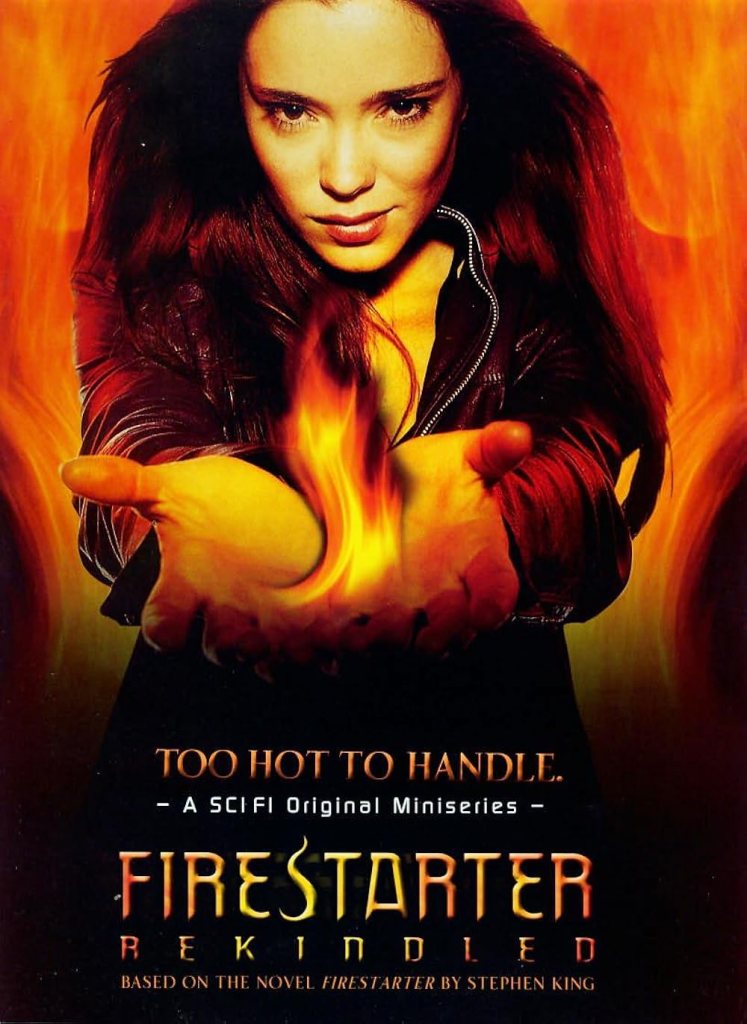
Firestarter: Rekindled (2002)

Directed by Robert Iscove [Other horror films: N/A]

I didn’t have much in the way of positive expectations when it came to Firestarter: Rekindled. Not that I’d heard much about this one, but I knew it was a mini-series that got lukewarm reviews. Admittedly, I didn’t know it was a Sci-Fi mini-series, which gives it a bit more personal spice, but given I didn’t love the first Firestarter, I wasn’t sure how well a sequel would fare.

Well, as a sequel to the 1984 movie, Rekindled fails hard, and for a very specific reason: it’s impossible for this to be a sequel. See, this movie has flashbacks from events that happen in that movie, but they don’t use footage from the film (which is fine, as I sometimes find that type of thing stylistically off-putting), instead re-creating them with new performances.

The problem is, the scenes they recorded for the flashbacks don’t actually match up to what happened in the 1984 movie. For God’s sake, instead of Charlie’s father dying in a barn, he’s killed by Rainbird in a nondescript room with what seems to be a needle. The flashbacks don’t match up, and because of that, I don’t think this can even really be called a sequel. I choose to see it as a new adaptation of material used in the novel, because as a sequel, it doesn’t work.

Viewing it, though, the way I choose to, the mini-series isn’t that bad. Don’t get me wrong, it doesn’t come close to rivaling Storm of the Century or the 1997 The Shining, but it’s not that shabby. The biggest problems, discounting the idea that this is a sequel, would be that the performances are sometimes shaky, the special effects aren’t always that special, and there’s a handful of story elements I didn’t care for, but otherwise, it sort of has some charm to it.

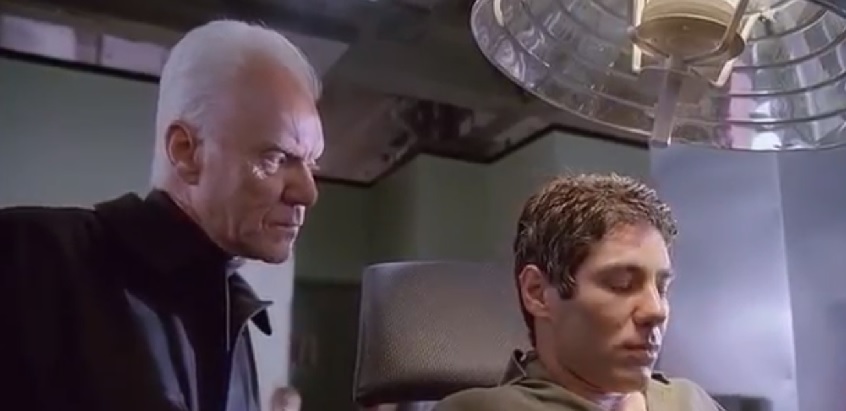
Generally speaking, I liked the cast of this one. Marguerite Moreau (The Uninvited, Queen of the Damned) made a decent adult Charlie. To be honest, I found her budding relationship with Danny Nucci’s character sort of cute, especially that scene in which they’re talking about kryptonite. Nucci is an actor I know from pretty random places (Titanic and an episode of House M.D.), and while he wasn’t amazing here, I dug his character. Oh, and Malcolm McDowell (Silent Night, Class of 1999, Cat People, Halloween) is here too, playing Rainbird, and he’s always a pleasure.

We also have Dennis Hopper (The Texas Chainsaw Massacre 2, House of 9, Land of the Dead, Night Tide) playing a somewhat interesting character. Portraying the young Charlie in flashbacks was Skye McCole Bartusiak (who I know as Pippa from Storm of the Century); she doesn’t have the character of Drew Barrymore, but she was nice to see. Also appearing are John Dennis Johnston (Communion), Darnell Williams, Travis Charitan, Dan Byrd (Salem’s Lot, Easy A), Ron Perkins (Storm of the Century, the 2002 Spider-Man), and Jeremy Hoop.

Like some of the performances, the special effects can be a bit touch-and-go. Some of them are decent; I tend to think the finale was mostly okay, aside from a scene involving Rainbird. Other times, well, the fire doesn’t look the greatest. Still, I don’t think the effects are terrible, and it’s certainly not much a hindrance to the story.

Speaking of the story, I have to say I didn’t care for the kids. See, part of this mini-series deals with Rainbird’s continuing Dr. Wanless’ experiments, and so he has a bunch of super-powered kids. One can sort of control people’s actions, another can read minds, one’s an energy sink, another has a sonic shout (similar to Banshee from Marvel Comics). These kids weren’t a big focus, and toward the end, they weren’t quite as prominent as I feared they were going to be, but it was still an element that didn’t do a lot for me when they did pop up.

Generally speaking, though, despite this being a combined 2 hours and 42 minutes, I had an okay time with Rekindled. I don’t think it’s a great mini-series, and it’s probably still weaker than average, but considering that I wasn’t expecting much from this at all, I can admit that this mini-series surprised me. I can also say that if you’re a fan of the 1984 movie, this one may disappoint, but if you can look at this as something other than an intended sequel, you may be in for perfectly fine time.

6.5/10

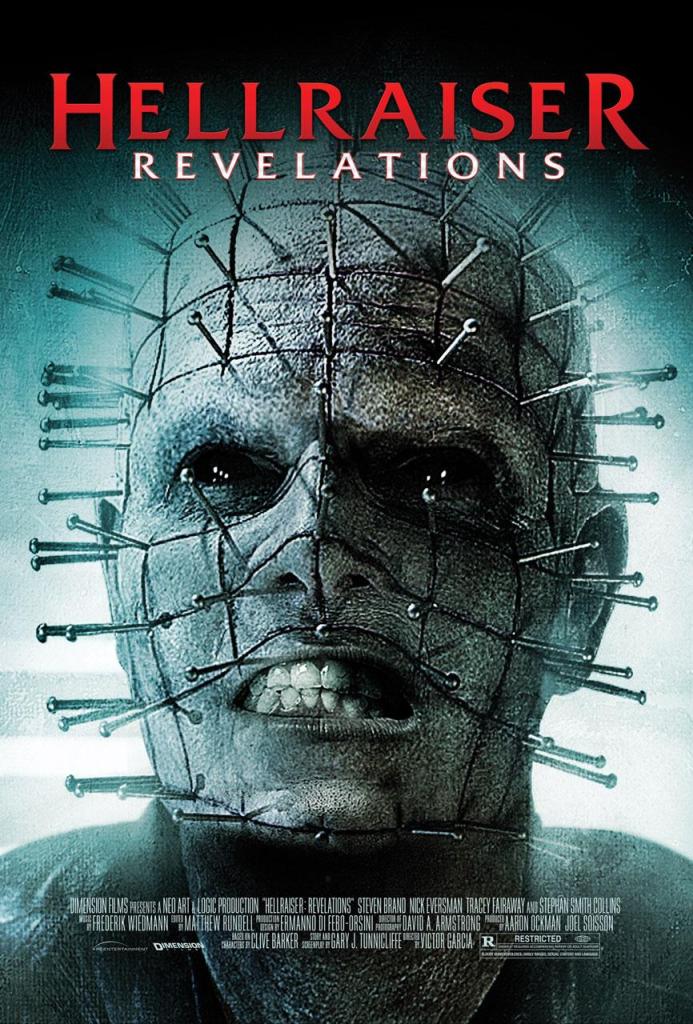
Hellraiser: Revelations (2011)

Directed by Víctor Garcia [Other horror films: Return to House on Haunted Hill (2007), Arctic Predator (2010), Mirrors 2 (2010), Gallows Hill (2013), An Affair to Die For (2019), La niña de la comunión (2022)]

It should come as no surprise that I didn’t care for Revelations. I don’t know if it’s quite as bad as others tend to feel it is, but it’s definitely a long way from good, and I don’t think it’s too much a stretch to say it’s the worst film in the franchise.

No doubt Deader, the seventh movie, had some issues, such as the fact it made no sense whatsoever, whereas Revelations does tend to explain most aspects of the story. However, Deader felt more like the Hellraiser I’d come to expect up to that point, and this one, despite theoretically going back to the basics (including a Frank-like character who steals someone’s skin), I just couldn’t get into it.

Most people know the history behind this one – it was shot in eleven days because Dimension Films realized that they’d lose the rights to the Hellraiser series if they didn’t get a sequel to Hellworld out. Given the short filming schedule and rushed post-production, Revelations does feel quite cheap. That alone isn’t necessarily damning, though the fact that they apparently got down to the wire as opposed to starting months earlier and making a far better film is worthy of some contempt.

Honestly, I don’t think the story itself is that bad. There are some elements of found footage that I could personally have done without, but there’s not enough of that to scare people away, in my view. Following two preppy teens as they fall into a hedonistic nightmare, you can certainly see that portions here are reminiscent of the original Hellraiser, and I can appreciate that. It’s also true, though, that I’ve never been the biggest fan of the first Hellraiser, so though this movie may bring back the vagrant with the puzzle box, I don’t know if that does much for me.

It’s not the story here that’s problematic, though – it’s the acting. I’m not one who goes out of my way to pin issues on performances, but I really felt like some of the performances here weren’t good. It may partially be due to some awkward dialogue (paired with occasionally awful delivery), but regardless, what interest the story may have cobbled up easily got lost in the sea of poor performances.

Nick Eversman (At the Devil’s Door, Urban Explorer) had some funny pieces of dialogue (“They want to experience your flesh”), but he’s a bit much as the movie goes on. Jay Gillespie (2001 Maniacs) and Tracey Fairaway (Patchwork) have more bad moments than good, but again, some of their lesser moments can still be amusing. I didn’t have much against Steven Brand (Triassic Attack, Echoes, The Diary of Ellen Rimbauer, XII, Demons) or Sebastien Roberts, aside from their dull characters, and Devon Sorvari was more stable than Sanny van Heteren, but there’s nothing much here that I think will wow people.

Oh, and we have to talk about Doug Bradley. Naturally, he didn’t reprise his role as Pinhead in this one, and instead we got Stephan Smith Collins (though Pinhead was voiced by Fred Tatasciore, apparently). I don’t know Collins, but I didn’t care much for his portrayal of Pinhead. It wasn’t necessarily the performance as far as the characterization, which felt more malicious than need-be, but he certainly doesn’t hold a candle to Bradley.

Another thing I wanted to mention may come as no surprise. Because of the quick filming schedule for this one, I don’t think the special effects look particularly good. A few sequences are okay, but generally, the hooks looked weak, the pillars of flesh looked faker than usual, and the Cenobites – well, we only see a handful, not counting Pinhead, including a female Chatterer and a Pinhead-wannabe – looked somewhat forgettable also.

Revelations is a movie with problems. Is it as bad as the current IMDb rating of 2.7/10 purports? I don’t think so. It’s a disappointment, but I don’t think it’s quite that poor at all. However, it’s definitely not good, save the basics of the story. Some people may appreciate this for at least breaking the mold of the previous four films (Inferno, Hellseeker, Deader, and Hellworld), but personally, I’d take most of those over this one any time.

4.5/10

DeadHouse (2005)

Directed by Pablo Macho Maysonet IV [Other horror films: The Things They Left Behind (2011), The Red Suit (2014), Fear of My Flesh (2015), Await the Dawn (2020), Tales from the Other Side (2022, segment ‘Scary Mary’] & Brian Rivera [Other horror films: N/A]

I’m an individual who’s seen plenty of lower-budget horror, and while I have a high tolerance of occasionally shoddy film-making, that doesn’t mean I’m oblivious to it when it occurs. DeadHouse is a movie with problems, and while it’s certainly not all bad, I can fairly say it’s far from good.

The story is rather basic – two sisters and a friend have car trouble while traveling, and run awry of some killers who live in a decrepit house. And – well, actually, that’s it. We get a bit of background on the killers, and there’s a very choreographed twist toward the end that I suspect would fool very few people, but then again, not all slashers are dripping in creativity.

And actually, I’ve seen DeadHouse before. A long time ago, Blog Talk Radio was a pretty decent site, and the horror forum Horror Movie Fans (a forum I’ve been of member of since 2009) had a show that I called into plenty of times. During one of those shows, we discussed DeadHouse. Now, that was a long time ago – 2010, if I had to guess – so it’s been around 13 years since I’ve seen this one, and as such, remembered very little of it (not that there was much to remember, truth be told).

If I recall, this used to be on YouTube in full, as I’m sure that’s where I watched it. Nowadays, it seems like it’s a mostly forgotten film, but luckily (such as it is), I own a copy on the 50-movie set Catacomb of Creepshows. Though I don’t care for the film overall, I am glad to have access to it, as it seems a rather difficult film to find online nowadays.

In all honesty, there’s not a whole lot to say about this one, though. The story’s rather simple, but it fails due to technical aspects, primarily the audio. The audio here was really bad – there are multiple conversations that I can’t understand at all, because it seems there was no microphone in the vicinity. Other times, the music plays over the dialogue, and little-to-none of the characters’ voices actually stand out. I’ve seen movies with poor audio before, but the consistently poor audio of this film was almost astounding.

Otherwise, you have occasionally decent (though rather low-budget) effects. Someone gets stabbed with a pitchfork, which was probably the best scene. Another gets their head slammed into a wall, causing said head to explode. Someone’s body gets slammed into a tree, causing their spine to crack. None of the deaths are that memorable, but at least they’re here.

I thought the performances were alright. Keep in mind, I couldn’t hear them a fifth of the time, but that’s not their fault. Tracey Dalton and Cara Dalton played believable sisters (and given their shared surnames, I wouldn’t be surprised if they actually were sisters). Pablo Macho Maysonet IV (also the director of this film) had some occasionally amusing dialogue, but was mostly whateves. Brian Rivera had a friendly persona, and Anthony Carvalho (who isn’t even credited on IMDb at the time of this writing) was fine too. None of the performances here did much, but at least they averaged out okay.

The story, though, didn’t feel fresh enough to me. I didn’t care for the twist at the end, and given the garbled and difficult-to-understand dialogue, it was a bit of a rough one to get through, made only marginally easier by the fact I was able to rope my brother into watching this one with me (shout-out James, wherever you are brah). It’s not a good movie, and while there are certainly worse out there, never doubt that there aren’t thousands of better ways to spend your time.

4/10

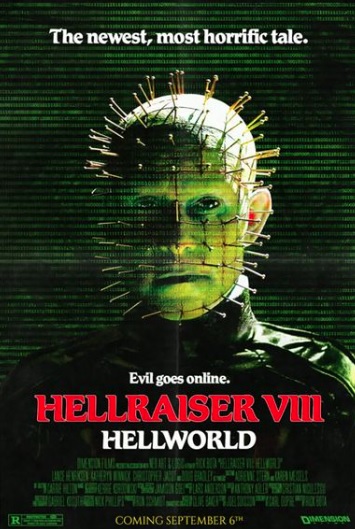
Hellraiser: Hellworld (2005)

Directed by Rick Bota [Other horror films: Hellraiser: Hellseeker (2002), Hellraiser: Deader (2005)]

When it comes to the various Hellraiser sequels, I have to admit that I have a tad of a soft spot for Hellworld. It’s not a return to classic form whatsoever, but at least it’s marginally different than what Inferno, Hellseeker, and Deader went for, so that’s a good start.

In truth, I do like the story of this one. It takes a somewhat meta view of things – players of a game called Hellworld (which is based on the myth behind the Hellraiser films #questionmark?) are invited to a Hellworld-themed party, and it’s not quite the festivities they were hoping for.

This was filmed back-to-back with Deader, which is why it feels far more like a film from the early 2000’s than it does one from the mid-2000’s, but I think it’s a hell of a lot more coherent than Deader ever was, and though the story sort of takes even a further divergent path from the original than do many of the other sequels, I think by this point in the franchise, they needed a little something to shake things up.

I love seeing a few familiar faces here. Henry Cavill (who later goes on to play Superman in Man of Steel and related DCEU movies, not to mention Blood Creek) made some quality facial expressions, and Khary Payton (the guy who voiced Cyborg on Teen Titans) appeared too, which was fun. I’ve seen Katheryn Winnick in a handful of things (Satan’s Little Helper, Amusement), and while her performance was a bit weak at times, it’s always nice to see a friendly face.

Anna Tolputt hasn’t been in many things, but her character’s reasonably fun, at least with the screentime she gets, and Christopher Jacot had some solid moments too. Of course, Doug Bradley as Pinhead is always fun, and he even comes with a decent quote in this one (“Oh, what wonders we have to show you,”), which have been lacking from recent sequels. Oh, and horror veteran Lance Henriksen (Pumpkinhead, Mansion of the Doomed, The Mangler 2, Gehenna: Where Death Lives, In the Spider’s Web) pops up too, and he does bring some charm to this one.

I think what sets Hellworld apart from many of the other sequels is the finale. True, a decent amount of the film feels disjointed and confusing, as Inferno through Deader felt, but the finale ties many aspects of the movie together. It’s possible that it could be the case that the idea outshone the execution, but even so, ever since I first saw this one many years ago, I’ve found it decently enjoyable.

As far as the special effects go, it’s up and down. Some sequences look decent, such as a simple decapitation. Others – well, not so much. There was an okay sequence with someone strapped to a chair and getting Saw-esque treatment, but there was also some disfigured corpses chasing after someone, so like I said, it had its ups and downs. I can gladly say, though, that my favorite Cenobite, Chatterer, pops up here, and it is nice to see his delightful face once more.

I know there are some out there who find this one of the weakest sequels (well, at least until Revelations came out), and I just never saw Hellworld that way. I don’t think it’s a great movie or anything but I think it tries something a bit different, and certainly stands out in the lineup of the franchise. It won’t do it for everyone – no movie does – but I’m a fan of this one, flaws and all.

7/10