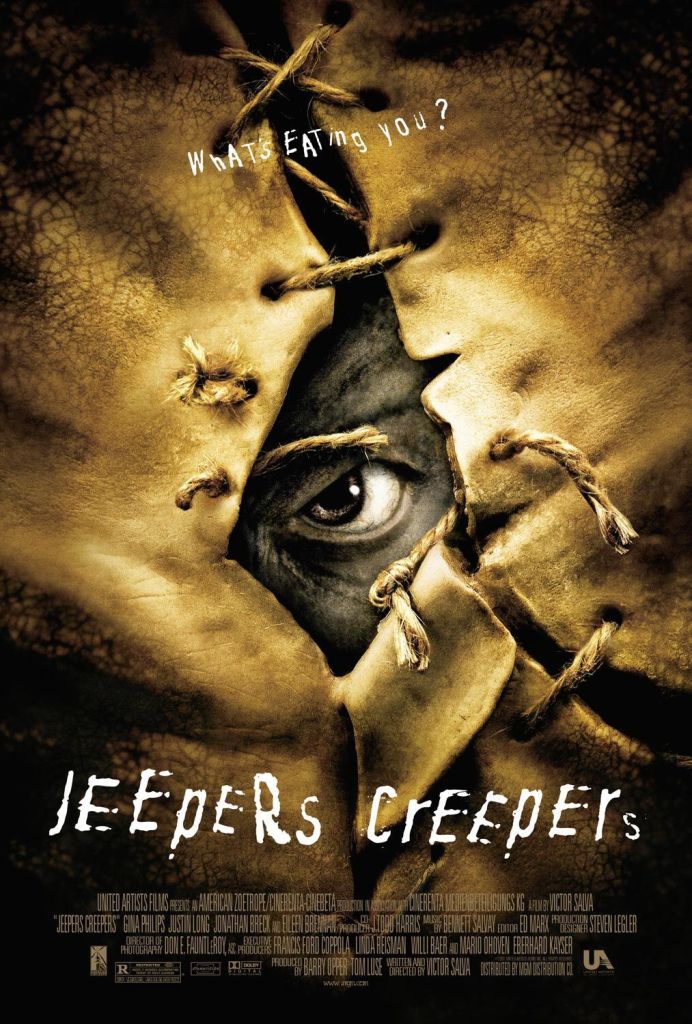
Jeepers Creepers (2001)

Directed by Victor Salva [Other horror films: Clownhouse (1989), The Nature of the Beast (1995), Jeepers Creepers 2 (2003), Rosewood Lane (2011), Haunted (2014), Jeepers Creepers 3 (2017)]

I’m not quite sure what it is about Jeepers Creepers that consistently works for me, I just know that it consistently does.

Certainly the first forty minutes or so are insanely tense, and that scene in which Trish (Gina Philips) and Darry (Justin Long) are driving past the Creeper as he’s throwing a body down a pipe is perfection. There’s a lot of suspense in the first half of the film, and they did a great job with it.

When the film moves to a more fantastic creature-feature type route, I still think the movie keeps things moderately decent, though it’s also fair to say that the latter half of the film isn’t always as interesting as the first half. The good thing, though, is that the movie is well-paced, and it really feels like it flies by, making the movie all the more digestible.

It’s also a decently original plot. The idea of some inhuman creature stalking people in order to eat parts of their body isn’t something you hear about every Sunday. The whole “every 23rd spring in every 23 years” thing could be a reference to Pennywise from It (and hey, the main lead even has the name “Darry,” which is close to “Derry”), and I imagine many would compare the beginning of the film with Duel, but for the most part, Jeepers Creepers tends to have an original feeling.

I also think that is was a great idea to feature siblings as the main characters. I can’t begin to tell you how utterly sick I am of every other movie having some romantic stuff thrown in, sometimes under the most ridiculous circumstances, so focusing instead on a brother and sister was great, and I really buy that relationship insofar as their performances go.

Justin Long (Drag Me to Hell, Barbarian) was pretty good here. Again, I bought his relationship with Gina Philips. Philips (The Sickhouse, Deadly Invasion: The Killer Bee Nightmare, Ring Around the Rosie, Jennifer’s Shadow) herself had a lot of emotional material to contend with, and she did well too. I wish we learned a bit more about Patricia Belcher’s character, but she was fun, and Jonathan Breck’s portrayal of the Creeper was the stuff of dreams.

There are a few grisly moments in the movie, but this is all really pretty tame. The suspense is what keeps things going throughout, and though there is some violence at times, that’s never really the point. Late in the film, we even have a somewhat action-packed showdown at a police station, which was a nice sequence.

Worth mentioning also are those fade-to-black cuts. They happened throughout the movie, and felt out of place. Honestly, I thought it felt like something you’d see in a TV movie, and not a feature film like this one. It didn’t hurt the movie or anything so drastic, but it was notable, and just seemed odd to me.

Naturally, I’ve seen Jeepers Creepers before, though I admit it’s been a hell of a long time. It’s a movie that I’ve enjoyed plenty of times in the past, and I imagine I’ll enjoy plenty more times in the future. It’s not a perfect movie, nor is it really a game-changer, but it does feel unique, and I can see why it’s largely lauded as a quality film in the horror community.

8/10

The Ruins (2008)

Directed by Carter Smith [Other horror films: Swallowed (2022)]

It’s been some time since I’ve seen this film. If I had to guess, I’d say around ten years or so. I can’t remember if I’ve seen it once or twice, but I do remember enjoying it whenever it was I last saw it, and I can say that, after seeing it again with fresh eyes, that’s largely still true.

Based on a novel of the same title by Scott Smith (a novel I’ve not read, but am interested in possibly reading in the future), the idea is pretty simple – six unfortunate souls in Mexico decided to go to a ruin that’s not good for their health, largely out of their control. It’s a somewhat bleak film, as there’s very little within their control in the situation they find themselves in, and it’s done pretty well.

The cast is solid – the six performances really worth mentioning would be Jonathan Tucker, Shawn Ashmore, Jena Malone, Laura Ramsey, Joe Anderson, and Sergio Calderón. It’s true that Calderón doesn’t have a lot to do aside from look threatening, but he does it well. Ashmore (who I know as Bobby Drake from the X-Men films, but has also been in Mother’s Day, Devil’s Gate, Wolf Girl, The Day, and Solstice) is more likable than Tucker (The Texas Chainsaw Massacre), but Tucker’s character is pretty good.

Jena Malone (Antebellum) reminded me of an actress on the tip of my tongue, but I can’t place her. Either way, Malone was pretty solid, and more stable than Laura Ramsey (Cruel World). I was hoping that Joe Anderson (The Crazies, Abattoir, The Reckoning) would have a bit more to do than he did, as I rather enjoyed his character, but it wasn’t to be.

The gore here can be pretty grisly. See, plants that grow around this ruin can get into your body if you have an open wound, and this happens to a couple of people. Not only does someone have their body cut in multiple places to pull out weeds, another individual has their legs cut off. That particular scene wasn’t too gory, but there’s a later one in which someone, under heavy mental stress, takes a knife to themselves in order to rid their body of the parasitic weeds, and that one can be trying.

It’s at this juncture that I should profess an odd love of plant-based horror. There’s not too many examples that come to mind, but those that do (including the somewhat awful Revenge of Doctor X) are films I have somewhat of an affinity for. I’ve always found malicious plant-life (or not even malicious – it’s just how they evolved) an interesting idea in horror. I have to imagine it comes from my love of Goosebumps as a child – Stay Out of the Basement, both the book and the two-part episode, are favorites of mine.

And on that note, I do wish we had some opportunity in this movie to learn more about these plants. Sure, the terror is in not knowing or understanding what exactly the characters are facing, but even so, it’d have been nice to have a biologist’s perspective, or even one of the Mayans who could perhaps manage some broken English.

Related, I understand where the Mayans are coming from, but wouldn’t it have been better to have a constant guard around the ruins as opposed to just trying to contain the problem after it was too late? Preventative measures, and all that.

I am aware that certainly they tried, but the problem is that the Mayans speak, well, Mayan, and can’t effectively communicate with people who don’t speak Mayan. If you’re trying to prevent people from going near this particular ruin, it might benefit them to at least learn Spanish, as many of those who approach the ruins could at least effectively be warned away.

Oh, and one last thing – did it never occur to any of the characters to possibly burn the plants? Sure, it might have been suicide, but I’d have definitely tried to light the plants on fire as opposed to starving to death with roots and weeds growing inside of me.

Despite those small issues, The Ruins is a well-made film. I don’t know what was changed from the novel, if anything, but it’s a high-budget film that’s somewhat dreary at times (and definitely could have done with an ending packing a bit more of a punch), plenty gory, and an overall enjoyable watch. It’s not stellar, but it is good.

7.5/10

A Cure for Wellness (2016)

Directed by Gore Verbinski [Other horror films: The Ring (2002)]

When I first saw A Cure for Wellness, I was quite impressed. I didn’t entirely understand everything that was going on, but the very fact the film is about two hours and 30 minutes yet it kept me engaged throughout was definitely a positive.

I was definitely interested in revisiting it, especially since I don’t really hear that many people speaking about this one at all. Part of that, I would suspect, is due to the film not doing well in theaters, understandably so, given the length and somewhat ambitious nature of the movie.

Even so, I found it just as engrossing this time around as I did the first time I saw it. Personally, while the narrative structure is occasionally mystifying (such as the death of the central character’s mother), I found most of the story quite enjoyable. It’s true that you could easily guess some of the twists – if you’ve seen any classic Hammer horror, it’s not too far removed – but the journey to the finale, while perhaps long-winded, was still worth seeing.

The cinematography is absolutely stellar, and a large reason I’d recommend this. A Cure for Wellness is a beautiful movie – even during some of the more horrific scenes (such as someone being tied down, a tube shoved down their throat, and eels swimming down into their body), there’s a beauty. Much of the medical facility/spa looks sparse, and even scenes with a large body of people (such as the dance toward the end) possess a certain charm to them too.

Horror-wise, you have both the oppressive feeling of being in a situation you can’t get out of, along with a more traditional element of gore. Being caught in a seemingly idyllic spa with no way to communicate to the outside world is indeed horrifying, especially when mixed with the idea that something is very wrong at the spa; not only are hallucinations plaguing the main character, but their teeth are falling out. Oh, and there seems to be a moose/deer loose in the steam rooms.

On the gorier side, there’s a stillborn calf cut out of cow – not only do a bunch of eels come out of the cow’s stomach alongside the calf, but there seems to be tiny eels moving under the stillborn calf’s skin. There’s a lot of eels in general – from a quality scene with a water tank to an unfortunate location for a young (????) woman to menstruate – you better enjoy your eely friends, as they’re everywhere. Oh, and someone gets one of their teeth drilled into, in what has to be one of the most painful scenes I’ve seen in some time.

I personally love how the story of the baron and baroness is slowly uncovered, piece by piece. It has a predictable conclusion, to be sure, and there’s really nothing that surprising during the finale, but I still think most things came together okay. I especially enjoyed the dance the staff was having, though it didn’t end that well for some of them.

I don’t really know Dane DeHaan (who also starred in Life After Beth), but despite how atrocious his character is to start with, I can’t help but sympathize with him from early on. The fact he looks like a clone of Leonardo DiCaprio helps. Jason Isaacs (of Harry Potter fame, along with roles in Event Horizon and The Patriot) is about as fun as always. Mia Goth (Marrowbone, X) didn’t have a ton of agency until the finale, but she was still quite good in her role.

For the right type of horror fan, I think that A Cure for Wellness can be a rewarding experience. Admittedly, for a movie that’s about two and a half hours long, anything less than rewarding might justifiably be criticized to Hell and back, but even so, I think there’s a lot to like here, from occasionally creepy scenes and brutal sequences of drills and teeth, to stellar cinematography and a familiar, yet interesting enough plot.

A Cure for Wellness won’t be for everyone. Personally, I think the film has a lot going for it. I find so much of it an enjoyable, if not necessarily fun, ride. It’s atmosphere is quality, and the steam rooms look comfortable. It’s not a film for everyone, but I enjoy it.

8/10

Anatomie (2000)

Directed by Stefan Ruzowitzky [Other horror films: Anatomie 2 (2003), Patient Zero (2018)]

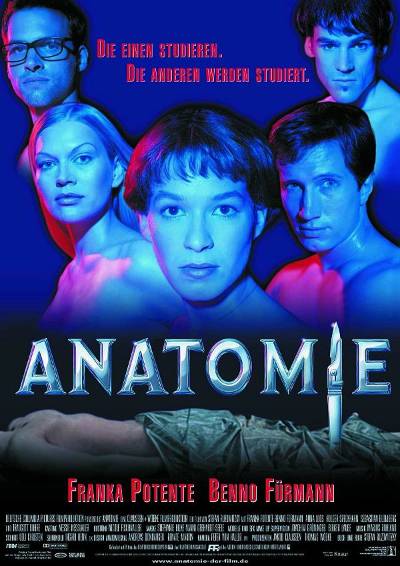
I’ve always enjoyed this German film, provided it’s in German with English subtitles. Anatomie (or Anatomy) has a pretty decent story, some good suspense at times, and quality brutality here and there.

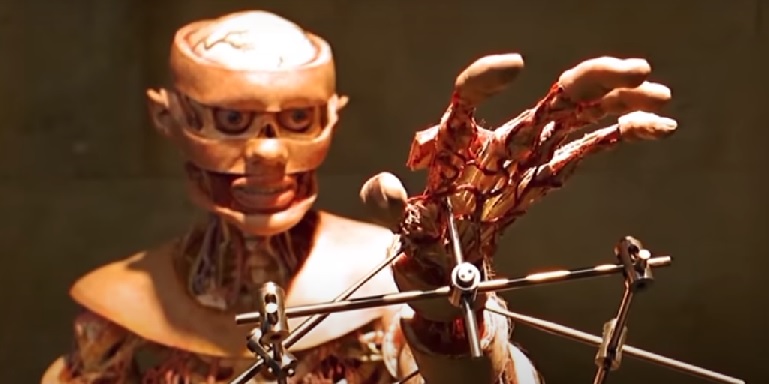
Of course, the brutality is more sterile in nature. During the opening, an individual wakes up on a mortuary table, and finds, among other things, that the fingers on one of his hands are stripped to the bone, as you might see on some anatomical models. A few people are stabbed with a chemical that sort of hardens their blood, and that doesn’t lead to great things. This movie isn’t at all gory save a few scenes, but those scenes are quite solid when they come up.

Another important note: I’ve always been a subtitles guy. I can watch dubbed movies if I have to, and often I do, but if I have the choice, I’ll always go with subtitles. I think this movie a good demonstration why – I tried watching this dubbed (I rented it off Amazon Prime for $3.99), but quit after five minutes, because I’ve seen the movie before in German with English subs, and I knew if I revisited the film in a dubbed version, it wouldn’t do the movie justice. Unable to find it online through less reputable sites, I just bought the DVD, and was then happy.

I’m a big fan of the story, dealing with a medical student (Franka Potente) who discovers the existence of an ancient cult of doctors called the Anti-Hippocratic Society, an organization focused on research and discovery, no matter the harm that may come to a few patients. It’s a fun idea, dealing with doctors and medical students who ignore commonly-accepted ethics, and when you throw in some members who are maybe a bit too extreme for the base group, it adds an extra element.

Germany used to be the largest exporter of horror films. Between 1913 and 1925 or so, they were the kings of the genre, and obviously, the first who dominated the genre. A bunch of krimis popped up throughout the 1960’s, some of which are horror, but their output has been inconsistent for a long while (sorry, but as fun as some Andreas Schnaas movies are, they don’t cut it), Because of that, it’s nice to see a more modern-day German horror film, which is one of the reasons I appreciate this film.

I thought Franka Potente made for a great lead, and I quite loved how she cared far more about actually learning something as opposed to sleeping with every guy possible (Anna Loos’ character, for instance). Sebastian Blomberg had some strong moments, and Traugott Buhre was solid. Benno Fürmann didn’t stand out at first, but I grew to enjoy him, and Arndt Schwering-Sohnrey was fun for the little bit he appeared.

Over the course of the film, we see different characters attacked, so I do think the pacing was pretty decent. The finale felt maybe a little long, but it was pretty suspenseful (despite some obvious red herrings), and we also got a somewhat interesting mid-credit scene, which was a nice extra.

When it comes down to it, I really liked Potente as the star here – I really liked her character, and I thought it was a lot of fun seeing her try to uncover some secret medical society. Anatomie is a pretty solid German horror film, though not a great one, and if you want a fun foreign time, check it out.

7.5/10

Wrong Turn 2: Dead End (2007)

Directed by Joe Lynch [Other horror films: Chillerama (2011, segment ‘Zom-B-Movie’), Mayhem (2017)]

When I first saw this one some years back, I found it underwhelming. I know, though, that there is a decently-sized contingent that find this a generally solid sequel, so I was sort of excited to see it again and perhaps wondering if it would move up in my rankings. And after doing so, while it is a little better than I initially gave it credit for, I still don’t think it’s all that memorable.

Aside from, of course, Henry Rollins, who is the sole reason to watch this film if you’re hesitant to do so, as his kick-ass character, from beginning to end, is just fantastic. I’m not saying that Rollins makes this movie great – honestly, while portions are good, I think the film still hovers around average to below average – but without Rollins, I think this movie would lose a lot of the charm it managed to create, as he brings quite a lot as an over-the-top drill sergeant who sends these mutated hillfolk back to their cabins, and how!

I have to admit that I expected quite a lot more from Aleksa Palladino’s character, but in a way, I can understand why they might want to get rid of the obvious final girl somewhat early on. Even so, I found it a bit of a shame, as I did find her character one of the better ones here. Otherwise, you have Erica Leerhsen, who did take a while to grow on me, but I eventually found myself quite enjoying her standoffish attitude.

Texas Battle (what a name, brah) had a quality moral code, which I appreciated (him turning down Yan-Kay Crystal Lowe’s character was nice to see). Battle didn’t stick out as much as Leerhsen, but he was still good. Yan-Kay Crystal Lowe (Final Destination 3, Black Christmas, and Yeti: Curse of the Snow Demon) was the stereotypical hot bitch, so while attractive, her character was as hideous as any of the deformed hillbillies. Most of the others, be it Steve Braun, Daniella Alonso (who was also amusingly in The Hills Have Eyes II), or Matthew Currie Holmes, were sort of there, and little more.

Of course, the gore here was pretty solid throughout. I never really cared for the whole cutting-someone-in-half with an axe/chainsaw/hatchet, so the opening kill was more meh, but it still looked good. A hatchet-throw stood out, if only because it struck me by surprise, and the finale was beautifully gory (what with a tree debarker debarking more than bark), though it did lead to a final scene that I thought was unnecessary.

Actually, since I mentioned the finale, I did rather like that paper mill that made for the setting, and when Rollins’ character is running through and blowing people up with his dynamite arrows, it’s a lot of fun, and of course there’s solid tension. I am disappointed by what goes down with Rollins’ character, but I get it.

All of this, though, doesn’t mean the movie’s great. I honestly don’t think it’s necessarily bad, but generally, I thought this hit some of the right spots without fully satisfying me, and some of it is admittedly smaller things, such as that supposed game show. I’m a fan of Survivor, which is partly, I suspect, what that game show is based on, but boy, does it sound unnecessarily complex. I’ll chalk that up to bad design for a reality TV show, though, and not an example of how I wasn’t wowed by this.

Something that does play a part, though, are the deformed antagonists. In the first film, things were kept simple with just three antagonists, but here’s there’s an extended family, and for me, it wasn’t always easy to keep in mind exactly how many family members there were, and related, where those members were at any given moment.

I don’t dispute that Dead End had some solid things going for it, such as the kills and a few of the characters, but despite what it does right, I think this is somewhat clearly below average, though not nearly as badly as many other films.

6.5/10

This is one of the films covered by Fight Evil’s podcast. Listen below, if it tickles your fancy, as Chucky (@ChuckyFE) and I discuss Wrong Turn 2.

Der Hund von Baskerville (1937)

Directed by Karel Lamac [Other horror films: De spooktrein (1939)]

Ah, finally, after having watched the 1914 and 1929 silent versions, I get to hear speaking once again. It’s in German, sure, but it’s also subtitled, so no problems there. This is a pretty good version of the story, but compared to many other versions, I have a hard time believing it really stands out.

Certainly the quality of the print I viewed wasn’t great – it seemed like some VHS rip, which of course has charm to it, but it would have been nice to see a little cleaner print. Even so, that doesn’t negatively impact the film, especially since I’m just glad the copy was in German with English subtitles thrown on.

The movie itself follows the main traditions the 1929 version did – Holmes not accompanying Watson to Baskerville castle, the escaped convict on the moors, and actually having a strong role for Watson (unlike the 1914 version) – and it did so competently enough, but I still think that some parts could have been trimmed (such as the somewhat unnecessary opening regarding the origins of the curse).

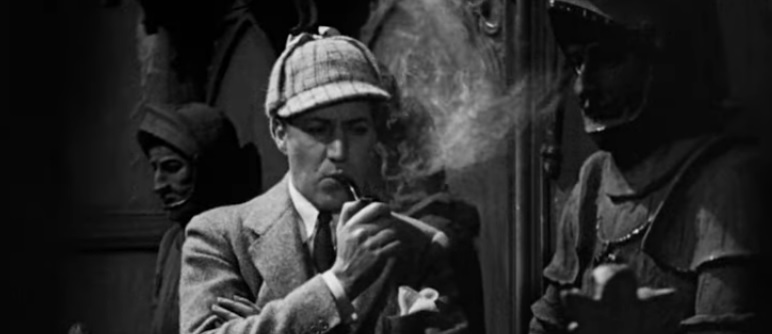
I will give it that this version has my favorite Sherlock Holmes thus far (compared to the 1914 and 1929 versions). Here, Holmes is played by Bruno Güttner as a rather analytic and none-too-sensitive Holmes, which is the type of Holmes I like. He has the confidence that 1914’s Alwin Neuß had, but he also had that analytic character trait (case in point: by looking at a cane, he can tell quite a bit about Doctor Mortimer) that wasn’t really shown in either of the previous versions I’ve seen today. What makes this even more impressive is that Güttner’s only been in a total of three films.

They also did Watson pretty well, and better than they have up to this point, having a Fritz Odemar portray him. Here, he doesn’t really come across as a pointless side-kick but a deductive individual of his own right (and investigative, as seen by his opening scene in which he’s looking at the ash remains of 117 types of cigarettes and cigars for comparison of some sort). Not that Odemar was perfect, but I did quite like his performance here.

Fritz Rasp appeared as Barrymore, and though he lacks the character the 1914 Andreas Van Horn got, he did a fine job, and related, Rasp was also in the 1929 version playing Stapleton. Here, Stapleton was played by Erich Ponto – Ponto did a decent job, and I sort of liked his seemingly-weak physique, but he sort of lacked the pache that the previous two Stapleton’s (Friedrich Kühne and Fritz Rasp) brought to the table. And as for Henry Baskerville, well, Peter Voß did okay, but his character has never really impressed me, and it’s no different here.

I think the mystery and horror elements were generally done pretty well here, and while the quality of the film wasn’t great, most of the scenes on the moor weren’t too marred, and the sinister aura that you’d hope to find among the most thrilling of those scenes was present still.

While both of the silent versions were also German films, it’s nice to see a version of the film with sound so I can hear the dulcet tones of the German language. As you can imagine, the cast of this film is somewhat insular (especially compared to the cast of the 1929 version, which had an American and an Italian in leading roles), with this being made during a somewhat bad time for the country, but it’s still an okay version of a good story, and sticks to the necessities, and comes out fine.

7/10

Der Hund von Baskerville (1929)

Directed by Richard Oswald [Other horror films: Der Hund von Baskerville, 3. Teil – Das unheimliche Zimmer (1916), Der Hund von Baskerville, 4. Teil (1916), Nächte des Grauens (1917), Das Bildnis des Dorian Gray (1917), Unheimliche Geschichten (1919), Nachtgestalten (1920), Cagliostro – Liebe un Leben eines großen Abenteurers (1929), Unheimliche Geschichten (1932)]

Though this came out 15 years after the 1914 adaptation, I think it’s arguably on equal grounding. Certainly this version of The Hound of the Baskervilles improves on some levels than the earlier silent movie, but at the same time, I think a few things were holding it back from making more of an impact.

One thing I did appreciate was a more traditional version of the story, and by that, I mean the version of the story I’m accustomed to. Here they brought in some elements that were missing from the 1914 version, including Watson and Holmes appearing and then disappearing for a good portion of the story (this classic element of the plot couldn’t have happened in the 1914 version, as, in unique fashion, Holmes actually went to investigate the case without first being summoned by Henry Baskerville, so the classic, “I can’t leave London, but take Watson with you,” line was absent).

Worth mentioning is that while Watson did appear in the 1914 version, he was such a non-entity that he wasn’t even credited.

It’s not that this addition instantly make the movie better, by any means, but it certainly was nice to see, as I was wondering at what point that sub-plot would make it into the movies.

What really gives this film a different and potentially more powerful aura is the strong atmosphere, especially in the opening sequence with the elder Baskerville being terrified of the howls coming from the stormy night, and the group of friends around him mostly laughing the superstitions off. The storm is great, the tension is great, and the film kicks off with such a fantastic atmosphere. I can also add that the black-and-white looked quite crisp, and helped in that endeavor (and yes – while the 1914 version was tinted, this version is in black-and-white).

It should also be said that this version isn’t complete – some sequences are missing, and to get around that, this reconstruction summarizes the missing moments while giving us stills of the characters introduced during those scenes (such as Fritz Rasp’s Stapleton and Betty Bird’s Beryl). Some might be bothered by the missing scenes, and I hope they turn up at some point, but I thought they did a pretty good job working with what they had, and it was certainly more watchable and engaging than the TCM restoration of London After Midnight, so there’s that.

If that’s one last issue I have, it’s that I didn’t care all that much for Carlyle Blackwell, who played Sherlock Holmes (at least in comparison to the 1914’s Alwin Neuß). It’s not that Blackwell gave a particularly poor performance – he most certainly didn’t – but he was younger and a bit more handsome than I usually expect from a Sherlock Holmes, and while far from perfect, I did think the 1914 rendition done by Neuß was better.

No complaints about the rest of the cast, though – playing Stapleton, Fritz Rasp brought a quality quiet insanity with him that wasn’t really in the 1914’s Friedrich Kühne’s version. Obviously Rasp and Kühne were going for different things – Kühne a traditional, mustache-twirling fiend and Rasp a mentally-unstable psychopath – but both had solid respective performances, and here, I thought Rasp did great.

As Henry Baskerville, Livio Pavanelli did decently, though he wasn’t anything special. Playing his love interest was Betty Bird, who did get more character than Baskerville’s love interest in the 1914 version (and that character, Lyons, does appear here, though in a different way), was likewise just okay. The butler Barrymore (Andreas Van Horn in the 1914 movie), played by Valy Arnheim, lost a bit of story that he previously had, but also gained a little something with the added escaped convict on the moors subplot, and Arnheim did well with that.

And lastly, playing Watson, George Seroff was pretty strong throughout most of the film, though his character gets overshadowed by Holmes (as one can naturally expect) by the end, and so he doesn’t leave all that much of an impact.

The conclusion presented here is quite a bit more action-packed than what we got 15 years ago, and it’s all a decent amount of fun (albeit I couldn’t help but notice Watson, as it seems he always is, is treated a bit like a doddering fool at times), and the use of shadows and other film techniques such as flashbacks, slow camera-swivels and close-ups make this film far more technical than what the 1914 version managed (though with a difference of 15 years, one would certainly hope that’s the case).

When all is said and done, Holmes said it best: “Supernatural dogs do not leave footprints,” and while this movie was enjoyable to watch, I can’t say that it’s the pillar of silent horror despite having many strong elements present.

7.5/10

Der Hund von Baskerville (1914)

Directed by Rudolf Meinert [Other horror films: N/A]

Being the first adaptation of the only Sherlock Holmes story really considered horror, this early German production has been a film I’ve long wanted to see, and luckily it came out as a special feature on Blu-Ray on the 1929 Der Hund von Baskerville disc set, so now I’ve finally seen it.

And it’s not too shabby. Oh, it’s not great – this is far from the finest version of the story out there (which I suspect is the 1959 version, but I need to revisit that first before committing to that) – and this version is focused far more on the suspense (the mystery aspect isn’t really relevant here, oddly enough) than on the horrors of the hound, but given that this came out 1914, I doubt anyone could find that deeply surprising.

Certainly there’s plenty of amusing things in the film to keep your interest, especially since the audience is pretty much told who the culprit behind the attacks is, along with why, pretty early on in the film. From a scene in which a character blows up a mailbox to prevent a letter from being sent to the ludicrous-yet-fun central focus of the movie, much of this German silent is a hoot.

Afraid for his life due to the curse of the Hound of the Baskervilles, Henry Baskerville (Erwin Fichtner) sends for the famous Sherlock Holmes (Alwin Neuß), but due to the mailbox being blown up by a sinister character (Friedrich Kühne), the letter doesn’t get there. Instead, the sinister character impersonates Holmes in order to get close to Baskerville and kill him. Once the real Holmes finds this out, he eventually impersonates the other guy, and the FakeHolmes and RealHolmes meeting toward the end just cracks me up.

Another quality sequence is RealHolmes’ first action sequence, in which he notes that a bomb has been placed within the castle, and alerts Baskerville. While the fuse is getting closer to the explosive, a calm Holmes, unperturbed that in twenty seconds he, along with the castle, will be blown up, asks for a light. Baskerville looks at him like he’s insane, and the woman he’s courting (Hanni Weisse) has long since fainted. Undaunted by this, Holmes just shoots the lit fuse, and upon picking it up, uses that to calmly light his cigarette.

By no means is this version of the story fantastic, but as I said, it is decently fun, and I personally found the ending satisfying, especially for Barrymore (Andreas Van Horn), a character who was given the short stick for much of the film. Alwin Neuß makes for a fine Holmes, one that’s certainly confident and, showcased when he just fucks with the other guy and impersonates him, has a bit of a trolly nature to him. Friedrich Kühne makes for a solid antagonist, and he and Neuß work well together.

I do wish we saw more of the hound – even an attack that I was hoping for (set up beautifully, with a character and the hound in silhouette in preparation) was instead foiled by the reaction of the horses to the hound – but again, this is 1914, and the “fiery hound” as this film describes it, will have other chances to strike terror in the hearts of men.

As it was, Der Hund von Baskerville made for a pleasurable viewing experience, and I for one am just ecstatic that it’s been found and put back together so beautifully (the score and tinting are masterfully done), so even if it lacks the thrills you’d hope, it’s still the earliest rendition of the story possible, and a fine silent film to watch.

7.5/10

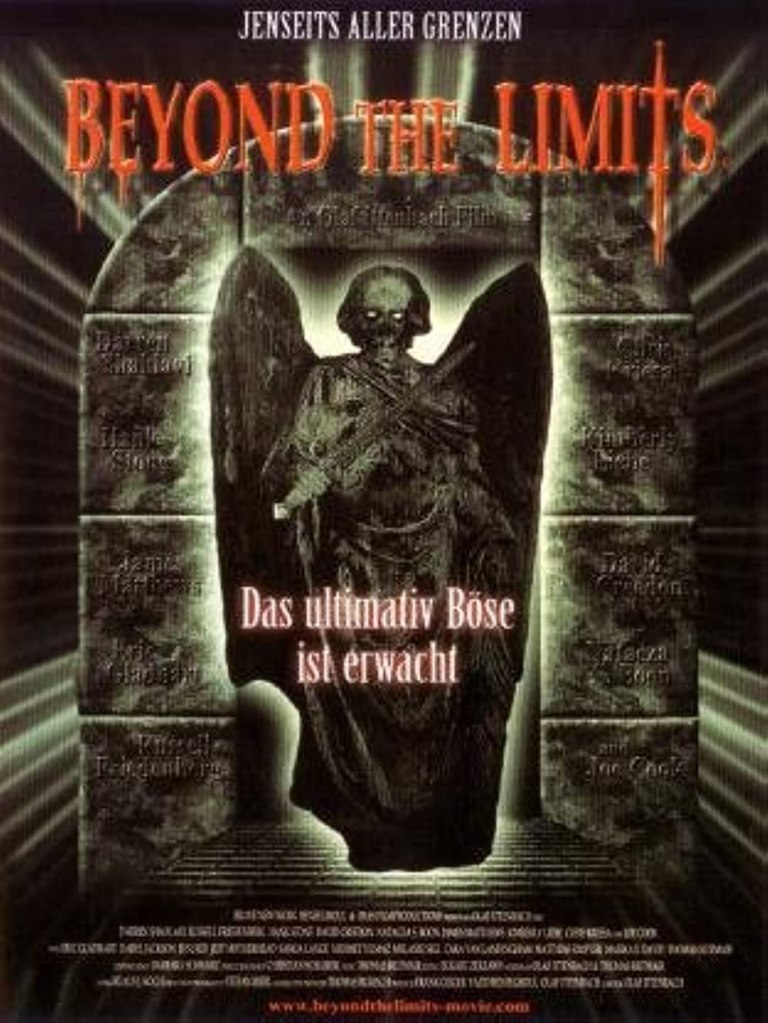
Beyond the Limits (2003)

Directed by Olaf Ittenbach [Other horror films: Black Past (1989), The Burning Moon (1992), Premutos – Der gefallene Engel (1997), Legion of the Dead (2001), Riverplay (2001), Evil Rising (2002), Garden of Love (2003), Familienradgeber (2006), Chain Reaction (2006), Dard Divorce (2007), No Reason (2010), Legend of Hell (2012), Savage Love (2012), 5 Seasons (2015), Olaf Ittenbach’s Colourman (2017), Garden of Love II (2017)]

I knew very little about this going in, which was, in this case, a positive thing, because if I had known it was an anthology movie with only two stories, each one taking approximately 50 minutes, I would have gone the other way. As it was, Beyond the Limits wasn’t terrible, and it has it’s place, but it’s certainly not a movie I’d expect too many people to enjoy or want to sit through.

Before anything else, though, I want to give credit to the gore. Director Olaf Ittenbach is somewhat well-known for his gorier films (though I’ve not personally seen any aside from this one), and this one is no different, with some quality decapitations, someone being garroted, a young kid taking a sledgehammer to the face, and other goodies. It’s a solid example of lower-budget gore being done right, so if you’re into this type of thing, this movie might be looking up.

Otherwise, I just don’t think it’s really a great movie. I’ve not seen that many anthology films which feature just two stories, but those that I have (such as Two Evil Eyes and 2009’s Late Fee) haven’t been that good. Part of the reason being, the stories are obviously too short to be full-length movies, but are also too long to be digestible, easy-to-view segments you’d expect from any decent anthology, be it Tales from the Crypt or Creepshow.

It also doesn’t help that neither story here, not to mention the framing sequence (which started out fine, but by the end just seemed terrible) made a positive impression on me. I’d say the first story – a bunch of people are tortured by a sadistic guy in relation to a gangland incident – was the better of the two, as it’s pretty much, past a certain point, a low-budget Hostel. The second story, a period piece about the torture of the Inquisition on religious folk, felt more like a bloodier The Bloody Judge than anything really worth getting into.

I didn’t hate any of the acting (though I will say that Simon Newby was a bit campier than I’d have personally preferred), but few people here really wowed me. From the first story, even with his flaws, Simon Newby was probably the best there. Thomas Reitmair (who I couldn’t help but see as a blonde Alan Rickman) needed a bit more character, and Daryl Jackson was too much a mystery to really get a hang on.

From the second story, while Darren Shahlavi could have been an okay protagonist, he really didn’t end up that memorable. Russell Friedenberg was delightfully evil, albeit maybe a bit over-the-top, but the real over-the-top performance award goes to David Creedon, who was just ridiculously campy (perhaps even rivaling Newby). There are some quality medieval set pieces and sword fights, but you can see it done decently better in the early episodes of Game of Thrones.

Honestly, Beyond the Limits is far from a terrible film. It’s competent in what it was aiming for, and save for a few really bad effects (such as a woman being thrown out of a building in the first story) and that rather awful and expected conclusion, it might be worth watching if you’re already familiar with Olaf Ittenbach or into low-budget horror. It’s just really not my type of thing.

5/10

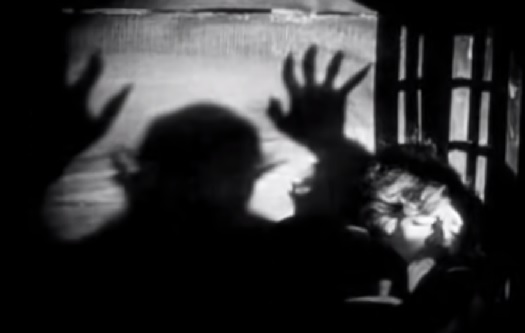
Nosferatu, eine Symphonie des Grauens (1922)

Directed by F.W. Murnau [Other horror films: Satanas (1920), Der Bucklige und die Tänzerin (1920), Der Januskopf (1920), Schloß Vogelöd (1921) Faust: Eine deutsche Volkssage (1926)]

I can’t say for sure, but this may be only the third time I’ve seen this German classic. There’s not a specific reason for this, aside from maybe the fact the print I own on DVD is a bit rough (thanks Mill Creek), but it’s also true that while I enjoy some ideas and aspects about Nosferatu, I’ve never really loved it as a whole.

Throwing in the whole plague sub-plot was a nifty idea, I think. Especially given that I’m writing this while many are still on moderate lock-down due to Covid-19, the diseases’ impact on the characters (while somewhat negligible as far as the story is concerned, and does more to help with the ominous atmosphere, to be honest) brought a bit of reality to the film. That scene in which bodies are being taken out through the narrow streets in particular was an effective one.

Count Orlac himself (played by none other than Max Schreck) didn’t have that much in the way of character, but definitely made his presence known. He was awkward as fuck, but everyone has their vices, and hey, I don’t have a castle in the land of phantoms, thieves, and ghosts, so maybe he’s doing something right. Schreck was great here, be him creeping up stairs or standing ramrod straight in a split second (both highly effective scenes).

I couldn’t help but feel for both Gustav von Wangenheim (who was also in Schattan – Eine nächtliche Halluzination) and Greta Schröder, as both of their characters went through the wringer. I felt legitimately dismayed as Schröder’s unhappiness at being away so long from her husband, and I enjoyed both of their performances, though I do think the ending maybe could have been extrapolated on a bit.

The print I watched this time around was pretty nice (it was on TCM, so could you imagine anything but?), with a nice tint, solid score, and all-around pleasant presentation. I just wished the inter-titles had been in German as opposed to English, but that’s a personal preference which has no impact on my enjoyment.

Overall, I don’t doubt at all that Nosferatu is a classic, and rightfully so. The effects were pretty good for the time, and some scenes, like I said, still increase suspense to this very day. It’s just never been a personal favorite of mine (The Cabinet of Dr. Caligari was always more my vibe).

7.5/10