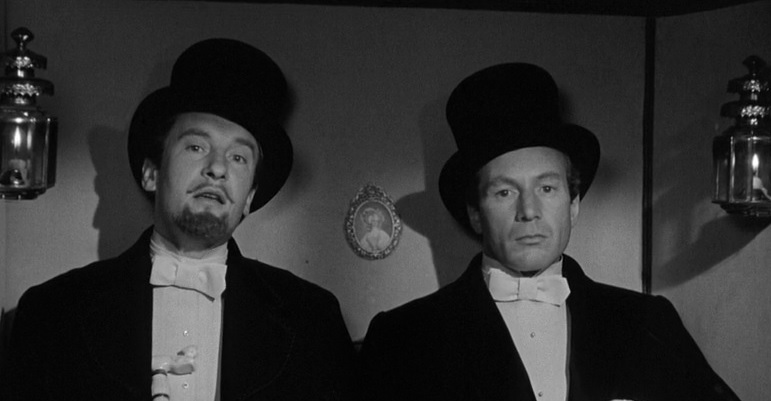
Dead of Night (1945)

Directed by Alberto Cavalcanti [Other horror films: The Halfway House (1944), Dead of Night (1945)], Charles Crichton [Other horror films: N/A], Basil Dearden [Other horror films: N/A], & Robert Hamer [Other horror films: N/A]

While a classic of both British horror and anthology horror, I have to admit that Dead of Night has never been a film I think about too often. It’s a decent film, and possesses both a solid framing sequence and a few solid stories, but overall, I think the movie is just okay.

It’s not the first anthology horror, of course – even if you’re hesitant about counting Waxworks (which I could understand), there’s the 1919 German film Unheimliche Geschichten (or Eerie Tales). Like many anthology films, it’s uneven, much like Dead of Night tends to be, but there is plenty to appreciate about this one.

The framing sequence is pretty good, and even a bit more involved than many framing stories you’d later see in Amicus films (Tales from the Crypt, Torture Garden, The Vault of Horror). It’s a good framing sequence with a fun conclusion and decent ideas, which is definitely not something you see in every anthology (though I like the film overall more, compare the framing story of Screamtime to this one).

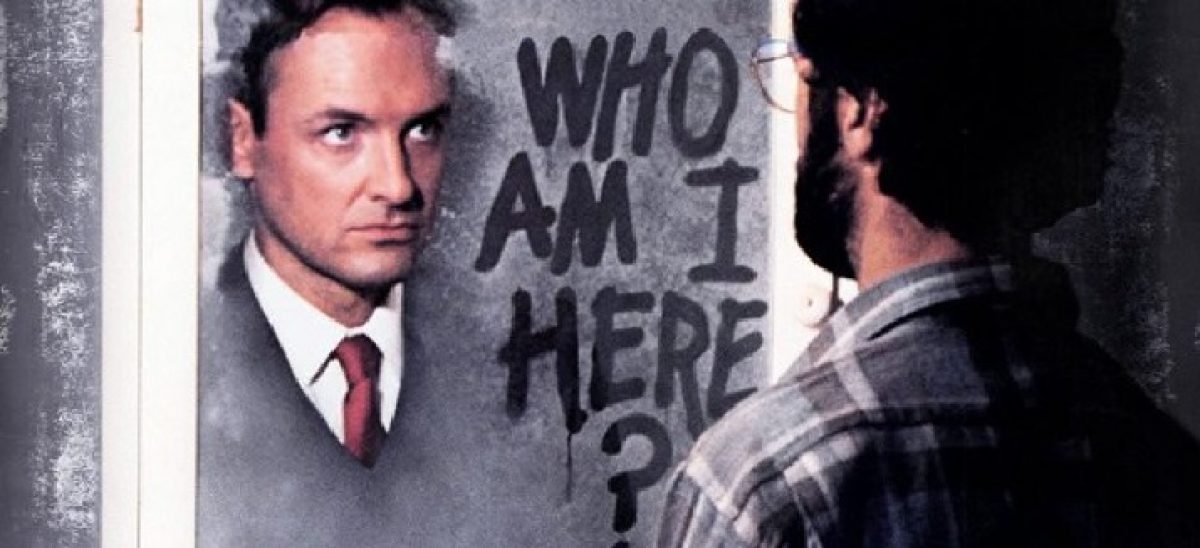
Of the five stories (‘The Hearse Driver’, ‘The Christmas Party’, ‘The Haunted Mirror’, ‘The Golfer’s Story’, and ‘The Ventriloquist’s Dummy’), I’d say only two are quite good, being ‘The Hearse Driver’ and ‘The Ventriloquist’s Dummy.’ ‘The Hearse Driver’ is really simple, but I enjoyed how it went, and it had a great Twilight Zone vibe to it. ‘The Ventriloquist’s Dummy’ is a longer story, but the ending to it, reminiscent of both Psycho and Pin, was quality.

And to be fair, ‘The Haunted Mirror’ isn’t shabby. It’s just that I wanted a bit more meat. I don’t know where the additional protein would have been derived from, but it was a solid story, and I just wanted a bit more. It’s also within reason to say ‘The Christmas Party’ is okay, though it’s somewhat derivative and more spooky than scary, and I feel like the story’s been done better.

‘The Golfer’s Story’ isn’t without potential, but as anyone who has seen the movie knows, it leans toward a more comic tone. There’s a ghost who can’t properly disappear, and he and the man he’s haunting have to try and make the best of the awkward situation, especially as the man is getting married, and doesn’t want to make sweet love to his new wife in front of a ghost. We’ve all been there, guys. For a comedy story, I guess it’s okay, but I didn’t care for it, as I’m not one who wants silly stories mixed up with his horror.

Somewhat amusingly, there’s no performances, save Michael Redgrave’s, that really stood out. Redgrave did great in ‘The Ventriloquist’s Dummy’, and it’s probably a big part as to why that story is one of the most memorable things of the film. Frederick Valk and Sally Ann Howes are decent, but when it comes to great performances, it’s really just Redgrave and maybe Miles “‘Just room for one inside, sir,’” Malleson.

Anthology horror films are hard to get right, because so often, there’s a story or two that just cut it. It’s the same with Dead of Night – the framing story is solid, and it does possess some good segments – but overall, Dead of Night is just okay. I thought it the first time I saw it, and I’ve thought it each time I’ve seen it since.

6/10
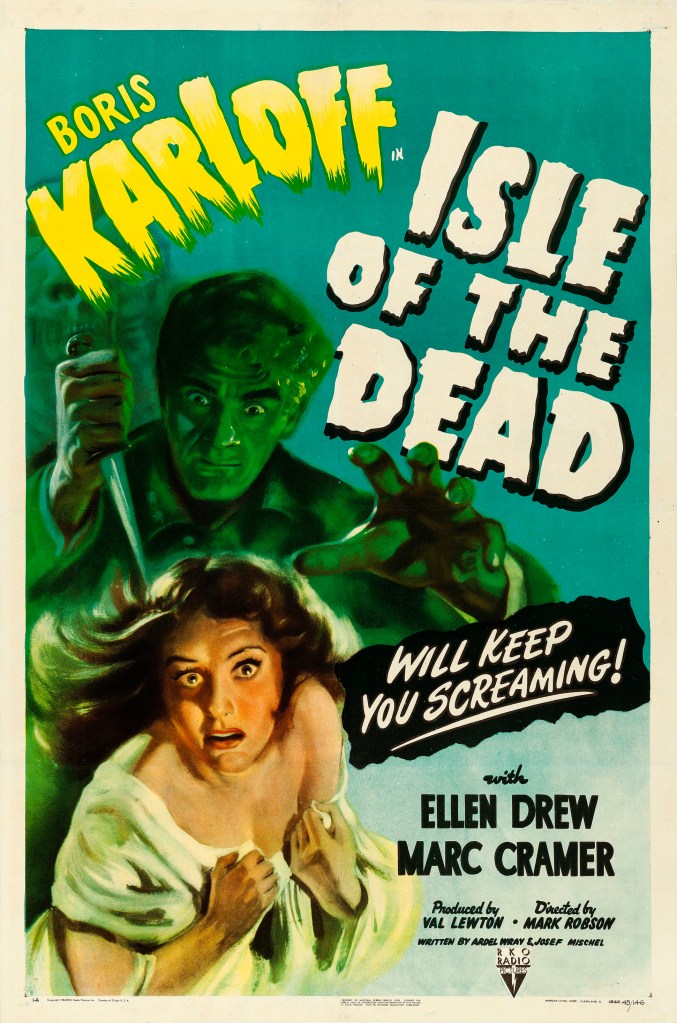
Isle of the Dead (1945)

Directed by Mark Robson [Other horror films: The Seventh Victim (1943), Bedlam (1946)]

I didn’t know what I was getting into when I started this movie because, in truth, while I knew the title, I didn’t really know anything about it. After seeing it, I can’t say I’m disappointed, as I had few expectations going in, but I can say that it’s not quite the movie I was looking for.

Like some horror films, especially horror films related to Val Lewton (who was one of the writers here), there’s a decent amount of build-up before we get to anything that really feels like actual horror. Hell, the director of this picture, Mark Robson, directed a horror film where it almost never gets to actual horror (being 1943’s The Seventh Victim), which is almost a feat in itself. Certainly this movie picks up with the final twenty minutes or so, and it’s not exactly dull beforehand, but given the talent involved here, I expected a bit more.

Obviously Boris Karloff doesn’t really need an introduction. Among my favorite performances of his is that of The Black Cat (a movie I didn’t love at a whole, but I won’t deny he did great in it), Frankenstein, The Body Snatcher, and Bedlam (which, coincidentally, was also directed by Robson), and he’s pretty good here, as a by-the-book general who might be a bit too brutal. Others here do okay, such as Ernst Deutsch, Marc Cramer, and Ellen Drew, but really, Karloff pretty much commands the screen.

Story-wise, there’s an interesting (and, as I’m writing this in late 2020, time-relevant) plot where a group of people are stuck on an island trying to survive a plague. It leads to the expected tension and increased feeling of being on edge, which might be a bit much for some characters, such as that played by, of course, Boris Karloff. It leads to some quality scenes in which characters argue between science and religion (and of course, this being an older movie, my atheist friends and comrades will be disappointed by the illogical nature of the conversations), but ultimately, it doesn’t really get good until a confluence of events at the end.

The finale itself is no doubt pretty solid, though I’d argue it’s not enough to really warrant watching this one again, at least any time soon. Isle of the Dead isn’t a movie that I could see myself throwing into a favorites pile of classics, but I did certainly appreciate the, for lack of a different word, almost atypical presentation and story, and it may just take some more viewings for it to really grow on me.

6/10

The Picture of Dorian Gray (1945)

Directed by Albert Lewin [Other horror films: The Living Idol (1957)]

While certainly more a morality tale than a straight horror film, there’s a reason that this classic is often listed as part of the genre, especially come the end of the film in it’s debauched glory.

More than anything, The Picture of Dorian Gray questions morality. Personally, when it comes to many aspects of the hedonistic lifestyle portrayed in the film, I didn’t have a big deal with it. It was a different time, though, so if you can get past how tame Dorian’s ‘sins’ seem (some of the worst stuff is off-screen, only alluded to), you can have a good time.

The cast here is stellar. Hurd Hatfield does a great job as the debonair but somewhat soulless Gray, and his youthful appearance lends credibility to the story. He’s never really been in much that I’ve seen, but given that this was only his second role, it shows the quality of his performance. Honestly, though, George Sanders and his amoral character impressed me more. He was witty, fun, and most importantly, entirely able to defend the actions others see as questionable. Sanders here really brought a great character to life.

Donna Reed and Angela Lansbury played two love interests of Gray at different periods of his life. Reed was decent, but it was Lansbury who made a bigger impression, and the scene in which she’s singing prior to meeting Gray was great. Her time with Gray was short and tragic, especially come the test of her virtuousness (all thanks to Sanders’ character).

One more name need be mentioned, and that’s Cedric Hardwicke, who narrated the film. I sometimes have an issue with narration (look at how awful it was in Curse of the Faceless Man), but it was very solid here, and only added to the tone of the film.

Another thing very much worth pointing out was how, despite the film being black-and-white, there were a few scenes in full color, when first showing the titular picture of Dorian Gray and again toward the end once, showing just how far his soul has fallen (which led to some unnecessary “Pray for your soul, Dorian,” stuff, but whateves, I can deal with it). It was a very effective use of dramatic coloring, and that, coupled with a murder that happens moments after the second portrait reveal, really bring the horror element of the film to the forefront for those scenes.

When it comes to classic films, it’s not uncommon for horror elements to get mixed up with heavy dollops of drama, and this movie is a prime example of that. For fans of modern-day horror, The Picture of Dorian Gray might not be up to their standards. It’s a great mixture, though, of a morality tale, throwing in elements of romance, horror, and the desire for one to better himself. Certainly a movie that’s recommended, and referred to a ‘classic’ for a reason.

8/10

The Body Snatcher (1945)

Directed by Robert Wise [Other horror films: The Curse of the Cat People (1944), The Haunting (1963), Audrey Rose (1977)]

This classic film is one that’s heavily bolstered by solid performances and a rather entertaining story. While somewhat light on what you might traditionally expect from a horror film, I think The Body Snatcher has a lot going for it.

One thing about this film that I rather enjoy is the fact that it’s easy to use this as a companion piece to the 1960 release The Flesh and the Fiends. If one were somewhat daring, you could even call The Flesh and the Fiends a prequel to The Body Snatcher. At the very least, the two films work together well, and as both are rather decent films, there’s possibilities there.

The Body Snatcher’s cast is probably the best part about the film. Bela Lugosi is somewhat underused, but both Henry Daniell and Boris Karloff are used to great effect. Daniell has that aura of a dignified man with a rather torrid past, while Karloff oozes sleaziness in virtually every second of screen-time. Daniell and Karloff are definitely the most memorable performances here, because while the audience’s moral center, played by Russell Wade, is decent, he’s ultimately somewhat forgettable by the time the story wraps up.

Speaking of which, while at first I was hesitant toward the final ten minutes of the film (they struck me as unnecessary, given the death of the antagonist that had already happened), I found them masterful (important to note that while I’ve seen this one before, it’s been quite a long while, so many of the details were forgotten). The final carriage ride is just fantastic, both introspective and somber, turning into a manic, thrilling conclusion.

While it’s light on some horror aspects (which is something I didn’t really notice at the time, but seems clear when thinking back to the film), The Body Snatcher is a lot of fun, and it really does have a lot going for. Definitely give it a watch, as it’s one of the high-lights of the often lackluster decade that was the 1940’s.

8/10