The Invisible Man’s Revenge (1944)

Directed by Ford Beebe [Other horror films: The Phantom Creeps (1939), Night Monster (1942)]

I found myself feeling somewhat lukewarm toward The Invisible Man Returns, and I have similar feelings for this one. The Invisible Man’s Revenge isn’t without some decent ideas, but especially toward the end, I find myself losing interest.

Part of this is because I found myself on the Invisible Man’s side. Played by Jon Hall (and not becoming invisible until something like 20 minutes into the movie), he was cheated out of money by a wealthy couple (Lester Matthews and Gale Sondergaard), and despite a signed agreement, they refuse to pay him back. To be sure, Hall’s character wasn’t the most stable, but he did have rights to some of the money, and so we’re supposed to root against him?

It wasn’t so much Matthews’ character that bothered me as it was Sondergaard’s – she obviously had no intention of paying back any owed money to the man, and would have been happy to kill him herself if she had any plausible way to get away with it. When the so-called antagonist is in the right, it just sometimes makes movies harder to play ball with.

There were also a few moments of amusing mirth that I probably could have done without. Most of Leon Errol’s dialogue pegged him for comic relief, and he was good at it. He cracked me up a handful of times, and he was good fun. The scene in which he wins at darts, though – with the help of the Invisible Man, who’s running the darts from his hand to the bullseye – went on too long and felt wholly unnecessary. The first time was sort of funny, but he threw three more darts in increasingly improbable ways, and at that point, the fun was draining from the sequence.

I do think, though, that Leon Errol was one of my favorite characters, though. Jon Hall (The Beach Girls and the Monster) was a decent lead, but Errol was simply more fun. It was also fun seeing John Carradine (Voodoo Man, Revenge of the Zombies) here – his scientist character had charm, though I have to say that his house – which held a bunch of invisible animals – also felt a bit on the silly side.

I couldn’t stand Gale Sondergaard’s (The Spider Woman Strikes Back, Savage Intruder, The Cat Creature, The Climax) character – she was just awful, and deserved to get got. Lester Matthews (Werewolf of London, The Mysterious Doctor, The Son of Dr. Jekyll, The Raven) was more bearable, but I personally thought that both Alan Curtis and Evelyn Ankers (Jungle Woman, Captive Wild Woman, The Mad Ghoul, Son of Dracula, The Frozen Ghost) were shallow, and neither, in my eyes, added a lot to the film.

Certainly the special effects here were decent, and perhaps more advanced than they have been in previous films, but there’s also not really that much of interest, as far as the story goes, in the second half of this. I mean, the Invisible Man’s titular revenge lasts just 15 minutes or so, and then he becomes visible again, and it just wasn’t doing it for me.

I don’t think it’s a terrible movie, but it definitely lacks the charm of the 1933 classic. Also, given that Vincent Price doesn’t appear as he did in The Invisible Man Returns, we don’t have his charm to fall back on either. It’s fine, I guess, but I doubt it’ll be watching it again in the next 50 years, and it doesn’t seem to me that it’ll really stand out in my memory.

6.5/10
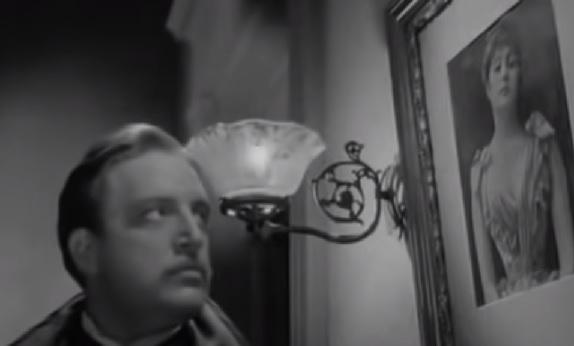
The Lodger (1944)

Directed by John Brahm [Other horror films: The Undying Monster (1942), The Mad Magician (1954)]

I’ve been well-aware of this film for years and years – it used to play on AMC what seemed like every week – but it took until now to see it, and I definitely found it an impressive film.

The story of Jack the Ripper is one that I’ve seen in a few other films, from the 1927 The Lodger: A Story of the London Fog and the 1953 Man in the Attic, and this is probably the best one. Man in the Attic was very enjoyable, and went a very similar route as this one, but since this came first, I’ve gotta give this more credit.

We don’t see any over-the-top murders or gore, of course, given this film is from the mid-1940’s, but we do get some very suspenseful scenes and occasionally great moments leading up to what one can imagine are brutal murders. Great use of setting too – I loved those scenes where the police and civilians were enclosed in a small portion of Whitechapel trying to trap Jack the Ripper in the mist, but just unable to do so. Great, great scenes there.

I don’t know if it’s his slightly larger frame, or just his imposing physique, but Laird Cregar reminded me a lot of Victor Buono, so it should go without saying that his performance was top-notch. The sad thing is, as some of you may know, Cregar died in late 1944 at the extraordinarily young age of 30, his final movie Hangover Square being released after his death. With less than twenty roles, I think it’s a damn shame he died that young, especially since he could have had a long-lasting career in horror had he survived into the 1950’s, 1960’s, and into the 1970’s. Cregar was great here, and it’s just a shame.

Cedric Hardwicke (The Ghoul) was solid, and he had one of the more reasonable characters in the film. As his wife, Sara Allgood was fine, though not necessarily stellar (not that really a whole lot would be expected from a character like hers). Merle Oberon does pretty well in her role, and I like her interactions with Cregar’s character, as they always had an undercurrent of growing suspense. Lastly, George Sanders (Village of the Damned and The Picture of Dorian Gray) was a wee bit generic to really stand out, but got more character in the end, so he turned out well.

I was impressed with just how suspenseful this one became at times, and I was also drawn into the whole “is the Lodger actually Jack the Ripper” plot-line as more and more possible coincidences occurred. The Lodger is a strong film, and definitely a highlight of the 1940’s, so I’m glad that I finally took the time to watch this.

8/10

The Uninvited (1944)

Directed by Lewis Allen [Other horror films: The Unseen (1945)]

This is a classic that I’ve not seen until now, and it was great to sit down and finally watch it. Quite a solid film with a decent mystery, it’s pretty easy to see how this influenced ghost films in the following decades, into today.

A large house on the English coast was a fine choice for the setting, and I also like that it is just a house (albeit a large one) as opposed to a castle or mansion. It makes it seem a bit more relatable to those of us who have never set foot in a castle or mansion, and shows that even us lowly poor people can be haunted.

The Uninvited also really started off great with a little voice-over talking about ghosts and the like, all set to the beautiful scenery we’d been exploring for the next hour-and-a-half. It reminded me a little of Return to Glennascaul, a 1953 horror short narrated by Orson Welles. The atmosphere started off strong, and never really let up.

Ruth Hussey and Ray Milland made a fine brother and sister (and I have to say that it’s quaint to have siblings buying a house together as opposed to a couple), and Milland (who has been in plenty of horror films, such as Frogs, X, Terror in the Wax Museum, The House in Nightmare Park, and Premature Burial) was pretty witty at times, giving us some pretty amusing lines.

Playing an older gent with a stick up his ass, Donald Crisp (who I actually saw earlier this very month in the 1941 version of Dr. Jekyll and Mr. Hyde) was pretty solid, and playing his granddaughter was Gail Russell (who apparently died at the young age of 36 due to a long bout with alcoholism). Russell got a bit hysterical at times, but she was cute, so I’ll give her a pass (it also helps that it makes sense with the story). Alan Napier was also #beast in this.

I loved the mystery here, as Milland and Hussey are trying to figure out the whole true story behind the murders that took place at their new house. It reminded me of many more modern ghost films in which the protagonists have to solve the old crimes before they can really understand what’s going on (such as The Changeling or Dark Water), and I thought it was done wonderfully here, with a solid sense of atmosphere.

The 1940’s wasn’t the strongest decade for horror, and in fact, I’ve long-thought that it was among the weakest, but The Uninvited belies that and ends up being a sometimes-amusing, sometimes-spooky film that it well worth seeing.

8/10

Cry of the Werewolf (1944)

Directed by Henry Levin [Other horror films: The Unknown (1946)]

I saw this one once before, and it didn’t do much for me. I didn’t hate it, it just came across as pretty generic and unmemorable. Unfortunately, not much has changed.

Part of this consistent disappointment comes from the fact that the title of the film is a bit misleading. There’s a woman in the film who can turn into a wolf, but there’s no werewolf whatsoever, so if you’re looking for The Wolf Man or Werewolf of London, you won’t find it here.

Honestly, this isn’t a film that there’s a lot to say about. The lead performance of Stephen Crane was pretty underwhelming, and while both Nina Foch and Osa Massen were okay, I don’t think either one particularly stood out, partially because of the script.

While the movie itself isn’t necessarily dull (given it’s just over an hour, there’s not really much time to mess around with anyway), the story is just sort of meh. There are some interesting elements, but I also can’t deny that it strikes me as occasionally xenophobic in regards to the gypsies.

Really, much of the film just feels pretty weak and tepid. There was a single suspenseful scene which didn’t go anywhere, but hey, it was something. The kills, though, are pretty much all uninspiring, and overall, Cry of the Werewolf doesn’t really have a hell of a lot going for it, even for a fan of older horror films such as myself.

If there’s one positive thing I can say about it, the plot, while I personally didn’t much care for it, was moderately unique. There’s sort of a nice mysterious vibe to portions of the film, and while, as an audience, there’s nothing that we don’t really know, it’s still almost okay. But having seen this twice, I just don’t think there’s much to it. Might be worth checking out, but I don’t know how much someone would get from this one, even if they’re into the classics of the genre.

5/10

Bluebeard (1944)

Directed by Edgar G. Ulmer [Other horror films: The Black Cat (1934), The Man from Planet X (1951), Daughter of Dr. Jekyll (1957), The Amazing Transparent Man (1960)]

Having seen this one about three times now, I have to admit that it’s never done much for me. The story is fine, and John Carradine does particularly well in it, but overall, Bluebeard just doesn’t impress me.

Generally, the plot’s perfectly enjoyable. I sort of like the brief side-step they took with the portrait subplot, which added a bit more meat to the film, and the conclusion’s pretty decent also. Carrdine’s presence here really brings life to the antagonist of the film, so that’s a plus.

Somewhat unfortunately, Carradine’s about the only performance here who really glowed. Jean Parker and Teala Loring were virtually indistinguishable to me, and Ludwig Stössel, while an interesting character, had a bit of an accent to him, and was hard, at times, to really decipher.

Which may not really be his fault, as the audio and visual quality of this film has somewhat faltered over the last eighty years. The most common print has pretty bad audio, and it’s not uncommon for some of the dialogue to be drowned out by background music. The black-and-white is a bit muddled, and while it’s not overly distracting, it is noticeable. Even if you can look past that, though, I’m not convinced that the film is all that enthralling.

Bluebeard is a story that’s been made multiple times within the genre, the earliest version, titled Barbe-bleue, is from 1901 (and, for a short from such an early period of cinematic history, it’s not that bad). Maybe that’s part of the issue – this movie, at 70 minutes, just feels too drawn out, and while some of the film is perfectly solid, after having seen it multiple times, it’s continually let me down.

If you see this for any reason, let it be for Carradine, who is fantastic, especially toward the end of the film. His character’s sanity toppling toward the end as he recounts the origins of his crimes was pretty spectacular, in a Poverty Row type of way.

This said, ultimately, Bluebeard isn’t one of those 40’s movies I’d go out of my way to recommend. It might be okay for a single viewing, but I don’t think multiple viewings will do much for you, no matter how fun Carradine is here. By no means a god-awful film, I do feel it’s below average, and pretty much always have.

6/10

One Body Too Many (1944)

One Body Too Many

Directed by Frank McDonald [Other horror films: N/A]

Though with an additional comedic element, One Body Too Many has almost all the staples of 1930’s and 1940’s horror movies. A dark and stormy night, a crowded mansion, mistaken identity, reading of a will, secret passages, red herrings, the whole shebang. In fact, the only thing it doesn’t have is a gorilla. Still, I don’t say this as to portray the movie as being too generic – while that might be the case, I happen to love these dark and stormy night will-reading movies; they’re entertaining, and this one’s no different.

The aesthetics are pretty cool – thunder and lightning in the backdrop as multiple mysterious people are creeping through a silent dark house. While the copy I own (and that’s most widely available) is a bit on the grainy side, it doesn’t lose the effect. The downside of the film is two-fold, though: firstly, the while the plot is simple, throwing in ten to twelve different characters can come across as convoluted. When the killer was revealed at the end, I thought he had already been seen with the other characters in the previous scene. Lost a bit of the power they might have been aiming for.

Really, the main character (played by Jack Haley), Bela Lugosi’s character, and Professor Hilton (William Edmunds) were the only ones that I could easily tell apart. Most of the others were interchangeable. Still, that may be more a problem with myself than the movie. Secondly, though, is the run time. While the movie is just 75 minutes (an hour and 15 minutes), some sequences seemed to drag on a bit too long (especially one particular sequence involving secret passageways about an hour into the film). Had they just cut out ten to 15 minutes, I think the movie would have been a bit better.

The comedic elements overall weren’t too bad or distracting (the main character’s cowardice, not to mention a few of the antics, were a bit much), and some of it was actually rather amusing, such as the recurring gag of the butler (Lugosi) trying to serve seemingly-poisoned coffee multiple times throughout the movie, only to get consistently rejected. I have to admit, I got a kick out of that. When I first saw this film, I rated it slightly above average. It just doesn’t stand up to my memories, though. One Body Too Many is an amusing film, but the problems can be a bit glaring. Overall, I think it’s slightly below average. Likely still worth a watch if these films are your type of thing.

6.5/10

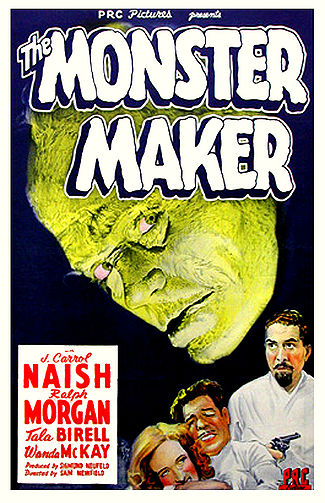
The Monster Maker (1944)

The Monster Maker

Directed by Sam Newfield [Other horror films: The Mad Monster (1942), Dead Men Walk (1943), The Flying Serpent (1946), Gigantis: The Fire Monster (1959)]

This is around the fourth time I’ve seen this film, and for the most part, I always have considered it around average. Not my cup of tea, but certainly not bad, in short.

The story is a moderately simple one: A crazed doctor infects a pianist with a deliberating disease, disfiguring him, and will cure him only if he can marry the pianist’s daughter, hence, becoming the ‘Monster Maker.’

J. Carrol Naish does a fine job as our Dr. Markoff, and the rest of the cast is decent too, though some hysterics from some of the actresses does tend to get on my nerves. There is a slightly boring portion halfway through the film, an eight-minute sequence of the doctor unleashing a gorilla on his assistant (he believes her to be a liability to his plan), but there is still some decent suspense present.

Of course, being a 40’s horror film, the ending is a bit sudden, but I was rather happy with the conclusion. Oh, another positive note – even if this movie isn’t your type of film, it clocks in at only and hour and two minutes. Quick to finish and easy to digest. I don’t love The Monster Maker, but for Poverty Row entertainment, it’s a fine movie.

7/10