Kaibyô nazo no shamisen (1938)

Directed by Kiyohiko Ushihara [Other horror films: Nijiotoko (1949)]

There was generally a dearth of horror films in the late 30’s, and some of the films I personally count as horror, others don’t (such as Sh! The Octopus, The Terror, and Riders of the Whistling Skull), so to come across a late 30’s Japanese film, beautifully subtitled on YouTube, was a treat that’s hard to beat.

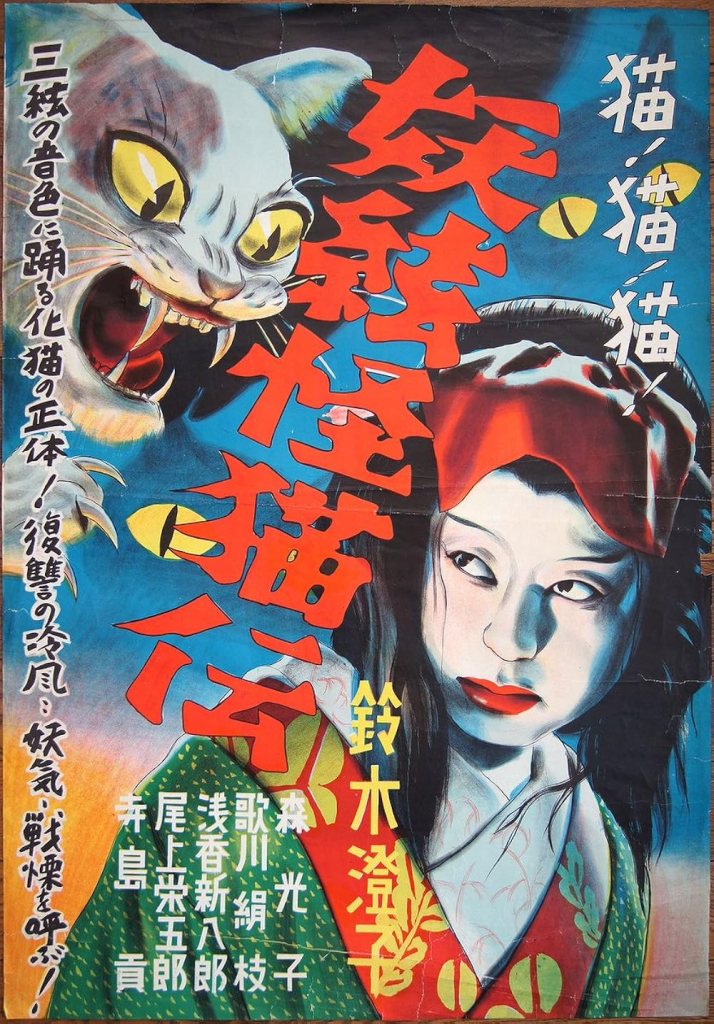
Known as The Ghost Cat and the Mysterious Shamisen, the story here strikes me as somewhat engaging. A jealous woman (Sumiko Suzuki) kills a cat, along with a young woman (Kinue Utagawa), because she’s awful (the jealous woman, to be clear; I’m sure the cat was kind). Of course, things in Japan never stay truly dead, and revenge strikes like a monkey’s dance.

Which makes more sense if you’ve seen the finale of this one.

First off, I guess I should mention that I had absolutely no idea what a shamisen was until I watched this. It’s a traditional Japanese musical instrument, sort of like an acoustic guitar, only infinitely different. The instrument plays a big part in this movie, as Shinpachirô Asaka’s character plays one, and gives the prized instrument to Kinue Utagawa’s character before her untimely demise. And like the cat that came back, the instrument slowly finds it’s way to the hands of Mitsuko Mori, who played the sister of Kinue Utagawa’s character.

Some scenes aren’t that easy to fully gauge – not only is the movie from 1938, but the print is rather scratchy at times – and I didn’t understand the final scene whatsoever, but it seems like both the spirit of the cat that was killed, along with the spirit of the woman, come back for revenge. At times it almost seems like the cat is the woman – or the woman is the cat; however it went, that wasn’t clear.

What was clear were the solid performances. Shinpachirô Asaka wasn’t quite as in focus as I expected, and even his part toward the finale seemed limited, but he definitely did well with his character. Playing a highly jealous and awful woman, Sumiko Suzuki did stellar, and though I never cared for her character, her performance throughout was good.

The stand-outs, though, would be both Mitsuko Mori and Kinue Utagawa. I honestly wasn’t expecting Mori to take a more central role, but toward the end, she does, playing a huge part in an act of revenge against Suzuki’s character. More to the point, there’s a conversation that Mori and Utagawa have that’s quite emotional, and that showed great promise.

The finale here is rather tense. It lasted around 15 minutes, all during a play-type deal, and though it felt a little rushed and hectic just at the moment where I’d have preferred more clarity, it was a solid finale, even possessing a few interesting camera tricks that I don’t have the vocabulary to describe.

Perhaps the most memorable scene would be when a cat’s face is sort of superimposed on a woman’s face, which was decently effective. I mean, none of the scares here are like to amaze most modern-day audiences, but there was a scene or two that had a solidly spooky atmosphere, such as the first time the ghost cat arises, so there is fun to be had.

One of the earliest Japanese horror films I’ve seen (aside from the silent A Page of Madness, which I abhor), The Ghost Cat and the Mysterious Shamisen isn’t an amazing movie, but it was perfectly adequate. I can say I thought it was almost special. What it really is, though, is an old Asian horror film many probably haven’t heard about, and it’s an okay watch, so if it sounds like your type of thing, give it a go.

7/10

The Terror (1938)

The Terror

Directed by Richard Bird [Other horror films: N/A]

This British adaptation of an Edgar Wallace play has many of the elements you would hope from an old dark house mystery, but falls just a bit flat due to some comprehension issues.

The story starts out more a crime movie than many other examples of the subgenre, what with a clever robbery of a rather large shipment of gold. Before long, though, we meet a large cast of characters, each one somewhat suspicious, including a drunkard who seems to have quite an interest in the grounds of an inn, a butler who seems to know far more than he says, and a parson who definitely doesn’t seem what he is, along with others.

It’s a good story with multiple red herrings and an enjoyable mystery, while also throwing in some delightful wit (much of it rather amusing) and characters that are rather memorable, such as Bernard Lee’s inept drunkard.

In fact, Bernard Lee, while being far from the main star, was probably my favorite performance of the bunch. Linden Travers did pretty good, but much of the time fell into the generic ‘hysterical woman’ that these movies always seemed to rely on. Wilfred Lawson didn’t make much an of impression until the end, and Arthur Wontner never really does. Iris Hoey’s character was pretty funny at times, but is representative of my main issue with the film.

Beforehand, I want to state that I know this may not be a necessarily fair criticism, but it was still a prevalent issue. Being a British movie of not the highest quality, some of the dialogue was hard to follow, especially from Hoey’s character, who had a rather rapid-fire delivery. I caught most of what Lee’s character said, slurred as it almost always was, but some character’s accents, mixed with the audio present, led to more than a few incomprehensible lines of dialogue. I still caught most of the story, but I know I missed some amusing quips, and even once, a whole conversation went over my head.

It didn’t help any that this movie had a rather staged feel, partially, I suspect, because it’s based off a play. A lot of conversations with different characters lead to increased opportunities of missed snatches of conversation, which happened multiple times. It’s not the fault of the movie, but it still impacted how I felt about it toward the end.

Otherwise, this is a delightful little film. I liked the ghostly monk, and his ghoulish chuckles, though he should have appeared more. The creepy organ music of mysterious origin was fun, and there were some desolate ruins too that played a part. Generally-speaking, the setting was pretty solid, as were the characters. It’s just the language barrier, as it was, that presented a problem.

I first saw this film some years back, though I don’t remember much about how much I enjoyed it. It probably came across as a somewhat generic old dark house mystery, which I guess it sort of is. Still, re-watching it certainly increased my appreciation of it, and were it not for the problem I had with it, I think it’d be getting a higher rating easily.

There was an American version of this play made in 1928, but unfortunately, it’s lost. It was apparently one of the earliest horror talkies, which makes it all the more a shame that it can no longer be seen. Elements of the film were then used in Return of the Terror, which came out in 1934. While this film does survive, it can only been seen from the Library of Congress, and as such, hasn’t had many words said about it.

As for the 1938 version, though, it certainly has it’s charm, much of it coming from the wit throughout, and if you’re a bit better at catching some fast-moving dialogue, you’ll probably get a bit more from the movie out of me. Still, by no means a bad movie, The Terror is an enjoyable late 30’s mystery/horror hybrid during a time when horror films were rather hard to come by.

6.5/10