

Directed by Rudolf Meinert [Other horror films: N/A]
Being the first adaptation of the only Sherlock Holmes story really considered horror, this early German production has been a film I’ve long wanted to see, and luckily it came out as a special feature on Blu-Ray on the 1929 Der Hund von Baskerville disc set, so now I’ve finally seen it.
And it’s not too shabby. Oh, it’s not great – this is far from the finest version of the story out there (which I suspect is the 1959 version, but I need to revisit that first before committing to that) – and this version is focused far more on the suspense (the mystery aspect isn’t really relevant here, oddly enough) than on the horrors of the hound, but given that this came out 1914, I doubt anyone could find that deeply surprising.
Certainly there’s plenty of amusing things in the film to keep your interest, especially since the audience is pretty much told who the culprit behind the attacks is, along with why, pretty early on in the film. From a scene in which a character blows up a mailbox to prevent a letter from being sent to the ludicrous-yet-fun central focus of the movie, much of this German silent is a hoot.
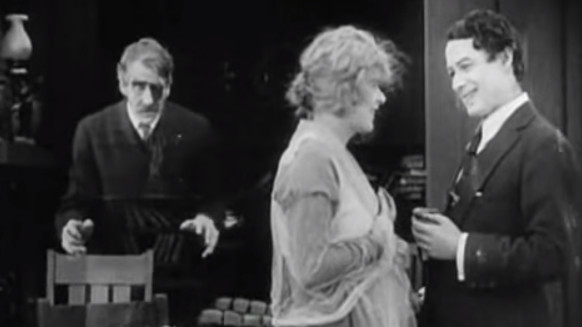
Afraid for his life due to the curse of the Hound of the Baskervilles, Henry Baskerville (Erwin Fichtner) sends for the famous Sherlock Holmes (Alwin Neuß), but due to the mailbox being blown up by a sinister character (Friedrich Kühne), the letter doesn’t get there. Instead, the sinister character impersonates Holmes in order to get close to Baskerville and kill him. Once the real Holmes finds this out, he eventually impersonates the other guy, and the FakeHolmes and RealHolmes meeting toward the end just cracks me up.
Another quality sequence is RealHolmes’ first action sequence, in which he notes that a bomb has been placed within the castle, and alerts Baskerville. While the fuse is getting closer to the explosive, a calm Holmes, unperturbed that in twenty seconds he, along with the castle, will be blown up, asks for a light. Baskerville looks at him like he’s insane, and the woman he’s courting (Hanni Weisse) has long since fainted. Undaunted by this, Holmes just shoots the lit fuse, and upon picking it up, uses that to calmly light his cigarette.
By no means is this version of the story fantastic, but as I said, it is decently fun, and I personally found the ending satisfying, especially for Barrymore (Andreas Van Horn), a character who was given the short stick for much of the film. Alwin Neuß makes for a fine Holmes, one that’s certainly confident and, showcased when he just fucks with the other guy and impersonates him, has a bit of a trolly nature to him. Friedrich Kühne makes for a solid antagonist, and he and Neuß work well together.
I do wish we saw more of the hound – even an attack that I was hoping for (set up beautifully, with a character and the hound in silhouette in preparation) was instead foiled by the reaction of the horses to the hound – but again, this is 1914, and the “fiery hound” as this film describes it, will have other chances to strike terror in the hearts of men.
As it was, Der Hund von Baskerville made for a pleasurable viewing experience, and I for one am just ecstatic that it’s been found and put back together so beautifully (the score and tinting are masterfully done), so even if it lacks the thrills you’d hope, it’s still the earliest rendition of the story possible, and a fine silent film to watch.
7.5/10
 Jiggy's Horror Corner