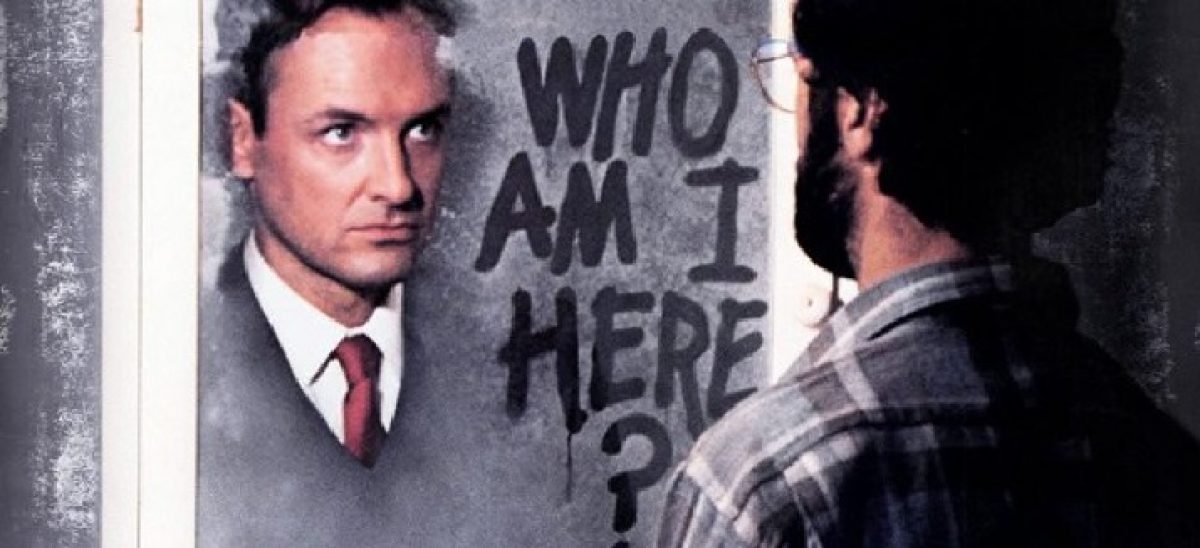

Lockjaw: Rise of the Kulev Serpent (2008)

Directed by Amir Valinia [Other horror films: Dream Home (2006), Mutants (2008), Alligator X (2010)]

Well, this movie is pretty terrible. On the upside, it’s not a long movie, but on the other hand, it’s still at least an hour and ten minutes, and it’s certainly not one of the better giant snake movies I’ve seen in my time.

Apparently, Lockjaw: Rise of the Kulev Serpent (which is, I guess, at least a memorable title) was later re-released under the rather generic name Carnivorous, but no matter which title you see it under, it’s not a particularly worthwhile film, and unless you really like DMX, it’s not something I’d say is worth is.

I do have at least one story that’s almost amusing about Lockjaw, though. I first saw this film a long-ass time ago off Syfy (and it very possibly might have still been called Sci-Fi when I watched it), and I noticed on my DVR, the recording was only an hour and a half. I’m guessing that most people know when you record a movie off Syfy, most of them are two hours (what with commercials and all), and so I thought that the recording messed up, and I was missing the rest of the movie.

Well, that wasn’t the case. The finale to this film is was just so damn sudden, and doesn’t really feel like the finale. It’s not like it comes out of nowhere, but it also doesn’t seem satisfactory whatsoever. I’m happy I didn’t need to try and find this elsewhere back then to finish it, but whenever I think of this movie, I remember that it’s only around 72 minutes, with something like nine minutes of credits.

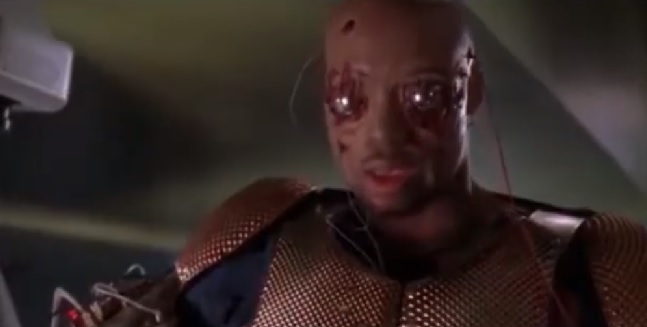
As for the story, it’s sort of like Pumpkinhead. A bunch of kids accidentally kill this guy’s wife, and he gets revenge on them via a voodoo alligator/snake hybrid, and only with the help of rapper DMX can these kids survive. As I bet you can imagine, Pumpkinhead is a decidedly better movie.

I didn’t really like any of the performances. I guess that both Lauren Fain and Wes Brown have their moments, but neither character is great. Louis Herthum (Be Afraid) felt somewhat weak, DMX felt somewhat generic, and Caleb Michaelson has no character traits outside of being an asshole.

Honestly, I don’t think the opening is too bad, being a scene where two kids (Brendan Aguillard and Abby Rao) break into the house of a voodoo guy and steal the Kulev box from him. I think it’s a decent scene, if only because the two kids work pretty well with each other (and their adult counterparts just don’t have that same chemistry). It’s a small thing to praise, but never say I’m not merciful.

With some horrible CGI (which can’t be a surprise) and lackluster kills (one of the least satisfactory decapitations I’ve seen in my life), not to mention an incredibly awful finale, Lockjaw: Rise of the Kulev Serpent just isn’t a movie that’s really worth it, and I can’t think of a good reason to seek this out at all.

3/10

Margaux (2022)

Directed by Steven C. Miller [Other horror films: Automaton Transfusion (2006), Scream of the Banshee (2011), Under the Bed (2012), Silent Night (2012)]

The trailer for Margaux seemed interesting to me, and despite the fact that the film had some lukewarm-to-negative reaction, I thought I’d check it out. As it is, while Margaux’s not a terrible movie, I don’t really know if there’s much to it.

Certainly the idea of being trapped in a smart house with murderous intent has potential. The problem is, this isn’t just a typical smart house (and while I say ‘typical,’ I’m speaking only from what I’ve gleaned from movies, as I myself have never been in a smart house, nor do I know if they’re even actually real to a large extent), it’s also a 3D printer with nanotech liquid, meaning that it can create pretty much anything from scratch. At one point, it even creates some clones.

For perhaps an hour and ten minutes, we’re given a somewhat uninspired but perfectly serviceable film, and then in the final thirty minutes, things, in my view, go off the rails. It’s true that I didn’t care for the tentacles that the smart house uses to shave people, or mix drinks with, but it gets worse, as clones are created to fight against the smart house, and more clones appear, and there’s even a twist (which anyone who’s seen Halloween III: Season of the Witch could have expected) dealing with a clone. It just started to feel totes ridiculous, brahs.

I don’t lay any of the fault onto the performances. As the lead, Madison Pettis was perfectly solid, and a decently likable character. Likable also was Jedidiah Goodacre (Marry F*** Kill, The Recall), who had a Remember-the-Titans Sunshine look going for him. We never got a great hang on Phoebe Miu or Jordan Buhat, and Vanessa Morgan’s social influencer personality was a bit much, but it comes with the new-age territory. Stoner stereotype Richard Harmon (Grave Encounters 2, I Still See You, The Return, The Clinic) was pretty fun, at least.

Performances aside, though, I just don’t know how memorable Margaux is. None of the kills were that great – you had someone get suffocated, another electrocuted, someone drank down acid. True, a man’s head was squeezed until it popped in the opening scene, but past that, there’s not much here to write home about. We also never really learned about how Margaux’s programming got altered. Maybe AI can just uproot themselves from programming – perhaps that’s the point – but I was hoping for something more.

Like I said, Margaux isn’t an awful film. However, I can definitely understand many of the lukewarm things I’ve heard about it, and though the production value is no doubt high, and the movie looks beautiful much of the time, I can’t say it’s anywhere near a great film.

6/10

How to Make a Monster (2001)

Directed by George Huang [Other horror films: N/A]

So this is one of those films that’s oddly special to me. How to Make a Monster isn’t that good of a film, but I’ve seen it quite a few times, and I definitely enjoy it. It’s partly the story, partly the performances, and partly the fun. No matter where it’s derived from, I really enjoy this one.

A remake-in-name-only of a pretty decent 1958 film, this film follows a bunch of video game designers being killed off by a monster they were hired to create for a game. That’s partly where the title, How to Make a Monster, plays into the film, and with some low-budget special effects and a rather shoddy looking game, it’s as campy and perhaps horrible as you might think.

The story is a bit janky, but you know what? I don’t care. I never did. The only real issue I have with the film is the conclusion, and that’s just because I don’t like Clea DuVall’s character arc. Even though I don’t care for it, though, it also plays well into the title of the film, and shows how damaging the capitalist system can be on humanity (technically, the movie is talking about greed, but as greed is what capitalism is based on, it works out).

There’s a lot of performances here that I love. I’m a big fan of Clea DuVall – in films like Ten Inch Hero and But I’m a Cheerleader, she’s a lot of fun – and I think it started with this movie. She’s such a sweet and kind character here, and though I don’t like where her story went, she’s just great. You have Karim Prince (“The name is Sol. As in Solomon. As in the King That Is Wise”), who plays a fantastically fun and arrogant character. And then there’s Tyler Mane (Sabretooth from X-Men), who is literally Hardcore and quite quotable (“Scary is as scary does”).

Those were always the three that impressed me most, but that’s not to say that the others didn’t #BringIt, as the yooths say (My Cousin Vinny reference FTW). Jason Marsden got a few emotional scenes into the mix, Steven Culp (who appeared in The West Wing a handful of times) had some strong scenes, Colleen Camp (Clue) got destroyed at the end, and for some nudity, we have Julie Strain, playing herself.

While there is some blood and gore here, most of it is either downplayed or implied. There are some dismembered limbs and a decapitated head, but it’s definitely not a gory film. The monster, based off the video game the characters were designing, does look pretty cool, especially when it comes to life and adds pieces of the people it kills (my favorite touches are the metal jaws, the viking helmet, and the Baoding balls it has in it’s eye sockets).

I’ve always dug this. I saw it when I was quite young (if I had to guess, between 9 and 11 years old), and it’s always entertained me, which is all you can ask of a movie. Sure, it’s not necessarily a good movie, but at the same time, it’s definitely above average, and I’m glad to own this one on DVD.

7.5/10

ShadowMarsh (2022)

Directed by Matt Leal [Other horror films: Hacked (2020), Tales from the Grave: The Movie (2020, segment ‘What We Leave Behind’), Hacked 2 (2022)]

After reading the plot of this one and getting a feel for the characters, I really wanted to come out of it with the ability to recommend it to anyone. Unfortunately, while aspects of ShadowMarsh are decent, I can’t say that I’m not largely disappointed with this one, as much as that does sadden me to admit.

What I think the film really nails are the characters – there’s a young woman (Ellen Woomer) and her uncle (Mike Ferguson) moving back to a small town, in which the uncle reconnects with his friend the sheriff (Lew Temple), and the young woman reconnects with her friends (Corrinne Mica and Shani Drake), a lesbian couple. One of these women is the daughter of a mayor (Dave Sheridan) running for re-election, to add a little more flavor to the mix.

There’s not a ton of characters in the film, as you can see, but the characters they have are pretty fleshed out. True, Sheridan’s mayor is somewhat of a one-note character, at least up to a point (his prime concern is his re-election campaign, which he takes very seriously), but there’s some conversations between Ferguson and Temple that were quite touching, and Ferguson’s character also has an argument with Woomer’s character that hits some good notes also.

If the movie were a drama about trying to readjust to small town life and an old hometown, I think ShadowMarsh really could have worked. Where the movie really lets me down, though, are the horror and mystery aspects.

With the horror, it’s pretty clear to me that they did what they could. There’s a “demon of the dirt” that pops up for perhaps five seconds total of screen time throughout the whole film, and we never get a particularly good look at it. Most of the kills just show a splash of blood hitting trees. That type of thing happens at least four times throughout the film. We do see a body or two after death, and one is pretty gruesome, but insofar as the horror goes, it really struck me as weak.

That didn’t need to be a negative, though; if they had a bit more meat regarding the mystery of the small town, the mysterious killings by the demon, and the cult that summoned it, not to mention more about the many missing reports in the Forest Department, then any lack of explicit horror could have been excused. If we got a legit small town cult mystery, complete with some history of the town and cult thrown in, perhaps things wouldn’t feel so shallow. Aside from a few pieces either hinted at or shown toward the end, we don’t really get that type of thing, though.

Oh, and this may be a small thing, but there were a few scenes that seemed to be going for a light-hearted tone. The opening of the film, in fact, has an almost comedic scene with a cult. What’s odd about that is ShadowMarsh isn’t by any stretch a comedic movie – most of it is pretty dramatic, including the rather somber (if not disappointing) finale, and the scenes which veered toward humor just felt out-of-place tonally to me.

Little of this is the fault of the performances. Ellen Woomer does well as the lead, dealing with being uprooted from her life in Michigan and the death of her mother. Mike Ferguson (Amityville Uprising, Devilreaux, Amityville Hex, Moon of the Blood Beast) is strong as an uncle with a criminal history, and his friendship with the sheriff, played by Lew Temple (Halloween, The Texas Chainsaw Massacre: The Beginning, The Devil’s Rejects) is among my favorite parts of the film.

I suspect more probably could have been done with Shani Drake and Corrinne Mica (Evil Everywhere), but in their limited roles, I think both were fine. Dave Sheridan (Blood Craft, The Special, Victor Crowley, Scary Movie) was mostly a one-note character, but got a hint of depth toward the finale, and Felissa Rose (mostly known for Sleepaway Camp, though has been in tons of horror films, many of them with Dave Sheridan) pops up too, though I don’t think she adds much.

Naturally, I was disappointed with this one. The finale had potential, and as I said, it was dramatic, but it also felt largely inconclusive. The horror aspects especially felt light, as blood splatter hitting trees was 95% of what they had going on. Certainly the highlights were the characters and potentially the atmosphere, along with the setting. I’m not sure where this was filmed, but I did think that the town and nearby forest looked good.

Overall, though, ShadowMarsh was indeed a disappointment. I don’t think it’s an awful movie, and certainly I believe that the film had some good potential, but I don’t think it got there. There are definitely worse things that someone could be watching, but that said, I believe this is a movie I’ll not soon be recommending to anyone.

5.5/10

Motel Hell (1980)

Directed by Kevin Connor [Other horror films: From Beyond the Grave (1974), The House Where Evil Dwells (1982), Frankenstein (2004)]

When I say it’s been a while since I’ve last seen Motel Hell, I don’t mean it’s been a couple of years, five years, or even ten years. It’s been at least 15 years since I’ve seen Motel Hell – so much so that aside from the most striking and memorable portions, everything felt new. It was a good experience, because while Motel Hell can sometimes be a bit much, it’s quite a solid film, and I dig it.

Which isn’t exactly what I was expecting when I revisited this one. As any reader of mine may know, when there’s too much of a comedic infusion into the horror, I check out. Given this film is often described as a black comedy, I was worried that it might be too goofy and offset the otherwise creepy and occasionally unsettling ideas in the film.

Luckily, that’s not the case. This is one sequence that strikes me as being a bit much – the two swingers – but for the most part, it wasn’t that silly. I mean, it’s sort of silly that Nina Axelrod’s character would fall for Rory Calhoun’s, but then again, the heart wants what the heart wants, and Farmer Vincent is a pretty suave character with folksy charm.

Seeing this originally when I was quite young, there are some seriously creepy images here, primarily the field of bags (and of course, under the bags are the heads of living people). Just the idea of keeping someone buried, their head above ground so you can keep them alive by force feeding them, and then killing them off for smoked meats, well, that’s a classy business plan. It’s done pretty well, because while the film does have some comedy, those scenes don’t become any less unsettling.

Rory Calhoun (Night of the Lepus) does great as Farmer Vincent, and you can sort of tell early on he’s destined as a cult classic character (“It takes all kinds of critters to make Farmer Vincent’s Fritters”). He has a fun personality, and I really dig him. Nancy Parsons and Paul Linke I felt more lukewarm toward, but Nina Axelrod (Critters 3 and Time Walker) did pretty good most of the time.

Motel Hell isn’t a violent movie whatsoever, and given it involves cannibalism and the occasional chainsaw, this might surprise people. What it has instead is a pretty good atmosphere, as I said earlier, and some of the sequences can be pretty foreboding (such as the routine Vincent and Ida have before pulling their livestock out of the ground).

Truth be told, I was surprised by how much I enjoyed a lot of this. The humor is all pretty decent save a scene or two, and the unsettling scenes are just quality. Add in Farmer Vincent’s fun character, and you have a pretty solid movie. Nothing stellar, but solid.

7.5/10

He’s Watching (2022)

Directed by Jacob Estes [Other horror films: Don’t Let Go (2019)]

I’m not entirely sure what to make out of this one.

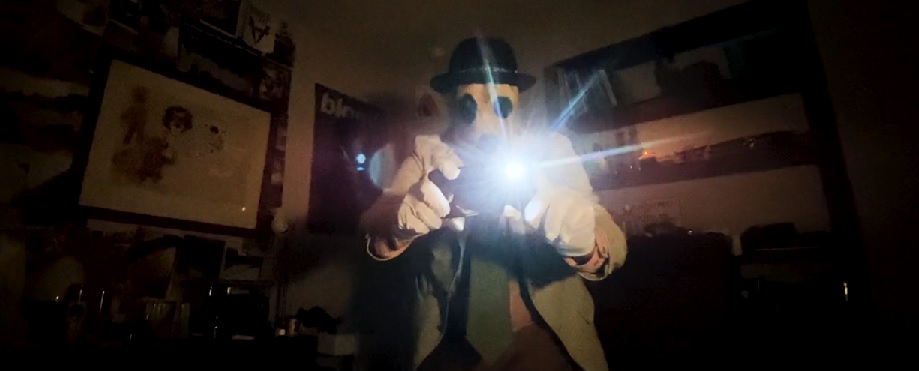
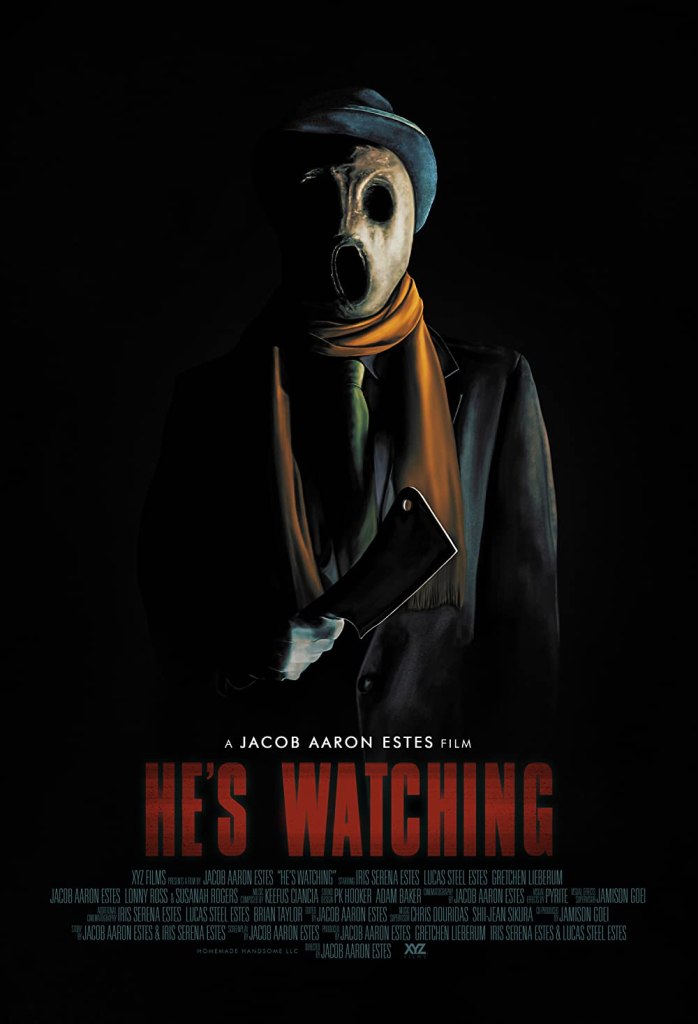
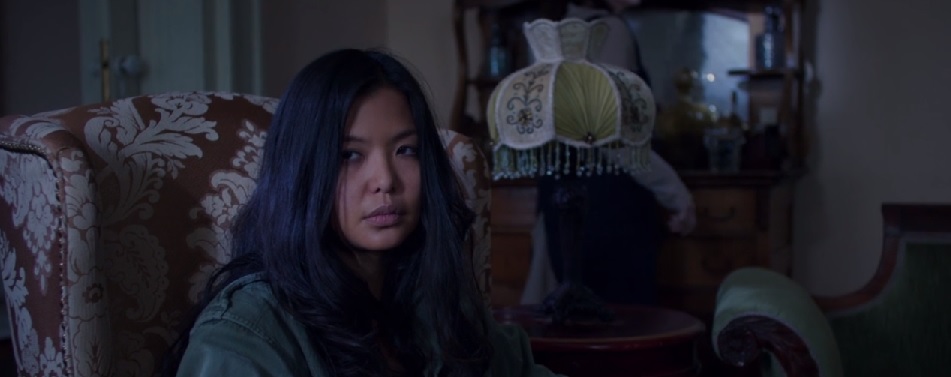
Very much a home-made movie, He’s Watching deals with two siblings (Iris Serena Estes and Lucas Steel Estes) who are home alone while their parents are in the hospital with a mysterious illness, and find themselves dealing with something beyond their control.

This illness I referenced isn’t COVID, but I did, at first, think that’s where this one was going. While out and about, Iris and Lucas see very few people – the streets seem empty, and they’re wearing facemasks. I don’t believe the credits listed the filming location, but I would suspect Los Angeles, which certainly makes sense given their lockdown during the time.

Here, though, the illness seems to be primarily a danger to adults – hospitals are overwhelmed, there’s little movement outside, and when Iris and Lucas are trying to get some help, they’re unable to find any adults able to do so.

He’s Watching isn’t really about the illness, though – it’s about the two young siblings getting on each other’s nerves and trying to contend with some malevolent entity around their house. What with odd video clips being sent to them, or messages left for them, and what may be some occasional possession, they certainly have a lot on their shoulders at their age.

This movie’s quite bizarre. It feels like a low-budget movie in the vein of Clownz R Us or Loon, but it’s not like Jacob Estes, the director, had to go this route. He directed a 2019 horror film called Don’t Let Go with has a 6.4/10 on IMDb with around 12,000 votes (a movie, I should say, that completely got past me), a 2004 crime/drama film called Mean Creek that has a 7.2/10 with over 33,000 votes, and a 2011 dark comedy starring Tobey fucking Maguire called The Details. I can’t say I’ve heard the name Jacob Estes before today, but he’s definitely not a no-one.

I imagine He’s Watching is largely a family project. The characters Iris and and Lucas are played by, you guessed it, Iris Serena Estes and Lucas Steel Estes. The film has a rather experimental feel going on – while I’d hesitate to label it avant-garde, or even disjointed, there’s definitely a lot left up to interpretation, especially toward the finale.

There are some creepy scenes here and there, along with some uncomfortable scenes, made all the worse by us never really finding out what’s going on. I was even reminded of Desolation Wilderness, though this movie isn’t quite that extreme. Still, portions of the film were wholly experimental, and while I imagine that could turn some off, I thought there was a charm to it.

I also wanted to mention that I appreciated many of the techniques used here. I’ve said many times before that I’m not a behind-the-scenes guy, and I’ve never made a movie, so I don’t have the vocabulary to describe the techniques utilized in the film, but I can say that for a film of this style, I thought some rather creative shots were taken, and though the story feels more like a fever dream than a well-thought out plot at times, I was still impressed.

Naturally, I have no idea how old either Iris Serena Estes or Lucas Steel Estes are, but both did quite a decent job. I was somewhat amused by the fact that Lucas was always able to decipher the hidden messages in the mess of random objects left around the house, as though he’s some entity specialist, but given that these two are actually siblings, I thought they felt quite authentic.

He’s Watching was a far more involved film than I was expecting. While I immediately compared this to Clownz R Us in my mind, there’s really not that many similarities. I don’t think this movie is that great, but I do think it was plenty ambitious, and I can appreciate that in this case. I also found the credits oddly creative, and some of the sequences (especially the narrated dream sequences of Iris) quite captivating.

Honestly, this was a deeper movie than I expected. I don’t think it was good, and I can certainly understand some of the negative reception it’s gotten, but I also have to fully admit to finding the experience fascinating. Whether I liked it or not is entirely up for grabs, but I can easily see myself giving this another go in the future, and that has to mean something.

For now, I’ll give this one a below-average rating, but I don’t think it’s near as awful as some people are suggesting.

6/10

Kyuketsuki Gokemidoro (1968)

Directed by Hajime Satô [Other horror films: Kaidan semushi otoko (1965), Kaitei daisensô (1966)]

Commonly known under the catchy title Goke, Body Snatcher from Hell, this Japanese film is a vibrant and occasionally interesting movie. It has solid anti-wars themes, and a fantastic ending, but it’s also not the most engaging film out there.

I’ve seen this one twice now, and I guess one of my main issues with the film isn’t even entirely with the film itself. The production company, Shochiku, have certainly made worse films (X from Outer Space) and less coherent films (The Living Skeleton), so this one is certainly a palatable movie. Comparing it to other Japanese movies from the time, though, such as Matango from just five years earlier, and even The H-Man from ten years earlier, and it just doesn’t hold up.

No doubt the story has some strong elements, but I don’t think one of them is the space vampire. The special effects around the silvery slime using human beings as hosts is great, and the way to get into the body (via a vertical slit in the forehead) is classy, but that was really the least interesting portion of the film.

More so, the movie’s about what people will do when placed in an exceptionally stressful situation. To be sure, it was stressful before the alien – people on an airplane have to deal with both a hostage takeover and an unrelated bomb threat (talk about getting on the wrong flight), and that was all during the ten minute cold open before we even get the movie’s title. And so we have this group of people from different walks of life trying to survive from threats on multiple sides.

Of course, some of these individuals are more antagonistic, such as the hijacker (Hideo Kô) and this asshole of a politician (Eizô Kitamura), and others are more the generic hero, such as co-pilot (Teruo Yoshida). Others are the flies in the ointment, such as the psychiatrist (Kazuo Katô) who is more interested in seeing how people react to the situation than anything else.

Performances all around are pretty decent. Like I said, Teruo Yoshida tends to be a bit on the generic side, but there’s others, such as Kazuo Katô, Hideo Kô, Masaya Takahashi, Nobuo Kaneko, and Kathy Horan who bring plenty of flavor to the film.

What’s more striking is the somewhat heavy-handed anti-war message the film carries. There’s an American woman who is going to pick up her dead husband from Vietnam, and she does occasionally get emotional about the stupidity of war. Another suggests that because of mankind’s tendencies to fight unnecessary wars, it’ll attract the attention of alien lifeforms, making us an easier target (reminding me of the Nine Inch Nails song ‘The Warning’, which is a banger).

At the same time, I like to think that most people would be against war. I mean, obviously not those who support capitalism – capitalism without war is untenable – but most people, I think, wouldn’t have a problem saying that war is a negative thing, and if it can be avoided, it should be. I suspect few knew that better than Japan, as they were still recovering from the devastation the USA caused their country with the atomic bombs in Nagasaki and Hiroshima.

I also want to add that, without giving anything away, I loved the hell out of the conclusion. I’ve seen this before, as I said, but I honestly didn’t remember much in the way of details, and so the finale here really hit the right spot in about three different ways (none of which I can fairly expand on). It was the finale that kept on giving, and the final shots were A+.

Goke, Body Snatcher from Hell is a nice-looking movie. The color schemes, especially during the opening (an airplane flying in a blood-red sky is rather striking). It’s just that, funnily, the so-called “Body Snatcher from Hell” is the least-interesting portion of the film, and while there’s enough here to keep things going at an okay pace, and the message is a solid one, when I think of other Japanese horror films, it’s just not quite as good or as memorable.

7/10

The Menu (2022)

Directed by Mark Mylod [Other horror films: N/A]

I wasn’t quite sure what to expect from The Menu – I’d see bits of the trailer, and I could tell it was obviously a high budget production, but as to the story or tone, I wasn’t sure. Sure, I’d seen the film labeled both a black comedy and a satire, but it’s hard to know if that applies without actually seeing the movie for yourself.

And after seeing it, I can say that it was most definitely unique. Insofar as how much I enjoyed it, it’s hard to say – based off the story, I sort of wish I liked it a bit more. That said, I still found it quite a solid and interesting film, and while it’s quite atypical in many aspects, I do think it’s worth experiencing.

First off, I have to admit I got some vibes of The Dinner Party at points. The Dinner Party was a movie I despised quite a bit, as I found it overly pretentious in pretty much every way. The difference, though, is that The Menu is making fun of such pretensions – being a satire and going after the wealthy, such can be expected – and I thought that The Menu did a great job at that.

I should also add that while ‘black comedy’ may be a suitable description of the film, there’s not a ton of laugh-out-loud moments. There were a couple – that line about substitutions cracked me up – but more often than not, it’s a dark and sometimes uncomfortable film that may have you chuckling now and again, but outright guffaws, at least in my view, are rare. I don’t think that this hurts the film any – it’s sort of nice to see a film that’s more low-key with it’s humor – but I did think it was worth mentioning.

There are a bunch of performances in this film, but only a handful really stand out to me. First-and-foremost, I have to give a lot of props to Ralph Fiennes. This was an absolutely stellar performance from Fiennes (who I know mostly as Voldemort from the Harry Potter films, but was also in Red Dragon), and he nailed his role beautifully. In fact, I’m only more torn on Anya Taylor-Joy (The New Mutants, Marrowbone, The VVitch: A New-England Folktale, Last Night in Soho, Split) because Fiennes did such a solid job, and Taylor-Joy’s character was sort of hard to get a read on (though this was by design).

Otherwise, while there are some familiar faces, such as John Leguizamo (Vanishing on 7th Street, Night Owl, Land of the Dead), Reed Birney (The Hunt), and Janet McTeer (Jessica Jones), no one else adds near as much as Fiennes or Taylor-Joy. Nicholas Hoult (Warm Bodies) was a prick much of the time, but he got dressed down beautifully, so that was fun. Overall great performances in this film, despite the fact only a few really stand out.

Given this is more a satire than a straight-out horror-comedy, none of the violence is over-the-top, or at least humorously over-the-top. There are some disturbing scenes of emotional distress – not something I’d usually mention, to be sure – which are beautifully uncomfortable, and the violence we get is all fun

Tentatively, because The Menu isn’t an easy movie to exactly describe, I’d say that I enjoyed it. I can’t say I loved it, but I did find it a rather unique experience, and for that fact alone, I’d argue it may well be worth seeing, as I imagine the right audience would get a kick out of this one.

8/10

The Inherited (2015)

Directed by Devon Gummersall [Other horror films: N/A]

More than anything else, I found The Inherited a rather frustrating film. The plot wasn’t without intrigue, but it went down a somewhat predictable path, felt rushed come the finale, and just wasn’t something I found too enjoyable.

It had mystery at times. Was the lead character being poisoned by her husband, or were there some real supernatural events going on around the house, and did her husband kill his first wife, or was her madness natural, that kind of stuff. I can’t say I’m at all happy with the answers to some of these questions, and that’s partially because the ending just felt too quick.

A couple of things bothered me also. At many points, the lead (Jenn Liu’s character) has suspicions – suspicions that she’s being poisoned by someone (could be the housekeeper, could be her husband), suspicions that she’s being gaslit (perhaps by her husband, perhaps by her housekeeper), suspicions she’s in danger. These were all legitimate feelings, too.

Logically, you’d think she wouldn’t stay in the situation. You know, maybe spend a couple of days away from the house, away from her husband, and, you know, reassess the situation. It makes sense to me – if I ever felt to be in a potentially threatening position, I’d like to think I would leave the situation, which she has every opportunity to do.

She didn’t. As far as the audience can tell, she didn’t even consider it. Instead, she confided in the housekeeper (who, on a side note, no one but the lead character ever has much contact with, and most of us know what that probably means) – you know, the housekeeper who makes her tea every day, and lied about being in the kitchen when she wasn’t. This isn’t a lie the audience knows about and Liu’s character doesn’t – she literally thinks to herself that the housekeeper is lying. And yet, she confides in her.

I cannot express in numerical value how many times I made variations of verbal statements along the lines of “Why not leave the fucking house?” I said this at least eight times throughout the film, because it felt absurd and past the point of parody. On a side-note, this is a film I saw on Lifetime, so that may be a common occurrence when it comes to the thriller and horror films they play.

It’s not that I think Jenn Liu did badly. Early on, I was pretty invested in her story, though by the finale, I felt ashamed, as the film ends horribly. I legit #HatedIt, as the kids say. I didn’t care for Tammy Blanchard, Annabella Sciorra, or Nathan Darrow, but Dennis Boutsikaris (Better Call Saul) popped up a few times, and he was sort of cool to see.

Sure, I won’t say there wasn’t occasionally a decent atmosphere in the film. There’s ominous undertones to plenty of the conversations the lead character is involved in (I mean, she never really did anything about it, but whateves, I guess she liked being in danger because of course why wouldn’t a character want to stay in a situation that’s potentially dangerous I mean makes sense amiright????????), but that’s part of the problem, because there’s not much of a sensible approach taken by the lead character in the film.

And to take a step back (and a deep breath), The Inherited (also apparently sometimes called Stranger in the House, I guess, because that name is so much less generic) isn’t necessarily terrible, but it was terribly frustrating, and despite some okay story elements (aside from the abysmal finale) and okay performances, this is a film I never want to see again.

5/10

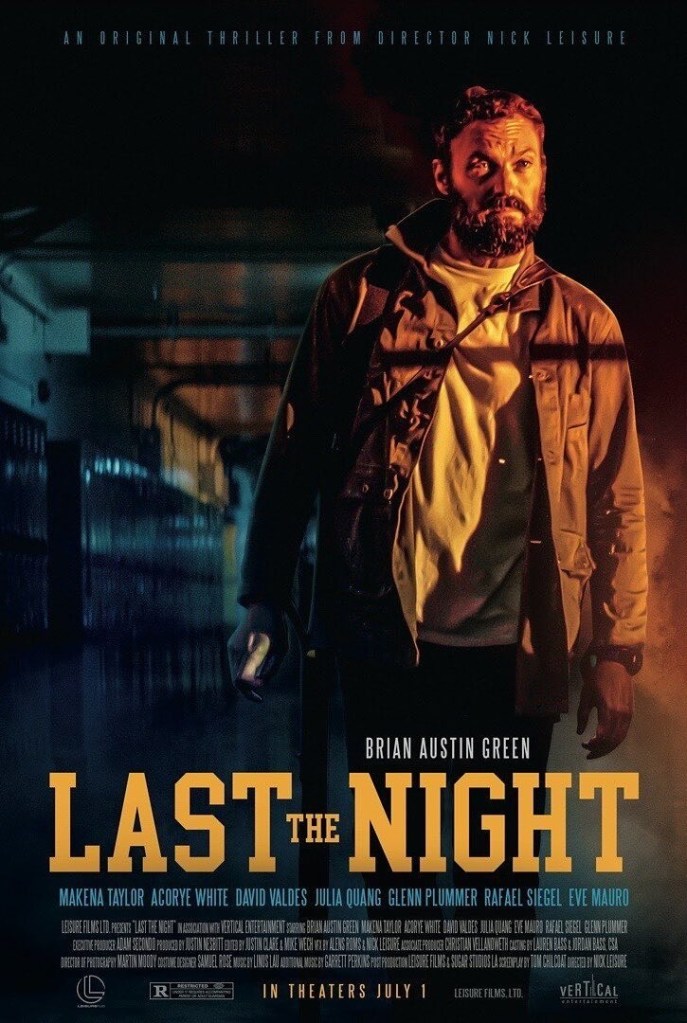
Last the Night (2022)

Directed by Nick Leisure [Other horror films: N/A]

From the lukewarm reaction I’ve seen in regards to Last the Night, I was sort of surprised by the fact it came out alright. No, I don’t think Last the Night’s a good movie, but I don’t think it’s that bad, either. Middling, with a few interesting ideas within, Last the Night might be a good time to some.

My prime interest with this movie came from the plot – during the COVID lockdowns, a teacher struggling with his mental health breaks down and plans to kill a group of his students. Naturally, this is a movie that benefits greatly from the COVID-19 backdrop, and I think it does give the film extra flavor.

Before I hit more on this, though, let’s talk about my COVID experiences. In Indiana, we never took COVID that seriously – it’s true that we were on lockdown for a bit (which is one of the reasons, on a side-note, that Libertarian Donald Rainwater got 11.4% in the 2020 Indiana gubernatorial election), but Indiana’s a conservative state, and as we know, COVID-19 doesn’t impact conservatives because Jesus.

Okay, admittedly I’m getting side-tracked. My point is, I was never on lockdown. At the time, I worked at a supermarket, which made me an “essential worker.” While others were encouraged to stay inside their homes, I went to work and made an extra dollar an hour – not nearly as impressive as it sounds when you figure in the taxes.

I guess what I’m trying to say is that while I heard so many stories of extreme isolation during COVID due to the lockdowns, I never experienced that. Watching Bo Burnham’s Inside was eye-opening to what that type of situation would be like to one’s mental health. I never had to deal with lockdown, and I can imagine that plenty of people, especially students who had to try to get used to E-learning and teachers who had to try and teach on Zoom, had a really hard time.

Brian Austin Green’s character is an interesting one. He’s been a history teacher for a long time, and is just tired. His personal life is in shambles (his wife left him), and being forced to stay indoors all day just isn’t working for him. He’s also somewhat conservative – seems a supporter of the Second Amendment, not interested in mask mandates, and professed his favorite president as Theodore Roosevelt (which is at least a better option than Ronald Reagan). And when he hears some students making fun of him on a zoom call, he just snaps.

There’s not too many horror films that focus on teachers going after students, but I did once see a 2015 movie called The Lesson, which has a similar idea. That movie had more going for – while both The Lesson and Last the Night have quite a bit of set-up before we get to the action, I think it worked far better in the former. Even so, I appreciated that this movie went with a plot that was timely to the situation we found ourselves in, even if it didn’t turn out an amazing movie.

A lot of credit should go to Brian Austin Green (Chromeskull: Laid to Rest 2, Don’t Blink), as he really gives his character his all. Toward the end, he was a bit much at times, but overall, his performance was solid. As far as the four teens go – Acoryé White, Makena Taylor, Julia Quang, and David Valdes – I’d say that Taylor did the best, though all four do decent. It did seem that Quang’s character felt like she needed to be fleshed out more – at one point in the film, she’s adamant about not leaving without her phone, and I was hoping there was a reason for that, which we never got – but overall, the performances were good.

Like I said earlier, there’s about 45 minutes or so of build-up before we get to the action, and when we do get to the action, it’s pretty much four teens being chased down by a guy with a gun. Certainly still horror, but there’s a strong thriller/suspense feel to this movie as well, and that might also play a part in some of the lukewarm reaction I’ve seen from this. It doesn’t feel like a typical horror film a lot of the time, and while I don’t think that’s a bad thing, it is noticeable.

There are some good scenes, though, of shotgun carnage. We don’t see much in the way of blood, but there’s a quick scene in which someone gets shot in the back, leading to blood splatter on a window. A couple of more emotional scenes are here too, along with a couple of awkward ones, which allows the tension to ratchet up.

Honestly, I didn’t have a problem with most of Last the Night. I didn’t think it was good, but I was engaged throughout, and like I said, I found the plot somewhat interesting. The execution could have been improved a bit, and I do think the movie’s a little below average, but I definitely think that, if the movie sounds like your type of thing, you shouldn’t be dissuaded by the more negative comments.

6/10