
Directed by Gary J. Tunnicliffe [Other horror films: Within the Rock (1996)]
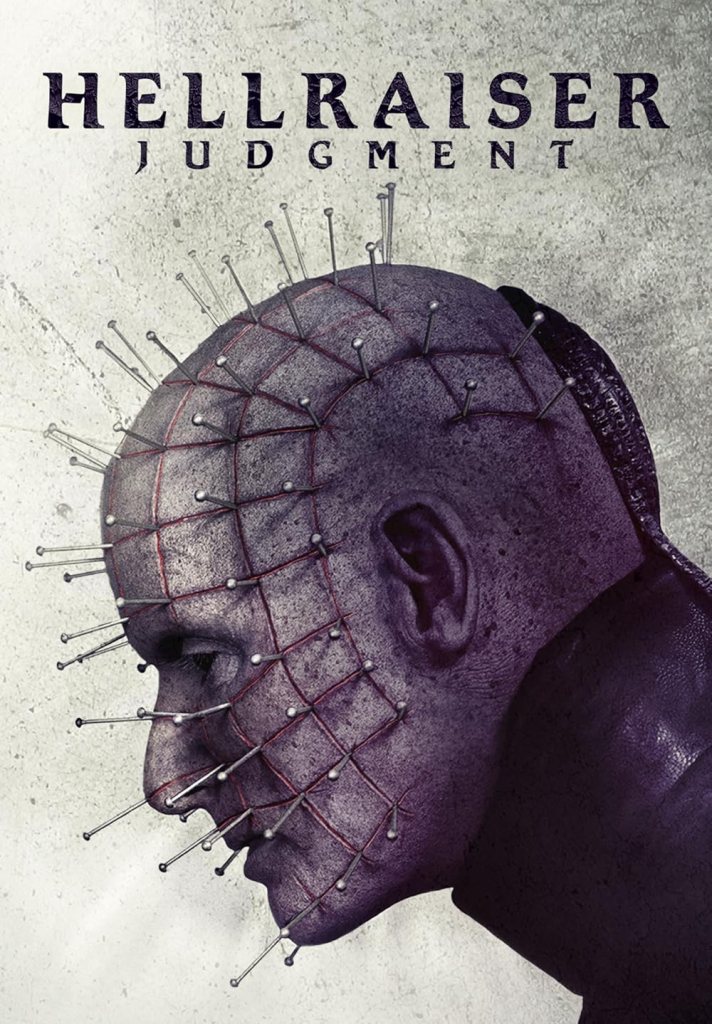
I’ve been curious about Hellraiser: Judgment ever since it came out. After Revelations, I was hoping the series could get back on track, and after watching the trailer to this one, I thought it had some potential. Well, I have some serious problems with Hellraiser: Judgment, but at the very least, I do think it’s mildly better than the previous entry, albeit not by a lot.
This doesn’t start out well, though, as I absolutely abhorred the first 12 or so minutes. In that time, we see Pinhead speaking to a character called the Auditor, which was fine (though I’d have liked some context as to who or what the Auditor was), and a man being lured to a house.
Once the man gets to the house, he meets the Auditor, who asks him questions about the man’s sins. Once those sins are written down, the man is sent to the Assessor (who looks completely human, on a side-note). The Assessor has a bottle of children’s tears, and combines that with the papers of the man’s sins, and eats them. He then throws the combination up into a pipe. That pipe leads down to the Jury. The Jury are three naked women with messed up faces who spread the vomit over their bodies to render a verdict. Once that verdit is rendered, the man is sent to the Butcher and the Surgeon (the Butcher a big, hulking hombre, and the Surgeon someone in a body-tight leather suit), who then do what they do best.
The whole thing feels like some dark, disturbing fantasy. As someone who doesn’t care for dark fantasy, I hated it. It reminded me of The School, in that it was trying to be as grimy and dirty as possible, and it came across as trying too hard. We get no information during this process – why is the Assessor the only human here? Is he human? Why are the Jury three nude women? Are they women? Why is the Butcher carrying around the Surgeon? Can the Surgeon walk?
We don’t get an answer to any of those questions. Not just during the first 12 minutes, but during the whole of the film. We never learn what these things are. Wikipedia says that they’re the Stygian Inquisition, which is a separate group from the Cenobites. Now, the movie never once mentions the word “Stygian” or “Inquisition,” so I have no idea if that’s accurate. If that’s the case, it would have been great if they mentioned that somewhere, because from my view, having a Hellraiser movie with only minimal Cenobite action, replacing that with random judgy things, doesn’t do much for me.
The reason I’m focused so much on this is because it had to be among one of the most unpleasant beginnings to a film I’ve seen in recent times, rivaling The Rage. During that time, I was thinking that if the movie continued on in that vein, I’d have absolutely no problem saying that Revelations is a better movie.
In fact, a good case could be made that while Judgment is certainly a better film insofar as budget is concerned, it’s a worse Hellraiser film than Revelations. Keep in mind, the focus of this film aren’t the Cenobites, it’s the Auditor. The movie doesn’t say what the Auditor is, but it’s clear that he and the process he follows has little to do with Pinhead, who seems to be an advisor (?) more than anything else. We do see a few other Cenobites, such as Chatterer (for brief moments) and some conjoined women, but we never get much of any of these, save Pinhead toward the end of the film.
Story-wise, I generally liked this one. It follows two detectives (who are also brothers) as they attempt to locate a religious serial killer. Throw in another detective, who is investigating, in part, one of the brothers, and the film feels almost like Se7en at times. I know some have complained about the procedural feel this sometimes has, but in truth, it never bothered me, and there’s a twist toward the end that I thought was actually decent.
Damon Carney (The Harrowing) and Randy Wayne (The Fun Park, Scar, Escape Room, The 13th Alley, Ghost Town, Hold Your Breath) made for somewhat believable brothers. I sort of expected more from Wayne’s character, but Carney was solid. Alexandra Harris (All Light Will End) appeared for a bit, but honestly didn’t stand out that well.
Playing Pinhead was Paul T. Taylor (Shifter), who did decently (though he was certainly no Doug Bradley). Director Gary J. Tunnicliffe himself plays the Auditor. Shame that this fact doesn’t give any more insight into his character. Lastly, playing an angel (I guess) is Helena Grace Donald.
I certainly don’t want to sound ungrateful, as I appreciated that Judgment tried to expand the mythos of Hellraiser. We have some ambitious, theological elements toward the finale, and I actually sort of liked that. I just wish they did a better job of explaining some of what we were seeing, such as the Auditor and his group’s relation to the Cenobites. The ending, too, was sort of unexpected, as Pinhead apparently went too far in his role.
Although I did want to touch on Pinhead, because again, I don’t think his character was done correctly. It’s my understanding that Pinhead is not a malevolent entity. In Hellbound, he stated that “It’s not hands that call us, but desire,” after a character was forced to open the box. In this film, two characters are forced to open the box at gunpoint, and Pinhead takes them anyway. I just don’t care for the more malicious characterization that Pinhead’s gotten in the last couple of movies, and I find it more interesting when he and the Cenobites are amoral as opposed to immoral.
Judgment’s a problematic movie. I was hoping that I’d like it a lot more than I ended up doing, but that doesn’t mean it’s not an improvement over Revelations. However, I can certainly understand why someone might prefer Revelations, if I’m being honest. Judgment was okay, but I really think if some things were cleaned up a bit, it could have possibly great. As it is, though, it’s nowhere close.
5/10

 Jiggy's Horror Corner